
Neste guia vai aprender a redigir ensaios com pontuação elevada para o IELTS writing task 1 e para o IELTS writing task 2. Independentemente do exame que vai realizar, academic ou general training, temos tudo o que precisa. Este guia inclui exemplos de IELTS Writing, temas e lições detalhadas para o general writing task 1 e 2 e para o academic writing task 1 e 2.
Receba redações de exemplo gratuitas de writing do IELTS após concluir um teste prático de writing do IELTS.
| Teste de General Writing do IELTS | Teste de Academic Writing do IELTS |
|---|---|
Abaixo está nossa lista completa de perguntas de writing do IELTS com redações de exemplo. Observação: os links em vermelho são nossas perguntas de writing mais populares e recomendadas, avaliadas por nossos alunos, e você pode praticá-las gratuitamente a qualquer momento.
Exemplos de IELTS General Writing Task 1 1 - 44
Informal, formal, & semi-formal letters
Exemplos de IELTS Academic Writing Task 1 1 - 52
Line graphs, bar charts, pie charts, tables, maps, flow charts, & multiple charts
Exemplos de IELTS Writing Task 2 1 - 96
Opinion, discussion, advantages & disadvantages, problem & solution, cause & effect, & two-part questions
Índice
Informação sobre o exame de IELTS Writing
O exame de writing é composto por 2 tarefas e dispõe de um total de 60 minutos para concluir ambas. Pode realizar as tarefas pela ordem que preferir; só tem de gerir bem o seu tempo e dedicar cerca de 20 minutos à tarefa 1 do IELTS Writing e 40 minutos à tarefa 2 do IELTS Writing.
IELTS Academic Writing vs. IELTS General Writing
O IELTS oferece duas versões do exame. A versão Academic destina-se a quem procura ingressar no ensino superior, enquanto a versão General Training se destina a quem pretende, sobretudo, emigrar ou prosseguir um nível de ensino inferior. Existem outros critérios em ambas as versões, pelo que deve contactar o apoio ao cliente do IELTS para saber qual o exame mais adequado para si.
Então, qual dos exames é mais difícil? O exame Academic, como já deve ter imaginado, é mais difícil do que o exame General Training. A diferença entre os dois está na dificuldade da tarefa 1 do writing. Felizmente, apenas a tarefa 1 é diferente. A tarefa 2 do IELTS Writing é igual nas duas versões. A tabela abaixo resume os dois tipos de exame de IELTS Writing.
| Tipo de exame | Tarefa 1 | Tarefa 2 |
|---|---|---|
| Academic Writing | IELTS Academic Writing – Tarefa 1
Na tarefa 1 do IELTS Academic Writing, é apresentado um gráfico, tabela ou diagrama e pede-se-lhe que descreva, resuma ou explique a informação por palavras suas. |
IELTS Writing – Tarefa 2 Na tarefa 2 do IELTS Writing, terá de escrever uma redação de estilo tradicional em resposta a uma questão. Deve escrever, no mínimo, 250 palavras |
| General Writing |
IELTS General Writing – Tarefa 1
Na tarefa 1 do IELTS General Writing, pede-se-lhe que escreva uma carta sobre uma determinada situação. Esta carta será de um dos seguintes tipos: - Formal (cartas formais são enviadas a pessoas que não conhecemos ou que nunca conhecemos pessoalmente.) - Semiformal (cartas semiformais são enviadas a pessoas que não conhecemos bem.) - Informal (cartas informais são enviadas a pessoas que conhecemos bem, como amigos) |
Vídeo de apresentação do IELTS Academic Writing
Vídeo de apresentação do IELTS General Writing
Em breve!
Como é classificado o IELTS Writing
No exame de IELTS Writing, a sua pontuação é atribuída com base em quatro categorias, conhecidas como
Task Achievement/Task Response, Coherence and Cohesion, Lexical Resource, e Grammatical Range and Accuracy.
Consulte os descritores de banda que os examinadores do IELTS usam para classificar a secção de writing:
- Descritores de banda da tarefa 1 do IELTS Writing
- Descritores de banda da tarefa 2 do IELTS Writing
Note que os critérios de classificação de ambas as tarefas incluem:
- Task Achievement/Task Response - Respondeu integralmente à pergunta e apresentou uma resposta plenamente desenvolvida?
- Coherence and Cohesion - A sua argumentação ou análise faz sentido? Está bem pensada e apresentada de forma completa?
- Lexical Resource – Utilizou um vocabulário variado, com um tom natural e formal?
- Grammatical Range and Accuracy – A sua redação está praticamente isenta de erros? Conseguiu utilizar uma ampla variedade de estruturas gramaticais?
A tarefa 1 e a tarefa 2 do IELTS Writing valem a mesma pontuação?
Tal como vai passar o dobro do tempo a escrever a tarefa 2,
esta vale também cerca do dobro dos pontos. Não é exatamente o dobro.
Outra forma de olhar para isto é somar a pontuação da tarefa 2 duas vezes. Tomando como exemplo
as pontuações 7 na tarefa 1 e 4 na tarefa 2, fica com a seguinte
fórmula para calcular a sua pontuação de IELTS Writing:
(7 + (4 x 2))/3 = 5.
Por isso, a band score total de Writing situa-se entre 4,5 e 6. Como vê, não conseguimos dar um número exato
porque o IELTS não tornou pública a sua fórmula de classificação, mas a fórmula
apresentada aqui é razoavelmente fiável, com uma diferença máxima de cerca de 0,5 pontos.
O que mostram 19.000 redações do IELTS avaliadas
Entre 2020 e 2026, os tutores do BestMyTest avaliaram cerca de 9.400 tarefas de escrita do IELTS, e nossa revisão por IA corrigiu outras 9.614 redações. Três pontos se destacam.
- A gramática determina a faixa de pontuação. Variedade e precisão gramatical foi o critério com a menor nota entre os quatro critérios em 91% das redações da Task 2, 84% dos relatórios da Task 1 do módulo Academic e 94% das cartas do módulo General Training. Médias atribuídas pelos tutores para a Task 2: gramática 5.5, recurso lexical 6.0, coerência e coesão 6.1, resposta à tarefa 6.1. Para a Task 1 do módulo Academic: gramática 5.5, coerência 5.8, cumprimento da tarefa 5.8, recurso lexical 5.8. Para a Task 1 do módulo General Training: gramática 5.3, recurso lexical 5.9, coerência 6.0, cumprimento da tarefa 6.2.
- Redações curtas são penalizadas. 17% das redações da Task 2 ficaram abaixo do mínimo de 250 palavras e tiveram média de 4.9 em resposta à tarefa, contra 6.1 para as redações que atingiram 250 palavras. 13% dos relatórios da Task 1 do módulo Academic e 16% das cartas do módulo General Training tinham menos de 150 palavras. As médias dos nossos alunos são de 285 palavras para a Task 2 e cerca de 175 palavras para a Task 1.
- Os erros são pequenos e repetitivos. Uma redação da Task 2 recebe cerca de 21 correções. A pontuação lidera (17% das correções), seguida por artigos (11%), ortografia (10%), substantivos no singular e no plural (9%), concordância verbal (7%) e preposições (6%). Dois terços das redações da Task 2 continham um erro de artigo e 58% um erro de concordância verbal. Na Task 1 do módulo Academic, o vocabulário usado para descrever dados causa erros adicionais: "male" para "males", "increase" para "increased", "compare" para "compared". Nas cartas do módulo General Training, o uso de maiúsculas (9% das correções) e o tempo verbal (6%) têm mais peso do que nas outras tarefas.
- As correções que nossa revisão faz com mais frequência: "this" para "these", "is" para "are", "have" para "has", "in" para "on", "of" para "for", "amount" para "number", "then" para "than", "that" para "who", "goverment" para "government", "belive" para "believe", "accomodation" para "accommodation".
Os números vêm dos dados de simulados e revisões do BestMyTest até outubro de 2026. As porcentagens por tipo de questão são taxas de acerto em todas as tentativas; os valores por critério são notas atribuídas por tutores ou pela IA, conforme indicado. Última atualização em 5 de outubro de 2026.
IELTS Academic Writing – Tarefa 1
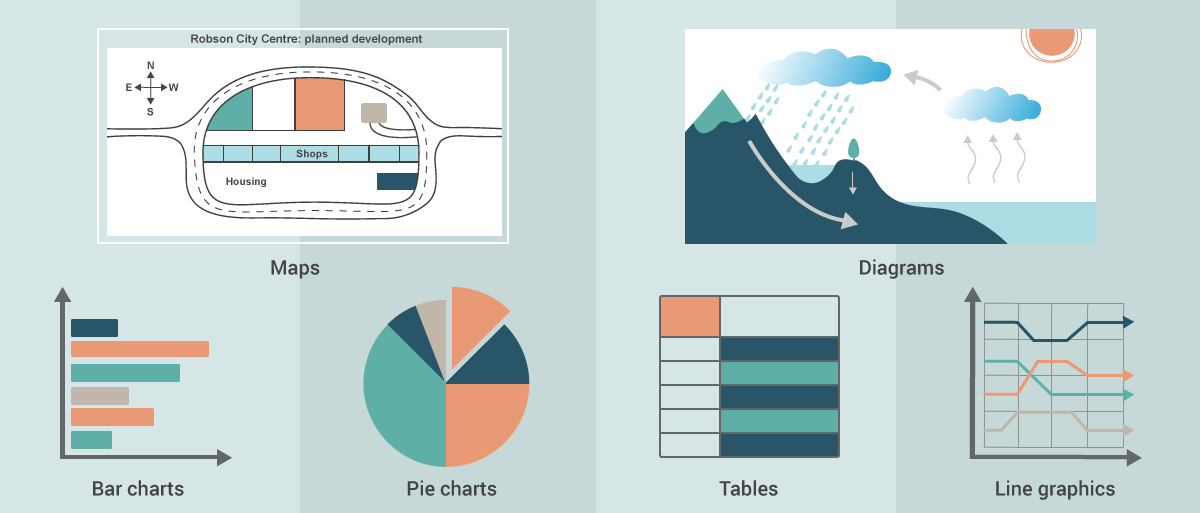
Na tarefa 1 do IELTS Academic Writing, é apresentado um gráfico, tabela ou diagrama e pede-se-lhe que descreva, resuma ou explique a informação por palavras suas. Pode pedir-se-lhe que descreva e explique dados, descreva as etapas de um processo, como algo funciona ou que descreva um objeto ou evento.
Independentemente da informação visual apresentada, o seu trabalho é escrever um resumo da informação visual, descrevendo as principais tendências, diferenças gerais, principais alterações, ou os principais componentes de um sistema ou as principais fases de um processo. Deve escrever, pelo menos, 150 palavras e dedicar cerca de 20 minutos a esta parte do exame. A estrutura da redação pode ser a seguinte:
- Introdução: parafraseie a pergunta
- Visão geral: descreva a tendência global ou apresente uma visão geral dos principais agrupamentos
- Parágrafo de desenvolvimento 1: descreva em detalhe o primeiro agrupamento, de forma lógica
- Parágrafo de desenvolvimento 2: descreva em detalhe o segundo agrupamento, de forma lógica
Os passos para redigir o relatório desta tarefa são, portanto, bastante simples:
- Analise o(s) gráfico(s) e planeie como agrupar a informação
- Escreva a redação seguindo a estrutura recomendada
- Reveja a redação
Vejamos os diferentes tipos de gráficos, tabelas e diagramas que pode encontrar no exame de IELTS Writing:
Gráficos de linhas
Neste tipo de tarefa, ser-lhe-ão apresentados um ou mais gráficos de linhas. Cada gráfico de linhas terá 1 a 8 linhas que mostram como os valores variam ao longo do tempo. O período de tempo pode ser o passado, o presente ou o futuro, ou uma combinação dos três. A sua tarefa é escrever um resumo, destacando os pontos mais importantes e sustentando a sua descrição com dados.
The chart illustrates average CO2 emissions per person in four European countries between 1975 and 2015.
Summarise the information by selecting and reporting the main features, and make comparisons where relevant.
- Write at least 150 words.
- You should spend around 20 minutes on this task.
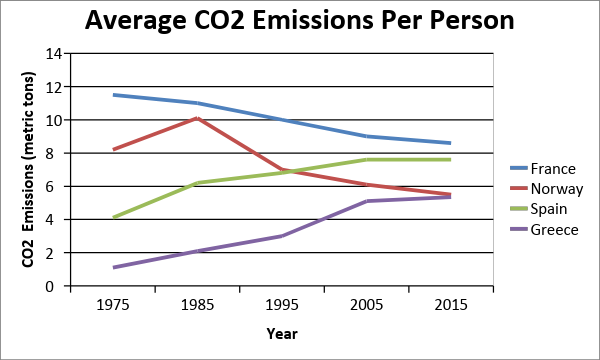
The line graph depicts the average Carbon dioxide emission for each individual residing in four countries, namely France, Norway, Spain, and Greece, over 40 years.
Overall, although CO2 production in France and Norway declined, it increased significantly in Spain and Greece over the period. Norway improved the most to become the most environmentally friendly, whereas Greece had the highest increase of all in that time.
Throughout the period, France produced the most CO2, though production declined overall from 11 tonnes per individual in 1975 to around 8.5 tonnes by 2015. In turn, except for a spike in emissions in 1985, Norway’s production of CO2 fell from 8 to under 6 tonnes forty years later.
On the contrary, CO2 release in Spain and Greece saw a more upward turn. In Spain, production doubled from 4 tonnes in 1975, overtaking Norway by 1995, to a final figure of just under 8 metric tonnes per head of population. Similarly, emissions in Greece, which were the lowest in 1975, increased five times to equal those of Norway in 2015.

Line Chart
Learn how to answer this question in a step-by-step interactive exercise
Line Chart
Na Task 1 do IELTS Academic, você descreve o que um gráfico mostra. Você não dá opinião e não explica por que os números são como são.
Um gráfico de linhas mostra como os valores mudam ao longo do tempo, muitas vezes com várias linhas ao mesmo tempo, então este relatório descreve a mudança e compara as linhas.
Veja a tarefa e clique em Próximo para continuar.
Veja a pergunta
Summarise the information by selecting and reporting the main features, and make comparisons where relevant.
Write at least 150 words.
Leia o gráfico antes de escrever. Confira o título, o período no eixo horizontal, as unidades no eixo vertical e a legenda que identifica cada linha.
Depois, encontre o ponto em que os dados medidos terminam e começa uma projeção. Esse ponto divide os tempos verbais: formas do passado para os anos já medidos e formas como is expected to, is predicted to e is set to para os anos que ainda vão chegar.
Responda às perguntas sobre o gráfico.
Leia o gráfico
A introdução diz com suas próprias palavras o que o gráfico mostra. Parafraseie a tarefa: mude as palavras, mantenha o sentido e mantenha o assunto, o que as linhas medem e o período.
Copiar a frase da tarefa não vale pontos, e dados numéricos não entram aqui. Guarde todos os números para os parágrafos de desenvolvimento.
Escreva uma ou duas frases que parafraseiem a tarefa.
Escreva a introdução
Enunciado da tarefa
The chart illustrates average CO2 emissions per person in four European countries between 1975 and 2015.
Summarise the information by selecting and reporting the main features, and make comparisons where relevant.
Write at least 150 words.
Um relatório de Task 1 precisa de um parágrafo de desenvolvimento para cada grupo de linhas, e um gráfico de linhas geralmente tem mais linhas do que grupos. Agrupe as linhas que seguem na mesma direção: as que sobem, as que caem e as que ficam estáveis. Se todas as linhas seguem na mesma direção, você tem um parágrafo; se há uma de cada tipo, você tem três.
Um parágrafo para cada linha, ou um parágrafo para cada metade do período, quebra a comparação que a tarefa pede. Agrupar só pelo nível pode colocar uma linha que sobe e uma linha que cai no mesmo parágrafo.
Escolha o agrupamento que dá a cada parágrafo um padrão claro.
Forme os grupos
Escolha o agrupamento que dá a cada parágrafo um padrão claro.
- Group 1: Norway, Spain, Greece. Group 2: France.
- Group 1: Greece. Group 2: France, Norway, Spain.
- Group 1: Norway, Greece. Group 2: France, Spain.
- Group 1: France, Norway. Group 2: Spain, Greece.
A visão geral é o maior padrão do gráfico inteiro. Ela é formada pelas características principais. Primeiro: qual é a direção geral de cada grupo ao longo do período? Depois: quando há dois ou mais grupos, qual é a distância entre o primeiro e o último grupo, e essa diferença aumenta, diminui ou se inverte?
Junte essas características e você terá sua visão geral. Não coloque anos ou números isolados aqui. Guarde-os para os parágrafos de desenvolvimento.
Encontre as características principais para montar sua visão geral.
Encontre a tendência geral
Agora transforme as duas características principais em uma ou duas frases. A visão geral é a parte do relatório que o examinador procura primeiro, então escreva-a antes de qualquer detalhe e mantenha-a geral.
Use o tempo verbal que combina com o gráfico e descreva o que o gráfico mostra, não por que ele é assim. Não dê números e não acrescente opinião.
Escreva uma ou duas frases gerais sobre o maior padrão.
Escreva sua visão geral
O parágrafo de desenvolvimento 1 trata apenas do seu primeiro grupo de linhas, ao longo de todo o período, e é aqui que entram os números.
Descreva o formato de cada linha, e não cada ponto dela: o valor inicial, a direção, qualquer mudança de direção e o valor final ou projetado. Use expressões de mudança ao longo do tempo como rise steadily, fluctuate, level off e peak, e informe o ano junto com cada número.
Se não souber como expressar um ponto, clique nele e uma frase de exemplo será adicionada à sua área de escrita.
Escreva três ou quatro frases sobre o seu primeiro grupo, com números.
Escreva o parágrafo de desenvolvimento 1
O parágrafo de desenvolvimento 2 trata apenas do seu segundo grupo de linhas. Faça o mesmo: o formato de cada linha, apoiado por números.
Não repita o parágrafo de desenvolvimento 1. Ligue os grupos quando houver uma diferença que valha a pena mencionar, usando expressões como in contrast e far lower than.
Se não souber como expressar um ponto, clique nele e uma frase de exemplo será adicionada à sua área de escrita.
Escreva três ou quatro frases sobre o seu segundo grupo, com números.
Escreva o parágrafo de desenvolvimento 2
O plano do seu relatório está completo. Uma resposta de Task 1 pronta tem estas partes, nesta ordem: uma introdução que parafraseia a tarefa, uma visão geral do maior padrão e um parágrafo de desenvolvimento por grupo, que sustenta esse padrão com números escolhidos.
Leia suas seções juntas e confira três coisas: a visão geral e os detalhes estão de acordo, o tempo verbal combina com os valores medidos e projetados, e cada número traz sua unidade e seu ano.
Revise o plano do seu relatório e depois compare-o com a redação modelo.
Plano completo do relatório
Como decidir
Um gráfico de linhas da Task 1 do IELTS Academic mostra como os valores mudam ao longo do tempo, muitas vezes em várias linhas ao mesmo tempo. Você descreve essas mudanças e compara as linhas. Não precisa de todos os pontos de todas as linhas.
Siga sempre a mesma ordem para que o relatório esteja planejado antes de você escrever a primeira frase.
- Leia o gráfico. Confira o título, o período, as unidades, a legenda e onde terminam os dados medidos e começa uma eventual projeção.
- Escreva a introdução. Parafraseie a tarefa e diga o que o gráfico mostra.
- Forme os grupos. Agrupe as linhas que se comportam de forma parecida para que cada parágrafo de desenvolvimento tenha uma ideia clara.
- Encontre a tendência geral. Decida qual é o padrão mais importante do gráfico inteiro antes de olhar valores isolados.
- Escreva o relatório por etapas. Escreva primeiro a visão geral, depois um parágrafo de desenvolvimento para cada grupo com números selecionados e, por fim, revise o plano completo.
Agrupe as linhas antes de descrevê-las. Um gráfico com muitas linhas vira um relatório curto quando linhas parecidas dividem o mesmo parágrafo, e agrupar é o que a tarefa quer dizer com selecionar as principais características.
Leia o gráfico
Comece pelos eixos. O eixo horizontal mostra o período, o eixo vertical mostra as unidades e a legenda dá o nome de cada linha. Encontre o ponto em que terminam os dados medidos, porque tudo o que vem depois é uma projeção e pede formas de futuro.
Introdução
A introdução tem uma ou duas frases que dizem o que o gráfico mostra com palavras diferentes das da tarefa. Mantenha o tema, o que as linhas medem e o período. Deixe de fora números e tendências.
Grupos
Um relatório da Task 1 tem um parágrafo de desenvolvimento para cada grupo de linhas. Agrupe as linhas que seguem na mesma direção: as que sobem, as que caem e as que ficam estáveis. Se todas as linhas seguem na mesma direção, há um parágrafo; se há uma de cada tipo, há três.
Tendência geral
A tendência geral é o padrão mais importante do gráfico: a direção geral de cada grupo ao longo do período e a distância que se mantém entre os grupos. É uma afirmação geral, então não traz números.
Para aprender a abordar gráficos de linhas na tarefa 1 do IELTS Academic Writing, consulte a nossa aula IELTS Academic Writing Task - Line Graphs.
Período de teste gratuito de 7 diasGráficos de barras
Neste tipo de tarefa, ser-lhe-ão apresentados um ou mais gráficos de barras. Os gráficos de barras podem mostrar a variação dos valores ao longo do tempo (dados dinâmicos), as diferenças entre valores num determinado momento (dados estáticos) ou os resultados de um inquérito ou questionário. A informação pode dizer respeito ao passado, ao presente ou ao futuro, ou a uma combinação dos três. A sua tarefa é escrever um resumo, destacando os pontos mais importantes e sustentando a sua descrição com dados.
The chart below shows the proportion of males and females in Malaysia who commonly do physical activity in 2010.
Summarise the information by selecting and reporting the main features, and make comparisons where necessary.
- Write at least 150 words.
- You should spend around 20 minutes on this task.
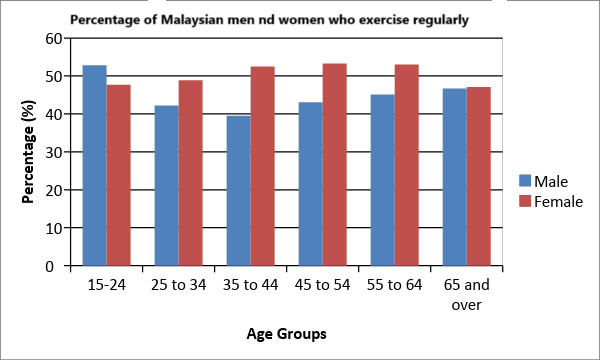
The bar chart compares the proportion of male and females of differing age groups who frequently undertook physical activity in 2010.
Overall, while the Malaysian population keeps fit in general, a higher proportion of women than men exercised in 2010, with some further differences between age groups. Middle-aged females were the most likely to work out, while for men, those aged 15 to 24 tended to do the most physical activity.
In terms of men’s exercise habits, younger men were much more likely to exercise than older men with 52.8% of those aged under 24 exercising as opposed to only around 40% of older age groups
By contrast, around half of all women in all age groups reported keeping fit, especially those aged between 35 and 64 at around 53%. The exception was the youngest age group in which only 47.7 percent of women exercised compared to 52.8% of men. Similarly, for people 65 and over, just approximately 47% of both sexes were recorded regularly working out.
Bar Chart
Learn how to answer this question in a step-by-step interactive exercise
Bar Chart
Na Task 1 do IELTS Academic, você descreve o que um gráfico mostra. Você não dá opinião e não explica por que os números são como são.
Um gráfico de barras compara grupos em um conjunto de categorias, então este relatório se baseia em comparações, e não em mudanças ao longo do tempo.
Veja a tarefa e clique em Próximo para continuar.
Veja a pergunta
Summarise the information by selecting and reporting the main features, and make comparisons where necessary.
Write at least 150 words
Leia o gráfico antes de escrever. Confira o título, as categorias no eixo horizontal, as unidades no eixo vertical e a legenda que identifica cada grupo de barras.
As unidades definem as palavras que você usa. Número de pessoas, porcentagens e quantias de dinheiro não são a mesma coisa, e citar a unidade errada tira pontos mesmo quando o resto da frase está correto.
Responda às perguntas sobre o gráfico.
Leia o gráfico
A introdução diz com suas próprias palavras o que o gráfico mostra. Parafraseie a tarefa: mude as palavras, mantenha o sentido e mantenha o assunto, os grupos comparados e o lugar ou o período, se a tarefa os informar.
Copiar a frase da tarefa não vale pontos, e dados numéricos não entram aqui. Guarde todos os números para os parágrafos de desenvolvimento.
Escreva uma ou duas frases que parafraseiem a tarefa.
Escreva a introdução
Enunciado da tarefa
The chart below shows the proportion of males and females in Malaysia who commonly do physical activity in 2010.
Summarise the information by selecting and reporting the main features, and make comparisons where necessary.
Write at least 150 words
Um relatório de Task 1 precisa de um parágrafo de desenvolvimento para cada grupo, então decida logo como vai dividir os dados. Agrupe as séries da legenda que se comportam de forma parecida: séries que ficam em um nível semelhante, ou que são mais altas e mais baixas nas mesmas categorias, ficam no mesmo parágrafo. Séries que se comportam de forma diferente ganham um parágrafo próprio. Assim, cada parágrafo traz uma ideia clara.
Uma divisão que só separa valores altos de valores baixos, ou que dá um parágrafo para cada categoria, faz você se repetir.
Escolha o agrupamento que dá a cada parágrafo uma ideia clara.
Forme os grupos
Escolha o agrupamento que dá a cada parágrafo uma ideia clara.
- Group 1: Female. Group 2: Male.
- One group: Male and Female.
A visão geral é o maior padrão do gráfico inteiro. Ela é formada por até três características principais. Qual grupo é mais alto na maioria das categorias? Qual grupo é o mais baixo na maioria das categorias? A diferença é mais ou menos a mesma em todas as categorias, ou há uma categoria muito diferente das outras?
Nem todo gráfico mostra as três, então esta etapa pergunta só sobre as características que importam neste gráfico. Junte-as e você terá sua visão geral. Não coloque números isolados aqui. Guarde-os para os parágrafos de desenvolvimento.
Encontre as características principais para montar sua visão geral.
Encontre a tendência geral
Agora transforme as características principais que você encontrou em uma ou duas frases. A visão geral é a parte do relatório que o examinador procura primeiro, então escreva-a antes de qualquer detalhe e mantenha-a geral.
Descreva o que o gráfico mostra, não por que ele é assim. Não dê números e não acrescente opinião.
Escreva uma ou duas frases gerais sobre o maior padrão.
Escreva sua visão geral
O parágrafo de desenvolvimento 1 trata apenas do seu primeiro grupo, e é aqui que entram os números.
Escolha as comparações que importam: o valor mais alto, o valor mais baixo e qualquer categoria que se comporte de forma diferente das demais. Como um gráfico de barras compara grupos no mesmo período, use expressões de comparação como higher than, twice as many as e the largest of all the categories.
Se não souber como expressar um ponto, clique nele e uma frase de exemplo será adicionada à sua área de escrita.
Escreva três ou quatro frases sobre o seu primeiro grupo, com números.
Escreva o parágrafo de desenvolvimento 1
O parágrafo de desenvolvimento 2 trata apenas do seu segundo grupo. Faça o mesmo que no primeiro: as comparações mais claras, apoiadas por números.
Não repita o parágrafo de desenvolvimento 1. Ligue os grupos quando houver uma diferença que valha a pena mencionar, usando expressões como in contrast e compared with.
Se não souber como expressar um ponto, clique nele e uma frase de exemplo será adicionada à sua área de escrita.
Escreva três ou quatro frases sobre o seu segundo grupo, com números.
Escreva o parágrafo de desenvolvimento 2
O plano do seu relatório está completo. Uma resposta de Task 1 pronta tem estas partes, nesta ordem: uma introdução que parafraseia a tarefa, uma visão geral do maior padrão e um parágrafo de desenvolvimento por grupo, que sustenta esse padrão com números escolhidos.
Leia suas seções juntas e confira três coisas: a visão geral e os detalhes estão de acordo, cada número traz sua unidade e você descreveu o gráfico sem explicá-lo.
Revise o plano do seu relatório e depois compare-o com a redação modelo.
Plano completo do relatório
Como decidir
Um gráfico de barras da Task 1 do IELTS Academic pede que você descreva o que o gráfico mostra e compare os grupos que aparecem nele. Você não precisa de todos os números. Precisa das comparações que importam.
Siga sempre a mesma ordem para que o relatório esteja planejado antes de você escrever a primeira frase.
- Leia o gráfico. Confira o título, as categorias, as unidades e a legenda antes de escrever qualquer coisa.
- Escreva a introdução. Parafraseie a tarefa e diga o que o gráfico mostra.
- Forme os grupos. Divida os dados para que cada parágrafo de desenvolvimento tenha uma ideia clara.
- Encontre a tendência geral. Decida qual é o padrão mais importante do gráfico inteiro antes de olhar valores isolados.
- Escreva o relatório por etapas. Escreva primeiro a visão geral, depois um parágrafo de desenvolvimento para cada grupo com números selecionados e, por fim, revise o plano completo.
Uma visão geral clara vale mais do que números a mais. A tarefa pede que você selecione as principais características, então uma afirmação geral com algumas comparações fortes pontua melhor do que uma lista de todos os valores.
Leia o gráfico
Comece pelos eixos. O eixo horizontal mostra o que está sendo comparado, o eixo vertical mostra as unidades e a legenda dá o nome de cada grupo de barras. Um relatório que cita a unidade errada muda o sentido de todas as frases.
Introdução
A introdução tem uma ou duas frases que dizem o que o gráfico mostra com palavras diferentes das da tarefa. Mantenha o tema, os grupos comparados e o lugar ou o período. Deixe de fora números e tendências.
Grupos
Um relatório da Task 1 tem um parágrafo de desenvolvimento para cada grupo. Agrupe as séries da legenda que se comportam de forma parecida: séries em um nível semelhante, ou séries que ficam mais altas e mais baixas nas mesmas categorias. Assim, cada parágrafo traz uma ideia e você nunca se repete.
Tendência geral
A tendência geral é o padrão mais importante do gráfico: qual grupo fica mais alto na maioria das categorias, qual grupo fica mais baixo na maioria das categorias e se a diferença é mais ou menos a mesma em todas as categorias ou se uma categoria é muito diferente. Um gráfico pode mostrar um, dois ou os três pontos. É uma afirmação geral, então não traz números.
Os gráficos de barras são bastante comuns na tarefa 1 do IELTS Academic Writing. Existem três cenários diferentes que pode encontrar numa tarefa com gráficos de barras:
- Um gráfico de barras com categorias no eixo dos x
- Um gráfico de barras com datas ou anos no eixo (funciona como um gráfico de linhas)
- Dois gráficos de barras apresentados em simultâneo
Cada cenário exige uma forma diferente de redigir o relatório. Inscreva-se no período de teste gratuito de 7 dias para aceder às seguintes aulas sobre gráficos de barras:
- IELTS Academic Writing Task - Bar Charts Part 1
- IELTS Academic Writing Task - Bar Charts Part 2
- IELTS Academic Writing Task - Bar Charts Part 3
Gráficos circulares
Neste tipo de tarefa, ser-lhe-ão apresentados um, dois ou três gráficos circulares. Os gráficos circulares podem mostrar percentagens de um total. Se tiver um único gráfico circular, este representará um determinado momento (dados estáticos). Se tiver dois ou mais gráficos circulares, estes poderão representar a variação das percentagens ao longo do tempo ou a comparação entre diferentes países ou grupos. A sua tarefa é escrever um resumo, destacando os pontos mais importantes e sustentando a sua descrição com dados.
The charts below show the percentage of water used for different purposes in six areas of the world. Summarise the information by selecting and reporting the main features, and make comparisons where relevant.
- Write at least 150 words.
- You should spend around 20 minutes on this task.
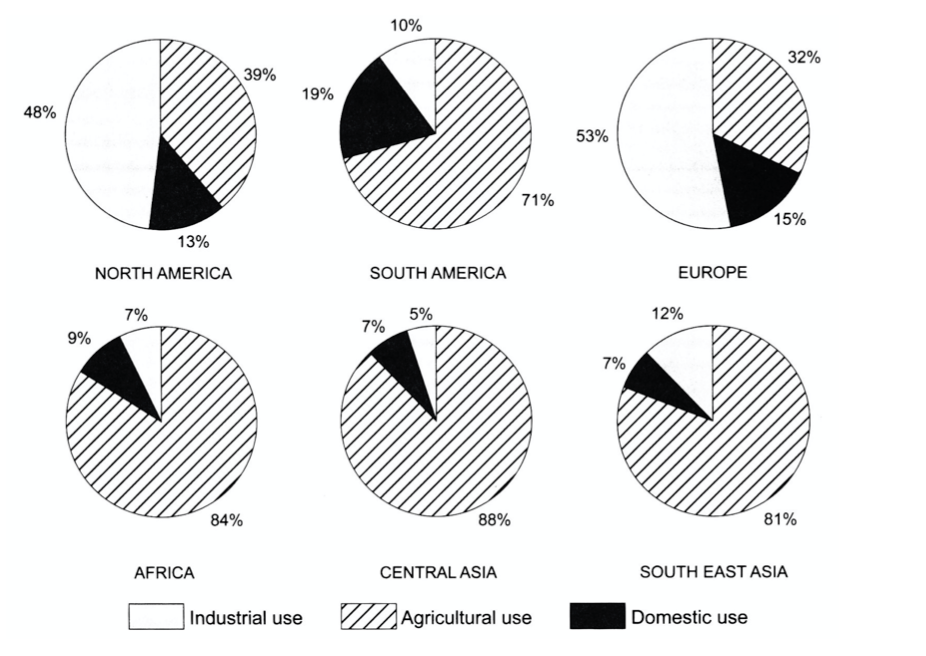
The pie charts provide information regarding the proportions of water used for industrial, agriculture, and domestic use in six regions.
In general, water serves mostly an industrial purpose in North America and Europe, whereas it is predominantly used for agriculture in South America, Africa, Central Asia, and South-East Asia.
Regarding industrial and domestic use, North America and Europe consume an average of approximately 50 percent of water for industrial purposes. However, these two regions report much less water consumption for domestic purposes, utilizing 13 percent and 15 percent, respectively. Out of all six regions, South America dedicates the highest percentage of water consumption for domestic use, but uses only 10 percent for industrial reasons. Both industrial and domestic use remain the least popular choices in Africa, Central Asia, and South-East Asia, where their combined use makes up less than 20 percent of the overall water consumption in each of the three regions.
Agricultural use, on the other hand, accounts for 71 percent of water consumption in South America and over three-fourths of water use in Africa, South-East Asia, and Central Asia, where it is nearly 90 percent. North America and Europe consume less than 40 percent of water for agricultural purposes.
Para aprender a abordar gráficos circulares na tarefa 1 do IELTS Academic Writing, inscreva-se no período de teste gratuito de 7 dias e aceda à aula IELTS Academic Writing Task - Pie Charts.
Período de teste gratuito de 7 diasTabelas
Neste tipo de tarefa, é-lhe entregue uma tabela com dados. Pode apresentar números dinâmicos que variam ao longo do tempo ou dados estáticos para um determinado momento. Muitas vezes há demasiada informação, pelo que não poderá incluir todos os pormenores. A sua tarefa é escrever um resumo, destacando os pontos mais importantes e sustentando a sua descrição com dados.
The table below gives the average time spent and distance traveled by UK commuters in one year. Time and distance are given in minutes and miles accordingly.
Summarise the information by selecting and reporting the main features, and make comparisons where relevant.
Commuting Habits of different regions of the UK in a year
UK Region | Average Commuting Time (minutes) | Average Commuting Distance (miles) |
London | 54 | 14 |
South East | 78 | 20 |
Scotland | 45 | 19 |
West Midlands | 39 | 18 |
North West | 36 | 18 |
Northern Ireland | 36 | 15 |
Yorkshire & Humberside | 36 | 14 |
South West | 34 | 16 |
East Anglia | 33 | 15 |
North East | 32 | 19 |
East Midlands | 32 | 15 |
Wales | 27 | 14 |
- Write at least 150 words.
- You should spend around 20 minutes on this task.
The table shows data on the average commuting time (minutes) and distance (miles) completed by UK citizens in 12 different regions in one year.
Overall, with the exception of London, the further people travel, the more time they need to reach work people. Commuters in the south east region spend the longest time commuting over the greatest distance, whereas people in Wales spend the least.
Regarding the top three UK regions, on average, people in the south east travel both the farthest and longest at 20 miles over 78 minutes. Likewise inhabitants of Scotland journey a similar distance to work, yet spend almost half the time doing so at 45 minutes to get there, while those living in London spend the second-longest time travelling (54 minutes) over just 14 miles.
Of the other regions, people in the West Midlands spent the most time travelling at 39 minutes whereas those in Wales recorded the lowest time at 27 minutes. With regard to distance, residents of the North East, West Midlands and North West recorded the greatest mileage at 19, 18 and 18 miles respectively, while people in Yorkshire and Humberside as well as Wales both travelled the shortest distance to work of all at 14 miles.
Para aprender a abordar tabelas na tarefa 1 do IELTS Academic Writing, inscreva-se no período de teste gratuito de 7 dias e aceda às seguintes aulas:
- IELTS Academic Writing Task - Tables Part 1
- IELTS Academic Writing Task - Tables Part 2
Diagramas de processo
Neste tipo de pergunta, é-lhe apresentado um diagrama que mostra como algo funciona.
O diagrama pode representar uma máquina, um sistema ou um fenómeno natural.
Muitas vezes, não existem dados ou existem poucos dados.
A sua tarefa é resumir a informação apresentada no diagrama.
The diagram below shows the water cycle, which is the continuous movement of water on, above and below the surface of the Earth.
Summarise the information by selecting and reporting the main features.
- Write at least 150 words.
- You should spend around 20 minutes on this task.
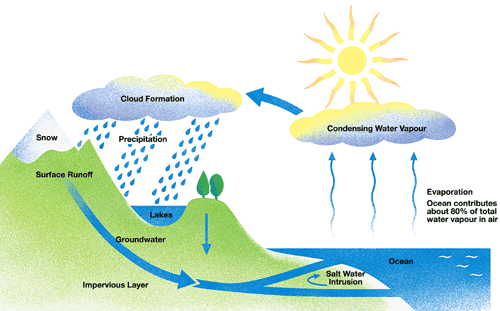
The diagram illustrates the hydrological cycle by which water moves through our natural environment. Overall, there are several stages to the process involving evaporation, precipitation and the final return of water to the ocean where the process begins over.
Since 80% of all water begins in the ocean, most water originates from this source. Initially sea water is warmed by the sun, causing it to evaporate into the air becoming water vapor. This then rises to condense into clouds at a higher elevation, which are then then pushed by the wind over land where it condenses further and precipitation occurs, falling as either snow or rain.
After precipitation on land, water then takes one of three routes. Some of it may fall into lakes or return to the ocean as surface runoff. Still further water percolates underground to an impermeable layer where it again flows back to the sea. Salt water also intrudes from the ocean into the land in coastal areas.

Process Diagram
Learn how to answer this question in a step-by-step interactive exercise
Process Diagram
Uma tarefa de diagrama de processo da Task 1 do IELTS Academic mostra, etapa por etapa, como algo é feito ou como um sistema funciona. Você apresenta as fases na ordem em que o diagrama as mostra, sem dar motivos nem opiniões.
Veja o enunciado da tarefa e clique em Próximo para continuar.
Veja a pergunta
Summarise the information by selecting and reporting the main features.
Write at least 150 words.
Antes de escrever qualquer coisa, entenda bem o diagrama. Conte as fases e siga as setas para ver onde o processo começa e onde termina. Se a última seta volta para a primeira fase, o processo é um ciclo e não há produto final.
Responda às perguntas sobre o diagrama.
Leia o gráfico
A introdução diz ao leitor o que o diagrama mostra. Parafraseie o enunciado da tarefa com suas próprias palavras em vez de copiá-lo e diga qual é o processo. Não descreva nenhuma das fases aqui.
Escreva uma ou duas frases para a sua introdução.
Escreva a introdução
Enunciado da tarefa
The diagram below shows the water cycle, which is the continuous movement of water on, above and below the surface of the Earth.
Summarise the information by selecting and reporting the main features.
Write at least 150 words.
Um relatório de Task 1 do IELTS precisa de um parágrafo de desenvolvimento para cada grupo de fases. Não escreva um parágrafo para cada fase. Divida o processo nos seus pontos naturais, onde muda o lugar, o material ou a finalidade, para que cada grupo seja uma sequência de fases seguidas. A maioria dos processos dá dois grupos; um processo curto pode dar um, e um longo, três.
Escolha os grupos.
Forme os grupos
Escolha os grupos.
- Group 1: stages 1 to 2 (Evaporation to Condensing Water Vapour). Group 2: stages 3 to 4 (Cloud Formation to Precipitation). Group 3: stages 5 to 6 (Surface Runoff to Groundwater).
- Group 1: stages 1 to 3 (Evaporation to Cloud Formation). Group 2: stages 4 to 5 (Precipitation to Surface Runoff). Group 3: stage 6 (Groundwater).
- Group 1: stages 1 to 3 (Evaporation to Cloud Formation). Group 2: stages 4 to 6 (Precipitation to Groundwater).
- Group 1: stages 1 to 2 (Evaporation to Condensing Water Vapour). Group 2: stages 3 to 5 (Cloud Formation to Surface Runoff). Group 3: stage 6 (Groundwater).
A visão geral resume o processo inteiro em poucas palavras. Pergunte-se quantas fases existem e quais são as fases principais do começo ao fim. Um processo raramente é comparado com outra coisa, então descreva o formato do processo em vez de procurar uma alta ou uma queda.
Responda às perguntas para encontrar a tendência geral.
Encontre a tendência geral
Use suas anotações da etapa anterior. A visão geral informa o número de fases e as fases principais, e diz se o processo termina com um produto ou se repete como um ciclo. Deixe equipamentos, tempos e temperaturas para os parágrafos de desenvolvimento, e não dê motivos nem opiniões.
Escreva uma ou duas frases para a sua visão geral.
Escreva sua visão geral
O parágrafo de desenvolvimento 1 descreve o primeiro grupo de fases, passo a passo, na ordem que as setas mostram. Use a voz passiva, como is heated, is mixed e is poured, porque o diagrama raramente diz quem faz o trabalho. Ligue as fases com palavras de sequência como first, then e after that.
Escreva três ou quatro frases para o parágrafo de desenvolvimento 1.
Escreva o parágrafo de desenvolvimento 1
O parágrafo de desenvolvimento 2 descreve o seu segundo grupo de fases. Ele continua do ponto em que o parágrafo de desenvolvimento 1 parou, para que a sequência nunca se quebre. Continue usando a voz passiva e ligue os grupos com expressões como once e after this. Se este for o último parágrafo, marque o fim com in the final stage ou finally e, se o processo for um ciclo, diga que a última fase leva de volta à primeira.
Escreva três ou quatro frases para o parágrafo de desenvolvimento 2.
Escreva o parágrafo de desenvolvimento 2
Suas seções agora formam um único relatório: a introdução, a visão geral e um parágrafo de desenvolvimento para cada grupo de fases. Leia-as juntas e confira se as fases continuam em sequência, se a voz passiva está correta e se o relatório tem o tamanho suficiente.
Leia o plano completo do seu relatório e depois clique em Próximo para compará-lo com o relatório modelo.
Plano completo do relatório
Como decidir
Uma tarefa de diagrama de processo mostra como algo é feito ou como um sistema funciona, passo a passo. O diagrama tem uma ordem fixa, então o relatório segue essa ordem da primeira à última fase.
Siga sempre a mesma ordem para que as fases fiquem em sequência e nenhuma etapa seja esquecida.
- Leia o gráfico. Conte as etapas e siga as setas para ver onde o processo começa e onde termina.
- Escreva a introdução. Parafraseie o enunciado da tarefa e diga qual é o processo, sem nenhum detalhe.
- Forme os grupos. Divida as fases em grupos nos pontos naturais do processo, com um parágrafo de desenvolvimento para cada grupo.
- Encontre a tendência geral. Decida quantas etapas existem e quais são as fases principais do início ao fim.
- Escreva a visão geral e os parágrafos de desenvolvimento. Resuma primeiro o formato do processo e depois descreva as etapas em sequência.
- Plano completo do relatório. Leia suas seções juntas e compare-as com o relatório modelo.
Um relatório de processo é escrito na voz passiva. O diagrama raramente diz quem faz o trabalho, então use formas como “is heated”, “is mixed” e “is stored” e ligue as etapas com palavras de sequência, como “first”, “after that” e “finally”.
Leia
Um diagrama de processo mostra fases ligadas por setas. Conte as etapas e siga as setas para conferir onde o processo começa e onde termina. Se a última seta volta para a primeira fase, o processo é um ciclo e não há produto final.
Introdução
A introdução diz o que o diagrama mostra. Parafraseie o enunciado da tarefa com suas próprias palavras em vez de copiá-lo e diga qual é o processo. Deixe as etapas individuais fora dessas frases.
Grupos
Um relatório da Task 1 precisa de um parágrafo de desenvolvimento para cada grupo de fases. Não escreva um parágrafo para cada etapa. Divida o processo nos seus pontos naturais, onde muda o lugar, o material ou a finalidade, para que cada grupo seja uma sequência de fases seguidas. A maioria dos processos forma dois grupos; um processo curto pode formar um, e um longo, três.
Tendência
A visão geral resume o processo inteiro de forma rápida: quantas etapas existem e quais são as fases principais. Um processo raramente é comparado com outra coisa, então descreva o formato do processo em vez de procurar um aumento ou uma queda.
Escreva
A visão geral vem primeiro e fica no nível geral, sem equipamentos, tempos ou temperaturas. Depois, cada parágrafo de desenvolvimento descreve suas etapas na ordem que as setas mostram. Use formas na voz passiva, como “is heated” e “is poured”, e ligue as etapas com palavras de sequência, como “first”, “next”, “after that” e “finally”.
Para aprender a abordar diagramas de processo na tarefa 1 do IELTS Academic Writing, inscreva-se no período de teste gratuito de 7 dias e aceda à aula IELTS Academic Writing Task - Process Diagrams.
Período de teste gratuito de 7 diasMapas
Neste tipo de pergunta, ser-lhe-ão apresentados um, dois ou três mapas.
Os mapas podem representar uma vila, cidade, ilha ou outra zona geográfica.
Em geral, os mapas mostram as alterações ocorridas numa zona ao longo de um determinado período.
Estas alterações podem dizer respeito a construção (por exemplo, urbanização de uma zona para turismo)
ou a destruição (por exemplo, o impacto de uma catástrofe natural, como um terramoto, numa zona).
A sua tarefa é escrever um resumo das alterações ocorridas e abordar os pontos mais importantes.
The maps below show the centre of a small town called Islip as it is now, and plans for its development. Summarise the information by selecting and reporting the main features, and make comparisons where relevant.
- Write at least 150 words.
- You should spend around 20 minutes on this task.
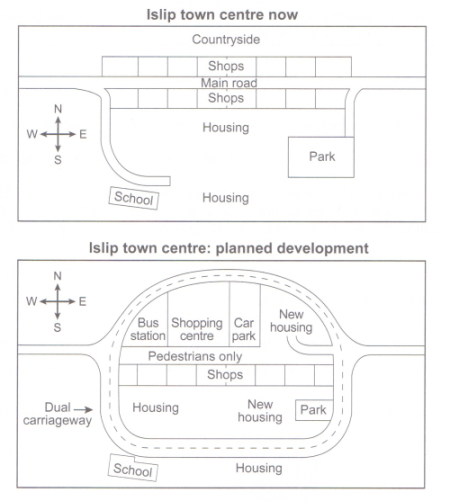
The diagrams illustrate some proposed changes to the central area of the town of Islip.
Overall, the principal change to the town will be the construction of a ring road around the centre. Various other developments with regard to shops and housing will accompany the building of this road.
As the first map reveals, lslip town center now is relatively small. There is a main road from the west to the east with shops on both sides. The northern area is rarely countryside, while the southern area is filled with houses with a school at the end of the fork road in the southwest corner and a park in the southeast area.
In the future, the main road is expected to reform into a dual carriageway as a round containing all the new buildings. The shops along the north side of the new pedestrian street will be demolished to make way for a bus station, shopping centre, car parks and new housing area. The shops along the south side of the street will remain, but it seems that the town's park will be reduced in size so that more new houses can be built within the ring road.
Map
Learn how to answer this question in a step-by-step interactive exercise
Map
Uma tarefa de mapa da Task 1 do IELTS Academic apresenta duas ou mais plantas do mesmo lugar em épocas diferentes, geralmente duas. Você escreve um relatório de pelo menos 150 palavras descrevendo como o lugar mudou, sem dar opiniões nem motivos.
Veja a tarefa e clique em Próximo para continuar.
Veja a pergunta
Write at least 150 words.
Comece lendo os mapas, não escrevendo. Confira o lugar mostrado, os momentos comparados e quantos mapas há. Depois, procure o que é novo, o que desapareceu e o que agora tem outro uso.
Responda às perguntas sobre os mapas.
Leia o gráfico
A introdução parafraseia a tarefa com suas próprias palavras. Diga o que os mapas mostram e o período que abrangem, e mude as palavras da tarefa em vez de copiá-las. Os detalhes, as expressões de localização e os verbos de mudança vêm depois.
Escreva uma ou duas frases que parafraseiem a tarefa.
Escreva a introdução
Enunciado da tarefa
The maps below show the centre of a small town called Islip as it is now, and plans for its development. Summarise the information by selecting and reporting the main features, and make comparisons where relevant.
Write at least 150 words.
Um relatório de Task 1 precisa de um parágrafo de desenvolvimento para cada grupo de mapas. Normalmente, cada mapa é um grupo: o mapa mais antigo no primeiro parágrafo e o mais recente no segundo, porque isso mantém os momentos separados. Dois mapas que ficam melhor descritos juntos podem formar um grupo, e três mapas geralmente dão três parágrafos.
Um parágrafo para cada elemento, ou um para cada metade do mapa, quebra a comparação entre os momentos.
Escolha o agrupamento que gera parágrafos de desenvolvimento claros.
Forme os grupos
Escolha o agrupamento que gera parágrafos de desenvolvimento claros.
- One group: now and planned development.
- Group 1: now. Group 2: planned development.
A visão geral apresenta a maior mudança ao longo de todo o período. Pergunte-se se o lugar cresceu ou diminuiu e quais tipos de uso do espaço surgiram ou desapareceram. Elementos isolados e posições exatas ficam fora da visão geral.
Escolha as respostas que descrevem a mudança geral.
Encontre a tendência geral
Agora escreva a visão geral com suas próprias palavras, usando as anotações da etapa anterior. Uma ou duas frases bastam. Descreva o desenvolvimento geral do lugar e deixe de fora posições exatas, elementos isolados e qualquer motivo para a mudança.
Escreva sua visão geral em uma ou duas frases.
Escreva sua visão geral
O primeiro parágrafo de desenvolvimento descreve em detalhes o mapa ou os mapas do seu primeiro grupo. Use formas do passado para uma situação que já terminou e use expressões de localização como “to the north of”, “beside” e “on the edge of”, para que o leitor consiga situar cada elemento. Descreva os elementos, não os motivos.
Escreva três ou quatro frases para o parágrafo de desenvolvimento 1.
Escreva o parágrafo de desenvolvimento 1
O segundo parágrafo de desenvolvimento descreve o mapa ou os mapas do seu segundo grupo e a mudança desde o mapa anterior. Use a voz passiva para o que foi construído, removido ou substituído, como “was built”, “had been cleared” e “has been converted”, porque os mapas não dizem quem fez a obra. As expressões de localização continuam mostrando onde cada mudança aconteceu.
Escreva três ou quatro frases para o parágrafo de desenvolvimento 2.
Escreva o parágrafo de desenvolvimento 2
Suas seções agora formam um único relatório: introdução, visão geral e um parágrafo de desenvolvimento para cada grupo de mapas. Leia-as na ordem e confira se a visão geral apresenta o quadro geral e se os parágrafos de desenvolvimento trazem os detalhes.
Leia o plano do seu relatório e depois compare-o com o relatório modelo.
Plano completo do relatório
Como decidir
Uma tarefa de mapa traz duas ou mais plantas do mesmo lugar em momentos diferentes. Você não descreve cada legenda. Você relata como o lugar mudou entre um momento e outro.
Siga sempre a mesma ordem para que o relatório apresente o panorama geral antes dos detalhes.
- Leia o gráfico. Confira o lugar, os momentos e as principais características de cada mapa antes de planejar.
- Forme os grupos. Divida as informações em grupos de mapas, com um parágrafo de desenvolvimento para cada um, normalmente primeiro o mapa mais antigo e depois o mais recente.
- Encontre a tendência geral. Decida qual é a maior mudança em todo o período, como crescimento, declínio ou um novo uso do terreno.
- Escreva o relatório por etapas. Escreva a introdução, depois a visão geral e depois um parágrafo de desenvolvimento para cada grupo.
- Plano completo do relatório. Leia as seções juntas e compare-as com o relatório modelo.
Expressões de posição e formas na voz passiva sustentam um relatório de mapa. Expressões como “to the north of” e “beside the river” situam cada elemento, e formas como “was built” ou “had been removed” relatam uma mudança sem dizer quem fez o trabalho.
Leia
Antes de planejar, confira o que os mapas mostram: o lugar, os momentos e as principais características de cada mapa. Depois, procure o que é novo, o que desapareceu e o que agora tem outro uso. Essa fase de leitura evita que você descreva só um dos mapas.
Grupos
Um relatório da Task 1 do IELTS precisa de um parágrafo de desenvolvimento para cada grupo de mapas. Normalmente cada mapa é um grupo, primeiro o mapa mais antigo e depois o mais recente. Dois mapas que ficam melhor descritos juntos podem formar um grupo, e três mapas normalmente rendem três parágrafos. Decida a divisão antes de escrever, porque ela define a ordem do relatório inteiro.
Visão geral
A visão geral apresenta a maior mudança em todo o período, e não os pequenos detalhes. Pergunte-se se o lugar cresceu ou encolheu e que tipos de uso do terreno surgiram ou desapareceram. Elementos isolados e posições exatas ficam nos parágrafos de desenvolvimento.
Escreva
O relatório é construído em fases curtas. A introdução parafraseia a tarefa, a visão geral apresenta a principal mudança e um parágrafo de desenvolvimento descreve cada grupo. Use formas do passado para uma situação que já terminou, formas na voz passiva como “was built” ou “had been cleared” para as mudanças e expressões de posição para mostrar onde fica cada elemento.
Para aprender a abordar mapas na tarefa 1 do IELTS Academic Writing, inscreva-se no período de teste gratuito de 7 dias e aceda à aula IELTS Academic Writing Task - Maps.
Período de teste gratuito de 7 diasDados mistos
Neste tipo de tarefa, ser-lhe-ão apresentados dois conjuntos de dados.
Os dados serão de tipos diferentes. Por exemplo, um conjunto pode mostrar uma variação ao longo do tempo, enquanto o segundo é estático.
Em alternativa, um conjunto pode apresentar percentagens, enquanto o outro apresenta números.
Pode também ser-lhe apresentada uma ilustração (p. ex., um diagrama ou um mapa) e um conjunto de dados (p. ex., um gráfico de barras, gráfico de linhas, gráfico circular ou tabela)
A sua tarefa é resumir ambos os conjuntos de dados.
The pie graph depicts the main reasons for the productivity loss of agricultural land worldwide. The table shows how these causes influenced three world regions during the 2000s.
Summarise the information by selecting and reporting the main features, and make comparisons where relevant.
Causes of Land Degradation by Region (%) | ||||
Region: | Deforestation | Over-cultivation | Over-grazing | Total land degraded |
North America | 0.3 | 3.4 | 1.7 | 5.4 |
Asia | 9.8 | 7.8 | 5.7 | 23.3 |
Australia & Oceania | 1.6 | 0.3 | 11 | 12.9 |
- Write at least 150 words.
- You should spend around 20 minutes on this task.
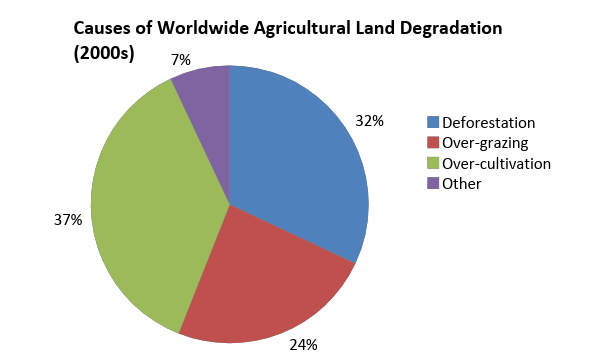
The pie chart shows the four main causes of farmland degradation in the world today, while the table presents the amount of land surface area affected by each one in three separate global regions during the 2000s.
Overall, Asia suffered more from the deterioration of farmland than other regions owing to deforestation and over-cultivation which were also the primary reasons for agricultural land loss worldwide.
Globally, 69% of degraded land is attributed to excessive cultivation and tree clearance, constituting 37% and 32% respectively. A further quarter of global land loss is due to over cultivation of crops. Other causes made up only 7% collectively.
In the 2000s, these causes affected regions of our planet differently. Asia was the worst affected where the top two causes of global land loss, deforestation and over-cultivation, resulted in 9.8% and 7.8% of degraded land there. The impact on Australia and Oceania was less severe though over-grazing was the predominant cause of land deterioration at eleven percent. The least affected of all was North America where only 5.4% of land was diminished, principally because of over-cultivation at 3.4%.
Mixed Charts
Learn how to answer this question in a step-by-step interactive exercise
Mixed Charts
Uma tarefa de gráficos combinados da Task 1 do IELTS Academic apresenta dois ou mais recursos visuais de tipos diferentes sobre um mesmo tema. Você escreve um relatório de pelo menos 150 palavras que apresenta as características principais e relaciona os recursos visuais, sem dar opiniões nem motivos.
Veja a tarefa e clique em Próximo para continuar.
Veja a pergunta
Summarise the information by selecting and reporting the main features, and make comparisons where relevant.
Write at least 150 words.
Comece lendo os recursos visuais, não escrevendo. Confira o que cada recurso visual mostra e leia todos os rótulos dos eixos e unidades antes de planejar. Recursos visuais de tipos diferentes muitas vezes medem coisas diferentes, então anote o que eles têm em comum, como o mesmo grupo de pessoas ou o mesmo período.
Responda às perguntas sobre os recursos visuais.
Leia o gráfico
A introdução parafraseia a tarefa com suas próprias palavras. Deixe claro o que cada recurso visual mostra e a qual grupo e período se refere, e mude as palavras da tarefa em vez de copiá-las. Os números e as ligações entre os recursos visuais vêm depois.
Escreva uma ou duas frases que parafraseiem a tarefa.
Escreva a introdução
Enunciado da tarefa
The pie graph depicts the main reasons for the productivity loss of agricultural land worldwide. The table shows how these causes influenced three world regions during the 2000s.
Summarise the information by selecting and reporting the main features, and make comparisons where relevant.
Write at least 150 words.
Um relatório de Task 1 precisa de um parágrafo de desenvolvimento para cada grupo de recursos visuais, e um conjunto de gráficos combinados dá de um a três grupos. Recursos visuais do mesmo tipo ou do mesmo assunto ficam juntos, porque um parágrafo que mistura duas medidas é difícil de acompanhar. Dois gráficos de pizza sobre a mesma coisa ficam no mesmo parágrafo, e um gráfico de linhas com outra medida ganha um parágrafo próprio.
Um parágrafo para cada recurso visual pode separar o que deve ficar junto, e um único parágrafo para todos os recursos visuais mistura medidas. Dividir por anos ou pelos números mais altos e mais baixos quebra a comparação que a tarefa pede.
Escolha o agrupamento que dá a cada parágrafo uma medida clara.
Forme os grupos
Escolha o agrupamento que dá a cada parágrafo uma medida clara.
- Group 1: the pie chart. Group 2: the table.
- One group: the pie chart and the table.
A visão geral apresenta o maior padrão em todos os recursos visuais e vem antes de qualquer detalhe. Encontre o movimento principal em cada recurso visual e depois decida se um deles confirma ou explica o outro. Números exatos ficam fora da visão geral.
Escolha as respostas que descrevem o padrão principal.
Encontre a tendência geral
Agora escreva a visão geral com suas próprias palavras, usando as anotações da etapa anterior. Uma ou duas frases bastam. Apresente o padrão principal e a ligação entre os recursos visuais, e deixe de fora números exatos e qualquer motivo para o padrão.
Escreva sua visão geral em uma ou duas frases.
Escreva sua visão geral
O primeiro parágrafo de desenvolvimento descreve em detalhes o primeiro grupo. Apresente as comparações relevantes, como o ponto mais alto, o ponto mais baixo e a mudança mais clara, e apoie cada uma com alguns números escolhidos. Não liste todos os números e não descreva os outros grupos aqui.
Escreva três ou quatro frases para o parágrafo de desenvolvimento 1.
Escreva o parágrafo de desenvolvimento 1
O segundo parágrafo de desenvolvimento descreve o segundo grupo e o relaciona ao primeiro. Agrupe as comparações que andam juntas, em vez de tratar uma categoria de cada vez, e use uma expressão de ligação para mostrar onde os recursos visuais concordam. Apresente o que os dados mostram, não o porquê.
Escreva três ou quatro frases para o parágrafo de desenvolvimento 2.
Escreva o parágrafo de desenvolvimento 2
Suas seções agora formam um único relatório: introdução, visão geral e um parágrafo de desenvolvimento para cada grupo de recursos visuais. Leia-as na ordem e confira se a visão geral apresenta o quadro geral e se os parágrafos de desenvolvimento trazem os detalhes.
Leia o plano do seu relatório e depois compare-o com o relatório modelo.
Plano completo do relatório
Como decidir
Uma tarefa de gráficos combinados traz dois ou mais recursos visuais de tipos diferentes sobre o mesmo tema. Você não escreve um relatório separado para cada um. Você relata as principais características de cada recurso visual e os relaciona onde os dados se conectam.
Siga sempre a mesma ordem para que o relatório apresente o panorama geral antes dos detalhes.
- Leia o gráfico. Confira o que cada recurso visual mostra e leia todos os eixos, rótulos e unidades antes de planejar.
- Forme os grupos. Divida os recursos visuais em um a três grupos, com um parágrafo de desenvolvimento para cada um, normalmente um tipo de gráfico ou um assunto em cada.
- Encontre a tendência geral. Decida qual é o padrão mais importante em todos os recursos visuais e anote qualquer relação entre eles.
- Escreva o relatório por etapas. Escreva a introdução, depois a visão geral e depois um parágrafo de desenvolvimento para cada grupo.
- Plano completo do relatório. Leia as seções juntas e compare-as com o relatório modelo.
Agrupe as comparações importantes em vez de listar todos os números. Alguns números selecionados que sustentam um padrão valem mais do que uma lista longa que só repete o que o recurso visual já mostra.
Leia
Recursos visuais de tipos diferentes medem coisas diferentes, então leia cada um separadamente primeiro. Confira o título, os rótulos dos eixos, as unidades e o período e depois anote o que os recursos visuais têm em comum, como o mesmo grupo de pessoas ou o mesmo período. Uma fatia do tempo num gráfico de pizza e um total num gráfico de linhas não são a mesma medida.
Grupos
Um relatório da Task 1 do IELTS precisa de um parágrafo de desenvolvimento para cada grupo de recursos visuais, então os recursos visuais precisam formar um, dois ou três grupos. Recursos visuais do mesmo tipo ou do mesmo assunto ficam juntos, e um recurso visual sobre uma medida diferente ganha um parágrafo só dele. Decida a divisão antes de escrever, porque ela define a ordem do relatório inteiro.
Visão geral
A visão geral apresenta, em uma ou duas frases, o padrão mais importante de todos os recursos visuais. Encontre o principal movimento de cada recurso visual e depois decida se um sustenta ou explica o outro. Números exatos e categorias isoladas ficam nos parágrafos de desenvolvimento.
Escreva
O relatório é construído em fases curtas. A introdução parafraseia a tarefa, a visão geral apresenta o padrão principal e um parágrafo de desenvolvimento descreve cada grupo. Nos parágrafos de desenvolvimento, agrupe as comparações que andam juntas e sustente cada uma com alguns números selecionados em vez de listar todos os números.
Para aprender a abordar dados mistos na tarefa 1 do IELTS Academic Writing, inscreva-se no período de teste gratuito de 7 dias e aceda à aula IELTS Academic Writing Task - Mixed Data.
Período de teste gratuito de 7 diasVocabulário para a tarefa 1 do IELTS Academic Writing
Para conseguir uma pontuação elevada nesta tarefa, terá de aprender a utilizar palavras e expressões adequadas para apresentar os dados de um gráfico circular, de barras, de linhas ou misto. Sugerimos que se inscreva no período de teste gratuito de 7 dias e que conclua as seguintes aulas:
- Aula da tarefa 1 do IELTS Academic Writing - como escrever sobre números
- Aula da tarefa 1 do IELTS Academic Writing - como escrever sobre percentagens
- Aula da tarefa 1 do IELTS Academic Writing - como escrever sobre alterações em dados
Exemplos da tarefa 1 do IELTS Writing
Esta secção apresenta uma lista de exemplos de redações para a tarefa 1 do IELTS Academic Writing.
- IELTS Academic Writing Task 1 - Line Chart Questions
- IELTS Academic Writing Task 1 - Bar Chart Questions
- IELTS Academic Writing Task 1 - Pie Chart Questions
- IELTS Academic Writing Task 1 - Map Questions
- IELTS Academic Writing Task 1 - Process Diagram Questions
- IELTS Academic Writing Task 1 - Mixed Data Questions
IELTS General Writing – Tarefa 1
Na tarefa 1 do IELTS General Training Writing, ser-lhe-á apresentada uma situação e terá de escrever uma resposta pessoal sob a forma de uma carta informal, semiformal ou formal, com pelo menos 150 palavras. As situações sobre as quais lhe é pedido que escreva são comuns no dia-a-dia, tais como:
- escrever ao responsável pelo alojamento universitário relatando problemas com o alojamento,
- escrever a um novo empregador sobre dificuldades de gestão de tempo,
- escrever a um jornal local sobre um plano para desenvolver um aeroporto local,
- escrever a uma agência de arrendamento para resolver problemas com o sistema de aquecimento da casa.
Em relação à situação, ser-lhe-á dada informação sob a forma de três tópicos que deverá incluir na sua resposta. Pode ser necessário pedir ou fornecer informação e/ou explicar uma situação. Para o fazer, poderá ter de:
- pedir e/ou prestar informação factual de carácter geral,
- expressar necessidades, vontades, gostos ou desagrados,
- expressar opiniões ou queixas,
- apresentar pedidos ou fazer sugestões/recomendações.
Estilo no IELTS General Writing
O estilo de escrita a adotar depende de a quem lhe é pedido para escrever (ou seja, o destinatário) e do nível de proximidade que se espera ter com essa pessoa. Tem de escrever num estilo adequado ao destinatário e que o ajude a cumprir o propósito da carta, por exemplo, escrever a um amigo (informal) ou escrever a um gestor (semiformal ou formal). Não precisa de incluir moradas no cabeçalho das cartas.
Como evitar perder pontos na tarefa 1 do IELTS General Writing
Como mencionámos, não dedique mais de 20 minutos a esta tarefa e certifique-se de que escreve, pelo menos, 150 palavras, caso contrário será penalizado. Embora não seja penalizado por escrever mais de 150 palavras, lembre-se de que uma resposta mais longa na tarefa 1 pode significar menos tempo para a tarefa 2, que contribui o dobro para a band score de Writing.
Lembre-se também de que será penalizado por falta de relevância, se a resposta estiver fora do tema ou não estiver escrita como texto contínuo (p. ex., utilizando tópicos em qualquer parte da resposta, ou em forma de apontamentos, etc.). Será fortemente penalizado por plágio (ou seja, por copiar de outra fonte).
Last weekend, your cousin celebrated her 50th birthday, but you couldn't attend and you forgot to cancel.
Write a letter to your cousin. In your letter:
- Apologize for missing the birthday celebration
- Explain why you missed it and why you hadn't let her know
- Describe how you will make it up to her
You do NOT need to write any addresses.
Begin your letter as follows:
Dear ___,
- Write at least 150 words.
- You should spend around 20 minutes on this task.
Dear Marnie,
Happy belated birthday! I hope you're doing well and that you had a great 50th birthday party.
I'm so sorry that I wasn't at your party to celebrate with you. It's been such a long time since we've been able to catch up and see each other.
To be completely honest, I've been swamped with work lately, and I was asked to go on a last-minute business trip a few days before your birthday. I was so busy that I had completely forgotten about your party, and it didn't occur to me to call you and cancel.
My busy schedule is absolutely not an excuse for missing your 50th birthday, though, and I would love to make it up to you. I've reserved a table for two next Friday night at the new sushi restaurant in town. Can I please treat you to a luxurious birthday dinner?
I hope we can celebrate together next Friday!
Speak to you soon,
Jessica
Total Word Count: 162 words

Task Achievement — Letter
Learn how to answer this question in a step-by-step interactive exercise
Task Achievement — Letter
Na Task 1 do IELTS General Training, você escreve uma carta em resposta a uma situação. O critério Task Achievement depende de você cobrir todos os tópicos do enunciado, porque uma carta boa que deixa um deles de fora ainda perde pontos.
Leia a situação, os tópicos e qualquer frase de abertura que a tarefa ofereça.
Veja a tarefa e clique em Próximo para continuar.
Veja a pergunta
Write a letter to your cousin. In your letter:
- Apologize for missing the birthday celebration
- Explain why you missed it and why you hadn't let her know
- Describe how you will make it up to her
Write at least 150 words. You do NOT need to write any addresses.
Begin your letter as follows:
Dear ___,
Antes de escrever, planeje a carta respondendo a três perguntas. Para quem você está escrevendo, por que está escrevendo e o que a carta precisa incluir?
O leitor define o grau de formalidade da linguagem, o objetivo define como você começa e os tópicos definem o conteúdo. Todas as respostas já estão em algum lugar do enunciado.
Relacione cada pergunta de planejamento à parte do enunciado que a responde.
Entenda a tarefa
Relacione cada pergunta de planejamento à parte do enunciado que a responde.
A saudação e a despedida mostram ao leitor o grau de formalidade da carta, então elas precisam combinar com a pessoa para quem você escreve. Uma carta para um desconhecido ou para um gerente é formal, e uma carta para um amigo é informal.
Mantenha o começo e o fim da carta no mesmo nível. Uma saudação formal seguida de uma despedida descontraída confunde o leitor.
Escolha uma saudação e uma despedida adequadas ao leitor.
Escolha a saudação e a despedida
Confirm the greeting
- Dear ___,
- Dear Sir or Madam,
- Dear Ms. Smith,
- Hey you,
Choose a closing
- Speak to you soon,
- Lots of love,
- Best wishes,
- Yours faithfully,
- Yours sincerely,
Dê ao primeiro tópico um parágrafo próprio. O critério Task Achievement avalia se cada tópico foi coberto e desenvolvido, e não apenas mencionado.
Há inícios de frase prontos para você começar. Complete a ideia com suas próprias palavras e mantenha o mesmo tom da saudação.
Escreva um parágrafo que cubra o primeiro tópico.
Escreva o tópico 1
Apologise for missing the birthday celebration
O segundo tópico também precisa de um parágrafo próprio. Dê a ele o mesmo tamanho e o mesmo nível de detalhe do primeiro, porque um tópico respondido pela metade ainda custa pontos.
Use um início de frase para começar e depois acrescente os detalhes de que o leitor realmente precisaria nessa situação.
Escreva um parágrafo que cubra o segundo tópico.
Escreva o tópico 2
Explain why you missed it and did not let her know
Termine o corpo da carta com o terceiro tópico. Quando os três estiverem cobertos com frases completas, a tarefa estará completa.
Mantenha o tom igual até o fim e confira se este parágrafo responde ao que o tópico realmente pediu.
Escreva um parágrafo que cubra o terceiro tópico.
Escreva o tópico 3
Describe how you will make it up to her
Seus parágrafos agora aparecem juntos como uma única carta, com a saudação e a despedida no lugar. Leia-a como um texto só e confira se todos os tópicos foram cobertos.
Compare suas palavras com a carta de exemplo e observe como o tom se mantém igual da saudação até a despedida.
Revise sua carta e depois clique em Próximo para continuar.
Revise sua carta completa
Como decidir
Uma carta da Task 1 responde a uma situação e cobre uma série de tópicos. A nota de Task Achievement depende de cobrir todos os tópicos e de adequar o tom ao leitor.
Siga sempre a mesma ordem para que nenhum tópico fique de fora e o nível de formalidade seja o mesmo do início ao fim.
- Entenda a tarefa. Descubra para quem você está escrevendo, por que está escrevendo e o que a carta precisa incluir.
- Escolha a saudação e a despedida. Adeque a abertura e o fechamento ao leitor e mantenha os dois no mesmo nível de formalidade.
- Escreva os tópicos. Dê a cada tópico um parágrafo próprio e desenvolva-o com detalhes concretos.
- Revise sua carta completa. Leia os parágrafos juntos e confira se todos os tópicos foram cobertos.
Escreva um parágrafo para cada tópico. Esse plano simples torna quase impossível deixar um tópico de fora, que é a forma mais rápida de perder pontos em Task Achievement.
Planeje
Três perguntas planejam a carta inteira. Para quem você está escrevendo, por que está escrevendo e o que a carta precisa incluir? Cada resposta já está em algum lugar do enunciado.
Tom
A saudação e o fechamento mostram ao leitor o quanto a carta é formal. Uma carta para um desconhecido ou para um gerente é formal, uma carta para um amigo é informal, e o início e o fim da carta precisam ficar no mesmo nível.
Tópicos
Cada tópico ganha um parágrafo próprio. Cubra-o com frases completas e com os detalhes de que o leitor realmente precisaria e dê aos parágrafos um tamanho parecido, para que nenhum ponto pareça feito às pressas.
Para mais informações sobre a tarefa 1 do IELTS General Writing, consulte The Ultimate Guide for the IELTS General Writing Task 1
IELTS Writing – Tarefa 2
Na tarefa 2 do IELTS Writing, terá de escrever uma redação de estilo tradicional em resposta a uma questão. Deve escrever, pelo menos, 250 palavras. Se não escrever o número mínimo de palavras, será penalizado. Existem 6 tipos diferentes de perguntas na tarefa 2. Vejamos exemplos de perguntas e redações-modelo para cada tipo de redação.
Causas e efeitos
Neste tipo de pergunta, ser-lhe-á apresentado um problema ou uma situação. A sua tarefa é descrever as causas dessa situação e alguns dos seus efeitos.
It is observed that in many countries not enough students are choosing to study science at university. What are the causes? And what will be the effects on society?
- Write at least 250 words.
- You should spend around 40 minutes on this task.
It is a fact that many students globally are avoiding science in favor of other subjects at university. Such a trend is largely due to how science is perceived, which may be having a detrimental effect on a nation’s development.
The primary reason for the drop in enrollment in science-based courses is that many undergraduates are put off by their difficulty. While many high school students enjoy science, they soon find themselves facing a lot of theory and research based courses once in college. For example according to a recent poll of UK universities, many students stated that while science was interesting in high school, there was too much theory learnt in classes, and not enough application in the lab to make it interesting. Furthermore, there are plenty of easier alternatives such as humanities for students to choose from these days. As a result, most choose a more appealing humanities degree over a science one.
Countries with the lowest science enrollment rates are affected the most competitively and economically. Fewer science graduates mean a shortage of skilled researchers in science-related fields like bio-engineering which reduces a countries competitiveness in attracting foreign investment. In other words foreign companies are usually unwilling to invest in nations with a low pool of skilled workers. In addition, a low number of skilled workers mean fewer technological developments for such countries, which may cause their economies to suffer from lost business in being the first to market with new products. For example, evidence shows that the number of patents filed by Chinese corporations is beginning to threaten the number credited to American ones.
In conclusion, there is a direct correlation between the perceived difficulty of science degrees and limited economic growth. Only by changing this attitude will countries reverse this trend.
Task Achievement — Task 2
Learn how to answer this question in a step-by-step interactive exercise
Task Achievement — Task 2
Na Task 2 do IELTS Writing, você escreve uma redação que responde a todas as partes da pergunta. Leia com atenção a afirmação e a linha de instrução e observe o que a pergunta pede para você discutir.
Uma redação que fica dentro do tema, mas nunca responde à pergunta feita, não consegue chegar a uma nota alta.
Veja a pergunta e clique em Próximo para continuar.
Veja a pergunta
Vamos escrever a introdução em duas frases, com cerca de 25 a 35 palavras no total. Primeiro, reescreva a pergunta com suas próprias palavras. Parafraseie a pergunta usando suas próprias palavras e sinônimos. Isso garante que sua redação fique dentro do tema e permite que você mostre um vocabulário variado. A segunda frase apresenta os temas específicos que você vai discutir nos parágrafos de desenvolvimento.
Escreva uma introdução.
Escreva a introdução
Cada parágrafo de desenvolvimento precisa de um tópico frasal que apresente seu ponto principal. Dois parágrafos de desenvolvimento bastam para uma redação deste tamanho.
Escreva uma frase clara para cada parágrafo. Mantenha cada frase entre 12 e 20 palavras e deixe as explicações e os exemplos para as próximas etapas.
Escreva um tópico frasal para cada parágrafo de desenvolvimento.
Escreva dois tópicos frasais
science courses are seen as too hard
fewer scientists hurt the economy
Um tópico frasal só ganha pontos quando é sustentado. Desenvolva o primeiro parágrafo de desenvolvimento com dois pontos. Para cada ponto, escreva uma explicação e um exemplo específico.
Cada parágrafo de desenvolvimento deve ter cerca de 4–5 frases, ou 60 a 80 palavras. Uma situação concreta é mais forte do que uma afirmação genérica.
Escreva o restante do primeiro parágrafo de desenvolvimento.
Elabore o parágrafo de desenvolvimento 1
60
Dê ao segundo parágrafo de desenvolvimento a mesma profundidade do primeiro. Use dois pontos e apoie cada um com uma explicação e um exemplo.
Cada parágrafo de desenvolvimento deve ter cerca de 4–5 frases, ou 60 a 80 palavras. Não repita o primeiro parágrafo com outras palavras.
Escreva o restante do segundo parágrafo de desenvolvimento.
Elabore o parágrafo de desenvolvimento 2
60
A conclusão fecha a redação. Escreva um resumo de duas frases dos pontos principais e depois acrescente uma ou duas frases sobre por que o tema é importante.
Não copie a introdução e não acrescente um argumento novo. Mantenha a conclusão inteira entre 35 e 50 palavras.
Escreva uma conclusão de 3–4 frases.
Escreva a conclusão
35
Sua introdução, seus tópicos frasais, seus parágrafos de desenvolvimento e sua conclusão agora aparecem juntos como uma única redação. Leia-a como um texto só e confira se ela responde a todas as partes da pergunta.
Compare suas palavras com a redação de exemplo e observe como cada parágrafo cumpre uma função diferente.
Revise sua redação e depois clique em Próximo para continuar.
Revise sua redação completa
Como decidir
Uma redação da Task 2 responde a todas as partes da pergunta. A nota de Task Achievement depende de cobrir o que a pergunta pede e de sustentar cada ponto principal com uma explicação e um exemplo.
Siga sempre a mesma ordem: introdução, dois tópicos frasais, dois parágrafos de desenvolvimento bem elaborados e, por fim, a conclusão.
- Escreva a introdução.
Em geral, você vai precisar de duas frases neste parágrafo. Parafraseie a pergunta com suas próprias palavras e com sinônimos. Isso garante que a sua redação não fuja do tema e permite mostrar um vocabulário variado. A segunda frase apresenta os tópicos específicos que você vai discutir nos parágrafos de desenvolvimento. Portanto, a sua introdução deve incluir:
- A pergunta reescrita
- A apresentação dos tópicos específicos
- Escreva dois tópicos frasais. Escreva um tópico frasal para cada parágrafo de desenvolvimento.
- Elabore os parágrafos de desenvolvimento. Sustente cada parágrafo de desenvolvimento com dois pontos e dê a cada ponto uma explicação e um exemplo. Cada parágrafo de desenvolvimento deve ter cerca de 4 a 5 frases.
- Escreva a conclusão. Resuma os pontos principais e depois diga por que o tema é importante.
- Revise sua redação completa. Leia as partes juntas e confira se todas as partes da pergunta foram respondidas.
Dois parágrafos bem elaborados pontuam melhor do que quatro pontos pouco desenvolvidos. Os examinadores valorizam a sustentação, então acrescente uma explicação e um exemplo a um ponto que você já tem em vez de acrescentar outro ponto.
Introdução
Em geral, você vai precisar de duas frases neste parágrafo. Parafraseie a pergunta com suas próprias palavras e com sinônimos. Isso garante que a sua redação não fuja do tema e permite mostrar um vocabulário variado. A segunda frase apresenta os tópicos específicos que você vai discutir nos parágrafos de desenvolvimento. Portanto, a sua introdução deve incluir:
- A pergunta reescrita
- A apresentação dos tópicos específicos
Tópicos frasais
Escreva um tópico frasal para cada parágrafo de desenvolvimento. Cada frase deve apresentar o ponto principal do parágrafo em 12 a 20 palavras e deixar os exemplos para a próxima fase.
Apoio
Um tópico frasal só rende pontos quando é sustentado. Explique por que o ponto é verdadeiro, dê um exemplo específico e dê aos dois parágrafos de desenvolvimento a mesma quantidade de sustentação. Cada parágrafo de desenvolvimento deve ter cerca de 4 a 5 frases.
Conclusão
A conclusão resume os pontos principais em duas frases e depois acrescenta uma ou duas frases sobre por que o tema é importante. Não copie a introdução e não acrescente um novo argumento.
Discutir os dois pontos de vista e dar a sua opinião
Neste tipo de pergunta, ser-lhe-ão apresentados dois pontos de vista opostos sobre um determinado tema. Normalmente, os dois pontos de vista surgem em frases distintas, ligadas por uma palavra de transição como «however», para indicar que se opõem. A sua tarefa é escrever uma redação dissertativa, contrapondo ambos os lados da questão e apresentando o seu próprio ponto de vista.
Some people argue that the public should be allowed to have guns. Others do not agree. Discuss both points of view and give your opinion.
- Write at least 250 words.
- You should spend around 40 minutes on this task.
Gun ownership is a controversial topic with some people arguing that the public should have the choice to own them, while others disagree wholeheartedly with the idea. In my opinion, I believe that the public should only be entitled to own guns after having proper training.
The benefits of gun ownership are touted in some countries more than others. In countries where owning one is a civic right, like the United States, it is legal to use one in self-defense is legal. With muggings, murder and burglary rising in many countries, there may be some truth to the claim that owing a gun gives the owner increased security. Furthermore, in remote or dangerous areas, guns may be a necessity rather than an option. Without police nearby, properly stored, guns may be a great asset in deterring criminals from breaking and entering a remote property.
However, rather than deter violence, guns tend to escalate it in areas where they are widely available. Research shows that violent crime increases dramatically when guns are prevalent in society. When the public is armed, criminals and the police become so too, creating a situation in which guns beget more guns and eventually death. Additionally, greater ease of access is dangerous for children. Having a gun easily accessible may tempt children to abuse them as evidenced by the almost weekly school shootings in the US. There is further a proven link between increased suicide rates when guns are present.
It is my belief that the general public should be barred from owning guns of any kind. Also, guns should be restricted to specialists with a proven need for a firearm such as soldiers or hunters. While there are certain circumstances where owning a gun is an advantage, in the vast majority of situations there is no place for a gun in modern society.
Task Achievement — Task 2
Learn how to answer this question in a step-by-step interactive exercise
Task Achievement — Task 2
Na Task 2 do IELTS Writing, você escreve uma redação que responde a todas as partes da pergunta. Leia com atenção a afirmação e a linha de instrução e observe o que a pergunta pede para você discutir.
Uma redação que fica dentro do tema, mas nunca responde à pergunta feita, não consegue chegar a uma nota alta.
Veja a pergunta e clique em Próximo para continuar.
Veja a pergunta
Vamos escrever a introdução em duas frases, com cerca de 25 a 35 palavras no total. Primeiro, reescreva a pergunta com suas próprias palavras. Parafraseie a pergunta usando suas próprias palavras e sinônimos. Isso garante que sua redação fique dentro do tema e permite que você mostre um vocabulário variado. A segunda frase apresenta os temas específicos que você vai discutir nos parágrafos de desenvolvimento.
Escreva uma introdução.
Escreva a introdução
Cada parágrafo de desenvolvimento precisa de um tópico frasal que apresente seu ponto principal. Dois parágrafos de desenvolvimento bastam para uma redação deste tamanho.
Escreva uma frase clara para cada parágrafo. Mantenha cada frase entre 12 e 20 palavras e deixe as explicações e os exemplos para as próximas etapas.
Escreva um tópico frasal para cada parágrafo de desenvolvimento.
Escreva dois tópicos frasais
guns help people defend themselves
more guns lead to more violence
Um tópico frasal só ganha pontos quando é sustentado. Desenvolva o primeiro parágrafo de desenvolvimento com dois pontos. Para cada ponto, escreva uma explicação e um exemplo específico.
Cada parágrafo de desenvolvimento deve ter cerca de 4–5 frases, ou 60 a 80 palavras. Uma situação concreta é mais forte do que uma afirmação genérica.
Escreva o restante do primeiro parágrafo de desenvolvimento.
Elabore o parágrafo de desenvolvimento 1
60
Dê ao segundo parágrafo de desenvolvimento a mesma profundidade do primeiro. Use dois pontos e apoie cada um com uma explicação e um exemplo.
Cada parágrafo de desenvolvimento deve ter cerca de 4–5 frases, ou 60 a 80 palavras. Não repita o primeiro parágrafo com outras palavras.
Escreva o restante do segundo parágrafo de desenvolvimento.
Elabore o parágrafo de desenvolvimento 2
60
A conclusão fecha a redação. Escreva um resumo de duas frases dos pontos principais e depois acrescente uma ou duas frases sobre por que o tema é importante.
Não copie a introdução e não acrescente um argumento novo. Mantenha a conclusão inteira entre 35 e 50 palavras.
Escreva uma conclusão de 3–4 frases.
Escreva a conclusão
35
Sua introdução, seus tópicos frasais, seus parágrafos de desenvolvimento e sua conclusão agora aparecem juntos como uma única redação. Leia-a como um texto só e confira se ela responde a todas as partes da pergunta.
Compare suas palavras com a redação de exemplo e observe como cada parágrafo cumpre uma função diferente.
Revise sua redação e depois clique em Próximo para continuar.
Revise sua redação completa
Como decidir
Uma redação da Task 2 responde a todas as partes da pergunta. A nota de Task Achievement depende de cobrir o que a pergunta pede e de sustentar cada ponto principal com uma explicação e um exemplo.
Siga sempre a mesma ordem: introdução, dois tópicos frasais, dois parágrafos de desenvolvimento bem elaborados e, por fim, a conclusão.
- Escreva a introdução.
Em geral, você vai precisar de duas frases neste parágrafo. Parafraseie a pergunta com suas próprias palavras e com sinônimos. Isso garante que a sua redação não fuja do tema e permite mostrar um vocabulário variado. A segunda frase apresenta os tópicos específicos que você vai discutir nos parágrafos de desenvolvimento. Portanto, a sua introdução deve incluir:
- A pergunta reescrita
- A apresentação dos tópicos específicos
- Escreva dois tópicos frasais. Escreva um tópico frasal para cada parágrafo de desenvolvimento.
- Elabore os parágrafos de desenvolvimento. Sustente cada parágrafo de desenvolvimento com dois pontos e dê a cada ponto uma explicação e um exemplo. Cada parágrafo de desenvolvimento deve ter cerca de 4 a 5 frases.
- Escreva a conclusão. Resuma os pontos principais e depois diga por que o tema é importante.
- Revise sua redação completa. Leia as partes juntas e confira se todas as partes da pergunta foram respondidas.
Dois parágrafos bem elaborados pontuam melhor do que quatro pontos pouco desenvolvidos. Os examinadores valorizam a sustentação, então acrescente uma explicação e um exemplo a um ponto que você já tem em vez de acrescentar outro ponto.
Introdução
Em geral, você vai precisar de duas frases neste parágrafo. Parafraseie a pergunta com suas próprias palavras e com sinônimos. Isso garante que a sua redação não fuja do tema e permite mostrar um vocabulário variado. A segunda frase apresenta os tópicos específicos que você vai discutir nos parágrafos de desenvolvimento. Portanto, a sua introdução deve incluir:
- A pergunta reescrita
- A apresentação dos tópicos específicos
Tópicos frasais
Escreva um tópico frasal para cada parágrafo de desenvolvimento. Cada frase deve apresentar o ponto principal do parágrafo em 12 a 20 palavras e deixar os exemplos para a próxima fase.
Apoio
Um tópico frasal só rende pontos quando é sustentado. Explique por que o ponto é verdadeiro, dê um exemplo específico e dê aos dois parágrafos de desenvolvimento a mesma quantidade de sustentação. Cada parágrafo de desenvolvimento deve ter cerca de 4 a 5 frases.
Conclusão
A conclusão resume os pontos principais em duas frases e depois acrescenta uma ou duas frases sobre por que o tema é importante. Não copie a introdução e não acrescente um novo argumento.
Vantagens e desvantagens
Neste tipo de pergunta, é-lhe pedido para discutir os aspetos positivos e negativos de uma situação, solução ou tendência. Pode também ser-lhe pedido que dê a sua opinião sobre qual dos lados considera mais importante.
In some countries, governments are encouraging industries and businesses to move to regional areas outside the big cities. Do the advantages of this trend outweigh the disadvantages?
- Write at least 250 words.
- You should spend around 40 minutes on this task.
There is a movement among some countries to promote regional areas away from cities as attractive to business and industry. In my opinion, I consider relocation of business to bring about more drawbacks than benefits over the long term.
There are several attractive benefits to businesses moving to regional areas. For businesses rural locations mean lower land prices. Cheaper land allows large or small business equal prospects to become established cheaply with additional room to expand. As an example, the average size of a business in UK cities is currently 25 square meters while those in the rural locales average around 50m2. Additionally, countries benefits principally from the direct investment in underperforming parts of the country. Having companies operating in less urbanized areas, creates jobs, attracts talent and increases immigration which brings greater wealth.
On the other hand, relocation is not without its drawbacks. For one thing, locations away from population centers may mean a greater distance to market for goods. As a result, cost savings from cheaper land may be mitigated by the increased transportation costs of shipping products to customers. For another thing, there are often fewer skilled workers in regional areas. It may not be easy to attract employees to work in out-of-the-way places, which would mean longer commutes for staff from nearby cities at the expense of the company coffers. Lastly, increased business in country areas, disturbs the life of local residents. Country roads are not built for heavy trucks or traffic which may cause increased noise, congestions and inconvenience to those living nearby.
To sum up, while regional settings may be well suited to certain internet-based businesses, for more traditional companies, the distance from the city presents many challenges to overcome.
Task Achievement — Task 2
Learn how to answer this question in a step-by-step interactive exercise
Task Achievement — Task 2
Na Task 2 do IELTS Writing, você escreve uma redação que responde a todas as partes da pergunta. Leia com atenção a afirmação e a linha de instrução e observe o que a pergunta pede para você discutir.
Uma redação que fica dentro do tema, mas nunca responde à pergunta feita, não consegue chegar a uma nota alta.
Veja a pergunta e clique em Próximo para continuar.
Veja a pergunta
Vamos escrever a introdução em duas frases, com cerca de 25 a 35 palavras no total. Primeiro, reescreva a pergunta com suas próprias palavras. Parafraseie a pergunta usando suas próprias palavras e sinônimos. Isso garante que sua redação fique dentro do tema e permite que você mostre um vocabulário variado. A segunda frase apresenta os temas específicos que você vai discutir nos parágrafos de desenvolvimento.
Escreva uma introdução.
Escreva a introdução
Cada parágrafo de desenvolvimento precisa de um tópico frasal que apresente seu ponto principal. Dois parágrafos de desenvolvimento bastam para uma redação deste tamanho.
Escreva uma frase clara para cada parágrafo. Mantenha cada frase entre 12 e 20 palavras e deixe as explicações e os exemplos para as próximas etapas.
Escreva um tópico frasal para cada parágrafo de desenvolvimento.
Escreva dois tópicos frasais
cheaper land and new jobs in the regions
higher transport costs and fewer skilled workers
Um tópico frasal só ganha pontos quando é sustentado. Desenvolva o primeiro parágrafo de desenvolvimento com dois pontos. Para cada ponto, escreva uma explicação e um exemplo específico.
Cada parágrafo de desenvolvimento deve ter cerca de 4–5 frases, ou 60 a 80 palavras. Uma situação concreta é mais forte do que uma afirmação genérica.
Escreva o restante do primeiro parágrafo de desenvolvimento.
Elabore o parágrafo de desenvolvimento 1
60
Dê ao segundo parágrafo de desenvolvimento a mesma profundidade do primeiro. Use dois pontos e apoie cada um com uma explicação e um exemplo.
Cada parágrafo de desenvolvimento deve ter cerca de 4–5 frases, ou 60 a 80 palavras. Não repita o primeiro parágrafo com outras palavras.
Escreva o restante do segundo parágrafo de desenvolvimento.
Elabore o parágrafo de desenvolvimento 2
60
A conclusão fecha a redação. Escreva um resumo de duas frases dos pontos principais e depois acrescente uma ou duas frases sobre por que o tema é importante.
Não copie a introdução e não acrescente um argumento novo. Mantenha a conclusão inteira entre 35 e 50 palavras.
Escreva uma conclusão de 3–4 frases.
Escreva a conclusão
35
Sua introdução, seus tópicos frasais, seus parágrafos de desenvolvimento e sua conclusão agora aparecem juntos como uma única redação. Leia-a como um texto só e confira se ela responde a todas as partes da pergunta.
Compare suas palavras com a redação de exemplo e observe como cada parágrafo cumpre uma função diferente.
Revise sua redação e depois clique em Próximo para continuar.
Revise sua redação completa
Como decidir
Uma redação da Task 2 responde a todas as partes da pergunta. A nota de Task Achievement depende de cobrir o que a pergunta pede e de sustentar cada ponto principal com uma explicação e um exemplo.
Siga sempre a mesma ordem: introdução, dois tópicos frasais, dois parágrafos de desenvolvimento bem elaborados e, por fim, a conclusão.
- Escreva a introdução.
Em geral, você vai precisar de duas frases neste parágrafo. Parafraseie a pergunta com suas próprias palavras e com sinônimos. Isso garante que a sua redação não fuja do tema e permite mostrar um vocabulário variado. A segunda frase apresenta os tópicos específicos que você vai discutir nos parágrafos de desenvolvimento. Portanto, a sua introdução deve incluir:
- A pergunta reescrita
- A apresentação dos tópicos específicos
- Escreva dois tópicos frasais. Escreva um tópico frasal para cada parágrafo de desenvolvimento.
- Elabore os parágrafos de desenvolvimento. Sustente cada parágrafo de desenvolvimento com dois pontos e dê a cada ponto uma explicação e um exemplo. Cada parágrafo de desenvolvimento deve ter cerca de 4 a 5 frases.
- Escreva a conclusão. Resuma os pontos principais e depois diga por que o tema é importante.
- Revise sua redação completa. Leia as partes juntas e confira se todas as partes da pergunta foram respondidas.
Dois parágrafos bem elaborados pontuam melhor do que quatro pontos pouco desenvolvidos. Os examinadores valorizam a sustentação, então acrescente uma explicação e um exemplo a um ponto que você já tem em vez de acrescentar outro ponto.
Introdução
Em geral, você vai precisar de duas frases neste parágrafo. Parafraseie a pergunta com suas próprias palavras e com sinônimos. Isso garante que a sua redação não fuja do tema e permite mostrar um vocabulário variado. A segunda frase apresenta os tópicos específicos que você vai discutir nos parágrafos de desenvolvimento. Portanto, a sua introdução deve incluir:
- A pergunta reescrita
- A apresentação dos tópicos específicos
Tópicos frasais
Escreva um tópico frasal para cada parágrafo de desenvolvimento. Cada frase deve apresentar o ponto principal do parágrafo em 12 a 20 palavras e deixar os exemplos para a próxima fase.
Apoio
Um tópico frasal só rende pontos quando é sustentado. Explique por que o ponto é verdadeiro, dê um exemplo específico e dê aos dois parágrafos de desenvolvimento a mesma quantidade de sustentação. Cada parágrafo de desenvolvimento deve ter cerca de 4 a 5 frases.
Conclusão
A conclusão resume os pontos principais em duas frases e depois acrescenta uma ou duas frases sobre por que o tema é importante. Não copie a introdução e não acrescente um novo argumento.
Problemas e soluções
Neste tipo de pergunta, ser-lhe-á apresentado um problema ou uma situação. A sua tarefa é descrever as causas dessa situação e algumas soluções para o problema. A pergunta pode pedir soluções gerais (por exemplo, «How could this problem be solved?») ou perguntar como determinados grupos podem resolver o problema (por exemplo, «What steps can governments and individuals take to address the problem?»). Não precisa de mencionar os efeitos em pormenor, basta fazê-lo brevemente.
More and more wild animals are on the verge of extinction and others are on the endangered list. What are the reasons for this? What can be done to solve this problem?
- Write at least 250 words.
- You should spend around 40 minutes on this task.
The number of critically endangered animals is growing significantly, while a disturbing number of other species have become threatened. This worrying trend stems from several causes, though solutions exist where the will to implement them is present.
Regarding species on the critically endangered list, outmoded beliefs in Eastern medicine that endangered animal parts have medicinal qualities is driving demand for them, particularly in China. Animals are needlessly killed to cure ailments from infertility to arthritis, and China’s increasing affluence mean demand is expected to increase even further. Despite this, limited action by governments has proven ineffective at stopping such a trade. Many species threatened with extinction live in national parks, typically in developing countries. However, chronic underfunding means officials there are powerless to catch poachers, and corruption means the ones who are caught, often get away.
Where political will is available, several solutions may help. To begin with, developed countries could help fund budgets to protect endangered species in poorer countries. While this doesn’t solve the issue of corruption, it would increase deterrence and hopefully reduce the number of animals needlessly killed. More meaningfully, in countries where animal parts are bought and sold, laws should be more strictly enforced and punishments massively increased to discourage both sellers and buyers alike. A concerted education campaign should also be effected to stamp out the perception that animal parts have any curative properties to reduce the market for such ‘goods’ once and for all.
In conclusion, removing the market for animal parts, and better protecting the endangered animals that remain may help preserve the world’s natural heritage before it is too late.
Further reasons to consider:
Development destroying their habitat and food sourceGrowing cities and farmland encroach on habitatMany animals cannot find the place to raise their youngFurther solutions to consider:
Increase government budgets to protect animalsFor example, the panda is now rebounding in Southern China due to concerted government efforts to protect it.Task Achievement — Task 2
Learn how to answer this question in a step-by-step interactive exercise
Task Achievement — Task 2
Na Task 2 do IELTS Writing, você escreve uma redação que responde a todas as partes da pergunta. Leia com atenção a afirmação e a linha de instrução e observe o que a pergunta pede para você discutir.
Uma redação que fica dentro do tema, mas nunca responde à pergunta feita, não consegue chegar a uma nota alta.
Veja a pergunta e clique em Próximo para continuar.
Veja a pergunta
Vamos escrever a introdução em duas frases, com cerca de 25 a 35 palavras no total. Primeiro, reescreva a pergunta com suas próprias palavras. Parafraseie a pergunta usando suas próprias palavras e sinônimos. Isso garante que sua redação fique dentro do tema e permite que você mostre um vocabulário variado. A segunda frase apresenta os temas específicos que você vai discutir nos parágrafos de desenvolvimento.
Escreva uma introdução.
Escreva a introdução
Cada parágrafo de desenvolvimento precisa de um tópico frasal que apresente seu ponto principal. Dois parágrafos de desenvolvimento bastam para uma redação deste tamanho.
Escreva uma frase clara para cada parágrafo. Mantenha cada frase entre 12 e 20 palavras e deixe as explicações e os exemplos para as próximas etapas.
Escreva um tópico frasal para cada parágrafo de desenvolvimento.
Escreva dois tópicos frasais
animals are killed for traditional medicine
more funding, stricter laws and education
Um tópico frasal só ganha pontos quando é sustentado. Desenvolva o primeiro parágrafo de desenvolvimento com dois pontos. Para cada ponto, escreva uma explicação e um exemplo específico.
Cada parágrafo de desenvolvimento deve ter cerca de 4–5 frases, ou 60 a 80 palavras. Uma situação concreta é mais forte do que uma afirmação genérica.
Escreva o restante do primeiro parágrafo de desenvolvimento.
Elabore o parágrafo de desenvolvimento 1
60
Dê ao segundo parágrafo de desenvolvimento a mesma profundidade do primeiro. Use dois pontos e apoie cada um com uma explicação e um exemplo.
Cada parágrafo de desenvolvimento deve ter cerca de 4–5 frases, ou 60 a 80 palavras. Não repita o primeiro parágrafo com outras palavras.
Escreva o restante do segundo parágrafo de desenvolvimento.
Elabore o parágrafo de desenvolvimento 2
60
A conclusão fecha a redação. Escreva um resumo de duas frases dos pontos principais e depois acrescente uma ou duas frases sobre por que o tema é importante.
Não copie a introdução e não acrescente um argumento novo. Mantenha a conclusão inteira entre 35 e 50 palavras.
Escreva uma conclusão de 3–4 frases.
Escreva a conclusão
35
Sua introdução, seus tópicos frasais, seus parágrafos de desenvolvimento e sua conclusão agora aparecem juntos como uma única redação. Leia-a como um texto só e confira se ela responde a todas as partes da pergunta.
Compare suas palavras com a redação de exemplo e observe como cada parágrafo cumpre uma função diferente.
Revise sua redação e depois clique em Próximo para continuar.
Revise sua redação completa
Como decidir
Uma redação da Task 2 responde a todas as partes da pergunta. A nota de Task Achievement depende de cobrir o que a pergunta pede e de sustentar cada ponto principal com uma explicação e um exemplo.
Siga sempre a mesma ordem: introdução, dois tópicos frasais, dois parágrafos de desenvolvimento bem elaborados e, por fim, a conclusão.
- Escreva a introdução.
Em geral, você vai precisar de duas frases neste parágrafo. Parafraseie a pergunta com suas próprias palavras e com sinônimos. Isso garante que a sua redação não fuja do tema e permite mostrar um vocabulário variado. A segunda frase apresenta os tópicos específicos que você vai discutir nos parágrafos de desenvolvimento. Portanto, a sua introdução deve incluir:
- A pergunta reescrita
- A apresentação dos tópicos específicos
- Escreva dois tópicos frasais. Escreva um tópico frasal para cada parágrafo de desenvolvimento.
- Elabore os parágrafos de desenvolvimento. Sustente cada parágrafo de desenvolvimento com dois pontos e dê a cada ponto uma explicação e um exemplo. Cada parágrafo de desenvolvimento deve ter cerca de 4 a 5 frases.
- Escreva a conclusão. Resuma os pontos principais e depois diga por que o tema é importante.
- Revise sua redação completa. Leia as partes juntas e confira se todas as partes da pergunta foram respondidas.
Dois parágrafos bem elaborados pontuam melhor do que quatro pontos pouco desenvolvidos. Os examinadores valorizam a sustentação, então acrescente uma explicação e um exemplo a um ponto que você já tem em vez de acrescentar outro ponto.
Introdução
Em geral, você vai precisar de duas frases neste parágrafo. Parafraseie a pergunta com suas próprias palavras e com sinônimos. Isso garante que a sua redação não fuja do tema e permite mostrar um vocabulário variado. A segunda frase apresenta os tópicos específicos que você vai discutir nos parágrafos de desenvolvimento. Portanto, a sua introdução deve incluir:
- A pergunta reescrita
- A apresentação dos tópicos específicos
Tópicos frasais
Escreva um tópico frasal para cada parágrafo de desenvolvimento. Cada frase deve apresentar o ponto principal do parágrafo em 12 a 20 palavras e deixar os exemplos para a próxima fase.
Apoio
Um tópico frasal só rende pontos quando é sustentado. Explique por que o ponto é verdadeiro, dê um exemplo específico e dê aos dois parágrafos de desenvolvimento a mesma quantidade de sustentação. Cada parágrafo de desenvolvimento deve ter cerca de 4 a 5 frases.
Conclusão
A conclusão resume os pontos principais em duas frases e depois acrescenta uma ou duas frases sobre por que o tema é importante. Não copie a introdução e não acrescente um novo argumento.
Pergunta em duas partes
Neste tipo de pergunta, ser-lhe-ão apresentadas duas perguntas e terá de responder a ambas. As duas perguntas serão diferentes. Por exemplo, pode ser-lhe pedido para avaliar a importância de uma ideia ou ação (por exemplo, «How important is it?») e dizer se concorda ou discorda (por exemplo, «Do you agree or disagree?»).
News editors decide what to broadcast on television and what to print in newspapers. What factors do you think influence these decisions? Do you think that there is too much emphasis on bad news these days?
- Write at least 250 words.
- You should spend around 40 minutes on this task.
In the news business, editors have the final say in what makes it to air, or what makes it to print in newspapers. There are a variety of factors that affect their decision making; however, in my opinion, the public is inundated with negative news content, and more positive news would be beneficial to all.
Regarding news stories worth focusing on, editors must weigh up a number of aspects. For one thing, timing is a major factor in choosing stories to inform the public, especially ones that affect many people. Stories that happen right away are classified as newsworthy, however, if the same story happens again, it’s no longer interesting. For another, proximity to a story is important. Stories that happen closer to home become more newsworthy than those far away, so domestic news stories become more noteworthy than international ones. Finally, human interest stories always garner attention since they don’t date quickly, and often offer an emotion connection with the audience.
However, to my mind most news shared with the public is of a negative slant. Through TV, print and online media, society is inundated with stories of crime, disasters, and war to the point that the good news becomes exceptional. As a result, people have become accustomed to this trend and become more anxious about the state of the world. For this reason, I believe having a greater proportion of positive news in the media would benefit everyone. Stories of human interest, scientific discovery or human achievement help everyone understand the world around them, and make better decisions. That way, society can better understand the world rather than simply view it as a dangerous place.
In conclusion, although news editors face a lot of challenges in choosing newsworthy stories, I believe a more optimistic approach would add further value to the news profession.
Task Achievement — Task 2
Learn how to answer this question in a step-by-step interactive exercise
Task Achievement — Task 2
Na Task 2 do IELTS Writing, você escreve uma redação que responde a todas as partes da pergunta. Leia com atenção a afirmação e a linha de instrução e observe o que a pergunta pede para você discutir.
Uma redação que fica dentro do tema, mas nunca responde à pergunta feita, não consegue chegar a uma nota alta.
Veja a pergunta e clique em Próximo para continuar.
Veja a pergunta
Vamos escrever a introdução em duas frases, com cerca de 25 a 35 palavras no total. Primeiro, reescreva a pergunta com suas próprias palavras. Parafraseie a pergunta usando suas próprias palavras e sinônimos. Isso garante que sua redação fique dentro do tema e permite que você mostre um vocabulário variado. A segunda frase apresenta os temas específicos que você vai discutir nos parágrafos de desenvolvimento.
Escreva uma introdução.
Escreva a introdução
Cada parágrafo de desenvolvimento precisa de um tópico frasal que apresente seu ponto principal. Dois parágrafos de desenvolvimento bastam para uma redação deste tamanho.
Escreva uma frase clara para cada parágrafo. Mantenha cada frase entre 12 e 20 palavras e deixe as explicações e os exemplos para as próximas etapas.
Escreva um tópico frasal para cada parágrafo de desenvolvimento.
Escreva dois tópicos frasais
timing, distance and human interest
too much bad news makes people anxious
Um tópico frasal só ganha pontos quando é sustentado. Desenvolva o primeiro parágrafo de desenvolvimento com dois pontos. Para cada ponto, escreva uma explicação e um exemplo específico.
Cada parágrafo de desenvolvimento deve ter cerca de 4–5 frases, ou 60 a 80 palavras. Uma situação concreta é mais forte do que uma afirmação genérica.
Escreva o restante do primeiro parágrafo de desenvolvimento.
Elabore o parágrafo de desenvolvimento 1
60
Dê ao segundo parágrafo de desenvolvimento a mesma profundidade do primeiro. Use dois pontos e apoie cada um com uma explicação e um exemplo.
Cada parágrafo de desenvolvimento deve ter cerca de 4–5 frases, ou 60 a 80 palavras. Não repita o primeiro parágrafo com outras palavras.
Escreva o restante do segundo parágrafo de desenvolvimento.
Elabore o parágrafo de desenvolvimento 2
60
A conclusão fecha a redação. Escreva um resumo de duas frases dos pontos principais e depois acrescente uma ou duas frases sobre por que o tema é importante.
Não copie a introdução e não acrescente um argumento novo. Mantenha a conclusão inteira entre 35 e 50 palavras.
Escreva uma conclusão de 3–4 frases.
Escreva a conclusão
35
Sua introdução, seus tópicos frasais, seus parágrafos de desenvolvimento e sua conclusão agora aparecem juntos como uma única redação. Leia-a como um texto só e confira se ela responde a todas as partes da pergunta.
Compare suas palavras com a redação de exemplo e observe como cada parágrafo cumpre uma função diferente.
Revise sua redação e depois clique em Próximo para continuar.
Revise sua redação completa
Como decidir
Uma redação da Task 2 responde a todas as partes da pergunta. A nota de Task Achievement depende de cobrir o que a pergunta pede e de sustentar cada ponto principal com uma explicação e um exemplo.
Siga sempre a mesma ordem: introdução, dois tópicos frasais, dois parágrafos de desenvolvimento bem elaborados e, por fim, a conclusão.
- Escreva a introdução.
Em geral, você vai precisar de duas frases neste parágrafo. Parafraseie a pergunta com suas próprias palavras e com sinônimos. Isso garante que a sua redação não fuja do tema e permite mostrar um vocabulário variado. A segunda frase apresenta os tópicos específicos que você vai discutir nos parágrafos de desenvolvimento. Portanto, a sua introdução deve incluir:
- A pergunta reescrita
- A apresentação dos tópicos específicos
- Escreva dois tópicos frasais. Escreva um tópico frasal para cada parágrafo de desenvolvimento.
- Elabore os parágrafos de desenvolvimento. Sustente cada parágrafo de desenvolvimento com dois pontos e dê a cada ponto uma explicação e um exemplo. Cada parágrafo de desenvolvimento deve ter cerca de 4 a 5 frases.
- Escreva a conclusão. Resuma os pontos principais e depois diga por que o tema é importante.
- Revise sua redação completa. Leia as partes juntas e confira se todas as partes da pergunta foram respondidas.
Dois parágrafos bem elaborados pontuam melhor do que quatro pontos pouco desenvolvidos. Os examinadores valorizam a sustentação, então acrescente uma explicação e um exemplo a um ponto que você já tem em vez de acrescentar outro ponto.
Introdução
Em geral, você vai precisar de duas frases neste parágrafo. Parafraseie a pergunta com suas próprias palavras e com sinônimos. Isso garante que a sua redação não fuja do tema e permite mostrar um vocabulário variado. A segunda frase apresenta os tópicos específicos que você vai discutir nos parágrafos de desenvolvimento. Portanto, a sua introdução deve incluir:
- A pergunta reescrita
- A apresentação dos tópicos específicos
Tópicos frasais
Escreva um tópico frasal para cada parágrafo de desenvolvimento. Cada frase deve apresentar o ponto principal do parágrafo em 12 a 20 palavras e deixar os exemplos para a próxima fase.
Apoio
Um tópico frasal só rende pontos quando é sustentado. Explique por que o ponto é verdadeiro, dê um exemplo específico e dê aos dois parágrafos de desenvolvimento a mesma quantidade de sustentação. Cada parágrafo de desenvolvimento deve ter cerca de 4 a 5 frases.
Conclusão
A conclusão resume os pontos principais em duas frases e depois acrescenta uma ou duas frases sobre por que o tema é importante. Não copie a introdução e não acrescente um novo argumento.
Opinião
Neste tipo de pergunta, ser-lhe-á apresentada uma pergunta que contém uma opinião. A sua tarefa é escrever uma redação em resposta a essa opinião. Este tipo de pergunta costuma perguntar se concorda ou discorda dessa opinião.
Some people are concerned that children spend too much time on computers – playing games, chatting and watching videos. But all this time is actually good preparation for children, who will have to spend many hours working on computers throughout their education and their working lives.To what extent do you agree or disagree with this statement?
- Write at least 250 words.
- You should spend around 40 minutes on this task.
With all the time that children spend engaged in various activities on computers, some people believe this is good preparation for a future in which many will work on computers full time through school and at work. I completely oppose this belief for several reasons.
To begin with, time on computers learning computer skills cannot be equated with that spent playing games or chatting online. While there may be some truth that videos games increase problem solving and analytical skills, there is no evidence to suggest that they improve other workplace skills. The skills children really need in a future work place are coding, designing, and software skills to name a few. The only way to ensure they learn these is for adults to be on hand to teach and supervise such learning.
Furthermore, spending too much time online may further have negative consequences to a child’s mental health. Unsupervised time on computers can result in children encountering inappropriate content online. Children have an extremely short attention span so are easily distracted by what they see or encounter online. There’s also the very real risk that children become addicted to the video games they play. Video game addiction is a proven disorder and affects many children in the US today. The quick-reward based system of such games is attractive and negatively affects how children learn and are motivated.
In conclusion, unless a child wishes to be a video game designer, increased computer time not only has little value to them beyond entertainment, it may even negatively affect a child’s development in the long term. Children should be supervised by adults when using computers to ensure they learn what they’re supposed to.
Task Achievement — Task 2
Learn how to answer this question in a step-by-step interactive exercise
Task Achievement — Task 2
Na Task 2 do IELTS Writing, você escreve uma redação que responde a todas as partes da pergunta. Leia com atenção a afirmação e a linha de instrução e observe o que a pergunta pede para você discutir.
Uma redação que fica dentro do tema, mas nunca responde à pergunta feita, não consegue chegar a uma nota alta.
Veja a pergunta e clique em Próximo para continuar.
Veja a pergunta
Vamos escrever a introdução em duas frases, com cerca de 25 a 35 palavras no total. Primeiro, reescreva a pergunta com suas próprias palavras. Parafraseie a pergunta usando suas próprias palavras e sinônimos. Isso garante que sua redação fique dentro do tema e permite que você mostre um vocabulário variado. A segunda frase apresenta os temas específicos que você vai discutir nos parágrafos de desenvolvimento.
Escreva uma introdução.
Escreva a introdução
Cada parágrafo de desenvolvimento precisa de um tópico frasal que apresente seu ponto principal. Dois parágrafos de desenvolvimento bastam para uma redação deste tamanho.
Escreva uma frase clara para cada parágrafo. Mantenha cada frase entre 12 e 20 palavras e deixe as explicações e os exemplos para as próximas etapas.
Escreva um tópico frasal para cada parágrafo de desenvolvimento.
Escreva dois tópicos frasais
games do not teach work skills
too much screen time harms children
Um tópico frasal só ganha pontos quando é sustentado. Desenvolva o primeiro parágrafo de desenvolvimento com dois pontos. Para cada ponto, escreva uma explicação e um exemplo específico.
Cada parágrafo de desenvolvimento deve ter cerca de 4–5 frases, ou 60 a 80 palavras. Uma situação concreta é mais forte do que uma afirmação genérica.
Escreva o restante do primeiro parágrafo de desenvolvimento.
Elabore o parágrafo de desenvolvimento 1
60
Dê ao segundo parágrafo de desenvolvimento a mesma profundidade do primeiro. Use dois pontos e apoie cada um com uma explicação e um exemplo.
Cada parágrafo de desenvolvimento deve ter cerca de 4–5 frases, ou 60 a 80 palavras. Não repita o primeiro parágrafo com outras palavras.
Escreva o restante do segundo parágrafo de desenvolvimento.
Elabore o parágrafo de desenvolvimento 2
60
A conclusão fecha a redação. Escreva um resumo de duas frases dos pontos principais e depois acrescente uma ou duas frases sobre por que o tema é importante.
Não copie a introdução e não acrescente um argumento novo. Mantenha a conclusão inteira entre 35 e 50 palavras.
Escreva uma conclusão de 3–4 frases.
Escreva a conclusão
35
Sua introdução, seus tópicos frasais, seus parágrafos de desenvolvimento e sua conclusão agora aparecem juntos como uma única redação. Leia-a como um texto só e confira se ela responde a todas as partes da pergunta.
Compare suas palavras com a redação de exemplo e observe como cada parágrafo cumpre uma função diferente.
Revise sua redação e depois clique em Próximo para continuar.
Revise sua redação completa
Como decidir
Uma redação da Task 2 responde a todas as partes da pergunta. A nota de Task Achievement depende de cobrir o que a pergunta pede e de sustentar cada ponto principal com uma explicação e um exemplo.
Siga sempre a mesma ordem: introdução, dois tópicos frasais, dois parágrafos de desenvolvimento bem elaborados e, por fim, a conclusão.
- Escreva a introdução.
Em geral, você vai precisar de duas frases neste parágrafo. Parafraseie a pergunta com suas próprias palavras e com sinônimos. Isso garante que a sua redação não fuja do tema e permite mostrar um vocabulário variado. A segunda frase apresenta os tópicos específicos que você vai discutir nos parágrafos de desenvolvimento. Portanto, a sua introdução deve incluir:
- A pergunta reescrita
- A apresentação dos tópicos específicos
- Escreva dois tópicos frasais. Escreva um tópico frasal para cada parágrafo de desenvolvimento.
- Elabore os parágrafos de desenvolvimento. Sustente cada parágrafo de desenvolvimento com dois pontos e dê a cada ponto uma explicação e um exemplo. Cada parágrafo de desenvolvimento deve ter cerca de 4 a 5 frases.
- Escreva a conclusão. Resuma os pontos principais e depois diga por que o tema é importante.
- Revise sua redação completa. Leia as partes juntas e confira se todas as partes da pergunta foram respondidas.
Dois parágrafos bem elaborados pontuam melhor do que quatro pontos pouco desenvolvidos. Os examinadores valorizam a sustentação, então acrescente uma explicação e um exemplo a um ponto que você já tem em vez de acrescentar outro ponto.
Introdução
Em geral, você vai precisar de duas frases neste parágrafo. Parafraseie a pergunta com suas próprias palavras e com sinônimos. Isso garante que a sua redação não fuja do tema e permite mostrar um vocabulário variado. A segunda frase apresenta os tópicos específicos que você vai discutir nos parágrafos de desenvolvimento. Portanto, a sua introdução deve incluir:
- A pergunta reescrita
- A apresentação dos tópicos específicos
Tópicos frasais
Escreva um tópico frasal para cada parágrafo de desenvolvimento. Cada frase deve apresentar o ponto principal do parágrafo em 12 a 20 palavras e deixar os exemplos para a próxima fase.
Apoio
Um tópico frasal só rende pontos quando é sustentado. Explique por que o ponto é verdadeiro, dê um exemplo específico e dê aos dois parágrafos de desenvolvimento a mesma quantidade de sustentação. Cada parágrafo de desenvolvimento deve ter cerca de 4 a 5 frases.
Conclusão
A conclusão resume os pontos principais em duas frases e depois acrescenta uma ou duas frases sobre por que o tema é importante. Não copie a introdução e não acrescente um novo argumento.
Exemplos e estratégias para a tarefa 2 do IELTS Writing
Em geral, existem 4 passos para abordar a tarefa 2 do IELTS Writing:
1. Ler e compreender - Embora este passo possa parecer evidente, muitos candidatos deixam-se dominar pelo nervosismo e não compreendem totalmente a pergunta em causa. Por isso, a primeira coisa a fazer na tarefa 2 do Writing é compreender plenamente a pergunta e sublinhar palavras-chave. Além disso, pense nestas duas coisas:
- Que tipo de redação terei de escrever? (Por exemplo, pode ser uma redação do tipo Problemas e soluções).
- Até que ponto estou familiarizado com este tema? (Esta pergunta é importante, pois pode influenciar o esquema que vai escolher.)
2. Planear o esquema - Agora que percebeu o que a pergunta está a pedir e qual o tipo de redação que terá de escrever, está pronto para esboçar o seu esquema. Não salte este passo. Esta etapa deverá demorar apenas 2 ou 3 minutose servirá de referência para o restante trabalho. Além disso, o esquema será diferente consoante o que a pergunta lhe pede. Para aprender a analisar a pergunta e a planear o esquema para cada tipo de redação, consulte as nossas aulas da tarefa 2 do IELTS Writing
3. Tomar notas no esquema - Agora que escolheu e esboçou o seu esquema, faça anotações no esquema com palavras-chave das principais frases de cada parágrafo. Isto ajudá-lo-á a «mapear» a sua redação e a ter uma visão geral do seu aspeto final. Nesta fase, já deverá conseguir perceber os tópicos principais de cada parágrafo.4. Começar a escrever - Depois de planear o esquema, comece a escrever pela introdução e prossiga a partir daí. Lembre-se de utilizar um tom formal (não use contrações, escreva por extenso os números inferiores a 10, etc.) e de avançar parágrafo após cada secção.
As publicações de blogue seguintes ensinam-lhe a abordar cada tipo de pergunta e contêm mais de 100 perguntas e redações-modelo da tarefa 2 do IELTS Writing. Sinta-se à vontade para as utilizar na sua preparação para o IELTS.
- How to Answer Opinion Question Types in IELTS Writing Task 2
- How to Answer Discussion Question Types in IELTS Writing Task 2
- How to Answer Advantage & Disadvantage Question Types in IELTS Writing Task 2
- How to Answer Problem and Solution Question Types in IELTS Writing Task 2
- How to Answer Answer Cause and Effect Question Types in IELTS Writing Task 2
- How to Answer Two-part Question Types in IELTS Writing Task 2