
În acest ghid poți începe să exersezi pentru IELTS Reading susținând un test gratuit IELTS Reading. Există însă două versiuni ale testului: IELTS general reading și IELTS academic reading. Vei afla care versiune este potrivită pentru tine și cum să rezolvi fiecare tip de întrebare la citire folosind materialele noastre IELTS Reading.
Obține o analiză gratuită a scorului IELTS reading și un plan de studiu personalizat după finalizarea unui test de practică IELTS reading gratuit.
| Test IELTS General Reading | Test IELTS Academic Reading |
|---|---|
Mai jos este lista noastră completă de întrebări IELTS reading cu răspunsuri. Notă: linkurile roșii reprezintă cele mai populare și recomandate întrebări de reading, evaluate de studenții noștri, pe care le poți exersa gratuit oricând.
Întrebări de practică pentru General IELTS Reading 1 - 135
Short everyday texts, workplace texts, and one longer passage
Întrebări de practică pentru Academic IELTS Reading 1 - 171
Three long passages from books, journals, magazines, and newspapers
Ghid pentru testul de practică IELTS Reading
Restul acestui ghid te va învăța tot ce trebuie să știi despre testul IELTS Reading, atât pentru General Training, cât și pentru Academic Reading. Vei afla cum se calculează scorul la reading, cum să răspunzi cu succes la fiecare tip de întrebare, cum să-ți îmbunătățești cititul cu materialele IELTS și cum să stăpânești cele 3 strategii ale noastre pentru succesul la practica IELTS Reading.
Cuprins
- Informații despre testul IELTS Reading
- Întrebări exemplu IELTS Reading
- Informații despre IELTS General Reading Test
- Informații despre IELTS Academic Reading Test
- Calculator de scor IELTS Reading
- Cum să răspunzi la toate cele 11 tipuri de întrebări IELTS Reading
- Cum să-ți îmbunătățești band score-ul IELTS Reading
- 3 strategii IELTS Reading
- Descărcare gratuită PDF cu test de practică IELTS Reading și răspunsuri
Informații despre testul IELTS Reading
Testul IELTS Reading este format din 3 secțiuni și un total de 40 de întrebări. În general, vei răspunde la 12-14 întrebări pentru fiecare secțiune și ai la dispoziție exact 60 de minute pentru a-ți finaliza examenul. Fiecare secțiune conține 1-3 pasaje, în funcție de ce test susții. Dacă știi deja ce test susții, poți sări peste următoarele câteva secțiuni. Dacă nu, este important să afli mai multe despre fiecare test și despre cum să te pregătești pentru ele.
Care test IELTS Reading este potrivit pentru mine?
Testul IELTS Reading are două versiuni: IELTS General Reading și IELTS Academic Reading. Vei susține General Reading dacă dorești să emigrezi sau să te înscrii la liceu. Vei susține Academic Reading dacă cauți o educație superioară. Cea mai mare diferență dintre general reading și academic reading constă în dificultatea pasajelor IELTS Reading. După cum sugerează numele, testul academic folosește materiale IELTS Reading din surse academice, în timp ce testul general folosește materiale din viața de zi cu zi.
Ambele teste conțin 3 secțiuni, 40 de întrebări și 11 tipuri de întrebări. Poți citi în detaliu despre fiecare secțiune pentru ambele teste în tabelul de mai jos.
| Secțiunea | IELTS Academic Reading Test | IELTS General Reading Test |
|---|---|---|
| 1 | Un text academic lung care variază de la descriptiv și factual la discursiv și analitic. Textul va fi
preluat din cărți, jurnale, reviste și ziare. 12-14 întrebări |
Două sau trei texte scurte cu caracter factual.
Subiectele sunt relevante pentru viața de zi cu zi într-o țară vorbitoare de engleză.
12-14 întrebări |
| 2 | Un text academic lung care variază de la descriptiv și factual la discursiv și analitic. Textul va fi
preluat din cărți, jurnale, reviste și ziare. 10-14 întrebări |
Două texte scurte cu caracter factual, axate pe subiecte legate de locul de muncă (de exemplu, candidatura pentru un job, politicile unei companii, salarii și condiții de muncă).
12-14 întrebări |
| 3 | Un text academic lung care variază de la descriptiv și factual la discursiv și analitic. Textul va fi
preluat din cărți, jurnale, reviste și ziare. 12-14 întrebări |
Un text mai lung și mai complex pe un subiect de interes general.
Textele sunt autentice și sunt preluate din anunțuri, reclame, manuale ale companiilor, cărți, reviste și ziare.
12-14 întrebări |
Acum că te-ai familiarizat cu structura testului IELTS Reading și cu IELTS General Reading și IELTS Academic Reading, este timpul să afli dacă ți se potrivește mai bine testul pe hârtie sau pe calculator.
Testul IELTS pe hârtie (PBT) vs. testul IELTS pe calculator (CBT)
La PBT, vei primi un Question Booklet și un Answer Sheet. Question Booklet este locul în care vei vedea toate întrebările la care trebuie să răspunzi. Answer Sheet este locul în care îți vei scrie răspunsurile finale pentru evaluare. Poți consulta PDF-ul oficial al foii de răspunsuri IELTS aici.
Notă: Spre deosebire de testul IELTS Listening, nu ți se va acorda timp suplimentar pentru a transfera răspunsurile din Question Booklet pe Answer Sheet, așa că asigură-te că adaugi fiecare răspuns IELTS Reading pe foaia de răspunsuri pe măsură ce le rezolvi.
La CBT, vei răspunde la întrebări pe calculator. Pasajele vor fi în stânga, iar întrebările în dreapta. Vei putea, de asemenea, să evidențiezi textul și să folosești funcții de control pentru a copia și lipi răspunsurile. Pentru mai multe informații despre PBT și CBT, consultă Ghidul testului IELTS pe calculator.
Poți exersa oricare dintre cele două versiuni oricând dorești cu testul nostru gratuit de practică IELTS Reading. Poți găsi linkuri către toate materialele noastre IELTS Reading în partea de sus a paginii.
Întrebări exemplu IELTS Reading
Iată două exerciții gratuite de IELTS Academic Reading. Încearcă fiecare singur, apoi deschide răspunsurile ca să verifici. Ghidul tipuri de întrebări IELTS Reading explică fiecare tip și oferă mai multe întrebări exemplu.
Match each item with the period of time it best corresponds with
NB You may use any letter more than once.
- The Palaeolithic era
- The Bronze age
- The Iron age
- The Medieval era
- The Mesolithic age
- Roman times
-
spellcheck Answers1. FALSE
2. FALSE
3. NOT GIVEN
4. FALSE
5. TRUE
6. FALSE
7. FALSE
8. TRUE
9. FALSE
10. F
11. C
12. A
13. B
14. D
The climate in Britain has been arctic for the last several million years, punctuated by relatively warm timespans, or interglacials of thousands of years, one of which we are in as of now. Since the last glaciation, British woodland history is considered quite short in terms of geological time spans, and is also closely related to the human civilization developing.
At the peak of the last glaciation (100,000 – 12,000 BC), the majority of Britain would have had no trees. Birch and willow scrub may have grown along the lower reaches of the ice, with pine in some areas. It’s possible that remnants of pre-glacial flora were sheltered along the western bays of Great Britain and Ireland’s coasts, but as far as the southern parts of England, the ice kept any land barren. Information regarding the development of Britain’s flora following glaciation can be found by studying the deposits of pollen and seed in peat, as well as by the use of radiocarbon dating. Tundra and moorland followed the retreating ice, which lead to phases of different tree species spreading from the south. First came birch, aspen and sallow, followed by pine and hazel continuing to spread north as of 8500 BC, replacing birch to make it less commonly found for the next few thousand years. Oak and alder came after pine, then lime, elm, beech, and maple, all spreading northwards one after the other. From the moment lime arrived, in about 7300, to about 4500 BC the climate remained stable for a length of time known as the Atlantic Period, a time in which numerous species grew to form a series of wildwood or wilderness types.
What did the wilderness or wildwood look like, before man started interfering with it? One theory holds that Britain and Western Europe in Palaeolithic times was covered from coast to coast in a wildwood of continuous trees. However, a modern theory proposed by Francis Vera holds that Western Europe wilderness was a combination of grassland, scrub, and clusters or groves of trees. It was not a dense, impassable wildwood, but instead, an area similar to a park, kept up by wild herbivores eating the plants and grass. Throughout earlier interglacial periods, this may also have been the case in Britain, as creatures of the Palaeolithic era needed to roam large areas of grassland to survive. A variety of grassland plants continued to live there in the last interglacial, as according to pollen records. However, since the last glaciation, the bison, elk and other large herbivores which persisted on mainland Europe were extinct in Britain, so Vera’s theory may not apply so well to Britain.
Meanwhile, throughout the period since it’s spread northwards after the last glaciation, the sustained growth of oak in Britain demonstrates that the wildwood was not as continual as once believed. Oak is a pioneer species, which requires vacant space to generate more of itself. Grazing animals are also present to keep areas open, so Oak regenerates in the thorny brush as a protective measure from their grazing. Archaeological evidence indicates that red deer, who graze on grass as well as browse from trees, were essential to the economy in Mesolithic Britain, with people utilizing them for meat, skins, antlers and bones.
As the Mesolithic (10,000-3000 BC) era ended, evidence of the beginnings of agriculture emerges. Agricultural weeds, such as plantain and stinging nettle, were also increasing in number. Nearly all the wildwood was cut down as the population increased rapidly. However, the falling elm population around 4,000 BC all across Europe has been attributed not to the clearing of trees, but to what’s referred to as Elm disease.
Throughout the Bronze Age (2400-750 BC), people were cutting down trees more than ever before, until the prevalence of the practice “coppicing” peaked, likely at some point during the early Iron Age. Oliver Rackham (1990) theorizes that nearly 50% of land throughout England was no longer wildwood by 500 BC. The regrowth from a stump grows more readily than the original tree, and Neolithic man had discovered this practice, known as coppicing. Much of the remaining woods were maintained by way of this method during the Bronze Age.
The Celtic peoples living in the Iron Age were able to master woodworking as an artform. Today, Celtic woodworking can be seen in houses, boats, wheels and other artifacts of the time. Coppicing as a means to manage woodland was of massive importance throughout two millennia that followed. Buildings, roads, fences, carts, and the fuel for heating, cooking, metalworking and pottery were all made possible due to wood materials gained from the vital practice of coppicing.
A clear divide has existed between wooded and non-wooded regions of Britain since the time of the Romans. As evidenced by The Domesday Book (1086), all the wood in England had an economic value and was the property of either an individual or community owner. Woods were the territories, or ‘exclaves’ of communities who lived some miles away. Even though it had to be transported over long distances, the materials which woodlands produced were of obvious value, and their ownership was long before established. Merely around 15% of land in England was represented by woodland or wood- pasture in the year 1086.
English woodlands produced mostly underwood used as fuel along with other things, with small oaks being used to construct buildings. The average wood-framed houses of the Medieval era mostly used oaks shorter than 18” in diameter. Longer pieces of timber were hard to come by, and kept only for elaborate buildings intended for the Church. Imported boards of thin oak or wainscot from Central Europe were brought in for the purpose of domestic building. Woodland cover was as low as 15% in 1086, and continued to decline from as a result of an ever- growing population to 10% by 1350. This stopped suddenly with the plague of the Black Death of 1349 wiping out some of the human population. Woods which had persisted up to 1350 mostly prospered over the next 500 years.
Match each description with the correct psychologist
NB You may use any letter more than once.
- Clark Hull
- Howard and Tracy Kendler
- Michael Cole and colleagues
- Simon Hewson
-
spellcheck Answers1. D
2. C
3. D
4. A
5. C
6. B
7. C
8. D
9. TRUE
10. FALSE
11. TRUE
12. FALSE
Could it be that the very essence of reasoning itself is found in the way we behave? Clark Hull, an acclaimed American psychologist, theorized that it was, describing that reasoning is achieved by the way two “behavior segments” are combined in new ways to achieve goals. Howard and Tracey Kendler, who were two of Hull’s followers, used Hull’s principle ideas to design a reasoning test for children. In this test, children needed to learn how to use a machine in a two-step process. The children learned each of the two steps individually, with the first being to correctly choose and press one of two buttons, and the second to place a marble into a small opening. If both steps were completed successfully, a toy would be released as rewards to the children.
From this test, the Kendlers learned that although the children were able to learn each step, they were not able to “integrate” the two tasks without intervention. In other words, the children could not successfully perform the first step, pushing the button, and then proceed to the second step, inserting the marble into the hole, by themselves. This failure to independently integrate the steps led the Kendlers to believe that children of this age were not able to use deductive reasoning.
According the the work of psychologist and professor Michael Cole and his associates, some adults from specific African tribes are also unable to successfully complete the Kendlers' two-step test of deductive reasoning. However, this finding remains questionable in light of the findings of a similar test to the Kenders’, which revealed that the African tribes people were, in fact, able to complete the test.
In this test, Cole substituted a locked box for the machine with the buttons, and then used two matchboxes of different colors. One of the matchboxes held a key for the locked box. Just like with the Kendlers’ test, Cole’s test also involved two behavior segments, these being to first open the right match-box to get the key, and second to use the key to open the box. However, Cole’s test differs quite a bit psychologically. Instead of subjects being presented with a strange machine, they are given familiar objects in a simpler context. Cole found the difficulty of 'integration' was greatly reduced here.
It seems that the same truth which Cole discovered can be extended to explain the deductive reasoning skills of young children. Psychologist Simon Hewson believes that perhaps the task’s difficulty is not in inferential processes themselves, but is instead tied to confusing features of the test apparatus, such as the button machine, as well as the context of the procedure being tested. When these factors are adjusted in order to prevent the inferential nature of the problem being affected, five-year-old children are able to successfully complete these tests as well as college students did in the Kendlers' test.
Hewson made two essential changes to the test in order to build on this idea. First, he replaced the button-pressing mechanism with drawers that a child could slide open and shut. This removed confusion on what to do with the original button apparatus from the first stage of training. Secondly, Hewson made sure that children understood that there was nothing special or magical about the marble which was used to successfully complete the second step of the task and get the reward.
This is important because a child cannot easily comprehend a mechanism in which a marble put into a hole can open a little door. It would then be safe to say that the child will not assume that different marbles of identical size could be used the same way. But, to solve the problem, this assumption must be made. Hewson clearly demonstrated the functional equivalence of different marbles to the children by playing a 'swapping game.” Hewson's two modifications to the experiment led to a rise in success rates from 30 percent to 90 percent for five-year old children and from 35 percent to 72.5 per cent for four-year-olds. Strangely enough for three-year olds, Hewson’s changes did not lead to any improvement, and instead there was a slight drop in performance from the change. Hewson's experiments showed that children faced with the Kendler apparatus experienced difficulty not related to reasoning, but to the nature of the tasks themselves, and that difficulty cannot be taken as proof that they are incapable of deductive reasoning.
Testul IELTS General Reading
La testul general, pasajele IELTS Reading sunt preluate din cărți, reviste, ziare, anunțuri, reclame, manuale ale companiilor și ghiduri din materiale pe care le-ai întâlni zilnic într-un mediu vorbitor de engleză. La fel ca la testul de academic reading, există 3 secțiuni, însă, la un test IELTS General Reading, fiecare secțiune este puțin diferită una de cealaltă.
Video de introducere IELTS General Reading
-
Section 1: Conține două sau trei texte scurte sau câteva texte mai mici
Această secțiune se numește Social Survival și conține texte relevante pentru supraviețuirea lingvistică de bază în engleză, cu sarcini ce vizează în principal extragerea și oferirea de informații generale cu caracter factual, de exemplu, anunțuri, reclame și orare. -
Section 2: Cuprinde două texte
Această secțiune se numește Workplace Survival și se concentrează pe contextul locului de muncă, de exemplu, descrieri de joburi, contracte și materiale de dezvoltare și formare a personalului. -
Section 3: Este un singur text lung
Această secțiune se numește General Reading și implică citirea unei proze mai extinse, cu o structură mai complexă. Accentul se pune pe texte descriptive și instructive, mai degrabă decât pe cele argumentative.
Sper că nu te simți copleșit. Testul de reading nu este atât de dificil pe cât pare. Atâta vreme cât urmezi sfaturile noastre IELTS Reading și folosești întrebările noastre gratuite de practică IELTS Reading, vei fi pregătit să faci față oricărui pasaj de citire și să obții scorul IELTS Reading dorit. Apropo, testul de academic reading este punctat ușor diferit față de testul de general reading. În continuare, vom parcurge band score-ul de reading și cum se calculează.
Testul IELTS Academic Reading
La testul academic, pasajele IELTS Reading sunt preluate din cărți, jurnale, reviste și ziare din surse academice potrivite pentru studenți universitari. Fiecare pasaj este lung, poate 6 - 10 paragrafe, poate fi scris într-o varietate de stiluri, precum narativ sau descriptiv, și acoperă o gamă largă de subiecte academice, cum ar fi antropologia, istoria, știința, biologia, arta, educația, lingvistica etc. Pasajele vor include uneori termeni tehnici sau chiar materiale vizuale precum diagrame și grafice. Poți exersa aceste subiecte și multe altele cu întrebările noastre de practică IELTS Reading.
Video de introducere IELTS Academic Reading
Așadar, ce subiecte academice apar cel mai des în testul oficial IELTS Academic Reading?
Ei bine, în 2022-2024 și 2024-2026, cel mai frecvent subiect de academic reading a fost istoria. A urmat biologia, apoi psihologia și științele sociale, care includ cultura, educația, lingvistica și sociologia.
Graficul de mai jos prezintă diferite subiecte testate la testele de academic IELTS Reading în 2022-2024 și 2024-2026.
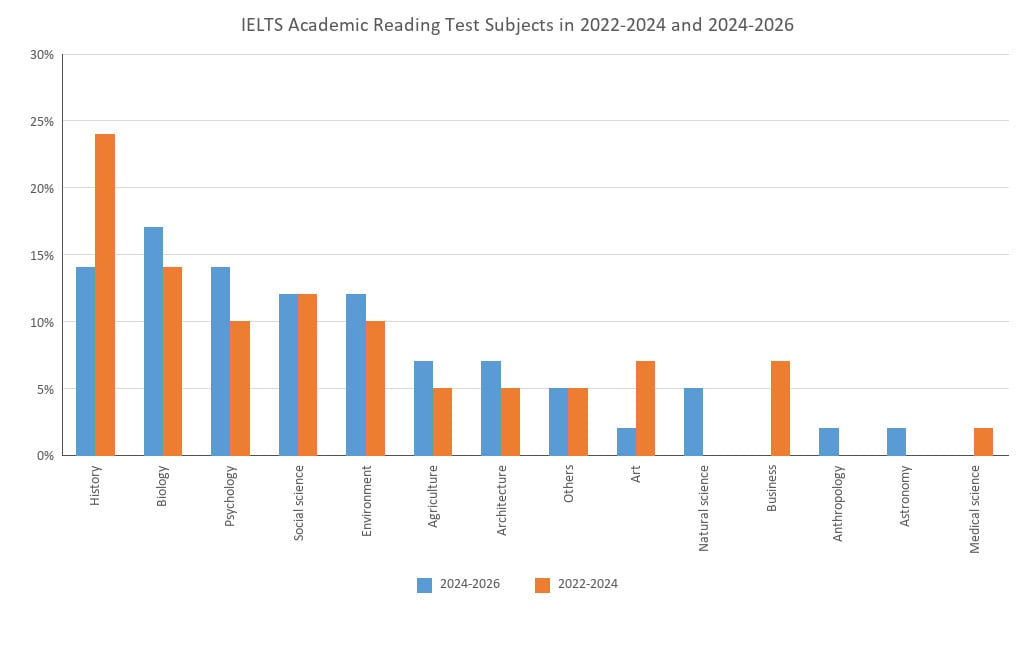
Datorită acestor tendințe, ne-am asigurat că testele noastre de practică IELTS Reading acoperă aceste subiecte. Am adăugat, de asemenea, exemple de citire din subiecte mai puțin folosite, pentru orice eventualitate. Este important să te pregătești pentru toate situațiile, pentru că niciodată nu știi ce subiect IELTS Reading vei primi.
Cum se calculează scorul tău IELTS Reading
Fiecare întrebare IELTS Reading valorează 1 punct, deci poți obține un scor „brut” de până la 40 de puncte. Apoi, scorul tău brut va fi convertit în band score. Tabelele de mai jos îți pot oferi o idee generală despre cum sunt convertite scorurile brute IELTS Reading în band score pentru fiecare test.
Scorul IELTS General Reading vs. scorul IELTS Academic Reading
| Scor brut: Academic | Band score: Academic | Scor brut: General | Band score: General |
|---|---|---|---|
| 39-40 | 9 | 40 | 9 |
| 37-38 | 8.5 | 39 | 8.5 |
| 35-36 | 8 | 37-38 | 8 |
| 33-34 | 7.5 | 36 | 7.5 |
| 30-32 | 7 | 34-35 | 7 |
| 27-29 | 6.5 | 32-33 | 6.5 |
| 23-26 | 6 | 30-31 | 6 |
| 19-22 | 5.5 | 27-29 | 5.5 |
| 15-18 | 5 | 23-26 | 5 |
| 13-14 | 4.5 | 19-22 | 4.5 |
| 10-12 | 4 | 15-18 | 4 |
| 8-9 | 3.5 | 12-14 | 3.5 |
| 6-7 | 3 | 9-11 | 3 |
| 4-5 | 2.5 | 6-8 | 2.5 |
| 1-3 | 2 | 1-5 | 2 |
Totuși, reține că fiecare versiune a testului IELTS Reading este ușor diferită, iar scorul necesar pentru a obține un anumit band se schimbă în funcție de cum s-au descurcat toți cei care au susținut testul în acea zi. Prin urmare, numărul de răspunsuri corecte necesare pentru a obține un band score va diferi ușor de la un test la altul, dar în general ar trebui să țintești să obții aproximativ 30 din 40 dacă vrei un band score de 7.
Un alt lucru pe care vrem să ți-l reamintim este că întrebările cele mai dificile și cele mai ușoare contează în mod egal la scorul tău final de reading, așa că asigură-te că nu pierzi puncte mai ușoare rămânând blocat la întrebări mai dificile. În continuare, vom acoperi câteva sfaturi și strategii IELTS Reading despre cum să răspunzi la fiecare întrebare a testului de reading.
Sfaturi IELTS Reading - Cum să răspunzi la cele 11 tipuri de întrebări de reading
Există 11 tipuri diferite de întrebări la testul de reading și toate necesită o strategie diferită.
Fiecare tip are un exemplu și răspunsul în ghidul tipuri de întrebări IELTS Reading.
- Tipul de întrebare 1 – Matching Information
- Tipul de întrebare 2 – Matching Headings
- Tipul de întrebare 3 – Matching Features
- Tipul de întrebare 4 – Identifying Information
- Tipul de întrebare 5 – Identifying Writer's Views/Claims
- Tipul de întrebare 6 – Multiple Choice
- Tipul de întrebare 7 – Matching Sentence Endings
- Tipul de întrebare 8 – Sentence Completion
- Tipul de întrebare 9 – Summary, Note, Table, Flow-chart Completion
- Tipul de întrebare 10 – Diagram Label Completion
- Tipul de întrebare 11 – Short Answer Questions
- Cum te ajută tendințele să te pregătești pentru testul IELTS Reading
Cum te ajută tendințele să te pregătești pentru testul IELTS Reading
Ce tipuri de întrebări de înțelegere a textului li se par cele mai dificile cursanților noștri
Cursanții BestMyTest au răspuns la un milion de întrebări din secțiunea de citire Academic și la 600.000 de întrebări din secțiunea de citire General Training în testele noastre de pregătire. Procentul arată cât de des s-a răspuns corect la fiecare tip de întrebare.
| Tip de întrebare | Academic | General Training |
|---|---|---|
| Asocierea informațiilor | 34% | 72% |
| Adevărat / Fals / Nu se precizează | 39% | 60% |
| Alegere multiplă | 43% | 48% |
| Asocierea caracteristicilor | 48% | 74% |
| Completarea propozițiilor | 49% | 75% |
| Asocierea titlurilor | 53% | 40% |
| Da / Nu / Nu se precizează | 55% | 57% |
| Completarea rezumatului | 59% | 46% |
| Răspuns scurt | 54% | 75% |
- În secțiunea de citire Academic, cele două tipuri cu cele mai slabe rezultate sunt asocierea informațiilor și Adevărat/Fals/Nu se precizează, ambele sub 40%. Ambele îți cer să găsești o idee parafrazată, nu un cuvânt-cheie identic.
- La General Training, situația se inversează: asocierea titlurilor este tipul cu cele mai slabe rezultate, la 40%, în timp ce întrebările care cer localizarea informațiilor primesc răspunsuri corecte în trei cazuri din patru, deoarece textele sunt mai scurte și formulate mai direct.
- Întrebările pe baza textelor Academic primesc răspunsuri corecte în proporție de 46% în medie, iar cele pe baza textelor General Training, de 59%. Jumătate dintre încercările de rezolvare a întrebărilor pe baza textelor Academic obțin un scor de 40% sau mai puțin.
- La cele 43.711 teste complete de pregătire pentru citire susținute de 38.534 de cursanți, scorul mediu a fost 5.4. 36% au atins scorul 6.0, iar 14% au atins scorul 7.0.
- Trebuie totuși să te pregătești pentru fiecare tip, dar, dacă ai puțin timp, tabelul îți arată unde merită cel mai mult să-l investești.
Cifrele provin din datele BestMyTest privind testele de pregătire și evaluările până în octombrie 2026. Procentele pe tipuri de întrebări reprezintă ratele răspunsurilor corecte pentru toate încercările; valorile pe criterii sunt scoruri acordate de tutori sau de IA, conform etichetelor. Ultima actualizare: 5 octombrie 2026.
În continuare vom parcurge sfaturile și strategiile IELTS Reading necesare pentru un scor ridicat la reading.
Sfaturi IELTS Reading - Cum să-ți îmbunătățești band score-ul de reading
Majoritatea studenților pică secțiunea de reading din următoarele trei motive
- Viteză mică de citire
- Vocabular slab
- Pregătire insuficientă sau deloc
Îmbunătățirea vitezei de citire
Mai întâi, hai să clarificăm un lucru evident. Pentru a-ți îmbunătăți viteza de citire, trebuie să exersezi efectiv cititul și să o faci constant.
Acum hai să ne uităm la o strategie mai puțin evidentă care te va ajuta să înțelegi sensul unor blocuri mari de propoziții. Începe prin a descompune propoziția. Fă asta căutând subiectul și verbul propoziției. Găsirea subiectului și a verbului te va ajuta să înțelegi sensul propoziției. Un motiv pentru care pasajele de academic reading sunt greu de înțeles este că leagă șiruri de idei pentru a forma propoziții lungi și compuse. Astfel se produc blocuri mari de propoziții care sunt mai greu de absorbit, așa că folosirea subiectului și a verbului ca ghid pentru a înțelege întregul bloc este un instrument grozav pe care îl poți folosi în timpul examenului tău IELTS Reading.
Îmbunătățirea vocabularului
Mulți cred că a răspunde la întrebările de reading este la fel de simplu ca a scana paragraful după cuvinte cheie și informații... Ei bine, din păcate, nu este chiar atât de simplu. Întrebările de reading sunt de obicei parafrazate, adică, cuvintele au fost schimbate pentru a folosi sinonime ale cuvintelor din pasajul IELTS Reading. Acest lucru este făcut pentru a crește dificultatea, altfel testul ar fi prea ușor. Din această cauză, trebuie să-ți îmbunătățești vocabularul pentru a cunoaște numeroasele sinonime ale unui cuvânt.
Pe măsură ce te pregătești pentru testul de reading și întâlnești un cuvânt pe care nu îl cunoști, fă-ți un obicei să te oprești și să-l cauți sau cel puțin să-l notezi și să-l cauți mai târziu. Este puțin obositor, dar este extrem de eficient. Obiectivul tău ar trebui să fie, dar nu limitat la, studierea a 15 - 20 de cuvinte academice noi în fiecare zi.
Să știi la ce tipuri de întrebări răspunsurile sunt/nu sunt în ordine
Este important să știi că, pentru unele tipuri de întrebări, răspunsurile sunt de obicei (aproape întotdeauna) în aceeași ordine ca pasajul IELTS Reading. Pentru alte tipuri de întrebări, răspunsurile sunt rareori în aceeași ordine ca pasajul de citire. Am alcătuit un tabel cu tipurile de întrebări care urmează această regulă și cele care nu. Te rugăm să reții.
| Răspunsurile sunt de obicei (aproape întotdeauna) în aceeași ordine ca pasajul | Răspunsurile sunt rareori în aceeași ordine ca pasajul. |
|---|---|
|
|
Găsirea celei mai bune strategii de reading pentru tine
Cea mai mare provocare cu care se confruntă majoritatea oamenilor la examenul IELTS Reading este să termine toate întrebările de citire înainte de a se scurge timpul. În secțiunea următoare, vei învăța trei strategii și va depinde de tine să-ți dai seama care ți se potrivește cel mai bine. Vei face asta folosind practicile noastre gratuite de reading.
3 strategii IELTS Reading
Strategia 1: Citirea întregului pasaj și apoi răspunsul la întrebări.
În primul rând, aceasta nu prea este o strategie. Este ceva ce fac oamenii când nu se pregătesc cum trebuie pentru examenul de reading. Totuși, am inclus-o ca strategie pentru că, tehnic vorbind, dacă poți reține informațiile din pasaj de la prima citire și ești capabil să răspunzi la întrebări, atunci nu vei avea nevoie de strategia 2.
Această strategie, dacă nu ai o memorie peste medie, este ineficientă. Vei ajunge să rămâi fără timp înainte de a putea răspunde la toate întrebările. Multe persoane fac această greșeală. Cu toate acestea, există unele întrebări care nu necesită mult efort și care vor beneficia de această strategie, cum ar fi: dacă întrebarea are un răspuns „Yes” sau „No”, vei putea scana rapid și găsi rapid răspunsul, dar nu există suficiente întrebări de acest tip, așa că nu este recomandabil să folosești această strategie decât dacă te poți descurca.
Strategia 2: Citește mai întâi întrebările, citește cu un obiectiv și ia notițe, apoi răspunde la întrebări cu înțelepciune
Aceasta este strategia noastră recomandată. Te va ajuta să obții un band score IELTS Reading mai ridicat. Gândește-te la asta ca la o hartă clară pentru cum să abordezi în general examenul:
Una dintre cele mai frecvente greșeli pe care le fac candidații când
abordează examenul de reading este să citească fiecare cuvânt din pasajele IELTS Reading. Deși poți
să te pregătești pentru examen citind pentru plăcere, „cititul orbește” (cititul fără un sens
despre ce vor întreba întrebările) nu îți va face niciun bine la examen. Dimpotrivă, îți va dăuna
șansele de a-ți gestiona eficient timpul și de a obține cel mai bun scor.
Motivul principal pentru a citi întrebările mai întâi este pentru că tipul întrebării poate determina ce
citești în pasaj sau cum îl citești. De exemplu, unele tipuri de întrebări vor cere
tehnica „skimming”, în timp ce altele pot cere tehnica „scanning”.
Este important să abordezi un set de întrebări de același tip.
Va trebui să stabilești cu ce tip de întrebare vrei să începi.
O strategie bună ar fi să începi cu tipul de întrebare mai ușor și să treci la tipuri de întrebări mai dificile mai târziu.
Cele mai ușoare tipuri de întrebări sunt cele la care petreci mai puțin timp citind.
De exemplu, tipul de întrebare Matching Heading este unul mai ușor, deoarece
trebuie doar să găsești headingul care descrie cel mai bine ideea principală a unui paragraf.
Un exemplu de tip de întrebare dificil ar fi Identifying Information. Pentru acest tip de întrebare,
va trebui să citești fiecare paragraf pentru a afla dacă fiecare afirmație este TRUE, FALSE sau NOT GIVEN conform pasajului.
Iată un tabel care listează nivelurile de dificultate pentru fiecare tip de întrebare. Folosește acest tabel ca referință când alegi ce tip
de întrebare vrei să abordezi primul.
| Nivel de dificultate | Tipul întrebării |
|---|---|
| Ușor | Match Headings Short answer |
| Mediu |
Matching Sentence Endings Matching Features Multiple choice Sentence Completion Diagram Label, Summary, Note, Table, Flow-Chart Completion |
| Dificil |
Match Information Identifying Information (TRUE/FALSE/NOT GIVEN) Identifying Viewer's claims (YES/NO/NOT GIVEN) |
După ce ai citit întrebările din textul IELTS, vei putea să citești cu un obiectiv. Ce înseamnă asta? De exemplu, dacă întâlnești o întrebare care include anul „1896”, poți nota când apare acest an în text, folosindu-l pentru a răspunde la întrebare mai târziu.
Există două tehnici de citire care te vor ajuta să rămâi pe drumul cel bun în citirea cu obiectiv. Prima, skimming, este cel mai bine definită ca cititul rapid pentru a obține „esența”, sau ideea generală, sau un pasaj. Cu această tehnică, nu te oprești pentru cuvinte nefamiliare sau nu cauți detalii specifice. A doua tehnică, scanning, este cel mai bine definită ca cititul pentru informații specifice. Cu această tehnică, nu citești pentru esența generală, ci mai degrabă pentru informații specifice. Observă cum fiecare dintre aceste tehnici are un obiectiv specific în minte. Acest lucru te va ajuta să găsești informațiile mai rapid.
Pe măsură ce citești cu un obiectiv, ar trebui, de asemenea, să faci notițe pe marginile pasajului, punând stele lângă informațiile cheie sau subliniind lucruri despre care crezi că te vor ajuta să răspunzi la diferitele întrebări. Asta îți va face mai ușor să verifici înapoi când ești întrebat anumite lucruri în întrebări. Alege orice sistem de luare a notițelor este potrivit pentru tine — doar asigură-te că faci asta!
După ce ai citit întrebările, ai citit pasajul și ai luat toate notițele potrivite, ar trebui să fi localizat partea din text unde trebuie să citești cu atenție. Apoi pur și simplu citește cu atenție și gândește critic pentru a determina răspunsul corect.
Strategia 3: Skimming, luare de notițe și tipuri de întrebări.
Aceasta este o altă strategie folosită de mulți candidați la IELTS. Te va ajuta să obții un scor mai ridicat la reading. Strategia constă în 4 pași:
- Fă skimming la fiecare paragraf pentru a obține ideea generală a fiecărui paragraf. Ideea principală a unui paragraf se găsește de obicei în primele câteva propoziții, așa că concentrează-te puțin mai mult pe acele propoziții. Propozițiile următoare pot fi parcurse rapid, subliniind nume/cuvinte/expresii care ies în evidență.
- După skimming la fiecare paragraf, scrie note scurte (2-5 cuvinte) lângă fiecare paragraf cu cea mai bună presupunere despre ideea principală a acelui paragraf.
- Apoi, răspunde la un set de întrebări de același tip.
- În final, răspunde la un set de întrebări eficient și corect.
Este important să nu petreci mai mult de 3-5 minute la pașii 1 și 2. Petrecerea unui timp prea mare cu acești pași va consuma prea mult timp și vei ajunge să rămâi fără el.
Pașii 1 și 2Obiectivul aici este să stabilești o metodă eficientă pentru găsirea răspunsurilor în pasaj. Notând ideea generală a fiecărui paragraf, vei ști ce paragraf conține răspunsul la fiecare întrebare. Asta îți va economisi mult timp pentru că, dacă nu ai fi notat-o, ar trebui probabil să faci skimming la fiecare paragraf pentru ideea generală a întrebării, iar apoi ar trebui să scanezi cu atenție paragraful pentru răspuns. Notând ideea principală a fiecărui paragraf, sari peste primul pas de skimming la fiecare paragraf și începi să scanezi pentru răspuns.
Pasul 3
După ce ai parcurs temeinic textul și ai notat câteva note, ești gata pentru pasul 3.
În acest pas, va trebui să stabilești cu ce tip de întrebare vrei să începi.
O strategie bună ar fi să începi cu tipul de întrebare mai ușor și să treci la tipuri de întrebări mai dificile mai târziu.
Cele mai ușoare tipuri de întrebări sunt cele la care petreci mai puțin timp citind.
De exemplu, tipul de întrebare Matching Heading este unul mai ușor, deoarece
trebuie doar să găsești headingul care descrie cel mai bine ideea principală a unui paragraf, deci tehnic ai nevoie doar de pașii 1 și 2 pentru a răspunde la acest tip de întrebare.
Un exemplu de tip de întrebare dificil ar fi Identifying Information. Pentru acest tip de întrebare,
va trebui să citești fiecare paragraf pentru a afla dacă fiecare afirmație este TRUE, FALSE sau NOT GIVEN conform pasajului.
Iată un tabel care listează nivelurile de dificultate pentru fiecare tip de întrebare. Folosește acest tabel ca referință când alegi ce tip de întrebare vrei să abordezi primul.
| Nivel de dificultate | Tipul întrebării |
|---|---|
| Ușor | Match Headings Short answer |
| Mediu |
Matching Sentence Endings Matching Features Multiple choice Sentence Completion Diagram Label, Summary, Note, Table, Flow-Chart Completion |
| Dificil |
Match Information Identifying Information (TRUE/FALSE/NOT GIVEN) Identifying Viewer's claims (YES/NO/NOT GIVEN) |
Acum că ai ales setul de întrebări la care vei răspunde primul, este timpul să răspunzi efectiv la ele :( Nu-ți face griji! Deși fiecare tip de întrebare este diferit, strategia de a răspunde corect la ele se aplică tuturor. Principiul de bază este simplu, doar urmează pașii de mai jos:
- Citește întrebarea cu atenție și identifică cuvintele cheie importante.
- Găsește paragraful care conține informațiile necesare pentru a răspunde la întrebare. (Sperăm că ai deja ideile generale notate pentru fiecare paragraf, așa că poți afla cu ușurință.)
- Scanează paragraful pentru cuvintele cheie importante (probabil sunt sinonime!) până când localizezi partea din text unde trebuie să citești cu atenție.
- În final, citește cu atenție și gândește critic pentru a determina răspunsul corect.
Descărcări gratuite PDF cu exemple IELTS Reading și răspunsuri
Mai jos sunt câteva exemple gratuite de reading de la British Council (creatorii examenului IELTS). Încearcă să răspunzi la întrebări și vezi cum te descurci!