В этом руководстве вы можете начать практику чтения IELTS, пройдя бесплатный тест IELTS Reading. Однако существует две версии теста: IELTS general reading и IELTS academic reading. Вы узнаете, какая версия подходит именно вам и как справляться с каждым типом вопросов по чтению, используя наши материалы IELTS Reading.
Получите бесплатный анализ баллов IELTS Reading и персональный учебный план после завершения бесплатного практического теста IELTS Reading.
| Тест IELTS General Reading | Тест IELTS Academic Reading |
|---|---|
Ниже представлен наш полный список вопросов IELTS Reading с ответами. Примечание: красные ссылки ведут к самым популярным и рекомендуемым вопросам по чтению, которые высоко оценили наши студенты, и вы можете практиковаться на них бесплатно в любое время.
Практические вопросы по чтению IELTS General 1 - 135
Short everyday texts, workplace texts, and one longer passage
Практические вопросы по чтению IELTS Academic 1 - 171
Three long passages from books, journals, magazines, and newspapers
Руководство по практическому тесту IELTS Reading
Оставшаяся часть этого руководства расскажет вам всё о тесте IELTS Reading как для General Training, так и для Academic версии. Вы узнаете, как рассчитывается балл по чтению, научитесь успешно отвечать на каждый тип вопросов по чтению, улучшите чтение с помощью текстовых материалов IELTS и освоите наши 3 стратегии для успеха в практике IELTS Reading.
Содержание
- Информация о тесте IELTS Reading
- Примеры вопросов IELTS Reading
- Информация о тесте IELTS General Reading
- Информация о тесте IELTS Academic Reading
- Калькулятор балла IELTS Reading
- Как отвечать на все 11 типов вопросов IELTS Reading
- Как повысить ваш band score по IELTS Reading
- 3 стратегии IELTS Reading
- Бесплатные PDF-материалы для практики IELTS Reading с ответами
Информация о тесте IELTS Reading
Тест IELTS Reading состоит из 3 разделов и содержит в общей сложности 40 вопросов. В целом вы будете отвечать на 12–14 вопросов в каждом разделе, и у вас есть ровно 60 минут, чтобы выполнить экзамен по чтению. Каждый раздел содержит 1–3 текста в зависимости от того, какой тест вы сдаёте. Если вы знаете, какой тест вы сдаёте, можете пропустить пару следующих разделов. Если нет, важно узнать о каждом тесте и о том, как к нему подготовиться.
Какой тест IELTS Reading подходит именно мне?
Тест IELTS Reading имеет две версии: IELTS General Reading и IELTS Academic Reading. Вы будете сдавать General Reading, если собираетесь эмигрировать или поступить в среднюю школу. Вы будете сдавать Academic Reading, если ищете возможности высшего образования. Самое большое различие между General Reading и Academic Reading — сложность текстов IELTS Reading. Как следует из названия, академический тест использует материалы IELTS Reading из академических источников, а general-тест — материалы из повседневной жизни.
Оба теста содержат 3 раздела, 40 вопросов и 11 типов вопросов. Вы можете прочитать о каждом разделе подробно для обоих тестов в таблице ниже.
| Раздел | Тест IELTS Academic Reading | Тест IELTS General Reading |
|---|---|---|
| 1 | Один длинный академический текст, который варьируется от описательного и фактического до дискурсивного и аналитического. Текст будет
взят из книг, журналов, изданий и газет. 12–14 вопросов |
Два или три коротких фактических текста.
Темы соответствуют повседневной жизни в англоязычной стране.
12–14 вопросов |
| 2 | Один длинный академический текст, который варьируется от описательного и фактического до дискурсивного и аналитического. Текст будет
взят из книг, журналов, изданий и газет. 10–14 вопросов |
Два коротких фактических текста, посвящённых вопросам, связанным с работой (например, поиск работы, политика компании, оплата и условия труда).
12–14 вопросов |
| 3 | Один длинный академический текст, который варьируется от описательного и фактического до дискурсивного и аналитического. Текст будет
взят из книг, журналов, изданий и газет. 12–14 вопросов |
Один более длинный, более сложный текст на тему общего интереса.
Тексты подлинные и взяты из объявлений, рекламы, корпоративных справочников, книг, журналов и газет.
12–14 вопросов |
Теперь, когда вы знакомы со структурой теста IELTS Reading, а также с IELTS General Reading и IELTS Academic Reading, пришло время узнать, что для вас лучше: бумажный тест или компьютерный.
Бумажный тест IELTS (PBT) против компьютерного теста IELTS (CBT)
В PBT вам выдадут буклет с вопросами (Question Booklet) и лист ответов (Answer Sheet). В буклете с вопросами вы увидите все вопросы, на которые вам нужно ответить. В лист ответов вы будете записывать свои окончательные ответы для оценивания. Вы можете ознакомиться с официальным PDF-листом ответов IELTS здесь
Внимание: в отличие от теста IELTS Listening, вам не дадут дополнительного времени на перенос ответов из буклета в лист ответов, поэтому обязательно записывайте ответы на вопросы IELTS Reading в лист ответов сразу же по мере того, как вы на них отвечаете.
В CBT вы будете отвечать на вопросы на компьютере. Тексты будут с левой стороны, а вопросы — с правой. Вы также сможете выделять текст и использовать функции управления, чтобы копировать и вставлять ответы. Для получения дополнительной информации о PBT и CBT ознакомьтесь с руководством по компьютерному тесту IELTS.
Вы можете в любое время потренироваться в любой версии с нашим бесплатным практическим тестом IELTS Reading. Ссылки на все наши материалы IELTS Reading вы найдёте в верхней части страницы.
Примеры вопросов IELTS Reading
Вот два бесплатных упражнения IELTS Academic Reading. Сначала решите каждое сами, затем откройте ответы, чтобы проверить. Руководство типы вопросов IELTS Reading объясняет каждый тип и даёт больше примеров.
Match each item with the period of time it best corresponds with
NB You may use any letter more than once.
- The Palaeolithic era
- The Bronze age
- The Iron age
- The Medieval era
- The Mesolithic age
- Roman times
-
spellcheck Answers1. FALSE
2. FALSE
3. NOT GIVEN
4. FALSE
5. TRUE
6. FALSE
7. FALSE
8. TRUE
9. FALSE
10. F
11. C
12. A
13. B
14. D
The climate in Britain has been arctic for the last several million years, punctuated by relatively warm timespans, or interglacials of thousands of years, one of which we are in as of now. Since the last glaciation, British woodland history is considered quite short in terms of geological time spans, and is also closely related to the human civilization developing.
At the peak of the last glaciation (100,000 – 12,000 BC), the majority of Britain would have had no trees. Birch and willow scrub may have grown along the lower reaches of the ice, with pine in some areas. It’s possible that remnants of pre-glacial flora were sheltered along the western bays of Great Britain and Ireland’s coasts, but as far as the southern parts of England, the ice kept any land barren. Information regarding the development of Britain’s flora following glaciation can be found by studying the deposits of pollen and seed in peat, as well as by the use of radiocarbon dating. Tundra and moorland followed the retreating ice, which lead to phases of different tree species spreading from the south. First came birch, aspen and sallow, followed by pine and hazel continuing to spread north as of 8500 BC, replacing birch to make it less commonly found for the next few thousand years. Oak and alder came after pine, then lime, elm, beech, and maple, all spreading northwards one after the other. From the moment lime arrived, in about 7300, to about 4500 BC the climate remained stable for a length of time known as the Atlantic Period, a time in which numerous species grew to form a series of wildwood or wilderness types.
What did the wilderness or wildwood look like, before man started interfering with it? One theory holds that Britain and Western Europe in Palaeolithic times was covered from coast to coast in a wildwood of continuous trees. However, a modern theory proposed by Francis Vera holds that Western Europe wilderness was a combination of grassland, scrub, and clusters or groves of trees. It was not a dense, impassable wildwood, but instead, an area similar to a park, kept up by wild herbivores eating the plants and grass. Throughout earlier interglacial periods, this may also have been the case in Britain, as creatures of the Palaeolithic era needed to roam large areas of grassland to survive. A variety of grassland plants continued to live there in the last interglacial, as according to pollen records. However, since the last glaciation, the bison, elk and other large herbivores which persisted on mainland Europe were extinct in Britain, so Vera’s theory may not apply so well to Britain.
Meanwhile, throughout the period since it’s spread northwards after the last glaciation, the sustained growth of oak in Britain demonstrates that the wildwood was not as continual as once believed. Oak is a pioneer species, which requires vacant space to generate more of itself. Grazing animals are also present to keep areas open, so Oak regenerates in the thorny brush as a protective measure from their grazing. Archaeological evidence indicates that red deer, who graze on grass as well as browse from trees, were essential to the economy in Mesolithic Britain, with people utilizing them for meat, skins, antlers and bones.
As the Mesolithic (10,000-3000 BC) era ended, evidence of the beginnings of agriculture emerges. Agricultural weeds, such as plantain and stinging nettle, were also increasing in number. Nearly all the wildwood was cut down as the population increased rapidly. However, the falling elm population around 4,000 BC all across Europe has been attributed not to the clearing of trees, but to what’s referred to as Elm disease.
Throughout the Bronze Age (2400-750 BC), people were cutting down trees more than ever before, until the prevalence of the practice “coppicing” peaked, likely at some point during the early Iron Age. Oliver Rackham (1990) theorizes that nearly 50% of land throughout England was no longer wildwood by 500 BC. The regrowth from a stump grows more readily than the original tree, and Neolithic man had discovered this practice, known as coppicing. Much of the remaining woods were maintained by way of this method during the Bronze Age.
The Celtic peoples living in the Iron Age were able to master woodworking as an artform. Today, Celtic woodworking can be seen in houses, boats, wheels and other artifacts of the time. Coppicing as a means to manage woodland was of massive importance throughout two millennia that followed. Buildings, roads, fences, carts, and the fuel for heating, cooking, metalworking and pottery were all made possible due to wood materials gained from the vital practice of coppicing.
A clear divide has existed between wooded and non-wooded regions of Britain since the time of the Romans. As evidenced by The Domesday Book (1086), all the wood in England had an economic value and was the property of either an individual or community owner. Woods were the territories, or ‘exclaves’ of communities who lived some miles away. Even though it had to be transported over long distances, the materials which woodlands produced were of obvious value, and their ownership was long before established. Merely around 15% of land in England was represented by woodland or wood- pasture in the year 1086.
English woodlands produced mostly underwood used as fuel along with other things, with small oaks being used to construct buildings. The average wood-framed houses of the Medieval era mostly used oaks shorter than 18” in diameter. Longer pieces of timber were hard to come by, and kept only for elaborate buildings intended for the Church. Imported boards of thin oak or wainscot from Central Europe were brought in for the purpose of domestic building. Woodland cover was as low as 15% in 1086, and continued to decline from as a result of an ever- growing population to 10% by 1350. This stopped suddenly with the plague of the Black Death of 1349 wiping out some of the human population. Woods which had persisted up to 1350 mostly prospered over the next 500 years.
Match each description with the correct psychologist
NB You may use any letter more than once.
- Clark Hull
- Howard and Tracy Kendler
- Michael Cole and colleagues
- Simon Hewson
-
spellcheck Answers1. D
2. C
3. D
4. A
5. C
6. B
7. C
8. D
9. TRUE
10. FALSE
11. TRUE
12. FALSE
Could it be that the very essence of reasoning itself is found in the way we behave? Clark Hull, an acclaimed American psychologist, theorized that it was, describing that reasoning is achieved by the way two “behavior segments” are combined in new ways to achieve goals. Howard and Tracey Kendler, who were two of Hull’s followers, used Hull’s principle ideas to design a reasoning test for children. In this test, children needed to learn how to use a machine in a two-step process. The children learned each of the two steps individually, with the first being to correctly choose and press one of two buttons, and the second to place a marble into a small opening. If both steps were completed successfully, a toy would be released as rewards to the children.
From this test, the Kendlers learned that although the children were able to learn each step, they were not able to “integrate” the two tasks without intervention. In other words, the children could not successfully perform the first step, pushing the button, and then proceed to the second step, inserting the marble into the hole, by themselves. This failure to independently integrate the steps led the Kendlers to believe that children of this age were not able to use deductive reasoning.
According the the work of psychologist and professor Michael Cole and his associates, some adults from specific African tribes are also unable to successfully complete the Kendlers' two-step test of deductive reasoning. However, this finding remains questionable in light of the findings of a similar test to the Kenders’, which revealed that the African tribes people were, in fact, able to complete the test.
In this test, Cole substituted a locked box for the machine with the buttons, and then used two matchboxes of different colors. One of the matchboxes held a key for the locked box. Just like with the Kendlers’ test, Cole’s test also involved two behavior segments, these being to first open the right match-box to get the key, and second to use the key to open the box. However, Cole’s test differs quite a bit psychologically. Instead of subjects being presented with a strange machine, they are given familiar objects in a simpler context. Cole found the difficulty of 'integration' was greatly reduced here.
It seems that the same truth which Cole discovered can be extended to explain the deductive reasoning skills of young children. Psychologist Simon Hewson believes that perhaps the task’s difficulty is not in inferential processes themselves, but is instead tied to confusing features of the test apparatus, such as the button machine, as well as the context of the procedure being tested. When these factors are adjusted in order to prevent the inferential nature of the problem being affected, five-year-old children are able to successfully complete these tests as well as college students did in the Kendlers' test.
Hewson made two essential changes to the test in order to build on this idea. First, he replaced the button-pressing mechanism with drawers that a child could slide open and shut. This removed confusion on what to do with the original button apparatus from the first stage of training. Secondly, Hewson made sure that children understood that there was nothing special or magical about the marble which was used to successfully complete the second step of the task and get the reward.
This is important because a child cannot easily comprehend a mechanism in which a marble put into a hole can open a little door. It would then be safe to say that the child will not assume that different marbles of identical size could be used the same way. But, to solve the problem, this assumption must be made. Hewson clearly demonstrated the functional equivalence of different marbles to the children by playing a 'swapping game.” Hewson's two modifications to the experiment led to a rise in success rates from 30 percent to 90 percent for five-year old children and from 35 percent to 72.5 per cent for four-year-olds. Strangely enough for three-year olds, Hewson’s changes did not lead to any improvement, and instead there was a slight drop in performance from the change. Hewson's experiments showed that children faced with the Kendler apparatus experienced difficulty not related to reasoning, but to the nature of the tasks themselves, and that difficulty cannot be taken as proof that they are incapable of deductive reasoning.
Тест IELTS General Reading
В general-тесте тексты IELTS Reading взяты из книг, журналов, газет, объявлений, рекламы, корпоративных справочников и руководств — материалов, с которыми вы сталкивались бы ежедневно в англоязычной среде. Как и в академическом тесте по чтению, здесь 3 раздела, однако в тесте IELTS General Reading каждый раздел немного отличается от другого.
Вводное видео по IELTS General Reading
-
Section 1: содержит два или три коротких текста или несколько более коротких текстов
Этот раздел называется Social Survival, и он содержит тексты, связанные с базовым лингвистическим выживанием в англоязычной среде, с заданиями главным образом о получении и предоставлении общей фактической информации, например объявления, реклама и расписания. -
Section 2: состоит из двух текстов
Этот раздел называется Workplace Survival и сосредоточен на контексте рабочего места, например описаниях должностей, контрактах и материалах по развитию персонала и обучению. -
Section 3: один длинный текст
Этот раздел называется General Reading и предполагает чтение более развёрнутой прозы со сложной структурой. Акцент сделан на описательные и инструктивные тексты, а не на аргументативные.
Надеемся, вы не чувствуете себя слишком ошеломлёнными. Тест по чтению не такой сложный, как кажется. Если вы будете следовать нашим советам по IELTS Reading и использовать наши бесплатные практические вопросы IELTS Reading, вы будете готовы справиться с любым текстом и достичь желаемого балла по IELTS Reading. Кстати, академический тест по чтению оценивается немного иначе, чем general-тест по чтению. Далее мы рассмотрим band score по чтению и то, как они рассчитываются.
Тест IELTS Academic Reading
В академическом тесте тексты IELTS Reading взяты из книг, журналов, изданий и газет из академических источников, которые подошли бы для студентов вузов. Каждый текст длинный, около 6–10 абзацев, может быть написан в различных стилях, таких как повествовательный или описательный, и охватывает широкий спектр академических тем, таких как антропология, история, наука, биология, искусство, образование, лингвистика и т. д. Тексты иногда содержат технические термины или даже визуальные материалы, такие как диаграммы и графики. Вы можете отрабатывать эти темы и не только с нашими практическими вопросами IELTS Reading.
Вводное видео по IELTS Academic Reading
Какие академические темы чаще всего встречаются в официальном тесте IELTS Academic Reading?
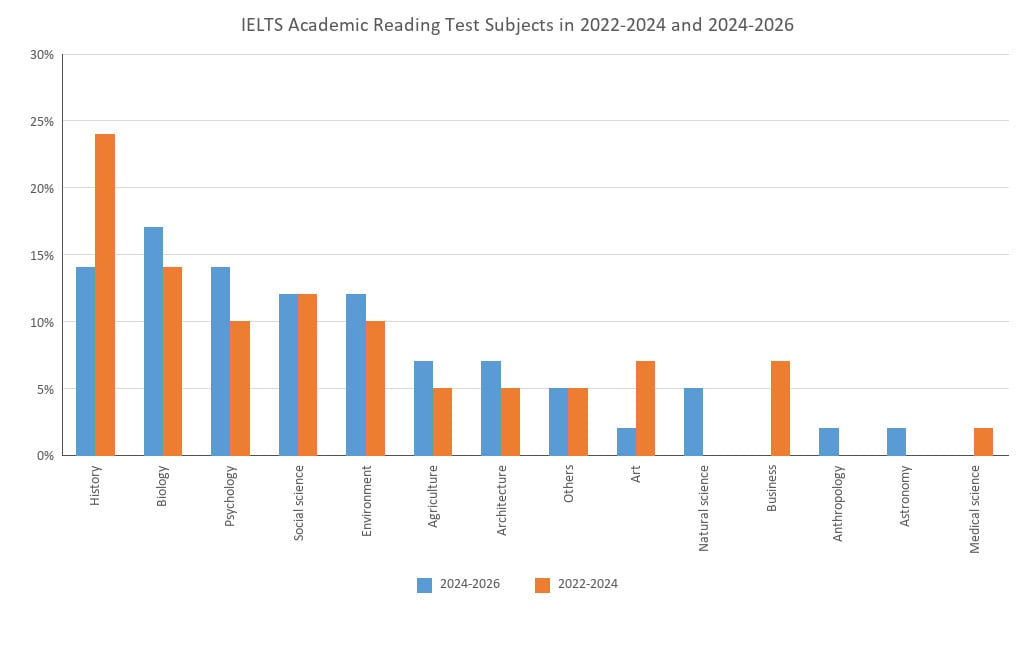
В 2022-2024 и 2024-2026 годах самой распространённой темой академического чтения была история. Далее шла биология, затем психология и общественные науки, включая культуру, образование, лингвистику и социологию.
Диаграмма ниже показывает различные предметы, проверявшиеся в академических тестах IELTS Reading в 2022-2024 и 2024-2026 годах.
Из-за этих тенденций мы позаботились о том, чтобы наши практические тесты IELTS Reading охватывали эти темы. Мы также добавили образцы чтения по менее распространённым темам — на всякий случай. Важно готовиться ко всем ситуациям, потому что вы никогда не знаете, какая тема IELTS Reading вам попадётся.
Как рассчитывается ваш балл IELTS Reading
Каждый вопрос IELTS Reading стоит 1 балл, поэтому вы можете получить «сырой» балл до 40 очков. Затем ваш сырой балл будет преобразован в band score. Таблицы ниже дадут вам общее представление о том, как сырые баллы IELTS Reading преобразуются в band score для каждого теста.
Балл IELTS General Reading против балла IELTS Academic Reading
| Сырые баллы: Academic | Band score: Academic | Сырые баллы: General | Band score: General |
|---|---|---|---|
| 39-40 | 9 | 40 | 9 |
| 37-38 | 8.5 | 39 | 8.5 |
| 35-36 | 8 | 37-38 | 8 |
| 33-34 | 7.5 | 36 | 7.5 |
| 30-32 | 7 | 34-35 | 7 |
| 27-29 | 6.5 | 32-33 | 6.5 |
| 23-26 | 6 | 30-31 | 6 |
| 19-22 | 5.5 | 27-29 | 5.5 |
| 15-18 | 5 | 23-26 | 5 |
| 13-14 | 4.5 | 19-22 | 4.5 |
| 10-12 | 4 | 15-18 | 4 |
| 8-9 | 3.5 | 12-14 | 3.5 |
| 6-7 | 3 | 9-11 | 3 |
| 4-5 | 2.5 | 6-8 | 2.5 |
| 1-3 | 2 | 1-5 | 2 |
Однако имейте в виду, что каждая версия теста IELTS Reading немного отличается, и балл, необходимый для достижения определённого band score, меняется в зависимости от того, как все, кто сдавал этот тест, справились в этот конкретный день. Поэтому количество правильных ответов, необходимое для получения определённого band score, будет немного отличаться от теста к тесту, но в целом вам следует стремиться получить около 30 из 40, если вы хотите получить band score 7.
Ещё одна вещь, которую мы хотим напомнить вам, заключается в том, что самые сложные и самые лёгкие вопросы одинаково учитываются в вашем итоговом балле по чтению, поэтому убедитесь, что вы не теряете лёгкие баллы, застревая на более сложных вопросах. Далее мы рассмотрим советы и стратегии IELTS Reading о том, как отвечать на каждый тип вопроса теста по чтению.
Советы IELTS Reading — как отвечать на 11 типов вопросов по чтению
В тесте по чтению есть 11 различных типов вопросов, и каждый из них требует особой стратегии.
У каждого типа есть пример и ответ в руководстве типы вопросов IELTS Reading.
- Тип вопроса 1 — Matching Information
- Тип вопроса 2 — Matching Headings
- Тип вопроса 3 — Matching Features
- Тип вопроса 4 — Identifying Information
- Тип вопроса 5 — Identifying Writer's Views/claims
- Тип вопроса 6 — Multiple Choice
- Тип вопроса 7 — Matching Sentence Endings
- Тип вопроса 8 — Sentence Completion
- Тип вопроса 9 — Summary, Note, Table, Flow-chart Completion
- Тип вопроса 10 — Diagram Label Completion
- Тип вопроса 11 — Short Answer Questions
- Как тенденции помогают вам подготовиться к тесту IELTS Reading
Как тенденции помогают вам подготовиться к тесту IELTS Reading
Какие типы заданий по чтению наши учащиеся считают самыми сложными
Учащиеся BestMyTest ответили на один миллион вопросов академического модуля чтения и 600 000 вопросов общего модуля чтения в наших тренировочных тестах. Процент показывает, как часто учащиеся правильно отвечали на вопросы каждого типа.
| Тип задания | Академический модуль | Общий модуль |
|---|---|---|
| Сопоставление информации (Matching information) | 34% | 72% |
| Верно / Неверно / Не указано (True / False / Not Given) | 39% | 60% |
| Выбор ответа из нескольких вариантов (Multiple choice) | 43% | 48% |
| Сопоставление характеристик (Matching features) | 48% | 74% |
| Заполнение пропусков в предложениях (Sentence completion) | 49% | 75% |
| Подбор заголовков (Matching headings) | 53% | 40% |
| Да / Нет / Не указано (Yes / No / Not Given) | 55% | 57% |
| Заполнение пропусков в кратком изложении (Summary completion) | 59% | 46% |
| Краткий ответ (Short answer) | 54% | 75% |
- В академическом модуле чтения самые низкие результаты показывают два типа заданий: сопоставление информации и «Верно / Неверно / Не указано» — в обоих случаях менее 40%. Оба требуют найти перефразированную мысль, а не совпадающее ключевое слово.
- В общем модуле картина обратная: самые низкие результаты у подбора заголовков — 40%, тогда как задания на поиск информации выполняются правильно в трёх случаях из четырёх, поскольку тексты короче, а формулировки более прямые.
- На вопросы к текстам академического модуля в среднем отвечают правильно в 46% случаев, а к текстам общего модуля — в 59%. В половине попыток выполнения заданий к текстам академического модуля доля правильных ответов составляет 40% или меньше.
- По результатам 43 711 полных тренировочных тестов по чтению, пройденных 38 534 учащимися, средний балл составил 5.4. 36% достигли балла 6.0, а 14% — балла 7.0.
- Вам всё равно нужно готовиться к каждому типу заданий, но если времени мало, таблица подскажет, на что его потратить с наибольшей пользой.
Показатели основаны на данных тренировочных тестов и проверок BestMyTest по октябрь 2026 года. Проценты по типам заданий — это доля правильных ответов среди всех попыток; показатели по критериям — это оценки преподавателя или ИИ, как указано в подписях. Последнее обновление: 5 октября 2026 года.
Далее мы рассмотрим советы и стратегии IELTS Reading, необходимые для высокого балла по чтению.
Советы IELTS Reading — как повысить ваш band score по чтению
Большинство студентов проваливают раздел по чтению по следующим трём причинам
- Низкая скорость чтения
- Скудный словарный запас
- Слабая подготовка или её отсутствие
Повышение скорости чтения
Сначала очевидное. Чтобы повысить скорость чтения, нужно действительно практиковаться в чтении и делать это последовательно.
Теперь рассмотрим менее очевидную стратегию, которая поможет вам понимать смысл больших фрагментов предложений. Начните с разбора предложения. Сделайте это, ища в предложении подлежащее и сказуемое. Нахождение подлежащего и сказуемого поможет вам понять смысл предложения. Одна из причин, по которым академические тексты для чтения могут быть трудны для понимания, заключается в том, что они объединяют цепочки идей в длинные сложные предложения. Это создаёт большие куски предложений, которые сложнее усвоить, поэтому использование подлежащего и сказуемого как ориентира для понимания всего фрагмента — отличный инструмент, который вы можете использовать во время вашего экзамена IELTS Reading.
Расширение словарного запаса
Многие думают, что отвечать на вопросы по чтению так же просто, как просканировать абзац в поисках ключевых слов и информации... Что ж, к сожалению, всё не так просто. Вопросы по чтению обычно перефразированы, то есть слова заменены синонимами слов из текста IELTS Reading. Это сделано для повышения сложности, иначе тест был бы слишком лёгким. Из-за этого вы должны расширять словарный запас, чтобы знать множество разных синонимов одного слова.
Готовясь к тесту по чтению и встречая незнакомое слово, возьмите за привычку либо останавливаться и искать его, либо хотя бы записывать и искать позже. Это немного утомительно, но крайне эффективно. Ваша цель должна быть, но не ограничиваться, изучением 15–20 новых академических слов в день.
Знание того, в каких типах вопросов ответы идут по порядку, а в каких — нет
Важно знать, что для некоторых типов вопросов ответы обычно (почти всегда) идут в том же порядке, что и текст IELTS Reading. Для других типов вопросов ответы редко когда идут в том же порядке, что и текст. Мы составили таблицу для типов вопросов, в которых это так, и тех, в которых это не так. Имейте это в виду.
| Ответы обычно (почти всегда) идут в том же порядке, что и текст | Ответы редко когда идут в том же порядке, что и текст. |
|---|---|
|
|
Поиск лучшей стратегии чтения для вас
Самая большая трудность, с которой сталкивается большинство людей на экзамене IELTS Reading, — это успеть выполнить все вопросы по чтению до того, как закончится время. В следующем разделе вы узнаете три стратегии, и вам предстоит самостоятельно определить, какая из них вам больше всего подходит. Сделать это вы сможете с помощью наших бесплатных практических тестов по чтению.
3 стратегии IELTS Reading
Стратегия 1: Прочитать весь текст, а затем отвечать на вопросы.
Во-первых, это не столько стратегия. Это то, что делают люди, когда они не подготовились должным образом к экзамену по чтению. Однако мы включили её как стратегию, потому что технически, если вы можете удерживать в памяти информацию из текста с первого прочтения и способны отвечать на вопросы, тогда вам не нужна стратегия 2.
Эта стратегия, если у вас не лучше среднего памяти, неэффективна. В итоге у вас закончится время до того, как вы сможете ответить на все вопросы. Многие совершают эту ошибку. Однако есть некоторые вопросы, которые не требуют больших усилий и выиграют от этой стратегии: например, если вопрос с ответом «Yes» или «No», вы сможете быстро прокрутить текст и быстро найти ответ, но таких типов вопросов недостаточно, поэтому не рекомендуется использовать эту стратегию, если вы не справляетесь.
Стратегия 2: Сначала читайте вопросы, читайте с целью и делайте заметки, а затем отвечайте на вопросы с умом
Это наша рекомендуемая стратегия. Она поможет вам получить более высокий балл по IELTS Reading. Считайте это ясной картой того, как в целом подходить к экзамену:
Одна из самых распространённых ошибок, которые кандидаты совершают при
подходе к экзамену по чтению, — чтение каждого слова текстов IELTS Reading. Хотя вы можете
готовиться к экзамену, читая ради удовольствия, «слепое чтение» (чтение без какого-либо понимания того,
что будут спрашивать вопросы) не пойдёт вам на пользу на экзамене. Наоборот, оно повредит вашим
шансам эффективно распределять время и получить лучший балл.
Главная причина читать вопросы первыми заключается в том, что тип вопроса может определить, что
вы будете читать в тексте или как вы это будете читать. Например, для некоторых типов вопросов потребуется
техника «skimming», а для других — техника «scanning».
Важно браться за набор вопросов одного типа.
Вам нужно будет определить, с каким типом вопросов вы хотите начать.
Хорошая стратегия — начать с более лёгкого типа вопросов и переходить к более сложным позже.
Самые лёгкие типы вопросов — это те, на которые вы тратите меньше времени на чтение.
Например, тип Matching Heading легче, потому что
вам нужно только найти заголовок, который лучше всего описывает основную идею абзаца.
Примером сложного типа вопросов будет Identifying Information. Для этого типа
вам нужно прочитать каждый абзац, чтобы выяснить, является ли каждое утверждение TRUE, FALSE или NOT GIVEN согласно тексту.
Вот таблица, которая перечисляет уровни сложности для каждого типа вопросов. Используйте эту таблицу как ориентир при выборе того,
с каким типом вопросов начать.
| Уровень сложности | Тип вопроса |
|---|---|
| Лёгкий | Match Headings Short answer |
| Средний |
Matching Sentence Endings Matching Features Multiple choice Sentence Completion Diagram Label, Summary, Note, Table, Flow-Chart Completion |
| Сложный |
Match Information Identifying Information (TRUE/FALSE/NOT GIVEN) Identifying Viewer's claims (YES/NO/NOT GIVEN) |
После того как вы прочитали вопросы из текста IELTS, вы сможете читать с целью. Что это значит? Например, если вы встретите вопрос, который включает год «1896», вы можете отметить, где этот год встречается в тексте, чтобы использовать его для ответа на вопрос позже.
Существует два метода чтения, которые помогут вам оставаться на верном пути при чтении с целью. Первый, skimming, лучше всего определяется как быстрое чтение для получения «сути» или общей идеи текста. С этой техникой вы не останавливаетесь на незнакомых словах и не ищете конкретные детали. Вторая техника, scanning, лучше всего определяется как чтение для получения конкретной информации. С этой техникой вы не читаете для общей сути, а скорее для конкретной информации. Заметьте, как у каждой из этих техник есть конкретная цель. Это поможет вам быстрее находить информацию.
По мере того как вы читаете с целью, вам также следует делать заметки на полях текста, ставя звёздочки рядом с ключевой информацией или подчёркивая то, что вы считаете полезным для ответа на различные вопросы. Это облегчит вам возврат к нужному месту, когда вас спросят что-то конкретное в вопросах. Выберите ту систему заметок, которая подходит именно вам, — главное, делайте их!
После того как вы прочитали вопросы, прочитали текст и сделали соответствующие заметки, вы должны были найти часть текста, где вам нужно читать внимательно. Затем просто читайте внимательно и думайте критически, чтобы определить правильный ответ.
Стратегия 3: Skimming, заметки и типы вопросов.
Это ещё одна стратегия, используемая многими сдающими IELTS. Она поможет вам получить более высокий балл по чтению. Стратегия состоит из 4 шагов:
- Просканируйте каждый абзац, чтобы получить общую идею каждого абзаца. Основная идея абзаца обычно содержится в первых нескольких предложениях, поэтому уделите этим предложениям немного больше внимания. Следующие предложения можно бегло просмотреть, подчёркивая выделяющиеся имена/слова/фразы.
- После беглого просмотра каждого абзаца напишите короткие заметки (2–5 слов) рядом с каждым абзацем со своим лучшим предположением о его основной идее.
- Затем отвечайте на набор вопросов одного типа.
- Наконец, эффективно и правильно отвечайте на набор вопросов.
Важно тратить не более 3–5 минут на шаги 1 и 2. Слишком много времени на этих шагах потратит впустую слишком много времени, и в итоге у вас оно закончится.
Шаги 1 и 2Цель здесь — выстроить эффективный метод поиска ответов в тексте. Записав общую идею каждого абзаца, вы будете знать, какой абзац содержит ответ на каждый вопрос. Это сэкономит вам много времени, потому что если бы вы этого не записали, вам, вероятно, пришлось бы пробежаться по каждому абзацу в поисках общей идеи вопроса, а затем тщательно сканировать абзац в поисках ответа. Записывая основную идею каждого абзаца, вы пропускаете первый шаг — пробегание по каждому абзацу — и сразу начинаете сканировать в поисках ответа.
Шаг 3
После того как вы тщательно пробежали глазами текст и записали несколько заметок, вы готовы к шагу 3.
На этом шаге вам нужно определить, с каким типом вопросов вы хотите начать.
Хорошая стратегия — начать с более лёгкого типа вопросов и переходить к более сложным позже.
Самые лёгкие типы вопросов — это те, на которые вы тратите меньше времени на чтение.
Например, тип Matching Heading легче, потому что
вам нужно только найти заголовок, который лучше всего описывает основную идею абзаца, поэтому технически вам нужны только шаги 1 и 2 для ответа на этот тип вопросов.
Примером сложного типа вопросов будет Identifying Information. Для этого типа
вам нужно прочитать каждый абзац, чтобы выяснить, является ли каждое утверждение TRUE, FALSE или NOT GIVEN согласно тексту.
Вот таблица, которая перечисляет уровни сложности для каждого типа вопросов. Используйте эту таблицу как ориентир при выборе того, с каким типом вопросов начать.
| Уровень сложности | Тип вопроса |
|---|---|
| Лёгкий | Match Headings Short answer |
| Средний |
Matching Sentence Endings Matching Features Multiple choice Sentence Completion Diagram Label, Summary, Note, Table, Flow-Chart Completion |
| Сложный |
Match Information Identifying Information (TRUE/FALSE/NOT GIVEN) Identifying Viewer's claims (YES/NO/NOT GIVEN) |
Теперь, когда вы определились, на какой набор вопросов будете отвечать первым, пора фактически на них ответить :( Не волнуйтесь! Хотя каждый тип вопросов отличается, стратегия правильного ответа применяется ко всем им. Основной принцип прост, просто следуйте шагам ниже:
- Внимательно прочитайте вопрос и определите важные ключевые слова.
- Найдите абзац, который содержит информацию, необходимую для ответа на вопрос. (Надеемся, у вас уже записаны общие идеи для каждого абзаца, чтобы вы могли легко это определить.)
- Просканируйте абзац в поисках важных ключевых слов (скорее всего, это синонимы!), пока не найдёте часть текста, где вам нужно читать внимательно.
- Наконец, читайте внимательно и думайте критически, чтобы определить правильный ответ.
Бесплатные PDF-загрузки образцов IELTS Reading с ответами
Ниже приведены некоторые бесплатные образцы по чтению от Британского совета (создателя экзамена IELTS). Попробуйте ответить на вопросы и посмотрите, как у вас получится!