В этом руководстве вы пройдёте бесплатный тест IELTS Listening и получите полный анализ результатов по аудированию IELTS. Вы будете готовиться с помощью более чем 125 практических тестов IELTS Listening, уроков, советов и видеообъяснений ответов. Следуя нашему персональному плану обучения, вы достигнете желаемого балла по аудированию IELTS.
Получите бесплатный анализ баллов IELTS Listening и персональный учебный план после завершения бесплатного практического теста IELTS Listening.
play_circle_outline Начать практический тест IELTS ListeningНиже представлен наш полный список вопросов IELTS Listening с ответами. Примечание: красные ссылки ведут к самым популярным и рекомендуемым вопросам по аудированию, которые высоко оценили наши студенты, и вы можете практиковаться на них бесплатно в любое время.
Руководство по практическому тесту IELTS Listening
Оставшаяся часть этого руководства расскажет вам всё о тесте IELTS Listening. Вы узнаете, как рассчитывается балл по аудированию, научитесь успешно отвечать на каждый тип заданий, чтобы повысить ваш band score по IELTS Listening, а также познакомитесь с нашим проверенным трёхшаговым методом онлайн-подготовки к тестам IELTS Listening.
Содержание
Информация о тесте IELTS Listening
Тест IELTS Listening разделён на 4 раздела. В каждом разделе вы будете слушать одного или нескольких носителей английского языка, после чего ответите примерно на 10 вопросов, связанных с услышанным. Весь раздел IELTS Listening содержит в общей сложности 40 вопросов. Как правило, аудиозаписи становятся сложнее по мере прохождения экзамена. Каждая запись звучит только один раз и включает различные акценты — британский, австралийский, новозеландский, американский и канадский.
- Section 1 — разговор между двумя людьми в повседневной социальной обстановке. Например, вы можете услышать разговор о подтверждении деталей бронирования или о размещении заказа по телефону.
- Section 2 — монолог в повседневной социальной обстановке. Например, вы можете услышать выступление о местных учреждениях, кого-то, дающего указания, или представляющего основную информацию о мероприятии.
- Section 3 — разговор между не более чем четырьмя людьми в учебном или образовательном контексте. Например, вы можете услышать обсуждение задания между университетским преподавателем и студентом, или нескольких студентов, обсуждающих что-то с занятия.
- Section 4 — монолог на академическую тему. Например, вы услышите университетскую лекцию профессора. Это самая сложная запись на экзамене Listening для большинства студентов.
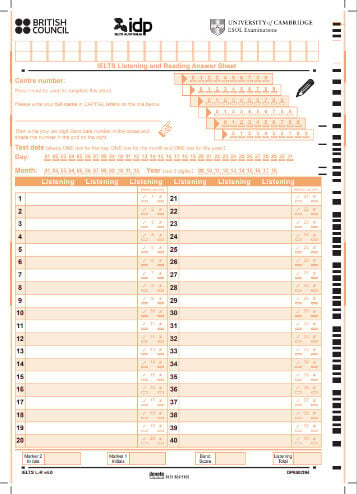
Тест IELTS Listening занимает около 40 минут. Вы потратите 30 минут на прослушивание записей и ответы на вопросы. Вам выдадут буклет с вопросами (Question Booklet) и лист ответов (Answer Sheet). В буклете с вопросами вы увидите все вопросы, на которые вам нужно ответить. В лист ответов вы будете записывать свои окончательные ответы для оценивания.
Вы можете ознакомиться с официальным PDF-листом ответов IELTS Listening здесь или просто посмотреть на изображение ниже :)
В конце раздела Listening вам даётся 10 минут на перенос ответов из буклета с вопросами в лист ответов.
ВАЖНО!
Орфографические и грамматические ошибки оцениваются как НЕПРАВИЛЬНЫЕ, поэтому используйте эти 10 минут, чтобы дважды проверить свою орфографию и грамматику.
Расчёт балла IELTS Listening
В разделе Listening каждый вопрос стоит 1 балл, поэтому вы можете набрать «сырой» балл до 40 очков. Затем ваш сырой балл будет преобразован в band score. Помните! Вы не теряете баллы за неправильные ответы. Таблица ниже даст вам общее представление о том, как сырые баллы преобразуются в band score.
| Сырые баллы | Band score |
|---|---|
| 39-40 | 9 |
| 37-38 | 8.5 |
| 35-36 | 8 |
| 32-34 | 7.5 |
| 30-31 | 7 |
| 26-29 | 6.5 |
| 23-25 | 6 |
| 18-22 | 5.5 |
| 16-17 | 5 |
| 13-15 | 4.5 |
| 11-12 | 4 |
Поскольку каждая версия IELTS немного отличается, сырой балл, необходимый для получения определённого band score, варьируется в зависимости от того, как все, кто сдавал тест в этот день, справились с заданиями. Таким образом, количество правильных ответов, необходимое для получения определённого band score, будет немного отличаться от теста к тесту, но в целом вам следует стремиться набрать около 30 из 40, если вы хотите получить band score 7.
Как отмечено выше, разделы становятся всё сложнее по мере прохождения теста IELTS Listening. Однако каждый вопрос стоит одинакового количества баллов. Поэтому убедитесь, что вы не теряете лёгкие баллы из-за того, что застряли на сложных вопросах.
Бесплатная загрузка примеров IELTS Listening в PDF с ответами
Вот несколько бесплатных примеров IELTS Listening в формате PDF с ответами от Британского совета (создателя экзамена IELTS). Попробуйте ответить на вопросы и посмотрите, как у вас получится!
- IELTS Listening Practice Test 1- questions (Online Examples)
- IELTS Listening Practice Test 1- answers (PDF)
- IELTS Listening Practice Test 1- answer sheet (PDF)
This is the first section of your IELTS Listening test. Listen to the audio and answer questions 1-10. You can download the audio transcripts from IELTS Listening Practice Test 1 - questions (PDF)

Questions 1-5
Complete the notes below.
Write no more than two words and/or a number for each answer.
| Questions: transport from Bayswater | |
|
Express train leaves at (1) Nearest station is (2) Number 706 bus goes to (3) Number (4) bus goes to station Earlier bus leaves at (5) | |
Complete the notes below.
Write no more than two words and/or a number for each answer.
| Transport | Cash fare | Card fare |
| Bus | (6) $ | $1.50 |
| Train (peak) | $10 | $10 |
|
Train (off-peak) – before 5pm or after (7) pm) |
$10 | (8) $ |
| (9) ferry | $4.50 | $3.55 |
| Tourist ferry ((10)) | $35 | – |
| Tourist ferry (whole day) | $65 | – |
-
spellcheck Ответы1. 9.30 (am)
2. Helendale
3. Central Street/St
4. (number/no./#) 792
5. 8.55 (am)
6. 1.80
7. 7.30
8. 7.15
9. commuter
10. afternoon
This is the second section of your Listening test. Listen to the audio and answer questions 11-20. You can download the audio transcripts from IELTS Listening Practice Test 1- questions (PDF)

Questions 11-14
Which counsellor should you see?
A Louise Bagshaw
B Tony Denby
C Naomi Flynn
Write the correct letter, A, B or C, next to questions 11–14.
11 if it is your first time seeing a counsellor
12 if you are unable to see a counsellor during normal office hours
13 if you do not have an appointment
14 if your concerns are related to anxiety
Questions 15–20
Complete the table below.
Write no more than two words for each answer.
| Workshop | Contact | Target group |
| Adjusting | what you need to succeed academically | (15) students |
| Getting Organised |
use time effectively, find (16) between study and leisure |
all students |
| Communicating | talking with staff, communicating across cultures |
all students, especially (17) |
| Anxiety | (18) , breathing techniques, meditation, etc. | students about to sit exams |
| (19) | staying on track for long periods | (20) students only |
-
spellcheck Ответы11. C
12. C
13. A
14. B
15. first/1st year
16. (right) balance
17. international/foreign (students)
18. relaxation
19. motivation
20. research/advanced
This is the third section of your Listening test. Listen to the audio and answer questions 21-30. You can download the audio transcripts from IELTS Listening Practice Test 1- questions (PDF)
Questions 21-30
Complete the notes below.
Write no more than three words for each answer.
| Questions |
| Novel: (21) |
| Protagonists: Mary Lennox; Colin Craven |
| Time period: Early in (22) |
|
Mary moves to UK – meets Colin who thinks he'll never be able to (23) . They become friends. |
| Point of view: “Omniscient�? – narrator knows all about characters' feelings, opinions and (24) |
| Audience: Good for children – story simple to follow |
Symbols (physical items that represent (25) ):
|
Motifs (patterns in the story):
|
Themes: Connections between
|
-
spellcheck Ответы21. The Secret Garden
22. (the) 20th/twentieth century
23. walk
24. motivations/motivation
25. abstract ideas
26. roses
27. dark(ness) to light(ness)
28. health
29. environment
30. human companionship
This is the fourth section of your Listening test. Listen to the audio and answer questions 31-40. You can download the audio transcripts from IELTS Listening Practice Test 1- questions (PDF)
Questions 31-35
Complete the table below.
Write one word only for each answer.
| Time Perspectives | ||
| Time Zone | Outlook | Features & Consequences |
| Past | Positive |
Remember good times, e.g. birthdays. Keep family records, photo albums, etc. |
| (31) | Focus on disappointments, failures, bad decisions. | |
| Present | Hedonistic | Live for (32) ; seek sensation; avoid pain. |
| Fatalistic | Life is governed by (33) , religious beliefs, social conditions. Life's path can't be changed. | |
| Future | (34) | Prefer work to play. Don't give in to temptation. |
| Fatalistic | Have a strong belief in life after death and importance of (35) in life. | |
Choose the correct letter, A, B or C.
- A. at school
- B. at birth
- C. while eating and drinking
- A. they need to be in control of the way they learn
- B. they play video games instead of doing school work
- C. they are not as intelligent as girls
- A. do not realise present actions can have negative future effects
- B. are unable to learn lessons from past mistakes
- C. know what could happen if they do something bad, but do it anyway
- A. working harder
- B. building relationships
- C. sharing family meals
- A become more virtuous
- B work together better
- C identify careless or ambitious people
-
spellcheck Ответы31. negative
32. pleasure
33. poverty
34. active
35. success
36. B
37. A
38. C
39. A
40. B
Как вы справились с приведёнными выше примерами вопросов IELTS Listening? Показались ли какие-либо вопросы сложными? Если да, вам будет полезно ближе познакомиться со всеми 6 типами заданий IELTS Listening. Чем лучше вы понимаете тип задания, тем меньше усилий вам потребуется, чтобы разобраться, что нужно сделать, и тем больше времени останется на поиск ответа.
6 типов заданий IELTS Listening
В тесте IELTS Listening встречается 6 различных типов вопросов. Важно отрабатывать каждый тип задания, чтобы научиться оптимально подходить к каждому из них для получения высокого балла по IELTS Listening. В следующих разделах вы узнаете обо всех 6 типах заданий IELTS Listening и попробуете решить пример вопроса для каждого из них.
Какие типы заданий по аудированию наши учащиеся считают самыми сложными
Вместо тенденции 2017 года приведём данные по 2.25 миллиона ответов учащихся BestMyTest на задания IELTS по аудированию. Процент показывает, как часто наши учащиеся правильно выполняли задания соответствующего типа.
| Тип задания | Правильные ответы |
|---|---|
| Заполнение пропусков в заметках (Note completion) | 33% |
| Заполнение таблицы (Table completion) | 34% |
| Завершение предложений (Sentence completion) | 45% |
| Краткий ответ (Short answer) | 48% |
| Выбор одного ответа (Multiple choice) | 50% |
| Выбор нескольких ответов (Multiple selection) | 51% |
| Подписи к плану, карте, схеме (Plan, map, diagram labelling) | 55% |
| Заполнение бланка (Form completion) | 73% |
| Сопоставление (Matching) | 85% |
- Именно в заданиях на заполнение пропусков теряются баллы. На задания по заполнению заметок и таблиц правильно отвечают лишь в одном случае из трёх, тогда как при заполнении бланка, где тот же навык применяется в более простой структуре, доля правильных ответов достигает 73%. Разница обусловлена правописанием, выбором формы слова и соблюдением ограничения по количеству слов в условиях нехватки времени, а не пониманием.
- По результатам 61 964 полных тренировочных тестов по аудированию, выполненных 55 296 учащимися, средний балл составил 5.5. В 41% тестов результат достиг 6.0 балла, а в 12% — 7.0 балла.
- В отдельных разделах аудирования треть попыток дала результат 40% или ниже, а 30% — 80% или выше. У большинства учащихся резко проседают один или два раздела, а не все разделы равномерно, поэтому отдельная отработка разделов 3 и 4 приносит пользу.
Показатели основаны на данных тренировочных тестов и проверок BestMyTest по октябрь 2026 года. Проценты по типам заданий отражают долю правильных ответов среди всех попыток; показатели по критериям — это оценки преподавателя или ИИ, как указано в подписях. Последнее обновление: 5 октября 2026 года.
Хотя каждый тип вопросов выглядит по-разному, базовый подход к каждому из них одинаков. Далее в этом материале мы покажем вам базовую стратегию для всех 6 типов вопросов. А теперь рассмотрим каждый тип задания подробно.
Тип задания 1 — Sentence Completion
Этот тип задания требует, чтобы вы дополнили предложение коротким ответом.
Предложение почти всегда будет перефразировкой того, что вы услышите в записи.
Иными словами, не ждите, что говорящий произнесёт предложение точно так, как оно написано в вопросе.
Вы должны очень внимательно читать инструкции. Например, если в инструкции указано NO MORE THAN TWO WORDS,
вас оштрафуют за написание более чем ДВУХ слов. Ответ может состоять из одного слова, но никогда не будет состоять более чем из двух.

Questions 27 – 30
Complete the sentences below.
Write NO MORE THAN TWO WORDS for each answer.
Studying with the Open University demanded a great deal of 27 _________
Studying and working at the same time improved Rachel's 28 _________ skills.
It was helpful that the course was structured in 29 _________
She enjoyed meeting other students at 30 _________
Лист ответов
| 27 | |
| 28 | |
| 29 | |
| 30 |
-
spellcheck Ответы27 motivation
28 time(-)management
29 modules
30 summer school(s)
Two friends, Rachel and Paul:, are discussing studying with the Open University. Rachel has already done a course at the university, but Paul: has not. The extract relating to these questions comes from the last part of the recording.
Paul: The other thing I wanted to ask you was, did you find it hard, studying with the Open University?
Rachel: You mean, because you're studying on your own, most of the time?
Paul: Mm.
Rachel: Well it took me a while to get used to it. I found I needed to maintain a high level of motivation, because it's so different from school. There's no-one saying, ‘Why haven't you written your assignment yet?' and that sort of thing.
Paul: Oh dear.
Rachel: You'll learn it, Paul. Another thing was that I got very good at time- management because I had to fit time for studying round a full-time job.
Paul: Well I'm hoping to change to working part-time, so that'll help.
Rachel: What makes it easier is that the degree is made up of modules, so you can take time off between them if you need to. It isn't like a traditional three-or four-year course, where you've got to do the whole thing of it in one go.
Paul: That's good, because I'd like to spend six months travelling next year.
Rachel: Huh, it's all right for some. Then even though you're mostly studying at home, remember you've got tutors to help you, and from time to time there are summer schools. They usually last a week. They're great, because you meet all the other people struggling with the same things as you. I've made some really good friends that way.
Paul: Sounds good. So how do I apply?
Тип задания 2 — Matching
В задании Matching вам нужно сопоставить пронумерованный список элементов из аудиотекста с набором вариантов на листе вопросов. Это задание требует, чтобы вы слушали в поисках детальной информации и распознавали отношения и связи между фактами в аудиотексте. Например, вам нужно определить разные типы гостиниц или гостевых домов. Важно проанализировать эти вопросы перед прослушиванием отрывка, чтобы понять категорию буквенных вариантов ответа.

Questions 21 - 25
What does Jack: tell his tutor about each of the following course options?
A. He'll definitely do it.
B. He may or may not do it.
C. He won't do it.
Write the correct letter, A, B or C next to questions 21- 25. You may choose any letter more than once.
21. Media Studies
22. Women and Power
23. Culture and Society
24. Identity and Popular Culture
25. Introduction to Cultural Theory
Лист ответов
| 21 | |
| 22 | |
| 23 | |
| 24 | |
| 25 |
-
spellcheck Ответы21. C
22. A
23. B
24. B
25. C
(A customer has been arranging with a shipping agent to send a large box overseas. This is the last part of the conversation.)
You will hear a Communication Studies student talking to his tutor about optional courses for the next semester.
Dr Ray: Come in. Oh hello Jack. Have a seat. Right ... you said you wanted to see me to talk about your options next semester?
Jack: That's right. We have to decide by the end of next week. Really, I'd like to do all five options but we have to choose two, don't we.
Dr Ray: Yes, but the choice depends on your major to some extent. You're majoring in Communication Studies, aren't you?
Jack: That's right.
Dr Ray: So for example the Media Studies Option will cover quite a lot of the same area you did in the core module on mass communications this semester - the development of the media through the last two series, in relation to political and social issues.
Jack: Mmm. Well that was interesting, but I've decided I'd rather do something completely new. There's a Women's Studies option, isn't there?
Dr Ray: Yes, 'Women and Power' – again it has a historical focus, it aims to contextualise women's studies by looking at the legal and social situation in the nineteenth and early twentieth centuries …
Jack: So it would be useful if I intended to specialise in women's studies ... but I'm not sure I do actually.
Dr Ray: Well, it might still be useful to give you an idea of the issues involved. It's taught by Dr Steed.
Jack: Oh, really? I'll sign up for that, then. What about the option on Culture and Society?
Dr Ray: That addresses the historical debate on the place of culture since the Industrial Revolution in Britain.
Jack: So a historical focus again ...
Dr Ray: Do I get the message you're not so keen on history?
Jack: Well, it's just we seem to have done quite a lot this semester … Listening sample task – Matching (example 1) anyway I'll think about that one.
Dr Ray: If you're interested in a course focusing on current issues there's the option on Identity and Popular Culture – that approaches the subject through things like contemporary film, adverts, soap operas and so on.
Jack: Oh? That sounds interesting. Can you tell me who runs it?
Dr Ray: Well, it's normally Dr Stevens but he's on sabbatical next semester, so I'm not sure who'll be running it. It should be decided by next week though.
Jack: Right, well I might wait until then to decide ... And the last option is Introduction to Cultural Theory, isn't it. I'm quite interested in that too – I was talking to one of the second year students, and she said it was really useful, it made a lot of things fall into place.
Dr Ray: Yes, but in fact in your major, you'll have covered a lot of that already in Communications 102, so that might be less useful than some of the others.
Jack: Oh, I'll forget about that one, then.
Dr Ray: Now while you're here, we could also discuss how you're getting on with your Core Module assignment ...
Тип задания 3 — Plan, Map, Diagram Labelling
В этом типе задания вам нужно подписать обозначения на плане (например, здания), карте (например, части города)
или схеме (например, какого-либо оборудования). Ответы обычно выбираются из списка на листе вопросов.
Этот тип заданий встречается во всех разделах, но чаще всего в Section 2.
В Section 2 вы услышите одного говорящего, рассказывающего о повседневной ситуации. Например,
вы можете услышать, как говорящий проводит экскурсию или описывает предлагаемое место инвесторам.

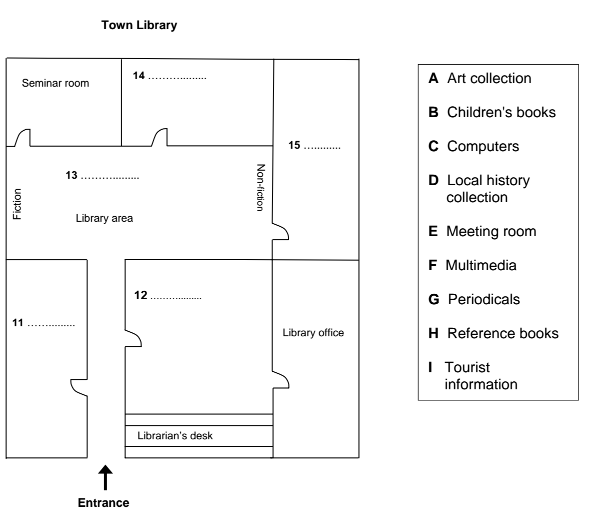
Question 11 - 15
Label the plan below.
Choose FIVE answers from the box and write the correct letters A-I next to questions 11-15.
Лист ответов
| 11 | |
| 12 | |
| 13 | |
| 14 | |
| 15 |
-
spellcheck Ответы11. H
12. G
13. D
14. B
15. F
You will hear the librarian of a new town library talking to a group of people who are visiting the library.
OK everyone. So here we are at the entrance to the town library. My name is Ann, and I'm the chief librarian here, and you'll usually find me at the desk just by the main entrance here. So I'd like to tell you a bit about the way the library is organised, and what you'll find where … and you should all have a plan in front of you. Well, as you see my desk is just on your right as you go in, and opposite this the first room on your left has an excellent collection of reference books and is also a place where people can read or study peacefully. Just beyond the librarian's desk on the right is a room where we have up to date periodicals such as newspapers and magazines and this room also has a photocopier in case you want to copy any of the articles. If you carry straight on you'll come into a large room and this is the main library area. There is fiction in the shelves on the left, and non-fiction materials on your right, and on the shelves on the far wall there is an excellent collection of books relating to local history. We're hoping to add a section on local tourist attractions too, later in the year. Through the far door in the library just past the fiction shelves is a seminar room, and that can be booked for meetings or talks, and next door to that is the children's library, which has a good collection of stories and picture books for the under elevens. Then there's a large room to the right of the library area – that's the multimedia collection, where you can borrow videos and DVDs and so on, and we also have CD-Roms you can borrow to use on your computer at home. It was originally the art collection but that's been moved to another building. And that's about it – oh, there's also the Library Office, on the left of the librarian's desk. OK, now does anyone have any questions?
Тип задания 4 — Form, Note, Table, Flow-chart, Summary Completion
В этом типе задания вам будут даны форма, набор заметок, таблица, краткое изложение или блок-схема, и вам нужно будет заполнить недостающую информацию на основе аудиотекста. Возможно, вам придётся выбирать ответы из списка на листе вопросов или определять недостающие слова из записи, не превышая ограничения по количеству слов, указанного в инструкциях.
- форма:
вопрос с формой — частый тип задания для Section 1. Вы будете заполнять форму, например анкету, бронирование или бланк заказа. Часто это будет телефонный разговор между двумя людьми. Один человек будет заказывать, бронировать или запрашивать информацию о чём-то, а другой ему помогает. - набор заметок:
вопрос с заметками — частый тип задания для Section 4. Вы услышите университетскую лекцию, после чего получите неполный конспект лекции. Вам нужно будет заполнить недостающие пункты на основе лекции. - таблица:
вопрос с таблицей часто используется для группировки вещей по таким признакам, как место, время и цена. Вам нужно будет заполнить недостающую информацию из таблицы. - блок-схема:
блок-схема может показывать процесс, план или последовательность прошлых событий. Вам нужно будет дополнить схему словами из записи или выбрав один из вариантов из списка с буквенными обозначениями. - краткое изложение:
в вопросе с кратким изложением вам будет представлен абзац, который суммирует аудиотекст, и вам нужно будет вставить слова, чтобы дополнить изложение на основе услышанного.
Вы должны очень внимательно читать инструкции. Например, если в инструкции указано «NO MORE THAN TWO WORDS», вас оштрафуют за написание более чем двух слов.

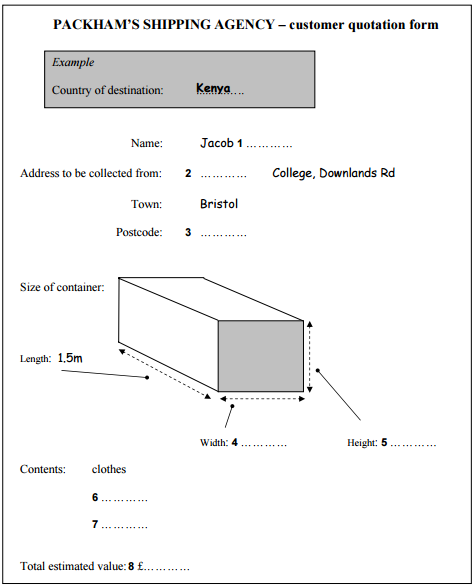
Question 1 - 8
Complete the form below
Write NO MORE THAN THREE WORDS AND/OR A NUMBER for each answer
Лист ответов
| 1 | |
| 2 | |
| 3 | |
| 4 | |
| 5 | |
| 6 | |
| 7 | |
| 8 |
-
spellcheck Ответы1. Mkere
2. Westall
3. BS8 9PU
4. 0.75 m/metre(s)/meter(s) (wide) / three(-)quarter(s) (of) (a) metre/meter (wide) / ¾ m (wide) / 75 cm(s) (wide)
5. 0.5 m/metre(s)/meter(s) (high/deep) / (a) half (a) metre/meter (high/deep) / ½ m (high/deep) / 50 cm(s) (high/deep)
6. & 7 in either order
(some) books (some) toys
8. 1,700
A: Good morning Packham's Shipping Agents. Can I help you?
B Oh yes, I'm ringing to make enquiries about sending a large box, a container, back home to Kenya from the UK.
A: Yes, of course. Would you like me to try and find some quotations for you?
B: Yes, that'd be great. Thank you.
A: Well first of all, I need a few details from you.
B: Fine.
A: Can I take your name?
B: It's Jacob Mkere.
A: Can you spell your surname, please?
B: Yes, it's M-K-E-R-E.
A: Is that ‘M' for mother?
B: Yes.
A: Thank you, and you say that you will be sending the box to Kenya?
B: That's right.
A: And where would you like the box picked up from?
B: From college, if possible.
A: Yes, of course. I'll take down the address now.
B: It's Westall College.
A: Is that W-E-S-T-A-L-L?
B: Yes, ... college.
A: Westall College. And where's that? Listening sample task – Form completion (to be used with IELTS Listening Recording 1)
B: It's Downlands Road, in Bristol.
A: Oh yes, I know it. And the postcode?
B: It's BS8 9PU.
A: Right ... and I need to know the size.
B: Yes, I've measured it carefully and it's 1.5m long ...
A: Right.
B: 0.75m wide ...
A: OK.
B: And it's 0.5m high or deep.
A: Great. So I'll calculate the volume in a moment and get some quotes for that. But first can you tell me, you know, very generally, what will be in the box?
B: Yes there's mostly clothes.
A: OK. [writing down]
B: And there's some books.
A: OK. Good. Um ... Anything else?
B: Yes, there's also some toys.
A: OK and what is the total value, do you think, of the contents?
B: Well the main costs are the clothes and the books – they'll be about £1500 but then the toys are about another two hundred – so I'd put down £1700.
Тип задания 5 — Multiple choice
В задании Multiple Choice есть вопрос, за которым следуют три возможных ответа, или начало предложения, за которым следуют три возможных способа его завершения.
Вы должны записывать на листе ответов БУКВЫ (A, B или C). Не записывайте слово(а) варианта ответа!
Иногда вам дают более длинный список возможных ответов и просят выбрать более одного.
В этом случае внимательно читайте вопрос и проверяйте, сколько ответов требуется.

Questions 9 – 10
Choose the correct letter, A, B or C.
- Economy
- Standard
- Premium
- port
- home
- depot
Лист ответов
| 9 | |
| 10 |
-
spellcheck Ответы9. C
10. A
(A customer has been arranging with a shipping agent to send a large box overseas. This is the last part of the conversation.)
A: OK right. Now obviously insurance is an important thing to consider and our companies are able to offer very good rates in a number of different all-inclusive packages.
B: Sorry, could you explain a bit more?
A: Yes, sorry, um. There's really three rates according to quality of insurance cover – there's the highest comprehensive cover which is Premium rate, then there's standard rate and then there's economy rate. That one will only cover the cost of the contents second hand.
B: Oh I've been stung before with economy insurance so I'll go for the highest.
A: Mh'hm and can I just check would you want home delivery or to a local depot or would you want to pick it up at the nearest port?
B: The port'd be fine – I've got transport that end.
A: Fine and will you be paying by credit card?
B: Can I pay by cheque?
Тип задания 6 — Short Answers
Вопросы с короткими ответами требуют, чтобы вы прочитали вопрос и затем написали короткий ответ, используя информацию из аудиотекста.
Вам, скорее всего, дадут ограничение, например «No more than two words».
Если вы напишете больше слов, чем указано в инструкциях, ваш ответ будет засчитан как неправильный.
Очень часто вам нужно будет найти подробную информацию, относящуюся к какой-то категории.
Например, вы можете получить такой вопрос:
What TWO factors can make social contact in a foreign country difficult?

Question 11 - 16
Answer the questions below
Write NO MORE THAN THREE WORDS AND/OR A NUMBER for each answer
What TWO factors can make social contact in a foreign country difficult?
- 11 ....................
- 12 ....................
Which types of community group does the speaker give examples of?
- theater
- 13 ....................
- 14 ....................
In which TWO places can information about community activities be found?
- 15 ....................
- 16 ....................
Лист ответов
| 11 | |
| 12 | |
| 13 | |
| 14 | |
| 15 | |
| 16 |
-
spellcheck Ответы11 & 12: (in either order) language, customs
13 & 14: (in either order) music, local history
15 & 16: (in either order) library/libraries, town hall
You will hear an extract from a talk given to a group who are going to stay in the UK. Good evening, and welcome to the British Council. My name is John Parker and I've been asked to talk to you briefly about certain aspects of life in the UK before you actually go there. So I'm going to talk first about the best ways of making social contacts there. Now you might be wondering why it should be necessary. After all, we meet people all the time. But when you're living in a foreign country it can be more difficult, not just because of the language, but because customs may be different. If you're going to work in the UK you will probably be living in private accommodation, so it won't be quite so easy to meet people. But there are still things that you can do to help yourself. First of all, you can get involved in activities in your local community, join a group of some kind. For example, you'll probably find that there are theatre groups who might be looking for actors, set designers and so on, or if you play an instrument you could join music groups in your area. Or if you like the idea of finding out about local history there'll be a group for that too. These are just examples. And the best places to get information about things like this are either the town hall or the public library. Libraries in the UK perform quite a broad range of functions nowadays – they're not just confined to lending books, although that's their main role of course.
3 шага для эффективной онлайн-подготовки к тесту IELTS Listening
Хотя каждый тип вопросов (заданий) IELTS Listening отличается, базовый подход к каждому из них одинаков. Вы можете справляться со всеми типами заданий, используя одну простую пошаговую стратегию. Вот три шага, которые мы рекомендуем использовать для подхода к вопросам Listening:
- Внимательно изучите вопросы, чтобы найти ключевую информацию
- Прогнозируйте возможные ответы перед прослушиванием
- Следите за записью, чтобы сопоставлять вопросы с содержанием по мере прослушивания
Шаг 1: Изучите вопросы
В разделе IELTS Listening вам даётся короткое время на подготовку (30–40 секунд) перед началом записи. Это ваша возможность взглянуть на вопросы, на которые вам предстоит ответить, — именно об этом и говорит первый шаг этой стратегии. Вместо того чтобы использовать это время на отдых или на проверку ответов, вы должны сосредоточиться на том, чтобы узнать как можно больше о предстоящих вопросах. Этот шаг важен, чтобы избежать ошибки, связанной с попыткой одновременно слушать диктора и впервые читать вопросы.
Когда начнётся ваше время на подготовку, в первую очередь максимально эффективно используйте его, изучая вопросы, чтобы узнать о них больше. Вот некоторая информация, которую вам следует искать при изучении каждого из вопросов IELTS Listening:
- Какой это тип вопроса?
- Как будет выглядеть ответ? (например: дата, число, имя)
- Какие самые важные фразы и слова, или ключевые слова, есть в вопросах?
Одним из примеров может быть тип Note Completion, например такой:
Complete the notes below.
Write NO MORE THAN THREE WORDS for each answer.
Сначала вы можете подчеркнуть некоторые ключевые слова в вопросе.
Two reasons for the new approach to pricing are changes in (27) ______ and (28) _________ programs.
В этом примере прослушивание ключевой фразы «two reasons», которую вы уже подчеркнули, позволяет
вам начать внимательно следить в нужный момент. Вот часть аудиотекста, в которой раскрывается ответ:
Mark: Well, there seem to be two basic reasons. Firstly, because the law has changed recently to allow companies to behave like this. In the past, they weren't allowed to change the prices of the tickets. And secondly, we now have computer programs that do the calculations so that prices can be changed very quickly and accurately.
Изучив вопросы, вы поняли бы, что «the law» и «computer» здесь являются правильными ответами на основе ключевых слов и понимания типа вопроса.
Шаг 2: Прогнозируйте возможные ответы
Второй шаг этой стратегии для успешного прохождения раздела IELTS Listening очень тесно связан с первым. Фактически, вы должны попытаться выполнить оба этих шага в течение одного и того же 20-секундного времени подготовки до начала записи. Хотя это может показаться сложной задачей за такое короткое время, помните, что эти шаги на самом деле связаны друг с другом.
Чтобы прогнозировать возможные ответы на вопросы Listening, вам сначала нужно завершить шаг один, внимательно изучив вопросы. На этом этапе вы должны знать, на какой тип вопроса вы смотрите, как будут выглядеть возможные ответы, а также какие ключевые слова помогут быстро найти ответы. Чтобы прогнозировать ответы, вы объедините всю эту информацию и сделаете предположение о том, какой ответ ожидаете услышать.
Давайте вернёмся к тому же примеру вопроса Note Completion, что выше.
Two reasons for the new approach to pricing are changes in (27) and (28) programs.
Просто посмотрев на грамматику этого предложения, можно определить, какой частью речи будет ответ. В данном случае предлог «in» предшествует обоим возможным ответам. Грамматически в предложных конструкциях так могут использоваться только существительные или именные словосочетания. Можно правильно прогнозировать не только то, что ответ будет существительным или именным словосочетанием, но также возможно прогнозировать, что ответ может быть чем-то связанным с политикой или правительством (law), и слово, которое может встречаться вместе с programs (computer), на основе контекста.
Хотя невозможно угадать точный правильный ответ только на основе предположений, попытка представить, каким может быть ответ, повышает вероятность того, что вы будете прислушиваться к релевантной информации, игнорируя нерелевантную. Прогнозирование возможных ответов до начала записи подготовит ваш слух, приблизив вас на один шаг к правильному ответу.
А теперь попробуйте объединить Шаг 1 (изучите вопросы) и Шаг 2 (прогнозируйте возможные ответы) в более сложном примере вопроса Multiple Choice.
Choose the correct letter, A, B, C or D.
- are for weekend shows
- are booked well in advance
- are non-refundable
- are booked for groups
Хотя нет способа точно знать ответы на эти вопросы, вы всё же можете использовать информацию из них, чтобы прогнозировать возможные ответы и направить своё внимание при прослушивании. Например, вопрос 24 касается причины, по которой цены на театральные билеты будут самыми низкими, поэтому вы захотите внимательно прислушаться к любым из этих упомянутых причин. Имейте в виду, что возможно будет упомянута не одна причина. Посмотрите на скрипт ниже, чтобы увидеть, как прогнозирование может помочь вам исключить неправильные ответы.
Обратите внимание, как упоминаются три из возможных ответов: «booked for groups», «are for weekend shows» и «are non-refundable». Однако правильный ответ — C «are non-refundable», потому что он упоминается как более дешёвый отдельно от двух других, которые просто перечислены вместе.
Шаг 3: Следите за записью
Когда запись начнётся и стартует собственно часть прослушивания теста, вам следует следить за ней, чтобы выполнить третий шаг этой стратегии для раздела IELTS Listening. Слежение за записью требует от вас сосредоточиться на том, что вы слышите, и одновременно отслеживать, к какому вопросу может относиться содержание.
Вопросы в разделе IELTS Listening обычно идут в том порядке, в каком ответы на них можно найти в содержимом записи. Это даёт вам преимущество в тесте, потому что это означает, что как только вы услышали ответ на один вопрос, вы немедленно переключаете внимание на следующий по порядку. Если вы сможете успешно следить за записью, сопоставляя контекст вопросов с тем, что вы слышите, вы останетесь на верном пути и не пропустите ключевую информацию, необходимую для ответа на каждый из вопросов.
Однако сделать это легче на словах, чем на деле. Вам нужно будет одновременно слушать и держать в поле зрения следующий вопрос. Если вы всё-таки пропустите ответ на вопрос, вы поймёте это, когда услышите ответ на один из последующих. Хотя это может смущать и даже расстраивать, пропустить один ответ и осознавать это всё же предпочтительнее, чем полностью потеряться в содержании и пропустить ещё больше ответов. В сценарии, когда вы пропускаете вопрос, просто оставьте его и переходите к следующему. В конце вам нужно будет сделать наилучшее предположение по пропущенному вопросу. Однако с положительной стороны, прослушивание записи целиком может дать вам другие контекстные подсказки и позволит точнее ответить на любые пропущенные вопросы.
Бесплатные ресурсы для подготовки к IELTS Listening
Чтобы получить высокий band score по IELTS Listening, вам понадобятся хорошие навыки аудирования. Поэтому важно тренироваться постоянно каждый день вплоть до дня экзамена.
Ниже приведены некоторые ресурсы, которые вы можете использовать для тренировки и поддержания своих навыков аудирования ежедневно.
- YouTube - https://www.youtube.com
- BBC Learning English - http://www.bbc.co.uk/learningenglish
- TED - https://www.ted.com/
- BBC radio - https://www.bbc.co.uk/worldserviceradio
- ABC news in Australia - https://radio.abc.net.au/stations/news/live?play=true