
Trong hướng dẫn này, bạn có thể bắt đầu luyện tập IELTS reading bằng cách làm một bài thi IELTS reading miễn phí. Tuy nhiên, có hai phiên bản của bài thi: IELTS general reading và IELTS academic reading. Bạn sẽ biết được phiên bản nào phù hợp với mình và cách xử lý từng loại câu hỏi reading bằng tài liệu IELTS reading của chúng tôi.
Nhận phân tích điểm IELTS Reading miễn phí và kế hoạch học tập cá nhân hóa sau khi hoàn thành một bài luyện tập IELTS Reading miễn phí.
| Bài thi IELTS General Reading | Bài thi IELTS Academic Reading |
|---|---|
Dưới đây là danh sách đầy đủ câu hỏi IELTS Reading của chúng tôi kèm đáp án. Lưu ý: các liên kết màu đỏ là những câu hỏi reading phổ biến và được đề xuất nhiều nhất do học viên của chúng tôi đánh giá, và bạn có thể luyện tập miễn phí bất cứ lúc nào.
Câu hỏi luyện tập IELTS General Reading 1 - 135
Short everyday texts, workplace texts, and one longer passage
Câu hỏi luyện tập IELTS Academic Reading 1 - 171
Three long passages from books, journals, magazines, and newspapers
Hướng dẫn bài thi luyện tập Reading IELTS
Phần còn lại của hướng dẫn này sẽ dạy bạn mọi thứ về bài thi Reading IELTS cho cả bài thi General Training và Academic Reading. Bạn sẽ tìm hiểu cách điểm Reading được tính, học cách trả lời thành công từng loại câu hỏi Reading, cải thiện khả năng đọc của bạn với tài liệu văn bản IELTS, và làm chủ 3 chiến lược của chúng tôi để thành công trong luyện tập Reading IELTS.
Mục lục
- Thông tin bài thi Reading IELTS
- Câu hỏi mẫu IELTS Reading
- Thông tin bài thi Reading IELTS General
- Thông tin bài thi Reading IELTS Academic
- Máy tính điểm Reading IELTS
- Cách trả lời tất cả 11 loại câu hỏi Reading IELTS
- Cách cải thiện điểm band Reading IELTS của bạn
- 3 chiến lược Reading IELTS
- Tải xuống PDF bài thi luyện tập Reading IELTS miễn phí kèm đáp án
Thông tin bài thi Reading IELTS
Bài thi Reading IELTS gồm 3 phần và tổng cộng 40 câu hỏi. Nhìn chung, bạn sẽ trả lời 12-14 câu hỏi cho mỗi phần và được cung cấp chính xác 60 phút để hoàn thành bài thi Reading của mình. Mỗi phần chứa 1-3 đoạn văn tùy thuộc vào bài thi bạn đang làm. Nếu bạn biết bài thi bạn đang làm, bạn có thể bỏ qua một vài phần tiếp theo. Nếu bạn không biết, điều quan trọng là tìm hiểu về mỗi bài thi và cách chuẩn bị cho chúng.
Bài thi Reading IELTS nào phù hợp với tôi?
Bài thi Reading IELTS có hai phiên bản: IELTS General Reading và IELTS Academic Reading. Bạn sẽ thi General Reading nếu bạn đang tìm cách di cư hoặc đăng ký vào trường trung học. Bạn sẽ thi Academic Reading nếu bạn đang tìm kiếm giáo dục đại học. Sự khác biệt lớn nhất giữa general reading và academic reading là độ khó trong các đoạn văn Reading IELTS. Như tên gọi, bài thi academic sử dụng tài liệu reading IELTS từ các nguồn học thuật, trong khi bài thi general sử dụng tài liệu từ cuộc sống hàng ngày.
Cả hai bài thi đều có 3 phần, 40 câu hỏi và 11 loại câu hỏi. Bạn có thể đọc về từng phần một cách chi tiết cho cả hai bài thi trong bảng dưới đây.
| Phần | Bài thi IELTS Academic Reading | Bài thi IELTS General Reading |
|---|---|---|
| 1 | Một văn bản học thuật dài, từ mang tính mô tả và thực tế đến mang tính luận giải và phân tích. Văn bản sẽ được
lấy từ sách, tạp chí học thuật, tạp chí và báo. 12-14 câu hỏi |
Hai hoặc ba văn bản thực tế ngắn.
Các chủ đề liên quan đến cuộc sống hàng ngày ở một quốc gia nói tiếng Anh.
12-14 câu hỏi |
| 2 | Một văn bản học thuật dài, từ mang tính mô tả và thực tế đến mang tính luận giải và phân tích. Văn bản sẽ được
lấy từ sách, tạp chí học thuật, tạp chí và báo. 10-14 câu hỏi |
Hai văn bản thực tế ngắn tập trung vào các vấn đề liên quan đến công việc (ví dụ: nộp đơn xin việc, chính sách công ty, lương và điều kiện).
12-14 câu hỏi |
| 3 | Một văn bản học thuật dài, từ mang tính mô tả và thực tế đến mang tính luận giải và phân tích. Văn bản sẽ được
lấy từ sách, tạp chí học thuật, tạp chí và báo. 12-14 câu hỏi |
Một văn bản dài hơn, phức tạp hơn về một chủ đề có sự quan tâm chung.
Các văn bản là xác thực và được lấy từ các thông báo, quảng cáo, sổ tay công ty, sách, tạp chí và báo.
12-14 câu hỏi |
Bây giờ bạn đã quen thuộc với cấu trúc bài thi Reading IELTS và cả IELTS general reading và IELTS academic reading, đã đến lúc tìm hiểu xem bạn nên làm bài thi trên giấy hay bài thi trên máy tính.
Bài thi IELTS trên giấy (PBT) so với bài thi IELTS trên máy tính (CBT)
Trong PBT, bạn sẽ được cung cấp một Tập câu hỏi và một Phiếu trả lời. Tập câu hỏi là nơi bạn sẽ thấy tất cả các câu hỏi bạn cần trả lời. Phiếu trả lời là nơi bạn sẽ ghi đáp án cuối cùng của mình để chấm điểm. Bạn có thể xem PDF phiếu trả lời IELTS chính thức tại đây
Lưu ý: Không giống như trong bài thi Listening IELTS, bạn sẽ không được cung cấp thêm thời gian để chuyển đáp án từ tập câu hỏi sang phiếu trả lời, vì vậy hãy đảm bảo bạn ghi mỗi câu hỏi bài thi Reading IELTS vào phiếu trả lời khi bạn trả lời chúng.
Trong CBT, bạn sẽ trả lời các câu hỏi trên máy tính. Các đoạn văn sẽ ở bên trái và các câu hỏi sẽ ở bên phải. Bạn cũng sẽ có thể tô đậm văn bản và sử dụng các chức năng điều khiển để sao chép và dán đáp án. Để biết thêm thông tin về PBT và CBT, hãy xem Hướng dẫn bài thi IELTS trên máy tính.
Bạn có thể luyện tập một trong hai phiên bản bất cứ lúc nào bạn muốn với bài thi luyện tập Reading IELTS miễn phí của chúng tôi. Bạn có thể tìm thấy các liên kết đến tất cả các tài liệu Reading IELTS của chúng tôi ở đầu trang.
Câu hỏi mẫu IELTS Reading
Đây là hai bài luyện IELTS Academic Reading miễn phí. Hãy tự làm từng bài, rồi mở đáp án để kiểm tra. Hướng dẫn dạng câu hỏi IELTS Reading giải thích từng dạng và đưa thêm câu hỏi mẫu.
Match each item with the period of time it best corresponds with
NB You may use any letter more than once.
- The Palaeolithic era
- The Bronze age
- The Iron age
- The Medieval era
- The Mesolithic age
- Roman times
-
spellcheck Answers1. FALSE
2. FALSE
3. NOT GIVEN
4. FALSE
5. TRUE
6. FALSE
7. FALSE
8. TRUE
9. FALSE
10. F
11. C
12. A
13. B
14. D
The climate in Britain has been arctic for the last several million years, punctuated by relatively warm timespans, or interglacials of thousands of years, one of which we are in as of now. Since the last glaciation, British woodland history is considered quite short in terms of geological time spans, and is also closely related to the human civilization developing.
At the peak of the last glaciation (100,000 – 12,000 BC), the majority of Britain would have had no trees. Birch and willow scrub may have grown along the lower reaches of the ice, with pine in some areas. It’s possible that remnants of pre-glacial flora were sheltered along the western bays of Great Britain and Ireland’s coasts, but as far as the southern parts of England, the ice kept any land barren. Information regarding the development of Britain’s flora following glaciation can be found by studying the deposits of pollen and seed in peat, as well as by the use of radiocarbon dating. Tundra and moorland followed the retreating ice, which lead to phases of different tree species spreading from the south. First came birch, aspen and sallow, followed by pine and hazel continuing to spread north as of 8500 BC, replacing birch to make it less commonly found for the next few thousand years. Oak and alder came after pine, then lime, elm, beech, and maple, all spreading northwards one after the other. From the moment lime arrived, in about 7300, to about 4500 BC the climate remained stable for a length of time known as the Atlantic Period, a time in which numerous species grew to form a series of wildwood or wilderness types.
What did the wilderness or wildwood look like, before man started interfering with it? One theory holds that Britain and Western Europe in Palaeolithic times was covered from coast to coast in a wildwood of continuous trees. However, a modern theory proposed by Francis Vera holds that Western Europe wilderness was a combination of grassland, scrub, and clusters or groves of trees. It was not a dense, impassable wildwood, but instead, an area similar to a park, kept up by wild herbivores eating the plants and grass. Throughout earlier interglacial periods, this may also have been the case in Britain, as creatures of the Palaeolithic era needed to roam large areas of grassland to survive. A variety of grassland plants continued to live there in the last interglacial, as according to pollen records. However, since the last glaciation, the bison, elk and other large herbivores which persisted on mainland Europe were extinct in Britain, so Vera’s theory may not apply so well to Britain.
Meanwhile, throughout the period since it’s spread northwards after the last glaciation, the sustained growth of oak in Britain demonstrates that the wildwood was not as continual as once believed. Oak is a pioneer species, which requires vacant space to generate more of itself. Grazing animals are also present to keep areas open, so Oak regenerates in the thorny brush as a protective measure from their grazing. Archaeological evidence indicates that red deer, who graze on grass as well as browse from trees, were essential to the economy in Mesolithic Britain, with people utilizing them for meat, skins, antlers and bones.
As the Mesolithic (10,000-3000 BC) era ended, evidence of the beginnings of agriculture emerges. Agricultural weeds, such as plantain and stinging nettle, were also increasing in number. Nearly all the wildwood was cut down as the population increased rapidly. However, the falling elm population around 4,000 BC all across Europe has been attributed not to the clearing of trees, but to what’s referred to as Elm disease.
Throughout the Bronze Age (2400-750 BC), people were cutting down trees more than ever before, until the prevalence of the practice “coppicing” peaked, likely at some point during the early Iron Age. Oliver Rackham (1990) theorizes that nearly 50% of land throughout England was no longer wildwood by 500 BC. The regrowth from a stump grows more readily than the original tree, and Neolithic man had discovered this practice, known as coppicing. Much of the remaining woods were maintained by way of this method during the Bronze Age.
The Celtic peoples living in the Iron Age were able to master woodworking as an artform. Today, Celtic woodworking can be seen in houses, boats, wheels and other artifacts of the time. Coppicing as a means to manage woodland was of massive importance throughout two millennia that followed. Buildings, roads, fences, carts, and the fuel for heating, cooking, metalworking and pottery were all made possible due to wood materials gained from the vital practice of coppicing.
A clear divide has existed between wooded and non-wooded regions of Britain since the time of the Romans. As evidenced by The Domesday Book (1086), all the wood in England had an economic value and was the property of either an individual or community owner. Woods were the territories, or ‘exclaves’ of communities who lived some miles away. Even though it had to be transported over long distances, the materials which woodlands produced were of obvious value, and their ownership was long before established. Merely around 15% of land in England was represented by woodland or wood- pasture in the year 1086.
English woodlands produced mostly underwood used as fuel along with other things, with small oaks being used to construct buildings. The average wood-framed houses of the Medieval era mostly used oaks shorter than 18” in diameter. Longer pieces of timber were hard to come by, and kept only for elaborate buildings intended for the Church. Imported boards of thin oak or wainscot from Central Europe were brought in for the purpose of domestic building. Woodland cover was as low as 15% in 1086, and continued to decline from as a result of an ever- growing population to 10% by 1350. This stopped suddenly with the plague of the Black Death of 1349 wiping out some of the human population. Woods which had persisted up to 1350 mostly prospered over the next 500 years.
Match each description with the correct psychologist
NB You may use any letter more than once.
- Clark Hull
- Howard and Tracy Kendler
- Michael Cole and colleagues
- Simon Hewson
-
spellcheck Answers1. D
2. C
3. D
4. A
5. C
6. B
7. C
8. D
9. TRUE
10. FALSE
11. TRUE
12. FALSE
Could it be that the very essence of reasoning itself is found in the way we behave? Clark Hull, an acclaimed American psychologist, theorized that it was, describing that reasoning is achieved by the way two “behavior segments” are combined in new ways to achieve goals. Howard and Tracey Kendler, who were two of Hull’s followers, used Hull’s principle ideas to design a reasoning test for children. In this test, children needed to learn how to use a machine in a two-step process. The children learned each of the two steps individually, with the first being to correctly choose and press one of two buttons, and the second to place a marble into a small opening. If both steps were completed successfully, a toy would be released as rewards to the children.
From this test, the Kendlers learned that although the children were able to learn each step, they were not able to “integrate” the two tasks without intervention. In other words, the children could not successfully perform the first step, pushing the button, and then proceed to the second step, inserting the marble into the hole, by themselves. This failure to independently integrate the steps led the Kendlers to believe that children of this age were not able to use deductive reasoning.
According the the work of psychologist and professor Michael Cole and his associates, some adults from specific African tribes are also unable to successfully complete the Kendlers' two-step test of deductive reasoning. However, this finding remains questionable in light of the findings of a similar test to the Kenders’, which revealed that the African tribes people were, in fact, able to complete the test.
In this test, Cole substituted a locked box for the machine with the buttons, and then used two matchboxes of different colors. One of the matchboxes held a key for the locked box. Just like with the Kendlers’ test, Cole’s test also involved two behavior segments, these being to first open the right match-box to get the key, and second to use the key to open the box. However, Cole’s test differs quite a bit psychologically. Instead of subjects being presented with a strange machine, they are given familiar objects in a simpler context. Cole found the difficulty of 'integration' was greatly reduced here.
It seems that the same truth which Cole discovered can be extended to explain the deductive reasoning skills of young children. Psychologist Simon Hewson believes that perhaps the task’s difficulty is not in inferential processes themselves, but is instead tied to confusing features of the test apparatus, such as the button machine, as well as the context of the procedure being tested. When these factors are adjusted in order to prevent the inferential nature of the problem being affected, five-year-old children are able to successfully complete these tests as well as college students did in the Kendlers' test.
Hewson made two essential changes to the test in order to build on this idea. First, he replaced the button-pressing mechanism with drawers that a child could slide open and shut. This removed confusion on what to do with the original button apparatus from the first stage of training. Secondly, Hewson made sure that children understood that there was nothing special or magical about the marble which was used to successfully complete the second step of the task and get the reward.
This is important because a child cannot easily comprehend a mechanism in which a marble put into a hole can open a little door. It would then be safe to say that the child will not assume that different marbles of identical size could be used the same way. But, to solve the problem, this assumption must be made. Hewson clearly demonstrated the functional equivalence of different marbles to the children by playing a 'swapping game.” Hewson's two modifications to the experiment led to a rise in success rates from 30 percent to 90 percent for five-year old children and from 35 percent to 72.5 per cent for four-year-olds. Strangely enough for three-year olds, Hewson’s changes did not lead to any improvement, and instead there was a slight drop in performance from the change. Hewson's experiments showed that children faced with the Kendler apparatus experienced difficulty not related to reasoning, but to the nature of the tasks themselves, and that difficulty cannot be taken as proof that they are incapable of deductive reasoning.
Bài thi Reading IELTS General
Trong bài thi general, các đoạn văn Reading IELTS được lấy từ sách, tạp chí, báo, thông báo, quảng cáo, sổ tay công ty và hướng dẫn được tìm thấy từ các tài liệu bạn sẽ gặp hàng ngày trong môi trường nói tiếng Anh. Giống như trong bài thi academic reading, có 3 phần, tuy nhiên trong bài thi IELTS general reading, mỗi phần hơi khác nhau.
Video giới thiệu IELTS General Reading
-
Phần 1: Chứa hai hoặc ba văn bản ngắn hoặc một số văn bản ngắn hơn
Phần này được gọi là Social Survival và chứa các văn bản liên quan đến sự sống còn về ngôn ngữ cơ bản trong tiếng Anh với các nhiệm vụ chủ yếu về truy xuất và cung cấp thông tin thực tế chung, ví dụ: thông báo, quảng cáo và thời gian biểu. -
Phần 2: Bao gồm hai văn bản
Phần này được gọi là Workplace Survival và tập trung vào bối cảnh nơi làm việc, ví dụ: mô tả công việc, hợp đồng và tài liệu phát triển và đào tạo nhân viên. -
Phần 3: Là một văn bản dài
Phần này được gọi là General Reading và liên quan đến việc đọc văn bản dài hơn với cấu trúc phức tạp hơn. Trọng tâm là vào các văn bản mô tả và hướng dẫn thay vì các văn bản tranh luận.
Tôi hy vọng bạn không cảm thấy quá choáng ngợp. Bài thi reading không khó như nó có vẻ. Miễn là bạn làm theo các mẹo Reading IELTS của chúng tôi và sử dụng các câu hỏi luyện tập Reading IELTS miễn phí của chúng tôi, bạn sẽ sẵn sàng xử lý bất kỳ đoạn văn reading nào và đạt được điểm Reading IELTS mục tiêu của mình. Nhân tiện, bài thi academic reading được chấm điểm hơi khác so với bài thi general reading. Tiếp theo, chúng tôi sẽ đi qua điểm band reading và cách chúng được tính.
Bài thi Reading IELTS Academic
Trong bài thi academic, các đoạn văn Reading IELTS được lấy từ sách, tạp chí học thuật, tạp chí và báo từ các nguồn học thuật phù hợp với sinh viên đại học. Mỗi đoạn văn dài, có thể 6 - 10 đoạn, có thể được viết theo nhiều phong cách khác nhau như tường thuật hoặc mô tả, và bao gồm một loạt các chủ đề học thuật như nhân chủng học, lịch sử, khoa học, sinh học, nghệ thuật, giáo dục, ngôn ngữ học, v.v. Các đoạn văn đôi khi sẽ bao gồm các thuật ngữ kỹ thuật hoặc thậm chí tài liệu trực quan như biểu đồ và đồ thị. Bạn có thể luyện tập những chủ đề này và nhiều hơn nữa với câu hỏi bài thi luyện tập Reading IELTS của chúng tôi.
Video giới thiệu IELTS Academic Reading
Vậy chủ đề học thuật nào xuất hiện nhiều nhất trong bài thi IELTS Academic Reading chính thức?
Vào năm 2022-2024 và 2024-2026, chủ đề academic reading phổ biến nhất là lịch sử. Tiếp theo là sinh học, rồi tâm lý học và khoa học xã hội, bao gồm văn hóa, giáo dục, ngôn ngữ học và xã hội học.
Biểu đồ dưới đây hiển thị các môn học khác nhau được kiểm tra trong các bài thi academic IELTS reading vào năm 2022-2024 và 2024-2026.
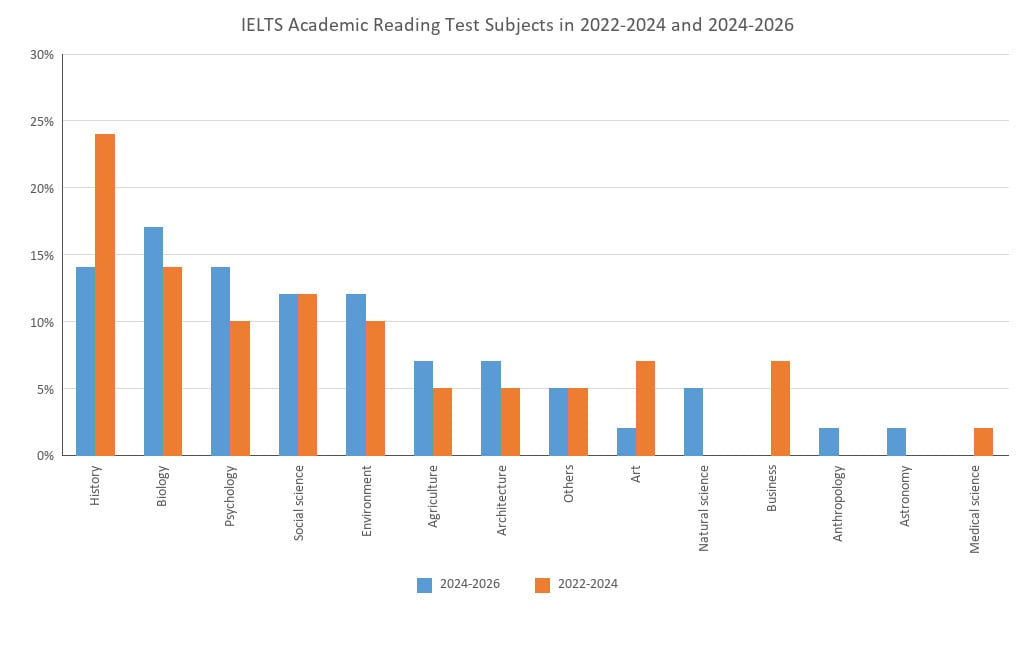
Vì những xu hướng này, chúng tôi đã đảm bảo rằng các bài thi luyện tập Reading IELTS của chúng tôi bao gồm những chủ đề này. Chúng tôi cũng đã thêm các mẫu reading từ các chủ đề ít được sử dụng hơn, để phòng trường hợp. Điều quan trọng là bạn chuẩn bị cho mọi tình huống, vì bạn không bao giờ biết bạn sẽ nhận được chủ đề Reading IELTS nào.
Cách điểm Reading IELTS của bạn được tính
Mỗi câu hỏi Reading IELTS có giá trị 1 điểm, vì vậy bạn có thể nhận được một điểm "thô" lên đến 40 điểm. Sau đó, điểm thô của bạn sẽ được chuyển đổi thành điểm band của bạn. Các bảng dưới đây có thể cho bạn ý tưởng chung về cách điểm Reading IELTS thô được chuyển đổi thành điểm band cho mỗi bài thi.
Điểm IELTS General Reading so với điểm IELTS Academic Reading
| Điểm thô: Academic | Điểm band: Academic | Điểm thô: General | Điểm band: General |
|---|---|---|---|
| 39-40 | 9 | 40 | 9 |
| 37-38 | 8.5 | 39 | 8.5 |
| 35-36 | 8 | 37-38 | 8 |
| 33-34 | 7.5 | 36 | 7.5 |
| 30-32 | 7 | 34-35 | 7 |
| 27-29 | 6.5 | 32-33 | 6.5 |
| 23-26 | 6 | 30-31 | 6 |
| 19-22 | 5.5 | 27-29 | 5.5 |
| 15-18 | 5 | 23-26 | 5 |
| 13-14 | 4.5 | 19-22 | 4.5 |
| 10-12 | 4 | 15-18 | 4 |
| 8-9 | 3.5 | 12-14 | 3.5 |
| 6-7 | 3 | 9-11 | 3 |
| 4-5 | 2.5 | 6-8 | 2.5 |
| 1-3 | 2 | 1-5 | 2 |
Tuy nhiên, hãy nhớ rằng mỗi phiên bản của bài thi Reading IELTS hơi khác nhau và điểm cần thiết để đạt được một band nào đó thay đổi tùy thuộc vào cách mọi người tham gia bài thi đó đã làm vào ngày cụ thể đó. Do đó, số lượng câu trả lời đúng cần thiết để đạt được điểm band sẽ hơi khác nhau từ bài thi sang bài thi, nhưng nói chung bạn nên hướng tới khoảng 30 trên 40 nếu bạn muốn đạt được điểm band 7.
Một điều khác chúng tôi muốn nhắc nhở bạn là các câu hỏi khó nhất và câu hỏi dễ nhất đều đóng góp như nhau vào điểm reading cuối cùng của bạn, vì vậy hãy đảm bảo bạn không đánh mất các điểm dễ hơn bằng cách bị mắc kẹt ở các câu hỏi khó hơn. Tiếp theo chúng tôi sẽ trình bày một số mẹo và chiến lược Reading IELTS về cách trả lời từng câu hỏi bài thi reading.
Mẹo Reading IELTS - Cách trả lời 11 loại câu hỏi Reading
Có 11 loại câu hỏi khác nhau trong bài thi reading và tất cả đều yêu cầu chiến lược khác nhau.
Mỗi dạng có một ví dụ và đáp án trong hướng dẫn dạng câu hỏi IELTS Reading.
- Loại câu hỏi 1 – Ghép thông tin
- Loại câu hỏi 2 – Ghép tiêu đề
- Loại câu hỏi 3 – Ghép đặc điểm
- Loại câu hỏi 4 – Xác định thông tin
- Loại câu hỏi 5 – Xác định quan điểm/tuyên bố của tác giả
- Loại câu hỏi 6 – Trắc nghiệm
- Loại câu hỏi 7 – Ghép kết câu
- Loại câu hỏi 8 – Hoàn thành câu
- Loại câu hỏi 9 – Hoàn thành tóm tắt, ghi chú, bảng, sơ đồ luồng
- Loại câu hỏi 10 – Hoàn thành nhãn sơ đồ
- Loại câu hỏi 11 – Câu hỏi trả lời ngắn
- Cách xu hướng giúp bạn chuẩn bị cho bài thi Reading IELTS
Cách các xu hướng giúp bạn chuẩn bị cho bài thi Reading IELTS
Những dạng câu hỏi đọc mà học viên của chúng tôi thấy khó nhất
Học viên BestMyTest đã trả lời một triệu câu hỏi Đọc Học thuật và 600.000 câu hỏi Đọc Tổng quát trong các bài thi thử của chúng tôi. Tỷ lệ phần trăm cho biết tỷ lệ trả lời đúng của từng dạng câu hỏi.
| Dạng câu hỏi | Học thuật | Tổng quát |
|---|---|---|
| Nối thông tin | 34% | 72% |
| Đúng / Sai / Không có thông tin | 39% | 60% |
| Trắc nghiệm | 43% | 48% |
| Nối đặc điểm | 48% | 74% |
| Hoàn thành câu | 49% | 75% |
| Nối tiêu đề | 53% | 40% |
| Có / Không / Không có thông tin | 55% | 57% |
| Hoàn thành bản tóm tắt | 59% | 46% |
| Trả lời ngắn | 54% | 75% |
- Trong phần Đọc Học thuật, hai dạng có kết quả thấp nhất là nối thông tin và Đúng/Sai/Không có thông tin, đều dưới 40%. Cả hai đều yêu cầu bạn xác định vị trí của một ý được diễn đạt lại thay vì tìm từ khóa trùng khớp.
- Trong phần Đọc Tổng quát, tình hình đảo ngược: nối tiêu đề là dạng có kết quả thấp nhất với 40%, trong khi các dạng tìm vị trí thông tin có tỷ lệ trả lời đúng là ba trên bốn lần vì các bài đọc ngắn hơn và diễn đạt trực tiếp hơn.
- Các bài đọc Học thuật có tỷ lệ trả lời đúng trung bình là 46%, còn các bài đọc Tổng quát là 59%. Một nửa số lượt làm bài đọc Học thuật có tỷ lệ trả lời đúng từ 40% trở xuống.
- Trong 43.711 bài thi thử đọc đầy đủ do 38.534 học viên thực hiện, điểm band trung bình là 5.4. 36% đạt band 6.0 và 14% đạt band 7.0.
- Bạn vẫn phải ôn luyện mọi dạng câu hỏi, nhưng nếu thời gian hạn hẹp, bảng này cho biết bạn nên dành thời gian vào đâu để đạt hiệu quả cao nhất.
Các số liệu được lấy từ dữ liệu thi thử và đánh giá của BestMyTest tính đến tháng 10 năm 2026. Tỷ lệ phần trăm theo dạng câu hỏi là tỷ lệ trả lời đúng trên tất cả các lượt làm bài; số liệu theo tiêu chí là điểm do giáo viên hoặc AI chấm như được ghi trên nhãn. Cập nhật lần cuối ngày 5 tháng 10 năm 2026.
Tiếp theo, chúng ta sẽ xem xét các mẹo và chiến lược reading IELTS cần thiết cho một điểm reading cao.
Mẹo Reading IELTS - Cách cải thiện điểm Band Reading của bạn
Hầu hết học viên thất bại trong phần reading vì ba lý do sau
- Tốc độ đọc chậm
- Vốn từ vựng nghèo nàn
- Ít hoặc không có sự chuẩn bị
Cải thiện tốc độ đọc của bạn
Trước tiên, hãy đề cập đến điều hiển nhiên. Để cải thiện tốc độ đọc của bạn, bạn cần thực sự luyện tập đọc và làm điều đó một cách nhất quán.
Bây giờ hãy xem xét một chiến lược ít hiển nhiên hơn sẽ giúp bạn hiểu nghĩa của các đoạn câu lớn. Bắt đầu bằng cách phân tích câu. Làm điều này bằng cách tìm chủ ngữ và động từ của câu. Việc tìm chủ ngữ và động từ sẽ giúp bạn hiểu nghĩa của câu. Một lý do tại sao các đoạn văn reading học thuật có thể khó hiểu là vì chúng kết hợp các chuỗi ý tưởng để hình thành các câu phức dài. Điều này tạo ra các đoạn câu lớn khó tiếp thu hơn, vì vậy sử dụng chủ ngữ và động từ làm hướng dẫn để hiểu toàn bộ đoạn là một công cụ tuyệt vời bạn có thể sử dụng trong kỳ thi reading IELTS của mình.
Cải thiện vốn từ vựng của bạn
Nhiều người nghĩ rằng việc trả lời câu hỏi reading đơn giản như quét đoạn văn để tìm từ khóa và thông tin... Thật không may, nó không đơn giản như vậy. Các câu hỏi reading thường được paraphrasing, có nghĩa là, các từ đã được thay đổi để sử dụng các từ đồng nghĩa của các từ từ đoạn văn reading IELTS. Điều này được thực hiện để tăng độ khó, nếu không, bài thi sẽ quá dễ. Vì điều này, bạn phải cải thiện vốn từ vựng của mình để biết nhiều từ đồng nghĩa khác nhau của một từ.
Khi bạn chuẩn bị cho bài thi reading và bạn gặp một từ bạn không biết, hãy tạo thói quen dừng lại và tra cứu nó hoặc ít nhất viết nó xuống và tra cứu nó sau. Đó là một chút tẻ nhạt, nhưng nó cực kỳ hiệu quả. Mục tiêu của bạn nên là, nhưng không giới hạn ở, học 15 đến 20 từ học thuật mới mỗi ngày.
Biết loại câu hỏi nào câu trả lời theo thứ tự/không theo thứ tự
Điều quan trọng cần biết là đối với một số loại câu hỏi, các câu trả lời thường (hầu như luôn luôn) cùng thứ tự với đoạn văn reading IELTS. Đối với các loại câu hỏi khác, các câu trả lời hiếm khi cùng thứ tự với đoạn văn reading. Chúng tôi đã hoàn thành một bảng cho các loại câu hỏi theo thứ tự và loại không theo thứ tự. Vui lòng ghi nhớ.
| Câu trả lời thường (hầu như luôn luôn) cùng thứ tự với đoạn văn | Câu trả lời hiếm khi cùng thứ tự với đoạn văn. |
|---|---|
|
|
Tìm chiến lược reading tốt nhất cho bạn
Thách thức lớn nhất mà hầu hết mọi người phải đối mặt trong kỳ thi reading IELTS là hoàn thành tất cả các câu hỏi reading trước khi hết giờ. Trong phần tiếp theo, bạn sẽ tìm hiểu ba chiến lược và sẽ tùy thuộc vào bạn để tìm ra chiến lược nào phù hợp nhất với mình. Bạn sẽ làm điều đó bằng cách sử dụng các bài luyện tập reading miễn phí của chúng tôi.
3 chiến lược Reading IELTS
Chiến lược 1: Đọc toàn bộ đoạn văn sau đó trả lời các câu hỏi.
Trước hết, đây không hẳn là một chiến lược. Đó là điều mọi người làm khi họ không chuẩn bị đúng cách cho kỳ thi reading. Tuy nhiên, chúng tôi đã đưa nó vào như một chiến lược vì, về mặt kỹ thuật, nếu bạn có thể giữ thông tin từ đoạn văn trong lần đọc đầu tiên và có khả năng trả lời các câu hỏi, thì bạn sẽ không cần chiến lược 2.
Chiến lược này, nếu bạn không có trí nhớ trên trung bình, là không hiệu quả. Bạn sẽ hết thời gian trước khi có thể trả lời tất cả các câu hỏi. Nhiều người mắc lỗi này. Tuy nhiên, có một số câu hỏi không yêu cầu nhiều nỗ lực và sẽ được lợi từ chiến lược này như Nếu câu hỏi là câu trả lời "Có" hoặc "Không", thì bạn sẽ có thể đọc lướt nhanh và tìm câu trả lời nhanh chóng, nhưng không có đủ loại câu hỏi như vậy, vì vậy không nên sử dụng chiến lược này trừ khi bạn có thể xử lý được.
Chiến lược 2: Đọc câu hỏi trước, đọc với mục tiêu và ghi chú, rồi sau đó trả lời câu hỏi một cách khôn ngoan
Đây là chiến lược chúng tôi khuyến nghị. Nó sẽ giúp bạn đạt được điểm reading IELTS cao hơn. Hãy nghĩ về điều này như một bản đồ rõ ràng về cách tiếp cận kỳ thi nói chung:
Một trong những lỗi phổ biến nhất mà các thí sinh mắc phải khi
tiếp cận kỳ thi reading là đọc từng từ một của các đoạn văn reading IELTS. Mặc dù bạn có thể
luyện tập cho kỳ thi bằng cách đọc để giải trí, "đọc mù quáng" (đọc không có bất kỳ ý thức nào về
những gì các câu hỏi sẽ hỏi) sẽ không có lợi cho bạn trong kỳ thi. Thay vào đó, nó sẽ làm tổn hại
cơ hội của bạn trong việc quản lý thời gian hiệu quả và đạt được điểm cao nhất.
Lý do chính để đọc câu hỏi trước là vì loại câu hỏi có thể quyết định những gì
bạn đọc trong đoạn văn hoặc cách bạn đọc nó. Ví dụ, một số loại câu hỏi sẽ yêu cầu
kỹ thuật "đọc lướt", trong khi những loại khác có thể yêu cầu kỹ thuật "quét".
Quan trọng là phải xử lý một bộ câu hỏi cùng loại câu hỏi.
Bạn sẽ cần quyết định bạn muốn xử lý loại câu hỏi nào trước.
Một chiến lược tốt sẽ là bắt đầu với loại câu hỏi dễ hơn và chuyển sang các loại câu hỏi khó hơn sau.
Các loại câu hỏi dễ nhất là những câu mà bạn dành ít thời gian đọc.
Ví dụ, loại câu hỏi Ghép tiêu đề là một loại dễ hơn vì bạn
chỉ cần tìm tiêu đề mô tả tốt nhất ý chính của một đoạn.
Một ví dụ về loại câu hỏi khó sẽ là Xác định thông tin. Đối với loại câu hỏi này,
bạn sẽ cần đọc từng đoạn để tìm ra liệu mỗi phát biểu là TRUE, FALSE, hoặc NOT GIVEN theo đoạn văn.
Đây là một bảng liệt kê các mức độ khó cho mỗi loại câu hỏi. Sử dụng bảng này làm tham chiếu khi chọn loại câu hỏi
nào bạn muốn xử lý trước.
| Mức độ khó | Loại câu hỏi |
|---|---|
| Dễ | Ghép tiêu đề Trả lời ngắn |
| Trung bình |
Ghép kết câu Ghép đặc điểm Trắc nghiệm Hoàn thành câu Hoàn thành nhãn sơ đồ, tóm tắt, ghi chú, bảng, sơ đồ luồng |
| Khó |
Ghép thông tin Xác định thông tin (TRUE/FALSE/NOT GIVEN) Xác định tuyên bố của người xem (YES/NO/NOT GIVEN) |
Sau khi bạn đã đọc các câu hỏi từ văn bản IELTS, bạn sẽ có thể đọc với mục tiêu. Điều này có nghĩa là gì? Ví dụ, nếu bạn gặp một câu hỏi có bao gồm năm "1896", bạn có thể ghi chú khi năm này xuất hiện trong văn bản, sử dụng nó để trả lời câu hỏi sau đó.
Có hai kỹ thuật reading sẽ giúp bạn theo đúng hướng với việc đọc có mục tiêu. Cái đầu tiên, đọc lướt, được định nghĩa tốt nhất là đọc nhanh để nắm được "ý chính", hoặc ý tưởng chung của một đoạn văn. Với kỹ thuật này, bạn không dừng lại cho bất kỳ từ không quen thuộc nào hoặc tìm kiếm các chi tiết cụ thể. Kỹ thuật thứ hai, quét, được định nghĩa tốt nhất là đọc cho thông tin cụ thể. Với kỹ thuật này, bạn không đọc cho ý chính tổng thể, mà thay vào đó, thông tin cụ thể. Lưu ý rằng mỗi kỹ thuật này có một mục tiêu cụ thể trong tâm trí. Điều này sẽ giúp bạn tìm thông tin nhanh hơn.
Khi bạn đang đọc với mục tiêu, bạn cũng nên ghi chú ở lề của đoạn văn, đặt dấu sao bên cạnh thông tin chính, hoặc gạch chân các điều mà bạn tin sẽ giúp bạn trả lời các câu hỏi khác nhau. Điều này sẽ giúp bạn dễ dàng kiểm tra lại khi bạn được hỏi những điều nhất định trong các câu hỏi. Chọn bất kỳ hệ thống ghi chú nào phù hợp với bạn—chỉ cần đảm bảo bạn làm điều đó!
Sau khi bạn đã đọc các câu hỏi, đọc đoạn văn, và đã ghi bất kỳ ghi chú thích hợp nào, bạn nên đã định vị phần của văn bản mà bạn cần đọc cẩn thận. Sau đó chỉ cần đọc cẩn thận và suy nghĩ phê phán để xác định câu trả lời chính xác.
Chiến lược 3: Đọc lướt, ghi chú, & loại câu hỏi.
Đây là một chiến lược khác được nhiều thí sinh IELTS sử dụng. Nó sẽ giúp bạn đạt được điểm reading cao hơn. Chiến lược bao gồm 4 bước:
- Đọc lướt từng đoạn để nắm ý tưởng chung của mỗi đoạn. Ý chính của một đoạn thường được tìm thấy trong vài câu đầu tiên nên tập trung một chút vào những câu đó. Các câu tiếp theo có thể được đọc lướt nhanh chóng, gạch chân tên/từ/cụm từ nổi bật.
- Sau khi đọc lướt từng đoạn, viết các ghi chú ngắn (2-5 từ) bên cạnh mỗi đoạn với phỏng đoán tốt nhất của bạn về ý chính của đoạn đó.
- Tiếp theo, trả lời một bộ câu hỏi cùng loại câu hỏi.
- Cuối cùng, Trả lời một bộ câu hỏi một cách hiệu quả và chính xác.
Quan trọng là bạn không dành quá 3-5 phút cho Bước 1 và 2. Dành quá nhiều thời gian cho các bước này sẽ lãng phí quá nhiều thời gian và cuối cùng bạn sẽ hết thời gian.
Bước 1 & 2Mục tiêu ở đây là thiết lập một phương pháp hiệu quả để tìm các câu trả lời trong đoạn văn. Bằng cách ghi lại ý tưởng chung của mỗi đoạn, bạn sẽ biết đoạn nào chứa câu trả lời cho mỗi câu hỏi. Điều này sẽ tiết kiệm cho bạn rất nhiều thời gian vì nếu bạn không ghi lại, bạn có thể sẽ cần đọc lướt từng đoạn để nắm ý chung của câu hỏi, sau đó bạn sẽ cần quét cẩn thận đoạn cho câu trả lời. Bằng cách ghi chú ý chính của mỗi đoạn, bạn có thể bỏ qua bước đầu tiên là đọc lướt từng đoạn và bắt đầu quét tìm câu trả lời.
Bước 3
Sau khi bạn đã đọc lướt văn bản kỹ lưỡng và viết một số ghi chú, bạn đã sẵn sàng cho Bước 3.
Trong bước này, bạn sẽ cần quyết định loại câu hỏi nào bạn muốn xử lý trước.
Một chiến lược tốt sẽ là bắt đầu với loại câu hỏi dễ hơn và chuyển sang các loại câu hỏi khó hơn sau.
Các loại câu hỏi dễ nhất là những câu mà bạn dành ít thời gian đọc.
Ví dụ, loại câu hỏi Ghép tiêu đề là một loại dễ hơn vì bạn
chỉ cần tìm tiêu đề mô tả tốt nhất ý chính của một đoạn, vì vậy về mặt kỹ thuật bạn chỉ cần Bước 1 và 2 để trả lời loại câu hỏi này.
Một ví dụ về loại câu hỏi khó sẽ là Xác định thông tin. Đối với loại câu hỏi này,
bạn sẽ cần đọc từng đoạn để tìm ra liệu mỗi phát biểu là TRUE, FALSE, hoặc NOT GIVEN theo đoạn văn.
Đây là một bảng liệt kê các mức độ khó cho mỗi loại câu hỏi. Sử dụng bảng này làm tham chiếu khi chọn loại câu hỏi nào bạn muốn xử lý trước.
| Mức độ khó | Loại câu hỏi |
|---|---|
| Dễ | Ghép tiêu đề Trả lời ngắn |
| Trung bình |
Ghép kết câu Ghép đặc điểm Trắc nghiệm Hoàn thành câu Hoàn thành nhãn sơ đồ, tóm tắt, ghi chú, bảng, sơ đồ luồng |
| Khó |
Ghép thông tin Xác định thông tin (TRUE/FALSE/NOT GIVEN) Xác định tuyên bố của người xem (YES/NO/NOT GIVEN) |
Bây giờ bạn đã tìm ra bộ câu hỏi nào bạn sẽ trả lời đầu tiên, đã đến lúc thực sự trả lời chúng :( Đừng lo lắng! Mặc dù mỗi loại câu hỏi đều khác nhau, chiến lược trả lời chúng chính xác áp dụng cho tất cả. Nguyên tắc cơ bản là đơn giản, chỉ cần làm theo các bước dưới đây:
- Đọc câu hỏi cẩn thận và xác định các từ khóa quan trọng.
- Tìm đoạn chứa thông tin cần thiết để trả lời câu hỏi.(Hy vọng bạn đã có ý tưởng chung được viết ra cho mỗi đoạn, vì vậy bạn có thể dễ dàng tìm ra điều này.)
- Quét đoạn cho các từ khóa quan trọng (Chúng rất có thể là từ đồng nghĩa!) cho đến khi bạn xác định phần của văn bản mà bạn cần đọc cẩn thận.
- Cuối cùng, đọc cẩn thận và suy nghĩ phê phán để xác định câu trả lời chính xác.
Tải xuống PDF mẫu Reading IELTS miễn phí kèm đáp án
Dưới đây là một số mẫu reading miễn phí từ Hội đồng Anh (những người tạo ra kỳ thi IELTS). Hãy thử trả lời các câu hỏi và xem bạn làm thế nào!