
Trong hướng dẫn này, bạn sẽ làm bài thi IELTS listening miễn phí và nhận được bản phân tích đầy đủ điểm IELTS listening của mình. Bạn sẽ luyện tập với hơn 125 bài thi luyện IELTS listening, bài học, mẹo và video giải thích đáp án. Theo lộ trình học tập cá nhân hóa của chúng tôi, bạn sẽ đạt được điểm Band IELTS listening mục tiêu.
Nhận phân tích điểm IELTS Listening miễn phí và kế hoạch học tập cá nhân hóa sau khi hoàn thành một bài luyện tập IELTS Listening miễn phí.
play_circle_outline Bắt đầu bài luyện tập IELTS ListeningDưới đây là danh sách đầy đủ câu hỏi IELTS Listening của chúng tôi kèm đáp án. Lưu ý: các liên kết màu đỏ là những câu hỏi listening phổ biến và được đề xuất nhiều nhất do học viên của chúng tôi đánh giá, và bạn có thể luyện tập miễn phí bất cứ lúc nào.
Câu hỏi luyện tập phần 1 bài thi Nghe IELTS 1 - 59
A conversation between two people in an everyday situation
Câu hỏi luyện tập phần 2 bài thi Nghe IELTS 1 - 75
A talk by one speaker about an everyday topic
Câu hỏi luyện tập phần 3 bài thi Nghe IELTS 1 - 65
A conversation between up to four people about studies or training
Câu hỏi luyện tập phần 4 bài thi Nghe IELTS 1 - 62
A talk by one speaker on an academic subject
Hướng dẫn bài thi luyện tập Listening IELTS
Phần còn lại của hướng dẫn này sẽ dạy bạn mọi thứ về bài thi Listening IELTS. Bạn sẽ tìm hiểu cách tính điểm Listening, học cách trả lời thành công từng loại câu hỏi Listening để cải thiện điểm band Listening IELTS của mình, và tìm hiểu quy trình 3 bước đã được thử nghiệm của chúng tôi để giúp bạn ôn tập bài thi Listening IELTS trực tuyến.
Mục lục
Thông tin bài thi Listening IELTS
Bài thi Listening IELTS được chia thành 4 phần. Trong mỗi phần, bạn sẽ nghe một hoặc nhiều người nói tiếng Anh bản xứ sau đó trả lời khoảng 10 câu hỏi liên quan đến những gì bạn vừa nghe. Toàn bộ phần Listening IELTS có tổng cộng 40 câu hỏi. Nói chung, các bài nghe bắt đầu dễ hơn và trở nên khó hơn khi bạn tiến qua bài thi. Mỗi bài nghe chỉ được nghe một lần và bao gồm nhiều giọng khác nhau, gồm Anh, Úc, New Zealand, Mỹ và Canada.
- Phần 1 – một cuộc trò chuyện giữa hai người trong bối cảnh xã hội hàng ngày. Ví dụ, bạn có thể nghe một cuộc trò chuyện về việc xác nhận chi tiết cho đặt phòng, hoặc đặt hàng qua điện thoại.
- Phần 2 - một độc thoại trong bối cảnh xã hội hàng ngày. Ví dụ, bạn có thể nghe một bài phát biểu về các cơ sở địa phương, hoặc ai đó cung cấp chỉ đường, hoặc trình bày thông tin cơ bản về một sự kiện.
- Phần 3 – một cuộc trò chuyện giữa tối đa bốn người trong bối cảnh giáo dục hoặc đào tạo. Ví dụ, bạn có thể nghe một giáo viên đại học và một sinh viên đang thảo luận về một bài tập, hoặc một vài sinh viên đang thảo luận về một điều gì đó từ lớp học.
- Phần 4 - một độc thoại về một chủ đề học thuật. Ví dụ, bạn sẽ nghe một bài giảng đại học từ một giáo sư. Đây là bài thu âm khó nhất trong bài thi Listening đối với hầu hết học sinh.
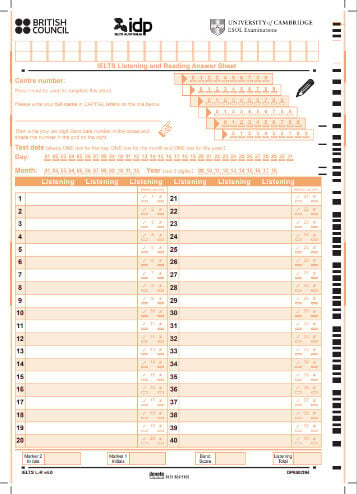
Bài thi Listening IELTS mất khoảng 40 phút. Bạn sẽ dành 30 phút để nghe các bản ghi âm và trả lời câu hỏi. Bạn sẽ được cung cấp một Quyển câu hỏi và một Phiếu trả lời. Quyển câu hỏi là nơi bạn sẽ thấy tất cả các câu hỏi bạn cần trả lời. Phiếu trả lời là nơi bạn sẽ viết câu trả lời cuối cùng của bạn để chấm điểm.
Bạn có thể xem phiếu trả lời Listening IELTS chính thức PDF tại đây hoặc chỉ cần xem hình ảnh bên dưới :)
Ở cuối phần listening, bạn được cho 10 phút để chuyển câu trả lời từ Quyển câu hỏi sang Phiếu trả lời.
QUAN TRỌNG!
Lỗi chính tả và ngữ pháp không chính xác được đánh dấu SAI, vì vậy hãy sử dụng 10 phút để kiểm tra lại chính tả và Ngữ pháp của bạn.
Tính điểm Listening IELTS
Trong phần Listening, mỗi câu hỏi có giá trị 1 điểm, vì vậy bạn có thể đạt được điểm "thô" lên đến 40 điểm. Sau đó, điểm thô của bạn sẽ được chuyển đổi thành điểm band. Hãy nhớ! Bạn không mất điểm khi trả lời sai. Bảng bên dưới có thể cho bạn ý tưởng chung về cách điểm thô được chuyển đổi thành điểm band.
| Điểm thô | Điểm band |
|---|---|
| 39-40 | 9 |
| 37-38 | 8.5 |
| 35-36 | 8 |
| 32-34 | 7.5 |
| 30-31 | 7 |
| 26-29 | 6.5 |
| 23-25 | 6 |
| 18-22 | 5.5 |
| 16-17 | 5 |
| 13-15 | 4.5 |
| 11-12 | 4 |
Vì mỗi phiên bản của IELTS hơi khác nhau, điểm thô cần thiết để đạt được một điểm band nhất định khác nhau tùy thuộc vào cách tất cả những người tham gia bài thi ngày đó thực hiện. Do đó, số câu trả lời đúng cần để đạt được điểm band sẽ khác nhau một chút từ bài thi này sang bài thi khác, nhưng nói chung bạn nên cố gắng đạt khoảng 30 trên 40 nếu bạn muốn đạt điểm band 7.
Như đã đề cập ở trên, các phần trở nên khó hơn và khó hơn khi bạn tiến qua bài thi Listening IELTS. Tuy nhiên, mỗi câu hỏi có giá trị cùng số điểm. Do đó, hãy đảm bảo rằng bạn không bị mất điểm dễ hơn vì bạn bị mắc kẹt với các câu hỏi khó.
Tải xuống PDF Mẫu Listening IELTS Miễn phí với Đáp án
Đây là một số mẫu Listening IELTS miễn phí trong định dạng PDF với câu trả lời từ British Council (nhà tạo ra bài thi IELTS). Bên dưới các liên kết, bạn cũng có thể làm miễn phí một bài thi Listening IELTS có âm thanh và đáp án của BestMyTest. Bài thi có đủ bốn phần, và mỗi phần hiển thị kịch bản âm thanh cùng với câu trả lời. Hãy thử trả lời các câu hỏi và xem bạn làm thế nào!
- Bài thi Luyện tập Listening IELTS 1- câu hỏi (Ví dụ Trực tuyến)
- Bài thi Luyện tập Listening IELTS 1- câu trả lời (PDF)
- Bài thi Luyện tập Listening IELTS 1- phiếu trả lời (PDF)
Hãy nghe bản ghi âm và trả lời các câu hỏi 1-10. Câu trả lời và kịch bản âm thanh nằm trong ô bên dưới các câu hỏi.
Questions 1-10
Complete the notes below.
Write ONE WORD AND/OR A NUMBER for each answer.
This can provide the carer with:
• time for other duties
• a 1
Assessment of aunt's needs
This may involve discussing:
• how much 2 is spent caring
Daily tasks discussed:
• help with dressing
• helping her take a 3
• shopping
• helping with meals
• managing 4
• any parts of caring that are particularly hard, e.g.
• loss of 5
• 6 her
• avoiding a 7
Types of support that may be provided for carers
• transport costs, e.g. cost of a 8
• vehicle-related costs, e.g. fuel and 9
• help with housework
• support to lower 10
-
spellcheck Câu trả lời
1. Break
Break is correct because this detail is stated in the recording at the point where the question is answered.2. Time
Time is correct because this detail is stated in the recording at the point where the question is answered.3. Shower
Shower is correct because this detail is stated in the recording at the point where the question is answered.4. Money
Money is correct because this detail is stated in the recording at the point where the question is answered.5. Memory
Memory is correct because this detail is stated in the recording at the point where the question is answered.6. Lifting
Lifting is correct because this detail is stated in the recording at the point where the question is answered.7. Fall
Fall is correct because this detail is stated in the recording at the point where the question is answered.8. Minicab
Minicab is correct because this detail is stated in the recording at the point where the question is answered.9. Parking
Parking is correct because this detail is stated in the recording at the point where the question is answered.10. Anxiety
Anxiety is correct because this detail is stated in the recording at the point where the question is answered.
Audio ScriptNora: It's really good to see you, Marcus. Since I had to give up work, I feel I'm losing touch with my friends and colleagues.
Marcus: We really miss you in the office. We were all so sorry you had to leave. But you must be relieved to have more time to look after your aunt. How is she?
Nora: Well, she's very cheerful, but she needs a lot of help.
Marcus: Have you tried to get any support from the local council?
Nora: No. I didn't know I could.
Marcus: Yes. But for different kinds of practical support, they realise that carers sometimes need time for all the other responsibilities they have, apart from the person they're caring for, and also that they sometimes need a break.
Nora: Absolutely. OK, so tell me more, how do I go about getting this support?
Marcus: Well, you'd have to have an assessment of your aunt's needs. That means someone would come round and talk to you about the situation and what you need. So for a start, they'd want to know the amount of time you spend looking after your aunt every day.
Nora: OK.
Marcus: Then they'll probably ask you what sorts of tasks you do for your aunt during the day. Things like if she needs help with getting dressed, for example.
Nora: Right. I help her with that. And also I help her get into the shower in the morning.
Marcus: Yes. That sort of thing. They'll probably ask you if you do the shopping for her, and help her at meal times, and whether she can cope using money.
Nora: Yes. That's becoming a bit of a problem. She used to be very good at it, but not anymore.
Before you hear the rest of the conversation, you have some time to look at questions 5 to 10. [20 seconds] Now listen, and answer questions 5 to 10.Marcus: And be ready to tell them about anything you find particularly difficult about caring for your aunt.
Nora: So recently I've noticed she started to have quite bad problems with her memory. If I wasn't there, I think she'd forget to eat, for example. And often she doesn't seem quite sure what day it is.
Marcus: Yes. Tell them about that. And are there any physical difficulties you have caring for her? Lifting her, for example.
Nora: Yes. She's quite heavy, and I'm afraid of hurting my back. I'd be in real trouble if that happened.
Marcus: They can give you advice about that, and also about how to avoid the possibility of your aunt having a fall.
Nora: Great. So, once they've done this assessment, if I'm eligible, what happens next?
Marcus: Well, they might support you financially. So they might help you with travel costs, like if you have to get a minicab to take your aunt for an appointment, for example.
Nora: I usually drive her myself, actually. So could I claim for the petrol?
Marcus: You could. And you can claim for the parking, too.
Nora: Oh, right.
Marcus: And if you need help with the housework, they can arrange for someone to come along once or twice a week. And one other thing. I hope you don't mind me saying this, but it's important you look after yourself. And it seems to me you're dealing with quite a bit of anxiety.
Nora: I am, yes.
Marcus: Well, tell the council, because they may be able to give you some advice on how to minimise it.
Nora: Really? Though, actually, I feel so much better having talked to you. I'll get in touch with the council straight away. Now, shall we go for coffee, or something?
Hãy nghe bản ghi âm và trả lời các câu hỏi 11-20. Câu trả lời và kịch bản âm thanh nằm trong ô bên dưới các câu hỏi.
Questions 11-14
Choose the correct letter, A, B or C.
11. Who began turning the unused Whitfield site into a planted space?
- city council officials.
- nearby residents.
- a gardening charity.
12. What was Lillian Hartley trying to achieve through public campaigning?
- preventing a housing sale
- blocking army exercises
- winning maintenance funding
13. Why was the park rejected as a place for troop exercises?
- council permission was refused.
- too little usable space.
- a better site was chosen.
14. How does the speaker describe the latest redesign plans?
- 2013 plan used unchanged.
- 2013 plan revised pre-work.
- 2015 plan finished in 2016.
Questions 15-20
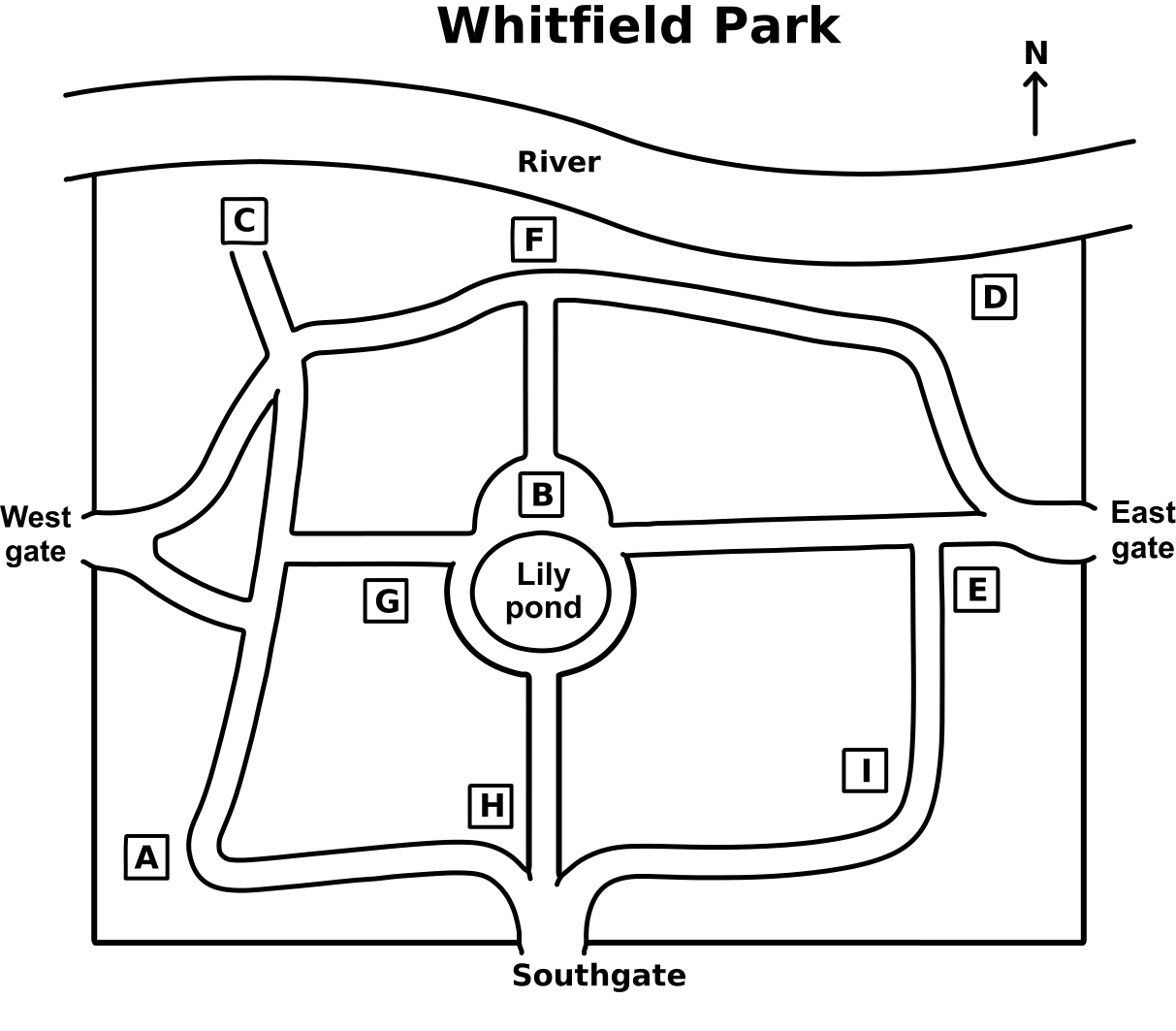
Label the plan of Whitfield Park below.
Write the correct letter, A-I, next to questions 15-20.
- statue of Lillian Hartley
- wooden sculptures
- playground
- maze
- tennis courts
- fitness area
-
spellcheck Câu trả lời
11. B
(A) is incorrect. The council took ownership later.(B) is correct. The initial planting was done by residents from nearby streets.
(C) is incorrect. The recording does not support this option: a gardening charity.
12. A
(A) is correct. Hartley organised public pressure so the council would keep the land as a park rather than sell it for housing.(B) is incorrect. The recording does not support this option: blocking army exercises.
(C) is incorrect. The recording does not support this option: winning maintenance funding.
13. B
(A) is incorrect. The recording does not support this option: council permission was refused.(B) is correct. , after inspection, the army concluded that the park was too small for practical use.
(C) is incorrect. The recording does not support this option: a better site was chosen.
14. B
(A) is incorrect. The recording does not support this option: 2013 plan used unchanged.(B) is correct. The plans dated from 2013 but were revised in 2015 before work began.
(C) is incorrect. The recording does not support this option: 2015 plan finished in 2016.
15. B
The correct answer is B because the statue of Lillian Hartley is now immediately north of the lily pond near the centre of the park, and that position is labelled B.16. D
The correct answer is D because the wooden sculptures are on the riverbank where the path from the East Gate makes a sharp bend, which corresponds to D.17. F
The correct answer is F because the playground is between the river and the path from the lily pond to the river, and that location is marked F.18. C
The correct answer is C because the maze is found by entering from the West Gate, walking north, and turning left, which places it at C.19. A
The correct answer is A because the tennis courts remain in the southern corner where the perimeter path makes a right-angled bend, labelled A.20. G
The correct answer is G because the fitness area is beside the lily pond on the same side as the West Gate, matching G on the plan.
Audio ScriptI'm delighted this evening to introduce our guest speaker, Sarah Holloway, who is going to talk to us about the recent transformation of Whitfield Park. Over to you, Sarah. Thank you very much. I'm sure you all know Whitfield Park well, it has been one of the city's landmarks for well over a century, and the city council has been responsible for it for most of that time. What perhaps fewer of you will know is how the park actually began.
Unlike many city centre parks, which started life as the private gardens of a large house, Whitfield was originally just an unused patch of waste ground. The first flowers there were actually planted by a small group of local residents who lived in the surrounding streets. They began work on the site in 1892. At that point nobody was entirely sure who legally owned the land, and it was a full twenty years later before the city council finally took it into public ownership. Some of you will have seen the statue near one of the gates. That figure is Lillian Hartley, who played a really important role in the early history of the park.
Once the council legally owned the land, its first instinct was to sell it off as building plots for housing. A great many local residents, however, wanted the park to stay open as a place where everyone could enjoy fresh air and green space, bear in mind that this is a very densely built up residential district. Lillian Hartley was at the heart of that campaign, and it was she who organised the petitions and the public demonstrations which, in the end, persuaded the council to drop the sale and keep the land as a park.
Soon afterwards, in 1914, the First World War broke out, and most of the park was dug up and used to grow vegetables, which were sold to local residents. At one point the army did look into taking over the park as a site for troop exercises. They actually wrote to the city council about it, but when they inspected it they concluded that the park was simply too small to be of any practical use to them, so the idea was dropped. The only military activity in the park during the war was the occasional public meeting held on a small area of grass that had been kept clear of vegetable plots.
After the war, the park was largely returned to the way it had been before 1914, and from then on it remained almost unchanged for decades. New plans for transforming the park were drawn up several times over the years; the most recent version dates from 2013, but those plans were then revised in 2015, well before any actual work had got under way. Work on the ground finally began in 2016 and was completed, on schedule, last year.
Before you hear the rest of the talk, you have some time to look at questions 15 to 20. [20 seconds] Now listen and answer questions 15 to 20.All right, I'd like to describe some of the more important changes that have been made, and one or two things that have deliberately been left as they were. If you take a quick look at the map you've been handed, you'll see the familiar outline of Whitfield Park. The river forms the northern boundary, and there is a gate in each of the three other walls.
From there, follow the path up towards the river and the enlarged children's playground sits between that path and the river itself. If you keep your eye on the riverbank, over towards the East Gate side, the new wooden sculptures are at the point where the path coming up from that gate makes a sharp bend.
Back near the West Gate side of the park, there is a maze, a circular pattern of paths separated by low hedges. Head in from the West Gate, walk north towards the river, and then turn left to find it. Close to the same central lily pond, on the side facing the West Gate, you'll also find the new outdoor fitness area.
Down in the southern corner, where the perimeter path makes that distinct right angled bend, the tennis courts are still in their familiar position, though we have now doubled them from four to eight. Now, since you are all keen gardeners, I'm sure you'll want to hear about the plants that have been chosen for the new beds.
Hãy nghe bản ghi âm và trả lời các câu hỏi 21-30. Câu trả lời và kịch bản âm thanh nằm trong ô bên dưới các câu hỏi.
Questions 21-25
Choose the correct letter, A, B or C.
21. Nina and Owen were surprised to learn that coastal cities
- are home to just under half of all people.
- account for many of the largest cities.
- are expanding at double the rate of inland cities.
22. According to Owen, building coastal cities near to rivers
- can carry contamination back towards urban areas.
- can leave too little land for farming upstream.
- can cause factories to damage rural scenery.
23. What mistake was made when building water drainage channels in Port Selby in the 1950s?
- The system did not include enough channels.
- The builders selected the wrong construction materials.
- The design failed to anticipate rising sea levels.
24. What do Nina and Owen think that the authorities in Port Selby should do immediately?
- take measures to restore coastal ecosystems
- pay for a new flood prevention system
- stop disposing of waste materials into the ocean
25. What do they agree should be the priority for international action?
- greater coordination of activities
- more sharing of information
- agreement on shared policies
Questions 26-30
What decision do the students make about each of the following parts of their presentation?
Write the correct letter, A-G, next to questions 26-30.
- use visuals
- keep it short
- involve other students
- check the information is accurate
- provide a handout
- focus on one example
- do online research
- Historical background
- Geographical factors
- Past mistakes
- Future risks
- International implications
-
spellcheck Câu trả lời
21. B
(A) is incorrect. The recording does not support this option: are home to just under half of all people.(B) is correct. Nina says most of the biggest cities are built by the sea.
(C) is incorrect. The recording does not support this option: are expanding at double the rate of inland cities.
22. A
(A) is correct. Owen says pollutants from inland agriculture and industry travel down rivers to cities.(B) is incorrect. The recording does not support this option: can leave too little land for farming upstream.
(C) is incorrect. The recording does not support this option: can cause factories to damage rural scenery.
23. C
(A) is incorrect. The recording does not support this option: The system did not include enough channels.(B) is incorrect. The recording does not support this option: The builders selected the wrong construction materials.
(C) is correct. Port Selby's drainage channels were built without allowing for global warming and rising sea levels.
24. B
(A) is incorrect. The recording does not support this option: take measures to restore coastal ecosystems.(B) is correct. Nina says they need money to replace the drainage channels for flood protection now.
(C) is incorrect. The recording does not support this option: stop disposing of waste materials into the ocean.
25. A
(A) is correct. They say coastal cities must act together internationally.(B) is incorrect. The recording does not support this option: more sharing of information.
(C) is incorrect. The recording does not support this option: agreement on shared policies.
26. B
B is correct because they decide not to spend too long on historical background, so they will keep it short.27. A
A is correct because they decide to use slides with maps showing geographical factors.28. F
F is correct because they choose the Meriton case study as the basis for past mistakes, focusing on one example.29. G
G is correct because they need to look at websites for future risks, so online research is required.30. C
C is correct because they plan to ask audience members from different places, involving other students.
Audio ScriptTutor: OK, so what I'd like you to do now is to talk to your partner about your presentations on environmental planning. You should have done most of the reading now, so I'd like you to share your ideas and talk about the structure of your presentation and what you need to do next.
Nina: OK, Owen, I'm glad we chose quite a specific topic: coastal cities. It made it much easier to find relevant information.
Owen: Yeah, and cities are growing so quickly. I mean, we know that more than half the world's population lives in cities now.
Nina: Yeah, though that's all cities, not just coastal ones. But most of the biggest cities are actually built by the sea. I'd not realised that before.
Owen: Nor me. And what's more, a lot of them are built at places where rivers come out into the sea. But apparently this can be a problem.
Nina: Why?
Owen: Well, as the city expands, agriculture and industry tend to spread further inland along the rivers. And so agriculture moves even further inland up the river. That's not necessarily a problem, except it means more and more pollutants are discharged into the rivers.
Nina: That's a serious problem.
Owen: Right.
Nina: Did you read that article about Port Selby on the south coast?
Owen: No.
Nina: Well, apparently back in the 1950s, they built channels to drain away the water in case of flooding.
Owen: Sounds sensible.
Nina: Yeah, they spent quite a lot of money on them. But what they didn't take into account was global warming. So they built the drainage channels too close to sea level. And now sea levels are rising, they're more or less useless. If there's a lot of rain, the water can't run away. There's nowhere for it to go.
Owen: So they did not help much in the end.
Nina: So what are the authorities doing about it now?
Owen: I don't know. I did read that they're aiming to stop disposing of waste water into the ocean over the next 10 years. But that won't help with flood prevention now, will it?
Nina: No, really, they just need to find the money for something to replace the drainage channels in order to protect against flooding now. But in the long term, they need to consider the whole ecosystem.
Owen: Right.
Nina: Really though, coastal cities can't deal with their problems on their own, can they? I mean, they've got to start acting together at an international level instead of just doing their own thing.
Owen: Absolutely. The thing is, everyone knows what the problems are and environmental planners have a pretty good idea of what we should be doing about them. So they should be able to work together to some extent.
Nina: But it's going to be a long time before countries come to a decision on what principles they're prepared to abide by.
Owen: Yeah, if they ever do.
Before you hear the rest of the conversation, you have some time to look at questions 26 to 30. [20 seconds] Now listen and answer questions 26 to 30.Nina: So I think we've probably got enough for our presentation. It's only 15 minutes.
Owen: OK, so I suppose we'll begin with some general historical background about why coastal cities were established. But we don't want to spend too long on that. The other students will already know a bit about it.
Nina: It's all to do with communications and so on.
Owen: Yes, we should mention some geographical factors, things like wetlands and river estuaries and coastal erosion and so on.
Nina: We could have some maps of different cities with these features marked.
Owen: On a handout, you mean, or some slides everyone can see.
Nina: Yeah, that'd be better.
Owen: It'd be good to go into past mistakes in a bit more detail. Did you read that case study of the problems there were in Meriton with flooding a few years ago?
Nina: Yes, we could use that as the basis for that part of the talk. I don't think the other students will have read it, but they'll remember hearing about the flooding at the time.
Owen: Hmm, OK. So that's probably enough background. So then we'll go on to talk about what actions have been taken to deal with the problems of coastal cities.
Nina: OK, what else do we need to talk about? Maybe something on future risks looking more at the long term if populations continue to grow?
Owen: Yeah, we'll need to do a bit of work there. I haven't got much information, have you?
Nina: No, we'll need to look at some websites. Shouldn't take too long.
Owen: OK. And I think we should end by talking about international implications. Maybe we could ask people in the audience. We've got people from quite a lot of different places.
Nina: That'd be interesting if we have time, yes. So now should we go on?
Hãy nghe bản ghi âm và trả lời các câu hỏi 31-40. Câu trả lời và kịch bản âm thanh nằm trong ô bên dưới các câu hỏi.
Questions 31-36
What point does the lecturer make about each item?
Write the correct letter, A-K, next to questions 31-36.
- changes drainage
- protects animals
- increases nutrients
- kills germs
- affects many species
- creates dense shade
- alters the soil
- supports farming
- reduces competition
- attracts bell-miners
- helps recovery
- Eucalyptus woodland
- Damage to eucalyptus woodland
- Oil from eucalyptus leaves
- Lime used in construction
- Direct iron supply
- Moderate bushfires
Questions 37-40
Complete the notes below.
Write ONE WORD ONLY for each answer.
Bell-miner associated dieback:
• The process starts with insects feeding on eucalyptus 37
• A sweet liquid containing 38 attracts bell-miners
Fire patterns:
• If fires happen too often, 39 becomes the main vegetation
• When fires are almost absent, thick growth gives bell-miners protected 40 sites
-
spellcheck Câu trả lời
31. B
B is correct because eucalyptus woodland provides nesting places and shelter for birds, bats and small mammals.32. E
E is correct because damage to eucalyptus woodland affects a wider community of species, not only the trees themselves.33. D
D is correct because oil from eucalyptus leaves is used in disinfectant, where it can kill certain germs.34. G
G is correct because lime from road construction was washed into the soil and interfered with tree roots.35. K
K is correct because affected trees recovered surprisingly quickly when iron was supplied directly.36. I
I is correct because occasional fire removes fast-growing competitors that would otherwise use water needed by eucalyptus trees.37. leaves
The correct answer is leaves. The lecturer says the process begins when insects settle on eucalyptus leaves and feed on them.38. sugar
The correct answer is sugar. The lecturer says the insects produce a sweet liquid containing sugar, which attracts bell-miners.39. grass
The correct answer is grass. The lecturer says grass tends to dominate afterwards if fires occur too often.40. nesting
The correct answer is nesting. The lecturer says dense growth creates protected nesting sites for bell-miners when fire is suppressed.
Audio ScriptGood morning. Today I want to focus on the eucalyptus tree, one of the best known features of the Australian landscape. Many people call it a gum tree, but the name eucalyptus actually covers hundreds of related species, from small scrubby trees to very tall forest giants.
Now, eucalyptus trees are important in several ways. Ecologically, they provide nesting places and shelter for birds, bats and small mammals. Their flowers also produce nectar, which is an important food source for insects and birds. So when eucalyptus woodland is damaged, the effect is felt across a much wider community of species.
As for their value to people, the trees are also useful. Oil from eucalyptus leaves has long been used in cleaning products, and one common use is in disinfectant, because the oil can kill certain germs. Eucalyptus timber is also used in building and fencing, although that is not really the main focus of today's lecture.
So, these trees can live for centuries, and some individuals survive for four hundred years or more. That is why researchers became concerned when large numbers began dying much earlier than expected in different parts of Australia.
Now, one disease that attracted attention was Mundulla Yellows. The leaves of affected trees slowly turned yellow and then, over time, the whole tree declined. For years the cause was unclear. Eventually, researchers discovered that lime, or calcium hydroxide, had been used in road construction nearby. Rain washed the lime into the surrounding soil, where it interfered with the roots of eucalyptus trees. The trees were still surrounded by nutrients, but they could no longer absorb the iron they needed for healthy growth. When iron was supplied directly to affected trees, they recovered surprisingly quickly.
However, Mundulla Yellows affected only a limited number of places. A much wider problem on the east coast was Bell miner associated dieback. Now, bell miners are small native birds, but they are not the direct cause of the damage. The process begins when insects settle on eucalyptus leaves and feed on them. While feeding, these insects produce a sweet liquid containing sugar. Bell miners are attracted to that liquid, and they aggressively chase away other birds and insects that might otherwise reduce the insect population. As a result, the insects multiply, the leaves are badly damaged, and the trees gradually lose their ability to survive.
But some scientists think fire history is also part of the explanation. An influential theory, first proposed by the ecologist William Jackson, links the type of vegetation in a region to the frequency of bushfires. If fires occur too often, grass tends to dominate the area afterwards. If fires occur at moderate intervals, eucalyptus forest is more likely to persist. This is because occasional fire removes fast growing competitors which would otherwise take up the water eucalyptus trees need. And it also helps maintain the soil by preventing dense undergrowth from changing the soil structure and removing nutrients.
At the other extreme, if fires are almost completely suppressed, a different ecosystem can develop. Scientists sometimes call this dry rainforest. Now, the name sounds contradictory, because we usually associate rainforest with wet tropical conditions. But in this case it means a dense, shaded vegetation system with relatively few species. It can create excellent conditions for bell miners, because the thick growth gives them protected nesting sites while excluding many of the species that would normally compete with them.
What this tells us is that before European settlement, Aboriginal communities used controlled burning over long periods, and this probably created a more balanced pattern of vegetation. Since European settlement, fire has often been suppressed, roads and farms have altered drainage, and some local ecosystems have shifted away from eucalyptus woodland. The decline of eucalyptus trees, then, is not caused by one single factor. It is the result of disease, insects, birds, soil chemistry and fire management interacting with one another.

Completion - Part 1
Learn how to answer these questions in a step-by-step interactive exercise
Completion - Part 1
Chỗ trống có thể yêu cầu một thời điểm hoặc tần suất. Người nói thường diễn đạt cùng khoảng thời gian đó bằng những từ khác, nên hãy khớp ý nghĩa với chỗ trống thay vì chờ đúng cách diễn đạt trên trang.
Sau đó hãy kiểm tra giới hạn số từ trước khi nộp. Đọc lại cả dòng với câu trả lời của bạn trong chỗ trống và bỏ đi những từ mà dòng đó đã có sẵn. Một câu trả lời đúng nghĩa nhưng quá dài sẽ không được điểm.
Nhấp nút phát để nghe âm thanh
Phần ghi chú dùng động từ đơn giản như must provide hoặc need to bring. Người nói hiếm khi nói đúng động từ đó mà thường dùng từ đồng nghĩa hoặc mô tả hành động, nên hãy nghe xem điều gì thực sự được yêu cầu.
Người nói thường nhắc đến các thứ khác trước rồi mới loại bỏ chúng. Nếu bạn lỡ một chỗ trống, hãy bỏ qua và chuyển sang chỗ tiếp theo, vì các đáp án theo đúng thứ tự của bản ghi âm và một chỗ trống bị lỡ có thể khiến bạn mất luôn các chỗ trống sau.
Nhấp nút phát để nghe âm thanh
Bạn đã làm như thế nào khi trả lời các câu hỏi mẫu Listening IELTS ở trên? Bạn có thấy bất kỳ câu hỏi nào khó không? Nếu có, có thể có lợi cho bạn khi xem xét kỹ tất cả 6 loại bài tập Listening IELTS. Bạn càng hiểu rõ một loại bài tập, bạn càng ít nỗ lực để tìm ra những gì bạn cần làm và bạn càng có thêm thời gian để tìm ra câu trả lời.
6 Loại Bài tập Listening IELTS
Có 6 loại câu hỏi khác nhau trong bài thi Listening IELTS. Việc thực hành mỗi loại bài tập là quan trọng để học cách tốt nhất để xử lý từng loại cho điểm Listening IELTS cao.
Những dạng bài nghe mà học viên của chúng tôi thấy khó nhất
Dưới đây là những gì 2.22 triệu câu trả lời IELTS Listening của học viên BestMyTest cho thấy. Bảng bên dưới cho biết tỷ lệ phần trăm câu trả lời đúng của học viên ở từng dạng bài, để bạn thấy ngay mình mất điểm ở đâu.
| Dạng bài | Tỷ lệ đúng |
|---|---|
| Note completion | 33% |
| Table completion | 34% |
| Sentence completion | 45% |
| Short answer | 48% |
| Multiple choice | 50% |
| Multiple selection | 52% |
| Plan, map, diagram labelling | 55% |
| Form completion | 73% |
| Matching | 85% |
- Các dạng bài điền từ (completion) là nơi học viên mất điểm. Trong các dạng bài điền từ, dạng Note completion chỉ được trả lời đúng 33% số lần, trong khi dạng Form completion, vốn dùng cùng kỹ năng nhưng có bố cục khác, đạt 73%. Mọi dạng bài điền từ đều yêu cầu bạn viết lại một từ bạn nghe được, nên chính tả, dạng từ và giới hạn số từ đều quan trọng, và đây đều là những điều bạn có thể luyện tập.
- Trong 61.104 bài thi thử nghe đầy đủ do 54.523 học viên thực hiện, điểm band trung bình là 5.6. 41% số bài thi đạt band 6.0 và 12% đạt band 7.0.
- Ở từng phần nghe riêng lẻ, 31% số lượt làm bài đạt 40% trở xuống và 30% đạt 80% trở lên. Phần 3 và 4 là các phần mang tính học thuật của bài thi, vì vậy hãy luyện riêng hai phần này, ngoài việc làm các bài thi đầy đủ.
Mặc dù mỗi loại câu hỏi listening trông khác nhau, cách tiếp cận cơ bản đối với mỗi loại là như nhau. Sau trong bài đăng này, chúng tôi sẽ cho bạn thấy chiến lược cơ bản để giải quyết tất cả 6 loại câu hỏi. Mỗi dạng có một đoạn audio và đáp án trong hướng dẫn dạng câu hỏi IELTS Listening.
3 bước cho việc Chuẩn bị bài thi Listening IELTS Trực tuyến Hiệu quả
Mặc dù mỗi loại câu hỏi (bài tập) Listening IELTS khác nhau, cách tiếp cận cơ bản đối với mỗi loại là như nhau. Bạn có thể giải quyết tất cả các loại bài tập bằng cách sử dụng một chiến lược đơn giản, từng bước. Đây là ba bước chúng tôi khuyên bạn nên sử dụng để tiếp cận các loại câu hỏi Listening:
- Xem xét các câu hỏi một cách cẩn thận để tìm thông tin quan trọng
- Dự đoán câu trả lời tiềm năng trước khi nghe
- Theo dõi để phù hợp với câu hỏi với nội dung khi họ nghe
Bước 1: Xem xét Câu hỏi
Trong phần Listening IELTS, bạn sẽ được cho một thời gian chuẩn bị ngắn (30-40 giây) trước khi bản ghi âm bắt đầu. Đây là cơ hội để bạn xem xét các câu hỏi bạn sẽ cần trả lời, đó chính xác là về bước đầu tiên trong chiến lược này. Thay vì sử dụng thời gian này để nghỉ ngơi, hoặc kiểm tra câu trả lời của bạn, bạn sẽ tập trung vào việc tìm hiểu càng nhiều càng tốt về các câu hỏi sắp tới. Thực hiện bước này là quan trọng để tránh sai lầm về việc đa nhiệm trong khi nghe người nói và cố gắng đọc các câu hỏi lần đầu tiên.
Khi thời gian chuẩn bị của bạn bắt đầu, trước hết hãy sử dụng tốt nhất thời gian này bằng cách xem xét các câu hỏi để tìm hiểu thêm về chúng. Đây là một số thông tin bạn nên tìm kiếm khi xem xét mỗi câu hỏi Listening IELTS:
- Đây là loại câu hỏi gì?
- Câu trả lời sẽ trông như thế nào? (ví dụ: một ngày, một con số, một tên)
- Các cụm từ và từ quan trọng nhất, hoặc từ khóa, trong các câu hỏi là gì?
Một ví dụ có thể là một loại câu hỏi Hoàn thành Ghi chú, như thế này:
Hoàn thành các ghi chú bên dưới.
Viết KHÔNG QUÁ BA TỪ cho mỗi câu trả lời.
Trước tiên, bạn có thể gạch chân một số từ khóa trong câu hỏi.
Hai lý do cho cách tiếp cận mới đối với định giá là sự thay đổi trong các chương trình (27) ______ và (28) _________.
Trong ví dụ này, lắng nghe cụm từ khóa "hai lý do" mà bạn đã gạch chân cho phép bạn
bắt đầu chú ý đặc biệt vào đúng thời điểm. Đây là phần của kịch bản âm thanh tiết lộ câu trả lời:
Mark: Vâng, dường như có hai lý do cơ bản. Thứ nhất, vì luật đã được thay đổi gần đây để cho phép các công ty hành động như thế này. Trong quá khứ, họ không được phép thay đổi giá vé. Và thứ hai, hiện nay chúng ta có các chương trình máy tính thực hiện tính toán để giá có thể được thay đổi rất nhanh chóng và chính xác.
Sau khi đã xem xét các câu hỏi, bạn sẽ biết rằng "luật" và "máy tính" là phản hồi chính xác ở đây dựa trên một số từ khóa và biết loại câu hỏi.
Bước 2: Dự đoán câu trả lời tiềm năng
Bước thứ hai trong chiến lược này để thành công trong phần Listening IELTS có liên quan rất chặt chẽ với bước đầu tiên. Trên thực tế, bạn nên cố gắng hoàn thành cả hai bước này trong cùng 20 giây thời gian chuẩn bị trước khi bản ghi âm bắt đầu. Mặc dù điều này có vẻ như một nhiệm vụ khó khăn để thực hiện trong thời gian ngắn như vậy, hãy nhớ rằng các bước này thực sự được liên kết với nhau.
Để dự đoán câu trả lời tiềm năng cho các câu hỏi Listening, trước tiên bạn cần đã hoàn thành bước một bằng cách xem xét các câu hỏi một cách kỹ lưỡng. Tại thời điểm này, bạn nên biết loại câu hỏi bạn đang xem, các câu trả lời tiềm năng sẽ trông như thế nào, cũng như những từ khóa sẽ giúp bạn tìm câu trả lời nhanh chóng. Để dự đoán câu trả lời, bạn sẽ kết hợp tất cả thông tin này và đưa ra dự đoán về loại câu trả lời bạn mong đợi sẽ nghe.
Hãy quay lại cùng một câu hỏi ví dụ Hoàn thành Ghi chú từ trên.
Hai lý do cho cách tiếp cận mới đối với định giá là sự thay đổi trong các chương trình (27) và (28) .
Chỉ cần nhìn vào ngữ pháp của câu này cho phép bạn xác định loại từ mà câu trả lời sẽ là. Trong trường hợp này, giới từ "in" đứng trước cả hai câu trả lời tiềm năng. Về mặt ngữ pháp, chỉ danh từ hoặc cụm danh từ có thể được sử dụng theo cách này trong các cụm giới từ. Không chỉ bạn có thể dự đoán, một cách chính xác, rằng câu trả lời sẽ là một danh từ hoặc cụm danh từ, mà còn có thể dự đoán rằng câu trả lời có thể là một cái gì đó liên quan đến chính sách hoặc chính phủ (luật), và một từ có thể xuất hiện với các chương trình (máy tính) dựa trên ngữ cảnh.
Mặc dù không thể đoán chính xác câu trả lời đúng dựa trên dự đoán đơn thuần, bằng cách cố gắng tưởng tượng câu trả lời có thể là gì, bạn có nhiều khả năng lắng nghe các thông tin liên quan trong khi bỏ qua các thông tin không liên quan. Việc dự đoán câu trả lời tiềm năng trước khi bản ghi âm bắt đầu sẽ chuẩn bị tai của bạn, đưa bạn một bước gần hơn đến câu trả lời chính xác.
Bây giờ, hãy thử kết hợp Bước 1 (xem xét câu hỏi) và Bước 2 (dự đoán câu trả lời tiềm năng) trong một câu hỏi ví dụ trắc nghiệm khó hơn.
Chọn đúng chữ, A, B, C hoặc D.
- là cho các buổi biểu diễn cuối tuần
- được đặt trước rất lâu
- không thể hoàn trả
- được đặt cho nhóm
Mặc dù không có cách nào để biết các câu trả lời cho những câu hỏi này một cách chắc chắn, bạn vẫn có thể sử dụng thông tin có trong các câu hỏi này để dự đoán các câu trả lời tiềm năng và nhắm mục tiêu cho việc nghe của bạn. Ví dụ, câu hỏi 24 liên quan đến lý do tại sao giá vé nhà hát sẽ thấp nhất, vì vậy bạn sẽ muốn nghe kỹ bất kỳ lý do nào trong số đó được đề cập. Hãy nhớ rằng, có thể nhiều hơn một sẽ được đề cập. Hãy xem kịch bản dưới đây để xem làm thế nào dự đoán có thể giúp bạn loại bỏ các câu trả lời sai.
Lưu ý cách ba trong số các câu trả lời tiềm năng được đề cập, "được đặt cho nhóm", "là cho các buổi biểu diễn cuối tuần" và "không thể hoàn trả." Tuy nhiên, câu trả lời chính xác là C "không thể hoàn trả" vì nó được đề cập là rẻ hơn riêng biệt với hai cái khác, đơn giản là được liệt kê cùng nhau.
Bước 3: Theo dõi
Khi bản ghi âm bắt đầu và phần listening thực sự của bài thi bắt đầu, bạn nên theo dõi để hoàn thành bước ba của chiến lược phần Listening IELTS này. Việc theo dõi yêu cầu bạn tập trung chặt chẽ vào những gì bạn đang nghe, đồng thời theo dõi câu hỏi nào nội dung có thể đang đề cập đến.
Các câu hỏi trong phần bài thi Listening IELTS thường xuất hiện theo thứ tự nơi câu trả lời của họ có thể được tìm thấy trong nội dung của bản ghi âm. Điều này mang lại lợi thế cho bạn trong bài thi, vì nó có nghĩa là một khi bạn đã nghe câu trả lời cho một câu hỏi, bạn sẽ ngay lập tức chuyển sự chú ý của mình sang câu tiếp theo theo thứ tự. Nếu bạn có thể theo dõi thành công bằng cách phù hợp với ngữ cảnh từ các câu hỏi với những gì bạn đang nghe trong bản ghi âm, bạn sẽ ở trên đường ray và tránh bỏ lỡ thông tin chính cần thiết để trả lời mỗi câu hỏi.
Tuy nhiên, làm điều này dễ nói hơn là làm. Bạn sẽ cần đa nhiệm bằng cách nghe trong khi đồng thời giữ mắt vào câu hỏi tiếp theo. Nếu bạn thực sự bỏ lỡ câu trả lời cho một câu hỏi, bạn sẽ biết khi bạn nghe câu trả lời cho một câu hỏi sau. Mặc dù điều này có thể gây nhầm lẫn và thậm chí gây thất vọng, bỏ lỡ một câu trả lời và nhận thức về điều đó vẫn tốt hơn là hoàn toàn lạc lối trong nội dung và bỏ lỡ thêm nhiều câu trả lời. Trong tình huống bỏ lỡ một câu hỏi, bạn nên đơn giản là bỏ qua nó, và tiếp tục đến câu tiếp theo. Ở cuối, bạn sẽ phải đưa ra dự đoán tốt nhất của mình về câu hỏi bạn đã bỏ lỡ. Tuy nhiên, mặt sáng là có thể nghe bản ghi âm toàn bộ có thể cung cấp cho bạn các manh mối ngữ cảnh khác và cho phép bạn trả lời bất kỳ câu hỏi nào bạn đã bỏ lỡ một cách chính xác hơn.
Tài nguyên Miễn phí Luyện tập Listening IELTS
Bạn sẽ cần kỹ năng nghe mạnh mẽ để đạt điểm Listening IELTS band cao. Vì vậy, điều quan trọng là bạn luyện tập một cách nhất quán mỗi ngày cho đến ngày thi.
Dưới đây là một số tài nguyên bạn có thể sử dụng để đào tạo và duy trì kỹ năng nghe của bạn hàng ngày.
- YouTube - https://www.youtube.com
- BBC Learning English - http://www.bbc.co.uk/learningenglish
- TED - https://www.ted.com/
- BBC radio - https://www.bbc.co.uk/worldserviceradio
- ABC news in Australia - https://www.abc.net.au/listen/live/news
Số liệu trên trang này lấy từ dữ liệu kết quả học viên IELTS của BestMyTest, tức là các bài luyện thi IELTS trên BestMyTest đến tháng 10/2026. Trang đó giải thích cách chúng tôi tính từng số liệu. Cập nhật lần cuối ngày 15/10/2026.