
Každý typ níže má zvukovou ukázku a odpověď. Zbytek průvodce listening je v testu IELTS Listening.
- Typ úlohy 1 – Sentence Completion (doplňování vět)
- Typ úlohy 2 – Matching (přiřazování)
- Typ úlohy 3 – Plan, Map, Diagram Labelling (popisování plánů, map, diagramů)
- Typ úlohy 4 – Form, Note, Table, Flow-Chart, Summary Completion (doplňování formuláře, poznámek, tabulky, vývojového diagramu, shrnutí)
- Typ úlohy 5 – Multiple Choice (výběr z více možností)
- Typ úlohy 6 – Short Answer Questions (krátké odpovědi)
Typ úlohy 1 – Sentence Completion (doplňování vět)
Tento typ úlohy vyžaduje, abyste doplnili větu krátkou odpovědí.
Věta bude téměř vždy parafrází něčeho, co uslyšíte v nahrávce.
Jinými slovy, neočekávejte, že mluvčí řekne přesně tu větu, jak je napsána v otázce.
Pokyny si musíte přečíst velmi pozorně. Pokud pokyn například říká NO MORE THAN TWO WORDS,
budete penalizováni za napsání více než DVOU slov. Odpověď může být jedno slovo, ale nikdy nebude delší než dvě slova.
Questions 31-34
Complete the sentences below.
Write NO MORE THAN ONE WORD AND/OR A NUMBER for each answer.
The red squirrel is the only species of squirrel that is 31 to the UK.
The grey squirrel was 32 to the UK in the 1870s.
Since then, the population of red squirrels in the UK has 33 dramatically.
Today, there are thought to be about 34 red squirrels in England.
-
spellcheck Answers
31. native
The answer is native. The sentence from the script states, 'The red squirrel is the UK's only native squirrel species.' This directly identifies 'native' as the word that describes the red squirrel's unique status in the UK. The term 'native' means it is naturally found in the UK, unlike other squirrel species.32. introduced
The answer is introduced. The script says, 'Numbers in the UK have fallen dramatically since grey squirrels were introduced as an ornamental species in the 1870s.' This explains that grey squirrels were not originally from the UK, but were 'introduced' to the area.33. fallen / dropped
The answer is fallen. The relevant part of the script is: 'Numbers in the UK have fallen dramatically since grey squirrels were introduced...' This shows that since the introduction of grey squirrels, red squirrel numbers have 'fallen' or decreased significantly.34. 15000 / 15,000
The answer is 15,000. The lecture says, 'The population in England is thought to be as low as 15,000.' This provides a precise figure for the current estimated number of red squirrels in England.
(Section 4: You will hear a talk on the topic of red squirrel conservation. First, you will have some time to look at questions 31 to 40 [20 seconds]. Listen carefully and answer questions 31 to 40.)
L=Lecturer
Good afternoon and welcome to today's lecture on red squirrel conservation in the UK.
The red squirrel is the UK's only native squirrel species, and was once a common sight across the UK. But for decades they've been in decline. Today, red squirrels are sadly absent from most of the UK, affected by the spread of the introduced non-native grey squirrel.
Red squirrels live in coniferous forests and deciduous woods in Europe and northern Asia. Their range extends from the UK, Ireland and Western Europe to Russia, Mongolia, and northwest China. Numbers in the UK have fallen dramatically since grey squirrels were introduced as an ornamental species in the 1870s.
Since then, the UK population of reds has dropped from around 3.5 million to between 120,000 to 160,000 individuals, according to different estimates. The population in England is thought to be as low as 15,000. Population strongholds are Scotland, Northumberland, Wales, Northern Ireland, and the Lake District as well as on islands such as Brownsea. By the way, if you want to see them in the wild, prime spotting times are morning and late afternoon because that's when they're most active.
The red squirrel is officially classed as 'near threatened' in England, Wales and Northern Ireland, but is locally common in Scotland. The main cause behind their decline, as I mentioned previously, is the introduction of grey squirrels from America. There are three main reasons why greys are a threat. Firstly, grey squirrels carry a disease, squirrel parapox virus, which does not appear to affect their health but often kills red squirrels. Also, grey squirrels are more likely to eat green acorns, so will decimate the food sources before reds get to them. Reds can't digest mature acorns, so can only eat green acorns. And, when red squirrels are put under pressure they will not breed as often. Another huge factor in their decline is the loss of woodland over the last century, but road traffic and predators are also threats, too.
Red squirrels are recognisable by their red to russet fur, ear tufts and long, fluffy tails. But the colour of their coats can vary with some reds appearing very grey (and some grey squirrels can have red fur down their backs and on their feet). Reds have small ear tufts that can develop into large tufts in the winter.
Red squirrels are very elusive and spend much of their time in the tree canopy. Ways to spot them include looking out for large dreys in trees, scratch marks on bark, and chewed pine cones that look like chewed apple cores. It is also helpful to listen for their 'chuk chuk' noise, which is a vocalisation they often use.
Red squirrels have a mainly vegetarian diet that includes seeds, hazelnuts and green acorns, fungus, bark, and sapwood. They also occasionally take animal prey such as young birds and eggs. They especially favour pine seeds, but also eat larch and spruce seeds. Because they disperse seeds, they play a vital role in the reforestation process.
Reds do not hibernate and store fungi in trees to eat over the winter months. When food is plentiful, they put on weight in the autumn to help them through the winter. This is important for breeding females, so that they are in good condition for producing young in the spring.
Red squirrels usually produce 2-3 young, called kittens, in February to April and they often produce a second litter from May to June. Outside of the mating season, red squirrels tend to live alone, but in early spring, watch out for their courtship displays in the trees. Babies are born 45-48 days after mating, and are looked after by their mothers. Kittens are weaned around 10 weeks when they develop a complete set of teeth. Some stay with their mothers over winter. Between 20 and 50 percent of red squirrel kittens survive to adulthood.
There are projects across Britain to develop long-term conservation strategies that deter greys and encourage reds. They include…

Completion - Part 4
Learn how to answer these questions in a step-by-step interactive exercise
Completion - Part 4
Poznámky a přednáška často používají pro stejný fakt jinou gramatiku. Řádek poznámek může uvést nejdřív následek, zatímco mluvčí nejdřív řekne příčinu, takže slovo, které potřebujete, může zaznít dřív, než čekáte.
Než audio začne, odhadněte, co mezera potřebuje. Když řádek říká, že jednu věc způsobila jiná, poslouchejte, co ji spustilo nebo k ní vedlo, ať už to stojí na kterémkoli konci věty.
Klikněte na přehrát a poslechněte si audio
Řádek poznámek může použít širokou kategorii, například materials nebo pollutants, zatímco přednáška jmenuje několik konkrétních členů této kategorie. Podmínku zapsanou v poznámkách splňuje jen jeden z nich.
Hledejte shodu s podmínkou, ne s kategorií, a nevšímejte si položek, které mluvčí označí za bezpečné nebo běžné. Pak spočítejte slova, protože odpověď nad uvedený limit nezíská žádný bod.
Klikněte na přehrát a poslechněte si audio
Typ úlohy 2 – Matching (přiřazování)
V úloze typu Matching máte za úkol přiřadit číslovaný seznam položek z poslechového textu k sadě možností na zadání. Tato úloha vyžaduje, abyste naslouchali detailním informacím a rozeznávali vztahy a souvislosti mezi fakty v poslechovém textu. Můžete například potřebovat identifikovat různé typy hotelů nebo penzionů. Před poslechem nahrávky je důležité tyto otázky analyzovat, abyste pochopili kategorii písmenných možností odpovědi.
Questions 27-30
What point do they make about each appearance?
Write the correct letter, A-F, next to questions 27-30.
- clear naked-eye sighting
- successful spacecraft observation
- recorded by court astronomers
- treated as a warning sign
- most accurate orbit calculation of its time
- disputed eyewitness accounts
- the 240 BC apparition
- the 1066 apparition
- the 1758 apparition
- the 1986 apparition
-
spellcheck Answers
27. C
The correct answer is C because the 240 BC apparition is described as the earliest record and as having been recorded by Chinese court astronomers.28. D
The correct answer is D because the 1066 apparition is described as being treated as a warning sign during a period of uncertainty.29. E
The correct answer is E because the 1758 return confirmed the orbit calculation, described as the most accurate orbit calculation of its time.30. B
The correct answer is B because the 1986 apparition is linked to successful spacecraft observation by Giotto and the Vega probes.
Lucas: Hannah, before we build the slides, we need one clear reason why this comet still matters.
Hannah: I would avoid saying it is simply the brightest comet people have seen. Some others were more spectacular, and some stayed visible for longer. And predictability alone is not enough either.
Lucas: Why does it still matter?
Hannah: Exactly. Few astronomical objects can be followed through observations made over more than two thousand years. That lets us compare very different observing traditions over an unusually long period.
Lucas: That gives us a solid way into the topic.
Lucas: I also had not expected much from the medieval European material. I thought it would be vague, but some of the drawings are surprisingly careful.
Hannah: More than the number of places where it was recorded?
Lucas: Yes. The spread of records is useful, but the drawings themselves are what caught my attention. Some show the tail shape, the brightness and even where the comet sat in relation to familiar stars.
Hannah: And they did not usually mistake it for an ordinary star or planet, so that is not the issue.
Lucas: Now, Edmond Halley. What exactly was significant about his 1705 calculation?
Hannah: We should be careful. Newton had already provided the mathematics for elliptical orbits, so Halley was not inventing that. And reducing it to a lucky date prediction makes it sound too small.
Lucas: Then what should we say?
Hannah: He made a claim that people in the future could check for themselves. If the comet came back near the calculated time, the calculation would stand or fall in public, as it were.
Lucas: We should include that.
Lucas: What about 1986? I want to call it a scientific success because spacecraft sent back close up data.
Hannah: Scientifically, yes, there was a lot to celebrate. But ordinary observers had a rather flat experience because the comet was badly placed in the sky. So if we are judging the visit as a whole, I would not make it sound like a triumph for everyone.
Lucas: So we differ on how positive the overall judgement should be.
Hannah: Exactly. We both value the spacecraft data; we just weigh the public experience differently. Now, for the 1066 apparition, which two claims can we support properly?
Before you hear the rest of the conversation, you have some time to look at questions 25 to 30. [20 seconds] Now listen and answer questions 25 to 30.Lucas: The Bayeux Tapestry is tempting, but stitched figures pointing upward do not prove what people felt. It shows the comet was noticed, not that we can measure fear from it.
Hannah: Agreed. The written sources are stronger on duration; several chronicles describe it remaining visible over a period of weeks.
Lucas: Yes, that appears in several European accounts.
Hannah: I would not say the comet caused the Norman victory. That is an interpretation people made around the event, not evidence about the apparition itself.
Lucas: The other useful point is that East Asian records line up with the European dates. Chinese and Japanese astronomers were observing independently, which makes the identification much more secure.
Hannah: Right. But saying it was first seen in the Mediterranean is more precise than the evidence allows.
Lucas: That should give us enough reliable evidence for that part.
Hannah: Now for the matching. The earliest entry, 240 BC, comes from Chinese court records.
Lucas: That gives us a good starting point for the long record.
Hannah: In 1066, people read the comet through the politics of the time. It was treated as a warning sign, especially because it appeared during a period of uncertainty.
Lucas: For 1758, the key thing is that the return matched Halley's calculation closely enough to confirm the orbital work.
Hannah: And in 1986 we get direct spacecraft encounters, with Giotto and the Vega probes sending back data.
Lucas: Good. Now the sequence is much clearer.

Matching
Learn how to answer these questions in a step-by-step interactive exercise
Matching
Možnosti označené písmeny jsou krátké a obecné. Mluvčí vyjádří stejnou myšlenku delším a přirozenějším způsobem, takže vytištěná slova jen zřídka odpovídají tomu, co slyšíte.
Než nahrávka začne, přečtěte si všechny možnosti a rozmyslete si, jak by každá zněla v běžné řeči. Slovo z jedné možnosti se může objevit i u jiné položky, takže přiřazujte podle významu.
Klikněte na přehrát a poslechněte si audio
Mluvčí často začnou obecným tvrzením nebo snadným souhlasem a pak ho změní. Slova jako „however“, „but“ a „actually“ signalizují, že skutečná odpověď teprve přijde.
Nevybírejte písmeno podle první rozumné věci, kterou uslyšíte. Zůstaňte u položky, dokud mluvčí nepřejde dál, protože odpovědí je to, co o ní zazní naposledy.
Klikněte na přehrát a poslechněte si audio
Typ úlohy 3 – Plan, Map, Diagram Labelling (popisování plánů, map, diagramů)
V tomto typu úlohy máte za úkol doplnit popisky do plánu (např. budovy), mapy (např. části města)
nebo diagramu (např. nějakého zařízení). Odpovědi se obvykle vybírají ze seznamu na zadání.
Tento typ úlohy se objevuje ve všech částech, ale především v části 2.
V části 2 si poslechnete jednoho mluvčího, který hovoří o běžné každodenní situaci. Můžete například
slyšet mluvčího, jak provádí prohlídku nebo popisuje navrhované místo investorům.
Questions 16-20
Label the plan of Westmoor Castle below.
Write the correct letter, A-H, next to questions 16-20.
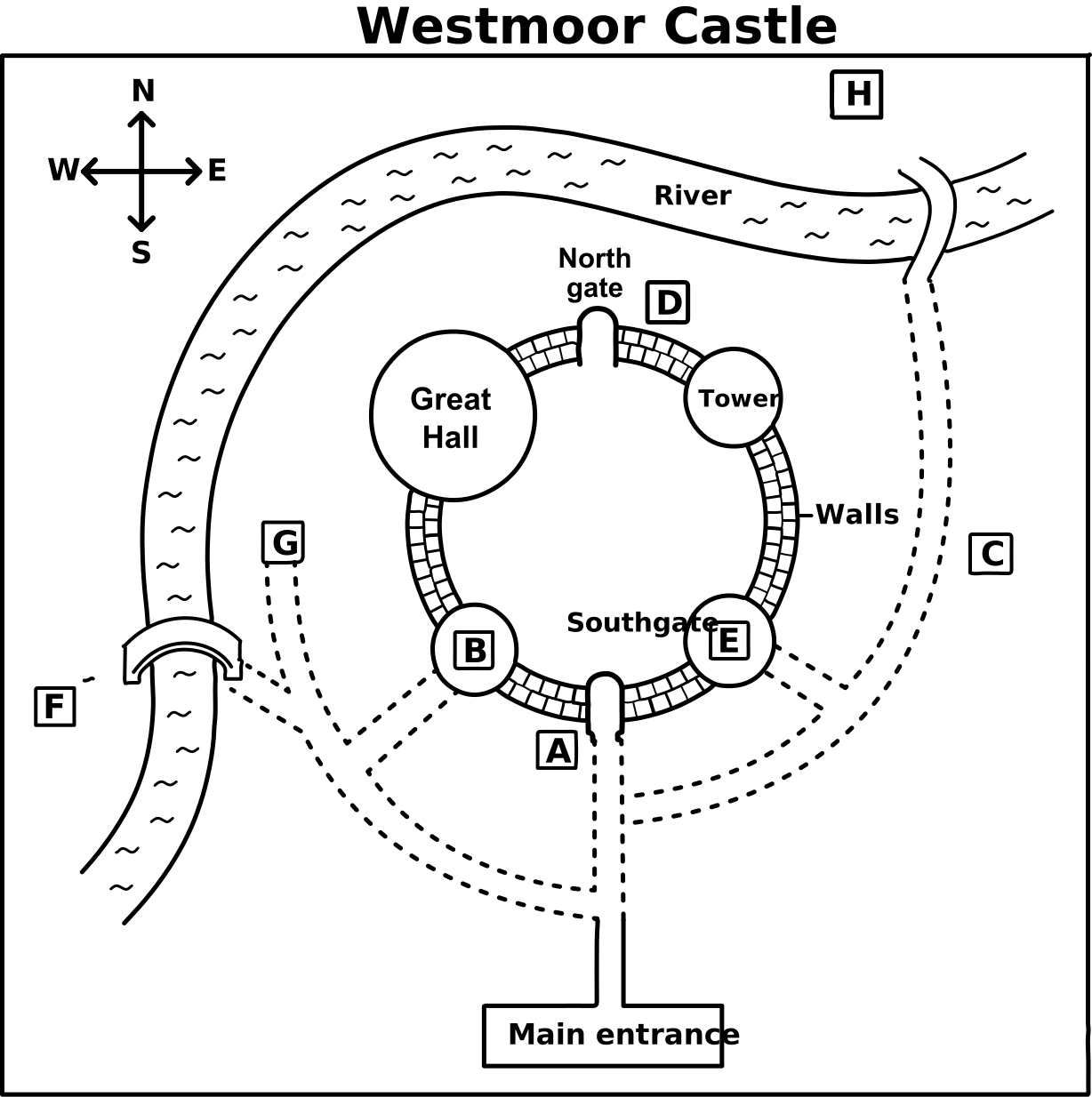
- Starting point for walking the walls
- Bow and arrow display
- Hunting birds display
- Traditional dancing
- Shop
-
spellcheck Answers
16. A
The correct answer is A because the wall walk starts at the Southgate after going straight up the path from the main entrance, and that starting point is labelled A.17. G
The correct answer is G because the bow and arrow display is reached by taking the left-hand path closest to the main entrance and following it past the bridge to the end, which is G.18. C
The correct answer is C because the hunting birds display is on the right after turning off just before the Southgate, past the tower there, matching C on the plan.19. H
The correct answer is H because the traditional dancing is on the open-air stage on the far side of the castle from the main entrance, beyond the bridge, which is H.20. B
The correct answer is B because the shop is inside one of the towers but entered from outside after following the left-hand path from the entrance and then turning right towards the tower doorway, and that location is B.
We'll be pulling up at Westmoor Castle in just under five minutes, but before we get there, let me give you a little background and explain what your visit will cover. The site itself has had some kind of fortified building on it for more than 1,100 years. The very first structure here was a small fort put up in 914 AD as a defence against Danish raiders. It was actually commissioned by King Alfred the Great's daughter, who was more or less ruling parts of England at that time. Roughly a hundred years later, after the Norman Conquest, the surrounding land was handed to a nobleman called Richard Davenport, and the castle he had built then stayed in the Davenport family for more than four centuries.
Things changed when Queen Elizabeth I announced, in 1576, that she planned to drop in on her way back from a royal progress. By that point the castle was looking distinctly tired, and rather than rebuild the existing guest rooms, the family decided to put up a brand new wooden lodging for her, attached to the side of the great hall. Her Majesty stayed there for four nights, and accounts from the time say it was extremely luxurious, but, sadly, the building was completely destroyed in a fire only a few years afterwards.
In the seventeenth century, the property changed hands again and was bought by the very wealthy Farnsworth family, who carried out major works to enlarge it and make it much more comfortable. The Farnsworths held on until 1982. By then, even with the modest grants the government was offering them for upkeep, the family simply couldn't cope with the running costs any longer, so the castle was put on the open market. It was eventually purchased by a national company that runs a chain of theme parks, and although that may sound off putting, you'll see when we arrive that they've been very careful to preserve the castle's original character.
Inside the building, the staterooms are now occupied by life sized wax figures dressed in costumes from various points in the castle's history. Some of them are even animatronic, they move and appear to chat to one another, which can be rather startling at first. Alongside the wax figures, in every single room you'll also find a printed booklet that explains what the room was once used for and tells you the history of the furniture and other objects on display.
The grounds are surprisingly large. In the past sheep were grazed here; in the nineteenth century the Farnsworths even kept their own small private zoo, which housed everything from rabbits to, at one point, a young elephant. Those former zoo buildings still stand and are now used as galleries for travelling exhibitions of paintings and sculpture, so do try to look in. The park also contains some magnificent old trees, although the very oldest ones, which were thought to be roughly 800 years old, were sadly brought down in the storms of 1987.
You're free to wander around independently until 4.30, and at that point we'll all meet again at the foot of the great staircase. From there, I'll take you through to the long gallery where we have a beautiful set of photographs showing the family who lived in the castle a hundred years ago, taking afternoon tea in a glass conservatory. We'll then walk you through to the very same conservatory, where afternoon tea will be served to you.
Before you hear the rest of the talk, you have some time to look at questions 16 to 20. [20 seconds] Now listen and answer questions 16 to 20.Right, if you can take a quick look at the plan I've handed out, you'll see that Westmoor Castle has four towers connected by a high curtain wall, with the river curling around two sides of the site. Use the main entrance as your starting point, and what you'll notice nearest the river is the Great Hall, inside the main tower, that's the largest of the four, which was made much bigger and redesigned during the eighteenth century.
From the main entrance, if you go straight up the path until you reach the Southgate, the steps up onto the walls are right there, just inside the grounds. That's where the wall walk begins for anyone who would like a good overall view of the castle. Please don't carry on as far as the Northgate, there's no way up onto the walls from that side.
Back near the entrance, take the left hand path closest to it and keep going past the bridge; the archery display, where experienced archers show off their skill with the bow and arrow, is straight ahead at the very end of that path. If you prefer animals, head again from the main entrance towards the Southgate, but turn off to the right just before you reach the gate instead of going through it. The hunting birds display is on your right, just past the tower you come to there.
Over on the far side of the castle from the main entrance, beyond the bridge, you'll find the open air stage where the traditional dancing starts at three o'clock; it's about a ten minute walk from where we'll be. The gift shop is also tucked into one of the towers, but the entrance is on the outside, so from the entrance area you follow that same left hand path and then take the right hand turn that leads around to the tower doorway.
Right, we're just pulling up now.

Diagram Labelling
Learn how to answer these questions in a step-by-step interactive exercise
Diagram Labelling
Nahrávky k popisování diagramů v IELTS Poslechu běžně používají slovní zásobu pro pohyb a navigaci, aby popsaly trasu. V tomto kroku si procvičíte poslech frází o tom, jak jít rovně, zahnout, minout orientační bod, přejít přes nějaké místo a dojít ke křižovatce nebo rozcestí.
| Pohyb | Jak to mluvčí obvykle řekne |
|---|---|
| Jděte dál rovně | Carry straight on · Continue down the main path · Follow the corridor until it ends |
| Zahněte / změňte směr | Veer to the left · Take a sharp right turn · Branch off to the side · Bend around to |
| Jděte kolem něčeho | Walk past the · Leave the fountain on your left · Bypass the main building |
| Přejděte přes | Cross the footbridge · Go over the intersection · Cut across the lawn |
| Slepé konce / křižovatky ve tvaru T | Where the path splits · At the T junction · Hits a dead end · When the path forks |
Poslouchejte v nahrávce tyto výrazy pro pohyb a použijte je k zodpovězení otázek.
Klikněte na přehrát a poslechněte si audio
Nahrávky k popisování diagramů v IELTS Poslechu často používají slovní zásobu pro vzájemnou polohu, aby popsaly jedno místo vzhledem k jinému. V tomto kroku si procvičíte poslech frází, které znamenají naproti, za, před, v rohu nebo obklopený jiným prvkem.
| Vzájemná poloha | Jak to mluvčí obvykle řekne |
|---|---|
| Přímo naproti | Facing the · Look straight across from · Directly opposite the |
| Za / před | At the rear of · Backing onto the · Obscured by the |
| Rohy / vrcholy | In the top right quadrant · In the far corner · Tucked into the bend |
| Obklopený / obehnaný | Ringed by trees · Encircled by the path · Hemmed in by |
Poslouchejte v nahrávce tyto výrazy pro vzájemnou polohu a použijte je k zodpovězení otázek.
Klikněte na přehrát a poslechněte si audio
Typ úlohy 4 – Form, Note, Table, Flow-chart, Summary Completion (doplňování formuláře, poznámek, tabulky, vývojového diagramu, shrnutí)
V tomto typu úlohy dostanete formulář, sadu poznámek, tabulku, shrnutí nebo vývojový diagram a budete muset doplnit chybějící informace na základě poslechového textu. Možná budete muset vybrat odpovědi ze seznamu na zadání nebo určit chybějící slova z nahrávky, přičemž je nutné dodržet limit počtu slov uvedený v pokynech.
- formulář:
Otázka typu formulář je častým typem úlohy v části 1. Budete vyplňovat formulář jako přihlášku, rezervaci nebo objednávku. Často se bude jednat o telefonní rozhovor mezi dvěma lidmi. Jeden bude objednávat, rezervovat nebo se ptát na informace, zatímco druhý mu bude pomáhat. - sada poznámek:
Otázka typu poznámky je častým typem úlohy v části 4. Uslyšíte univerzitní přednášku a poté dostanete neúplné poznámky z přednášky. Budete muset doplnit chybějící body na základě přednášky. - tabulka:
Otázka typu tabulka se často používá ke kategorizaci mnoha věcí, jako jsou místo, čas a cena. Budete muset doplnit chybějící informace z tabulky. - vývojový diagram:
Vývojový diagram může znázorňovat proces, plán nebo posloupnost událostí v minulosti. Budete muset diagram doplnit buď slovy z nahrávky, nebo výběrem jedné z možností z písmenného seznamu. - shrnutí:
V otázce typu shrnutí dostanete odstavec, který shrnuje poslechový text, a budete muset doplnit slova, abyste shrnutí dokončili na základě toho, co slyšíte.
Pokyny si musíte přečíst velmi pozorně. Pokud například pokyn říká „NO MORE THAN TWO WORDS“, budete penalizováni za napsání více než dvou slov.
Questions 1-10
Complete the form below.
Write ONE WORD AND/OR A NUMBER for each answer.
| Name | Louisa 1 |
| Address | 2 White Stone Rd |
| Area | Bradfield |
| Postcode | 3 |
| Occupation | 4 |
| Reason for visit to town | To go to the 5 |
| Suggestions for improvement: | better 6 have more footpaths more frequent 7 |
| Things that would encourage cycling to work: | having 8 parking places for bicycles being able to use a 9 at work the opportunity to have cycling 10 on busy roads |
-
spellcheck Answers
1. Hardie
The answer is Hardie. The script says, "What's your name? It's Luisa.... Yes. Hardie." This line directly provides the surname needed for the answer.2. 19
The answer is 19. The script states, "It's 19, White Stone Road." This clearly indicates the street number of the address.3. GT82LC
The answer is GT8 2LC. The relevant line says, "It's actually G-T-8. 2-L-C." This provides the postcode exactly as required in the correct format.4. hairdresser
The answer is hairdresser. The script states, "I've actually just finished my training. I'm a hairdresser." This gives the respondent's occupation.5. dentist / dentists
The answer is dentist. The relevant statement is, "Actually it's not for shopping today, which would be my normal reason, but to see the dentist." This clearly gives the purpose of the visit to town.6. lighting
The answer is lighting. The line from the script says, "I think the lighting should be better." This shows the suggestion for improvement that is required.7. trains
The answer is trains. The script states, "I don't think there are enough trains. That's why I don't use them - you have to wait so long." This shows that trains are the public transport with an insufficient frequency.8. safe
The answer is safe. The passage says, "where I work there are no safe places to leave your bikes." This highlights the need for safe parking places for bicycles.9. shower
The answer is shower. The script states, "I'd arrive at work pretty sweaty so I think I'd need a shower somewhere at work." This identifies the facility needed to encourage cycling to work.10. training
The answer is training. The script mentions, "I think I'd like to see you offering training for that, you know, I'd feel a lot better about starting if that was the case." This shows that training is required to encourage cycling on busy roads.
Excuse me.
Yes?
I wonder if you could spare a few minutes to do a survey on transport.
It won't take long.
No, that's fine.
Lovely. The survey is on behalf of the local council. They'd like to know about what transport you use and any suggestions for improvement.
Can I start by asking you how you travelled to town today?
Sure. I came on the bus.
Great. Now can I get a few details about yourself?
OK.
What's your name?
It's Luisa ....
Yes.
Hardie.
Can you spell that, please?
Yes, it's H-A-R-D-l-E.
Great. Thanks. And can I have your address?
It's 19, White Stone Road.
Oh, right'. I know that area. It's Bradfield, isn't it?
That's right.
Is the postcode GT7?
It's actually G-T-8. 2-L-C.
Great. And could I ask what your job is? Are you a student?
I've actually just finished my training. I'm a hairdresser.
Oh, right. And one more question in this section. What is the reason for you coming into town today?
Actually it's not for shopping today, which would be my normal reason, but to see the dentist.
Right. Thanks.
Now in this last section I'd like you to give us some ideas about the facilities and arrangements in the city for getting to and from work, er, any suggestions you have for improvements.
Well, something I've thought about for some time is that when I do walk and I'm doing a later shift, I think the lighting should be better.
Yes, good point.
And of course, I think it's a real shame they've been cutting down on the number of footpaths. They should have more of those. Then people would walk more.
Yes, right.
And, I don't think there are enough trains. That's why I don't use them - you have to wait so long.
Thanks. And finally I'd like to ask your opinion on cycling. As you may know, there's a drive in the city to get more people to cycle to work.
Right.
But we realise that there are things which the council, but also employers, might do to help encourage workers to cycle to work.
Yep. Well, I have thought about it and where I work there are no safe places to leave your bikes.
OK.
And also, I'd have to cycle uphill and on a hot day I'd arrive at work pretty sweaty so I think I'd need a shower somewhere at work.
Right.
And I suppose the last thing is that I wouldn't be all that confident about cycling on such busy roads. I think I'd like to see you offering training for that, you know, I'd feel a lot better about starting if that was the case.
Well, that's very helpful. Thank you very much for your time.
No problem. Bye.
Completion - Part 1
Learn how to answer these questions in a step-by-step interactive exercise
Completion - Part 1
Mluvčí v Part 1 často řeknou jednu informaci a pak se sami opraví. Výrazy jako „actually“, „oh wait“ a „hold on“ vás varují, že první verze je špatně, takže odpovědí bývá až druhé datum, čas nebo číslo.
Nezapisujte první datum nebo číslo, které uslyšíte. Počkejte, až se oba mluvčí shodnou na stejné verzi, a teprve tu napište.
Klikněte na přehrát a poslechněte si audio
Part 1 po vás často chce napsat jméno, ulici nebo e-mailovou adresu a počítá se pravopis. Riziko představují písmena, která zní podobně, například A a E, E a I nebo G a J.
Zapisujte písmena tak, jak je mluvčí říká, a nehádejte podle zvuku celého slova. Když mluvčí písmeno upřesní pomocí slova, opište přesně to písmeno, protože právě to si většina uchazečů plete.
Klikněte na přehrát a poslechněte si audio
Než nahrávka začne, rozhodněte se, jaký druh slova každá mezera potřebuje. Když mezera potřebuje číslo, počítejte s tím, že mluvčí bude číslice seskupovat, místo aby je četl jednu po druhé. Oh znamená nulu, double opakuje číslici dvakrát a triple třikrát.
Zapisujte číslice rovnou, jak skupiny přicházejí. Pokud budete čekat na slovo zero, může vám uniknout zbytek řady.
Klikněte na přehrát a poslechněte si audio
Mezera se může ptát na čas nebo četnost. Mluvčí obvykle pojmenuje stejné období jinými slovy, takže k mezeře přiřaďte význam a nečekejte na formulaci ze stránky.
Před odesláním pak zkontrolujte limit slov. Přečtěte si celý řádek znovu s odpovědí v mezeře a odstraňte každé slovo, které už řádek obsahuje. Odpověď, která je významově správně, ale je příliš dlouhá, nezíská žádný bod.
Klikněte na přehrát a poslechněte si audio
Poznámky používají jednoduché sloveso, například must provide nebo need to bring. Mluvčí toto sloveso řekne jen zřídka, místo toho použije synonymum nebo činnost popíše, takže poslouchejte, co je skutečně požadováno.
Mluvčí často nejdřív zmíní další položky a pak je vyloučí. Když mezeru propásnete, nechte ji být a přejděte k další, protože odpovědi jdou v pořadí nahrávky a jedna ztracená mezera vás může připravit i o ty následující.
Klikněte na přehrát a poslechněte si audio
Questions 35-40
Complete the notes below.
Write ONE WORD ONLY for each answer.
Case studies:
Major Asian 35 were important early examples of commercial adoption
Major recent application is in 36 , where patients recover faster
Evidence:
Office studies recorded 15-20% 37 in the main stress hormone
Improved 38 is the clearest school-related finding
Limitations:
The extra cost is a bigger problem when project 39 are narrow
The ongoing maintenance 40 is considerable for living features
-
spellcheck Answers
35. airports
The correct answer is airports. The speaker identifies major Asian airports as early examples and says airports led early adoption rather than office headquarters.36. hospitals
The correct answer is hospitals. The lecture says hospitals are a key recent building type for biophilic design, where patients with greenery or natural light recover faster.37. reductions
The correct answer is reductions. The lecturer says office workers in biophilic interiors typically show reductions of fifteen to twenty per cent in cortisol, the main stress hormone.38. attendance
The correct answer is attendance. In schools, the speaker says the headline measure that improves is attendance rather than test scores.39. margins
The correct answer is margins. The lecturer says the cost premium is an obstacle in projects where the margins are tight.40. overhead / cost
The correct answer is overhead. The lecturer says the ongoing maintenance overhead is substantial because living plants, water features and living walls need specialist care.
Good morning. So, today's lecture is about a movement in modern architecture called biophilic design, a movement that has gone, in less than two decades, from a niche idea promoted by a handful of academics into a mainstream principle adopted by some of the largest commercial property developers in the world.
Now, biophilic design rests on the simple, though originally controversial, idea that human beings need regular sensory contact with nature in order to function well, that we are evolutionary creatures of forests and grasslands, not of windowless office cubicles. From that starting point, designers ask the question: what would a building look like if it actually took human contact with nature seriously? The argument that has captured commercial attention is the practical one, that biophilic buildings produce measurable gains in worker productivity. Productivity, ultimately, is what has persuaded the property developers, not aesthetics.
So, almost every biophilic project, you know, shares several features.
With that in mind, daylight is central. Maximising natural daylight throughout the interior, large windows, deep light wells, glass partitions instead of solid walls, central atria that bring sun into the heart of the building. Wherever possible, daylight replaces artificial lighting during working hours.
And living plants matter as well. Not a single decorative pot in the lobby, but plants throughout, at the workstation, on green walls running through the office, in interior planted courtyards. Living plants are central to the biophilic claim; without them, I mean, you essentially do not have a biophilic interior.
As for materiality, that also matters. Where the dominant materials in a conventional commercial building are steel, concrete and glass, biophilic interiors deliberately use exposed natural materials, and the standout choice is wood, in floors, ceilings, beams and wall panelling. Visible wood does most of the work in giving a biophilic interior its characteristic feel.
That is why two building types in particular have driven the spread of biophilic design.
In fact, airports, perhaps surprisingly, have been important early examples. The new generation of major Asian airports, and Singapore's Jewel Changi terminal is the obvious flagship, have integrated extensive indoor gardens, central tropical waterfalls, and walls of living plants directly into the passenger experience. Airports, with their long dwell times and stressed travellers, have been ideal demonstrators for the technology; they led early adoption rather than office headquarters, as some people assume.
And hospitals are another key building type. The biophilic literature on hospitals is now substantial, and the consistent finding is that patients in rooms with views of greenery, gardens, or natural light recover measurably faster than patients in equivalent rooms without those views. Length of stay drops, painkiller use drops, mood improves. Hospitals have therefore become a major arena for biophilic design over the past decade.
Well, the supporting evidence has shifted dramatically over the last fifteen years. The earliest biophilic claims were largely anecdotal; the recent evidence is hard physiology. The most cited finding is on stress hormones. Office workers in biophilic interiors show measurably lower levels of cortisol, the principal stress hormone, than matched workers in conventional offices. Reductions of fifteen to twenty per cent in cortisol are typical, and the effect persists across the working week.
Schools tell a similar story, but with a different headline measure. The crucial finding from school studies is on attendance. Classrooms with much higher natural light and direct views of greenery show meaningful reductions in absenteeism, pupil attendance rates rise, sometimes by several percentage points across the year. That school finding is about attendance rather than test scores, which are far harder to attribute.
But biophilic design is genuinely good, not free, and I want to be clear about the trade offs.
This means upfront cost is a limitation. Biophilic interiors typically add somewhere between five and fifteen per cent to the construction cost of a building, and that cost premium has been an obstacle to adoption in projects where the margins are tight. The cost question, more than any aesthetic concern, is what slows the spread of biophilic design.
And long term maintenance is another limitation. Living plants need watering, feeding, and periodic replacement. Water features need filtration. Living walls need horticultural specialists on contract. The ongoing maintenance overhead is substantial, and developers who installed biophilic features without budgeting properly for that maintenance have seen the features degrade visibly within five years.
So biophilic design is real, it is increasingly evidence based, and it is here to stay, but it is not a free lunch, and the cost and maintenance issues need honest discussion at the design stage.
Completion - Part 4
Learn how to answer these questions in a step-by-step interactive exercise
Completion - Part 4
Přednášející málokdy něco jen prostě tvrdí. Fráze jako it was once thought, a popular theory a this has been disproved vylučují myšlenku, která právě zazněla.
Nezapisujte první slovo, které do mezery sedí. Počkejte, zda ho mluvčí přijme, nebo odmítne, a pak napište myšlenku, která obstojí.
Klikněte na přehrát a poslechněte si audio
Řádek poznámek může použít širokou kategorii, například materials nebo pollutants, zatímco přednáška jmenuje několik konkrétních členů této kategorie. Podmínku zapsanou v poznámkách splňuje jen jeden z nich.
Hledejte shodu s podmínkou, ne s kategorií, a nevšímejte si položek, které mluvčí označí za bezpečné nebo běžné. Pak spočítejte slova, protože odpověď nad uvedený limit nezíská žádný bod.
Klikněte na přehrát a poslechněte si audio
Přednášky v Part 4 používají hustou odbornou slovní zásobu a neznámá slova vás mohou vyvést z míry. Jazyk kolem mezery může být obtížný, ale samotná odpověď je obvykle běžné slovo, protože test měří poslech, ne odborné znalosti.
Těžká slova nechte projít a držte se jednoduchého významu věty. Pak napište odpověď tak, jak ji slyšíte, protože špatné písmeno nezíská bod, ani když je slovo správně.
Klikněte na přehrát a poslechněte si audio
Typ úlohy 5 – Multiple choice (výběr z více možností)
V úloze typu multiple choice je otázka následovaná třemi možnými odpověďmi nebo začátkem věty
následovaný třemi možnými způsoby, jak větu dokončit.
Do Answer Sheet musíte odpovídat PÍSMENY (A, B nebo C). Nepište slovo (slova) odpovědi!
Někdy dostanete delší seznam možných odpovědí a jste vyzváni, abyste vybrali více než jednu.
V takovém případě byste si měli otázku pozorně přečíst a zkontrolovat, kolik odpovědí je požadováno.
Questions 21-24
Choose the correct letter, A, B or C.
21. What surprised Sophie most when she began researching news photography?
- printing photos was possible long before newspapers used it
- early photographers carried heavier equipment than expected
- the first printed photos were heavily retouched
22. According to Marcus, how were the very first portrait photographers in the 1840s and 1850s regarded?
- as reporters of individual lives
- mainly as artists, not journalists
- as a curiosity, not a profession
23. What aspect of today's news photography do both students find most worrying?
- readers distrust photos because of editing
- algorithms choose which photos people see
- modern photographers receive less training
24. What do the students agree is the most significant change smartphones have brought to photojournalism?
- Phones have mostly replaced staff photographers.
- Phones make image verification harder.
- Phones have reduced image quality.
-
spellcheck Answers
21. A
(A) is correct. Sophie says a workable means of reproducing photographs in print existed before editors were willing to use photographs instead of engravings.(B) is incorrect. Marcus only says he had assumed equipment was the bottleneck, but Sophie rejects that.
(C) is incorrect. Retouching is not mentioned as the surprising delay.
22. B
(A) is incorrect. He says the reporter idea came much later.(B) is correct. Marcus says early portrait photography sat closer to painting than reporting, with photographers charging like portrait painters and showing work in galleries.
(C) is incorrect. Their work was treated seriously in art settings.
23. C
(A) is incorrect. She says photo-editing software is too obvious and not the main issue.(B) is incorrect. Algorithms are not discussed as the students' main concern.
(C) is correct. Sophie says the main worry is that many people now enter the field with far less formal preparation than photographers used to have.
24. B
(A) is incorrect. Marcus says professional photojournalists have not been made redundant.(B) is correct. The students agree that smartphones have made editors work harder to check whether an image really shows what the sender claims.
(C) is incorrect. Image quality is not identified as the significant change.
Sophie: Professor Adams, well, the first thing that caught me out was the long gap between the invention of photography and its normal use in newspapers.
Professor Adams: What had you expected?
Sophie: I suppose I thought newspapers were simply waiting for the machinery to catch up. But that is not really what happened. For years, the means of reproducing photographs in print was there, at least in a workable form, and editors still preferred engravings based on photographs. It seems they trusted the familiar look of drawn images more than the new photographic one.
Marcus: I had the same false assumption, actually. I imagined the equipment was holding everything back.
Sophie: Yes, that surprised me too, to be honest.
Marcus: On a related point, I have been looking at the very early portrait photographers, you know, the ones working in the 1840s and 1850s in studios. I found it interesting how they fitted into society at the time.
Professor Adams: In what way?
Marcus: Well, they were using cameras, of course, and the sitters were real people, but the work sat much closer to painting than reporting. They charged like portrait painters, showed their work in galleries, and were discussed in the art pages. The idea of a photographer as someone gathering news comes later.
Sophie: Right, so they were treated almost as a new kind of portrait painter.
Sophie: Now, moving to the present, I think we need one section on the flood of images people see every day. Did you check the figures, Marcus?
Marcus: Yes, I checked them. The numbers are huge, billions of images going online daily.
Professor Adams: And where do you think the real risk lies?
Sophie: Well, not just in the number of images. I mean, I do not want to make it only about photo editing software, because that is too obvious. I keep coming back to the fact that a lot of people now enter the field with far less formal preparation than photographers used to have. The old apprenticeship route was not perfect, but it did teach people what could and could not be done in a news context.
Marcus: Yes, exactly. The professional filter is thinner than it was. That is what worries me too.
Marcus: And for the smartphone section, can we agree on our angle? I would not say phones have made professional photojournalists unnecessary. The major papers still employ serious photographers.
Sophie: I agree. I mean, the bigger change is what happens when a picture arrives from almost anyone, from almost anywhere. Editors then have to work out whether the scene, date and source are what the sender claims. That checking process has become much more demanding.
Marcus: Right.
Professor Adams: Good, agreement on that.
Before you hear the rest of the conversation, you have some time to look at questions 25 to 30. [20 seconds] Now listen and answer questions 25 to 30.Professor Adams: Right, for these six developments in the history of news photography. Think about what kind of shift each one caused. Was it mainly about what cameras and presses could do, what readers expected to see, or the rules around using images?
Sophie: The daguerreotype in 1839 feels like the starting point. I mean, before that, there just was not a practical photographic process that people could use reliably. Once that existed, the rest of the story became possible.
Marcus: Yes, basically, it changes the basic means of making an image.
Marcus: The wet plate process in the 1850s is similar in that sense, I suppose, though it comes a bit later. Exposure times became much shorter, and photographers could make negatives that were useful again, rather than treating every image as a single object.
Sophie: So, yes, that is still about the method becoming more workable.
Sophie: War photography is different, I think. With Fenton in the Crimea and then the Brady studio in the American Civil War, people were beginning to want more than written descriptions. They wanted visual evidence of events they had previously only imagined.
Marcus: Yes, I think so. The camera mattered, but the real pressure came from what readers were ready to look at.
Marcus: The rotogravure press around 1900 is a bit more complicated. It made large scale newspaper reproduction easier, but the interesting consequence for journalism was what happened afterwards. If the same photograph could appear across the country, newspapers had to settle who controlled it, who could reuse it, and under what conditions.
Sophie: That's an important consequence, actually.
Sophie: Colour photography after the war is more straightforward. Film and printing processes developed to the point where newspapers could gradually move beyond black and white.
Marcus: Yes, readers liked the result, but the possibility had to exist.
Marcus: Digital cameras are the tricky one, I think. The sensors were new, obviously, but in journalism the bigger change was the speed and quantity of pictures readers came to expect. Suddenly a story from almost anywhere felt incomplete without an image arriving almost immediately.
Sophie: Yes, in a way, people began to assume there would be a picture of nearly everything.
Professor Adams: Good. That gives you a useful classification without making the presentation too mechanical.

Multiple Choice
Learn how to answer these questions in a step-by-step interactive exercise
Multiple Choice
Správná možnost obvykle parafrázuje to, co mluvčí říká. Možnost, která opakuje slovo, jež jste slyšeli, bývá často past, protože mluvčí může toto slovo použít k odmítnutí myšlenky nebo k popisu něčeho jiného.
Než audio začne, přečtěte si všechny možnosti a rozmyslete si, jak by každá zněla v běžné řeči. Pak poslouchejte význam, ne slova.
Klikněte na přehrát a poslechněte si audio
Mluvčí často popisuje, čím místo nebo plán býval dříve, čím je teď a čím bude později. Každá možnost může platit v jiném čase, takže si před rozhodnutím ověřte, na který čas se otázka ptá.
Časové signály jako used to, at the moment a next year roztřídí možnosti na minulost, přítomnost a budoucnost.
Klikněte na přehrát a poslechněte si audio
Mluvčí během řeči mění názor. První návrh může znít jako konečný, ale pak druhý mluvčí nesouhlasí, přidá omezení nebo nabídne něco lepšího. Když se mluvčí opraví, správná je druhá odpověď.
Počkejte, až oba mluvčí přijmou stejnou možnost. Otázky jdou v pořadí nahrávky, takže když jednu ztratíte, pokračujte dál, místo abyste si ji přehrávali v hlavě.
Klikněte na přehrát a poslechněte si audio
Questions 21-22
Choose TWO letters, A-E.
Which TWO factors most strongly predict tram-network success?
- separate tram lanes
- single tickets for trams, buses and metro
- many stops along each route
- discounted off-peak fares
- accessible low-floor vehicles
-
spellcheck Answers
21-22. A, B (in either order)
(A) is correct. Daniel says dedicated lanes are the single most important factor, and Maya agrees.(B) is correct. The recording supports this option: single tickets for trams, buses and metro.
(C) is incorrect. Stop density matters less after controlling for fare integration.
(D) is incorrect. Stop density, off-peak discounts, and low-floor vehicles are all described as weaker or non-distinguishing factors.
(E) is incorrect. Stop density, off-peak discounts, and low-floor vehicles are all described as weaker or non-distinguishing factors.
Maya: Now that we've done the research into tram systems, we need to decide how to organise the report.
Daniel: We should probably begin with what makes a network succeed. I used to think stop spacing would be the main thing, because if stops are too far apart people won't walk to them.
Maya: True, but the figures don't really put that at the top, do they?
Daniel: No. The clearest difference is between trams that have to crawl along with cars and buses, and trams that get their own space for most of the route. Once they are kept out of traffic, reliability improves, and people seem much more willing to use them.
Maya: That makes sense. A tram is not much use if it gets stuck like a bus.
Daniel: The other thing I underestimated was ticketing. In cities where one ticket covers the tram, bus and metro, passengers treat the tram as part of the whole journey. If they have to buy a separate tram ticket, usage is much lower.
Maya: That's a strong point.
Daniel: Exactly. Off peak discounts help a bit, but they don't transform a network. Low floor access is important, of course, but it is standard on new systems now, so it doesn't explain the difference between success and failure.
Maya: OK, that gives us enough for that section. What about recommendations for planners starting from scratch?
Daniel: I was tempted to say never mix trams with cars, but that is too absolute. Some good networks share central streets and still work.
Maya: Then what should we emphasise?
Daniel: Start modestly, but make the first line excellent. The systems that began with one frequent, reliable corridor had something solid to build on. The cities that launched several lines at once often struggled to make the service feel dependable.
Maya: Yes, prove the first line works before extending it.
Daniel: And routes need to match where people already live. If the housing is too spread out, a tram line looks impressive on a map but does not attract enough daily passengers.
Maya: Yes, they'd need to align.
Daniel: Exactly. I don't think we need to insist on a flat fare, and buying the newest fleet immediately is not really the central issue.
Maya: Good, those recommendations feel defensible. Shall we look at the city examples now?
Before you hear the rest of the conversation, you have some time to look at questions 25 to 30. [20 seconds] Now listen and answer questions 25 to 30.Daniel: Yes. Melbourne is the obvious one to start with. It is enormous, but it does not feel chaotic. The routes form a clear grid, central sections often have their own space, and people can work out when the next tram is likely to come.
Maya: So it is big, but still legible.
Daniel: Lisbon is a surprise. You'd expect those old hill trams to be kept mainly for nostalgia, or even to have disappeared, but visitors have turned them into a serious earner for the city.
Maya: Yes, tourism has changed the whole financial picture. Vienna is trickier. We both agree it works brilliantly, but not on the explanation.
Daniel: I keep coming back to the frequency. You rarely wait long.
Maya: Whereas I think the dense housing and compact streets are doing at least as much work.
Daniel: We can present both readings.
Maya: Toronto?
Daniel: Long history, loyal users, but the recent graph is frustrating. It hasn't collapsed, but it hasn't really climbed either, even while the city has kept growing.
Maya: Yes, it is stuck rather than failing.
Daniel: Edinburgh is the cautionary tale. The first line was late and expensive, and the Newhaven extension has not yet repaired the reputation. The early reviews talk about weak passenger numbers and reliability problems.
Maya: Not exactly the reset they wanted. And Bordeaux?
Daniel: The first phase was strong, but then the city added branches faster than demand could justify. Some of the newer lines run into areas where there just aren't enough regular riders.
Maya: That explains the problem.
Daniel: Exactly.
Multiple Selection
Learn how to answer these questions in a step-by-step interactive exercise
Multiple Selection
Správná možnost obvykle parafrázuje to, co mluvčí říká. Možnost, která opakuje slovo, jež jste slyšeli, bývá často past, protože mluvčí může toto slovo použít k tomu, aby řekl, že daná věc nabízena není.
Zkontrolujte, kolik odpovědí zadání požaduje, a označte přesně tolik. Třetí možnost, která se stále zdá možná, nic nezíská, když jsou správná jen dvě písmena.
Klikněte na přehrát a poslechněte si audio
Typ úlohy 6 – Short Answers (krátké odpovědi)
Otázky s krátkou odpovědí vyžadují, abyste si přečetli otázku a poté napsali krátkou odpověď s použitím informací z poslechového textu.
Pravděpodobně dostanete limit, například „No more than two words“.
Pokud napíšete více slov, než kolik vám pokyny dovolují, vaše odpověď bude označena jako nesprávná.
Velmi často budete muset najít podrobné informace související s nějakou kategorií.
Můžete například dostat otázku jako tuto:
What type of boxes were used to catch wombats gently?
Questions 38-40
Answer the questions below.
Write ONE WORD ONLY for each answer.
38. What type of boxes were used to catch wombats gently?
39. Where was the soft padded harness fitted?
40. What direct problem may wombats avoid by keeping apart?
-
spellcheck Answers
38. traps / trap
The correct answer is traps because the wombats were caught gently in box traps.39. neck
The correct answer is neck because the GPS unit was attached to a soft padded harness around the neck.40. conflict / injuries
The correct answer is conflict because the lecturer suggests wombats may avoid one another to prevent direct conflict.
Okay, last week we started looking at marsupials, including kangaroos and possums. So today I'd like us to have a look at another marsupial, the wombat. And in particular, at some studies that have been done on a particular type of wombat whose Latin name is Vombatus ursinus. This is commonly known as the common wombat or bare nosed wombat, because it has a hairless nose pad, in contrast with the hairy nosed species.
Now, the common wombat itself is worth describing in some detail. Common wombats live in southern and south eastern Australia, where they're still relatively common. Unlike most other marsupials, which are largely arboreal or hopping in lifestyle, wombats are short legged, heavy bodied burrowers. They're mostly grey brown in colour, but what's particularly distinctive about them is their teeth, which grow continuously throughout their entire lives, like those of rodents, and that has all sorts of consequences for their diet and dental health, as we'll see in a minute. And, you know, they're much heavier than most other marsupials of their size, with a thick set body and a famously cube shaped scat.
In terms of diet, they have quite a varied feeding repertoire, including bark and roots, but they mostly eat grasses of various kinds. Now, even though they're quite large and powerful, with strong jaws that can chew through tough fibrous stems, they still have a few predators. Large birds of prey were one of the main ones for the young, but nowadays adults are more likely to be caught and killed by dingoes, particularly during droughts when food is scarce. Another threat to their survival isn't a predator at all, but is man made: quite a large number of common wombats are killed by cars when they're trying to cross country roads at dusk.
So one study carried out by Dr Naomi Coltrane at the University of New England investigated the methods of navigation of these wombats. Although they move slowly, they can travel long distances between feeding patches, and they always return to the same burrow systems. She found that even if individual wombats were taken some distance away from their home territory, they could usually find their way back home as long as they could detect a clear scent trail along the route, they didn't need any visual landmarks at all. The animals would stop, lift their heads, sniff the air, and then move with real confidence in a particular direction, even in low light.
Now, observations of these wombats in the wild have also revealed that their living habits are quite unusual. Unlike most ground dwelling mammals of their size, it seems that they're relatively settled, returning to the same burrow year after year. Generations of wombats can use the same burrow for decades. The male and female don't share the burrow most of the year, but they do come together at the same site during the mating season.
Well, it's quite interesting to think about the possible reasons for the male staying around in mating season. It could be that it's to do with protecting the young. You'd expect them to have a much better chance of survival if both parents are around. But in fact, observers have noted that, once the babies have left the pouch and are independent, there's very little interaction between the male and his young. So there isn't really any evidence to support the parental protection idea.
So another suggestion, then, is based on the observation that male wombats which return to the same burrow tend to be larger and more aggressive than other males. So maybe the male wombats stay around so they can give the female access to the safety of the burrow, and so provide a kind of shelter from rival males that try to drive her out. But again, we're not really sure.
Now, another study involved collecting data by tracking the wombats. I mean, I was actually involved in this myself. We caught some wombats in the wild, gently, in box traps, and we developed a small GPS unit that would allow us to track them. We fitted this onto their collar, a soft padded harness around the neck. Then we set the wombats free again, and we were able to track them for thirty days and gather data, not just about their location, but even about the number of encounters they had with other wombats during the night.
Okay, one surprising thing we discovered from this is that there were far fewer encounters between wombats than we had expected. It seems that they were actually trying to avoid one another. So why would that be? Well, again, we have no clear evidence, but one hypothesis is that wombats can cause quite serious injuries to one another in territorial disputes, a wombat's head and shoulders are heavily armoured, and they can deliver a painful charge. So maybe this active avoidance is a way of preventing direct conflict. But we need to collect a lot more data before we can be sure of any of this.

Short Answer
Learn how to answer these questions in a step-by-step interactive exercise
Short Answer
Nahrávka nesleduje pořadí slov vytištěné na vaší stránce. Mluvčí často řekne odpověď nejdřív a slovo z otázky až potom, takže odpověď může zaznít dřív než nápověda, na kterou čekáte.
Odhadněte, jaký druh slova otázka potřebuje, například místo, čas nebo materiál, a zachyťte toto slovo, ať zazní kdykoli.
Klikněte na přehrát a poslechněte si audio
Přednášející může větu otočit a podmět nechat až na konec. Gramatika v nahrávce nemusí odpovídat gramatice na vaší stránce, takže sledujte význam, ne pořadí slov.
Otázky jdou v pořadí nahrávky, takže když vám některá uteče, hned přejděte k další. Pak spočítejte slova v odpovědi a zkontrolujte pravopis.
Klikněte na přehrát a poslechněte si audio