The Writing Task 1 of the IELTS Academic test requires you to write a summary of at least 150 words in response to a particular graph (bar, line or pie graph), table, chart, or process (how something works, how something is done).
This task tests your ability to select and report the main features,
to describe and compare data, identify significance and trends in factual information, or describe a process.
- - You should spend about 20 minutes on this task.
- - Write in a formal style
- - Write at least 150 words
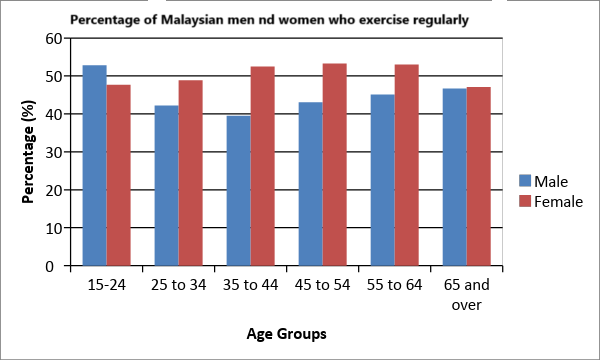
The chart below shows the proportion of males and females in Malaysia who commonly do physical activity in 2010.
Summarise the information by selecting and reporting the main features, and make comparisons where necessary.
Write at least 150 words
Klíčová slova v tomto cvičení
Související slova
K tomuto cvičení není přiřazena žádná slovní zásoba
Nechte si ohodnotit esej s opravami gramatiky a podrobnou zprávou o skóre.
assignment
Získat prémiové hodnocení psaní
Ukázkové hodnocení writing
Souhrn skóre
Hodnocení AI
Zpětná vazba ke kritériím
Strengths
- The writing gives a clear overview of the process.
- It covers the main starting point and ending point of the recycling cycle.
- Most key stages of the process are included.
The overview is helpful and easy to find. The sentence “Overall, recycling plastic is a six-step process” clearly tells the reader the number of stages. It also shows the first and last stages with “starts from the pick-up of sorted waste and ends with the production of new goods.” This matches the task well because a process report needs a clear summary of the whole diagram.
The body paragraphs also describe several important stages. For example, the student mentions collection, transport, storage, sorting, inspection, cleaning, chopping, shipping, and making new products. These points show that the writer understands the general process and does not ignore the main route of the plastic.
Weaknesses- Some details from the process are missing or not fully clear.
- A few stages are joined together too quickly.
- One added idea is not clearly shown as part of the diagram.
The report covers the main process, but some steps are not explained enough. For example, “it is cleaned with environmentally safe substances and chopped into small particles” combines two stages very quickly. The reference process shows cleaning and then the material becoming plastic grind before boxing and resale. The student gives the main idea, but the middle development is quite brief.
Another point is that “plastic masses are shipped in boxes” is a little unclear. The diagram shows small plastic pieces or processed plastic being boxed, so this phrase does not fully explain what is sent. A clearer line would be: “The chopped and cleaned plastic is then packed in boxes and sent to another factory.”
The final sentence says, “And that is when the cycle begins again, with used products going to waste.” This idea sounds logical, but it is not clearly required by the task. In a process description, it is safer to report only what the diagram shows. A better ending would be: “These new products are then sold on the market.”
Exercises for Improvement- Practice writing one clear overview sentence with the first stage, last stage, and number of steps.
- Practice expanding short process stages into full sentences.
- Practice checking each sentence against the diagram, and remove ideas that are not shown.
For the first exercise, use this model: “Overall, the process has six stages, beginning with collection and ending with the sale of new plastic products.” Then make three new versions for other diagrams.
For the second exercise, take one short line like “cleaned and chopped” and split it into two steps: “Next, the plastic is washed with safe soap and water. After that, it is chopped into tiny pieces.” This helps you show each stage more fully.
For the third exercise, draw a checklist from the diagram. After writing, ask: “Did I mention only visible stages?” If a sentence adds extra ideas, rewrite it. For this task, replace the last sentence with “The new goods are finally sold to consumers.”
Grammatical Range and Accuracy
Strengths
- The writing shows good control of basic sentence grammar.
- Passive forms are used well for process description.
- There is some variety in sentence structure.
The grammar is often accurate in simple and complex sentences. For example, “The waste is then transported by a truck to the factory's warehouse” is correct and suitable for a process report. Process tasks often need passive voice, and the student uses it naturally here.
There is also a good mix of structures. The sentence “Once the plastic waste has been thoroughly inspected, it is cleaned with environmentally safe substances and chopped into small particles” uses a time clause well. This helps the writing sound more controlled and shows more than only basic sentence forms.
Weaknesses- There are some grammar mistakes in word form and sentence building.
- A few phrases are not grammatically natural.
- One sentence start creates an avoidable linking problem.
The opening sentence has a grammar problem: “illustrates the behind the scenes of plastic renewance cycle.” After “illustrates,” the phrase is not built correctly. “The behind the scenes of” is not a natural structure here, and “renewance cycle” uses the wrong form. A better sentence would be: “The diagram illustrates the plastic recycling process.”
There is also a small grammar issue in “which starts from the pick-up of sorted waste.” In English, “starts with” is more natural than “starts from” in this sentence. So a better version is: “which starts with the collection of sorted waste.” Small grammar choices like this affect accuracy.
The last paragraph begins with “And that is when the cycle begins again.” Starting with “And” is possible in some styles, but here it makes the sentence sound less formal and less controlled for IELTS Task 1. A smoother option is: “The cycle then ends with the sale of these products.”
Exercises for Improvement- Practice rewriting awkward phrases into simple process sentences.
- Practice passive voice sentences for each stage of a diagram.
- Practice common process patterns such as “starts with,” “is then,” and “is finally.”
For the first exercise, take incorrect phrases and rewrite them. Example: change “the behind the scenes of plastic renewance cycle” to “the process of plastic recycling.” Do this with five phrases from your own writing.
For the second exercise, write one passive sentence for each step. For example: “The plastic is collected.” “It is stored in a warehouse.” “It is chopped into small pieces.” This will build accuracy for Task 1 grammar.
For the third exercise, make a short template list: “The process starts with… Next, … is transported… After that, … is cleaned… Finally, … is sold.” Then use the template with new diagrams until the patterns feel natural.
Lexical Resource (Vocabulary)
Strengths
- The student uses enough topic words for a process about recycling.
- There is some attempt to vary vocabulary.
- Several word choices fit the task well.
The writing includes useful words for this topic, such as “recycling,” “sorted waste,” “warehouse,” “inspected,” “chopped,” “particles,” “shipped,” and “manufacturing.” These words help explain the plastic recycling process clearly and show enough language for the task.
The student also avoids repeating the same noun every time. For example, the writing uses “plastic waste,” “stored waste,” and “new goods.” This shows some range, which is useful in IELTS Task 1.
Weaknesses- Some vocabulary choices are incorrect or unnatural.
- A few words make the process less clear.
- There is some overuse of unusual wording where simple words would work better.
The phrase “plastic renewance cycle” is the clearest example of a weak word choice. “Renewance” is not the right word here. It sounds invented or wrongly formed. In IELTS Task 1, accurate simple words are better than unusual words. A clear replacement is: “plastic recycling process.”
The phrase “behind the scenes” is also not a good fit for this report. It is more common in everyday speech, not in a process description. Because of this, the sentence sounds less precise. A better option is: “The diagram shows how plastic is recycled.”
Another unclear phrase is “plastic masses.” This does not clearly describe the material in the diagram. The reader may not know if this means liquid plastic, large blocks, or small pieces. A more exact phrase would be: “the cleaned plastic pieces” or “the plastic grind.”
The student sometimes uses longer phrases when a simple one would be stronger. For example, “environmentally safe substances” is understandable, but if the diagram shows soap and water, then “soap and water” is more exact. In this task, exact words usually help more than broad words.
Exercises for Improvement- Build a small word list for common process tasks.
- Practice replacing awkward words with simple, exact ones.
- Match words to the diagram so each noun clearly names the material or action.
For the first exercise, make a list with pairs like: collect, transport, store, sort, inspect, wash, chop, pack, manufacture, sell. Write one sentence with each word.
For the second exercise, rewrite phrases from your report. Change “renewance cycle” to “recycling process,” “behind the scenes” to “shows,” and “plastic masses” to “plastic pieces.” This trains you to choose safer words.
For the third exercise, look at each stage in the diagram and name it with one exact noun and one exact verb. For example: “warehouse - store,” “machine - chop,” “boxes - pack.” Then use those words in a short full report.
Coherence & Cohesion
Strengths
- The report has a clear overall structure.
- The stages are mostly presented in the correct order.
- The writer uses linking words to guide the reader.
The writing is easy to follow because it has an introduction, an overview, and body details. This is a good structure for IELTS Task 1. The reader can quickly understand what the diagram is about and then follow the process from beginning to end.
The order of ideas is also mostly clear. Phrases like “Everything starts with,” “then,” “When the time comes,” “Once,” and “After the following steps” help move the reader through the process. These signals support the sequence of events, which is important in a flow chart report.
Weaknesses- Some linking phrases are unclear or not well chosen.
- A few stages are grouped together, so the flow feels rushed.
- The final sentence weakens the ending of the report.
The phrase “After the following steps” is confusing. It does not clearly tell the reader which steps have finished. A clearer link would be: “After the plastic has been cleaned and chopped, it is shipped in boxes…” Good cohesion needs links that point clearly to the previous stage.
Some stages are packed into one sentence, especially in the middle. For example, inspection, cleaning, and chopping are all placed very close together. This makes the process feel faster than it is in the diagram. In Task 1, it often helps to separate important stages. You could write: “Next, the plastic is inspected by hand. It is then cleaned. After that, it is chopped into small pieces.”
The ending is less effective because it adds “the cycle begins again, with used products going to waste.” This moves away from the main reporting line and changes the focus at the end. A stronger ending would stay with the last shown stage: “Finally, the new products are sold to consumers.”
Exercises for Improvement- Practice using simple time-order linkers for each stage.
- Practice splitting long process sentences into shorter step-by-step sentences.
- Practice writing a clean ending that stops at the final stage in the diagram.
For the first exercise, write a list of linkers in order: “First,” “Next,” “Then,” “After that,” and “Finally.” Use them to rewrite this report with one main action in each sentence.
For the second exercise, take one long sentence from your report and break it into three short ones. For example, split the sentence about inspection, cleaning, and chopping into three separate steps.
For the third exercise, write three different final sentences that match the diagram only. Example: “Finally, the recycled plastic is made into new products and sold.” This will help your reports end in a clear and direct way.
Opravy gramatiky
Overall, recycling plastic is a six-step process, which starts from the pick-up of sorted waste and ends with the production of new goods made out of recycled plastic.
Everything starts with the collection of sorted materials by a company specializing in plastic recycling. The waste is then transported by a truck to the factory's warehouse, in which it is stored until the next stage. When the time comes, stored waste is sent out for final sorting. Once the plastic waste has been thoroughly inspected, it is cleaned with environmentally safe substances and chopped into small particles.
After the following steps, the plastic masses are shipped in boxes to partner companies that use the cut up pieces for manufacturing new products that will later be sold to consumers. And that is when the cycle begins again, with used products going to waste.
Overall, recycling plastic is a six-step process, which starts from with the pick-up of sorted waste and ends with the production of new goods made out of recycled plastic.
Everything starts with the collection of sorted materials by a company specializing in plastic recycling. The waste is then transported by a truck to the factory's warehouse, in which it is stored until the next stage. When the time comes, stored waste is sent out for final sorting. Once the plastic waste has been thoroughly inspected, it is cleaned with environmentally safe substances and chopped into small particles.
After the following steps, the plastic masses are shipped in boxes to partner companies that use the cut up cut-up pieces for manufacturing new products that will later be sold to consumers. And that is when the cycle begins again, with used products going to waste.
Návrhy na zlepšení
Overall, plastic recycling plastic is a six-step process, which starts six-stage process that begins with the pick-up collection of sorted waste and ends with the production of new goods made out of from recycled plastic.
Everything The process starts with the collection of when a specialist recycling company collects sorted materials by a company specializing in plastic recycling. waste. The waste is then transported by a truck to the factory's a warehouse, in which where it is stored until the next stage. When processing begins, the time comes, stored waste is sent out for final sorting. Once After the plastic waste has been thoroughly carefully inspected, it is cleaned with environmentally safe substances and then chopped into small particles. pieces.
After In the following steps, the final stage, these plastic masses pieces are shipped in packed into boxes and delivered to partner companies. These companies that use the cut-up pieces for manufacturing recycled material to manufacture new products that will later be products, which are then sold to consumers. And that is when Once these products are used and discarded, the cycle begins again, with used products going to waste. again.
Zlepšení slovní zásoby


Sentence Variety
Přepište několik vět své odpovědi s použitím různých větných struktur.

Soudržnost v psaní
Zlepšete svou schopnost uspořádat myšlenky tak, aby se váš text dobře četl.
cancel Grammar Correction
| Řešení | Vysvětlení |
|---|---|
| behind-the-scenes | This should be hyphenated because it is acting as a compound adjective before a noun ('behind-the-scenes of plastic renewance cycle'). |
cancel Grammar Correction
| Řešení | Vysvětlení |
|---|---|
| with | Use 'with' instead of 'from' to correctly introduce the instrument or material involved in the process. |
cancel Grammar Correction
| Řešení | Vysvětlení |
|---|---|
| cut-up | Use a hyphenated compound adjective before a noun: "cut-up pieces". Without the noun, "cut up" is a phrasal verb, but here it describes the pieces, so the hyphen is needed. |
cancel Improvement Suggestion
| Řešení | Vysvětlení |
|---|---|
| recycling cycle for plastic. | This wording is more natural and accurate. "Behind-the-scenes" is unnecessary here, and "renewance" is not standard English, so "recycling cycle for plastic" clearly states the process being described. |
cancel Improvement Suggestion
| Řešení | Vysvětlení |
|---|---|
| plastic | Adding "plastic" makes the phrase complete and ensures the subject is clear. The sentence needs this word to specify what kind of recycling cycle is being discussed. |
cancel Improvement Suggestion
| Řešení | Vysvětlení |
|---|---|
| This word is removed to avoid repetition, since the surrounding sentence already refers to plastic recycling. Deleting it makes the sentence smoother and less redundant. |
cancel Improvement Suggestion
| Řešení | Vysvětlení |
|---|---|
| six-stage process that begins | "Six-stage process" is a more formal and natural way to describe a sequence in a flow chart. "That begins" also reads more smoothly than "which starts" in this context. |
cancel Improvement Suggestion
| Řešení | Vysvětlení |
|---|---|
| collection | "Collection" is the more precise and formal noun for gathering waste in a recycling process. It fits better with the style of process descriptions. |
cancel Improvement Suggestion
| Řešení | Vysvětlení |
|---|---|
| from | "From" is the correct preposition here. It is more natural when describing movement or origin in this sentence. |
cancel Improvement Suggestion
| Řešení | Vysvětlení |
|---|---|
| The process | "The process" is more specific and appropriate than the vague word "Everything." It better introduces the sequence being described. |
cancel Improvement Suggestion
| Řešení | Vysvětlení |
|---|---|
| when a specialist recycling company collects | This change turns the phrase into a clearer active construction. It shows who performs the action and makes the first stage of the process easier to understand. |
cancel Improvement Suggestion
| Řešení | Vysvětlení |
|---|---|
| This phrase is removed because it is redundant after the revised wording already identifies the company and its action. Deleting it improves clarity and avoids repetition. |
cancel Improvement Suggestion
| Řešení | Vysvětlení |
|---|---|
| waste. | "Waste" is the correct and more accurate term in a recycling process. "Recycling" alone is incomplete here and does not fit the meaning of the sentence. |
cancel Improvement Suggestion
| Řešení | Vysvětlení |
|---|---|
| The article "a" is unnecessary here because the phrase reads more naturally without it in this context. |
cancel Improvement Suggestion
| Řešení | Vysvětlení |
|---|---|
| a | "The factory's" is too specific and awkward here; changing it to "a" makes the phrase more general and grammatically smoother. |
cancel Improvement Suggestion
| Řešení | Vysvětlení |
|---|---|
| where | "Where" is a clearer and more natural choice than "in which" when referring to a location. |
cancel Improvement Suggestion
| Řešení | Vysvětlení |
|---|---|
| processing begins, | This phrase adds a clear transition and helps explain the start of the next stage in the process. |
cancel Improvement Suggestion
| Řešení | Vysvětlení |
|---|---|
| This phrase is redundant and can be removed to make the sentence more concise and direct. |
cancel Improvement Suggestion
| Řešení | Vysvětlení |
|---|---|
| The word "out" is unnecessary in this context and removing it makes the phrase more natural. |
cancel Improvement Suggestion
| Řešení | Vysvětlení |
|---|---|
| After | "After" is more suitable here because it better matches the sequence of events in the process description. |
cancel Improvement Suggestion
| Řešení | Vysvětlení |
|---|---|
| This word is repetitive and can be removed to avoid redundancy and improve flow. |
cancel Improvement Suggestion
| Řešení | Vysvětlení |
|---|---|
| carefully | "Carefully" is a better fit because it describes the action in a more natural and precise way. |
cancel Improvement Suggestion
| Řešení | Vysvětlení |
|---|---|
| then | "Then" improves the logical flow by clearly linking one step to the next in the sequence. |
cancel Improvement Suggestion
| Řešení | Vysvětlení |
|---|---|
| pieces. | “Pieces” is a more natural and precise word for the small parts of plastic after chopping, while “particles” sounds less suitable in this context. |
cancel Improvement Suggestion
| Řešení | Vysvětlení |
|---|---|
| In | “In” creates a smoother transition into the description of the final stage, while “After” is awkward here. |
cancel Improvement Suggestion
| Řešení | Vysvětlení |
|---|---|
| final stage, these | This replacement makes the sentence more specific and grammatically clear by referring directly to the final stage and the material involved. |
cancel Improvement Suggestion
| Řešení | Vysvětlení |
|---|---|
| pieces | “Pieces” is more appropriate for chopped plastic, whereas “masses” is vague and unnatural here. |
cancel Improvement Suggestion
| Řešení | Vysvětlení |
|---|---|
| packed into | “Packed into” better describes placing the material into boxes for transport, instead of the less precise “shipped in.” |
cancel Improvement Suggestion
| Řešení | Vysvětlení |
|---|---|
| and delivered | This addition completes the action by showing that the packed material is sent to another place. |
cancel Improvement Suggestion
| Řešení | Vysvětlení |
|---|---|
| companies. These | This addition links the shipment to the partner companies and introduces the next sentence smoothly. |
cancel Improvement Suggestion
| Řešení | Vysvětlení |
|---|---|
| This word is unnecessary and makes the sentence less direct, so removing it improves clarity. |
cancel Improvement Suggestion
| Řešení | Vysvětlení |
|---|---|
| recycled material to manufacture | “Recycled material” is a more accurate and formal way to describe the processed plastic, and “to manufacture” improves the grammar of the phrase. |
cancel Improvement Suggestion
| Řešení | Vysvětlení |
|---|---|
| products, which are then | This change makes the sentence flow better and avoids the awkward repetition of future tense by using a relative clause. |
cancel Improvement Suggestion
| Řešení | Vysvětlení |
|---|---|
| Once these products are used and discarded, | This revision clearly explains when the cycle restarts and uses more natural, formal wording. |
cancel Improvement Suggestion
| Řešení | Vysvětlení |
|---|---|
| again. | The extra detail is redundant, so shortening it makes the ending cleaner and more concise. |
Zprávy o skóre podle kritérií
Task Achievement 6/9
• presents an overview with information appropriately selected
• presents and adequately highlights key features/bullet points but details may be irrelevant, inappropriate or inaccurate
| Score | General Report |
|---|---|
| 9 | • fully addresses all parts of the task • presents a fully developed position in answer to the question with relevant, fully extended and well supported ideas |
| 8 | • sufficiently addresses all parts of the task • presents a well-developed response to the question with relevant, extended and supported ideas |
| 7 | • covers the requirements of the task • presents a clear overview of main trends, differences or stages • clearly presents and highlights key features/bullet points but could be more fully extended |
| 6 | • addresses the requirements of the task • presents an overview with information appropriately selected • presents and adequately highlights key features/bullet points but details may be irrelevant, inappropriate or inaccurate |
| 5 | • generally addresses the task; the format may be inappropriate in places • recounts detail mechanically with no clear overview; there may be no data to support the description • presents, but inadequately covers, key features/bullet points; there may be a tendency to focus on detail |
| 4 | • attempts to address the task but does not cover all key features/bullet points; the format may be inappropriate • may confuse key features/bullet points with detail; parts may be unclear,irrelevant, rep |
| 3 | • does not adequately address any part of the task • does not express a clear position • presents few ideas, which are largely undeveloped or irrelevant |
| 2 | • barely responds to the task • does not express a position • may attempt to present one or two ideas but there is no development |
| 1 | • answer is completely unrelated to the task |
| 0 | • does not attend • does not attempt the task in any way • writes a totally memorised response |
Grammatical Range and Accuracy 6/9
• makes some errors in grammar and punctuation but they rarely reduce
communication
| Score | General Report |
|---|---|
| 9 | • uses a wide range of structures with full flexibility and accuracy; rare minor errors occur only as ‘slips’ |
| 8 | • uses a wide range of structures • the majority of sentences are error-free • makes only very occasional errors or inappropriacies |
| 7 | • uses a variety of complex structures • produces frequent error-free sentences • has good control of grammar and punctuation but may make a few errors |
| 6 | • uses a mix of simple and complex sentence forms • makes some errors in grammar and punctuation but they rarely reduce communication |
| 5 | • uses only a limited range of structures • attempts complex sentences but these tend to be less accurate than simple sentences • may make frequent grammatical errors and punctuation may be faulty; errors can cause some difficulty for the reader |
| 4 | • uses only a very limited range of structures with only rare use of subordinate clauses • some structures are accurate but errors predominate, and punctuation is often faulty |
| 3 | • attempts sentence forms but errors in grammar and punctuation predominate and distort the meaning |
| 2 | • cannot use sentence forms except in memorised phrases |
| 1 | • cannot use sentence forms at all |
| 0 | • does not attend • does not attempt the task in any way • writes a totally memorised response |
Lexical Resource (Vocabulary) 6/9
• attempts to use less common vocabulary but with some inaccuracy
• makes some errors in spelling and/or word formation, but they
do not impede communication
| Score | General Report |
|---|---|
| 9 | • uses a wide range of vocabulary with very natural and sophisticated control of lexical features; rare minor errors occur only as ‘slips |
| 8 | • uses a wide range of vocabulary • fluently and flexibly to convey precise meanings • skilfully uses uncommon lexical items but there may be occasional inaccuracies in word choice and collocation • produces rare errors in spelling and/or word formation |
| 7 | • uses a sufficient range of vocabulary to allow some flexibility and precision • uses less common lexical items with some awareness of style and collocation • may produce occasional errors in word choice, spelling and/or word formation |
| 6 | • uses an adequate range of vocabulary for the task • attempts to use less common vocabulary but with some inaccuracy • makes some errors in spelling and/or word formation, but they do not impede communication |
| 5 | • uses a limited range of vocabulary, but this is minimally adequate for the task • may make noticeable errors in spelling and/or word formation that may cause some difficulty for the reader |
| 4 | • uses only basic vocabulary which may be used repetitively or which may be inappropriate for the task • has limited control of word formation and/or spelling; errors may cause strain for the reader |
| 3 | • uses only a very limited range of words and expressions with very limited control of word formation and/or spelling • errors may severely distort the message |
| 2 | • uses an extremely limited range of vocabulary; essentially no control of word formation and/or spelling |
| 1 | • can only use a few isolated words |
| 0 | • does not attend • does not attempt the task in any way • writes a totally memorised response |
Coherence & Cohesion 6/9
• uses cohesive devices effectively, but cohesion within and/or between sentences may be faulty or mechanical
• may not always use referencing clearly
or appropriately
uses paragraphing, but not always
logically
| Score | General Report |
|---|---|
| 9 | • uses cohesion in such a way that it attracts no attention • skilfully manages paragraphing |
| 8 | • sequences information and ideas logically • manages all aspects of cohesion well • uses paragraphing sufficiently and appropriately |
| 7 | • logically organises information and ideas; there is clear progression throughout • uses a range of cohesive devices appropriately although there may be some under-/over-use presents a clear central topic within each paragraph |
| 6 | • arranges information and ideas coherently and there is a clear overall progression • uses cohesive devices effectively, but cohesion within and/or between sentences may be faulty or mechanical • may not always use referencing clearly or appropriately uses paragraphing, but not always logically |
| 5 | • presents information with some organisation but there may be a lack of overall progression • makes inadequate, inaccurate or over use of cohesive devices • may be repetitive because of lack of referencing and substitution • may not write in paragraphs, or paragraphing may be inadequate |
| 4 | • presents information and ideas but these are not arranged coherently and there is no clear progression in the response • uses some basic cohesive devices but these may be inaccurate or repetitive • may not write in paragraphs or their use may be confusing |
| 3 | • does not organise ideas logically • may use a very limited range of cohesive devices, and those used may not indicate a logical relationship between ideas |
| 2 | • has very little control of organisational features |
| 1 | • fails to communicate any message |
| 0 | • does not attend • does not attempt the task in any way • writes a totally memorised response |
Vytvořte si účet, abyste mohli požádat o hodnocení.
The chart below shows the proportion of males and females in Malaysia who commonly do physical activity in 2010.
Summarise the information by selecting and reporting the main features, and make comparisons where necessary.
Write at least 150 words
Tato funkce je dostupná pouze našim premium členům.
Upgradujte a získejte přístup až ke 50 opravám gramatiky pomocí AI.
Ukázkové opravy gramatiky
The professor explain that the Chevalier rich in assets, but poor in the cash, while he lived in Switzerland and had to occasionally borrow funds while waiting for its assets to selling. Accordingly, to the professor, being low on cash fund is not same as being financially poors. However, in reading someone who borrowing large of amounts of money could not be wealth, therefore the Chevalier must have lied his wealthy life in Switzerland.
The skepticism regards the reliability of the recorded conversations with Voltaire is challenging by the professor as well. She explains that, due to habit of recording each conversation with Voltaire immediately afterward, the Chevalier was able to recall those discussions in detail even after several years had passing.
Finally, the professor refute the idea briber was how the Chevalier got out of prison. She point out that because even the other prisoners who had better resources were unable to successfully bribe their way out of prison it was very unlikely that bribery was how he escaped. Also, she notes the existences of government papers recording repair work done to the Chevalier's prison cell ceiling as strong evidence that his escaping from the prison was accurately recorded.
The professor explain explains that the Chevalier was rich in assets, but poor in the cash, while he lived in Switzerland and had to occasionally borrow funds while waiting for its his assets to selling. Accordingly, sell. According to the professor, being low on cash fund funds is not the same as being financially poors. poor. However, in reading the reading, someone who borrowing borrows large of amounts of money could not be wealth, wealthy, therefore the Chevalier must have lied about his wealthy life in Switzerland.
The skepticism regards regarding the reliability of the recorded conversations with Voltaire is challenging challenged by the professor as well. She explains that, due to the habit of recording each conversation with Voltaire immediately afterward, the Chevalier was able to recall those discussions in detail even after several years had passing. passed.
Finally, the professor refute refutes the idea briber that bribery was how the Chevalier got out of prison. She point points out that because even the other prisoners who had better resources were unable to successfully bribe their way out of prison prison, it was very unlikely that bribery was how he escaped. Also, she notes the existences existence of government papers recording repair work done to the Chevalier's prison cell ceiling as strong evidence that his escaping escape from the prison was accurately recorded.
The professor explains that the Chevalier was rich in assets, but poor in cash, while he lived in Switzerland and had to occasionally borrow funds while waiting for his assets to sell. According to the professor, being low on cash funds is not the same as being financially poor. However, in the reading, someone who borrows large amounts of money could not be wealthy, therefore the Chevalier must have lied about his wealthy life in Switzerland.
The skepticism regarding the reliability of the recorded conversations with Voltaire is challenged by the professor as well. She explains that, due to the habit of recording each conversation with Voltaire immediately afterward, the Chevalier was able to recall those discussions in detail even after several years had passed.
Finally, the professor refutes the idea that bribery was how the Chevalier got out of prison. She points out that because even the other prisoners who had better resources were unable to successfully bribe their way out of prison, it was very unlikely that bribery was how he escaped. Also, she notes the existence of government papers recording repair work done to the Chevalier's prison cell ceiling as strong evidence that his escape from the prison was accurately recorded.
cancel Grammar Correction
| Řešení | Vysvětlení |
|---|---|
| doubts | The plural form 'doubts' is needed here because there are multiple uncertainties being discussed. |
cancel Grammar Correction
| Řešení | Vysvětlení |
|---|---|
| written | The correct past participle of 'write' is 'written'. |
cancel Grammar Correction
| Řešení | Vysvětlení |
|---|---|
| reading, | A comma is needed after 'reading' to separate the two independent clauses. |
cancel Grammar Correction
| Řešení | Vysvětlení |
|---|---|
| clarifies | The third person singular form 'clarifies' is needed to agree with the singular subject 'professor'. |
cancel Grammar Correction
| Řešení | Vysvětlení |
|---|---|
| explains | The third person singular form 'explains' is needed to agree with the singular subject 'professor'. |
cancel Grammar Correction
| Řešení | Vysvětlení |
|---|---|
| was | The verb 'was' is needed to form the past continuous tense. |
cancel Grammar Correction
| Řešení | Vysvětlení |
|---|---|
| The article 'the' is not needed before 'assets'. |
cancel Grammar Correction
| Řešení | Vysvětlení |
|---|---|
| his | The possessive pronoun 'his' is needed to refer back to 'the Chevalier'. |
cancel Grammar Correction
| Řešení | Vysvětlení |
|---|---|
| sell. According | The verb 'sell' is needed here, and 'According' should start a new sentence. |
cancel Grammar Correction
| Řešení | Vysvětlení |
|---|---|
| funds | The plural form 'funds' is needed here because it refers to money in general. |
cancel Grammar Correction
| Řešení | Vysvětlení |
|---|---|
| the | The article 'the' is needed before 'Chevalier'. |
cancel Grammar Correction
| Řešení | Vysvětlení |
|---|---|
| poor. | The correct adjective form is 'poor'. |
cancel Grammar Correction
| Řešení | Vysvětlení |
|---|---|
| the reading, | The article 'the' is needed before 'reading', and a comma is needed to separate the two independent clauses. |
cancel Grammar Correction
| Řešení | Vysvětlení |
|---|---|
| borrows | The present simple tense 'borrows' is needed to describe a general situation. |
cancel Grammar Correction
| Řešení | Vysvětlení |
|---|---|
| The preposition 'of' is not needed here. |
cancel Grammar Correction
| Řešení | Vysvětlení |
|---|---|
| wealthy, | The adjective 'wealthy' is needed to describe 'the Chevalier'. |
cancel Grammar Correction
| Řešení | Vysvětlení |
|---|---|
| about | The preposition 'about' is needed to introduce the topic of the sentence. |
cancel Grammar Correction
| Řešení | Vysvětlení |
|---|---|
| regarding | The preposition 'regarding' is needed to introduce the topic of the sentence. |
cancel Grammar Correction
| Řešení | Vysvětlení |
|---|---|
| challenged | The past participle 'challenged' is needed to form the passive voice. |
cancel Grammar Correction
| Řešení | Vysvětlení |
|---|---|
| the | The article 'the' is needed before 'Chevalier'. |
cancel Grammar Correction
| Řešení | Vysvětlení |
|---|---|
| passed. | The past participle 'passed' is needed to form the past perfect tense. |
cancel Grammar Correction
| Řešení | Vysvětlení |
|---|---|
| refutes | The third person singular form 'refutes' is needed to agree with the singular subject 'professor'. |
cancel Grammar Correction
| Řešení | Vysvětlení |
|---|---|
| that bribery | The noun 'bribery' is needed to refer to the act of giving bribes. |
cancel Grammar Correction
| Řešení | Vysvětlení |
|---|---|
| points | The third person singular form 'points' is needed to agree with the singular subject 'she'. |
cancel Grammar Correction
| Řešení | Vysvětlení |
|---|---|
| prison, | A comma is needed after 'prison' to separate the two independent clauses. |
cancel Grammar Correction
| Řešení | Vysvětlení |
|---|---|
| existence | The singular form 'existence' is needed because it refers to one specific thing. |
cancel Grammar Correction
| Řešení | Vysvětlení |
|---|---|
| escape | The noun 'escape' is needed to refer to the act of escaping. |