
W tym przewodniku możesz rozpocząć ćwiczenia z czytania IELTS, podchodząc do bezpłatnego testu IELTS Reading. Istnieją jednak dwie wersje testu: IELTS general reading oraz IELTS academic reading. Dowiesz się, która wersja jest dla Ciebie odpowiednia oraz jak radzić sobie z każdym typem pytań w części Reading, korzystając z naszych materiałów IELTS Reading.
Po ukończeniu darmowego testu ćwiczeniowego IELTS Reading otrzymaj darmową analizę wyniku IELTS Reading oraz spersonalizowany plan nauki.
| Test IELTS General Reading | Test IELTS Academic Reading |
|---|---|
Poniżej znajduje się pełna lista naszych pytań IELTS Reading z odpowiedziami. Uwaga: czerwone linki to nasze najpopularniejsze i najbardziej polecane pytania reading oceniane przez naszych uczniów, które możesz ćwiczyć za darmo w dowolnym momencie.
General IELTS Reading Practice Test Questions 1 - 135
Short everyday texts, workplace texts, and one longer passage
Academic IELTS Reading Practice Test Questions 1 - 171
Three long passages from books, journals, magazines, and newspapers
Przewodnik po teście próbnym IELTS Reading
Reszta tego przewodnika nauczy Cię wszystkiego o teście IELTS Reading – zarówno w wersji general training, jak i academic. Dowiesz się, jak obliczany jest wynik z czytania, jak skutecznie odpowiadać na każdy typ pytania, jak poprawić rozumienie tekstu w oparciu o materiały IELTS oraz opanujesz nasze 3 strategie zapewniające sukces w ćwiczeniu IELTS Reading.
Spis treści
- Informacje o teście IELTS Reading
- Przykładowe pytania IELTS Reading
- Informacje o teście IELTS General Reading
- Informacje o teście IELTS Academic Reading
- Kalkulator wyniku IELTS Reading
- Jak odpowiadać na wszystkie 11 typów pytań w IELTS Reading
- Jak poprawić swój band score w IELTS Reading
- 3 strategie do IELTS Reading
- Bezpłatne pobranie testu próbnego IELTS Reading w PDF z odpowiedziami
Informacje o teście IELTS Reading
Test IELTS Reading składa się z 3 sekcji i łącznie 40 pytań. Generalnie odpowiesz na 12–14 pytań w każdej sekcji i otrzymasz dokładnie 60 minut na ukończenie egzaminu z czytania. Każda sekcja zawiera 1–3 fragmentów w zależności od tego, którą wersję testu zdajesz. Jeśli wiesz, którą wersję testu zdajesz, możesz pominąć kilka kolejnych sekcji. Jeśli nie, ważne jest, aby dowiedzieć się o każdej wersji i jak się do niej przygotować.
Która wersja testu IELTS Reading jest dla mnie odpowiednia?
Test IELTS Reading ma dwie wersje: IELTS General Reading i IELTS Academic Reading. Wersję General Reading zdajesz, jeśli zamierzasz emigrować lub zapisać się do szkoły średniej. Wersję Academic Reading zdajesz, jeśli planujesz studia wyższe. Największą różnicą między general reading a academic reading jest trudność tekstów IELTS Reading. Jak sama nazwa wskazuje, test akademicki wykorzystuje materiały IELTS Reading ze źródeł akademickich, podczas gdy test ogólny wykorzystuje materiały z życia codziennego.
Oba testy zawierają 3 sekcje, 40 pytań i 11 typów pytań. Możesz przeczytać szczegóły o każdej sekcji obu testów w poniższej tabeli.
| Sekcja | Test IELTS Academic Reading | Test IELTS General Reading |
|---|---|---|
| 1 | Jeden długi tekst akademicki, który wahać się może od opisowego i faktograficznego po dyskursywny i analityczny. Tekst pochodzi z
książek, czasopism, magazynów i gazet. 12–14 pytań |
Dwa lub trzy krótkie teksty faktograficzne.
Tematy są związane z codziennym życiem w kraju anglojęzycznym.
12–14 pytań |
| 2 | Jeden długi tekst akademicki, który wahać się może od opisowego i faktograficznego po dyskursywny i analityczny. Tekst pochodzi z
książek, czasopism, magazynów i gazet. 10–14 pytań |
Dwa krótkie teksty faktograficzne dotyczące spraw związanych z pracą (np. aplikowanie o pracę, polityka firmy, wynagrodzenie i warunki pracy).
12–14 pytań |
| 3 | Jeden długi tekst akademicki, który wahać się może od opisowego i faktograficznego po dyskursywny i analityczny. Tekst pochodzi z
książek, czasopism, magazynów i gazet. 12–14 pytań |
Jeden dłuższy, bardziej złożony tekst na temat ogólnego zainteresowania.
Teksty są autentyczne i pochodzą z ogłoszeń, reklam, podręczników firmowych, książek, magazynów i gazet.
12–14 pytań |
Teraz, gdy znasz strukturę testu IELTS Reading oraz obie wersje – IELTS general reading i IELTS academic reading – pora dowiedzieć się, czy lepiej zdawać test papierowy czy komputerowy.
Test papierowy IELTS (PBT) vs test komputerowy IELTS (CBT)
W PBT otrzymasz Question Booklet (zeszyt z pytaniami) i Answer Sheet (arkusz odpowiedzi). W Question Booklet zobaczysz wszystkie pytania, na które musisz odpowiedzieć. W Answer Sheet zapiszesz swoje finalne odpowiedzi do oceny. Możesz zapoznać się z oficjalnym arkuszem odpowiedzi IELTS w PDF tutaj
Uwaga: w przeciwieństwie do testu IELTS Listening, nie otrzymasz dodatkowego czasu na przeniesienie odpowiedzi z zeszytu do arkusza odpowiedzi, więc upewnij się, że dodajesz każde pytanie z testu IELTS Reading do arkusza odpowiedzi w trakcie udzielania odpowiedzi.
W CBT odpowiadasz na pytania na komputerze. Twoje fragmenty będą po lewej stronie, a pytania po prawej. Możesz również zaznaczać tekst i używać funkcji sterujących do kopiowania i wklejania odpowiedzi. Aby uzyskać więcej informacji o PBT i CBT, sprawdź Przewodnik po teście komputerowym IELTS.
Możesz ćwiczyć dowolną wersję, kiedy tylko chcesz, dzięki naszemu bezpłatnemu testowi próbnemu IELTS Reading. Linki do wszystkich naszych materiałów IELTS Reading znajdziesz na górze strony.
Przykładowe pytania IELTS Reading
Oto dwa bezpłatne ćwiczenia IELTS Academic Reading. Rozwiąż każde samodzielnie, a potem otwórz odpowiedzi, aby sprawdzić. Przewodnik typy pytań IELTS Reading wyjaśnia każdy typ i podaje więcej przykładowych pytań.
Match each item with the period of time it best corresponds with
NB You may use any letter more than once.
- The Palaeolithic era
- The Bronze age
- The Iron age
- The Medieval era
- The Mesolithic age
- Roman times
-
spellcheck Answers1. FALSE
2. FALSE
3. NOT GIVEN
4. FALSE
5. TRUE
6. FALSE
7. FALSE
8. TRUE
9. FALSE
10. F
11. C
12. A
13. B
14. D
The climate in Britain has been arctic for the last several million years, punctuated by relatively warm timespans, or interglacials of thousands of years, one of which we are in as of now. Since the last glaciation, British woodland history is considered quite short in terms of geological time spans, and is also closely related to the human civilization developing.
At the peak of the last glaciation (100,000 – 12,000 BC), the majority of Britain would have had no trees. Birch and willow scrub may have grown along the lower reaches of the ice, with pine in some areas. It’s possible that remnants of pre-glacial flora were sheltered along the western bays of Great Britain and Ireland’s coasts, but as far as the southern parts of England, the ice kept any land barren. Information regarding the development of Britain’s flora following glaciation can be found by studying the deposits of pollen and seed in peat, as well as by the use of radiocarbon dating. Tundra and moorland followed the retreating ice, which lead to phases of different tree species spreading from the south. First came birch, aspen and sallow, followed by pine and hazel continuing to spread north as of 8500 BC, replacing birch to make it less commonly found for the next few thousand years. Oak and alder came after pine, then lime, elm, beech, and maple, all spreading northwards one after the other. From the moment lime arrived, in about 7300, to about 4500 BC the climate remained stable for a length of time known as the Atlantic Period, a time in which numerous species grew to form a series of wildwood or wilderness types.
What did the wilderness or wildwood look like, before man started interfering with it? One theory holds that Britain and Western Europe in Palaeolithic times was covered from coast to coast in a wildwood of continuous trees. However, a modern theory proposed by Francis Vera holds that Western Europe wilderness was a combination of grassland, scrub, and clusters or groves of trees. It was not a dense, impassable wildwood, but instead, an area similar to a park, kept up by wild herbivores eating the plants and grass. Throughout earlier interglacial periods, this may also have been the case in Britain, as creatures of the Palaeolithic era needed to roam large areas of grassland to survive. A variety of grassland plants continued to live there in the last interglacial, as according to pollen records. However, since the last glaciation, the bison, elk and other large herbivores which persisted on mainland Europe were extinct in Britain, so Vera’s theory may not apply so well to Britain.
Meanwhile, throughout the period since it’s spread northwards after the last glaciation, the sustained growth of oak in Britain demonstrates that the wildwood was not as continual as once believed. Oak is a pioneer species, which requires vacant space to generate more of itself. Grazing animals are also present to keep areas open, so Oak regenerates in the thorny brush as a protective measure from their grazing. Archaeological evidence indicates that red deer, who graze on grass as well as browse from trees, were essential to the economy in Mesolithic Britain, with people utilizing them for meat, skins, antlers and bones.
As the Mesolithic (10,000-3000 BC) era ended, evidence of the beginnings of agriculture emerges. Agricultural weeds, such as plantain and stinging nettle, were also increasing in number. Nearly all the wildwood was cut down as the population increased rapidly. However, the falling elm population around 4,000 BC all across Europe has been attributed not to the clearing of trees, but to what’s referred to as Elm disease.
Throughout the Bronze Age (2400-750 BC), people were cutting down trees more than ever before, until the prevalence of the practice “coppicing” peaked, likely at some point during the early Iron Age. Oliver Rackham (1990) theorizes that nearly 50% of land throughout England was no longer wildwood by 500 BC. The regrowth from a stump grows more readily than the original tree, and Neolithic man had discovered this practice, known as coppicing. Much of the remaining woods were maintained by way of this method during the Bronze Age.
The Celtic peoples living in the Iron Age were able to master woodworking as an artform. Today, Celtic woodworking can be seen in houses, boats, wheels and other artifacts of the time. Coppicing as a means to manage woodland was of massive importance throughout two millennia that followed. Buildings, roads, fences, carts, and the fuel for heating, cooking, metalworking and pottery were all made possible due to wood materials gained from the vital practice of coppicing.
A clear divide has existed between wooded and non-wooded regions of Britain since the time of the Romans. As evidenced by The Domesday Book (1086), all the wood in England had an economic value and was the property of either an individual or community owner. Woods were the territories, or ‘exclaves’ of communities who lived some miles away. Even though it had to be transported over long distances, the materials which woodlands produced were of obvious value, and their ownership was long before established. Merely around 15% of land in England was represented by woodland or wood- pasture in the year 1086.
English woodlands produced mostly underwood used as fuel along with other things, with small oaks being used to construct buildings. The average wood-framed houses of the Medieval era mostly used oaks shorter than 18” in diameter. Longer pieces of timber were hard to come by, and kept only for elaborate buildings intended for the Church. Imported boards of thin oak or wainscot from Central Europe were brought in for the purpose of domestic building. Woodland cover was as low as 15% in 1086, and continued to decline from as a result of an ever- growing population to 10% by 1350. This stopped suddenly with the plague of the Black Death of 1349 wiping out some of the human population. Woods which had persisted up to 1350 mostly prospered over the next 500 years.
Match each description with the correct psychologist
NB You may use any letter more than once.
- Clark Hull
- Howard and Tracy Kendler
- Michael Cole and colleagues
- Simon Hewson
-
spellcheck Answers1. D
2. C
3. D
4. A
5. C
6. B
7. C
8. D
9. TRUE
10. FALSE
11. TRUE
12. FALSE
Could it be that the very essence of reasoning itself is found in the way we behave? Clark Hull, an acclaimed American psychologist, theorized that it was, describing that reasoning is achieved by the way two “behavior segments” are combined in new ways to achieve goals. Howard and Tracey Kendler, who were two of Hull’s followers, used Hull’s principle ideas to design a reasoning test for children. In this test, children needed to learn how to use a machine in a two-step process. The children learned each of the two steps individually, with the first being to correctly choose and press one of two buttons, and the second to place a marble into a small opening. If both steps were completed successfully, a toy would be released as rewards to the children.
From this test, the Kendlers learned that although the children were able to learn each step, they were not able to “integrate” the two tasks without intervention. In other words, the children could not successfully perform the first step, pushing the button, and then proceed to the second step, inserting the marble into the hole, by themselves. This failure to independently integrate the steps led the Kendlers to believe that children of this age were not able to use deductive reasoning.
According the the work of psychologist and professor Michael Cole and his associates, some adults from specific African tribes are also unable to successfully complete the Kendlers' two-step test of deductive reasoning. However, this finding remains questionable in light of the findings of a similar test to the Kenders’, which revealed that the African tribes people were, in fact, able to complete the test.
In this test, Cole substituted a locked box for the machine with the buttons, and then used two matchboxes of different colors. One of the matchboxes held a key for the locked box. Just like with the Kendlers’ test, Cole’s test also involved two behavior segments, these being to first open the right match-box to get the key, and second to use the key to open the box. However, Cole’s test differs quite a bit psychologically. Instead of subjects being presented with a strange machine, they are given familiar objects in a simpler context. Cole found the difficulty of 'integration' was greatly reduced here.
It seems that the same truth which Cole discovered can be extended to explain the deductive reasoning skills of young children. Psychologist Simon Hewson believes that perhaps the task’s difficulty is not in inferential processes themselves, but is instead tied to confusing features of the test apparatus, such as the button machine, as well as the context of the procedure being tested. When these factors are adjusted in order to prevent the inferential nature of the problem being affected, five-year-old children are able to successfully complete these tests as well as college students did in the Kendlers' test.
Hewson made two essential changes to the test in order to build on this idea. First, he replaced the button-pressing mechanism with drawers that a child could slide open and shut. This removed confusion on what to do with the original button apparatus from the first stage of training. Secondly, Hewson made sure that children understood that there was nothing special or magical about the marble which was used to successfully complete the second step of the task and get the reward.
This is important because a child cannot easily comprehend a mechanism in which a marble put into a hole can open a little door. It would then be safe to say that the child will not assume that different marbles of identical size could be used the same way. But, to solve the problem, this assumption must be made. Hewson clearly demonstrated the functional equivalence of different marbles to the children by playing a 'swapping game.” Hewson's two modifications to the experiment led to a rise in success rates from 30 percent to 90 percent for five-year old children and from 35 percent to 72.5 per cent for four-year-olds. Strangely enough for three-year olds, Hewson’s changes did not lead to any improvement, and instead there was a slight drop in performance from the change. Hewson's experiments showed that children faced with the Kendler apparatus experienced difficulty not related to reasoning, but to the nature of the tasks themselves, and that difficulty cannot be taken as proof that they are incapable of deductive reasoning.
Test IELTS General Reading
W teście general fragmenty IELTS Reading pochodzą z książek, magazynów, gazet, ogłoszeń, reklam, podręczników firmowych i wytycznych, znajdujących się w materiałach, z którymi spotkasz się na co dzień w środowisku anglojęzycznym. Podobnie jak w teście academic reading, są tu 3 sekcje, jednak w teście IELTS general reading każda sekcja jest nieco inna od pozostałych.
Film wprowadzający do IELTS General Reading
-
Sekcja 1: zawiera dwa lub trzy krótkie teksty albo kilka krótszych tekstów
Ta sekcja nazywa się Social Survival i zawiera teksty związane z podstawowym językowym przetrwaniem w języku angielskim, z zadaniami głównie polegającymi na odnajdywaniu i podawaniu ogólnych informacji faktograficznych, na przykład ogłoszeń, reklam i rozkładów jazdy. -
Sekcja 2: składa się z dwóch tekstów
Ta sekcja nazywa się Workplace Survival i skupia się na kontekście miejsca pracy, na przykład opisach stanowisk, umowach oraz materiałach do rozwoju i szkolenia personelu. -
Sekcja 3: jest jednym długim tekstem
Ta sekcja nazywa się General Reading i wymaga przeczytania bardziej rozbudowanej prozy o bardziej złożonej strukturze. Skupia się na tekstach opisowych i instruktażowych, a nie argumentacyjnych.
Mam nadzieję, że nie czujesz się przytłoczony. Test czytania nie jest tak trudny, jak wygląda. Tak długo, jak będziesz stosować się do naszych wskazówek IELTS Reading i wykorzystywać nasze bezpłatne pytania do ćwiczenia IELTS Reading, będziesz gotowy poradzić sobie z każdym fragmentem i osiągnąć docelowy wynik IELTS Reading. Nawiasem mówiąc, test academic reading jest oceniany nieco inaczej niż test general reading. W następnej części omówimy band score w czytaniu i sposób ich obliczania.
Test IELTS Academic Reading
W teście academic fragmenty IELTS Reading pochodzą z książek, czasopism, magazynów i gazet pochodzących ze źródeł akademickich, odpowiednich dla studentów uczelni wyższych. Każdy fragment jest długi, może mieć 6–10 akapitów, może być napisany w różnych stylach, takich jak narracyjny lub opisowy, i obejmuje szeroki zakres tematów akademickich, takich jak antropologia, historia, nauka, biologia, sztuka, edukacja, językoznawstwo itd. Fragmenty czasem zawierają terminy techniczne, a nawet materiały wizualne, takie jak wykresy. Możesz ćwiczyć te i inne tematy z naszymi pytaniami z testu próbnego IELTS Reading.
Film wprowadzający do IELTS Academic Reading
Które tematy akademickie pojawiają się najczęściej w oficjalnym teście IELTS Academic Reading?
W latach 2022-2024 i 2024-2026 najczęstszym tematem akademickim w czytaniu była historia. Następnie biologia, a potem psychologia i nauki społeczne, do których zaliczają się kultura, edukacja, językoznawstwo i socjologia.
Poniższy wykres pokazuje różne dziedziny sprawdzane w testach IELTS academic reading w latach 2022-2024 i 2024-2026.
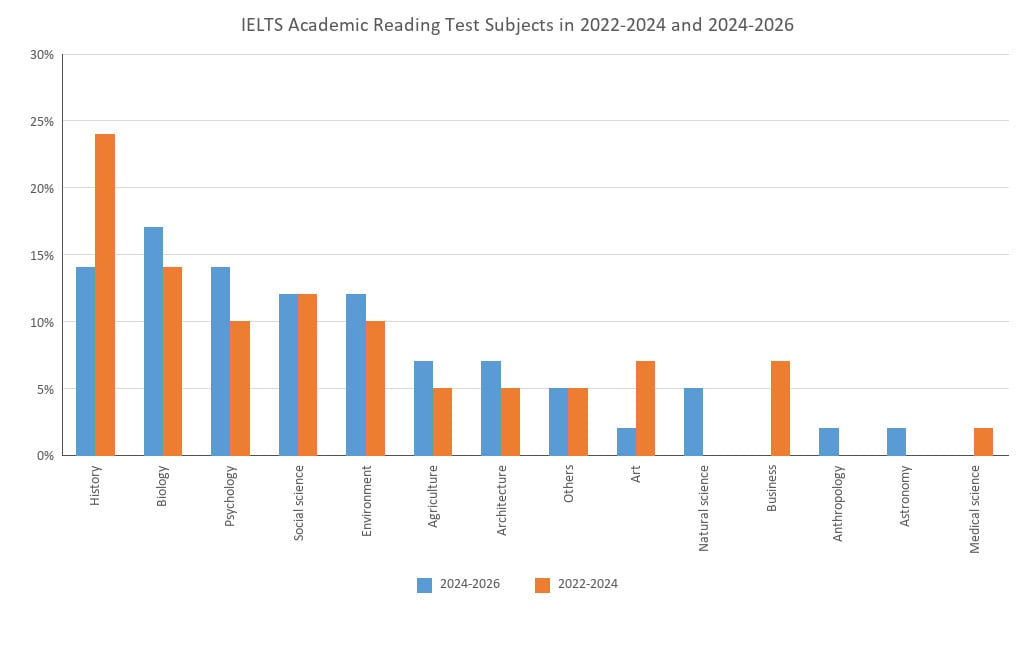
Z uwagi na te trendy zadbaliśmy o to, by nasze testy próbne IELTS Reading obejmowały te tematy. Dodaliśmy również przykłady czytania z mniej popularnych tematów, na wszelki wypadek. Ważne jest, abyś przygotował się na każdą sytuację, ponieważ nigdy nie wiadomo, jaki temat IELTS Reading Ci się trafi.
Jak obliczany jest Twój wynik IELTS Reading
Każde pytanie IELTS Reading jest warte 1 punkt, więc możesz uzyskać „surowy” wynik do 40 punktów. Następnie Twój surowy wynik zostanie przeliczony na band score. Poniższe tabele dadzą Ci ogólne wyobrażenie o tym, jak surowe wyniki IELTS Reading są przeliczane na band score dla każdego testu.
Wynik IELTS General Reading vs IELTS Academic Reading
| Wynik surowy: Academic | Band score: Academic | Wynik surowy: General | Band score: General |
|---|---|---|---|
| 39-40 | 9 | 40 | 9 |
| 37-38 | 8.5 | 39 | 8.5 |
| 35-36 | 8 | 37-38 | 8 |
| 33-34 | 7.5 | 36 | 7.5 |
| 30-32 | 7 | 34-35 | 7 |
| 27-29 | 6.5 | 32-33 | 6.5 |
| 23-26 | 6 | 30-31 | 6 |
| 19-22 | 5.5 | 27-29 | 5.5 |
| 15-18 | 5 | 23-26 | 5 |
| 13-14 | 4.5 | 19-22 | 4.5 |
| 10-12 | 4 | 15-18 | 4 |
| 8-9 | 3.5 | 12-14 | 3.5 |
| 6-7 | 3 | 9-11 | 3 |
| 4-5 | 2.5 | 6-8 | 2.5 |
| 1-3 | 2 | 1-5 | 2 |
Pamiętaj jednak, że każda wersja testu IELTS Reading jest nieco inna, a wynik wymagany do osiągnięcia danego band score zmienia się w zależności od tego, jak wszyscy zdający test poradzili sobie danego dnia. Liczba poprawnych odpowiedzi potrzebnych do uzyskania danego band score będzie więc nieznacznie się różnić od testu do testu, ale ogólnie powinieneś dążyć do uzyskania około 30 z 40 punktów, jeśli chcesz osiągnąć band score 7.
Kolejna rzecz, o której chcemy Ci przypomnieć: najtrudniejsze pytania i najłatwiejsze pytania liczą się tak samo do Twojego końcowego wyniku z czytania, więc upewnij się, że nie tracisz łatwych punktów, utykając na trudniejszych pytaniach. W następnej części omówimy kilka wskazówek i strategii IELTS Reading dotyczących tego, jak odpowiadać na każde pytanie z testu czytania.
Wskazówki IELTS Reading – jak odpowiadać na 11 typów pytań
W teście czytania jest 11 różnych typów pytań i każdy z nich wymaga innej strategii.
Każdy typ ma przykład i odpowiedź w przewodniku typy pytań IELTS Reading.
- Typ pytania 1 – Matching Information (dopasowywanie informacji)
- Typ pytania 2 – Matching Headings (dopasowywanie nagłówków)
- Typ pytania 3 – Matching Features (dopasowywanie cech)
- Typ pytania 4 – Identifying Information (rozpoznawanie informacji)
- Typ pytania 5 – Identifying Writer's Views/Claims (rozpoznawanie poglądów/twierdzeń autora)
- Typ pytania 6 – Multiple Choice (wielokrotny wybór)
- Typ pytania 7 – Matching Sentence Endings (dopasowywanie zakończeń zdań)
- Typ pytania 8 – Sentence Completion (uzupełnianie zdań)
- Typ pytania 9 – Summary, Note, Table, Flow-chart Completion (uzupełnianie streszczenia, notatek, tabeli, schematu)
- Typ pytania 10 – Diagram Label Completion (uzupełnianie podpisów na diagramie)
- Typ pytania 11 – Short Answer Questions (pytania na krótką odpowiedź)
- Jak trendy pomagają przygotować się do testu IELTS Reading
Jak trendy pomagają przygotować się do testu IELTS Reading
Które typy pytań z czytania sprawiają naszym kursantom największą trudność
Kursanci BestMyTest odpowiedzieli na milion pytań z czytania w wersji Academic i 600 000 pytań z czytania w wersji General Training w naszych testach próbnych. Wartości procentowe pokazują, jak często udzielano poprawnych odpowiedzi na poszczególne typy pytań.
| Typ pytania | Academic | General Training |
|---|---|---|
| Dopasowywanie informacji | 34% | 72% |
| Prawda / Fałsz / Brak informacji | 39% | 60% |
| Wielokrotny wybór | 43% | 48% |
| Dopasowywanie cech | 48% | 74% |
| Uzupełnianie zdań | 49% | 75% |
| Dopasowywanie nagłówków | 53% | 40% |
| Tak / Nie / Brak informacji | 55% | 57% |
| Uzupełnianie streszczenia | 59% | 46% |
| Krótka odpowiedź | 54% | 75% |
- W czytaniu w wersji Academic dwa typy pytań z najniższymi wynikami to dopasowywanie informacji i Prawda/Fałsz/Brak informacji — w obu przypadkach poniżej 40%. Oba wymagają odnalezienia myśli wyrażonej innymi słowami, a nie pasującego słowa kluczowego.
- W wersji General Training sytuacja się odwraca: najniższe wyniki uzyskuje się w dopasowywaniu nagłówków — 40%, natomiast na pytania wymagające odnajdywania informacji poprawne odpowiedzi padają w trzech przypadkach na cztery, ponieważ teksty są krótsze, a informacje podane bardziej wprost.
- Na pytania do tekstów w wersji Academic udziela się średnio 46% poprawnych odpowiedzi, a do tekstów w wersji General Training — 59%. Połowa prób rozwiązania pytań do tekstów w wersji Academic kończy się wynikiem 40% lub niższym.
- W 43 711 pełnych testach próbnych z czytania rozwiązanych przez 38 534 kursantów średni wynik wyniósł 5.4. 36% osiągnęło wynik 6.0, a 14% — wynik 7.0.
- Nadal musisz przygotować się do każdego typu pytań, ale jeśli masz mało czasu, tabela podpowie Ci, na co warto go przeznaczyć, by zyskać najwięcej.
Dane pochodzą z testów próbnych i ocen w BestMyTest zebranych do października 2026. Wartości procentowe dla typów pytań to odsetki poprawnych odpowiedzi we wszystkich próbach; wyniki według kryteriów to oceny wystawione przez nauczycieli lub AI, zgodnie z oznaczeniem. Ostatnia aktualizacja: 5 października 2026.
Następnie omówimy wskazówki i strategie IELTS Reading niezbędne do uzyskania wysokiego wyniku z czytania.
Wskazówki IELTS Reading – jak poprawić swój band score w czytaniu
Większość studentów oblewa sekcję czytania z trzech następujących powodów
- Wolna prędkość czytania
- Słabe słownictwo
- Brak lub niewielkie przygotowanie
Poprawa prędkości czytania
Najpierw rzecz oczywista. Aby poprawić prędkość czytania, musisz faktycznie ćwiczyć czytanie i robić to konsekwentnie.
Teraz spójrzmy na mniej oczywistą strategię, która pomoże Ci zrozumieć znaczenie dużych fragmentów zdań. Zacznij od rozłożenia zdania na części. Zrób to, szukając podmiotu i orzeczenia w zdaniu. Znalezienie podmiotu i orzeczenia pomoże Ci zrozumieć znaczenie zdania. Jednym z powodów, dla których fragmenty akademickie mogą być trudne do zrozumienia, jest fakt, że łączą one ciągi pomysłów, tworząc długie zdania złożone. To produkuje duże fragmenty zdań, które są trudniejsze do przyswojenia, więc wykorzystywanie podmiotu i orzeczenia jako przewodnika do zrozumienia całego fragmentu jest świetnym narzędziem, którego możesz używać podczas egzaminu IELTS Reading.
Poprawa słownictwa
Wielu uważa, że odpowiadanie na pytania z czytania jest tak proste, jak skanowanie akapitu w poszukiwaniu słów kluczowych i informacji... Niestety nie jest to takie proste. Pytania z czytania są zazwyczaj parafrazowane, czyli słowa zostały zmienione na synonimy słów z fragmentu IELTS Reading. Robi się to, by zwiększyć trudność, w przeciwnym razie test byłby zbyt łatwy. Z tego powodu musisz poprawić swoje słownictwo, aby znać wiele różnych synonimów danego słowa.
Przygotowując się do testu czytania i napotykając słowo, którego nie znasz, wyrób sobie nawyk zatrzymywania się i sprawdzania go lub przynajmniej zapisania i sprawdzenia później. Jest to nieco żmudne, ale niezwykle skuteczne. Twoim celem powinno być, ale nie tylko, uczenie się 15 do 20 nowych słów akademickich każdego dnia.
Wiedza o tym, w których typach pytań odpowiedzi są/nie są w kolejności
Ważne jest, aby wiedzieć, że dla niektórych typów pytań odpowiedzi są zazwyczaj (prawie zawsze) w tej samej kolejności co w fragmencie IELTS Reading. Dla innych typów pytań odpowiedzi rzadko kiedy są w tej samej kolejności co fragment. Stworzyliśmy tabelę dla typów pytań, które się trzymają tej kolejności, oraz tych, które się nie trzymają. Pamiętaj o tym.
| Odpowiedzi są zazwyczaj (prawie zawsze) w tej samej kolejności co fragment | Odpowiedzi rzadko kiedy są w tej samej kolejności co fragment. |
|---|---|
|
|
Znalezienie najlepszej strategii czytania dla Ciebie
Największym wyzwaniem, z którym mierzy się większość ludzi w egzaminie IELTS Reading, jest ukończenie wszystkich pytań przed upłynięciem czasu. W następnej sekcji poznasz trzy strategie, a od Ciebie zależy, którą wybierzesz jako najlepiej Ci odpowiadającą. Zrobisz to z naszymi bezpłatnymi ćwiczeniami z czytania.
3 strategie do IELTS Reading
Strategia 1: Przeczytanie całego fragmentu, a następnie odpowiadanie na pytania.
Po pierwsze, to nie jest właściwie strategia. To coś, co ludzie robią, gdy nie przygotują się odpowiednio do egzaminu z czytania. Jednak uwzględniliśmy to jako strategię, ponieważ technicznie rzecz biorąc, jeśli potrafisz zapamiętać informacje z fragmentu po pierwszym czytaniu i jesteś w stanie odpowiedzieć na pytania, nie będziesz potrzebować strategii 2.
Ta strategia, jeśli nie masz lepszej niż przeciętna pamięci, jest nieefektywna. Skończysz z tym, że zabraknie Ci czasu, zanim będziesz mógł odpowiedzieć na wszystkie pytania. Wiele osób popełnia ten błąd. Są jednak pewne pytania, które nie wymagają wiele wysiłku i skorzystają z tej strategii, np. jeśli pytanie ma odpowiedź „Yes” lub „No”, będziesz w stanie szybko skanować i znaleźć odpowiedź szybko, ale nie ma wystarczająco wielu takich typów pytań, więc nie zaleca się stosowania tej strategii, chyba że potrafisz sobie z nią poradzić.
Strategia 2: Najpierw przeczytaj pytania, czytaj z konkretnym celem, rób notatki, a następnie mądrze odpowiadaj na pytania
To nasza zalecana strategia. Pomoże Ci uzyskać wyższy wynik w IELTS Reading. Pomyśl o tym jak o jasnej mapie tego, jak ogólnie podejść do egzaminu:
Jednym z najczęstszych błędów, jakie popełniają kandydaci, podchodząc
do egzaminu z czytania, jest czytanie każdego słowa fragmentów IELTS Reading. Choć możesz
ćwiczyć do egzaminu, czytając dla przyjemności, „ślepe czytanie” (czytanie bez świadomości
tego, o co będą pytały pytania) nie wyjdzie Ci na dobre na egzaminie. Zamiast tego zaszkodzi to Twoim
szansom na efektywne zarządzanie czasem i uzyskanie najlepszego wyniku.
Główny powód, dla którego należy najpierw przeczytać pytania, to fakt, że typ pytania może decydować o tym, co
czytasz we fragmencie lub jak to czytasz. Na przykład niektóre typy pytań wymagają
techniki „skimming”, podczas gdy inne mogą wymagać techniki „scanning”.
Ważne jest, aby zająć się zestawem pytań, które są tego samego typu.
Musisz zdecydować, którym typem pytania chcesz się zająć najpierw.
Dobrą strategią byłoby zacząć od łatwiejszego typu pytania, a do trudniejszych przejść później.
Najłatwiejsze typy pytań to te, w których spędzasz mniej czasu na czytaniu.
Na przykład typ pytania Matching Heading jest łatwiejszym, ponieważ
musisz tylko znaleźć nagłówek najlepiej opisujący główną myśl akapitu.
Przykładem trudnego typu pytania byłoby Identifying Information. W tym typie pytania
musisz przeczytać każdy akapit, by ustalić, czy każde stwierdzenie jest TRUE, FALSE czy NOT GIVEN według tekstu.
Oto tabela, która wymienia poziomy trudności dla każdego typu pytania. Użyj jej jako punktu odniesienia przy wyborze, którym
typem pytania chcesz się zająć najpierw.
| Poziom trudności | Typ pytania |
|---|---|
| Łatwy | Match Headings Short answer |
| Średni |
Matching Sentence Endings Matching Features Multiple choice Sentence Completion Diagram Label, Summary, Note, Table, Flow-Chart Completion |
| Trudny |
Match Information Identifying Information (TRUE/FALSE/NOT GIVEN) Identifying Viewer's claims (YES/NO/NOT GIVEN) |
Po przeczytaniu pytań z tekstu IELTS będziesz w stanie czytać z konkretnym celem. Co to oznacza? Na przykład, jeśli natkniesz się na pytanie, które zawiera rok „1896”, możesz zanotować, kiedy ten rok pojawia się w tekście, używając tego do późniejszej odpowiedzi na pytanie.
Istnieją dwie techniki czytania, które pomogą Ci utrzymać kurs przy czytaniu z konkretnym celem. Pierwsza, skimming, najlepiej definiowana jest jako szybkie czytanie w celu uzyskania „gistu”, czyli ogólnej idei, lub fragmentu. Przy tej technice nie zatrzymujesz się przy żadnych nieznanych słowach ani nie szukasz konkretnych szczegółów. Druga technika, scanning, najlepiej definiowana jest jako czytanie w celu znalezienia konkretnych informacji. Przy tej technice nie czytasz dla ogólnego sensu, lecz w celu znalezienia konkretnych informacji. Zauważ, że każda z tych technik ma na uwadze konkretny cel. To pomoże Ci szybciej znaleźć informacje.
Czytając z konkretnym celem, powinieneś również robić notatki na marginesach fragmentu, umieszczając gwiazdki obok kluczowych informacji lub podkreślając rzeczy, które Twoim zdaniem pomogą Ci odpowiedzieć na różne pytania. Ułatwi Ci to wracanie do tekstu, gdy zostaniesz zapytany o określone rzeczy w pytaniach. Wybierz dowolny system notatek, który jest dla Ciebie odpowiedni – po prostu upewnij się, że to robisz!
Po przeczytaniu pytań, przeczytaniu fragmentu i zrobieniu odpowiednich notatek powinieneś zlokalizować część tekstu, w której musisz uważnie czytać. Następnie po prostu czytaj uważnie i myśl krytycznie, by ustalić poprawną odpowiedź.
Strategia 3: Skimming, robienie notatek i typy pytań.
To kolejna strategia używana przez wielu zdających IELTS. Pomoże Ci uzyskać wyższy wynik z czytania. Strategia składa się z 4 kroków:
- Skanuj (skim) każdy akapit, aby uzyskać ogólną ideę każdego akapitu. Główna idea akapitu znajduje się zazwyczaj w pierwszych kilku zdaniach, więc skup się trochę bardziej na tych zdaniach. Następne zdania można szybko przeskanować, podkreślając wyróżniające się nazwy/słowa/frazy.
- Po przeskanowaniu każdego akapitu zapisz krótkie notatki (2–5 słów) obok każdego akapitu z najlepszym przypuszczeniem na temat głównej idei tego akapitu.
- Następnie odpowiedz na zestaw pytań tego samego typu.
- Wreszcie, odpowiedz na zestaw pytań sprawnie i poprawnie.
Ważne jest, abyś nie spędzał więcej niż 3–5 minut na krokach 1 i 2. Spędzanie zbyt dużo czasu na tych krokach zmarnuje za dużo czasu i skończysz z brakiem czasu.
Kroki 1 i 2Celem jest tu ustanowienie sprawnej metody znajdowania odpowiedzi we fragmencie. Zapisując ogólną ideę każdego akapitu, będziesz wiedział, który akapit zawiera odpowiedź na każde pytanie. To zaoszczędzi Ci dużo czasu, ponieważ jeśli byś tego nie zapisał, prawdopodobnie musiałbyś przeskanować każdy akapit w poszukiwaniu ogólnej idei pytania, a następnie ostrożnie zeskanować akapit w poszukiwaniu odpowiedzi. Notując główną ideę każdego akapitu, możesz pominąć pierwszy krok skanowania każdego akapitu i zacząć skanować w poszukiwaniu odpowiedzi.
Krok 3
Po dokładnym przeskanowaniu tekstu i zapisaniu kilku notatek jesteś gotowy na krok 3.
W tym kroku musisz zdecydować, którym typem pytania chcesz się zająć najpierw.
Dobrą strategią byłoby zacząć od łatwiejszego typu pytania, a do trudniejszych przejść później.
Najłatwiejsze typy pytań to te, w których spędzasz mniej czasu na czytaniu.
Na przykład typ pytania Matching Heading jest łatwiejszym, ponieważ
musisz tylko znaleźć nagłówek najlepiej opisujący główną myśl akapitu, więc technicznie potrzebujesz tylko kroków 1 i 2, by odpowiedzieć na ten typ pytania.
Przykładem trudnego typu pytania byłoby Identifying Information. W tym typie pytania
musisz przeczytać każdy akapit, by ustalić, czy każde stwierdzenie jest TRUE, FALSE czy NOT GIVEN według tekstu.
Oto tabela, która wymienia poziomy trudności dla każdego typu pytania. Użyj jej jako punktu odniesienia przy wyborze, którym typem pytania chcesz się zająć najpierw.
| Poziom trudności | Typ pytania |
|---|---|
| Łatwy | Match Headings Short answer |
| Średni |
Matching Sentence Endings Matching Features Multiple choice Sentence Completion Diagram Label, Summary, Note, Table, Flow-Chart Completion |
| Trudny |
Match Information Identifying Information (TRUE/FALSE/NOT GIVEN) Identifying Viewer's claims (YES/NO/NOT GIVEN) |
Skoro już ustaliłeś, na który zestaw pytań odpowiesz najpierw, czas faktycznie na nie odpowiedzieć :( Nie martw się! Choć każdy typ pytania jest inny, strategia poprawnego odpowiadania na nie odnosi się do wszystkich. Podstawowa zasada jest prosta, po prostu wykonaj poniższe kroki:
- Uważnie przeczytaj pytanie i zidentyfikuj ważne słowa kluczowe.
- Znajdź akapit, który zawiera informacje potrzebne do udzielenia odpowiedzi na pytanie. (Mam nadzieję, że masz już zapisane ogólne idee dla każdego akapitu, więc możesz to łatwo ustalić).
- Skanuj akapit w poszukiwaniu ważnych słów kluczowych (najprawdopodobniej są to synonimy!), aż zlokalizujesz część tekstu, gdzie musisz uważnie czytać.
- Wreszcie, czytaj uważnie i myśl krytycznie, by ustalić poprawną odpowiedź.
Bezpłatne pobieranie przykładowych testów IELTS Reading w PDF z odpowiedziami
Poniżej znajduje się kilka bezpłatnych przykładów czytania od British Council (twórców egzaminu IELTS). Spróbuj odpowiedzieć na pytania i sprawdź, jak Ci pójdzie!