IELTS Speaking Part 3 is the discussion at the end of the Speaking test. The examiner takes the topic of your Part 2 cue card and asks you bigger questions about it: why things happen, how they are changing, and what people or governments should do. It is the hardest part of the test, and the part where higher bands are won or lost.
This guide gives you the IELTS Speaking Part 3 questions you are most likely to hear in 2026: 16 common discussion topics with real questions from our practice tests, sample answers, and the 10 answer patterns that fit almost any Part 3 question.
If you’re looking for free IELTS Speaking Part 3 practice, then click the button below to answer real Part 3 questions and get a free AI score.
play_circle_outline Start Free Speaking Part 3 PracticeTable Of Contents
- What Is IELTS Speaking Part 3?
- Common IELTS Speaking Part 3 Topics and Questions
- IELTS Speaking Part 3 Sample Answers
- How to Answer IELTS Speaking Part 3 Questions
- IELTS Speaking Part 3 Model Answers by Question Style
- Common Part 3 Mistakes to Avoid
- How Long Our Learners’ Part 3 Answers Are
- Practise IELTS Speaking Part 3 with BestMyTest
- All IELTS Speaking Part 3 Practice Questions
- Frequently Asked Questions About IELTS Speaking Part 3
What Is IELTS Speaking Part 3?
Part 3 is the last of the three parts of the IELTS Speaking test, and it lasts about 4 to 5 minutes. It follows straight on from your Part 2 talk: if your cue card was about a book you enjoyed, Part 3 might ask whether people read less than they used to, or how e-books will affect paper books.
- The questions are abstract. Part 1 asks about you. Part 3 asks about people, society, and the future, so you need to talk in general terms.
- It is a real discussion. The examiner can ask follow-up questions, challenge your view, or ask you to explain more, so listen carefully to each question.
- Longer answers are expected. A good Part 3 answer explains a view and supports it with a reason and an example, usually in five or six sentences.
Your English is still what is scored, not your ideas. For an overview of all three parts, see our IELTS Speaking test guide, and for the warm-up and the long turn, our IELTS Speaking Part 1 questions and IELTS cue cards 2026.
Common IELTS Speaking Part 3 Topics and Questions
These 16 topics come up again and again in Part 3. The questions under each one are real Part 3 questions from our practice tests, and each topic links to the practices that ask them, so you can answer out loud and get an AI score.
1. Advertising
- What are popular types of advertising in today's world?
- Do you think advertising influences what people buy?
- Is advertising really necessary in modern society?
- How has advertising changed in your country over the past decade?
- In what ways can advertising be both beneficial and harmful to society?
Practise this topic: Part 3 Practice 1 Part 3 Practice 74
2. Art
- How do people in your country feel about art?
- What are some traditional art forms in your country?
- How has art changed in the past few decades in your country?
- Do you think children should study art in school?
- How can children benefit from learning about art?
Practise this topic: Part 3 Practice 2
3. Reading and Books
- Do people read more nowadays?
- In your opinion, how will e-books affect paper books?
- What's the difference between films and books?
- What is one example of traditional literature in your country?
Practise this topic: Part 3 Practice 3
4. Work and Business
- In your opinion, do business people have to work long hours?
- How can a small business grow big?
- What are the good things about working for a big company?
- Do you think job satisfaction is more important than salary when choosing a job?
- What skills do you think are needed to get a good job these days?
Practise this topic: Part 3 Practice 4 Part 3 Practice 8 Part 3 Practice 51
5. Cities
- In your opinion, what makes a city a good one to live in?
- What are the advantages of living in a city?
- What are the negative aspects of crowded cities?
- How can governments improve living standards in crowded cities?
- What can people do to improve the air quality in the city?
Practise this topic: Part 3 Practice 6
6. Education
- Is higher education too expensive in your country?
- Can you compare the education your parents had with the education that you received?
- What changes do you think will happen in the classrooms of the near future?
- What are some advantages and disadvantages of a strict curriculum in schools?
- What do you think are some effective teaching methods in modern classrooms?
Practise this topic: Part 3 Practice 39 Part 3 Practice 52 Part 3 Practice 53
7. Technology
- How has technology changed the way students learn in modern classrooms?
- How has technology changed the way people interact within society?
- What are some of the positive and negative effects of social media on communities?
- How do you think technology will change our lives in the next 20 years?
- What potential risks do you see if people become too dependent on advanced technology?
Practise this topic: Part 3 Practice 56 Part 3 Practice 58 Part 3 Practice 62
8. Environment
- What are some of the main environmental problems in your country?
- Why should people be concerned about the environment?
- How can people protect the environment?
- Do you think money should be spent on protecting animals?
- Is water pollution a problem in your country?
Practise this topic: Part 3 Practice 11
9. Family
- Is family important in your country?
- Who should be responsible for caring for the elderly, the family or the government?
- How has the size of the average family changed in your country in the last few decades?
- How do you think families will change in the future?
- What are the advantages and disadvantages of living in a large extended family compared to a nuclear family?
Practise this topic: Part 3 Practice 13 Part 3 Practice 64
10. Friends
- What is the importance of friends?
- Would you like to have a few very good friends or a lot of friends?
- If you had a problem, would you go to your friends or your family?
- Is it important to have friends from other countries?
Practise this topic: Part 3 Practice 15
11. Food
- What kinds of foreign food are popular in your country?
- In your country, is it important to have a meal together with your family?
- Is food now better than in the past?
- Why do some people enjoy eating out?
- Nowadays, more and more people are unwilling to cook. Why is this happening?
Practise this topic: Part 3 Practice 14 Part 3 Practice 37
12. Health
- How can people improve their health?
- Do you think healthcare should be free?
- Do you think people today lead healthier lifestyles than those in the past?
- What role do you think governments should play in promoting public health?
- Is it more challenging to maintain a healthy lifestyle in urban areas compared to rural areas?
Practise this topic: Part 3 Practice 18 Part 3 Practice 76
13. Travel and Holidays
- Why do people go on holiday?
- How have holidays changed over the past few decades?
- What kind of holidays will be popular in the future?
- Why do some people prefer to travel abroad rather than travel in their own country?
- What are the positive impacts of tourism in your country?
Practise this topic: Part 3 Practice 21 Part 3 Practice 48
14. Media and News
- How do people get their news in today's society?
- How do you think people will get their news in the future?
- Do you believe everything you read in the newspaper?
- What role does social media play in shaping public opinion nowadays?
- Why do you think some people struggle to differentiate between real and fake news?
Practise this topic: Part 3 Practice 32 Part 3 Practice 63 Part 3 Practice 73
15. Shopping
- Is shopping a popular activity in your country?
- How have shopping habits changed over recent years?
- What are the pros and cons of shopping online?
- How do you think the Internet will change people's buying habits in the future?
- Is service better in large shops or in small shops?
Practise this topic: Part 3 Practice 23 Part 3 Practice 41
16. Sport
- What types of sports are popular in your country?
- Do you think the types of sports that are popular will change in the future?
- In your opinion, what are the benefits of playing a sport?
- How can sports bring people from different countries closer together?
Practise this topic: Part 3 Practice 43
Part 3 always builds on your Part 2 topic, so the cue cards you prepare are a good guide to the discussion that follows. See our IELTS cue cards 2026 for the current Part 2 topics with possible Part 3 questions, and our IELTS Speaking prediction 2026 for the topic areas expected this cycle.
IELTS Speaking Part 3 Sample Answers
Each sample below answers a question from the topics above and follows one of the Part 3 answer patterns. Notice how every answer gives a clear view, explains it, supports it with an example, and finishes with a short conclusion.
Is advertising really necessary in modern society?
Well, I’d say advertising is necessary, although there’s far too much of it. The main reason is that businesses need a way to tell people about their products. Without ads, a new company would find it almost impossible to compete with famous brands. For example, a small café near my home started advertising on social media, and within a few months it was full most evenings. As a result, it was able to hire more staff. That said, people are exposed to so many ads online now that it can feel quite intrusive. So overall, advertising is useful, but it should be limited.
Pattern: Opinion / View. A direct answer (“advertising is necessary”), a reason and an explanation (new companies need to reach customers), an example and its result (the café that hired more staff), a contrast (“That said…”), and a conclusion (“So overall…”).
Nowadays, more and more people are unwilling to cook. Why is this happening?
I think the main reason is that people simply don’t have enough time. Many people work long hours and have a long commute, so when they get home they’re too tired to cook a proper meal. For example, a lot of my colleagues order food through delivery apps almost every evening. On top of that, ordering in has become much cheaper and more convenient than it used to be. Because of that, cooking feels like a chore rather than a necessity. That’s why I think home cooking will keep declining unless people’s working lives become less busy.
Pattern: Cause / Reason. The main cause (no time), an explanation (long hours and commutes), an example (colleagues using delivery apps), a second cause (“On top of that…”) with its result, and a conclusion (“That’s why…”).
What’s the difference between films and books?
The biggest difference, I’d say, is how much imagination each one needs. When you read a book, you have to picture the characters and places yourself, whereas a film shows you everything. For example, when I watched the Harry Potter films after reading the books, Hogwarts looked quite different from what I had imagined. Another difference is time. A novel can take weeks to read, so it can include much more detail. Films, on the other hand, have to tell the story in about two hours, so a lot gets cut. So overall, books give you more depth, while films are quicker and more vivid.
Pattern: Compare / Contrast. The main difference (imagination), an explanation and an example (picturing Hogwarts), a second difference (time), a contrast (“on the other hand”), and an overall comparison (“books give you more depth, while films are quicker”).
Video Sample Answers from IELTS Speaking Part 3 Practice 1
These are the real questions from our IELTS Speaking Part 3 Practice 1 on advertising. Watch the examiner ask each question, record your own answer, then open the band 9 video answer to compare. Notice how each one gives a clear view and supports it with reasons and examples.
Question 1
-
spellcheck TranscriptWhat are popular types of advertising in today’s world?
-
Sample Response
Band 9 video model answer
Well, um, in today’s world, there are, you know, quite a few popular types of advertising that we see almost everywhere. For example, um, online advertising is huge right now, especially on social media platforms like Instagram and Facebook, where companies, you know, use targeted ads. Then, um, of course, there’s television advertising, which still reaches a wide audience, um, along with ads on YouTube and other video streaming services. Also, um, there are outdoor advertising, like billboards and ads on public transport, which is also quite common. And finally, we have the influencer marketing, which has really taken off recently because, you know, many people trust recommendations from influencers they follow. So, um, overall, there are many different types, but digital advertising seems to dominate these days.
Watch the video question, then click to record your answer.
Practice speaking questions in our appQuestion 2
-
spellcheck TranscriptWhat type of media advertising do you like most?
-
Sample Response
Band 9 video model answer
Personally, I think I like online advertising the most, especially ads on social media or video platforms. The main reason is that, you know, these ads can be really interactive and sometimes even entertaining. For example, um, some ads come in the form of short videos or, like, fun challenges, which makes them more enjoyable to watch. Besides, online ads are often tailored to my interests, so I feel like they’re more relevant to me. Essentially, um, unlike traditional ads on television or the radio, digital ads don’t always interrupt what I’m doing, and sometimes I can just skip them if I want. So, um, overall, I prefer online ads because they’re more engaging and, you know, less intrusive at times.
Watch the video question, then click to record your answer.
Practice speaking questions in our appQuestion 3
-
spellcheck TranscriptDo you think advertising influences what people buy?
-
Sample Response
Band 9 video model answer
Yes, definitely. I mean, if there were no advertising and you went into a shop, you’d probably just buy whatever you wanted at the time. Um, your choice might depend on what other people have told you or what the product looks like. But with advertising, it’s a different story. Advertising, um, kind of helps build a brand. What I mean by that is that over time, people start to trust certain products, mainly because they’ve seen them on television or in other places. Plus, you know, advertising is so widespread nowadays that it is almost impossible to avoid. So yes, advertising definitely, and I would say inevitably influences what we buy.
Watch the video question, then click to record your answer.
Practice speaking questions in our appQuestion 4
-
spellcheck TranscriptWhat factors should be taken into account when making advertisements?
-
Sample Response
Band 9 video model answer
Well, um, there are several important factors to consider when making advertisements. First of all, you need to, um, understand your target audience, because that really influences the style and message of the ad. Secondly, the message should be, you know, clear and easy to understand, so people can immediately see what the product or service is about. Also, um, creativity is quite important to grab people’s attention and make the ad stand out. Another thing is, um, honesty. Advertisements shouldn’t mislead customers with false claims. And finally, you need to, you know, choose the right platform, whether it’s social media, television, or radio.
Watch the video question, then click to record your answer.
Practice speaking questions in our appQuestion 5
-
spellcheck TranscriptIs advertising really necessary in modern society?
-
Sample Response
Band 9 video model answer
Actually, um, I think advertising is quite necessary in modern society. To begin with, it helps companies, you know, reach customers and inform them about what they offer. Without advertising, people might not really know about new products or special deals. In addition, um, advertising supports many industries like media and entertainment because they rely on revenue from ads. Plus, ads give consumers more choice by showing them different brands and options. That said, I also think advertising should be responsible and not create false needs or use manipulative tactics. So, um, even though advertising can feel overwhelming at times, I believe it plays an important role in the economy and helps connect businesses with people.
Watch the video question, then click to record your answer.
Practice speaking questions in our appQuestion 6
-
spellcheck TranscriptLet’s move on from types of advertising to the impact of advertising on children. How does advertising influence children?
-
Sample Response
Band 9 video model answer
On top of my head, um, I can think of a few ways advertising affects children. First of all, ads can, you know, mislead and confuse kids by exaggerating what a product can actually do. For example, um, makeup ads sometimes suggest that using a certain brand of mascara will dramatically change someone’s appearance. Secondly, advertising can, um, affect children’s self-image and self-esteem by making them feel they need to look or behave like the people shown in ads, who often don’t really represent real life. You know, since children are quite impressionable, they may, um, develop unrealistic ideas about themselves and the world around them.
Watch the video question, then click to record your answer.
Practice speaking questions in our appQuestion 7
-
spellcheck TranscriptIs there any advertising that can be harmful to children?
-
Sample Response
Band 9 video model answer
Unfortunately, yeah. There are some advertisements that can be harmful to kids. As I said, ads can harm children by negatively affecting their self-esteem. You see, um, children who see models in advertisements may feel they need to look like those people, and, um, become upset when they’re unable to achieve that kind of perfection. Um, also, there are ads for certain foods and drinks that contain high amounts of sugar and fat. Those types of ads can influence children into wanting to consume these products. So, I believe it’s really important for parents to be careful about what kinds of ads children are exposed to.
Watch the video question, then click to record your answer.
Practice speaking questions in our appHow to Answer IELTS Speaking Part 3 Questions
Most Part 3 questions belong to one of a small number of types. Once you recognise the type, you know what your answer needs. Our AI Tutor uses the 10 answer patterns below: find the pattern that matches the question, then follow its steps in order.
Pattern | Steps | Example question |
|---|---|---|
Opinion / View | Answer → Reason → Explain → Example → Result → Second Point or Contrast → Conclusion | Is advertising really necessary in modern society? |
Cause / Reason | Main Cause → Explain → Example → Second Cause → Explain or Result → Conclusion | Nowadays, more and more people are unwilling to cook. Why is this happening? |
Effect / Consequence | Main Effect → Explain → Example → Second Effect → Explain or Result → Conclusion | How can children benefit from learning about art? |
Advantages / Disadvantages | Main Advantage → Explain → Example or Result → Main Disadvantage → Explain → Example or Result → Overall View | What are the pros and cons of shopping online? |
Compare / Contrast | Main Difference → Explain → Example → Second Difference → Contrast → Overall Comparison | What's the difference between films and books? |
Change Over Time | Main Change → Past vs Present → Example → Reason for Change → Result → Overall View | How has the size of the average family changed in your country in the last few decades? |
Future / Prediction | Prediction → Reason → Explain → Example → Possible Limitation or Contrast → Conclusion | How do you think people will get their news in the future? |
Descriptive / Types | Main Type → Explain → Example → Second Type → Explain or Compare → Overall View | What types of sports are popular in your country? |
Problem / Solution | Problem → Main Solution → Explain → Example → Second Solution → Conclusion | How can governments improve living standards in crowded cities? |
Hypothetical Situation | Choice or Answer → Reason → Explain → Imagined Example → Result → Conclusion | If you had a problem, would you go to your friends or your family? |
Following the steps gives you five to seven sentences, or roughly 40 to 60 seconds of speaking, which is about right for Part 3. Talk about people in general (“many people”, “young people in my country”) rather than only yourself, and use a personal example to support the general point. You can hear these patterns in action, in model answers to nine common question styles, in the model answers below.
Use Controlled Fillers to Link Your Ideas
Part 3 answers are longer, so you need words that move you from one step to the next. Use these controlled fillers to buy thinking time and show the examiner how your ideas connect.
Purpose | Phrases |
|---|---|
Start / buy thinking time | Well, That’s an interesting question, I’d say, I suppose |
Explain / clarify | What I mean by that is, In other words |
Give an example / detail | For example, For instance, Take … for example |
Add another idea | On top of that, Another reason is, Also |
Show contrast | That said, Having said that, On the other hand |
Show result / consequence | As a result, Because of that, This means that |
Finish / summarize | So overall, That’s why, All in all |
Don’t use a filler in every sentence. Use them where your answer moves to the next step, or when you need a moment to organize your next idea without a long pause.
IELTS Speaking Part 3 Model Answers by Question Style
Each model answer below follows one of the patterns above, step by step. The tags show where each step begins, and the bold words are the controlled fillers that move the answer from one step to the next. Press play to hear how a band 9 answer sounds, then try the same question yourself.
Make a prediction on something in the future
Future / Prediction- 1 Prediction
- 2 Reason
- 3 Explain
- 4 Example
- 5 Possible Limitation or Contrast
- 6 Conclusion
Prediction I’d probably say cities will be much greener and far less dependent on cars in fifty years’ time. Reason The reason I say that is, many governments are already trying to cut pollution and traffic. Explain What I mean by that is, as public transport becomes faster and cheaper, fewer people will need to own a car, so space now used for roads and car parks could be turned into parks and cycle lanes. Example For example, some European cities have already closed parts of their centres to traffic, and I imagine this will be completely normal by then. Possible Limitation or Contrast That said, cities will probably be even more crowded, so housing could become a serious problem. Conclusion Overall, I think cities will be cleaner and quieter, but also busier than they are today.
Make a comparison with the past
Change Over Time- 1 Main Change
- 2 Past vs Present
- 3 Example
- 4 Reason for Change
- 5 Result
- 6 Overall View
Main Change The biggest change, I’d say, is that teaching has become much more interactive. Past vs Present In the past, teachers mainly lectured while students copied notes in silence, whereas nowadays lessons often involve discussion, group work and presentations. Example For example, my younger brother regularly researches topics online and presents them to his class, which never happened when my parents were at school. Reason for Change The main reason for this is technology. Information is now available instantly, so teachers focus more on helping students use it well. Result As a result, students tend to be more confident and better at working in teams. Overall View So overall, I think the change has been very positive, even if some basic skills, like handwriting, get less attention.
Compare and contrast two things
Compare / Contrast- 1 Main Difference
- 2 Explain
- 3 Example
- 4 Second Difference
- 5 Contrast
- 6 Overall Comparison
Main Difference I think the biggest difference is the pace of life. Explain In the city, people are usually busier, and everything moves quickly, from public transport to working hours. Example For instance, in a big city you can buy groceries at midnight or get a taxi in a few minutes. Second Difference Another difference is the sense of community. Contrast On the other hand, in the countryside neighbours tend to know each other well and help one another, although there are far fewer jobs and services. Overall Comparison So overall, the city offers convenience and opportunities, while the countryside offers a calmer, closer-knit way of life.
Provide solutions to a problem
Problem / Solution- 1 Problem
- 2 Main Solution
- 3 Explain
- 4 Example
- 5 Second Solution
- 6 Conclusion
Problem Well, I think the real problem isn’t violence on TV itself, but the fact that young children can see it so easily. Main Solution One of the most effective solutions would be stricter rules on when violent programmes can be shown. Explain What I mean by that is, broadcasters could only show violent content late at night, when most children are asleep. Example For example, in some countries programmes that are unsuitable for children can’t be broadcast before nine o’clock in the evening. Second Solution Another solution is for parents to use the parental controls on streaming services, so children can only watch age-appropriate shows. Conclusion So overall, combining clear broadcasting rules with responsible parenting would protect children much better than trying to ban violence completely.
Talk about causes or effects of a phenomenon
Cause / Reason- 1 Main Cause
- 2 Explain
- 3 Example
- 4 Second Cause
- 5 Explain or Result
- 6 Conclusion
Main Cause I’d say one of the main causes is industrial waste. Explain To explain that a little more, some factories release chemicals directly into rivers because treating their waste properly is expensive. Example For example, there have been cases where fish in a river died suddenly after a nearby factory leaked chemicals into the water. Second Cause Another major cause is farming, especially the fertilisers and pesticides that farmers use on their fields. Explain or Result When it rains, these chemicals wash into lakes and rivers, and as a result, the water can become unsafe to drink. Conclusion So overall, industry and agriculture are probably the two biggest sources of water pollution.
Talk about people or things in your country
Descriptive / Types- 1 Main Type
- 2 Explain
- 3 Example
- 4 Second Type
- 5 Explain or Compare
- 6 Overall View
Main Type I’d say watching TV is still very popular, but these days the most common way to watch is through streaming services. Explain People like them because they can choose what to watch and when, instead of following a fixed schedule. Example For example, my friends and I often watch a whole series over a single weekend. Second Type Another common type is traditional live TV, especially for the news and big sports events. Explain or Compare Compared with streaming, live TV is mainly watched by older people and by families who want to watch something together at the same time. Overall View So overall, television is as popular as ever, but the way people watch it has become much more varied.
Give your opinion on a topic
Opinion / View- 1 Answer
- 2 Reason
- 3 Explain
- 4 Example
- 5 Result
- 6 Second Point or Contrast
- 7 Conclusion
Answer Personally, I think many people do spend too much on electronic devices. Reason The main reason is that they often replace their phones and laptops long before they actually need to. Explain What I mean by that is, advertising makes the latest model seem essential, even when the old one works perfectly well. Example For example, a friend of mine buys a new phone every year, even though the changes between models are tiny. Result As a result, people waste a lot of money, and old devices add to electronic waste. Second Point or Contrast That said, spending more on a reliable laptop can be a good investment for someone who needs it for work. Conclusion Overall, I think spending a lot is only reasonable when the device really meets a need.
Express your preference
Opinion / View- 1 Answer
- 2 Reason
- 3 Explain
- 4 Example
- 5 Result
- 6 Second Point or Contrast
- 7 Conclusion
Answer If I had to choose, I’d say I prefer reading books to watching TV. Reason The main reason is that reading lets me use my imagination. Explain In other words, when I read a story, I create the characters and places in my own head, which feels more personal than watching someone else’s version. Example For example, I recently read a fantasy novel, and when I later watched the TV adaptation, I was disappointed because it looked nothing like I’d imagined. Result Because of that, I usually finish a book feeling much more involved in the story. Second Point or Contrast Having said that, I do watch TV when I’m too tired to concentrate. Conclusion So for me, books come first, but TV is a nice way to relax.
Talk about a hypothetical situation
Hypothetical Situation- 1 Choice or Answer
- 2 Reason
- 3 Explain
- 4 Imagined Example
- 5 Result
- 6 Conclusion
Choice or Answer If I had that power, I would write to change the way people consume, especially how much plastic we use. Reason The main reason is that single-use plastic is causing enormous damage to the environment. Explain To explain that a little more, most plastic is used for a few minutes but takes hundreds of years to break down, so much of it ends up in the oceans and harms wildlife. Imagined Example For instance, I would write stories that follow a single plastic bottle from a supermarket shelf all the way to the stomach of a sea turtle. Result As a result, I hope readers would think twice before buying products wrapped in plastic. Conclusion So for me, changing everyday buying habits would be the most powerful change I could make.
Common Part 3 Mistakes to Avoid
- Part 1-length answers. Two sentences are fine in Part 1 but too short for Part 3. Add a reason, an example, and a conclusion.
- Only talking about yourself. Part 3 asks about people and society. Make a general point first, then use your own experience as the example.
- Giving an opinion with no support. “I think it’s good” is not enough. Explain why, and show it with a real or realistic example.
- Answering a different question. Listen for what the question asks: a cause, a prediction, a comparison, or a solution. A good answer to the wrong question still loses marks.
- Memorized speeches. Examiners notice them, and the follow-up questions quickly show when an answer was rehearsed. Prepare ideas and patterns, not scripts.
How Long Our Learners’ Part 3 Answers Are
Across 12.277 Part 3 recordings by our learners, the average answer lasted 40,6 seconds and contained 69 words, at about 89 correctly spoken words per minute. In our speech scoring, grammar was the lowest criterion most often, in 84% of Part 3 answers. Following one of the answer patterns above is a simple way to develop a full answer instead of stopping after one or two sentences.

Practise IELTS Speaking Part 3 with BestMyTest
Part 3 improves fastest when you answer out loud and develop each answer fully. In our IELTS Speaking Part 3 practice, you record each answer and get an instant AI score on fluency, vocabulary, grammar, and pronunciation. For a detailed review of your recordings, see our IELTS speaking review guide.

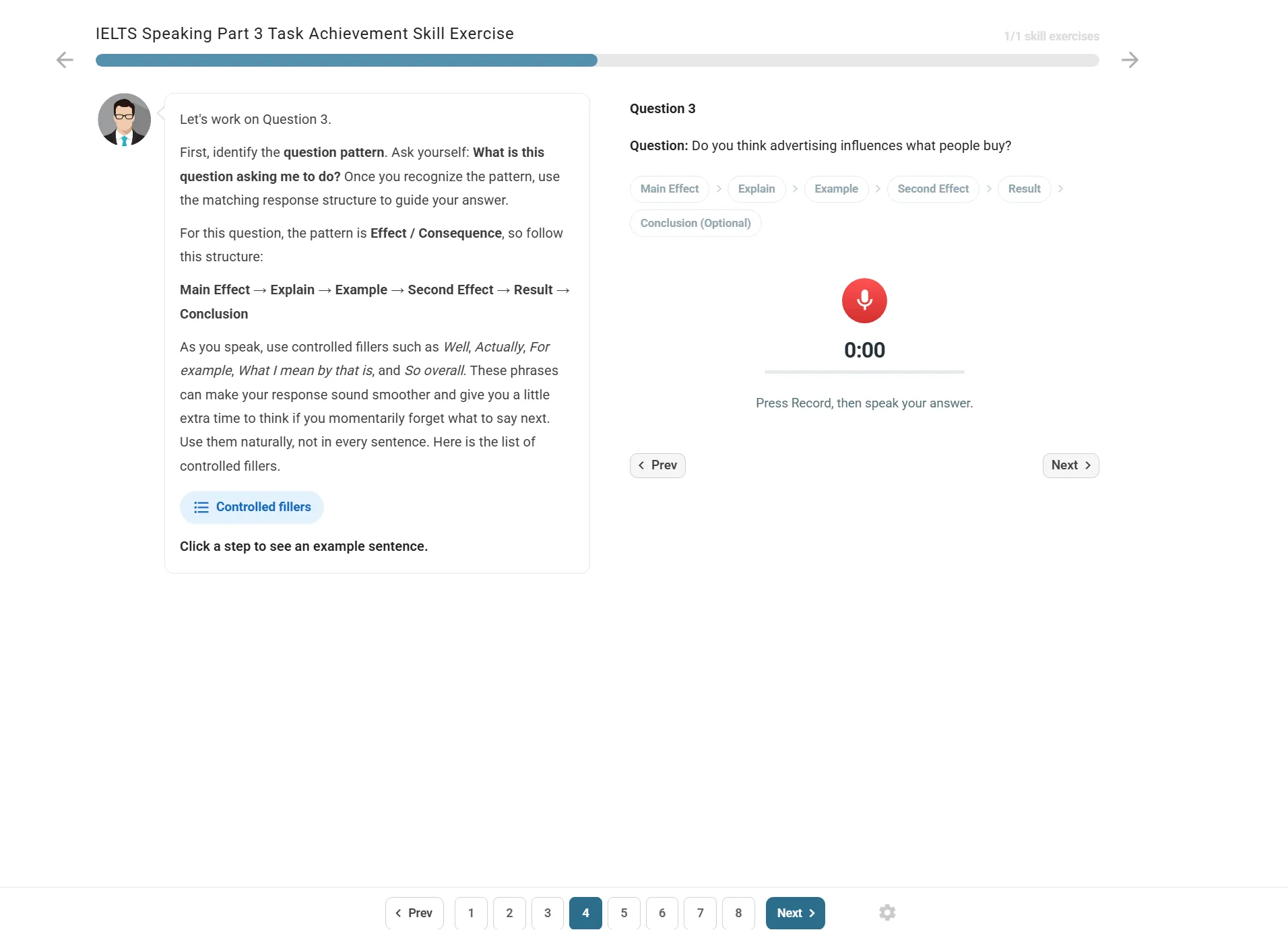
When an answer comes out too short or loses its structure, our AI Tutor helps you rebuild it with the right pattern. This exercise walks you through a real IELTS Speaking Part 3 question from our bank, step by step:

Task Achievement — IELTS Speaking 3
Learn how to answer this question in a step-by-step interactive exercise
Task Achievement — IELTS Speaking 3
Bir IELTS Speaking Part 3 sorusunu cevaplamanın ilk adımı soru kalıbını belirlemektir. Kalıbı tanıdığınızda, ona uyan cevap yapısını zihninizde hemen kullanabilirsiniz.
Bu size sonra ne söyleyeceğiniz konusunda net bir fikir verir; böylece cevabınızı akıcı bir şekilde geliştirebilir ve takılıp kalmaktan kaçınabilirsiniz. Konuşmadan önce cevabın tamamını planlamaya çalışmak yerine yapıyı adım adım izleyin.
Bu adımda 8 yaygın IELTS Speaking Part 3 soru kalıbını ve her birinin cevap yapısını öğreneceksiniz. Nasıl işlediğini görmek için her kalıbın sekmesine tıklayın.
Hadi 1. soru üzerinde çalışalım.
Önce soru kalıbını belirleyin. Kendinize şunu sorun: Bu soru benden ne yapmamı istiyor? Kalıbı tanıdığınızda, cevabınıza yön vermek için ona uyan cevap yapısını kullanın.
Bu sorunun kalıbı Opinion / View, bu yüzden şu yapıyı izleyin:
Answer → Reason → Explain → Example → Result → Second Point or Contrast → Conclusion
Konuşurken Well, Actually, For example, What I mean by that is ve So overall gibi kontrollü dolgu ifadeleri kullanın. Bu ifadeler cevabınızın daha akıcı duyulmasını sağlar ve sonra ne söyleyeceğinizi bir anlığına unutursanız size düşünmek için biraz ek zaman kazandırır. Onları her cümlede değil, doğal bir şekilde kullanın. İşte kontrollü dolgu ifadelerinin listesi.
Do you think job satisfaction is more important than your salary when choosing a job?
Hadi 2. soru üzerinde çalışalım.
Önce soru kalıbını belirleyin. Kendinize şunu sorun: Bu soru benden ne yapmamı istiyor? Kalıbı tanıdığınızda, cevabınıza yön vermek için ona uyan cevap yapısını kullanın.
Bu sorunun kalıbı Descriptive / Types, bu yüzden şu yapıyı izleyin:
Main Type → Explain → Example → Second Type → Explain or Compare → Overall View
Konuşurken Well, Actually, For example, What I mean by that is ve So overall gibi kontrollü dolgu ifadeleri kullanın. Bu ifadeler cevabınızın daha akıcı duyulmasını sağlar ve sonra ne söyleyeceğinizi bir anlığına unutursanız size düşünmek için biraz ek zaman kazandırır. Onları her cümlede değil, doğal bir şekilde kullanın. İşte kontrollü dolgu ifadelerinin listesi.
What skills do you think are needed to get a good job these days?
Hadi 3. soru üzerinde çalışalım.
Önce soru kalıbını belirleyin. Kendinize şunu sorun: Bu soru benden ne yapmamı istiyor? Kalıbı tanıdığınızda, cevabınıza yön vermek için ona uyan cevap yapısını kullanın.
Bu sorunun kalıbı Opinion / View, bu yüzden şu yapıyı izleyin:
Answer → Reason → Explain → Example → Result → Second Point or Contrast → Conclusion
Konuşurken Well, Actually, For example, What I mean by that is ve So overall gibi kontrollü dolgu ifadeleri kullanın. Bu ifadeler cevabınızın daha akıcı duyulmasını sağlar ve sonra ne söyleyeceğinizi bir anlığına unutursanız size düşünmek için biraz ek zaman kazandırır. Onları her cümlede değil, doğal bir şekilde kullanın. İşte kontrollü dolgu ifadelerinin listesi.
Do you think that women should be able to do the same jobs as men?
Hadi 4. soru üzerinde çalışalım.
Önce soru kalıbını belirleyin. Kendinize şunu sorun: Bu soru benden ne yapmamı istiyor? Kalıbı tanıdığınızda, cevabınıza yön vermek için ona uyan cevap yapısını kullanın.
Bu sorunun kalıbı Compare / Contrast, bu yüzden şu yapıyı izleyin:
Main Difference → Explain → Example → Second Difference → Contrast → Overall Comparison
Konuşurken Well, Actually, For example, What I mean by that is ve So overall gibi kontrollü dolgu ifadeleri kullanın. Bu ifadeler cevabınızın daha akıcı duyulmasını sağlar ve sonra ne söyleyeceğinizi bir anlığına unutursanız size düşünmek için biraz ek zaman kazandırır. Onları her cümlede değil, doğal bir şekilde kullanın. İşte kontrollü dolgu ifadelerinin listesi.
What’s the difference between white collar and blue collar jobs?
Hadi 5. soru üzerinde çalışalım.
Önce soru kalıbını belirleyin. Kendinize şunu sorun: Bu soru benden ne yapmamı istiyor? Kalıbı tanıdığınızda, cevabınıza yön vermek için ona uyan cevap yapısını kullanın.
Bu sorunun kalıbı Descriptive / Types, bu yüzden şu yapıyı izleyin:
Main Type → Explain → Example → Second Type → Explain or Compare → Overall View
Konuşurken Well, Actually, For example, What I mean by that is ve So overall gibi kontrollü dolgu ifadeleri kullanın. Bu ifadeler cevabınızın daha akıcı duyulmasını sağlar ve sonra ne söyleyeceğinizi bir anlığına unutursanız size düşünmek için biraz ek zaman kazandırır. Onları her cümlede değil, doğal bir şekilde kullanın. İşte kontrollü dolgu ifadelerinin listesi.
What jobs do you think are most valuable to society?
When you’re ready for the full test, try a complete IELTS practice test with all three Speaking parts.
All IELTS Speaking Part 3 Practice Questions
Every IELTS Speaking Part 3 practice in our question bank is listed below, with its topic and first question. Open any set to answer the discussion questions out loud and get an instant AI score.
Frequently Asked Questions About IELTS Speaking Part 3
helpHow long is IELTS Speaking Part 3?expand_moreexpand_less
Part 3 lasts about 4 to 5 minutes. The examiner asks discussion questions linked to the topic of your Part 2 cue card, but about people and society in general rather than your own life.
helpHow long should my IELTS Speaking Part 3 answers be?expand_moreexpand_less
Aim for about 40 to 60 seconds, usually five or six sentences: a clear answer, a reason, an explanation, an example, and a short conclusion. Part 3 answers should be longer and more developed than Part 1 answers.
helpWhat topics come up in IELTS Speaking Part 3?expand_moreexpand_less
Part 3 follows the topic of your Part 2 cue card and widens it to society. Common areas include education, technology, work, cities, the environment, family, health, the media, and shopping.
helpIs it OK to give my own opinion in IELTS Speaking Part 3?expand_moreexpand_less
Yes. Many Part 3 questions ask for your opinion, and there is no right or wrong answer. The examiner scores how clearly you explain and support your view, not the view itself.
helpWhat if I don't know much about a Part 3 topic?expand_moreexpand_less
Say so briefly, then give your best guess with a reason and an example. A short phrase to buy thinking time is fine, and you can still show the examiner your range of English even on an unfamiliar topic.
The figures on this page come from the BestMyTest IELTS learner performance data, our records of IELTS practice on BestMyTest up to October 2026. That page explains how we measure each figure. Last updated 15 October 2026.