
У цьому посібнику ви пройдете безкоштовний тест IELTS Listening та отримаєте повний аналіз результатів аудіювання IELTS. Ви будете готуватися з понад 125 практичними тестами IELTS Listening, уроками, порадами та відеопоясненнями відповідей. Дотримуючись нашого індивідуального плану навчання, ви досягнете бажаного балу з аудіювання IELTS.
Отримайте безкоштовний аналіз результату IELTS Listening і персональний план навчання після проходження безкоштовного практичного тесту IELTS Listening.
play_circle_outline Розпочати практичний тест IELTS ListeningНижче наведено повний список наших запитань IELTS Listening з відповідями. Примітка: червоні посилання ведуть до наших найпопулярніших і рекомендованих запитань listening, які високо оцінили наші учні, і ви можете безкоштовно практикуватися на них будь-коли.
IELTS Аудіювання. Тренувальні запитання до частини 1 1 - 59
A conversation between two people in an everyday situation
IELTS Аудіювання. Тренувальні запитання до частини 2 1 - 75
A talk by one speaker about an everyday topic
IELTS Аудіювання. Тренувальні запитання до частини 3 1 - 65
A conversation between up to four people about studies or training
IELTS Аудіювання. Тренувальні запитання до частини 4 1 - 62
A talk by one speaker on an academic subject
Посібник із пробного тесту IELTS Listening
У решті цього посібника ви дізнаєтеся все про тест IELTS Listening. Ви зрозумієте, як обчислюється бал за аудіювання, навчитеся успішно відповідати на кожен тип запитань, щоб підвищити свій бал IELTS Listening, а також ознайомитеся з нашим перевіреним 3-кроковим процесом онлайн-підготовки до тестів IELTS Listening.
Зміст
Інформація про тест IELTS Listening
Тест IELTS Listening поділений на 4 розділи. У кожному розділі ви прослуховуєте одного або кількох носіїв англійської мови, а потім відповідаєте приблизно на 10 запитань, пов'язаних із почутим. Загалом розділ IELTS Listening містить 40 запитань. Зазвичай записи починаються з простіших і поступово стають складнішими в міру проходження іспиту. Кожен запис відтворюється лише один раз і містить різноманітні акценти, зокрема британський, австралійський, новозеландський, американський та канадський.
- Розділ 1 – розмова між двома людьми у повсякденному соціальному контексті. Наприклад, ви можете почути розмову про підтвердження деталей бронювання або оформлення замовлення по телефону.
- Розділ 2 – монолог у повсякденному соціальному контексті. Наприклад, ви можете почути виступ про місцеві заклади, або людину, яка пояснює маршрут чи подає базову інформацію про якусь подію.
- Розділ 3 – розмова між максимум чотирма людьми в освітньому або навчальному контексті. Наприклад, ви можете почути університетського викладача та студента, які обговорюють завдання, або кількох студентів, що обговорюють щось із заняття.
- Розділ 4 – монолог на академічну тему. Наприклад, ви чутимете університетську лекцію професора. Для більшості студентів це найскладніший запис у тесті Listening.
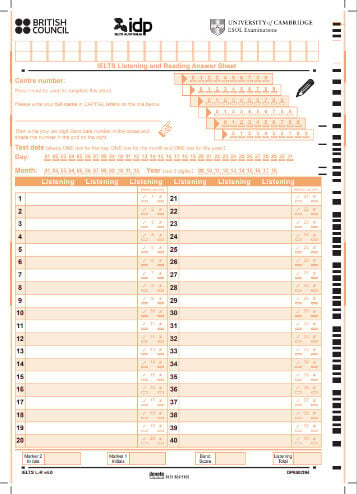
Тест IELTS Listening триває близько 40 хвилин. Ви витратите 30 хвилин на прослуховування записів і відповіді на запитання. Вам видадуть зошит із запитаннями (Question Booklet) та бланк для відповідей (Answer Sheet). У зошиті з запитаннями ви побачите всі питання, на які потрібно відповісти. На бланку для відповідей ви запишете остаточні відповіді для оцінювання.
Ви можете переглянути офіційний бланк відповідей IELTS Listening у форматі PDF тут або просто подивитися на зображення нижче :)
Наприкінці розділу аудіювання вам надається 10 хвилин для перенесення відповідей із зошита запитань на бланк для відповідей.
ВАЖЛИВО!
Орфографічні та граматичні помилки зараховуються як НЕПРАВИЛЬНА відповідь, тож скористайтеся цими 10 хвилинами, щоб ще раз перевірити написання та граматику.
Як обчислюється бал IELTS Listening
У розділі Listening кожне запитання оцінюється в 1 бал, тож максимально можна набрати «сирий» (raw) бал у 40 балів. Потім ваш сирий бал перетворюється на band score. Пам'ятайте! За неправильні відповіді бали не знімаються. Таблиця нижче дає загальне уявлення про те, як сирі бали переводяться у band score.
| Сирий бал | Band score |
|---|---|
| 39-40 | 9 |
| 37-38 | 8.5 |
| 35-36 | 8 |
| 32-34 | 7.5 |
| 30-31 | 7 |
| 26-29 | 6.5 |
| 23-25 | 6 |
| 18-22 | 5.5 |
| 16-17 | 5 |
| 13-15 | 4.5 |
| 11-12 | 4 |
Оскільки кожна версія IELTS дещо відрізняється, кількість сирих балів, необхідна для отримання певного band score, залежить від того, як склали тест усі учасники у відповідний день. Тож кількість правильних відповідей, потрібна для досягнення певного band score, може незначно змінюватися від тесту до тесту, але загалом, щоб отримати band score 7, варто прагнути приблизно 30 правильних відповідей із 40.
Як зазначалося вище, розділи стають дедалі складнішими в міру проходження тесту IELTS Listening. Однак кожне запитання оцінюється однаковою кількістю балів. Тому стежте, щоб не втрачати легкі бали, застрягши на складних запитаннях.
Безкоштовне завантаження зразка PDF IELTS Listening із відповідями
Нижче подано кілька безкоштовних зразків IELTS Listening у форматі PDF із відповідями від British Council (організатора іспиту IELTS). Під посиланнями ви також можете безкоштовно пройти тест IELTS Listening з аудіо та відповідями від BestMyTest. У ньому є всі чотири частини, і кожна частина показує текст аудіозапису разом із відповідями. Спробуйте відповісти на запитання та перевірте свої результати!
- IELTS Listening Practice Test 1 - questions (Online Examples)
- IELTS Listening Practice Test 1 - answers (PDF)
- IELTS Listening Practice Test 1 - answer sheet (PDF)
Listen to the recording and answer questions 1 to 10. The answers and the audio script are in the box below the questions.
Questions 1-10
Complete the notes below.
Write ONE WORD AND/OR A NUMBER for each answer.
This can provide the carer with:
• time for other duties
• a 1
Assessment of aunt's needs
This may involve discussing:
• how much 2 is spent caring
Daily tasks discussed:
• help with dressing
• helping her take a 3
• shopping
• helping with meals
• managing 4
• any parts of caring that are particularly hard, e.g.
• loss of 5
• 6 her
• avoiding a 7
Types of support that may be provided for carers
• transport costs, e.g. cost of a 8
• vehicle-related costs, e.g. fuel and 9
• help with housework
• support to lower 10
-
spellcheck Answers
1. Break
Break is correct because this detail is stated in the recording at the point where the question is answered.2. Time
Time is correct because this detail is stated in the recording at the point where the question is answered.3. Shower
Shower is correct because this detail is stated in the recording at the point where the question is answered.4. Money
Money is correct because this detail is stated in the recording at the point where the question is answered.5. Memory
Memory is correct because this detail is stated in the recording at the point where the question is answered.6. Lifting
Lifting is correct because this detail is stated in the recording at the point where the question is answered.7. Fall
Fall is correct because this detail is stated in the recording at the point where the question is answered.8. Minicab
Minicab is correct because this detail is stated in the recording at the point where the question is answered.9. Parking
Parking is correct because this detail is stated in the recording at the point where the question is answered.10. Anxiety
Anxiety is correct because this detail is stated in the recording at the point where the question is answered.
Audio ScriptNora: It's really good to see you, Marcus. Since I had to give up work, I feel I'm losing touch with my friends and colleagues.
Marcus: We really miss you in the office. We were all so sorry you had to leave. But you must be relieved to have more time to look after your aunt. How is she?
Nora: Well, she's very cheerful, but she needs a lot of help.
Marcus: Have you tried to get any support from the local council?
Nora: No. I didn't know I could.
Marcus: Yes. But for different kinds of practical support, they realise that carers sometimes need time for all the other responsibilities they have, apart from the person they're caring for, and also that they sometimes need a break.
Nora: Absolutely. OK, so tell me more, how do I go about getting this support?
Marcus: Well, you'd have to have an assessment of your aunt's needs. That means someone would come round and talk to you about the situation and what you need. So for a start, they'd want to know the amount of time you spend looking after your aunt every day.
Nora: OK.
Marcus: Then they'll probably ask you what sorts of tasks you do for your aunt during the day. Things like if she needs help with getting dressed, for example.
Nora: Right. I help her with that. And also I help her get into the shower in the morning.
Marcus: Yes. That sort of thing. They'll probably ask you if you do the shopping for her, and help her at meal times, and whether she can cope using money.
Nora: Yes. That's becoming a bit of a problem. She used to be very good at it, but not anymore.
Before you hear the rest of the conversation, you have some time to look at questions 5 to 10. [20 seconds] Now listen, and answer questions 5 to 10.Marcus: And be ready to tell them about anything you find particularly difficult about caring for your aunt.
Nora: So recently I've noticed she started to have quite bad problems with her memory. If I wasn't there, I think she'd forget to eat, for example. And often she doesn't seem quite sure what day it is.
Marcus: Yes. Tell them about that. And are there any physical difficulties you have caring for her? Lifting her, for example.
Nora: Yes. She's quite heavy, and I'm afraid of hurting my back. I'd be in real trouble if that happened.
Marcus: They can give you advice about that, and also about how to avoid the possibility of your aunt having a fall.
Nora: Great. So, once they've done this assessment, if I'm eligible, what happens next?
Marcus: Well, they might support you financially. So they might help you with travel costs, like if you have to get a minicab to take your aunt for an appointment, for example.
Nora: I usually drive her myself, actually. So could I claim for the petrol?
Marcus: You could. And you can claim for the parking, too.
Nora: Oh, right.
Marcus: And if you need help with the housework, they can arrange for someone to come along once or twice a week. And one other thing. I hope you don't mind me saying this, but it's important you look after yourself. And it seems to me you're dealing with quite a bit of anxiety.
Nora: I am, yes.
Marcus: Well, tell the council, because they may be able to give you some advice on how to minimise it.
Nora: Really? Though, actually, I feel so much better having talked to you. I'll get in touch with the council straight away. Now, shall we go for coffee, or something?
Listen to the recording and answer questions 11 to 20. The answers and the audio script are in the box below the questions.
Questions 11-14
Choose the correct letter, A, B or C.
11. Who began turning the unused Whitfield site into a planted space?
- city council officials.
- nearby residents.
- a gardening charity.
12. What was Lillian Hartley trying to achieve through public campaigning?
- preventing a housing sale
- blocking army exercises
- winning maintenance funding
13. Why was the park rejected as a place for troop exercises?
- council permission was refused.
- too little usable space.
- a better site was chosen.
14. How does the speaker describe the latest redesign plans?
- 2013 plan used unchanged.
- 2013 plan revised pre-work.
- 2015 plan finished in 2016.
Questions 15-20
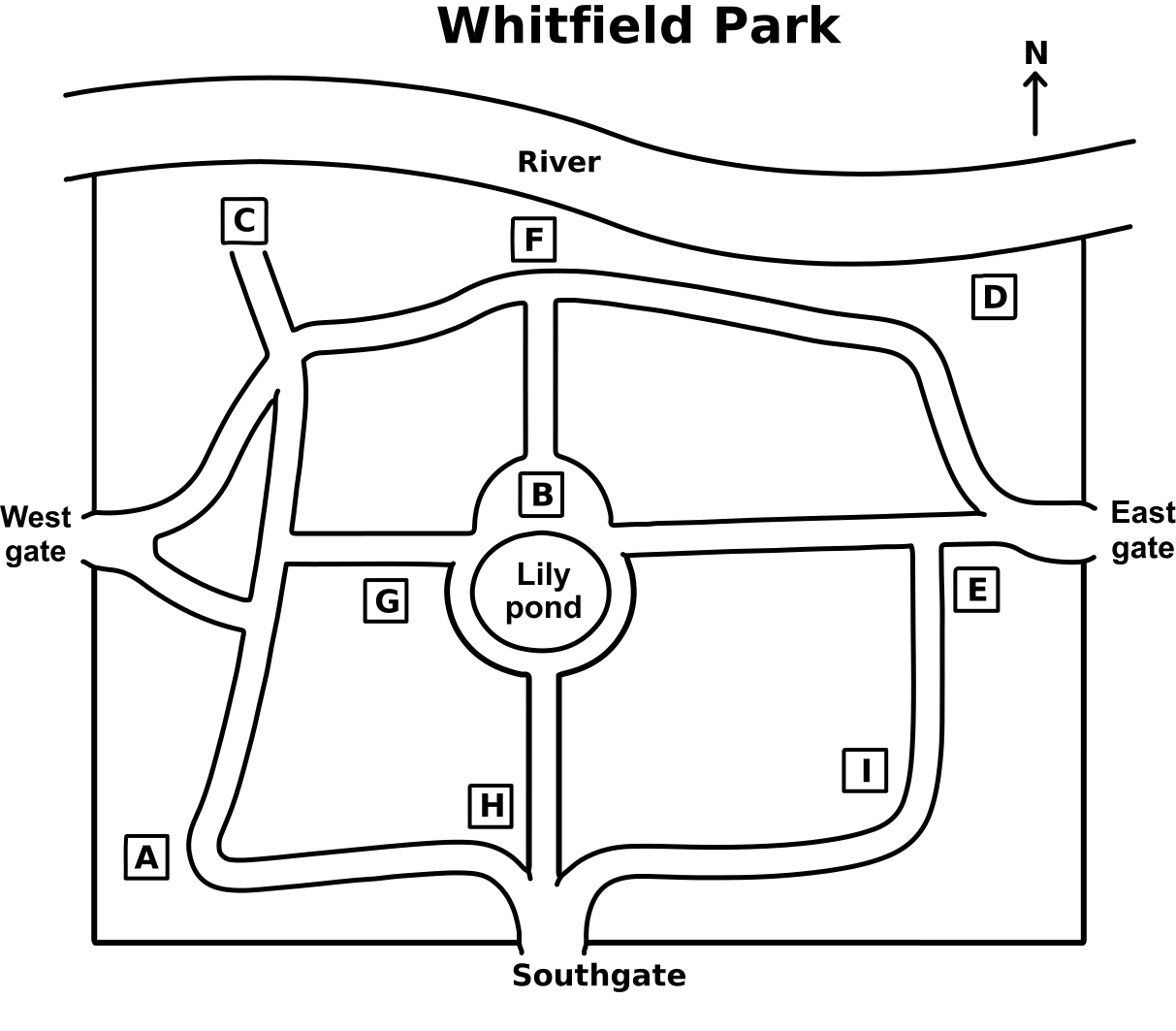
Label the plan of Whitfield Park below.
Write the correct letter, A-I, next to questions 15-20.
- statue of Lillian Hartley
- wooden sculptures
- playground
- maze
- tennis courts
- fitness area
-
spellcheck Answers
11. B
(A) is incorrect. The council took ownership later.(B) is correct. The initial planting was done by residents from nearby streets.
(C) is incorrect. The recording does not support this option: a gardening charity.
12. A
(A) is correct. Hartley organised public pressure so the council would keep the land as a park rather than sell it for housing.(B) is incorrect. The recording does not support this option: blocking army exercises.
(C) is incorrect. The recording does not support this option: winning maintenance funding.
13. B
(A) is incorrect. The recording does not support this option: council permission was refused.(B) is correct. , after inspection, the army concluded that the park was too small for practical use.
(C) is incorrect. The recording does not support this option: a better site was chosen.
14. B
(A) is incorrect. The recording does not support this option: 2013 plan used unchanged.(B) is correct. The plans dated from 2013 but were revised in 2015 before work began.
(C) is incorrect. The recording does not support this option: 2015 plan finished in 2016.
15. B
The correct answer is B because the statue of Lillian Hartley is now immediately north of the lily pond near the centre of the park, and that position is labelled B.16. D
The correct answer is D because the wooden sculptures are on the riverbank where the path from the East Gate makes a sharp bend, which corresponds to D.17. F
The correct answer is F because the playground is between the river and the path from the lily pond to the river, and that location is marked F.18. C
The correct answer is C because the maze is found by entering from the West Gate, walking north, and turning left, which places it at C.19. A
The correct answer is A because the tennis courts remain in the southern corner where the perimeter path makes a right-angled bend, labelled A.20. G
The correct answer is G because the fitness area is beside the lily pond on the same side as the West Gate, matching G on the plan.
Audio ScriptI'm delighted this evening to introduce our guest speaker, Sarah Holloway, who is going to talk to us about the recent transformation of Whitfield Park. Over to you, Sarah. Thank you very much. I'm sure you all know Whitfield Park well, it has been one of the city's landmarks for well over a century, and the city council has been responsible for it for most of that time. What perhaps fewer of you will know is how the park actually began.
Unlike many city centre parks, which started life as the private gardens of a large house, Whitfield was originally just an unused patch of waste ground. The first flowers there were actually planted by a small group of local residents who lived in the surrounding streets. They began work on the site in 1892. At that point nobody was entirely sure who legally owned the land, and it was a full twenty years later before the city council finally took it into public ownership. Some of you will have seen the statue near one of the gates. That figure is Lillian Hartley, who played a really important role in the early history of the park.
Once the council legally owned the land, its first instinct was to sell it off as building plots for housing. A great many local residents, however, wanted the park to stay open as a place where everyone could enjoy fresh air and green space, bear in mind that this is a very densely built up residential district. Lillian Hartley was at the heart of that campaign, and it was she who organised the petitions and the public demonstrations which, in the end, persuaded the council to drop the sale and keep the land as a park.
Soon afterwards, in 1914, the First World War broke out, and most of the park was dug up and used to grow vegetables, which were sold to local residents. At one point the army did look into taking over the park as a site for troop exercises. They actually wrote to the city council about it, but when they inspected it they concluded that the park was simply too small to be of any practical use to them, so the idea was dropped. The only military activity in the park during the war was the occasional public meeting held on a small area of grass that had been kept clear of vegetable plots.
After the war, the park was largely returned to the way it had been before 1914, and from then on it remained almost unchanged for decades. New plans for transforming the park were drawn up several times over the years; the most recent version dates from 2013, but those plans were then revised in 2015, well before any actual work had got under way. Work on the ground finally began in 2016 and was completed, on schedule, last year.
Before you hear the rest of the talk, you have some time to look at questions 15 to 20. [20 seconds] Now listen and answer questions 15 to 20.All right, I'd like to describe some of the more important changes that have been made, and one or two things that have deliberately been left as they were. If you take a quick look at the map you've been handed, you'll see the familiar outline of Whitfield Park. The river forms the northern boundary, and there is a gate in each of the three other walls.
From there, follow the path up towards the river and the enlarged children's playground sits between that path and the river itself. If you keep your eye on the riverbank, over towards the East Gate side, the new wooden sculptures are at the point where the path coming up from that gate makes a sharp bend.
Back near the West Gate side of the park, there is a maze, a circular pattern of paths separated by low hedges. Head in from the West Gate, walk north towards the river, and then turn left to find it. Close to the same central lily pond, on the side facing the West Gate, you'll also find the new outdoor fitness area.
Down in the southern corner, where the perimeter path makes that distinct right angled bend, the tennis courts are still in their familiar position, though we have now doubled them from four to eight. Now, since you are all keen gardeners, I'm sure you'll want to hear about the plants that have been chosen for the new beds.
Listen to the recording and answer questions 21 to 30. The answers and the audio script are in the box below the questions.
Questions 21-25
Choose the correct letter, A, B or C.
21. Nina and Owen were surprised to learn that coastal cities
- are home to just under half of all people.
- account for many of the largest cities.
- are expanding at double the rate of inland cities.
22. According to Owen, building coastal cities near to rivers
- can carry contamination back towards urban areas.
- can leave too little land for farming upstream.
- can cause factories to damage rural scenery.
23. What mistake was made when building water drainage channels in Port Selby in the 1950s?
- The system did not include enough channels.
- The builders selected the wrong construction materials.
- The design failed to anticipate rising sea levels.
24. What do Nina and Owen think that the authorities in Port Selby should do immediately?
- take measures to restore coastal ecosystems
- pay for a new flood prevention system
- stop disposing of waste materials into the ocean
25. What do they agree should be the priority for international action?
- greater coordination of activities
- more sharing of information
- agreement on shared policies
Questions 26-30
What decision do the students make about each of the following parts of their presentation?
Write the correct letter, A-G, next to questions 26-30.
- use visuals
- keep it short
- involve other students
- check the information is accurate
- provide a handout
- focus on one example
- do online research
- Historical background
- Geographical factors
- Past mistakes
- Future risks
- International implications
-
spellcheck Answers
21. B
(A) is incorrect. The recording does not support this option: are home to just under half of all people.(B) is correct. Nina says most of the biggest cities are built by the sea.
(C) is incorrect. The recording does not support this option: are expanding at double the rate of inland cities.
22. A
(A) is correct. Owen says pollutants from inland agriculture and industry travel down rivers to cities.(B) is incorrect. The recording does not support this option: can leave too little land for farming upstream.
(C) is incorrect. The recording does not support this option: can cause factories to damage rural scenery.
23. C
(A) is incorrect. The recording does not support this option: The system did not include enough channels.(B) is incorrect. The recording does not support this option: The builders selected the wrong construction materials.
(C) is correct. Port Selby's drainage channels were built without allowing for global warming and rising sea levels.
24. B
(A) is incorrect. The recording does not support this option: take measures to restore coastal ecosystems.(B) is correct. Nina says they need money to replace the drainage channels for flood protection now.
(C) is incorrect. The recording does not support this option: stop disposing of waste materials into the ocean.
25. A
(A) is correct. They say coastal cities must act together internationally.(B) is incorrect. The recording does not support this option: more sharing of information.
(C) is incorrect. The recording does not support this option: agreement on shared policies.
26. B
B is correct because they decide not to spend too long on historical background, so they will keep it short.27. A
A is correct because they decide to use slides with maps showing geographical factors.28. F
F is correct because they choose the Meriton case study as the basis for past mistakes, focusing on one example.29. G
G is correct because they need to look at websites for future risks, so online research is required.30. C
C is correct because they plan to ask audience members from different places, involving other students.
Audio ScriptTutor: OK, so what I'd like you to do now is to talk to your partner about your presentations on environmental planning. You should have done most of the reading now, so I'd like you to share your ideas and talk about the structure of your presentation and what you need to do next.
Nina: OK, Owen, I'm glad we chose quite a specific topic: coastal cities. It made it much easier to find relevant information.
Owen: Yeah, and cities are growing so quickly. I mean, we know that more than half the world's population lives in cities now.
Nina: Yeah, though that's all cities, not just coastal ones. But most of the biggest cities are actually built by the sea. I'd not realised that before.
Owen: Nor me. And what's more, a lot of them are built at places where rivers come out into the sea. But apparently this can be a problem.
Nina: Why?
Owen: Well, as the city expands, agriculture and industry tend to spread further inland along the rivers. And so agriculture moves even further inland up the river. That's not necessarily a problem, except it means more and more pollutants are discharged into the rivers.
Nina: That's a serious problem.
Owen: Right.
Nina: Did you read that article about Port Selby on the south coast?
Owen: No.
Nina: Well, apparently back in the 1950s, they built channels to drain away the water in case of flooding.
Owen: Sounds sensible.
Nina: Yeah, they spent quite a lot of money on them. But what they didn't take into account was global warming. So they built the drainage channels too close to sea level. And now sea levels are rising, they're more or less useless. If there's a lot of rain, the water can't run away. There's nowhere for it to go.
Owen: So they did not help much in the end.
Nina: So what are the authorities doing about it now?
Owen: I don't know. I did read that they're aiming to stop disposing of waste water into the ocean over the next 10 years. But that won't help with flood prevention now, will it?
Nina: No, really, they just need to find the money for something to replace the drainage channels in order to protect against flooding now. But in the long term, they need to consider the whole ecosystem.
Owen: Right.
Nina: Really though, coastal cities can't deal with their problems on their own, can they? I mean, they've got to start acting together at an international level instead of just doing their own thing.
Owen: Absolutely. The thing is, everyone knows what the problems are and environmental planners have a pretty good idea of what we should be doing about them. So they should be able to work together to some extent.
Nina: But it's going to be a long time before countries come to a decision on what principles they're prepared to abide by.
Owen: Yeah, if they ever do.
Before you hear the rest of the conversation, you have some time to look at questions 26 to 30. [20 seconds] Now listen and answer questions 26 to 30.Nina: So I think we've probably got enough for our presentation. It's only 15 minutes.
Owen: OK, so I suppose we'll begin with some general historical background about why coastal cities were established. But we don't want to spend too long on that. The other students will already know a bit about it.
Nina: It's all to do with communications and so on.
Owen: Yes, we should mention some geographical factors, things like wetlands and river estuaries and coastal erosion and so on.
Nina: We could have some maps of different cities with these features marked.
Owen: On a handout, you mean, or some slides everyone can see.
Nina: Yeah, that'd be better.
Owen: It'd be good to go into past mistakes in a bit more detail. Did you read that case study of the problems there were in Meriton with flooding a few years ago?
Nina: Yes, we could use that as the basis for that part of the talk. I don't think the other students will have read it, but they'll remember hearing about the flooding at the time.
Owen: Hmm, OK. So that's probably enough background. So then we'll go on to talk about what actions have been taken to deal with the problems of coastal cities.
Nina: OK, what else do we need to talk about? Maybe something on future risks looking more at the long term if populations continue to grow?
Owen: Yeah, we'll need to do a bit of work there. I haven't got much information, have you?
Nina: No, we'll need to look at some websites. Shouldn't take too long.
Owen: OK. And I think we should end by talking about international implications. Maybe we could ask people in the audience. We've got people from quite a lot of different places.
Nina: That'd be interesting if we have time, yes. So now should we go on?
Listen to the recording and answer questions 31 to 40. The answers and the audio script are in the box below the questions.
Questions 31-36
What point does the lecturer make about each item?
Write the correct letter, A-K, next to questions 31-36.
- changes drainage
- protects animals
- increases nutrients
- kills germs
- affects many species
- creates dense shade
- alters the soil
- supports farming
- reduces competition
- attracts bell-miners
- helps recovery
- Eucalyptus woodland
- Damage to eucalyptus woodland
- Oil from eucalyptus leaves
- Lime used in construction
- Direct iron supply
- Moderate bushfires
Questions 37-40
Complete the notes below.
Write ONE WORD ONLY for each answer.
Bell-miner associated dieback:
• The process starts with insects feeding on eucalyptus 37
• A sweet liquid containing 38 attracts bell-miners
Fire patterns:
• If fires happen too often, 39 becomes the main vegetation
• When fires are almost absent, thick growth gives bell-miners protected 40 sites
-
spellcheck Answers
31. B
B is correct because eucalyptus woodland provides nesting places and shelter for birds, bats and small mammals.32. E
E is correct because damage to eucalyptus woodland affects a wider community of species, not only the trees themselves.33. D
D is correct because oil from eucalyptus leaves is used in disinfectant, where it can kill certain germs.34. G
G is correct because lime from road construction was washed into the soil and interfered with tree roots.35. K
K is correct because affected trees recovered surprisingly quickly when iron was supplied directly.36. I
I is correct because occasional fire removes fast-growing competitors that would otherwise use water needed by eucalyptus trees.37. leaves
The correct answer is leaves. The lecturer says the process begins when insects settle on eucalyptus leaves and feed on them.38. sugar
The correct answer is sugar. The lecturer says the insects produce a sweet liquid containing sugar, which attracts bell-miners.39. grass
The correct answer is grass. The lecturer says grass tends to dominate afterwards if fires occur too often.40. nesting
The correct answer is nesting. The lecturer says dense growth creates protected nesting sites for bell-miners when fire is suppressed.
Audio ScriptGood morning. Today I want to focus on the eucalyptus tree, one of the best known features of the Australian landscape. Many people call it a gum tree, but the name eucalyptus actually covers hundreds of related species, from small scrubby trees to very tall forest giants.
Now, eucalyptus trees are important in several ways. Ecologically, they provide nesting places and shelter for birds, bats and small mammals. Their flowers also produce nectar, which is an important food source for insects and birds. So when eucalyptus woodland is damaged, the effect is felt across a much wider community of species.
As for their value to people, the trees are also useful. Oil from eucalyptus leaves has long been used in cleaning products, and one common use is in disinfectant, because the oil can kill certain germs. Eucalyptus timber is also used in building and fencing, although that is not really the main focus of today's lecture.
So, these trees can live for centuries, and some individuals survive for four hundred years or more. That is why researchers became concerned when large numbers began dying much earlier than expected in different parts of Australia.
Now, one disease that attracted attention was Mundulla Yellows. The leaves of affected trees slowly turned yellow and then, over time, the whole tree declined. For years the cause was unclear. Eventually, researchers discovered that lime, or calcium hydroxide, had been used in road construction nearby. Rain washed the lime into the surrounding soil, where it interfered with the roots of eucalyptus trees. The trees were still surrounded by nutrients, but they could no longer absorb the iron they needed for healthy growth. When iron was supplied directly to affected trees, they recovered surprisingly quickly.
However, Mundulla Yellows affected only a limited number of places. A much wider problem on the east coast was Bell miner associated dieback. Now, bell miners are small native birds, but they are not the direct cause of the damage. The process begins when insects settle on eucalyptus leaves and feed on them. While feeding, these insects produce a sweet liquid containing sugar. Bell miners are attracted to that liquid, and they aggressively chase away other birds and insects that might otherwise reduce the insect population. As a result, the insects multiply, the leaves are badly damaged, and the trees gradually lose their ability to survive.
But some scientists think fire history is also part of the explanation. An influential theory, first proposed by the ecologist William Jackson, links the type of vegetation in a region to the frequency of bushfires. If fires occur too often, grass tends to dominate the area afterwards. If fires occur at moderate intervals, eucalyptus forest is more likely to persist. This is because occasional fire removes fast growing competitors which would otherwise take up the water eucalyptus trees need. And it also helps maintain the soil by preventing dense undergrowth from changing the soil structure and removing nutrients.
At the other extreme, if fires are almost completely suppressed, a different ecosystem can develop. Scientists sometimes call this dry rainforest. Now, the name sounds contradictory, because we usually associate rainforest with wet tropical conditions. But in this case it means a dense, shaded vegetation system with relatively few species. It can create excellent conditions for bell miners, because the thick growth gives them protected nesting sites while excluding many of the species that would normally compete with them.
What this tells us is that before European settlement, Aboriginal communities used controlled burning over long periods, and this probably created a more balanced pattern of vegetation. Since European settlement, fire has often been suppressed, roads and farms have altered drainage, and some local ecosystems have shifted away from eucalyptus woodland. The decline of eucalyptus trees, then, is not caused by one single factor. It is the result of disease, insects, birds, soil chemistry and fire management interacting with one another.

Completion - Part 1
Learn how to answer these questions in a step-by-step interactive exercise
Completion - Part 1
Пропуск може вимагати часу або частоти. Мовець зазвичай називає той самий період іншими словами, тож зіставляйте з пропуском зміст, а не чекайте формулювання зі сторінки.
Потім перед надсиланням перевірте ліміт слів. Перечитайте весь рядок із вашою відповіддю в пропуску й приберіть будь-яке слово, яке вже є в рядку. Відповідь, правильна за змістом, але задовга, не отримує жодного бала.
Натисніть «Відтворити», щоб прослухати аудіо
У нотатках використано просте дієслово, як-от must provide або need to bring. Мовець рідко вживає саме це дієслово: натомість він використовує синонім або описує дію, тож слухайте, що насправді потрібно.
Мовці часто спершу згадують зайві речі, а потім їх відкидають. Якщо пропустили відповідь, залиште цей пропуск і переходьте до наступного, бо відповіді йдуть у порядку запису, і один втрачений пропуск може коштувати вам наступних.
Натисніть «Відтворити», щоб прослухати аудіо
Як ви впоралися із зразками запитань IELTS Listening вище? Чи виявилися деякі запитання складними? Якщо так, варто детальніше розглянути всі 6 типів завдань IELTS Listening. Чим краще ви розумієте тип завдання, тим менше зусиль витратите на з'ясування того, що саме потрібно зробити, і тим більше часу матимете на пошук відповіді.
6 типів завдань IELTS Listening
У тесті IELTS Listening є 6 різних типів запитань. Важливо опрацьовувати кожен тип завдань, щоб засвоїти найкращий спосіб розв'язання кожного з них і отримати високий бал за IELTS Listening.
Які типи завдань з аудіювання найскладніші для наших учнів
Замість тенденції 2017 року наведемо те, що показують 2.22 млн відповідей учнів BestMyTest на завдання IELTS з аудіювання. Відсоток показує, як часто наші учні правильно виконували завдання цього типу, тож ви одразу бачите, де губляться бали.
| Тип завдання | Правильні відповіді |
|---|---|
| Note completion | 33% |
| Table completion | 34% |
| Sentence completion | 45% |
| Short answer | 48% |
| Multiple choice | 50% |
| Multiple selection | 52% |
| Plan, map, diagram labelling | 55% |
| Form completion | 73% |
| Matching | 85% |
- Саме в завданнях на заповнення пропусків учні втрачають бали. Серед завдань на заповнення пропусків Note completion виконують правильно у 33% випадків, тоді як Form completion, що перевіряє ту саму навичку в іншому форматі, сягає 73%. У кожному завданні на заповнення пропусків треба записати почуте слово, тож правопис, форма слова й обмеження кількості слів мають значення, і все це можна натренувати.
- Серед повних тренувальних тестів з аудіювання (усього: 61 104; кількість учнів: 54 523) середній бал становив 5.6. У 41% тестів результат сягнув 6.0 бала, а у 12% — 7.0 бала.
- В окремих розділах аудіювання 31% спроб мали результат 40% або менше, а 30% — 80% або більше. Розділи 3 і 4 — це академічні частини тесту, тож тренуйте їх окремо, а не лише в повних тестах.
Хоча кожен тип запитань Listening виглядає по-різному, базовий підхід до них однаковий. Далі в цій статті ми покажемо вам базову стратегію для всіх 6 типів запитань. У кожного типу є аудіоприклад і відповідь у посібнику типи запитань IELTS Listening.
3 кроки до ефективної онлайн-підготовки до тесту IELTS Listening
Хоча кожен тип запитань (завдань) IELTS Listening різний, базовий підхід до них однаковий. Ви можете розв'язувати завдання всіх типів за допомогою однієї простої покрокової стратегії. Ось три кроки, які ми рекомендуємо застосовувати до запитань Listening:
- Уважно вивчайте запитання, щоб знайти ключову інформацію
- Передбачайте можливі відповіді ще до прослуховування
- Слідкуйте за змістом, зіставляючи запитання з тим, що чуєте
Крок 1: Уважно вивчіть запитання
У розділі IELTS Listening вам нададуть короткий час підготовки (30–40 секунд) до початку запису. Це ваша можливість поглянути на запитання, на які потрібно буде відповісти, і саме на цьому зосереджений перший крок цієї стратегії. Замість того, щоб використати цей час на перерву чи перевірку відповідей, ви маєте сконцентруватися на тому, щоб дізнатися якомога більше про запитання, що чекають далі. Цей крок важливий, щоб уникнути помилки, коли ви одночасно слухаєте мовця та намагаєтеся вперше прочитати запитання.
Коли почнеться час підготовки, насамперед ефективно використайте його, переглядаючи запитання, щоб зрозуміти їх. Ось деякі відомості, які варто шукати, аналізуючи кожне запитання IELTS Listening:
- Який це тип запитання?
- Який вигляд матиме відповідь? (наприклад, дата, число, ім'я)
- Які найважливіші фрази, слова або ключові слова в запитаннях?
Розгляньмо, наприклад, запитання типу Note Completion:
Complete the notes below.
Write NO MORE THAN THREE WORDS for each answer.
Спершу можна підкреслити деякі ключові слова в запитанні.
Two reasons for the new approach to pricing are changes in (27) ______ and (28) _________ programs.
У цьому прикладі, прислухавшись до ключової фрази «two reasons», яку ви вже підкреслили, ви зможете
вчасно зосередитися. Ось частина аудіоскрипта, яка розкриває відповідь:
Mark: Well, there seem to be two basic reasons. Firstly, because the law has changed recently to allow companies to behave like this. In the past, they weren't allowed to change the prices of the tickets. And secondly, we now have computer programs that do the calculations so that prices can be changed very quickly and accurately.
Проаналізувавши запитання, ви розумієте, що правильні відповіді тут — «the law» і «computer» — на основі ключових слів і знання типу запитання.
Крок 2: Передбачте можливі відповіді
Другий крок цієї стратегії успіху в IELTS Listening дуже тісно пов'язаний з першим. Фактично, ви маєте намагатися виконати обидва кроки за ті самі 20 секунд часу підготовки до початку запису. Хоч це може здаватися важким за такий короткий час, пам'ятайте, що ці кроки фактично взаємопов'язані.
Щоб передбачити можливі відповіді на запитання Listening, спочатку потрібно виконати крок 1 — уважно проаналізувати запитання. На цьому етапі ви маєте знати, з яким типом запитання маєте справу, як виглядатимуть потенційні відповіді, а також які ключові слова допоможуть швидко знайти відповіді. Щоб передбачити відповіді, ви поєднаєте всю цю інформацію та зробите припущення про те, якого роду відповідь варто очікувати.
Повернімося до того ж прикладу запитання Note Completion, що й вище.
Two reasons for the new approach to pricing are changes in (27) and (28) programs.
Просто проаналізувавши граматику цього речення, можна визначити, якою частиною мови буде відповідь. У цьому випадку прийменник «in» передує обом потенційним відповідям. З погляду граматики, у прийменникових словосполученнях у такій позиції можуть стояти лише іменники або іменникові групи. Можна не лише правильно передбачити, що відповідь буде іменником чи іменниковою групою, а й припустити, що вона стосуватиметься політики чи уряду (law) і слова, яке може поєднуватися з programs (computer), на основі контексту.
Хоча неможливо точно вгадати правильну відповідь на основі лише прогнозів, спроба уявити, якою може бути відповідь, допомагає вам зосередитися на релевантній інформації та ігнорувати нерелевантну. Прогнозування потенційних відповідей до початку запису підготує ваш слух і наблизить вас до правильної відповіді.
Тепер спробуймо поєднати Крок 1 (вивчити запитання) та Крок 2 (передбачити можливі відповіді) на складнішому прикладі запитання з вибором відповіді.
Choose the correct letter, A, B, C or D.
- are for weekend shows
- are booked well in advance
- are non-refundable
- are booked for groups
Хоча відповіді на ці запитання неможливо знати напевно, ви все одно можете скористатися наявною в запитаннях інформацією, щоб передбачити потенційні відповіді та цілеспрямовано прислухатися. Наприклад, запитання 24 стосується причини, чому ціни на квитки в театр будуть найнижчими, тож варто уважно слухати будь-які з цих причин. Майте на увазі, що може бути згадано більше ніж одну. Подивіться на скрипт нижче, щоб побачити, як прогнозування може допомогти вам відкинути неправильні відповіді.
Зверніть увагу, що згадуються три з потенційних відповідей: «booked for groups», «are for weekend shows» та «are non-refundable». Однак правильна відповідь — C «are non-refundable», оскільки вона згадується як дешевша окремо від двох інших, які просто перелічені разом.
Крок 3: Слідкуйте за змістом
Щойно почнеться запис і фактична частина прослуховування тесту, ви маєте слідкувати за змістом, виконуючи третій крок цієї стратегії розділу IELTS Listening. Слідкування за змістом вимагає від вас пильно зосередитися на тому, що ви чуєте, водночас тримаючи в полі зору, до якого запитання може стосуватися почуте.
Запитання в розділі IELTS Listening зазвичай розташовані в порядку, у якому їхні відповіді з'являються в записі. Це дає вам перевагу в тесті, оскільки означає, що щойно ви почуєте відповідь на одне запитання, ви одразу переключаєте увагу на наступне в порядку. Якщо вам вдасться успішно слідкувати за змістом, зіставляючи контекст запитань із тим, що чуєте у записі, ви залишатиметеся на правильному шляху та не пропустите ключову інформацію, потрібну для відповіді на кожне запитання.
Однак робити це легше на словах, ніж на ділі. Вам доведеться виконувати кілька завдань одночасно: слухати й водночас краєм ока стежити за наступним запитанням. Якщо ви все ж пропустите відповідь на якесь запитання, ви зрозумієте це, коли почуєте відповідь на одне з пізніших. Хоча це може заплутувати і навіть фруструвати, пропустити одну відповідь, але усвідомлювати це, все ж краще, ніж повністю загубитися в змісті й пропустити ще більше відповідей. Якщо ви пропустили запитання, просто залиште його та переходьте до наступного. У кінці вам доведеться зробити найкраще можливе припущення щодо пропущеного запитання. Утім, є й позитив: прослуховування запису повністю може дати вам інші контекстні підказки та дозволити точніше відповісти на пропущені запитання.
Безкоштовні ресурси для практики IELTS Listening
Щоб отримати високий бал за IELTS Listening, потрібні сильні навички аудіювання. Тому важливо систематично тренуватися щодня до самого тесту.
Нижче подано кілька ресурсів, які можна використовувати для щоденного тренування й підтримки навичок аудіювання.
- YouTube - https://www.youtube.com
- BBC Learning English - http://www.bbc.co.uk/learningenglish
- TED - https://www.ted.com/
- BBC radio - https://www.bbc.co.uk/worldserviceradio
- ABC news in Australia - https://www.abc.net.au/listen/live/news
Показники на цій сторінці взято з даних BestMyTest про результати учнів IELTS, тобто наших записів тренувань IELTS на BestMyTest до жовтня 2026 року. На тій сторінці пояснено, як ми обчислюємо кожен показник. Останнє оновлення: 15 жовтня 2026 року.