У цьому посібнику ви пройдете безкоштовний тест IELTS Speaking та потренуєтеся з найчастіше вживаними темами запитань IELTS Speaking з відповідями. Ви навчитеся відповідати на запитання тесту IELTS Speaking для частин 1, 2 та 3, використовуючи наші повністю перевірені шаблони для усної частини.
Отримайте безкоштовні зразки відповідей IELTS Speaking після проходження практичного тесту IELTS Speaking.
play_circle_outline Розпочати практичний тест IELTS SpeakingНижче наведено повний список наших запитань IELTS Speaking зі зразками відповідей. Примітка: червоні посилання ведуть до наших найпопулярніших і рекомендованих запитань speaking, які високо оцінили наші учні, і ви можете безкоштовно практикуватися на них будь-коли.
Запитання IELTS Speaking Part 1 1 - 96
Short questions about familiar topics like your home, work, and hobbies
Запитання IELTS Speaking Part 2 1 - 83
Cue cards where you speak for 1 to 2 minutes about one topic
Запитання IELTS Speaking Part 3 1 - 97
Discussion questions linked to the Part 2 topic
Посібник з успішного складання IELTS Speaking
Ласкаво просимо до офіційного посібника BestMyTest із тесту IELTS Speaking. У решті цього посібника ми зосередимося на найпоширеніших темах IELTS Speaking для частин 1 — 3, прослуховуванні зразкових відповідей рівня band 9, а також на важливих порадах і ресурсах для вашого успіху на IELTS Speaking. Скористайтеся змістом нижче, щоб швидко знайти потрібне.
Зміст
- Вступ до тесту IELTS Speaking
- Теми IELTS Speaking для Частини 1
- Теми IELTS Speaking для Частин 2 та 3
- Як упоратися з IELTS Speaking Part 1
- Як упоратися з IELTS Speaking Part 2
- Як упоратися з IELTS Speaking Part 3
- Практика IELTS Speaking для вашого успіху
- Як оцінюються запитання IELTS Speaking
- Безкоштовні ресурси для IELTS Speaking
Тест IELTS Speaking
Тест IELTS Speaking спочатку може здаватися дещо лячним, особливо тому, що ви проходитимете його наживо перед екзаменатором. Через такий «живий» формат знайти безкоштовні теми для говоріння зі зразковими відповідями буває непросто, але не хвилюйтеся — у нас є все, що вам потрібно. Перед практикою з нашими темами IELTS Speaking коротко погляньмо, як працює сам тест.
Формат тесту Speaking
Тест Speaking триває близько 11 — 15 хвилин і складається з 3 частин. Зверніть увагу: теми для Greeting і Part 1 однакові, тож формально вони рахуються як одна частина, але для вашої зручності ми розділили їх.
- Привітання у тесті IELTS Speaking
- IELTS Speaking — Частина 1
- IELTS Speaking — Частина 2
- IELTS Speaking — Частина 3
Привітання (The Greeting)
Коли ви заходите до екзаменаційної кімнати на тесті IELTS Speaking, екзаменатор не починає одразу зі складних запитань — натомість бесіда розпочинається з простого привітання. Зверніть увагу: вашу здатність привітатися БУДЕ ОЦІНЕНО, тож важливо до цього підготуватися. Розгляньмо коротко простий приклад привітання та відповіді.
- Екзаменатор представиться та запитає, як вас звати. Ви відповідаєте: «My name's _______».
- Далі вас запитають «What can I call you?», на що ви можете відповісти «You can call me_______». Тут можна назвати своє англійське ім'я, якщо воно у вас є. Це може звучати дивно, але деякі люди не можуть правильно вимовити власне англійське ім'я. Це НЕПРИЙНЯТНО. Якщо ви не можете його вимовити, краще його не використовувати.
- Після імені вас запитають, звідки ви. Просто скажіть «I'm from_____». Цього достатньо. На цьому етапі не потрібно надавати додаткової інформації.
- Нарешті, у вас попросять документ, що засвідчує особу. Після цього розпочнеться тест.
IELTS Speaking Part 1
IELTS Speaking Part 1 триває 4 — 5 хвилин, містить близько 8 — 10 запитань і приблизно 2 — 3 знайомі теми, такі як ваша робота, навчання, родина, рідне місто, житло тощо. Ці теми простіші за теми з IELTS Speaking Part 2. Нижче подано приклади того, що вас можуть запитати.
Where is your hometown?
What do you like about it?
What do you not like about it?
How important is your hometown to you?
Let's move on to talk about accommodation:
Tell me about the kind of accommodation you live in?
Does the place you live in have many amenities?
Is there anything you would like to change about the place you live in?
Do you plan to live there for a long time?
Запитання Частини 1 найкраще охарактеризувати як такі, що імітують невимушену бесіду (small talk) між двома незнайомцями чи знайомими. Вони не дуже складні, але не дайте цим запитанням обманути вас, наче готуватися до них не потрібно. Навіть невелика підготовка допоможе багато в чому, і ви ще будете нам вдячні, що ми вас змусили це зробити! Далі в цій статті ви також знайдете поради, як підготуватися до запитань Частини 1.
IELTS Speaking Part 2
У Частині 2 ви говоритимете на конкретну тему IELTS Speaking. Тему обирають за вас і подають на картці (Candidate Task Card). Потім у вас буде 1 хвилина на підготовку відповіді й максимум 2 хвилини на сам виступ. Вам нададуть олівець та папір для нотаток. Нижче подано приклад запитання IELTS Speaking Part 2:
Describe a useful electronic device you would like to own.
You should say:
- What it is
- How it would help your life
- If it would be expensive to buy
And explain why you would like it.
Коли ваші дві хвилини часу для виступу закінчаться, екзаменатор може завершити цю частину тесту, поставивши кілька простих запитань, пов'язаних із вашою відповіддю в Частині 2.
Іноді їх називають rounding off questions,
оскільки вони допомагають «закруглити» або завершити вашу розмову. Розгляньмо кілька можливих запитань.
Наприклад, припустімо, що темою IELTS Speaking, яку ви обговорювали в Частині 2, було «Describe your favorite form of public transport».
Екзаменатор може закруглити вашу розмову запитанням:
- Are the buses cheap in your city?
- Did you travel to the test today by bus?
Як правило, ці закруглюючі запитання прості, тож достатньо буде дати такі ж прості відповіді.
Тут не потрібні довгі та складні відповіді, оскільки екзаменатор, імовірно, готовий перейти до Частини 3.
Наприклад, на закруглююче запитання можна відповісти коротко:
- Yes, about 2 dollars for a single journey.
- No, actually I came by taxi.
З іншого боку, бувають випадки, коли екзаменатор повністю пропускає закруглюючі запитання й одразу переходить до Частини 3. Якщо так станеться під час вашого тесту IELTS Speaking, не хвилюйтеся — це означає, що ваша відповідь у Частині 2 була достатньо довгою, і 3 хвилини часу на цю частину вже минули.
IELTS Speaking Part 3
У Частині 3 вам поставлять ще близько 4 — 8 запитань IELTS Speaking, пов'язаних з темами, які обговорювалися в Частині 2. Екзаменатор також ставитиме додаткові запитання, спираючись на ваші відповіді, тож уся Частина 3 — це двостороння розмова з екзаменатором, яка триватиме 4 — 5 хвилин. Ось деякі загальні запитання, які екзаменатор може поставити вам, спираючись на наведені вище теми Частини 2:
What devices do you think will be popular in the future?
Do you think people spend too much money on electronic devices?
In what ways can electronic devices make our lives harder?
What would the world be like without computers?
Should children be taught to use computers at school?
Теми IELTS Speaking
Тепер, коли ви ознайомилися з тим, як проходить тест IELTS Speaking, ви бачите, що вас можуть запитати про безліч різних тем. Важливо ознайомитися з найпоширенішими темами IELTS Speaking. Ми не лише склали повний список, але й до кожної теми додали зразкову відповідь IELTS Speaking.
Стовпчикова діаграма нижче показує найпоширеніші категорії тем IELTS Speaking частин 2 і 3 у 2025 і 2026 роках. Горизонтальна вісь (вісь x) перелічує сім категорій тем, а вертикальна вісь (вісь y) показує частку тем у кожній категорії. Сині стовпчики позначають 2025 рік, помаранчеві — 2026 рік.
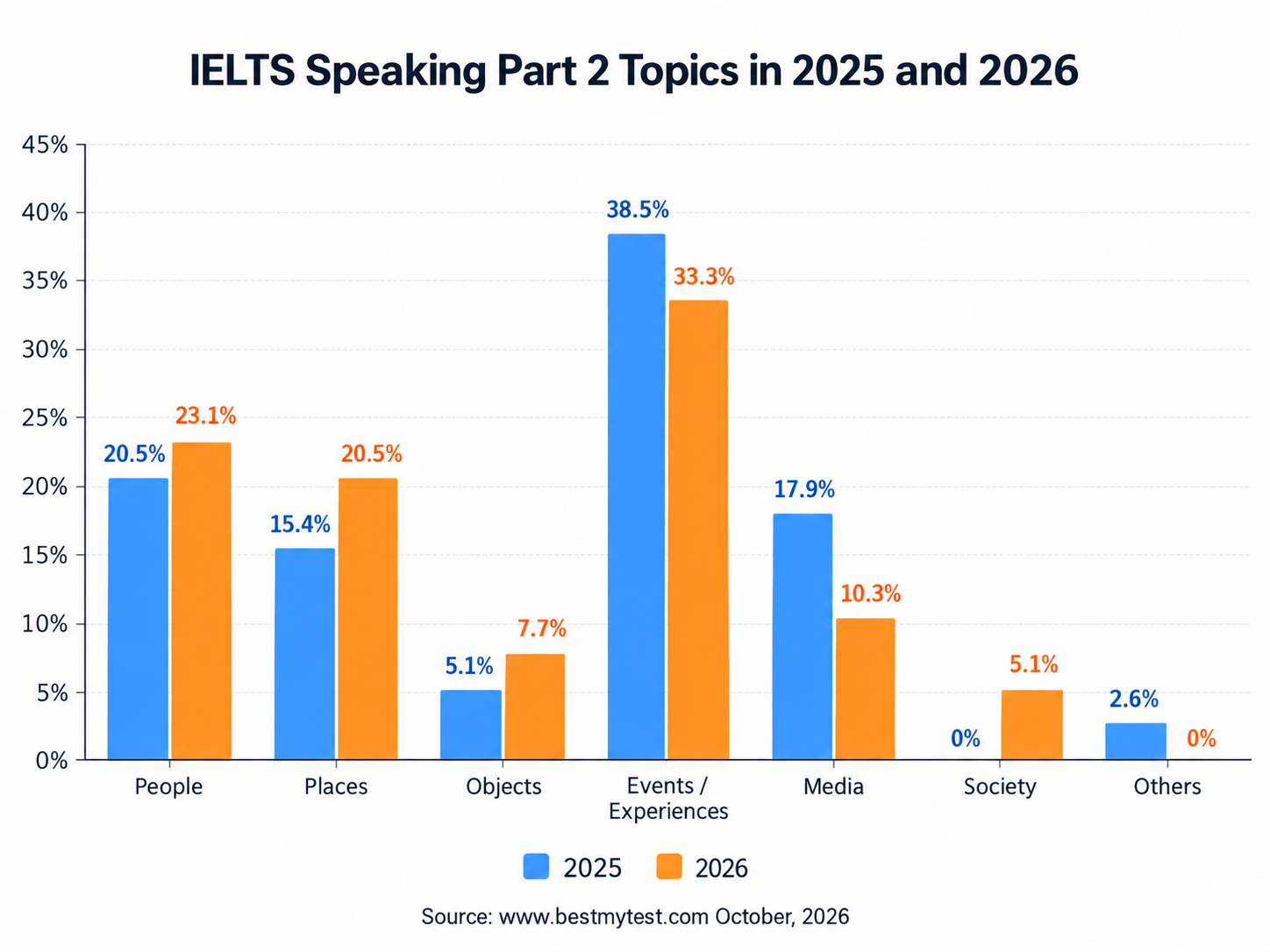
Як видно, події та досвід — найбільша категорія в обидва роки: 38,5% тем у 2025 році і 33,3% у 2026. Ці запитання зазвичай просять описати те, що ви зробили або пережили, наприклад незабутню подорож, особливе свято або випадок, коли ви комусь допомогли.
Люди й місця теж важливі категорії. Разом вони становлять 43,6% тем у 2026 році. Вас можуть попросити описати людину, якою ви захоплюєтеся, того, хто на вас вплинув, місце, яке ви любите відвідувати, або місце, яке хотіли б дослідити.
Інші категорії, зокрема предмети, медіа та суспільство, трапляються в цій вибірці рідше. Їх усе одно варто тренувати, бо запитання IELTS Speaking можуть охоплювати найрізноманітніші повсякденні теми.
Що це означає для підготовки до IELTS? Почніть із запитань про особистий досвід, людей, яких ви знаєте, і місця, де ви бували. Ці теми складають велику частку запитань на діаграмі. Підготуйте кілька гнучких історій і прикладів, які можна підлаштувати під різні запитання, замість того щоб заучувати відповіді цілком.
Теми IELTS Speaking — Частина 1
Список нижче містить не лише запитання, а й теми, на які екзаменатори запитували раніше. Чудова порада — відповідати на ці запитання IELTS Speaking Part 1 перед дзеркалом або разом із другом. Таблиця нижче показує, як часто використовується кожна тема:
| Теми | Частота |
|---|---|
| Hometown/Accommodation/Country | Висока |
| Friends/Family/Housework/Children | Висока |
| TV/Reading/Music/Newspapers & Magazines/Films | Висока |
| Technology/Computers/Internet | Висока |
| Work/Jobs/Career Planning/Volunteer Work | Висока |
| School majors/High School | Середня |
| Sports/Outdoor Activities/Indoor Activities | Середня |
| Travel/Lifestyle | Середня |
| Season/Rain/Sunny Days/Weather | Середня |
| Fashion/Shoes/Bags/Clothes | Середня |
| Transportation/Boats/Buses/Taxis | Середня |
| Celebrities/Advertisements/Media | Середня |
| Photos/Photography/Colors/Art | Низька |
| Noise/Patience/Politeness | Низька |
| Mirrors/Gifts | Низька |
Question 1
-
spellcheck TranscriptDo you enjoy going out in your free time? Why or why not?
-
Sample Response
Yeah, I usually enjoy going out in my free time because it helps me relax and meet new people. Honestly, it’s a great way to take a break from daily routine and clear my mind a little.
Watch the video question, then click to record your answer.
Practice speaking questions in our appQuestion 2
-
spellcheck TranscriptWhat kind of places do you usually go to when you go out?
-
Sample Response
Well, when I go out, I often like to visit cafes or parks. Sometimes, I also enjoy going to the cinema or shopping malls because those places are lively and fun to hang out in, you know.
Watch the video question, then click to record your answer.
Practice speaking questions in our appQuestion 3
-
spellcheck TranscriptWho do you prefer to go out with, friends or family? Why?
-
Sample Response
I think I prefer going out with friends, actually, because we share similar interests. However, sometimes I also enjoy spending time with my family. It really depends on the occasion, to be honest.
Watch the video question, then click to record your answer.
Practice speaking questions in our appQuestion 4
-
spellcheck TranscriptHow often do you go out in the evenings?
-
Sample Response
To be fair, I don’t go out every evening. I guess maybe two or three times a week, depending on my schedule. If I’m tired or busy, I usually just stay at home and relax.
Watch the video question, then click to record your answer.
Practice speaking questions in our appQuestion 5
-
spellcheck TranscriptHas the way you go out changed compared to when you were younger?
-
Sample Response
Yes, the way I go out has definitely changed since I was younger. I used to go out more often and stay out late. Now, I prefer quieter places and I’m a bit more careful with my time.
Watch the video question, then click to record your answer.
Practice speaking questions in our appQuestion 6
-
spellcheck TranscriptLet's move on to talk about goals. Do you have any specific goals for this year?
-
Sample Response
Let’s see, this year my main goal is to improve my English and maybe learn a new skill. I also want to travel to at least one new country if possible, just to experience something different.
Watch the video question, then click to record your answer.
Practice speaking questions in our appQuestion 7
-
spellcheck TranscriptWhy is it important for people to set goals?
-
Sample Response
I believe setting goals is really important because it gives us direction and motivation. Without goals, it’s easy to lose focus and just drift through life without achieving anything meaningful, don’t you think?
Watch the video question, then click to record your answer.
Practice speaking questions in our appQuestion 8
-
spellcheck TranscriptHave you ever achieved a goal that was difficult for you?
-
Sample Response
Actually, yes, I once had a goal to run a half marathon. It was really difficult for me because I’m not a natural runner. But after a lot of training, I finally managed to do it and I felt so proud.
Watch the video question, then click to record your answer.
Practice speaking questions in our appQuestion 9
-
spellcheck TranscriptHow do you keep track of your progress towards your goals?
-
Sample Response
To be honest, I usually write my goals down in a notebook or on my phone. I try to check in regularly, maybe once a week, to see how I’m doing and make any changes if needed.
Watch the video question, then click to record your answer.
Practice speaking questions in our appQuestion 10
-
spellcheck TranscriptDid you have any goals when you were a child?
-
Sample Response
When I was a child, I definitely had some goals, like becoming a teacher or learning to play the piano. Even though I didn’t achieve all of them, some childhood dreams still motivate me today.
Watch the video question, then click to record your answer.
Practice speaking questions in our app
Task Achievement — IELTS Speaking 1
Learn how to answer these questions in a step-by-step interactive exercise
Task Achievement — IELTS Speaking 1
Відповідаючи на запитання IELTS Speaking Part 1, спершу дайте пряму відповідь, а потім розвиньте її, додавши трохи деталей.
Проста структура відповіді допомагає зрозуміти, що сказати далі, тож ви зможете відповідати швидко й говорити природно, не роблячи відповідь надто довгою. Не зупиняйтеся після одного короткого речення, а дотримуйтеся структури крок за кроком.
На цьому кроці ви навчитеся користуватися цією структурою, щоб будувати чіткі й природні відповіді в IELTS Speaking Part 1.
Попрацюймо над запитанням 1.
Спершу визначте шаблон запитання. Запитайте себе: що від мене вимагає це запитання? Щойно ви впізнаєте шаблон, спирайтеся у відповіді на відповідну структуру.
Шаблон цього запитання: Direct Answer, тож дотримуйтеся такої структури:
Answer + Reason → Example or Detail → Result or Extra Detail
Під час відповіді використовуйте контрольовані слова-заповнювачі, як-от Well, Actually, For example, What I mean by that is і So overall. Ці фрази можуть зробити вашу відповідь плавнішою й дати трохи часу на роздуми, якщо ви на мить забудете, що сказати далі. Використовуйте їх природно, а не в кожному реченні. Ось список контрольованих слів-заповнювачів.
Do you enjoy going out in your free time? Why or why not?
Попрацюймо над запитанням 2.
Спершу визначте шаблон запитання. Запитайте себе: що від мене вимагає це запитання? Щойно ви впізнаєте шаблон, спирайтеся у відповіді на відповідну структуру.
Шаблон цього запитання: Direct Answer, тож дотримуйтеся такої структури:
Answer + Reason → Example or Detail → Result or Extra Detail
Під час відповіді використовуйте контрольовані слова-заповнювачі, як-от Well, Actually, For example, What I mean by that is і So overall. Ці фрази можуть зробити вашу відповідь плавнішою й дати трохи часу на роздуми, якщо ви на мить забудете, що сказати далі. Використовуйте їх природно, а не в кожному реченні. Ось список контрольованих слів-заповнювачів.
What kind of places do you usually go to when you go out?
Попрацюймо над запитанням 3.
Спершу визначте шаблон запитання. Запитайте себе: що від мене вимагає це запитання? Щойно ви впізнаєте шаблон, спирайтеся у відповіді на відповідну структуру.
Шаблон цього запитання: Direct Answer, тож дотримуйтеся такої структури:
Answer + Reason → Example or Detail → Result or Extra Detail
Під час відповіді використовуйте контрольовані слова-заповнювачі, як-от Well, Actually, For example, What I mean by that is і So overall. Ці фрази можуть зробити вашу відповідь плавнішою й дати трохи часу на роздуми, якщо ви на мить забудете, що сказати далі. Використовуйте їх природно, а не в кожному реченні. Ось список контрольованих слів-заповнювачів.
Who do you prefer to go out with, friends or family? Why?
Попрацюймо над запитанням 4.
Спершу визначте шаблон запитання. Запитайте себе: що від мене вимагає це запитання? Щойно ви впізнаєте шаблон, спирайтеся у відповіді на відповідну структуру.
Шаблон цього запитання: Direct Answer, тож дотримуйтеся такої структури:
Answer + Reason → Example or Detail → Result or Extra Detail
Під час відповіді використовуйте контрольовані слова-заповнювачі, як-от Well, Actually, For example, What I mean by that is і So overall. Ці фрази можуть зробити вашу відповідь плавнішою й дати трохи часу на роздуми, якщо ви на мить забудете, що сказати далі. Використовуйте їх природно, а не в кожному реченні. Ось список контрольованих слів-заповнювачів.
How often do you go out in the evenings?
Попрацюймо над запитанням 5.
Спершу визначте шаблон запитання. Запитайте себе: що від мене вимагає це запитання? Щойно ви впізнаєте шаблон, спирайтеся у відповіді на відповідну структуру.
Шаблон цього запитання: Direct Answer, тож дотримуйтеся такої структури:
Answer + Reason → Example or Detail → Result or Extra Detail
Під час відповіді використовуйте контрольовані слова-заповнювачі, як-от Well, Actually, For example, What I mean by that is і So overall. Ці фрази можуть зробити вашу відповідь плавнішою й дати трохи часу на роздуми, якщо ви на мить забудете, що сказати далі. Використовуйте їх природно, а не в кожному реченні. Ось список контрольованих слів-заповнювачів.
Has the way you go out changed compared to when you were younger?
Попрацюймо над запитанням 6.
Спершу визначте шаблон запитання. Запитайте себе: що від мене вимагає це запитання? Щойно ви впізнаєте шаблон, спирайтеся у відповіді на відповідну структуру.
Шаблон цього запитання: Direct Answer, тож дотримуйтеся такої структури:
Answer + Reason → Example or Detail → Result or Extra Detail
Під час відповіді використовуйте контрольовані слова-заповнювачі, як-от Well, Actually, For example, What I mean by that is і So overall. Ці фрази можуть зробити вашу відповідь плавнішою й дати трохи часу на роздуми, якщо ви на мить забудете, що сказати далі. Використовуйте їх природно, а не в кожному реченні. Ось список контрольованих слів-заповнювачів.
Let's move on to talk about goals. Do you have any specific goals for this year?
Попрацюймо над запитанням 7.
Спершу визначте шаблон запитання. Запитайте себе: що від мене вимагає це запитання? Щойно ви впізнаєте шаблон, спирайтеся у відповіді на відповідну структуру.
Шаблон цього запитання: Direct Answer, тож дотримуйтеся такої структури:
Answer + Reason → Example or Detail → Result or Extra Detail
Під час відповіді використовуйте контрольовані слова-заповнювачі, як-от Well, Actually, For example, What I mean by that is і So overall. Ці фрази можуть зробити вашу відповідь плавнішою й дати трохи часу на роздуми, якщо ви на мить забудете, що сказати далі. Використовуйте їх природно, а не в кожному реченні. Ось список контрольованих слів-заповнювачів.
Why is it important for people to set goals?
Попрацюймо над запитанням 8.
Спершу визначте шаблон запитання. Запитайте себе: що від мене вимагає це запитання? Щойно ви впізнаєте шаблон, спирайтеся у відповіді на відповідну структуру.
Шаблон цього запитання: Direct Answer, тож дотримуйтеся такої структури:
Answer + Reason → Example or Detail → Result or Extra Detail
Під час відповіді використовуйте контрольовані слова-заповнювачі, як-от Well, Actually, For example, What I mean by that is і So overall. Ці фрази можуть зробити вашу відповідь плавнішою й дати трохи часу на роздуми, якщо ви на мить забудете, що сказати далі. Використовуйте їх природно, а не в кожному реченні. Ось список контрольованих слів-заповнювачів.
Have you ever achieved a goal that was difficult for you?
Попрацюймо над запитанням 9.
Спершу визначте шаблон запитання. Запитайте себе: що від мене вимагає це запитання? Щойно ви впізнаєте шаблон, спирайтеся у відповіді на відповідну структуру.
Шаблон цього запитання: Direct Answer, тож дотримуйтеся такої структури:
Answer + Reason → Example or Detail → Result or Extra Detail
Під час відповіді використовуйте контрольовані слова-заповнювачі, як-от Well, Actually, For example, What I mean by that is і So overall. Ці фрази можуть зробити вашу відповідь плавнішою й дати трохи часу на роздуми, якщо ви на мить забудете, що сказати далі. Використовуйте їх природно, а не в кожному реченні. Ось список контрольованих слів-заповнювачів.
How do you keep track of your progress towards your goals?
Попрацюймо над запитанням 10.
Спершу визначте шаблон запитання. Запитайте себе: що від мене вимагає це запитання? Щойно ви впізнаєте шаблон, спирайтеся у відповіді на відповідну структуру.
Шаблон цього запитання: Direct Answer, тож дотримуйтеся такої структури:
Answer + Reason → Example or Detail → Result or Extra Detail
Під час відповіді використовуйте контрольовані слова-заповнювачі, як-от Well, Actually, For example, What I mean by that is і So overall. Ці фрази можуть зробити вашу відповідь плавнішою й дати трохи часу на роздуми, якщо ви на мить забудете, що сказати далі. Використовуйте їх природно, а не в кожному реченні. Ось список контрольованих слів-заповнювачів.
Did you have any goals when you were a child?
Хочете побачити повний список наших тем IELTS Speaking? Перегляньте їх тут: Повний список тем Speaking
Шукаєте зразки IELTS Speaking з відповідями? Розпочати безкоштовну практику можна, натиснувши кнопку нижче.
Безкоштовний пробний тест IELTS Speaking — Part 1
Теми IELTS Speaking — Частини 2 та 3
Тепер ви ознайомитеся з найпоширенішими темами Speaking Part 2 і 3 та розглянете кілька запитань, пов'язаних із цими темами (до кожного запитання додано зразкову відповідь).
| Загальна категорія | IELTS Speaking Part 2 та 3 |
|---|---|
| Медіа та розваги | Advertisements/Art/Books/Internet/News/TV |
| Об'єкт | Clothing/Electronic Devices/Food/Furniture/Gifts Machine/Money/Musical Instruments/Traditional Products/Vegetables |
| Люди | Teacher/Family/Friends/Influential People/Good Parents |
| Місце | City/Company/School/Museums/party/Shopping Places |
| Події | A change in life/Decision/Exciting Experiences/Holiday/Illness Experiences Helping People/Memorable Experiences/An Experience of Being Late/Travel Experiences |
| Суспільство | Environment/Traffic Rule/Society/Transportation |
| Інше | Leisure Activities/Language/Sports |
У Частинах 2 та 3 вас перевірятимуть на схожих темах, тож тема work нижче міститиме зразкові запитання та відповіді для обох частин.
candidate task card
Describe your dream job.
You should say:
What kind of things you would do in that job
What the working conditions would be like
What kind of workplace you would work in
And say if you think you will be able to get a job like that or not, and why
-
Sample Response
My dream job is to be a freelance writer, and today I’ll explain a little bit about what it means to be a freelance writer, as well as why it interests me.
If I were a writer, I would use my computer to write things for different clients. A freelance employee does not have to work at an office, or at any specific company. My ideal workplace if I were a freelance writer would be at a home office. I would like to set up a comfortable desk in a quiet space at home for an environment that keeps me focused.
So, as a freelance writer, I would be able to do my writing from any place I choose, while also having some control over my work schedule. However, most writers will need complete assignments by a specific date, so there would still be some time constraints. I would probably have some stress over meeting deadlines on time, but I think I could handle it.
As far as finding a job as freelance writer is concerned, I think it may be possible in the future. First, I’ll need more experience writing, so that reputable companies will want to hire me. And most importantly, I’ll need to be financially stable enough that I can handle working less hours in the beginning.
Becoming a freelance writer would allow me independence, while doing something I enjoy. I believe with skill and patience, my dream of being a freelance writer will come true someday.
Read the cue card, then click to record your answer.
Practice speaking questions in our appTask Achievement — IELTS Speaking 2
Learn how to answer this question in a step-by-step interactive exercise
Task Achievement — IELTS Speaking 2
В **IELTS Speaking Part 2** у вас є **1 хвилина на підготовку**, а потім ви говорите **1–2 хвилини**. Екзаменатор дає вам **картку із завданням (cue card)**, **олівець** і **аркуш паперу** для нотаток.
Використайте цей час на підготовку з розумом. Спочатку прочитайте картку із завданням, а вже потім плануйте відповідь.
Писати чи говорити поки не потрібно. Просто переконайтеся, що розумієте, про що просить кожен пункт. На наступному кроці ви запишете **одну коротку ідею для кожного пункту**.
Тепер вирішіть, що ви хочете сказати про кожен пункт картки із завданням. Запишіть лише **одну коротку головну думку** для кожного пункту.
Ваша коротка ідея має складатися лише з **кількох слів або короткої фрази**, **а не** з **повного речення чи готової усної відповіді**. **Одного короткого рядка** для кожного пункту достатньо.
На наступних кроках ви розвиватимете кожну ідею, додаючи **підтверджувальну деталь** і **особисту реакцію, рішення або результат**.
Для першого **пункту картки із завданням** залиште коротку ідею, яку ви вже записали, і додайте **одну-дві підтверджувальні деталі**.
**Не** намагайтеся записати все, що плануєте сказати. За 1 хвилину підготовки запишіть лише **4–5 коротких слів або фраз** до пунктів картки в тому порядку, у якому хочете про них говорити.
У **другому рядку** додайте корисну деталь: **хто, що, де, коли, чому, приклад або короткий опис**.
У **третьому рядку** додайте щось особисте: **що ви відчували, що вирішили або що сталося потім**. Не обов’язково додавати все це. Виберіть те, що підходить найкраще.
Якщо вам потрібна допомога, щоб почати, натисніть **Show an Idea**, щоб заповнити другий і третій рядки.
Інші пункти картки залишаться закритими на цьому кроці.
Для другого **пункту картки із завданням** залиште коротку ідею, яку ви вже записали, і додайте **одну-дві підтверджувальні деталі**.
**Не** намагайтеся записати все, що плануєте сказати. За 1 хвилину підготовки запишіть лише **4–5 коротких слів або фраз** до пунктів картки в тому порядку, у якому хочете про них говорити.
У **другому рядку** додайте корисну деталь: **хто, що, де, коли, чому, приклад або короткий опис**.
У **третьому рядку** додайте щось особисте: **що ви відчували, що вирішили або що сталося потім**. Не обов’язково додавати все це. Виберіть те, що підходить найкраще.
Якщо вам потрібна допомога, щоб почати, натисніть **Show an Idea**, щоб заповнити другий і третій рядки.
Інші пункти картки залишаться закритими на цьому кроці.
Для третього **пункту картки із завданням** залиште коротку ідею, яку ви вже записали, і додайте **одну-дві підтверджувальні деталі**.
**Не** намагайтеся записати все, що плануєте сказати. За 1 хвилину підготовки запишіть лише **4–5 коротких слів або фраз** до пунктів картки в тому порядку, у якому хочете про них говорити.
У **другому рядку** додайте корисну деталь: **хто, що, де, коли, чому, приклад або короткий опис**.
У **третьому рядку** додайте щось особисте: **що ви відчували, що вирішили або що сталося потім**. Не обов’язково додавати все це. Виберіть те, що підходить найкраще.
Якщо вам потрібна допомога, щоб почати, натисніть **Show an Idea**, щоб заповнити другий і третій рядки.
Інші пункти картки залишаться закритими на цьому кроці.
Для четвертого **пункту картки із завданням** залиште коротку ідею, яку ви вже записали, і додайте **одну-дві підтверджувальні деталі**.
**Не** намагайтеся записати все, що плануєте сказати. За 1 хвилину підготовки запишіть лише **4–5 коротких слів або фраз** до пунктів картки в тому порядку, у якому хочете про них говорити.
У **другому рядку** додайте корисну деталь: **хто, що, де, коли, чому, приклад або короткий опис**.
У **третьому рядку** додайте щось особисте: **що ви відчували, що вирішили або що сталося потім**. Не обов’язково додавати все це. Виберіть те, що підходить найкраще.
Якщо вам потрібна допомога, щоб почати, натисніть **Show an Idea**, щоб заповнити другий і третій рядки.
Інші пункти картки залишаться закритими на цьому кроці.
Тепер скористайтеся нотатками, щоб дати повну відповідь. Говоріть від однієї до двох хвилин і розкрийте кожен пункт картки із завданням.
Ідіть за нотатками від першого пункту до останнього. Для кожного пункту поєднайте ідею, деталь і особисту реакцію в один короткий фрагмент мовлення. Завчати формулювання не потрібно. Говоріть, доки не розкриєте всі чотири пункти.
Question 1
-
spellcheck TranscriptDo you think job satisfaction is more important than your salary when choosing a job?
-
Sample Response
Yes, overall I think that job satisfaction outweighs salary in importance when someone chooses a job. Even though the job’s salary is important to survive and pay the bills, with enough money, it becomes more important to be happy at work. After all, most people spend the majority of their time outside of the home working, so they might as well be content, or even excited about their jobs. For people like me, I think being satisfied at work is a more important component when choosing a job than the salary.
Watch the video question, then click to record your answer.
Practice speaking questions in our appQuestion 2
-
spellcheck TranscriptWhat skills do you think are needed to get a good job these days?
-
Sample Response
These days I think having a variety of skills is important in the workplace, but there are a few that are essential to getting a good job. First, most employees today need to be able to communicate effectively with a variety of people. Speaking a second or even third language is one way to communicate well with many others. Another important skill to get a good job is being able to use a computer well, as in, typing, word processing, and using the internet. Without these skills, finding a job will be difficult for most people in today’s world.
Watch the video question, then click to record your answer.
Practice speaking questions in our appQuestion 3
-
spellcheck TranscriptDo you think that women should be able to do the same jobs as men?
-
Sample Response
Yes, as a woman I think that I should be allowed to do the same kind of jobs that men do. In the past, women were limited to very few lines of work, such as nursing and teaching. These days, we see women in all different jobs, and they make important contributions to the fields they work in, such as female scientists, doctors, and lawyers. Even though women and men are different in some ways, they should both still be equally able to find employment in a variety of jobs.
Watch the video question, then click to record your answer.
Practice speaking questions in our appQuestion 4
-
spellcheck TranscriptWhat’s the difference between white collar and blue collar jobs?
-
Sample Response
To me, there are two main differences between white collar and blue collar jobs. The first big difference is work environment. Blue collar workers tend to work on specific job sites, like construction sites, factories, or kitchens, while white collar workers are almost all in offices. Another big difference between these two types of jobs is the level of respect people give them socially. White collar workers tend to be seen as more successful, even if that’s not necessarily true. Blue collar workers are seen as more low-class by many, even if they are highly-skilled. So, those are the two ways I think blue and white collar jobs are different.
Watch the video question, then click to record your answer.
Practice speaking questions in our appQuestion 5
-
spellcheck TranscriptWhat jobs do you think are most valuable to society?
-
Sample Response
That’s a somewhat difficult question, because there are so many important jobs, but I would say that in today’s world, the most important jobs are those that provide us with stability, and those that promote progress. An example of a job that provides stability would be something like an electrician. This type of job keeps our houses and businesses powered, so we can live our lives without inconvenience. On the other hand, a type of job that promotes progress would be something like a scientist, who does research that may help us cure diseases or create new technology. Those are the two types of job I think matter most.
Watch the video question, then click to record your answer.
Practice speaking questions in our appTask Achievement — IELTS Speaking 3
Learn how to answer these questions in a step-by-step interactive exercise
Task Achievement — IELTS Speaking 3
Відповідаючи на запитання IELTS Speaking Part 3, спершу визначте шаблон запитання. Щойно ви впізнаєте шаблон, ви зможете швидко подумки застосувати відповідну структуру відповіді.
Так ви чітко розумітимете, що сказати далі, тож зможете плавно розвивати відповідь і не застрягати. Не намагайтеся спланувати всю відповідь, перш ніж почати говорити: просто дотримуйтеся структури крок за кроком.
На цьому кроці ви вивчите 8 поширених шаблонів запитань IELTS Speaking Part 3 і структуру відповіді для кожного з них. Натискайте на вкладку кожного шаблону, щоб дізнатися, як він працює.
Попрацюймо над запитанням 1.
Спершу визначте шаблон запитання. Запитайте себе: що від мене вимагає це запитання? Щойно ви впізнаєте шаблон, спирайтеся у відповіді на відповідну структуру.
Шаблон цього запитання: Opinion / View, тож дотримуйтеся такої структури:
Answer → Reason → Explain → Example → Result → Second Point or Contrast → Conclusion
Під час відповіді використовуйте контрольовані слова-заповнювачі, як-от Well, Actually, For example, What I mean by that is і So overall. Ці фрази можуть зробити вашу відповідь плавнішою й дати трохи часу на роздуми, якщо ви на мить забудете, що сказати далі. Використовуйте їх природно, а не в кожному реченні. Ось список контрольованих слів-заповнювачів.
Do you think job satisfaction is more important than your salary when choosing a job?
Попрацюймо над запитанням 2.
Спершу визначте шаблон запитання. Запитайте себе: що від мене вимагає це запитання? Щойно ви впізнаєте шаблон, спирайтеся у відповіді на відповідну структуру.
Шаблон цього запитання: Descriptive / Types, тож дотримуйтеся такої структури:
Main Type → Explain → Example → Second Type → Explain or Compare → Overall View
Під час відповіді використовуйте контрольовані слова-заповнювачі, як-от Well, Actually, For example, What I mean by that is і So overall. Ці фрази можуть зробити вашу відповідь плавнішою й дати трохи часу на роздуми, якщо ви на мить забудете, що сказати далі. Використовуйте їх природно, а не в кожному реченні. Ось список контрольованих слів-заповнювачів.
What skills do you think are needed to get a good job these days?
Попрацюймо над запитанням 3.
Спершу визначте шаблон запитання. Запитайте себе: що від мене вимагає це запитання? Щойно ви впізнаєте шаблон, спирайтеся у відповіді на відповідну структуру.
Шаблон цього запитання: Opinion / View, тож дотримуйтеся такої структури:
Answer → Reason → Explain → Example → Result → Second Point or Contrast → Conclusion
Під час відповіді використовуйте контрольовані слова-заповнювачі, як-от Well, Actually, For example, What I mean by that is і So overall. Ці фрази можуть зробити вашу відповідь плавнішою й дати трохи часу на роздуми, якщо ви на мить забудете, що сказати далі. Використовуйте їх природно, а не в кожному реченні. Ось список контрольованих слів-заповнювачів.
Do you think that women should be able to do the same jobs as men?
Попрацюймо над запитанням 4.
Спершу визначте шаблон запитання. Запитайте себе: що від мене вимагає це запитання? Щойно ви впізнаєте шаблон, спирайтеся у відповіді на відповідну структуру.
Шаблон цього запитання: Compare / Contrast, тож дотримуйтеся такої структури:
Main Difference → Explain → Example → Second Difference → Contrast → Overall Comparison
Під час відповіді використовуйте контрольовані слова-заповнювачі, як-от Well, Actually, For example, What I mean by that is і So overall. Ці фрази можуть зробити вашу відповідь плавнішою й дати трохи часу на роздуми, якщо ви на мить забудете, що сказати далі. Використовуйте їх природно, а не в кожному реченні. Ось список контрольованих слів-заповнювачів.
What’s the difference between white collar and blue collar jobs?
Попрацюймо над запитанням 5.
Спершу визначте шаблон запитання. Запитайте себе: що від мене вимагає це запитання? Щойно ви впізнаєте шаблон, спирайтеся у відповіді на відповідну структуру.
Шаблон цього запитання: Descriptive / Types, тож дотримуйтеся такої структури:
Main Type → Explain → Example → Second Type → Explain or Compare → Overall View
Під час відповіді використовуйте контрольовані слова-заповнювачі, як-от Well, Actually, For example, What I mean by that is і So overall. Ці фрази можуть зробити вашу відповідь плавнішою й дати трохи часу на роздуми, якщо ви на мить забудете, що сказати далі. Використовуйте їх природно, а не в кожному реченні. Ось список контрольованих слів-заповнювачів.
What jobs do you think are most valuable to society?
Хочете побачити повний список наших тем IELTS Speaking? Перегляньте їх тут: Повний список тем Speaking
Шукаєте зразки IELTS Speaking з відповідями? Розпочати безкоштовну практику можна, натиснувши кнопку нижче.
Безкоштовний пробний тест IELTS Speaking — Part 2
Як упоратися з IELTS Speaking Part 1
Як зазначалося раніше, запитання IELTS Speaking Part 1 нагадують повсякденні розмови з носіями мови. Якщо ви впевнено почуваєтеся в простих бесідах англійською з носієм, Частина 1 не повинна викликати труднощів, проте все ж варто до неї підготуватися.
Відповідаючи на теми IELTS Speaking з Частини 1, ваша відповідь не має бути ні надто короткою, ні надто довгою.. Наприклад, якщо вас запитають «Do you like sports?», відповідь «No. I don't like sports.» — недостатньо хороша. Завжди пам'ятайте, що ви тут, щоб довести своє вміння говорити англійською, тож ви маєте давати екзаменатору довші відповіді, щоб він міг вас оцінити. Прийнятна відповідь могла б звучати так: «I understand the benefits of being in sports and the entertainment of watching it, but even as a child, I could never get into sports. I prefer to sit down and read an engaging book.». Як загальне правило, відповідь у Частині 1 має складатися з 3 — 4 речень.
На щастя, є кілька простих способів природно подовжити ваші відповіді IELTS Speaking, не ризикуючи використати складну чи незнайому граматику. Тут ви знайдете 5 простих способів з прикладами того, як ефективно подовжити ваші відповіді в IELTS Speaking Part 1.
| 1. Наводьте причини | |
|---|---|
|
What do you like to do in your spare time? I am really into swimming, so I like to swim in my free time. I suppose this is thanks to the influence of my parents who both like swimming. |
|
|
What kind of programme do you like to watch on TV? My favorite TV programmes are dramas, since I don't have to think too much when I watch them. They're a little over dramatic at times, but that's part of the fun. |
|
|
Do you usually watch films alone or with others? I like watching films with my family and friends, because afterwards we can talk about our favorite parts and figure out what we think the plot was about. |
|
|
Who do you get on best within your family? It's hard to say, since we're all so close. I guess I probably get on best with my mother, as we are the most alike. We're both very chatty and warm people. |
|
| 2. Наводьте приклади | |
|---|---|
|
Do you like to keep fit? Yes! I like to keep fit. I am keen on sports! For instance, I play basketball every week and use the gym whenever I have the chance |
|
|
Do you like learning a new language? Yes! I really do! Take learning English as example. I love reading English magazines and listening to English podcasts. |
|
|
Is there anything you would change about your hometown? Well.. my least favorite thing about it is that there aren't too many fun things to do or see. A case in point is that shopping centres and restaurants close too early. |
|
| 3. Подавайте деталі | |
|---|---|
|
Tell me about your hometown? My hometown, Delhi, is the second largest in India. The capital of the country, New Delhi, is also there. There is an international airport in Delhi, so it's easy to travel in and out of the country from there. |
|
|
Tell me about the kind of accommodation you live in? I live in a rented room in a paying guest accommodation. It is a superb building equipped with all the facilities. Round-the-clock security, access to free Wi-Fi, medical room and a common room all are made available to the guests living in the building. Every major part of the city is accessible from our building. |
|
|
Tell me about the favorite shop you often go to? It is a book shop near where I live. It's on the main street. I often go in there to browse and have a look through all the books they have. |
|
| 4. Говоріть про минуле або майбутнє | |
|---|---|
|
Where do you live in your country now? I am currently living in Delhi, which is the second most populated city in India. I've lived there for a couple of years, but I used to live in Bangalore, which is also a big city in southern India. |
|
|
Are you working at the moment? No! Not at the moment. I am unemployed now, but I am planning to apply for some internship positions this summer. Hopefully things will change soon. |
|
|
Have you ever been to a concert before? No. I've never been to a concert before, but I think I will. Concerts are always happening around where I live, so I will try to go check them out when I can. |
|
| 5. Робіть припущення | |
|---|---|
|
Do you think you'll ever live in another country? I suppose I'd be happy to leave my country if I was offered a job abroad that was interesting. |
|
|
What would be your ideal holiday destination? Hmm.. I'd doubt whether I'll ever go there, but I'd love to go to Africa to see the wild nature. Right now I don't have money for vacation. If I had more money, I would probably go with my girlfriend. |
|
|
What would be your ideal job? You know..that's a tricky one. It would probably be working as a software engineer in Google if I managed to pass Google's interview. |
|
Під час іспиту намагайтеся говорити природно — наче ви розмовляєте з добрим другом. Коли ви нервуєте чи відчуваєте стрес, типово опускати погляд, говорити монотонно, надто тихо, давати короткі односкладні відповіді або навіть хмуритися. Ці звички роблять ваші відповіді менш упевненими та можуть негативно вплинути на ваш бал, тож їх варто уникати.
Натомість зосередьтеся на тому, що створює сильне, позитивне враження. Підтримуйте природний зоровий контакт з екзаменатором, говоріть з енергією та ентузіазмом і досить голосно, щоб вас було добре чути. Давайте розгорнуті, описові відповіді замість коротких і не забувайте усміхатися. Дружня, упевнена манера робить ваше говоріння набагато цікавішим та ефективнішим.
Як упоратися з IELTS Speaking Part 2
IELTS Speaking Part 2 вимагає говорити безперервно протягом 2 хвилин і потенційно — на незнайому тему. Багато студентів IELTS нервуються та відчувають стрес під час свого виступу й не знають, що ще сказати. Щоб допомогти вам подолати ці труднощі, ми підготували 4 поради IELTS Speaking, які допоможуть вам почуватися впевнено та спокійно під час виступу.
1. Розкрийте кожен пункт на cue card в IELTS Speaking Part 2
Cue card дає вам тему і чотири пункти, про які треба говорити. Говоріть про кожен пункт у тому порядку, у якому вони стоять на картці. Пункти і є вашим планом, тож ви завжди знаєте, що сказати далі. Якщо якийсь пункт складний, скажіть про нього одну коротку ідею і переходьте до наступного пункту. Тримайтеся теми картки протягом усієї відповіді.
2. Сплануйте відповідь під час 1 хвилини підготовки
Перед початком ви матимете одну хвилину на підготовку. За цю хвилину варто скласти структуру відповіді й записати кілька ключових слів, які допоможуть пам'ятати, про що ви хочете говорити.
3. Не хвилюйтеся через помилки
Остання порада з IELTS Speaking — не перейматися помилками. Усі, хто складає тест IELTS Speaking, припускаються граматичних і лексичних помилок. Екзаменатори насправді очікують, що ви робитимете помилки. Важливо донести думку — кілька дрібних помилок не вплинуть на загальне сприйняття. А ось зосередження на самій помилці може зашкодити, бо ви втратите хід думки, а це дуже небезпечно. Якщо ви можете виправитися одразу — добре, виправтеся; але якщо це забирає час чи дається важко, то краще забути про це й рухатися далі.
4. Підготуйте структуру для своєї відповіді
Немає нічого гіршого, ніж мати ідею в голові, але не зуміти чітко її висловити. Структура допомагає вам говорити чітко, а екзаменаторові легше за вами стежити. Ось одна структура для вашої відповіді в IELTS Speaking Part 2: розкрийте кожен пункт cue card у трьох коротких рядках.
Структура IELTS Speaking Part 2: один пункт за раз
За одну хвилину підготовки напишіть три короткі рядки для кожного пункту cue card. Пишіть слова і короткі фрази, а не повні речення.
Коротка ідея:
Запишіть одну коротку головну ідею для пункту кількома словами. Наприклад, для «what it is» можна написати «My HP laptop».
Підтримувальна деталь:
Додайте одну корисну деталь про ідею. Подумайте про «who», «what», «where», «when» або «why», приклад чи короткий опис.
Особиста реакція:
Додайте щось особисте: що ви відчули, що вирішили або що сталося потім. Оберіть те, що підходить найкраще.
Говоріть за своїми нотатками:
Коли екзаменатор попросить вас почати, розкажіть про пункти по черзі. Для кожного пункту поєднайте ідею, деталь і реакцію в кілька речень. Говоріть, доки не розкриєте всі чотири пункти. Якщо після останнього пункту ще є час, можна додати одне речення про те, що ви відчуваєте загалом, наприклад «Overall, I feel ...».
You should say:
- what it is
- what you used it for
- how long you have used it
- and describe why it is important to you
What I use it for: Study and entertainment / Notes, songs, Netflix / Faster than notes by hand
How long I have used it: About one year / Old laptop for five years / Wanted the latest software
Why it is important: Essential part of my life / Movies, music, blog, games / Will keep it if broken
-
Sample Response
This is an interesting topic. My immediate thought is that I find much electronic equipment useful, but I am going to talk about the laptop I have.
This is a laptop computer which is manufactured by HP. This laptop has a good configuration and it supports most of the latest software. It came with the Windows 8 operating system and a warranty for three years. I remembered my mom bought it for me as a present. We bought it at BestBuy. I remember it was black friday so the price is discounted.
As for what I used it for, I’d say it is useful in virtually all aspects of my life, including study, and entertainment. For instance, I use my laptop to take notes. I remember I used to take notes by hand in highschool. It was extremely time-consuming. Now with my laptop, I can type my notes directly into a document. It is just much faster and much more flexible. I also use my laptop for entertainment purposes. For example, When I get back home from school, I play songs on the laptop. On weekends, I like watching my favorite TV shows on Netflix. If I didn’t have my laptop, I would have to use my phone to watch videos, and I think the phone’s screen would be too small for me to really enjoy the program.
With regards to how long I have used it, well. I used to have a laptop for more than 5 years but I bought this current one a year ago because this one has the latest software.
Finally, I want to talk about why it is important to me. As I said earlier, this laptop has become an essential piece of equipment for me in every aspect of my life. I use it to watch movies and listen to music. I also use it to take notes. I even use it to write a blog, and play games occasionally.
Overall, I feel I am a bit emotionally attached to this laptop as it has become part of my life. I think in the future, I will continue to use it until it is broken. Even it is broken, I will still keep it and treat it as a valuable item.
Read the cue card, then click to record your answer.
Practice speaking questions in our appTask Achievement — IELTS Speaking 2
Learn how to answer this question in a step-by-step interactive exercise
Task Achievement — IELTS Speaking 2
В **IELTS Speaking Part 2** у вас є **1 хвилина на підготовку**, а потім ви говорите **1–2 хвилини**. Екзаменатор дає вам **картку із завданням (cue card)**, **олівець** і **аркуш паперу** для нотаток.
Використайте цей час на підготовку з розумом. Спочатку прочитайте картку із завданням, а вже потім плануйте відповідь.
Писати чи говорити поки не потрібно. Просто переконайтеся, що розумієте, про що просить кожен пункт. На наступному кроці ви запишете **одну коротку ідею для кожного пункту**.
Тепер вирішіть, що ви хочете сказати про кожен пункт картки із завданням. Запишіть лише **одну коротку головну думку** для кожного пункту.
Ваша коротка ідея має складатися лише з **кількох слів або короткої фрази**, **а не** з **повного речення чи готової усної відповіді**. **Одного короткого рядка** для кожного пункту достатньо.
На наступних кроках ви розвиватимете кожну ідею, додаючи **підтверджувальну деталь** і **особисту реакцію, рішення або результат**.
Для першого **пункту картки із завданням** залиште коротку ідею, яку ви вже записали, і додайте **одну-дві підтверджувальні деталі**.
**Не** намагайтеся записати все, що плануєте сказати. За 1 хвилину підготовки запишіть лише **4–5 коротких слів або фраз** до пунктів картки в тому порядку, у якому хочете про них говорити.
У **другому рядку** додайте корисну деталь: **хто, що, де, коли, чому, приклад або короткий опис**.
У **третьому рядку** додайте щось особисте: **що ви відчували, що вирішили або що сталося потім**. Не обов’язково додавати все це. Виберіть те, що підходить найкраще.
Якщо вам потрібна допомога, щоб почати, натисніть **Show an Idea**, щоб заповнити другий і третій рядки.
Інші пункти картки залишаться закритими на цьому кроці.
Для другого **пункту картки із завданням** залиште коротку ідею, яку ви вже записали, і додайте **одну-дві підтверджувальні деталі**.
**Не** намагайтеся записати все, що плануєте сказати. За 1 хвилину підготовки запишіть лише **4–5 коротких слів або фраз** до пунктів картки в тому порядку, у якому хочете про них говорити.
У **другому рядку** додайте корисну деталь: **хто, що, де, коли, чому, приклад або короткий опис**.
У **третьому рядку** додайте щось особисте: **що ви відчували, що вирішили або що сталося потім**. Не обов’язково додавати все це. Виберіть те, що підходить найкраще.
Якщо вам потрібна допомога, щоб почати, натисніть **Show an Idea**, щоб заповнити другий і третій рядки.
Інші пункти картки залишаться закритими на цьому кроці.
Для третього **пункту картки із завданням** залиште коротку ідею, яку ви вже записали, і додайте **одну-дві підтверджувальні деталі**.
**Не** намагайтеся записати все, що плануєте сказати. За 1 хвилину підготовки запишіть лише **4–5 коротких слів або фраз** до пунктів картки в тому порядку, у якому хочете про них говорити.
У **другому рядку** додайте корисну деталь: **хто, що, де, коли, чому, приклад або короткий опис**.
У **третьому рядку** додайте щось особисте: **що ви відчували, що вирішили або що сталося потім**. Не обов’язково додавати все це. Виберіть те, що підходить найкраще.
Якщо вам потрібна допомога, щоб почати, натисніть **Show an Idea**, щоб заповнити другий і третій рядки.
Інші пункти картки залишаться закритими на цьому кроці.
Для четвертого **пункту картки із завданням** залиште коротку ідею, яку ви вже записали, і додайте **одну-дві підтверджувальні деталі**.
**Не** намагайтеся записати все, що плануєте сказати. За 1 хвилину підготовки запишіть лише **4–5 коротких слів або фраз** до пунктів картки в тому порядку, у якому хочете про них говорити.
У **другому рядку** додайте корисну деталь: **хто, що, де, коли, чому, приклад або короткий опис**.
У **третьому рядку** додайте щось особисте: **що ви відчували, що вирішили або що сталося потім**. Не обов’язково додавати все це. Виберіть те, що підходить найкраще.
Якщо вам потрібна допомога, щоб почати, натисніть **Show an Idea**, щоб заповнити другий і третій рядки.
Інші пункти картки залишаться закритими на цьому кроці.
Тепер скористайтеся нотатками, щоб дати повну відповідь. Говоріть від однієї до двох хвилин і розкрийте кожен пункт картки із завданням.
Ідіть за нотатками від першого пункту до останнього. Для кожного пункту поєднайте ідею, деталь і особисту реакцію в один короткий фрагмент мовлення. Завчати формулювання не потрібно. Говоріть, доки не розкриєте всі чотири пункти.
- Who they are
- How you met them
- Why you think they are good parents
- And explain what it requires to be good parents.
How I met them: Through Delilah, at fourteen / Moved from another country / Always chatted with me
Why they are good parents: Respect and attention / Gave us our space / I respect and admire them
What good parents need: Clear rules and some freedom / Their own hobbies and interests / Support a child's interests
-
Sample Response
Although I’ve met many great parents throughout my life, I think some of the people I know who best exemplify good parenting are my best friend from high school’s parents.
My friend Delilah and I met when I was about 14 years old. Her parents moved to the country where I grew up from a different country, so their cultural background was a little different than my family’s. When I would go to her house, her parents would always make a point to have a short conversation with me. They genuinely seemed interested in our lives.
I think the reason why I respect and admire Delilah’s parents so much is that they always treated us with respect, gave us our space, and yet seemed very attentive to us at the same time. With their own daughter Delilah, they had established clear boundaries as far as what was expected from her, but they also gave her quite a bit of freedom. The most important reason why I think they are good examples as parents is that they had their own hobbies and interests, and helped Delilah to do the same. When she expressed interest in something, they gave her as many opportunities as possible to do it.
Read the cue card, then click to record your answer.
Practice speaking questions in our appTask Achievement — IELTS Speaking 2
Learn how to answer this question in a step-by-step interactive exercise
Task Achievement — IELTS Speaking 2
В **IELTS Speaking Part 2** у вас є **1 хвилина на підготовку**, а потім ви говорите **1–2 хвилини**. Екзаменатор дає вам **картку із завданням (cue card)**, **олівець** і **аркуш паперу** для нотаток.
Використайте цей час на підготовку з розумом. Спочатку прочитайте картку із завданням, а вже потім плануйте відповідь.
Писати чи говорити поки не потрібно. Просто переконайтеся, що розумієте, про що просить кожен пункт. На наступному кроці ви запишете **одну коротку ідею для кожного пункту**.
Тепер вирішіть, що ви хочете сказати про кожен пункт картки із завданням. Запишіть лише **одну коротку головну думку** для кожного пункту.
Ваша коротка ідея має складатися лише з **кількох слів або короткої фрази**, **а не** з **повного речення чи готової усної відповіді**. **Одного короткого рядка** для кожного пункту достатньо.
На наступних кроках ви розвиватимете кожну ідею, додаючи **підтверджувальну деталь** і **особисту реакцію, рішення або результат**.
Для першого **пункту картки із завданням** залиште коротку ідею, яку ви вже записали, і додайте **одну-дві підтверджувальні деталі**.
**Не** намагайтеся записати все, що плануєте сказати. За 1 хвилину підготовки запишіть лише **4–5 коротких слів або фраз** до пунктів картки в тому порядку, у якому хочете про них говорити.
У **другому рядку** додайте корисну деталь: **хто, що, де, коли, чому, приклад або короткий опис**.
У **третьому рядку** додайте щось особисте: **що ви відчували, що вирішили або що сталося потім**. Не обов’язково додавати все це. Виберіть те, що підходить найкраще.
Якщо вам потрібна допомога, щоб почати, натисніть **Show an Idea**, щоб заповнити другий і третій рядки.
Інші пункти картки залишаться закритими на цьому кроці.
Для другого **пункту картки із завданням** залиште коротку ідею, яку ви вже записали, і додайте **одну-дві підтверджувальні деталі**.
**Не** намагайтеся записати все, що плануєте сказати. За 1 хвилину підготовки запишіть лише **4–5 коротких слів або фраз** до пунктів картки в тому порядку, у якому хочете про них говорити.
У **другому рядку** додайте корисну деталь: **хто, що, де, коли, чому, приклад або короткий опис**.
У **третьому рядку** додайте щось особисте: **що ви відчували, що вирішили або що сталося потім**. Не обов’язково додавати все це. Виберіть те, що підходить найкраще.
Якщо вам потрібна допомога, щоб почати, натисніть **Show an Idea**, щоб заповнити другий і третій рядки.
Інші пункти картки залишаться закритими на цьому кроці.
Для третього **пункту картки із завданням** залиште коротку ідею, яку ви вже записали, і додайте **одну-дві підтверджувальні деталі**.
**Не** намагайтеся записати все, що плануєте сказати. За 1 хвилину підготовки запишіть лише **4–5 коротких слів або фраз** до пунктів картки в тому порядку, у якому хочете про них говорити.
У **другому рядку** додайте корисну деталь: **хто, що, де, коли, чому, приклад або короткий опис**.
У **третьому рядку** додайте щось особисте: **що ви відчували, що вирішили або що сталося потім**. Не обов’язково додавати все це. Виберіть те, що підходить найкраще.
Якщо вам потрібна допомога, щоб почати, натисніть **Show an Idea**, щоб заповнити другий і третій рядки.
Інші пункти картки залишаться закритими на цьому кроці.
Для четвертого **пункту картки із завданням** залиште коротку ідею, яку ви вже записали, і додайте **одну-дві підтверджувальні деталі**.
**Не** намагайтеся записати все, що плануєте сказати. За 1 хвилину підготовки запишіть лише **4–5 коротких слів або фраз** до пунктів картки в тому порядку, у якому хочете про них говорити.
У **другому рядку** додайте корисну деталь: **хто, що, де, коли, чому, приклад або короткий опис**.
У **третьому рядку** додайте щось особисте: **що ви відчували, що вирішили або що сталося потім**. Не обов’язково додавати все це. Виберіть те, що підходить найкраще.
Якщо вам потрібна допомога, щоб почати, натисніть **Show an Idea**, щоб заповнити другий і третій рядки.
Інші пункти картки залишаться закритими на цьому кроці.
Тепер скористайтеся нотатками, щоб дати повну відповідь. Говоріть від однієї до двох хвилин і розкрийте кожен пункт картки із завданням.
Ідіть за нотатками від першого пункту до останнього. Для кожного пункту поєднайте ідею, деталь і особисту реакцію в один короткий фрагмент мовлення. Завчати формулювання не потрібно. Говоріть, доки не розкриєте всі чотири пункти.
Як упоратися з IELTS Speaking Part 3
У Частині 3 тесту IELTS Speaking екзаменатор ставитиме ширші запитання, які базуються на темах, обговорюваних у Частині 2. Ці запитання загальніші й вимагають детальніше розгорнути відповідь, наводячи пояснення та приклади.
Якщо ви вивчали запитання IELTS Speaking Part 3, ви могли подумати, що вони непередбачувані, тож готуватися до них складно. Однак, якщо придивитися, можна побачити закономірності. Загалом запитання IELTS Speaking Part 3 просять вас:
- висловити свою думку щодо теми
- висловити свої вподобання щодо теми
- порівняти й протиставити дві речі
- зробити прогноз щодо чогось у майбутньому
- порівняти з минулим
- обговорити гіпотетичну ситуацію
- розповісти свої думки про людей у суспільстві
- розповісти про причини й наслідки
- запропонувати рішення проблеми
| Типи запитань IELTS Speaking Part 3 | |
|---|---|
Висловіть свою думку щодо теми
|
|
Висловіть свої вподобання
|
|
Розкажіть про людей чи речі у вашій країні
|
|
Розкажіть про причини й наслідки
|
|
Порівняйте та протиставте дві речі
|
|
Зробіть прогноз щодо чогось у майбутньому
|
|
Порівняйте з минулим
|
|
Обговоріть гіпотетичну ситуацію
|
|
Запропонуйте рішення проблеми
|
|
Якщо вас лякає думка про стільки речень, ви не самотні. Навіть носіям мови потрібна практика з запитаннями IELTS Speaking, щоб дати високобальну відповідь з 5 — 8 речень. Однак існують зразкові шаблони IELTS Speaking, які значно полегшать вам завдання. Якщо достатньо практикуватися, вивчити наші теми IELTS Speaking і дотримуватися наших структур мовлення, ви почуватиметеся впевненіше та покращите свій виступ.
Розгляньмо, як вибудовувати відповідь залежно від стилю запитання IELTS Speaking. Памʼятайте, що структури відповідей слугують лише для того, щоб дати вам чітке уявлення про те, що сказати та допомогти зберігати порядок думок. Однак ви не зобов'язані строго їх дотримуватися — головне, щоб відповідь була по темі та демонструвала ваше володіння англійською.
Розгляньмо, як розширити та структурувати відповідь залежно від стилю запитання.
| Зробіть прогноз щодо чогось у майбутньому | |
|---|---|
| Структура |
|
| Запитання IELTS Speaking | What do you think cities will be like in 50 years time? |
| Зразкова відповідь та аналіз: | |
|
Опишіть прогноз:
I think cities in the future will be more densely populated. At the same time, people will still require transportation, so I think the transportation in future cities will be more modern, fast, and convenient. Опишіть поточну тенденцію та зазначте, що вона, ймовірно, продовжиться: In fact, I think there is a growing trend across the world of futuristic cities emerging where transportation is becoming more convenient to meet the growing demands of population. This trend will probably continue going forward. Опишіть, як ви ставитеся до цього прогнозу: I personally like this trend as more futuristic cities will emerge. A good example of a futuristic city is I think I will say it is Tokyo, where people have access to clean transportation, and live in compact spaces, like high-rises. |
|
| Порівняйте з минулим | |
|---|---|
| Структура |
|
| Запитання IELTS Speaking | How has teaching changed in your country over the past few decades? |
| Зразкова відповідь та аналіз: | |
|
Зазначте, що за останнє десятиліття відбулися зміни:
In the past few decades, there have definitely been some noticeable changes in education through generations. Опишіть перше порівняння: I mean ..most notably, students today can no longer be punished physically by teachers, while in the past, that was pretty common. Опишіть друге порівняння: Another way that education has changed is teacher student interaction. Today, it’s more normal to see students answering questions and having discussions, while in the past, the teacher simply lectured, and the students listened silently. Опишіть, як ви ставитеся до цих змін: Overall, I think education is making progress in my country. |
|
| Порівняйте та протиставте дві речі | |
|---|---|
| Структура |
|
| Запитання IELTS Speaking | What are the differences between living in the city and the countryside? |
| Зразкова відповідь та аналіз: | |
|
Зазначте, що між цими двома речами є кілька відмінностей:
For me, there are quite a few differences between life in the city and life in the country. Life in the city and in the country is vastly different. Опишіть перше порівняння: First of all, the way people interact with each other is different. For example, in a small town, people usually wave to say hello, and notice strangers in town. But in a big city, most people ignore each other and try to give each other space in public. Опишіть друге порівняння: Another big difference between the two is the amount of noise, which is higher in cities, and lower in small towns. Дайте короткий висновок: Overall, life in both places varies. |
|
| Запропонуйте рішення проблеми | |
|---|---|
| Структура |
|
| Запитання IELTS Speaking | How can we stop violence on TV? |
| Зразкова відповідь та аналіз: | |
|
Коротко опишіть проблему:
I think violence on TV is the most problematic for children, but there isn’t really a simple way to make it stop, because there is a demand for action, horror, and excitement on TV. Розкажіть про перше рішення: The way I see it, there are two possible ways to deal with violent TV shows. The first is to make policies that actually ban that kind of programming altogether, although that would likely not be popular. Розкажіть про друге рішення: The second way could be to educate people on why violent TV shows are problematic, and see if they will stop watching the shows to lower the demand for them. Опишіть, як ви ставитеся до проблеми та її рішень: I mean either way, I think this problem probably isn’t going to disappear with just one simple solution. |
|
| Розкажіть про причини або наслідки явища | |
|---|---|
| Структура |
|
| Запитання IELTS Speaking | What are some of the causes of water pollution? |
| Зразкова відповідь та аналіз: | |
|
Коротко опишіть явище:
Water pollution definitely has more disastrous effects on our health Назвіть причину або наслідок: From what I understand, water pollution is caused mostly by human activity, so it seems like the likely sources of water pollution would be factories, runoff from farms, and sewage from cities. Наведіть приклад причини або наслідку: For instance, I’ve seen a few studies recently that declared the Australian Great Barrier Reef to be dead due to man-made pollutants and garbage in the water. Опишіть, як ви ставитеся до цього явища: I think it’s quite sad, as that probably could have been prevented if people paid more attention to the effects big industry has on the environment. |
|
| Розкажіть про людей чи речі у вашій країні | |
|---|---|
| Структура |
|
| Запитання IELTS Speaking | How popular is watching television in your country? |
| Зразкова відповідь та аналіз: | |
|
Дайте відповідь на запитання IELTS Speaking:
As far as I know, watching TV is probably one of the most popular pastimes for people in my country. Наведіть приклади того, як це роблять більшість людей: For example, in the evening, almost every home I pass has the TV in the living room switched on, and families will be sitting around together watching shows. I think most people like watching the news, or watching dramas. Наведіть приклади того, як це робите ви: As for me, I also watch quite a bit of TV when I’m at home. For instance, I watch sitcoms on Friday nights after work.I guess other people in my country probably do the same thing as I do. |
|
| Висловіть свою думку щодо теми | |
|---|---|
| Запитання IELTS Speaking | Do you think people spend too much money on electronic devices? |
| Зразкова відповідь та аналіз: | |
|
Дайте відповідь на запитання:
If you ask me, yes, I think that some people spend too much money trying to keep up with the latest trends in technology. Поясніть причину: However, I can understand why they do it, because these days devices become obsolete almost immediately after they are purchased. Наведіть приклади на підтвердження своїх причин: For example, a new smartphone might have some great new camera today, but tomorrow, another one will appear with an even better camera. Then, everyone will want to upgrade to the new device. As for me, I am satisfied with using a slightly outdated device in order to save money until I really need a new one. |
|
| Висловіть свої вподобання | |
|---|---|
| Запитання IELTS Speaking | Do you generally read a lot of books or do you prefer watching T.V? |
| Зразкова відповідь та аналіз: | |
|
Дайте відповідь на запитання:
Even though I love to read, the reality is I spend quite a bit more time watching TV. Поясніть причину: I think the main reason I watch more TV is because it’s lazier, which is unfortunate. But at the same time, there are some great shows to choose from. Наведіть приклади на підтвердження своїх причин: For instance, one of my favorite shows is “Dexter”, which has great writing, an interesting plot, and well-developed characters, just like a book. I think in the age we live in now, TV is just going to keep getting better and better, so I am going to probably continue watching more TV. |
|
| Обговоріть гіпотетичну ситуацію | |
|---|---|
| Запитання IELTS Speaking | If you could influence or had the power to change the world with your writings what would you want to change? |
| Зразкова відповідь та аналіз: | |
|
Дайте відповідь на запитання:
If I could change the world with my writings, my biggest priority would probably be to educate people about how and why they need to make changes to what they buy, what they eat, and consume to help save the environment. Поясніть причину: The main reason is that people nowadays are using so much disposable plastic and products. This has led to many environmental problems. If my writing could change our consumption habits, that would have a drastic effect on our environmental footprint. Наведіть приклади на підтвердження своїх причин: For example, I’ve seen a few studies recently predicting that, by 2050, the mass of plastic in the world’s oceans will exceed the mass of all the fish that live there. If that happens, the entire food chain will be severely damaged. |
|
Практика IELTS Speaking для вашого успіху
BestMyTest — це онлайн-курс підготовки до IELTS, створений для вашої зручності. Наші запитання IELTS Speaking розроблені так, щоб виглядати й відчуватися ідентично до офіційного тесту IELTS Speaking (ми зробили все можливе, аби змоделювати атмосферу справжнього інтерв'ю). Ми подбали, щоб усе було таким самим — від рівня складності до форматування й роботи самого тесту. Зверніть увагу: ми пропонуємо 4 симульовані тести IELTS із унікальними запитаннями та цілком безкоштовним зразком тесту IELTS Speaking. Розпочати практику можна вже зараз: IELTS Speaking Practice 1 part 1
Ці теми IELTS Speaking створено на основі тем останніх років, тож наші зразки IELTS Speaking є актуальними для вашої підготовки! Опрацюйте їх усі — і ви досягнете високого band score з IELTS Speaking.
Що далі
Зареєструйтеся на 7-денну безкоштовну пробну версію, щоб отримати доступ до наших уроків і запитань IELTS Speaking та розпочати підготовку до IELTS.
7-денна безкоштовна пробна версіяЯк оцінюються запитання IELTS Speaking
Що розповідають 52 000 записів усних відповідей IELTS
У період із 2023 до 2026 року BestMyTest оцінив 52 043 записи усних відповідей IELTS від 2 557 учнів, а наші викладачі перевірили ще 3 600 відповідей і повних усних тестів. У кожному наборі даних спостерігається та сама закономірність: найнижчі бали — за граматику, а найвищі — за вимову.
- Граматика визначає підсумковий бал. Граматичний діапазон і точність (Grammatical Range and Accuracy) мали найнижчу з чотирьох оцінок у 71% записів Part 1, 81% записів Part 2 і 83% записів Part 3. Наші викладачі поставили за цей критерій найнижчий бал у 79%, 85% і 86% перевірених відповідей.
- Вимова рідко визначає підсумковий бал. Вимова (Pronunciation) була критерієм із найнижчою оцінкою менш ніж у 4% записів. Якщо ваш рівень — 6 балів, майже ніколи саме акцент не заважає вам досягти вищого результату.
- Середні оцінки викладачів за окремі відповіді: у Part 1 граматика — 5.2, словниковий запас — 5.7, плавність і зв’язність мовлення — 6.0, вимова — 7.1. Part 3 є найскладнішою з погляду граматики: середній бал — 5.0.
- Різниця між рівнями — у швидкості мовлення, а не в кількості пауз. Учні, які отримали 5 балів, вимовляли 57 правильних слів за хвилину й мовчали 39% часу. Учні з результатом 7 балів вимовляли 107 слів за хвилину й мовчали 23% часу. На кожному рівні кількість пауз за хвилину становила близько 45, тож сильніші мовці роблять паузи так само часто, але коротші.
- Багато учнів губляться й замовкають. У 18% записів Part 2 і 22% записів Part 3 не було мовлення, яке можна було б оцінити, порівняно з 5% у Part 1. Відпрацьовувати розгорнуту усну відповідь і абстрактні запитання Part 3 з таймером важливіше, ніж тренуватися відповідати на запитання Part 1.
- Типова довжина відповідей за нашими даними: Part 1 — близько 55 слів за 30 секунд, Part 3 — близько 75 слів за 40 секунд, Part 2 — близько 180 слів за 100 секунд.
- Слова, які наші учні найчастіше вимовляють неправильно, за результатами оцінювання 2.16 мільйона спроб вимови слів під час підготовки до усної частини TOEFL та IELTS: calm, meals, decisions, offer, energy, wanted, bears, moments, culture та uncomfortable. Спільні проблеми — пропуск кінцевих звуків (-s, -ed), німі літери (calm) і неправильний наголос у словах (energy, culture, museum).
Цифри взято з даних тренувальних тестів і перевірок BestMyTest станом на жовтень 2026 року. Відсотки за типами запитань — це частка правильних відповідей серед усіх спроб; показники за критеріями — це оцінки викладачів або ШІ, як зазначено. Останнє оновлення: 5 жовтня 2026 року.
У тесті IELTS Speaking ваше вміння говорити оцінюватимуть за чотирма категоріями. Вони відомі як Fluency and coherence, Lexical resource, Grammatical range and accuracy та Pronunciation. Читайте далі, щоб краще ознайомитися з кожною з цих категорій. Для отримання детальнішої інформації див. також band descriptors, які екзаменатори IELTS використовують для оцінювання розділу Speaking. А тепер розгляньмо ці чотири категорії детальніше.
Fluency & Coherence (плавність і зв'язність)
Чи можете ви ясно та логічно викладати свої думки? Fluency означає здатність раціонально доносити свої ідеї, а coherence — наскільки інші можуть зрозуміти ваші думки. Щоб отримати Band 9 у категорії Fluency and Coherence, ви маєте говорити безперервно, не зупиняючись, щоб пригадати слова чи граматику, водночас формуючи цілісну, практичну відповідь на запитання IELTS Speaking.
Якщо ви часто вагаєтесь, аби сформулювати граматично правильну відповідь, ваша плавність постраждає. Постійно зосереджуйтесь на тому, аби ефективно передавати зміст повідомлення англійською, а не на пошуку «правильних» слів. Щоб отримати високий бал за coherence, ваші ідеї мають логічно поєднуватися для слухача. Можна користуватися засобами зв'язності — переходами та поширеними дискурсивними маркерами — щоб поліпшити логіку викладу та водночас виграти трохи часу на обмірковування найкращої відповіді.
Lexical Resource (лексичний запас)
Lexical resource стосується вашої здатності ефективно користуватися своїм «ментальним словником» (лексиконом). Якщо ви говорите багатою, різноманітною лексикою, ви точно отримаєте високий бал у цій категорії. Зверніть увагу, що тут оцінюється як доречність, так і точність вибору слів, тож ви маєте обирати правильне слово і за значенням, і за контекстом, у якому воно з'являється.
З іншого боку, якщо у вас обмежений словниковий запас або ви не маєте досвіду в підборі правильного контексту для деяких слів, у цій сфері може знадобитися додаткова практика. Пам'ятайте: знання того, що «означає» англійське слово, не гарантує, що ви використовуєте його правильно, оскільки англійські слова часто мають конотації, які не завжди можна знайти в словнику. До речі, ви краще зрозумієте, про що йдеться, коли пройдете наші зразки IELTS Speaking. Окрім того, повторне використання тих самих слів, із якими вам зручно, є поширеною помилкою, якої варто уникати — це сигналізує екзаменатору про обмежений лексичний запас. Нарешті, екзаменатор очікуватиме, що ви зможете правильно перефразовувати запитання IELTS Speaking, повторюючи їх своїми словами. Тобто слухати й розуміти формулювання запитань — теж важливо.
Grammatical Range (граматичний діапазон)
Не дивно, що ваша граматика також враховуватиметься в балі за IELTS Speaking. Щоб виявити себе якнайкраще в цій категорії, ознайомтеся з якомога більшою кількістю тем IELTS Speaking, аби могти більше зосередитися на граматиці й якомога природніше демонструвати свої граматичні навички та діапазон. Уникнення помилок не буде достатньо для високого бала в цій сфері — екзаменатору потрібно мати достатньо нагод почути від вас складніші чи більш різноманітні граматичні структури. Ваша мета — продемонструвати знання граматики, водночас невимушено користуючись різноманітними синтаксичними конструкціями та часами. У відгуках наших викладачів саме цей критерій визначає підсумковий бал: у типового користувача BestMyTest оцінка за ним на цілий бал нижча, ніж за вимову.
Однак, як знають багато тих, хто говорить другою мовою, це легше сказати, ніж зробити. Якщо ви не зовсім впевнені, як використовувати деякі граматичні моменти, або не знаєте, чи припускаєтеся помилок під час говоріння, наступного разу спробуйте записувати свої усні відповіді під час практики із запитаннями IELTS Speaking. Прослухавши їх, ви можете виявити помилки, про які навіть не підозрювали. Це дозволить вам відучитися від поганих звичок ДО того, як екзаменатор почує їх на тесті. Якщо є можливість, попросіть носія, викладача чи друга з гарною англійською допомогти вам виправити помилки та пояснити правила. Не лінуйтеся повертатися й переглядати — навіть найбазовіші уроки граматики.
Pronunciation (вимова)
Останньою, але не менш важливою категорією є вимова. Ті, хто отримує найвищі бали тут, вимовляють слова достатньо чітко, щоб носії мови постійно їх розуміли. Проблеми з вимовою, які заважають іншим вас розуміти, знизять ваш бал.
Важливо пам'ятати, що англійська вимова — це не лише звуки слів. Носії також звертатимуть увагу на правильні тон, наголос і плавність як у словах, так і в реченнях. Якщо ви не звикли до природного ритму та інтонацій англійської мови, єдиний надійний спосіб покращення — слухати та використовувати якомога більше розмовної англійської щодня. Ви можете говорити англійською та слухати свою відповідь щодня просто тут, на BestMyTest, із нашими тренувальними запитаннями IELTS Speaking.
Реалістично — це може бути не для всіх можливо. Навіть так ви можете якнайкраще використати обмежений час, прослуховуючи записи носіїв мови. Щоб попрактикувати вимову, потрібно «увімкнути внутрішнього папугу». Спробуйте зупиняти запис і кілька разів повторювати короткі уривки точно так, як ви чули. Прислухайтеся до висхідних і низхідних тонів, пауз і навіть емоцій мовця. Це допоможе вам розвивати власну вимову в різних контекстах та навчитися чути й відтворювати справжні звуки, наближені до мовлення носіїв.
Безкоштовні ресурси для тесту IELTS Speaking
Покращення навичок говоріння за допомогою безкоштовних ресурсів — дещо складніше завдання, ніж для трьох інших розділів IELTS. Так, говоріння англійською допомагає, але найкраще — мати розмови з людиною, яка вільно володіє англійською. З тим, хто може виправити ваші помилки. Звичайно, така людина не завжди поруч, тож звернімося до наступного найкращого варіанту — безкоштовних ресурсів для IELTS Speaking.
Запитання IELTS Speaking
Щоб уявити, який тест IELTS Speaking для кожної частини, ви можете безкоштовно подивитися офіційні відео IELTS на YouTube нижче. Вони містять багато корисної інформації та зразків IELTS Speaking.
- YouTube Video: IELTS Speaking 1 (Kenn, Band 8.5)
- YouTube Video: IELTS Speaking 2 (Tina, Band 5)
- YouTube Video: IELTS Speaking 3 (Kopi, Band 8)
Нижче — кілька чудових безкоштовних ресурсів, якими можна користуватися, щоб тренувати й підтримувати свої навички IELTS Speaking.
1. Google Speech-to-Text
Це чудовий інструмент, щоб навчити себе говорити в гарному темпі та правильно вимовляти слова. Ви помітите: коли ви робите помилку, Google API запише те, що, на його думку, ви сказали. Ми маємо подібний функціонал у нашому розділі запитань IELTS Speaking під вкладкою «SAMPLE», але для його використання потрібен Google Chrome на десктопі.
2. YouTube
На YouTube є безліч безкоштовних ресурсів для практики IELTS Speaking. У деяких відео навіть пропонують зразки IELTS Speaking з відповідями.
3. Google Play Store
У Google Play Store є купа безкоштовних застосунків для розвитку розмовної англійської. Із цими безкоштовними застосунками важко помилитися. Просто завантажте їх і почніть. З правильним застосунком ви точно зможете покращити свої навички IELTS Speaking — принаймні трохи.