The TOEFL 2026 changes are the biggest update to the TOEFL iBT® test in years. Since January 21, 2026, the test is shorter, the Reading and Listening sections are adaptive, and your score is a band from 1 to 6 instead of a number out of 120. Almost every task is new. Only one task stays from the previous test: Write for an Academic Discussion.
This page is the overview of the new TOEFL format. You’ll see what changed in each section, how the old and new tests compare, and a sample of every new task. Each task also has its own full guide, linked in each section below, with free practice, tips, and data from our learners. For why ETS made these changes and what they mean for your preparation, see our guide to the TOEFL 2026 redesign.
Looking to Prepare for the TOEFL 2026 Changes?
Try our New TOEFL Online Preparation Course, where you can practice every new TOEFL question type today. The link opens your TOEFL Tutor dashboard, where you choose the TOEFL test format you want to prepare for.
Table of Contents
- TOEFL 2026 Changes at a Glance
- Old vs. New TOEFL: What Changed
- TOEFL Reading Changes in 2026
- TOEFL Listening Changes in 2026
- TOEFL Writing Changes in 2026
- TOEFL Speaking Changes in 2026
- Adaptive Reading and Listening
- The New TOEFL 1–6 Band Score
- Other TOEFL Changes: Score Delivery and Fairness
- How to Prepare for the New TOEFL Format
- TOEFL 2026 Changes: Frequently Asked Questions
TOEFL 2026 Changes at a Glance
The 2026 TOEFL iBT takes about 90 minutes of actual testing time. With check-in, ID checks, and instructions, plan for a total appointment of about 2 hours at the test center. The sections always come in the same order: Reading, Listening, Writing, and Speaking. Click any task below to open its full guide.
New TOEFL Format 2026 |
|
|---|---|
|
50 questions, about 30 minutes, adaptive
|
|
|
47 questions, about 29 minutes, adaptive
|
|
|
12 questions, about 23 minutes
|
|
|
11 questions, about 8 minutes |
|
120 questions, about 90 minutes of testing time |
|
No Scheduled Breaks Between Sections
You complete all four sections one after another, with no scheduled break. Once Reading ends, Listening starts, and Writing and Speaking follow straight after.
For test day, that means two things. First, build the focus to work for 90 minutes without a pause, because Speaking comes last, when you are most tired. Second, practice the sections in the real order, so the switch from one section to the next feels normal and does not cost you time.
Old vs. New TOEFL: What Changed
The table compares the TOEFL iBT taken until January 2026 with the new TOEFL format. The new test has more questions, but each one is much shorter, so the whole test takes less time.
|
TOEFL iBT until January 2026 |
New TOEFL from January 2026 |
|---|---|---|
Testing time | About 2 hours | About 90 minutes |
Reading | 2 long academic passages, 20 questions, 35 minutes | Complete the Words, Read in Daily Life, and a short Academic Passage: 50 questions, about 30 minutes |
Listening | Conversations and long lectures, 28 questions, 36 minutes | Choose a Response, Conversations, Announcements, and short Academic Talks: 47 questions, about 29 minutes |
Writing | Integrated Writing and Academic Discussion, 29 minutes | Build a Sentence, Write an Email, and Academic Discussion: 12 questions, about 23 minutes |
Speaking | 4 tasks with reading and note-taking, 16 minutes | Listen and Repeat and Take an Interview: 11 questions, about 8 minutes |
Difficulty | The same questions for everyone | Reading and Listening adapt to your level |
Score | 0 to 30 per section, 0 to 120 overall | Band 1 to 6 per section and overall, in half-point steps |
Three changes matter most for your preparation. The tasks are new, so older study books no longer match the test. The adaptive sections reward accuracy in the first stage. And the score is a band, so you need to know what each TOEFL band score means for your university.
TOEFL Reading Changes in 2026
The new Reading section replaces the two long passages of the old test with many short texts. You answer 50 questions in about 30 minutes, with one timer for the whole section, so you decide how to spend your time. The section is adaptive in two stages: how well you do in stage 1 sets the difficulty of stage 2. The texts range from everyday English to the level of a first-year university course, and all answers come from the text itself.
Complete the Words
You see a short academic paragraph of about 80 words in which 10 words are cut in half. You type the missing letters of each word. This task checks spelling, grammar, and how well you follow the meaning of a sentence. Tip: read the whole sentence before you fill a gap, because the word form (plural, past tense, adjective) often depends on the words around it.

-
spellcheck Answers1. gists (Biologists)
2. nted (jointed)
3. sory (sensory)
4. stand (understand)
5. cupy (occupy)
6. tats (habitats)
7. ders (spiders)
8. ong (belong)
9. oad (broad)
10. oup (group)

Complete the Words
Learn how to answer this question in a step-by-step interactive exercise
Complete the Words
Bei der Aufgabe Wörter ergänzen erhalten Sie einen Absatz mit Lücken. Eine Lücke ist ein Wort, dem die Hälfte seiner Buchstaben fehlt. Ihre Aufgabe ist, alle 10 Lücken zu füllen.
Sehen Sie sich die Frage an und klicken Sie dann auf „Weiter“, um fortzufahren.
Die Frage ansehen
Frage 1: Wählen Sie die richtige Wortart. Danach ergänzen Sie die fehlenden Buchstaben.
Complete the Word Biolo_____
So entscheiden Sie
Sie müssen nicht jedes schwierige Wort kennen, um diese Lücken zu füllen. Die Grammatik gibt Ihnen einen verlässlichen Ausgangspunkt, und die sichtbaren Buchstaben bestätigen Ihre Wahl.
- Ignorieren Sie die sichtbaren Buchstaben vorübergehend.
- Lesen Sie die Wörter auf beiden Seiten und fragen Sie sich: Welche Aufgabe muss das fehlende Wort erfüllen?
- Sagen Sie die Wortart voraus: Nomen, Verb, Modalverb, Adjektiv, Adverb, Präposition oder Determinativ.
- Nutzen Sie die sichtbaren Buchstaben und die Bedeutung erst, wenn Sie die Wortart kennen.
The experiment produced a surprising
result: ein Nomen nach einem Adjektiv.Scientists the samples daily
observed: ein Verb nach dem Subjekt.The change affect the climate
might: ein Modalverb vor einem Verb in der Grundform.The team used a method
reliable: ein Adjektiv vor einem Nomen.Researchers recorded the data
carefully: ein Adverb, das beschreibt, wie sie die Daten erfasst haben.The samples remained the cabinet
inside: eine Präposition, die einen Ort angibt.As a , the trial was repeated
result: ein Nomen, das eine Überleitungswendung vervollständigt.studies reached the same conclusion
Several: ein Determinativ, das ein Nomen einleitet.Überspringen Sie die Wörter, die Sie nicht kennen. Wenn Sie die Wörter ergänzen, die Sie kennen, hilft Ihnen das oft, auch die unbekannten Wörter herauszufinden.
Nomen (S/O)
Ein Nomen benennt eine Person, einen Ort, eine Sache oder eine Idee. Im Satz erfüllt es oft eine von zwei Aufgaben: Es ist das Subjekt, das die Handlung ausführt, oder das Objekt, das sie empfängt.
Achten Sie auf starke Hinweise: „a“, „an“, „the“, „this“ oder „that“ vor der Lücke, ein Adjektiv direkt davor oder ein Verb bzw. eine Präposition, die danach ein Objekt braucht.
BeispieleThe changed medicine
discovery: Nomen als Subjekt.Researchers measured the
temperature: Nomen als Objekt.a useful
method: Nomen nach einem Adjektiv.Wenn die Lücke die Frage „Wer?“ oder „Was?“ beantwortet, ist ein Nomen eine ausgezeichnete Vorhersage.
Nomen (Überleitung)
Manche Nomen stecken in festen Überleitungswendungen, die Gedanken verbinden. Lernen Sie die ganze Wendung als eine nützliche Einheit: „for example“, „in fact“ und „as a result“.
Beispielefor
example: Teil der Wendung „for example“.in
fact: Teil der Wendung „in fact“.As a
result: Teil der Wendung „as a result“.Viele Prüflinge erwarten, dass ein akademischer Text nur schwierigen Wortschatz wie „photosynthesis“ oder „archaeological“ abfragt. Tatsächlich entfernt diese Aufgabe Buchstaben aus Wörtern in regelmäßigen Abständen. Ein einfaches Strukturwort in einer Verbindungswendung kann deshalb leicht zur Lücke werden.
Wenn Sie Kommas oder den Anfang einer bekannten Verbindungswendung sehen, vervollständigen Sie die Wendung, die Sie schon kennen. Die Antwort kann viel einfacher sein als das Thema.
Verb
Ein Verb drückt eine Handlung oder einen Zustand aus. Es muss zu seinem Subjekt und zur Zeit des Satzes passen. Ein Verb kann auch als Partizip auf „-ing“ oder „-ed“ auftreten.
BeispielePlants sunlight
require: ein Verb nach dem Subjekt.The evidence a change
suggests: ein Verb nach dem Subjekt.The river is rapidly
flowing: ein Verb nach einem Hilfsverb.Hinweise: Suchen Sie das Subjekt und fragen Sie dann, was es tut oder in welchem Zustand es ist. Prüfen Sie Hilfsverben in der Nähe wie „is“, „was“, „has“ oder „can“.
Sobald Sie das Subjekt gefunden haben, ist die Form des fehlenden Verbs oft schon stark eingeschränkt.
Modalverb
Ein Modalverb ist ein besonderes Hilfsverb, das Möglichkeit, Fähigkeit, Erlaubnis, Rat, Vorhersage oder Notwendigkeit ausdrückt. Häufige Modalverben sind „can“, „could“, „may“, „might“, „must“, „should“, „will“ und „would“.
BeispieleThe change affect the climate
might: ein Modalverb vor einem Verb in der Grundform.This process explain the pattern
could: ein Modalverb vor einem Verb in der Grundform.Researchers compare both samples
should: ein Modalverb vor einem Verb in der Grundform.Der stärkste Hinweis ist das Wort nach der Lücke: Auf ein Modalverb folgt normalerweise die Grundform eines Verbs ohne „to“. Zum Beispiel: „might occur“, „could explain“ und „should compare“.
Wenn ein kurzes fehlendes Wort vor einem Verb in der Grundform steht, probieren Sie ein Modalverb. Diese kleinen Strukturverben sind häufig und gut vorhersagbar.
Adjektiv
Ein Adjektiv beschreibt ein Nomen. Es steht meist direkt vor diesem Nomen oder nach einem verbindenden Verb wie „be“, „seem“ oder „become“.
Beispielea source
reliable: ein Adjektiv vor einem Nomen.the known fossil
oldest: ein Adjektiv vor einem Nomen.The surface became
rough: ein Adjektiv nach einem verbindenden Verb.Hinweise: Schauen Sie direkt rechts neben die Lücke, ob dort ein Nomen steht, oder links, ob dort ein verbindendes Verb steht. Auch „more“, „most“, „-er“ und „-est“ deuten auf ein Adjektiv hin.
Wenn die Lücke sagt, „was für ein“ oder „welches“ Nomen gemeint ist, sagen Sie ein Adjektiv voraus.
Adverb
Ein Adverb bestimmt ein Verb, ein Adjektiv oder ein anderes Adverb näher. Es kann sagen, wie, wann, wo oder in welchem Maß etwas geschieht.
Beispielely
only: ein Adverb vor „-ly“.The team moved
quickly: ein Adverb auf „-ly“.The result was significant
highly: ein Adverb, das ein Adjektiv näher bestimmt.Die Endung „-ly“ ist ein starker Hinweis, auch wenn nicht jedes Adverb auf „-ly“ endet und nicht jedes Wort auf „-ly“ ein Adverb ist. Prüfen Sie, welche Aufgabe das Wort im Satz hat.
Wenn die Lücke die Stärke oder die Art und Weise eines anderen Wortes verändert, ist ein Adverb wahrscheinlich.
Präposition
Eine Präposition ist ein kurzes Strukturwort, das eine Beziehung zeigt: Ort, Zeit, Richtung, Herkunft oder Mittel. Häufige Beispiele sind „in“, „on“, „at“, „by“, „with“, „through“ und „between“.
BeispieleResearchers worked the sample
with: eine Präposition, die ein Mittel angibt.The border lies two regions
between: eine Präposition, die einen Ort angibt.Water passed the membrane
through: eine Präposition, die eine Richtung angibt.Viele Prüflinge erwarten, dass ein akademischer Text nur schwierigen Wortschatz wie „photosynthesis“ oder „archaeological“ abfragt. Tatsächlich entfernt diese Aufgabe Buchstaben aus Wörtern in regelmäßigen Abständen. Deshalb werden auch sehr einfache Strukturwörter oft zerschnitten.
Verwerfen Sie eine einfache Antwort nicht, nur weil der Text schwierig klingt. Prüfen Sie, welche Beziehung der Satz braucht.
Determinativ
Ein Determinativ leitet eine Nominalphrase ein oder grenzt sie ein. Es sagt uns, welches, wie viele oder wessen. Beispiele sind „a“, „an“, „the“, „this“, „these“, „each“, „every“, „several“ und „many“.
Beispieleparticipant
each: ein Determinativ, das ein Nomen einleitet.experiments
several: ein Determinativ, das ein Nomen einleitet.results
these: ein Determinativ, das ein Nomen einleitet.Viele Prüflinge erwarten, dass ein akademischer Text nur schwierigen Wortschatz wie „photosynthesis“ oder „archaeological“ abfragt. Tatsächlich entfernt diese Aufgabe Buchstaben aus Wörtern in regelmäßigen Abständen. Kleine Grammatikwörter, die Nomen einleiten, kommen deshalb häufig infrage.
Wenn direkt danach ein Adjektiv oder Nomen folgt und die Phrase ein einleitendes Wort braucht, probieren Sie ein Determinativ. Auch einfache Wörter können die richtige Antwort sein.
Frage 2: Wählen Sie die richtige Wortart. Danach ergänzen Sie die fehlenden Buchstaben.
Complete the Word joi____
So entscheiden Sie
Sie müssen nicht jedes schwierige Wort kennen, um diese Lücken zu füllen. Die Grammatik gibt Ihnen einen verlässlichen Ausgangspunkt, und die sichtbaren Buchstaben bestätigen Ihre Wahl.
- Ignorieren Sie die sichtbaren Buchstaben vorübergehend.
- Lesen Sie die Wörter auf beiden Seiten und fragen Sie sich: Welche Aufgabe muss das fehlende Wort erfüllen?
- Sagen Sie die Wortart voraus: Nomen, Verb, Modalverb, Adjektiv, Adverb, Präposition oder Determinativ.
- Nutzen Sie die sichtbaren Buchstaben und die Bedeutung erst, wenn Sie die Wortart kennen.
The experiment produced a surprising
result: ein Nomen nach einem Adjektiv.Scientists the samples daily
observed: ein Verb nach dem Subjekt.The change affect the climate
might: ein Modalverb vor einem Verb in der Grundform.The team used a method
reliable: ein Adjektiv vor einem Nomen.Researchers recorded the data
carefully: ein Adverb, das beschreibt, wie sie die Daten erfasst haben.The samples remained the cabinet
inside: eine Präposition, die einen Ort angibt.As a , the trial was repeated
result: ein Nomen, das eine Überleitungswendung vervollständigt.studies reached the same conclusion
Several: ein Determinativ, das ein Nomen einleitet.Überspringen Sie die Wörter, die Sie nicht kennen. Wenn Sie die Wörter ergänzen, die Sie kennen, hilft Ihnen das oft, auch die unbekannten Wörter herauszufinden.
Nomen (S/O)
Ein Nomen benennt eine Person, einen Ort, eine Sache oder eine Idee. Im Satz erfüllt es oft eine von zwei Aufgaben: Es ist das Subjekt, das die Handlung ausführt, oder das Objekt, das sie empfängt.
Achten Sie auf starke Hinweise: „a“, „an“, „the“, „this“ oder „that“ vor der Lücke, ein Adjektiv direkt davor oder ein Verb bzw. eine Präposition, die danach ein Objekt braucht.
BeispieleThe changed medicine
discovery: Nomen als Subjekt.Researchers measured the
temperature: Nomen als Objekt.a useful
method: Nomen nach einem Adjektiv.Wenn die Lücke die Frage „Wer?“ oder „Was?“ beantwortet, ist ein Nomen eine ausgezeichnete Vorhersage.
Nomen (Überleitung)
Manche Nomen stecken in festen Überleitungswendungen, die Gedanken verbinden. Lernen Sie die ganze Wendung als eine nützliche Einheit: „for example“, „in fact“ und „as a result“.
Beispielefor
example: Teil der Wendung „for example“.in
fact: Teil der Wendung „in fact“.As a
result: Teil der Wendung „as a result“.Viele Prüflinge erwarten, dass ein akademischer Text nur schwierigen Wortschatz wie „photosynthesis“ oder „archaeological“ abfragt. Tatsächlich entfernt diese Aufgabe Buchstaben aus Wörtern in regelmäßigen Abständen. Ein einfaches Strukturwort in einer Verbindungswendung kann deshalb leicht zur Lücke werden.
Wenn Sie Kommas oder den Anfang einer bekannten Verbindungswendung sehen, vervollständigen Sie die Wendung, die Sie schon kennen. Die Antwort kann viel einfacher sein als das Thema.
Verb
Ein Verb drückt eine Handlung oder einen Zustand aus. Es muss zu seinem Subjekt und zur Zeit des Satzes passen. Ein Verb kann auch als Partizip auf „-ing“ oder „-ed“ auftreten.
BeispielePlants sunlight
require: ein Verb nach dem Subjekt.The evidence a change
suggests: ein Verb nach dem Subjekt.The river is rapidly
flowing: ein Verb nach einem Hilfsverb.Hinweise: Suchen Sie das Subjekt und fragen Sie dann, was es tut oder in welchem Zustand es ist. Prüfen Sie Hilfsverben in der Nähe wie „is“, „was“, „has“ oder „can“.
Sobald Sie das Subjekt gefunden haben, ist die Form des fehlenden Verbs oft schon stark eingeschränkt.
Modalverb
Ein Modalverb ist ein besonderes Hilfsverb, das Möglichkeit, Fähigkeit, Erlaubnis, Rat, Vorhersage oder Notwendigkeit ausdrückt. Häufige Modalverben sind „can“, „could“, „may“, „might“, „must“, „should“, „will“ und „would“.
BeispieleThe change affect the climate
might: ein Modalverb vor einem Verb in der Grundform.This process explain the pattern
could: ein Modalverb vor einem Verb in der Grundform.Researchers compare both samples
should: ein Modalverb vor einem Verb in der Grundform.Der stärkste Hinweis ist das Wort nach der Lücke: Auf ein Modalverb folgt normalerweise die Grundform eines Verbs ohne „to“. Zum Beispiel: „might occur“, „could explain“ und „should compare“.
Wenn ein kurzes fehlendes Wort vor einem Verb in der Grundform steht, probieren Sie ein Modalverb. Diese kleinen Strukturverben sind häufig und gut vorhersagbar.
Adjektiv
Ein Adjektiv beschreibt ein Nomen. Es steht meist direkt vor diesem Nomen oder nach einem verbindenden Verb wie „be“, „seem“ oder „become“.
Beispielea source
reliable: ein Adjektiv vor einem Nomen.the known fossil
oldest: ein Adjektiv vor einem Nomen.The surface became
rough: ein Adjektiv nach einem verbindenden Verb.Hinweise: Schauen Sie direkt rechts neben die Lücke, ob dort ein Nomen steht, oder links, ob dort ein verbindendes Verb steht. Auch „more“, „most“, „-er“ und „-est“ deuten auf ein Adjektiv hin.
Wenn die Lücke sagt, „was für ein“ oder „welches“ Nomen gemeint ist, sagen Sie ein Adjektiv voraus.
Adverb
Ein Adverb bestimmt ein Verb, ein Adjektiv oder ein anderes Adverb näher. Es kann sagen, wie, wann, wo oder in welchem Maß etwas geschieht.
Beispielely
only: ein Adverb vor „-ly“.The team moved
quickly: ein Adverb auf „-ly“.The result was significant
highly: ein Adverb, das ein Adjektiv näher bestimmt.Die Endung „-ly“ ist ein starker Hinweis, auch wenn nicht jedes Adverb auf „-ly“ endet und nicht jedes Wort auf „-ly“ ein Adverb ist. Prüfen Sie, welche Aufgabe das Wort im Satz hat.
Wenn die Lücke die Stärke oder die Art und Weise eines anderen Wortes verändert, ist ein Adverb wahrscheinlich.
Präposition
Eine Präposition ist ein kurzes Strukturwort, das eine Beziehung zeigt: Ort, Zeit, Richtung, Herkunft oder Mittel. Häufige Beispiele sind „in“, „on“, „at“, „by“, „with“, „through“ und „between“.
BeispieleResearchers worked the sample
with: eine Präposition, die ein Mittel angibt.The border lies two regions
between: eine Präposition, die einen Ort angibt.Water passed the membrane
through: eine Präposition, die eine Richtung angibt.Viele Prüflinge erwarten, dass ein akademischer Text nur schwierigen Wortschatz wie „photosynthesis“ oder „archaeological“ abfragt. Tatsächlich entfernt diese Aufgabe Buchstaben aus Wörtern in regelmäßigen Abständen. Deshalb werden auch sehr einfache Strukturwörter oft zerschnitten.
Verwerfen Sie eine einfache Antwort nicht, nur weil der Text schwierig klingt. Prüfen Sie, welche Beziehung der Satz braucht.
Determinativ
Ein Determinativ leitet eine Nominalphrase ein oder grenzt sie ein. Es sagt uns, welches, wie viele oder wessen. Beispiele sind „a“, „an“, „the“, „this“, „these“, „each“, „every“, „several“ und „many“.
Beispieleparticipant
each: ein Determinativ, das ein Nomen einleitet.experiments
several: ein Determinativ, das ein Nomen einleitet.results
these: ein Determinativ, das ein Nomen einleitet.Viele Prüflinge erwarten, dass ein akademischer Text nur schwierigen Wortschatz wie „photosynthesis“ oder „archaeological“ abfragt. Tatsächlich entfernt diese Aufgabe Buchstaben aus Wörtern in regelmäßigen Abständen. Kleine Grammatikwörter, die Nomen einleiten, kommen deshalb häufig infrage.
Wenn direkt danach ein Adjektiv oder Nomen folgt und die Phrase ein einleitendes Wort braucht, probieren Sie ein Determinativ. Auch einfache Wörter können die richtige Antwort sein.
Frage 3: Wählen Sie die richtige Wortart. Danach ergänzen Sie die fehlenden Buchstaben.
Complete the Word sen____
So entscheiden Sie
Sie müssen nicht jedes schwierige Wort kennen, um diese Lücken zu füllen. Die Grammatik gibt Ihnen einen verlässlichen Ausgangspunkt, und die sichtbaren Buchstaben bestätigen Ihre Wahl.
- Ignorieren Sie die sichtbaren Buchstaben vorübergehend.
- Lesen Sie die Wörter auf beiden Seiten und fragen Sie sich: Welche Aufgabe muss das fehlende Wort erfüllen?
- Sagen Sie die Wortart voraus: Nomen, Verb, Modalverb, Adjektiv, Adverb, Präposition oder Determinativ.
- Nutzen Sie die sichtbaren Buchstaben und die Bedeutung erst, wenn Sie die Wortart kennen.
The experiment produced a surprising
result: ein Nomen nach einem Adjektiv.Scientists the samples daily
observed: ein Verb nach dem Subjekt.The change affect the climate
might: ein Modalverb vor einem Verb in der Grundform.The team used a method
reliable: ein Adjektiv vor einem Nomen.Researchers recorded the data
carefully: ein Adverb, das beschreibt, wie sie die Daten erfasst haben.The samples remained the cabinet
inside: eine Präposition, die einen Ort angibt.As a , the trial was repeated
result: ein Nomen, das eine Überleitungswendung vervollständigt.studies reached the same conclusion
Several: ein Determinativ, das ein Nomen einleitet.Überspringen Sie die Wörter, die Sie nicht kennen. Wenn Sie die Wörter ergänzen, die Sie kennen, hilft Ihnen das oft, auch die unbekannten Wörter herauszufinden.
Nomen (S/O)
Ein Nomen benennt eine Person, einen Ort, eine Sache oder eine Idee. Im Satz erfüllt es oft eine von zwei Aufgaben: Es ist das Subjekt, das die Handlung ausführt, oder das Objekt, das sie empfängt.
Achten Sie auf starke Hinweise: „a“, „an“, „the“, „this“ oder „that“ vor der Lücke, ein Adjektiv direkt davor oder ein Verb bzw. eine Präposition, die danach ein Objekt braucht.
BeispieleThe changed medicine
discovery: Nomen als Subjekt.Researchers measured the
temperature: Nomen als Objekt.a useful
method: Nomen nach einem Adjektiv.Wenn die Lücke die Frage „Wer?“ oder „Was?“ beantwortet, ist ein Nomen eine ausgezeichnete Vorhersage.
Nomen (Überleitung)
Manche Nomen stecken in festen Überleitungswendungen, die Gedanken verbinden. Lernen Sie die ganze Wendung als eine nützliche Einheit: „for example“, „in fact“ und „as a result“.
Beispielefor
example: Teil der Wendung „for example“.in
fact: Teil der Wendung „in fact“.As a
result: Teil der Wendung „as a result“.Viele Prüflinge erwarten, dass ein akademischer Text nur schwierigen Wortschatz wie „photosynthesis“ oder „archaeological“ abfragt. Tatsächlich entfernt diese Aufgabe Buchstaben aus Wörtern in regelmäßigen Abständen. Ein einfaches Strukturwort in einer Verbindungswendung kann deshalb leicht zur Lücke werden.
Wenn Sie Kommas oder den Anfang einer bekannten Verbindungswendung sehen, vervollständigen Sie die Wendung, die Sie schon kennen. Die Antwort kann viel einfacher sein als das Thema.
Verb
Ein Verb drückt eine Handlung oder einen Zustand aus. Es muss zu seinem Subjekt und zur Zeit des Satzes passen. Ein Verb kann auch als Partizip auf „-ing“ oder „-ed“ auftreten.
BeispielePlants sunlight
require: ein Verb nach dem Subjekt.The evidence a change
suggests: ein Verb nach dem Subjekt.The river is rapidly
flowing: ein Verb nach einem Hilfsverb.Hinweise: Suchen Sie das Subjekt und fragen Sie dann, was es tut oder in welchem Zustand es ist. Prüfen Sie Hilfsverben in der Nähe wie „is“, „was“, „has“ oder „can“.
Sobald Sie das Subjekt gefunden haben, ist die Form des fehlenden Verbs oft schon stark eingeschränkt.
Modalverb
Ein Modalverb ist ein besonderes Hilfsverb, das Möglichkeit, Fähigkeit, Erlaubnis, Rat, Vorhersage oder Notwendigkeit ausdrückt. Häufige Modalverben sind „can“, „could“, „may“, „might“, „must“, „should“, „will“ und „would“.
BeispieleThe change affect the climate
might: ein Modalverb vor einem Verb in der Grundform.This process explain the pattern
could: ein Modalverb vor einem Verb in der Grundform.Researchers compare both samples
should: ein Modalverb vor einem Verb in der Grundform.Der stärkste Hinweis ist das Wort nach der Lücke: Auf ein Modalverb folgt normalerweise die Grundform eines Verbs ohne „to“. Zum Beispiel: „might occur“, „could explain“ und „should compare“.
Wenn ein kurzes fehlendes Wort vor einem Verb in der Grundform steht, probieren Sie ein Modalverb. Diese kleinen Strukturverben sind häufig und gut vorhersagbar.
Adjektiv
Ein Adjektiv beschreibt ein Nomen. Es steht meist direkt vor diesem Nomen oder nach einem verbindenden Verb wie „be“, „seem“ oder „become“.
Beispielea source
reliable: ein Adjektiv vor einem Nomen.the known fossil
oldest: ein Adjektiv vor einem Nomen.The surface became
rough: ein Adjektiv nach einem verbindenden Verb.Hinweise: Schauen Sie direkt rechts neben die Lücke, ob dort ein Nomen steht, oder links, ob dort ein verbindendes Verb steht. Auch „more“, „most“, „-er“ und „-est“ deuten auf ein Adjektiv hin.
Wenn die Lücke sagt, „was für ein“ oder „welches“ Nomen gemeint ist, sagen Sie ein Adjektiv voraus.
Adverb
Ein Adverb bestimmt ein Verb, ein Adjektiv oder ein anderes Adverb näher. Es kann sagen, wie, wann, wo oder in welchem Maß etwas geschieht.
Beispielely
only: ein Adverb vor „-ly“.The team moved
quickly: ein Adverb auf „-ly“.The result was significant
highly: ein Adverb, das ein Adjektiv näher bestimmt.Die Endung „-ly“ ist ein starker Hinweis, auch wenn nicht jedes Adverb auf „-ly“ endet und nicht jedes Wort auf „-ly“ ein Adverb ist. Prüfen Sie, welche Aufgabe das Wort im Satz hat.
Wenn die Lücke die Stärke oder die Art und Weise eines anderen Wortes verändert, ist ein Adverb wahrscheinlich.
Präposition
Eine Präposition ist ein kurzes Strukturwort, das eine Beziehung zeigt: Ort, Zeit, Richtung, Herkunft oder Mittel. Häufige Beispiele sind „in“, „on“, „at“, „by“, „with“, „through“ und „between“.
BeispieleResearchers worked the sample
with: eine Präposition, die ein Mittel angibt.The border lies two regions
between: eine Präposition, die einen Ort angibt.Water passed the membrane
through: eine Präposition, die eine Richtung angibt.Viele Prüflinge erwarten, dass ein akademischer Text nur schwierigen Wortschatz wie „photosynthesis“ oder „archaeological“ abfragt. Tatsächlich entfernt diese Aufgabe Buchstaben aus Wörtern in regelmäßigen Abständen. Deshalb werden auch sehr einfache Strukturwörter oft zerschnitten.
Verwerfen Sie eine einfache Antwort nicht, nur weil der Text schwierig klingt. Prüfen Sie, welche Beziehung der Satz braucht.
Determinativ
Ein Determinativ leitet eine Nominalphrase ein oder grenzt sie ein. Es sagt uns, welches, wie viele oder wessen. Beispiele sind „a“, „an“, „the“, „this“, „these“, „each“, „every“, „several“ und „many“.
Beispieleparticipant
each: ein Determinativ, das ein Nomen einleitet.experiments
several: ein Determinativ, das ein Nomen einleitet.results
these: ein Determinativ, das ein Nomen einleitet.Viele Prüflinge erwarten, dass ein akademischer Text nur schwierigen Wortschatz wie „photosynthesis“ oder „archaeological“ abfragt. Tatsächlich entfernt diese Aufgabe Buchstaben aus Wörtern in regelmäßigen Abständen. Kleine Grammatikwörter, die Nomen einleiten, kommen deshalb häufig infrage.
Wenn direkt danach ein Adjektiv oder Nomen folgt und die Phrase ein einleitendes Wort braucht, probieren Sie ein Determinativ. Auch einfache Wörter können die richtige Antwort sein.
Frage 4: Wählen Sie die richtige Wortart. Danach ergänzen Sie die fehlenden Buchstaben.
Complete the Word under_____
So entscheiden Sie
Sie müssen nicht jedes schwierige Wort kennen, um diese Lücken zu füllen. Die Grammatik gibt Ihnen einen verlässlichen Ausgangspunkt, und die sichtbaren Buchstaben bestätigen Ihre Wahl.
- Ignorieren Sie die sichtbaren Buchstaben vorübergehend.
- Lesen Sie die Wörter auf beiden Seiten und fragen Sie sich: Welche Aufgabe muss das fehlende Wort erfüllen?
- Sagen Sie die Wortart voraus: Nomen, Verb, Modalverb, Adjektiv, Adverb, Präposition oder Determinativ.
- Nutzen Sie die sichtbaren Buchstaben und die Bedeutung erst, wenn Sie die Wortart kennen.
The experiment produced a surprising
result: ein Nomen nach einem Adjektiv.Scientists the samples daily
observed: ein Verb nach dem Subjekt.The change affect the climate
might: ein Modalverb vor einem Verb in der Grundform.The team used a method
reliable: ein Adjektiv vor einem Nomen.Researchers recorded the data
carefully: ein Adverb, das beschreibt, wie sie die Daten erfasst haben.The samples remained the cabinet
inside: eine Präposition, die einen Ort angibt.As a , the trial was repeated
result: ein Nomen, das eine Überleitungswendung vervollständigt.studies reached the same conclusion
Several: ein Determinativ, das ein Nomen einleitet.Überspringen Sie die Wörter, die Sie nicht kennen. Wenn Sie die Wörter ergänzen, die Sie kennen, hilft Ihnen das oft, auch die unbekannten Wörter herauszufinden.
Nomen (S/O)
Ein Nomen benennt eine Person, einen Ort, eine Sache oder eine Idee. Im Satz erfüllt es oft eine von zwei Aufgaben: Es ist das Subjekt, das die Handlung ausführt, oder das Objekt, das sie empfängt.
Achten Sie auf starke Hinweise: „a“, „an“, „the“, „this“ oder „that“ vor der Lücke, ein Adjektiv direkt davor oder ein Verb bzw. eine Präposition, die danach ein Objekt braucht.
BeispieleThe changed medicine
discovery: Nomen als Subjekt.Researchers measured the
temperature: Nomen als Objekt.a useful
method: Nomen nach einem Adjektiv.Wenn die Lücke die Frage „Wer?“ oder „Was?“ beantwortet, ist ein Nomen eine ausgezeichnete Vorhersage.
Nomen (Überleitung)
Manche Nomen stecken in festen Überleitungswendungen, die Gedanken verbinden. Lernen Sie die ganze Wendung als eine nützliche Einheit: „for example“, „in fact“ und „as a result“.
Beispielefor
example: Teil der Wendung „for example“.in
fact: Teil der Wendung „in fact“.As a
result: Teil der Wendung „as a result“.Viele Prüflinge erwarten, dass ein akademischer Text nur schwierigen Wortschatz wie „photosynthesis“ oder „archaeological“ abfragt. Tatsächlich entfernt diese Aufgabe Buchstaben aus Wörtern in regelmäßigen Abständen. Ein einfaches Strukturwort in einer Verbindungswendung kann deshalb leicht zur Lücke werden.
Wenn Sie Kommas oder den Anfang einer bekannten Verbindungswendung sehen, vervollständigen Sie die Wendung, die Sie schon kennen. Die Antwort kann viel einfacher sein als das Thema.
Verb
Ein Verb drückt eine Handlung oder einen Zustand aus. Es muss zu seinem Subjekt und zur Zeit des Satzes passen. Ein Verb kann auch als Partizip auf „-ing“ oder „-ed“ auftreten.
BeispielePlants sunlight
require: ein Verb nach dem Subjekt.The evidence a change
suggests: ein Verb nach dem Subjekt.The river is rapidly
flowing: ein Verb nach einem Hilfsverb.Hinweise: Suchen Sie das Subjekt und fragen Sie dann, was es tut oder in welchem Zustand es ist. Prüfen Sie Hilfsverben in der Nähe wie „is“, „was“, „has“ oder „can“.
Sobald Sie das Subjekt gefunden haben, ist die Form des fehlenden Verbs oft schon stark eingeschränkt.
Modalverb
Ein Modalverb ist ein besonderes Hilfsverb, das Möglichkeit, Fähigkeit, Erlaubnis, Rat, Vorhersage oder Notwendigkeit ausdrückt. Häufige Modalverben sind „can“, „could“, „may“, „might“, „must“, „should“, „will“ und „would“.
BeispieleThe change affect the climate
might: ein Modalverb vor einem Verb in der Grundform.This process explain the pattern
could: ein Modalverb vor einem Verb in der Grundform.Researchers compare both samples
should: ein Modalverb vor einem Verb in der Grundform.Der stärkste Hinweis ist das Wort nach der Lücke: Auf ein Modalverb folgt normalerweise die Grundform eines Verbs ohne „to“. Zum Beispiel: „might occur“, „could explain“ und „should compare“.
Wenn ein kurzes fehlendes Wort vor einem Verb in der Grundform steht, probieren Sie ein Modalverb. Diese kleinen Strukturverben sind häufig und gut vorhersagbar.
Adjektiv
Ein Adjektiv beschreibt ein Nomen. Es steht meist direkt vor diesem Nomen oder nach einem verbindenden Verb wie „be“, „seem“ oder „become“.
Beispielea source
reliable: ein Adjektiv vor einem Nomen.the known fossil
oldest: ein Adjektiv vor einem Nomen.The surface became
rough: ein Adjektiv nach einem verbindenden Verb.Hinweise: Schauen Sie direkt rechts neben die Lücke, ob dort ein Nomen steht, oder links, ob dort ein verbindendes Verb steht. Auch „more“, „most“, „-er“ und „-est“ deuten auf ein Adjektiv hin.
Wenn die Lücke sagt, „was für ein“ oder „welches“ Nomen gemeint ist, sagen Sie ein Adjektiv voraus.
Adverb
Ein Adverb bestimmt ein Verb, ein Adjektiv oder ein anderes Adverb näher. Es kann sagen, wie, wann, wo oder in welchem Maß etwas geschieht.
Beispielely
only: ein Adverb vor „-ly“.The team moved
quickly: ein Adverb auf „-ly“.The result was significant
highly: ein Adverb, das ein Adjektiv näher bestimmt.Die Endung „-ly“ ist ein starker Hinweis, auch wenn nicht jedes Adverb auf „-ly“ endet und nicht jedes Wort auf „-ly“ ein Adverb ist. Prüfen Sie, welche Aufgabe das Wort im Satz hat.
Wenn die Lücke die Stärke oder die Art und Weise eines anderen Wortes verändert, ist ein Adverb wahrscheinlich.
Präposition
Eine Präposition ist ein kurzes Strukturwort, das eine Beziehung zeigt: Ort, Zeit, Richtung, Herkunft oder Mittel. Häufige Beispiele sind „in“, „on“, „at“, „by“, „with“, „through“ und „between“.
BeispieleResearchers worked the sample
with: eine Präposition, die ein Mittel angibt.The border lies two regions
between: eine Präposition, die einen Ort angibt.Water passed the membrane
through: eine Präposition, die eine Richtung angibt.Viele Prüflinge erwarten, dass ein akademischer Text nur schwierigen Wortschatz wie „photosynthesis“ oder „archaeological“ abfragt. Tatsächlich entfernt diese Aufgabe Buchstaben aus Wörtern in regelmäßigen Abständen. Deshalb werden auch sehr einfache Strukturwörter oft zerschnitten.
Verwerfen Sie eine einfache Antwort nicht, nur weil der Text schwierig klingt. Prüfen Sie, welche Beziehung der Satz braucht.
Determinativ
Ein Determinativ leitet eine Nominalphrase ein oder grenzt sie ein. Es sagt uns, welches, wie viele oder wessen. Beispiele sind „a“, „an“, „the“, „this“, „these“, „each“, „every“, „several“ und „many“.
Beispieleparticipant
each: ein Determinativ, das ein Nomen einleitet.experiments
several: ein Determinativ, das ein Nomen einleitet.results
these: ein Determinativ, das ein Nomen einleitet.Viele Prüflinge erwarten, dass ein akademischer Text nur schwierigen Wortschatz wie „photosynthesis“ oder „archaeological“ abfragt. Tatsächlich entfernt diese Aufgabe Buchstaben aus Wörtern in regelmäßigen Abständen. Kleine Grammatikwörter, die Nomen einleiten, kommen deshalb häufig infrage.
Wenn direkt danach ein Adjektiv oder Nomen folgt und die Phrase ein einleitendes Wort braucht, probieren Sie ein Determinativ. Auch einfache Wörter können die richtige Antwort sein.
Frage 5: Wählen Sie die richtige Wortart. Danach ergänzen Sie die fehlenden Buchstaben.
Complete the Word oc____
So entscheiden Sie
Sie müssen nicht jedes schwierige Wort kennen, um diese Lücken zu füllen. Die Grammatik gibt Ihnen einen verlässlichen Ausgangspunkt, und die sichtbaren Buchstaben bestätigen Ihre Wahl.
- Ignorieren Sie die sichtbaren Buchstaben vorübergehend.
- Lesen Sie die Wörter auf beiden Seiten und fragen Sie sich: Welche Aufgabe muss das fehlende Wort erfüllen?
- Sagen Sie die Wortart voraus: Nomen, Verb, Modalverb, Adjektiv, Adverb, Präposition oder Determinativ.
- Nutzen Sie die sichtbaren Buchstaben und die Bedeutung erst, wenn Sie die Wortart kennen.
The experiment produced a surprising
result: ein Nomen nach einem Adjektiv.Scientists the samples daily
observed: ein Verb nach dem Subjekt.The change affect the climate
might: ein Modalverb vor einem Verb in der Grundform.The team used a method
reliable: ein Adjektiv vor einem Nomen.Researchers recorded the data
carefully: ein Adverb, das beschreibt, wie sie die Daten erfasst haben.The samples remained the cabinet
inside: eine Präposition, die einen Ort angibt.As a , the trial was repeated
result: ein Nomen, das eine Überleitungswendung vervollständigt.studies reached the same conclusion
Several: ein Determinativ, das ein Nomen einleitet.Überspringen Sie die Wörter, die Sie nicht kennen. Wenn Sie die Wörter ergänzen, die Sie kennen, hilft Ihnen das oft, auch die unbekannten Wörter herauszufinden.
Nomen (S/O)
Ein Nomen benennt eine Person, einen Ort, eine Sache oder eine Idee. Im Satz erfüllt es oft eine von zwei Aufgaben: Es ist das Subjekt, das die Handlung ausführt, oder das Objekt, das sie empfängt.
Achten Sie auf starke Hinweise: „a“, „an“, „the“, „this“ oder „that“ vor der Lücke, ein Adjektiv direkt davor oder ein Verb bzw. eine Präposition, die danach ein Objekt braucht.
BeispieleThe changed medicine
discovery: Nomen als Subjekt.Researchers measured the
temperature: Nomen als Objekt.a useful
method: Nomen nach einem Adjektiv.Wenn die Lücke die Frage „Wer?“ oder „Was?“ beantwortet, ist ein Nomen eine ausgezeichnete Vorhersage.
Nomen (Überleitung)
Manche Nomen stecken in festen Überleitungswendungen, die Gedanken verbinden. Lernen Sie die ganze Wendung als eine nützliche Einheit: „for example“, „in fact“ und „as a result“.
Beispielefor
example: Teil der Wendung „for example“.in
fact: Teil der Wendung „in fact“.As a
result: Teil der Wendung „as a result“.Viele Prüflinge erwarten, dass ein akademischer Text nur schwierigen Wortschatz wie „photosynthesis“ oder „archaeological“ abfragt. Tatsächlich entfernt diese Aufgabe Buchstaben aus Wörtern in regelmäßigen Abständen. Ein einfaches Strukturwort in einer Verbindungswendung kann deshalb leicht zur Lücke werden.
Wenn Sie Kommas oder den Anfang einer bekannten Verbindungswendung sehen, vervollständigen Sie die Wendung, die Sie schon kennen. Die Antwort kann viel einfacher sein als das Thema.
Verb
Ein Verb drückt eine Handlung oder einen Zustand aus. Es muss zu seinem Subjekt und zur Zeit des Satzes passen. Ein Verb kann auch als Partizip auf „-ing“ oder „-ed“ auftreten.
BeispielePlants sunlight
require: ein Verb nach dem Subjekt.The evidence a change
suggests: ein Verb nach dem Subjekt.The river is rapidly
flowing: ein Verb nach einem Hilfsverb.Hinweise: Suchen Sie das Subjekt und fragen Sie dann, was es tut oder in welchem Zustand es ist. Prüfen Sie Hilfsverben in der Nähe wie „is“, „was“, „has“ oder „can“.
Sobald Sie das Subjekt gefunden haben, ist die Form des fehlenden Verbs oft schon stark eingeschränkt.
Modalverb
Ein Modalverb ist ein besonderes Hilfsverb, das Möglichkeit, Fähigkeit, Erlaubnis, Rat, Vorhersage oder Notwendigkeit ausdrückt. Häufige Modalverben sind „can“, „could“, „may“, „might“, „must“, „should“, „will“ und „would“.
BeispieleThe change affect the climate
might: ein Modalverb vor einem Verb in der Grundform.This process explain the pattern
could: ein Modalverb vor einem Verb in der Grundform.Researchers compare both samples
should: ein Modalverb vor einem Verb in der Grundform.Der stärkste Hinweis ist das Wort nach der Lücke: Auf ein Modalverb folgt normalerweise die Grundform eines Verbs ohne „to“. Zum Beispiel: „might occur“, „could explain“ und „should compare“.
Wenn ein kurzes fehlendes Wort vor einem Verb in der Grundform steht, probieren Sie ein Modalverb. Diese kleinen Strukturverben sind häufig und gut vorhersagbar.
Adjektiv
Ein Adjektiv beschreibt ein Nomen. Es steht meist direkt vor diesem Nomen oder nach einem verbindenden Verb wie „be“, „seem“ oder „become“.
Beispielea source
reliable: ein Adjektiv vor einem Nomen.the known fossil
oldest: ein Adjektiv vor einem Nomen.The surface became
rough: ein Adjektiv nach einem verbindenden Verb.Hinweise: Schauen Sie direkt rechts neben die Lücke, ob dort ein Nomen steht, oder links, ob dort ein verbindendes Verb steht. Auch „more“, „most“, „-er“ und „-est“ deuten auf ein Adjektiv hin.
Wenn die Lücke sagt, „was für ein“ oder „welches“ Nomen gemeint ist, sagen Sie ein Adjektiv voraus.
Adverb
Ein Adverb bestimmt ein Verb, ein Adjektiv oder ein anderes Adverb näher. Es kann sagen, wie, wann, wo oder in welchem Maß etwas geschieht.
Beispielely
only: ein Adverb vor „-ly“.The team moved
quickly: ein Adverb auf „-ly“.The result was significant
highly: ein Adverb, das ein Adjektiv näher bestimmt.Die Endung „-ly“ ist ein starker Hinweis, auch wenn nicht jedes Adverb auf „-ly“ endet und nicht jedes Wort auf „-ly“ ein Adverb ist. Prüfen Sie, welche Aufgabe das Wort im Satz hat.
Wenn die Lücke die Stärke oder die Art und Weise eines anderen Wortes verändert, ist ein Adverb wahrscheinlich.
Präposition
Eine Präposition ist ein kurzes Strukturwort, das eine Beziehung zeigt: Ort, Zeit, Richtung, Herkunft oder Mittel. Häufige Beispiele sind „in“, „on“, „at“, „by“, „with“, „through“ und „between“.
BeispieleResearchers worked the sample
with: eine Präposition, die ein Mittel angibt.The border lies two regions
between: eine Präposition, die einen Ort angibt.Water passed the membrane
through: eine Präposition, die eine Richtung angibt.Viele Prüflinge erwarten, dass ein akademischer Text nur schwierigen Wortschatz wie „photosynthesis“ oder „archaeological“ abfragt. Tatsächlich entfernt diese Aufgabe Buchstaben aus Wörtern in regelmäßigen Abständen. Deshalb werden auch sehr einfache Strukturwörter oft zerschnitten.
Verwerfen Sie eine einfache Antwort nicht, nur weil der Text schwierig klingt. Prüfen Sie, welche Beziehung der Satz braucht.
Determinativ
Ein Determinativ leitet eine Nominalphrase ein oder grenzt sie ein. Es sagt uns, welches, wie viele oder wessen. Beispiele sind „a“, „an“, „the“, „this“, „these“, „each“, „every“, „several“ und „many“.
Beispieleparticipant
each: ein Determinativ, das ein Nomen einleitet.experiments
several: ein Determinativ, das ein Nomen einleitet.results
these: ein Determinativ, das ein Nomen einleitet.Viele Prüflinge erwarten, dass ein akademischer Text nur schwierigen Wortschatz wie „photosynthesis“ oder „archaeological“ abfragt. Tatsächlich entfernt diese Aufgabe Buchstaben aus Wörtern in regelmäßigen Abständen. Kleine Grammatikwörter, die Nomen einleiten, kommen deshalb häufig infrage.
Wenn direkt danach ein Adjektiv oder Nomen folgt und die Phrase ein einleitendes Wort braucht, probieren Sie ein Determinativ. Auch einfache Wörter können die richtige Antwort sein.
Frage 6: Wählen Sie die richtige Wortart. Danach ergänzen Sie die fehlenden Buchstaben.
Complete the Word habi____
So entscheiden Sie
Sie müssen nicht jedes schwierige Wort kennen, um diese Lücken zu füllen. Die Grammatik gibt Ihnen einen verlässlichen Ausgangspunkt, und die sichtbaren Buchstaben bestätigen Ihre Wahl.
- Ignorieren Sie die sichtbaren Buchstaben vorübergehend.
- Lesen Sie die Wörter auf beiden Seiten und fragen Sie sich: Welche Aufgabe muss das fehlende Wort erfüllen?
- Sagen Sie die Wortart voraus: Nomen, Verb, Modalverb, Adjektiv, Adverb, Präposition oder Determinativ.
- Nutzen Sie die sichtbaren Buchstaben und die Bedeutung erst, wenn Sie die Wortart kennen.
The experiment produced a surprising
result: ein Nomen nach einem Adjektiv.Scientists the samples daily
observed: ein Verb nach dem Subjekt.The change affect the climate
might: ein Modalverb vor einem Verb in der Grundform.The team used a method
reliable: ein Adjektiv vor einem Nomen.Researchers recorded the data
carefully: ein Adverb, das beschreibt, wie sie die Daten erfasst haben.The samples remained the cabinet
inside: eine Präposition, die einen Ort angibt.As a , the trial was repeated
result: ein Nomen, das eine Überleitungswendung vervollständigt.studies reached the same conclusion
Several: ein Determinativ, das ein Nomen einleitet.Überspringen Sie die Wörter, die Sie nicht kennen. Wenn Sie die Wörter ergänzen, die Sie kennen, hilft Ihnen das oft, auch die unbekannten Wörter herauszufinden.
Nomen (S/O)
Ein Nomen benennt eine Person, einen Ort, eine Sache oder eine Idee. Im Satz erfüllt es oft eine von zwei Aufgaben: Es ist das Subjekt, das die Handlung ausführt, oder das Objekt, das sie empfängt.
Achten Sie auf starke Hinweise: „a“, „an“, „the“, „this“ oder „that“ vor der Lücke, ein Adjektiv direkt davor oder ein Verb bzw. eine Präposition, die danach ein Objekt braucht.
BeispieleThe changed medicine
discovery: Nomen als Subjekt.Researchers measured the
temperature: Nomen als Objekt.a useful
method: Nomen nach einem Adjektiv.Wenn die Lücke die Frage „Wer?“ oder „Was?“ beantwortet, ist ein Nomen eine ausgezeichnete Vorhersage.
Nomen (Überleitung)
Manche Nomen stecken in festen Überleitungswendungen, die Gedanken verbinden. Lernen Sie die ganze Wendung als eine nützliche Einheit: „for example“, „in fact“ und „as a result“.
Beispielefor
example: Teil der Wendung „for example“.in
fact: Teil der Wendung „in fact“.As a
result: Teil der Wendung „as a result“.Viele Prüflinge erwarten, dass ein akademischer Text nur schwierigen Wortschatz wie „photosynthesis“ oder „archaeological“ abfragt. Tatsächlich entfernt diese Aufgabe Buchstaben aus Wörtern in regelmäßigen Abständen. Ein einfaches Strukturwort in einer Verbindungswendung kann deshalb leicht zur Lücke werden.
Wenn Sie Kommas oder den Anfang einer bekannten Verbindungswendung sehen, vervollständigen Sie die Wendung, die Sie schon kennen. Die Antwort kann viel einfacher sein als das Thema.
Verb
Ein Verb drückt eine Handlung oder einen Zustand aus. Es muss zu seinem Subjekt und zur Zeit des Satzes passen. Ein Verb kann auch als Partizip auf „-ing“ oder „-ed“ auftreten.
BeispielePlants sunlight
require: ein Verb nach dem Subjekt.The evidence a change
suggests: ein Verb nach dem Subjekt.The river is rapidly
flowing: ein Verb nach einem Hilfsverb.Hinweise: Suchen Sie das Subjekt und fragen Sie dann, was es tut oder in welchem Zustand es ist. Prüfen Sie Hilfsverben in der Nähe wie „is“, „was“, „has“ oder „can“.
Sobald Sie das Subjekt gefunden haben, ist die Form des fehlenden Verbs oft schon stark eingeschränkt.
Modalverb
Ein Modalverb ist ein besonderes Hilfsverb, das Möglichkeit, Fähigkeit, Erlaubnis, Rat, Vorhersage oder Notwendigkeit ausdrückt. Häufige Modalverben sind „can“, „could“, „may“, „might“, „must“, „should“, „will“ und „would“.
BeispieleThe change affect the climate
might: ein Modalverb vor einem Verb in der Grundform.This process explain the pattern
could: ein Modalverb vor einem Verb in der Grundform.Researchers compare both samples
should: ein Modalverb vor einem Verb in der Grundform.Der stärkste Hinweis ist das Wort nach der Lücke: Auf ein Modalverb folgt normalerweise die Grundform eines Verbs ohne „to“. Zum Beispiel: „might occur“, „could explain“ und „should compare“.
Wenn ein kurzes fehlendes Wort vor einem Verb in der Grundform steht, probieren Sie ein Modalverb. Diese kleinen Strukturverben sind häufig und gut vorhersagbar.
Adjektiv
Ein Adjektiv beschreibt ein Nomen. Es steht meist direkt vor diesem Nomen oder nach einem verbindenden Verb wie „be“, „seem“ oder „become“.
Beispielea source
reliable: ein Adjektiv vor einem Nomen.the known fossil
oldest: ein Adjektiv vor einem Nomen.The surface became
rough: ein Adjektiv nach einem verbindenden Verb.Hinweise: Schauen Sie direkt rechts neben die Lücke, ob dort ein Nomen steht, oder links, ob dort ein verbindendes Verb steht. Auch „more“, „most“, „-er“ und „-est“ deuten auf ein Adjektiv hin.
Wenn die Lücke sagt, „was für ein“ oder „welches“ Nomen gemeint ist, sagen Sie ein Adjektiv voraus.
Adverb
Ein Adverb bestimmt ein Verb, ein Adjektiv oder ein anderes Adverb näher. Es kann sagen, wie, wann, wo oder in welchem Maß etwas geschieht.
Beispielely
only: ein Adverb vor „-ly“.The team moved
quickly: ein Adverb auf „-ly“.The result was significant
highly: ein Adverb, das ein Adjektiv näher bestimmt.Die Endung „-ly“ ist ein starker Hinweis, auch wenn nicht jedes Adverb auf „-ly“ endet und nicht jedes Wort auf „-ly“ ein Adverb ist. Prüfen Sie, welche Aufgabe das Wort im Satz hat.
Wenn die Lücke die Stärke oder die Art und Weise eines anderen Wortes verändert, ist ein Adverb wahrscheinlich.
Präposition
Eine Präposition ist ein kurzes Strukturwort, das eine Beziehung zeigt: Ort, Zeit, Richtung, Herkunft oder Mittel. Häufige Beispiele sind „in“, „on“, „at“, „by“, „with“, „through“ und „between“.
BeispieleResearchers worked the sample
with: eine Präposition, die ein Mittel angibt.The border lies two regions
between: eine Präposition, die einen Ort angibt.Water passed the membrane
through: eine Präposition, die eine Richtung angibt.Viele Prüflinge erwarten, dass ein akademischer Text nur schwierigen Wortschatz wie „photosynthesis“ oder „archaeological“ abfragt. Tatsächlich entfernt diese Aufgabe Buchstaben aus Wörtern in regelmäßigen Abständen. Deshalb werden auch sehr einfache Strukturwörter oft zerschnitten.
Verwerfen Sie eine einfache Antwort nicht, nur weil der Text schwierig klingt. Prüfen Sie, welche Beziehung der Satz braucht.
Determinativ
Ein Determinativ leitet eine Nominalphrase ein oder grenzt sie ein. Es sagt uns, welches, wie viele oder wessen. Beispiele sind „a“, „an“, „the“, „this“, „these“, „each“, „every“, „several“ und „many“.
Beispieleparticipant
each: ein Determinativ, das ein Nomen einleitet.experiments
several: ein Determinativ, das ein Nomen einleitet.results
these: ein Determinativ, das ein Nomen einleitet.Viele Prüflinge erwarten, dass ein akademischer Text nur schwierigen Wortschatz wie „photosynthesis“ oder „archaeological“ abfragt. Tatsächlich entfernt diese Aufgabe Buchstaben aus Wörtern in regelmäßigen Abständen. Kleine Grammatikwörter, die Nomen einleiten, kommen deshalb häufig infrage.
Wenn direkt danach ein Adjektiv oder Nomen folgt und die Phrase ein einleitendes Wort braucht, probieren Sie ein Determinativ. Auch einfache Wörter können die richtige Antwort sein.
Frage 7: Wählen Sie die richtige Wortart. Danach ergänzen Sie die fehlenden Buchstaben.
Complete the Word spi____
So entscheiden Sie
Sie müssen nicht jedes schwierige Wort kennen, um diese Lücken zu füllen. Die Grammatik gibt Ihnen einen verlässlichen Ausgangspunkt, und die sichtbaren Buchstaben bestätigen Ihre Wahl.
- Ignorieren Sie die sichtbaren Buchstaben vorübergehend.
- Lesen Sie die Wörter auf beiden Seiten und fragen Sie sich: Welche Aufgabe muss das fehlende Wort erfüllen?
- Sagen Sie die Wortart voraus: Nomen, Verb, Modalverb, Adjektiv, Adverb, Präposition oder Determinativ.
- Nutzen Sie die sichtbaren Buchstaben und die Bedeutung erst, wenn Sie die Wortart kennen.
The experiment produced a surprising
result: ein Nomen nach einem Adjektiv.Scientists the samples daily
observed: ein Verb nach dem Subjekt.The change affect the climate
might: ein Modalverb vor einem Verb in der Grundform.The team used a method
reliable: ein Adjektiv vor einem Nomen.Researchers recorded the data
carefully: ein Adverb, das beschreibt, wie sie die Daten erfasst haben.The samples remained the cabinet
inside: eine Präposition, die einen Ort angibt.As a , the trial was repeated
result: ein Nomen, das eine Überleitungswendung vervollständigt.studies reached the same conclusion
Several: ein Determinativ, das ein Nomen einleitet.Überspringen Sie die Wörter, die Sie nicht kennen. Wenn Sie die Wörter ergänzen, die Sie kennen, hilft Ihnen das oft, auch die unbekannten Wörter herauszufinden.
Nomen (S/O)
Ein Nomen benennt eine Person, einen Ort, eine Sache oder eine Idee. Im Satz erfüllt es oft eine von zwei Aufgaben: Es ist das Subjekt, das die Handlung ausführt, oder das Objekt, das sie empfängt.
Achten Sie auf starke Hinweise: „a“, „an“, „the“, „this“ oder „that“ vor der Lücke, ein Adjektiv direkt davor oder ein Verb bzw. eine Präposition, die danach ein Objekt braucht.
BeispieleThe changed medicine
discovery: Nomen als Subjekt.Researchers measured the
temperature: Nomen als Objekt.a useful
method: Nomen nach einem Adjektiv.Wenn die Lücke die Frage „Wer?“ oder „Was?“ beantwortet, ist ein Nomen eine ausgezeichnete Vorhersage.
Nomen (Überleitung)
Manche Nomen stecken in festen Überleitungswendungen, die Gedanken verbinden. Lernen Sie die ganze Wendung als eine nützliche Einheit: „for example“, „in fact“ und „as a result“.
Beispielefor
example: Teil der Wendung „for example“.in
fact: Teil der Wendung „in fact“.As a
result: Teil der Wendung „as a result“.Viele Prüflinge erwarten, dass ein akademischer Text nur schwierigen Wortschatz wie „photosynthesis“ oder „archaeological“ abfragt. Tatsächlich entfernt diese Aufgabe Buchstaben aus Wörtern in regelmäßigen Abständen. Ein einfaches Strukturwort in einer Verbindungswendung kann deshalb leicht zur Lücke werden.
Wenn Sie Kommas oder den Anfang einer bekannten Verbindungswendung sehen, vervollständigen Sie die Wendung, die Sie schon kennen. Die Antwort kann viel einfacher sein als das Thema.
Verb
Ein Verb drückt eine Handlung oder einen Zustand aus. Es muss zu seinem Subjekt und zur Zeit des Satzes passen. Ein Verb kann auch als Partizip auf „-ing“ oder „-ed“ auftreten.
BeispielePlants sunlight
require: ein Verb nach dem Subjekt.The evidence a change
suggests: ein Verb nach dem Subjekt.The river is rapidly
flowing: ein Verb nach einem Hilfsverb.Hinweise: Suchen Sie das Subjekt und fragen Sie dann, was es tut oder in welchem Zustand es ist. Prüfen Sie Hilfsverben in der Nähe wie „is“, „was“, „has“ oder „can“.
Sobald Sie das Subjekt gefunden haben, ist die Form des fehlenden Verbs oft schon stark eingeschränkt.
Modalverb
Ein Modalverb ist ein besonderes Hilfsverb, das Möglichkeit, Fähigkeit, Erlaubnis, Rat, Vorhersage oder Notwendigkeit ausdrückt. Häufige Modalverben sind „can“, „could“, „may“, „might“, „must“, „should“, „will“ und „would“.
BeispieleThe change affect the climate
might: ein Modalverb vor einem Verb in der Grundform.This process explain the pattern
could: ein Modalverb vor einem Verb in der Grundform.Researchers compare both samples
should: ein Modalverb vor einem Verb in der Grundform.Der stärkste Hinweis ist das Wort nach der Lücke: Auf ein Modalverb folgt normalerweise die Grundform eines Verbs ohne „to“. Zum Beispiel: „might occur“, „could explain“ und „should compare“.
Wenn ein kurzes fehlendes Wort vor einem Verb in der Grundform steht, probieren Sie ein Modalverb. Diese kleinen Strukturverben sind häufig und gut vorhersagbar.
Adjektiv
Ein Adjektiv beschreibt ein Nomen. Es steht meist direkt vor diesem Nomen oder nach einem verbindenden Verb wie „be“, „seem“ oder „become“.
Beispielea source
reliable: ein Adjektiv vor einem Nomen.the known fossil
oldest: ein Adjektiv vor einem Nomen.The surface became
rough: ein Adjektiv nach einem verbindenden Verb.Hinweise: Schauen Sie direkt rechts neben die Lücke, ob dort ein Nomen steht, oder links, ob dort ein verbindendes Verb steht. Auch „more“, „most“, „-er“ und „-est“ deuten auf ein Adjektiv hin.
Wenn die Lücke sagt, „was für ein“ oder „welches“ Nomen gemeint ist, sagen Sie ein Adjektiv voraus.
Adverb
Ein Adverb bestimmt ein Verb, ein Adjektiv oder ein anderes Adverb näher. Es kann sagen, wie, wann, wo oder in welchem Maß etwas geschieht.
Beispielely
only: ein Adverb vor „-ly“.The team moved
quickly: ein Adverb auf „-ly“.The result was significant
highly: ein Adverb, das ein Adjektiv näher bestimmt.Die Endung „-ly“ ist ein starker Hinweis, auch wenn nicht jedes Adverb auf „-ly“ endet und nicht jedes Wort auf „-ly“ ein Adverb ist. Prüfen Sie, welche Aufgabe das Wort im Satz hat.
Wenn die Lücke die Stärke oder die Art und Weise eines anderen Wortes verändert, ist ein Adverb wahrscheinlich.
Präposition
Eine Präposition ist ein kurzes Strukturwort, das eine Beziehung zeigt: Ort, Zeit, Richtung, Herkunft oder Mittel. Häufige Beispiele sind „in“, „on“, „at“, „by“, „with“, „through“ und „between“.
BeispieleResearchers worked the sample
with: eine Präposition, die ein Mittel angibt.The border lies two regions
between: eine Präposition, die einen Ort angibt.Water passed the membrane
through: eine Präposition, die eine Richtung angibt.Viele Prüflinge erwarten, dass ein akademischer Text nur schwierigen Wortschatz wie „photosynthesis“ oder „archaeological“ abfragt. Tatsächlich entfernt diese Aufgabe Buchstaben aus Wörtern in regelmäßigen Abständen. Deshalb werden auch sehr einfache Strukturwörter oft zerschnitten.
Verwerfen Sie eine einfache Antwort nicht, nur weil der Text schwierig klingt. Prüfen Sie, welche Beziehung der Satz braucht.
Determinativ
Ein Determinativ leitet eine Nominalphrase ein oder grenzt sie ein. Es sagt uns, welches, wie viele oder wessen. Beispiele sind „a“, „an“, „the“, „this“, „these“, „each“, „every“, „several“ und „many“.
Beispieleparticipant
each: ein Determinativ, das ein Nomen einleitet.experiments
several: ein Determinativ, das ein Nomen einleitet.results
these: ein Determinativ, das ein Nomen einleitet.Viele Prüflinge erwarten, dass ein akademischer Text nur schwierigen Wortschatz wie „photosynthesis“ oder „archaeological“ abfragt. Tatsächlich entfernt diese Aufgabe Buchstaben aus Wörtern in regelmäßigen Abständen. Kleine Grammatikwörter, die Nomen einleiten, kommen deshalb häufig infrage.
Wenn direkt danach ein Adjektiv oder Nomen folgt und die Phrase ein einleitendes Wort braucht, probieren Sie ein Determinativ. Auch einfache Wörter können die richtige Antwort sein.
Frage 8: Wählen Sie die richtige grammatische Kategorie. Nachdem Sie die richtige Kategorie gewählt haben, ergänzen Sie die fehlenden Buchstaben.
Complete the Word bel___
So entscheiden Sie
Sie müssen nicht jedes schwierige Wort kennen, um diese Lücken zu füllen. Die Grammatik gibt Ihnen einen verlässlichen Ausgangspunkt, und die sichtbaren Buchstaben bestätigen Ihre Wahl.
- Ignorieren Sie die sichtbaren Buchstaben vorübergehend.
- Lesen Sie die Wörter auf beiden Seiten und fragen Sie sich: Welche Aufgabe muss das fehlende Wort erfüllen?
- Sagen Sie die Wortart voraus: Nomen, Verb, Modalverb, Adjektiv, Adverb, Präposition oder Determinativ.
- Nutzen Sie die sichtbaren Buchstaben und die Bedeutung erst, wenn Sie die Wortart kennen.
The experiment produced a surprising
result: ein Nomen nach einem Adjektiv.Scientists the samples daily
observed: ein Verb nach dem Subjekt.The change affect the climate
might: ein Modalverb vor einem Verb in der Grundform.The team used a method
reliable: ein Adjektiv vor einem Nomen.Researchers recorded the data
carefully: ein Adverb, das beschreibt, wie sie die Daten erfasst haben.The samples remained the cabinet
inside: eine Präposition, die einen Ort angibt.As a , the trial was repeated
result: ein Nomen, das eine Überleitungswendung vervollständigt.studies reached the same conclusion
Several: ein Determinativ, das ein Nomen einleitet.Überspringen Sie die Wörter, die Sie nicht kennen. Wenn Sie die Wörter ergänzen, die Sie kennen, hilft Ihnen das oft, auch die unbekannten Wörter herauszufinden.
Nomen (S/O)
Ein Nomen benennt eine Person, einen Ort, eine Sache oder eine Idee. Im Satz erfüllt es oft eine von zwei Aufgaben: Es ist das Subjekt, das die Handlung ausführt, oder das Objekt, das sie empfängt.
Achten Sie auf starke Hinweise: „a“, „an“, „the“, „this“ oder „that“ vor der Lücke, ein Adjektiv direkt davor oder ein Verb bzw. eine Präposition, die danach ein Objekt braucht.
BeispieleThe changed medicine
discovery: Nomen als Subjekt.Researchers measured the
temperature: Nomen als Objekt.a useful
method: Nomen nach einem Adjektiv.Wenn die Lücke die Frage „Wer?“ oder „Was?“ beantwortet, ist ein Nomen eine ausgezeichnete Vorhersage.
Nomen (Überleitung)
Manche Nomen stecken in festen Überleitungswendungen, die Gedanken verbinden. Lernen Sie die ganze Wendung als eine nützliche Einheit: „for example“, „in fact“ und „as a result“.
Beispielefor
example: Teil der Wendung „for example“.in
fact: Teil der Wendung „in fact“.As a
result: Teil der Wendung „as a result“.Viele Prüflinge erwarten, dass ein akademischer Text nur schwierigen Wortschatz wie „photosynthesis“ oder „archaeological“ abfragt. Tatsächlich entfernt diese Aufgabe Buchstaben aus Wörtern in regelmäßigen Abständen. Ein einfaches Strukturwort in einer Verbindungswendung kann deshalb leicht zur Lücke werden.
Wenn Sie Kommas oder den Anfang einer bekannten Verbindungswendung sehen, vervollständigen Sie die Wendung, die Sie schon kennen. Die Antwort kann viel einfacher sein als das Thema.
Verb
Ein Verb drückt eine Handlung oder einen Zustand aus. Es muss zu seinem Subjekt und zur Zeit des Satzes passen. Ein Verb kann auch als Partizip auf „-ing“ oder „-ed“ auftreten.
BeispielePlants sunlight
require: ein Verb nach dem Subjekt.The evidence a change
suggests: ein Verb nach dem Subjekt.The river is rapidly
flowing: ein Verb nach einem Hilfsverb.Hinweise: Suchen Sie das Subjekt und fragen Sie dann, was es tut oder in welchem Zustand es ist. Prüfen Sie Hilfsverben in der Nähe wie „is“, „was“, „has“ oder „can“.
Sobald Sie das Subjekt gefunden haben, ist die Form des fehlenden Verbs oft schon stark eingeschränkt.
Modalverb
Ein Modalverb ist ein besonderes Hilfsverb, das Möglichkeit, Fähigkeit, Erlaubnis, Rat, Vorhersage oder Notwendigkeit ausdrückt. Häufige Modalverben sind „can“, „could“, „may“, „might“, „must“, „should“, „will“ und „would“.
BeispieleThe change affect the climate
might: ein Modalverb vor einem Verb in der Grundform.This process explain the pattern
could: ein Modalverb vor einem Verb in der Grundform.Researchers compare both samples
should: ein Modalverb vor einem Verb in der Grundform.Der stärkste Hinweis ist das Wort nach der Lücke: Auf ein Modalverb folgt normalerweise die Grundform eines Verbs ohne „to“. Zum Beispiel: „might occur“, „could explain“ und „should compare“.
Wenn ein kurzes fehlendes Wort vor einem Verb in der Grundform steht, probieren Sie ein Modalverb. Diese kleinen Strukturverben sind häufig und gut vorhersagbar.
Adjektiv
Ein Adjektiv beschreibt ein Nomen. Es steht meist direkt vor diesem Nomen oder nach einem verbindenden Verb wie „be“, „seem“ oder „become“.
Beispielea source
reliable: ein Adjektiv vor einem Nomen.the known fossil
oldest: ein Adjektiv vor einem Nomen.The surface became
rough: ein Adjektiv nach einem verbindenden Verb.Hinweise: Schauen Sie direkt rechts neben die Lücke, ob dort ein Nomen steht, oder links, ob dort ein verbindendes Verb steht. Auch „more“, „most“, „-er“ und „-est“ deuten auf ein Adjektiv hin.
Wenn die Lücke sagt, „was für ein“ oder „welches“ Nomen gemeint ist, sagen Sie ein Adjektiv voraus.
Adverb
Ein Adverb bestimmt ein Verb, ein Adjektiv oder ein anderes Adverb näher. Es kann sagen, wie, wann, wo oder in welchem Maß etwas geschieht.
Beispielely
only: ein Adverb vor „-ly“.The team moved
quickly: ein Adverb auf „-ly“.The result was significant
highly: ein Adverb, das ein Adjektiv näher bestimmt.Die Endung „-ly“ ist ein starker Hinweis, auch wenn nicht jedes Adverb auf „-ly“ endet und nicht jedes Wort auf „-ly“ ein Adverb ist. Prüfen Sie, welche Aufgabe das Wort im Satz hat.
Wenn die Lücke die Stärke oder die Art und Weise eines anderen Wortes verändert, ist ein Adverb wahrscheinlich.
Präposition
Eine Präposition ist ein kurzes Strukturwort, das eine Beziehung zeigt: Ort, Zeit, Richtung, Herkunft oder Mittel. Häufige Beispiele sind „in“, „on“, „at“, „by“, „with“, „through“ und „between“.
BeispieleResearchers worked the sample
with: eine Präposition, die ein Mittel angibt.The border lies two regions
between: eine Präposition, die einen Ort angibt.Water passed the membrane
through: eine Präposition, die eine Richtung angibt.Viele Prüflinge erwarten, dass ein akademischer Text nur schwierigen Wortschatz wie „photosynthesis“ oder „archaeological“ abfragt. Tatsächlich entfernt diese Aufgabe Buchstaben aus Wörtern in regelmäßigen Abständen. Deshalb werden auch sehr einfache Strukturwörter oft zerschnitten.
Verwerfen Sie eine einfache Antwort nicht, nur weil der Text schwierig klingt. Prüfen Sie, welche Beziehung der Satz braucht.
Determinativ
Ein Determinativ leitet eine Nominalphrase ein oder grenzt sie ein. Es sagt uns, welches, wie viele oder wessen. Beispiele sind „a“, „an“, „the“, „this“, „these“, „each“, „every“, „several“ und „many“.
Beispieleparticipant
each: ein Determinativ, das ein Nomen einleitet.experiments
several: ein Determinativ, das ein Nomen einleitet.results
these: ein Determinativ, das ein Nomen einleitet.Viele Prüflinge erwarten, dass ein akademischer Text nur schwierigen Wortschatz wie „photosynthesis“ oder „archaeological“ abfragt. Tatsächlich entfernt diese Aufgabe Buchstaben aus Wörtern in regelmäßigen Abständen. Kleine Grammatikwörter, die Nomen einleiten, kommen deshalb häufig infrage.
Wenn direkt danach ein Adjektiv oder Nomen folgt und die Phrase ein einleitendes Wort braucht, probieren Sie ein Determinativ. Auch einfache Wörter können die richtige Antwort sein.
Frage 9: Wählen Sie die richtige grammatische Kategorie. Nachdem Sie die richtige Kategorie gewählt haben, ergänzen Sie die fehlenden Buchstaben.
Complete the Word br___
So entscheiden Sie
Sie müssen nicht jedes schwierige Wort kennen, um diese Lücken zu füllen. Die Grammatik gibt Ihnen einen verlässlichen Ausgangspunkt, und die sichtbaren Buchstaben bestätigen Ihre Wahl.
- Ignorieren Sie die sichtbaren Buchstaben vorübergehend.
- Lesen Sie die Wörter auf beiden Seiten und fragen Sie sich: Welche Aufgabe muss das fehlende Wort erfüllen?
- Sagen Sie die Wortart voraus: Nomen, Verb, Modalverb, Adjektiv, Adverb, Präposition oder Determinativ.
- Nutzen Sie die sichtbaren Buchstaben und die Bedeutung erst, wenn Sie die Wortart kennen.
The experiment produced a surprising
result: ein Nomen nach einem Adjektiv.Scientists the samples daily
observed: ein Verb nach dem Subjekt.The change affect the climate
might: ein Modalverb vor einem Verb in der Grundform.The team used a method
reliable: ein Adjektiv vor einem Nomen.Researchers recorded the data
carefully: ein Adverb, das beschreibt, wie sie die Daten erfasst haben.The samples remained the cabinet
inside: eine Präposition, die einen Ort angibt.As a , the trial was repeated
result: ein Nomen, das eine Überleitungswendung vervollständigt.studies reached the same conclusion
Several: ein Determinativ, das ein Nomen einleitet.Überspringen Sie die Wörter, die Sie nicht kennen. Wenn Sie die Wörter ergänzen, die Sie kennen, hilft Ihnen das oft, auch die unbekannten Wörter herauszufinden.
Nomen (S/O)
Ein Nomen benennt eine Person, einen Ort, eine Sache oder eine Idee. Im Satz erfüllt es oft eine von zwei Aufgaben: Es ist das Subjekt, das die Handlung ausführt, oder das Objekt, das sie empfängt.
Achten Sie auf starke Hinweise: „a“, „an“, „the“, „this“ oder „that“ vor der Lücke, ein Adjektiv direkt davor oder ein Verb bzw. eine Präposition, die danach ein Objekt braucht.
BeispieleThe changed medicine
discovery: Nomen als Subjekt.Researchers measured the
temperature: Nomen als Objekt.a useful
method: Nomen nach einem Adjektiv.Wenn die Lücke die Frage „Wer?“ oder „Was?“ beantwortet, ist ein Nomen eine ausgezeichnete Vorhersage.
Nomen (Überleitung)
Manche Nomen stecken in festen Überleitungswendungen, die Gedanken verbinden. Lernen Sie die ganze Wendung als eine nützliche Einheit: „for example“, „in fact“ und „as a result“.
Beispielefor
example: Teil der Wendung „for example“.in
fact: Teil der Wendung „in fact“.As a
result: Teil der Wendung „as a result“.Viele Prüflinge erwarten, dass ein akademischer Text nur schwierigen Wortschatz wie „photosynthesis“ oder „archaeological“ abfragt. Tatsächlich entfernt diese Aufgabe Buchstaben aus Wörtern in regelmäßigen Abständen. Ein einfaches Strukturwort in einer Verbindungswendung kann deshalb leicht zur Lücke werden.
Wenn Sie Kommas oder den Anfang einer bekannten Verbindungswendung sehen, vervollständigen Sie die Wendung, die Sie schon kennen. Die Antwort kann viel einfacher sein als das Thema.
Verb
Ein Verb drückt eine Handlung oder einen Zustand aus. Es muss zu seinem Subjekt und zur Zeit des Satzes passen. Ein Verb kann auch als Partizip auf „-ing“ oder „-ed“ auftreten.
BeispielePlants sunlight
require: ein Verb nach dem Subjekt.The evidence a change
suggests: ein Verb nach dem Subjekt.The river is rapidly
flowing: ein Verb nach einem Hilfsverb.Hinweise: Suchen Sie das Subjekt und fragen Sie dann, was es tut oder in welchem Zustand es ist. Prüfen Sie Hilfsverben in der Nähe wie „is“, „was“, „has“ oder „can“.
Sobald Sie das Subjekt gefunden haben, ist die Form des fehlenden Verbs oft schon stark eingeschränkt.
Modalverb
Ein Modalverb ist ein besonderes Hilfsverb, das Möglichkeit, Fähigkeit, Erlaubnis, Rat, Vorhersage oder Notwendigkeit ausdrückt. Häufige Modalverben sind „can“, „could“, „may“, „might“, „must“, „should“, „will“ und „would“.
BeispieleThe change affect the climate
might: ein Modalverb vor einem Verb in der Grundform.This process explain the pattern
could: ein Modalverb vor einem Verb in der Grundform.Researchers compare both samples
should: ein Modalverb vor einem Verb in der Grundform.Der stärkste Hinweis ist das Wort nach der Lücke: Auf ein Modalverb folgt normalerweise die Grundform eines Verbs ohne „to“. Zum Beispiel: „might occur“, „could explain“ und „should compare“.
Wenn ein kurzes fehlendes Wort vor einem Verb in der Grundform steht, probieren Sie ein Modalverb. Diese kleinen Strukturverben sind häufig und gut vorhersagbar.
Adjektiv
Ein Adjektiv beschreibt ein Nomen. Es steht meist direkt vor diesem Nomen oder nach einem verbindenden Verb wie „be“, „seem“ oder „become“.
Beispielea source
reliable: ein Adjektiv vor einem Nomen.the known fossil
oldest: ein Adjektiv vor einem Nomen.The surface became
rough: ein Adjektiv nach einem verbindenden Verb.Hinweise: Schauen Sie direkt rechts neben die Lücke, ob dort ein Nomen steht, oder links, ob dort ein verbindendes Verb steht. Auch „more“, „most“, „-er“ und „-est“ deuten auf ein Adjektiv hin.
Wenn die Lücke sagt, „was für ein“ oder „welches“ Nomen gemeint ist, sagen Sie ein Adjektiv voraus.
Adverb
Ein Adverb bestimmt ein Verb, ein Adjektiv oder ein anderes Adverb näher. Es kann sagen, wie, wann, wo oder in welchem Maß etwas geschieht.
Beispielely
only: ein Adverb vor „-ly“.The team moved
quickly: ein Adverb auf „-ly“.The result was significant
highly: ein Adverb, das ein Adjektiv näher bestimmt.Die Endung „-ly“ ist ein starker Hinweis, auch wenn nicht jedes Adverb auf „-ly“ endet und nicht jedes Wort auf „-ly“ ein Adverb ist. Prüfen Sie, welche Aufgabe das Wort im Satz hat.
Wenn die Lücke die Stärke oder die Art und Weise eines anderen Wortes verändert, ist ein Adverb wahrscheinlich.
Präposition
Eine Präposition ist ein kurzes Strukturwort, das eine Beziehung zeigt: Ort, Zeit, Richtung, Herkunft oder Mittel. Häufige Beispiele sind „in“, „on“, „at“, „by“, „with“, „through“ und „between“.
BeispieleResearchers worked the sample
with: eine Präposition, die ein Mittel angibt.The border lies two regions
between: eine Präposition, die einen Ort angibt.Water passed the membrane
through: eine Präposition, die eine Richtung angibt.Viele Prüflinge erwarten, dass ein akademischer Text nur schwierigen Wortschatz wie „photosynthesis“ oder „archaeological“ abfragt. Tatsächlich entfernt diese Aufgabe Buchstaben aus Wörtern in regelmäßigen Abständen. Deshalb werden auch sehr einfache Strukturwörter oft zerschnitten.
Verwerfen Sie eine einfache Antwort nicht, nur weil der Text schwierig klingt. Prüfen Sie, welche Beziehung der Satz braucht.
Determinativ
Ein Determinativ leitet eine Nominalphrase ein oder grenzt sie ein. Es sagt uns, welches, wie viele oder wessen. Beispiele sind „a“, „an“, „the“, „this“, „these“, „each“, „every“, „several“ und „many“.
Beispieleparticipant
each: ein Determinativ, das ein Nomen einleitet.experiments
several: ein Determinativ, das ein Nomen einleitet.results
these: ein Determinativ, das ein Nomen einleitet.Viele Prüflinge erwarten, dass ein akademischer Text nur schwierigen Wortschatz wie „photosynthesis“ oder „archaeological“ abfragt. Tatsächlich entfernt diese Aufgabe Buchstaben aus Wörtern in regelmäßigen Abständen. Kleine Grammatikwörter, die Nomen einleiten, kommen deshalb häufig infrage.
Wenn direkt danach ein Adjektiv oder Nomen folgt und die Phrase ein einleitendes Wort braucht, probieren Sie ein Determinativ. Auch einfache Wörter können die richtige Antwort sein.
Frage 10: Wählen Sie die richtige grammatische Kategorie. Nachdem Sie die richtige Kategorie gewählt haben, ergänzen Sie die fehlenden Buchstaben.
Complete the Word gr___
So entscheiden Sie
Sie müssen nicht jedes schwierige Wort kennen, um diese Lücken zu füllen. Die Grammatik gibt Ihnen einen verlässlichen Ausgangspunkt, und die sichtbaren Buchstaben bestätigen Ihre Wahl.
- Ignorieren Sie die sichtbaren Buchstaben vorübergehend.
- Lesen Sie die Wörter auf beiden Seiten und fragen Sie sich: Welche Aufgabe muss das fehlende Wort erfüllen?
- Sagen Sie die Wortart voraus: Nomen, Verb, Modalverb, Adjektiv, Adverb, Präposition oder Determinativ.
- Nutzen Sie die sichtbaren Buchstaben und die Bedeutung erst, wenn Sie die Wortart kennen.
The experiment produced a surprising
result: ein Nomen nach einem Adjektiv.Scientists the samples daily
observed: ein Verb nach dem Subjekt.The change affect the climate
might: ein Modalverb vor einem Verb in der Grundform.The team used a method
reliable: ein Adjektiv vor einem Nomen.Researchers recorded the data
carefully: ein Adverb, das beschreibt, wie sie die Daten erfasst haben.The samples remained the cabinet
inside: eine Präposition, die einen Ort angibt.As a , the trial was repeated
result: ein Nomen, das eine Überleitungswendung vervollständigt.studies reached the same conclusion
Several: ein Determinativ, das ein Nomen einleitet.Überspringen Sie die Wörter, die Sie nicht kennen. Wenn Sie die Wörter ergänzen, die Sie kennen, hilft Ihnen das oft, auch die unbekannten Wörter herauszufinden.
Nomen (S/O)
Ein Nomen benennt eine Person, einen Ort, eine Sache oder eine Idee. Im Satz erfüllt es oft eine von zwei Aufgaben: Es ist das Subjekt, das die Handlung ausführt, oder das Objekt, das sie empfängt.
Achten Sie auf starke Hinweise: „a“, „an“, „the“, „this“ oder „that“ vor der Lücke, ein Adjektiv direkt davor oder ein Verb bzw. eine Präposition, die danach ein Objekt braucht.
BeispieleThe changed medicine
discovery: Nomen als Subjekt.Researchers measured the
temperature: Nomen als Objekt.a useful
method: Nomen nach einem Adjektiv.Wenn die Lücke die Frage „Wer?“ oder „Was?“ beantwortet, ist ein Nomen eine ausgezeichnete Vorhersage.
Nomen (Überleitung)
Manche Nomen stecken in festen Überleitungswendungen, die Gedanken verbinden. Lernen Sie die ganze Wendung als eine nützliche Einheit: „for example“, „in fact“ und „as a result“.
Beispielefor
example: Teil der Wendung „for example“.in
fact: Teil der Wendung „in fact“.As a
result: Teil der Wendung „as a result“.Viele Prüflinge erwarten, dass ein akademischer Text nur schwierigen Wortschatz wie „photosynthesis“ oder „archaeological“ abfragt. Tatsächlich entfernt diese Aufgabe Buchstaben aus Wörtern in regelmäßigen Abständen. Ein einfaches Strukturwort in einer Verbindungswendung kann deshalb leicht zur Lücke werden.
Wenn Sie Kommas oder den Anfang einer bekannten Verbindungswendung sehen, vervollständigen Sie die Wendung, die Sie schon kennen. Die Antwort kann viel einfacher sein als das Thema.
Verb
Ein Verb drückt eine Handlung oder einen Zustand aus. Es muss zu seinem Subjekt und zur Zeit des Satzes passen. Ein Verb kann auch als Partizip auf „-ing“ oder „-ed“ auftreten.
BeispielePlants sunlight
require: ein Verb nach dem Subjekt.The evidence a change
suggests: ein Verb nach dem Subjekt.The river is rapidly
flowing: ein Verb nach einem Hilfsverb.Hinweise: Suchen Sie das Subjekt und fragen Sie dann, was es tut oder in welchem Zustand es ist. Prüfen Sie Hilfsverben in der Nähe wie „is“, „was“, „has“ oder „can“.
Sobald Sie das Subjekt gefunden haben, ist die Form des fehlenden Verbs oft schon stark eingeschränkt.
Modalverb
Ein Modalverb ist ein besonderes Hilfsverb, das Möglichkeit, Fähigkeit, Erlaubnis, Rat, Vorhersage oder Notwendigkeit ausdrückt. Häufige Modalverben sind „can“, „could“, „may“, „might“, „must“, „should“, „will“ und „would“.
BeispieleThe change affect the climate
might: ein Modalverb vor einem Verb in der Grundform.This process explain the pattern
could: ein Modalverb vor einem Verb in der Grundform.Researchers compare both samples
should: ein Modalverb vor einem Verb in der Grundform.Der stärkste Hinweis ist das Wort nach der Lücke: Auf ein Modalverb folgt normalerweise die Grundform eines Verbs ohne „to“. Zum Beispiel: „might occur“, „could explain“ und „should compare“.
Wenn ein kurzes fehlendes Wort vor einem Verb in der Grundform steht, probieren Sie ein Modalverb. Diese kleinen Strukturverben sind häufig und gut vorhersagbar.
Adjektiv
Ein Adjektiv beschreibt ein Nomen. Es steht meist direkt vor diesem Nomen oder nach einem verbindenden Verb wie „be“, „seem“ oder „become“.
Beispielea source
reliable: ein Adjektiv vor einem Nomen.the known fossil
oldest: ein Adjektiv vor einem Nomen.The surface became
rough: ein Adjektiv nach einem verbindenden Verb.Hinweise: Schauen Sie direkt rechts neben die Lücke, ob dort ein Nomen steht, oder links, ob dort ein verbindendes Verb steht. Auch „more“, „most“, „-er“ und „-est“ deuten auf ein Adjektiv hin.
Wenn die Lücke sagt, „was für ein“ oder „welches“ Nomen gemeint ist, sagen Sie ein Adjektiv voraus.
Adverb
Ein Adverb bestimmt ein Verb, ein Adjektiv oder ein anderes Adverb näher. Es kann sagen, wie, wann, wo oder in welchem Maß etwas geschieht.
Beispielely
only: ein Adverb vor „-ly“.The team moved
quickly: ein Adverb auf „-ly“.The result was significant
highly: ein Adverb, das ein Adjektiv näher bestimmt.Die Endung „-ly“ ist ein starker Hinweis, auch wenn nicht jedes Adverb auf „-ly“ endet und nicht jedes Wort auf „-ly“ ein Adverb ist. Prüfen Sie, welche Aufgabe das Wort im Satz hat.
Wenn die Lücke die Stärke oder die Art und Weise eines anderen Wortes verändert, ist ein Adverb wahrscheinlich.
Präposition
Eine Präposition ist ein kurzes Strukturwort, das eine Beziehung zeigt: Ort, Zeit, Richtung, Herkunft oder Mittel. Häufige Beispiele sind „in“, „on“, „at“, „by“, „with“, „through“ und „between“.
BeispieleResearchers worked the sample
with: eine Präposition, die ein Mittel angibt.The border lies two regions
between: eine Präposition, die einen Ort angibt.Water passed the membrane
through: eine Präposition, die eine Richtung angibt.Viele Prüflinge erwarten, dass ein akademischer Text nur schwierigen Wortschatz wie „photosynthesis“ oder „archaeological“ abfragt. Tatsächlich entfernt diese Aufgabe Buchstaben aus Wörtern in regelmäßigen Abständen. Deshalb werden auch sehr einfache Strukturwörter oft zerschnitten.
Verwerfen Sie eine einfache Antwort nicht, nur weil der Text schwierig klingt. Prüfen Sie, welche Beziehung der Satz braucht.
Determinativ
Ein Determinativ leitet eine Nominalphrase ein oder grenzt sie ein. Es sagt uns, welches, wie viele oder wessen. Beispiele sind „a“, „an“, „the“, „this“, „these“, „each“, „every“, „several“ und „many“.
Beispieleparticipant
each: ein Determinativ, das ein Nomen einleitet.experiments
several: ein Determinativ, das ein Nomen einleitet.results
these: ein Determinativ, das ein Nomen einleitet.Viele Prüflinge erwarten, dass ein akademischer Text nur schwierigen Wortschatz wie „photosynthesis“ oder „archaeological“ abfragt. Tatsächlich entfernt diese Aufgabe Buchstaben aus Wörtern in regelmäßigen Abständen. Kleine Grammatikwörter, die Nomen einleiten, kommen deshalb häufig infrage.
Wenn direkt danach ein Adjektiv oder Nomen folgt und die Phrase ein einleitendes Wort braucht, probieren Sie ein Determinativ. Auch einfache Wörter können die richtige Antwort sein.
Full guide: TOEFL Complete the Words practice, with the eight kinds of missing word and how long to spend on each gap.
Read in Daily Life
You read a short, practical text such as a notice, an email, a text message, or a web post, between 50 and 170 words long. Each text usually has 2 multiple-choice questions about details, purpose, or what the writer suggests. On a text message, a Function question asks what a writer means by one statement in the conversation. Tip: look at who wrote the text and why, because many questions ask what the reader should do next.
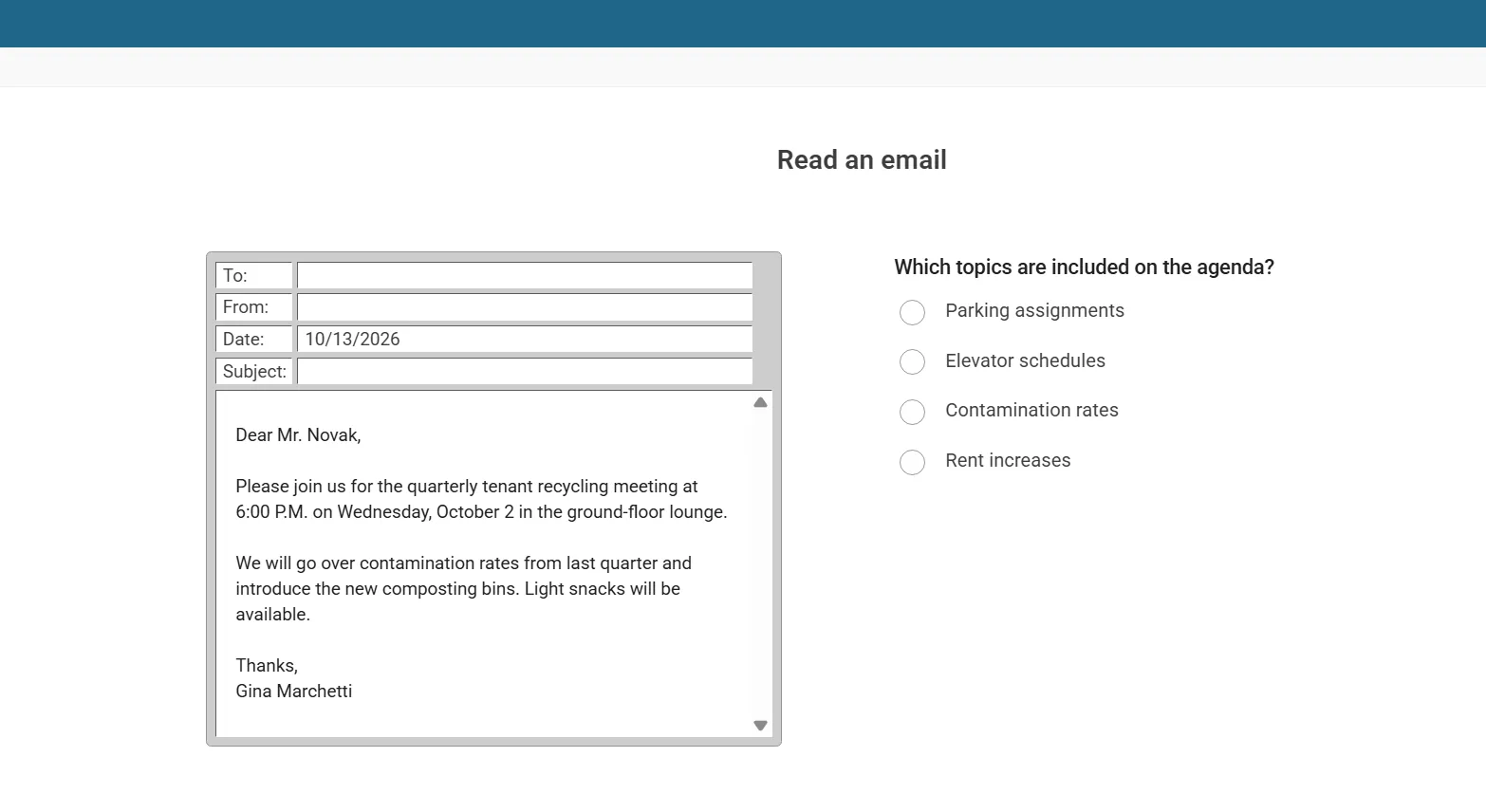
Upcoming Billing Cycle and Payment Reminders
Important Dates for July 2025 Billing Cycle
The monthly billing cycle for all SecureBank credit accounts will close on July 24, 2025, with automatic payments processed on July 25, 2025 for enrolled customers. To avoid payment failure or late fees, make sure sufficient funds are available in your linked account by 5:00 P.M. on July 24. Customers not enrolled in automatic payments are encouraged to submit their payment manually through our online banking platform, mobile app, or at any branch before the due date.
To review your billing statement, sign in at www.securebank.com. For questions or updates to your payment settings, contact us at billing@securebank.com or call (800) 555-0123.
Thank you for choosing SecureBank.
- To announce a new account policy
- To remind all customers of the upcoming billing cycle
- To confirm individual payments
- To promote mobile banking features
- Update their credit limit
- Disable payment alerts
- Ensure funds are available by July 24
- Close their accounts
-
spellcheck Answers
1. Answer: B
(B) The correct answer is to remind all customers of the upcoming billing cycle. In paragraph 1 and the heading, "Upcoming Billing Cycle and Payment Reminders," the notice explains that "The monthly billing cycle for all SecureBank credit accounts will close on July 24, 2025, with automatic payments processed on July 25, 2025" and provides instructions about avoiding late fees. These details confirm that the notice’s main purpose is to alert every customer about the upcoming billing cycle and associated payment dates.
(A) "To announce a new account policy" is incorrect since no new or revised policies are introduced; the text only reiterates existing billing dates and procedures.
(C) "To confirm individual payments" is incorrect because the notice does not acknowledge receipt of any specific payment; instead, it speaks prospectively about what customers should do before the billing cycle ends.
(D) "To promote mobile banking features" is incorrect; although the notice mentions the mobile app as one payment option, the document’s focus is not marketing the app but reminding customers of billing deadlines.
2. Answer: C
(C) The correct answer is ensure funds are available by July 24. In paragraph 1, the notice states, "To avoid payment failure or late fees, make sure sufficient funds are available in your linked account by 5:00 P.M. on July 24." This directive is specifically aimed at customers whose automatic payments will be processed the next day, indicating the recommended action.
(A) "Update their credit limit" is incorrect because the notice never advises changing credit limits; it only addresses payment timing and fund availability.
(B) "Disable payment alerts" is incorrect as the notice does not mention disabling alerts; instead, it emphasizes keeping automatic payments active and funded.
(D) "Close their accounts" is incorrect since the text nowhere suggests that customers should close their accounts; it focuses on maintaining payments.

Gist Purpose
Learn how to answer question 1 in a step-by-step interactive exercise
Gist Purpose
Eine Frage zum Hauptzweck (Gist-Purpose) fragt nach dem Hauptanliegen der Verfasserin oder des Verfassers einer Mitteilung, einer Ankündigung oder einer E-Mail. Sie fragt nicht nach einem kleinen Detail weiter hinten im Text. Sie wählen einen Buchstaben: A, B, C oder D.
Sehen Sie sich die Frage an und klicken Sie dann auf „Weiter“.
Die Frage ansehen
- To announce a new account policy
- To remind all customers of the upcoming billing cycle
- To confirm individual payments
- To promote mobile banking features
Um eine Frage zum Hauptzweck zu beantworten, brauchen Sie zuerst den Hauptgedanken des Textes. In Mitteilungen, Ankündigungen und E-Mails nennt man das Wichtigste sofort, deshalb stecken es meist die ersten paar Sätze. Diese Anfangssätze sagen, wozu der Text dient, und liefern die ersten stützenden Details. Sätze weiter unten fügen meist Informationen hinzu, die zwar stimmen, aber zu klein sind, um der Zweck zu sein.
Markieren Sie die Sätze, die den Hauptzweck zeigen.
Die ersten Sätze (der Aufhänger)
Markieren Sie die Sätze, die den Hauptzweck zeigen.
Important Dates for July 2025 Billing Cycle
The monthly billing cycle for all SecureBank credit accounts will close on July 24, 2025, with automatic payments processed on July 25, 2025 for enrolled customers. To avoid payment failure or late fees, make sure sufficient funds are available in your linked account by 5:00 P.M. on July 24. Customers not enrolled in automatic payments are encouraged to submit their payment manually through our online banking platform, mobile app, or at any branch before the due date.
To review your billing statement, sign in at www.securebank.com. For questions or updates to your payment settings, contact us at billing@securebank.com or call (800) 555-0123.
Sie haben die Anfangssätze und eine kürzere Liste von Antwortoptionen. Die richtige Antwort wiederholt selten den Wortlaut des Textes. Sie gibt den Zweck mit Synonymen oder anderen Wörtern wieder. Wählen Sie also eine Option nicht nur deshalb, weil sie Wörter enthält, die Sie im Text gesehen haben.
Wählen Sie den Buchstaben, der den Hauptzweck mit anderen Worten wiedergibt.
Important Dates for July 2025 Billing Cycle
The monthly billing cycle for all SecureBank credit accounts will close on July 24, 2025, with automatic payments processed on July 25, 2025 for enrolled customers. To avoid payment failure or late fees, make sure sufficient funds are available in your linked account by 5:00 P.M. on July 24. Customers not enrolled in automatic payments are encouraged to submit their payment manually through our online banking platform, mobile app, or at any branch before the due date.
To review your billing statement, sign in at www.securebank.com. For questions or updates to your payment settings, contact us at billing@securebank.com or call (800) 555-0123.
Die Frage beantworten
- To announce a new account policy
- To remind all customers of the upcoming billing cycle
- To confirm individual payments
- To promote mobile banking features
Read an Academic Passage
This is the one familiar task, but much shorter than before. The passage is 150 to 400 words on an academic topic, followed by about 5 questions on vocabulary, details, inference, and the passage's purpose. Tip: skim the passage once for its main idea, then go back to the exact sentence each question points to.
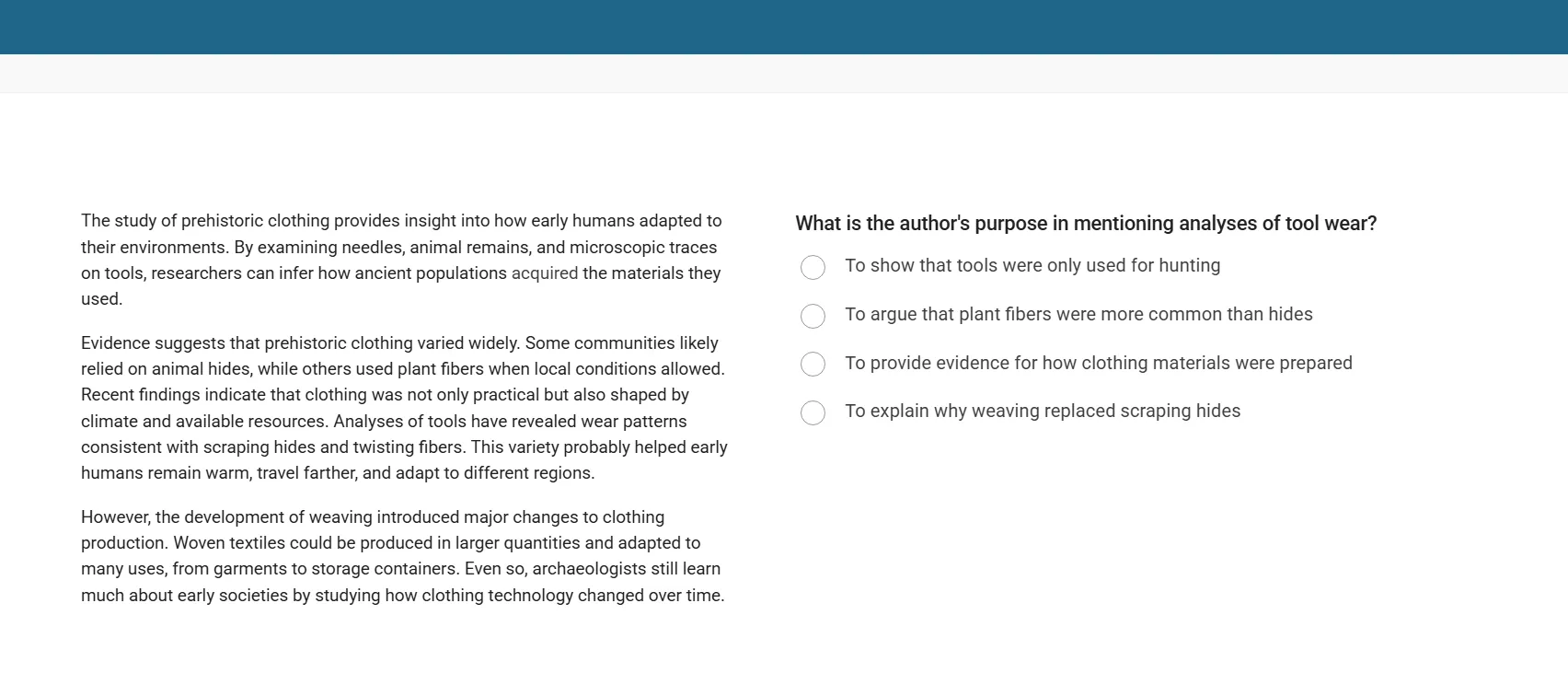
The development of windmills marked an important step in the history of mechanical power. Historical evidence suggests that early wind-driven machines were used for grinding grain, pumping water, and supporting agricultural communities. These devices were especially valuable in regions where flowing water was limited.
Some of the earliest windmills were simple in design. [A] Builders often used wooden frames and cloth sails to catch moving air. [B] However, not all early windmills remained rudimentary. [C] Over time, engineers developed improved gears and stronger towers that allowed mills to work more reliably. [D] These advances increased the range of tasks windmills could perform.
The shift from simple wind-powered structures to more refined machines suggests advances in design, planning, and local engineering knowledge. Better windmills allowed communities to process food more efficiently and manage water with less labor. Recent discoveries have also shown that windmill technology may have spread between regions in more complex ways than researchers once believed.
- basic
- decorative
- fragile
- imported
- They could help grind grain.
- Some used cloth sails.
- They were always highly complex from the beginning.
- They were valuable where flowing water was limited.
- They made windmills more reliable and useful for more tasks.
- They removed the need for sails entirely.
- They prevented windmills from spreading between regions.
- They made wind power less efficient than before.
- It spread between regions in more complex ways than once believed.
- It was used only for decorative buildings.
- It depended entirely on metal sails.
- It appeared only after steam engines were invented.
There are four locations [▪] in the passage that indicate where the following sentence could be added.
Where would the sentence best fit? Select a location [▪] to add the sentence to the passage.
Some mills could be turned so their sails faced changing wind directions more effectively.
- [A]
- [B]
- [C]
- [D]
-
spellcheck Answers
1. Answer: A
(A) The correct answer is basic. In the passage, "The development of windmills marked an important step in the history of mechanical power." shows that the word is closest in meaning to "basic".
(B) decorative is incorrect because that meaning does not fit the way the word is used in the sentence
(C) fragile is incorrect because that meaning does not fit the way the word is used in the sentence
(D) imported is incorrect because that meaning does not fit the way the word is used in the sentence
2. Answer: C
(C) The correct answer is They were always highly complex from the beginning. This question asks for the choice that is NOT mentioned or supported. The passage gives support for They could help grind grain.; Some used cloth sails.; They were valuable where flowing water was limited., but it does not support "They were always highly complex from the beginning."
(A) They could help grind grain. is incorrect because the passage does mention this point; However, not all early windmills remained rudimentary.
(B) Some used cloth sails. is incorrect because the passage does mention this point; However, not all early windmills remained rudimentary.
(D) They were valuable where flowing water was limited. is incorrect because the passage does mention this point; These devices were especially valuable in regions where flowing water was limited.
3. Answer: A
(A) The correct answer is They made windmills more reliable and useful for more tasks. In the passage, "Some of the earliest windmills were simple in design." supports the inference that "They made windmills more reliable and useful for more tasks."
(B) They removed the need for sails entirely. is incorrect because it is not supported by what the passage implies
(C) They prevented windmills from spreading between regions. is incorrect because it goes beyond what the passage suggests; the support points instead to Some of the earliest windmills were simple in design.
(D) They made wind power less efficient than before. is incorrect because it is not supported by what the passage implies
4. Answer: A
(A) The correct answer is It spread between regions in more complex ways than once believed. In the passage, "Recent discoveries have also shown that windmill technology may have spread between regions in more complex ways than researchers once believed." directly supports "It spread between regions in more complex ways than once believed."
(B) It was used only for decorative buildings. is incorrect because the passage does not support that detail
(C) It depended entirely on metal sails. is incorrect because the passage does not support that detail
(D) It appeared only after steam engines were invented. is incorrect because the passage does not support that detail
5. Answer: C
(C) The correct answer is Position C. This position follows the sentence “However, not all early windmills remained rudimentary,” which clearly introduces a shift toward technological improvements. The added sentence fits perfectly here as a specific example of that improvement, and it smoothly leads into the next sentence about improved gears and stronger towers. The structure becomes: contrast → example → further developments.
(A) Position A. Too early—this part describes simple windmills. The sentence adds an advanced feature, which contradicts that idea.
(B) Position B. It comes before “However,” which introduces improvement. Adding the sentence here makes the contrast unclear or repetitive.
(D) Position D. Too late—the paragraph is summarizing. Adding a specific detail here breaks the general flow.

Vocabulary
Learn how to answer question 1 in a step-by-step interactive exercise
Vocabulary
In diesem Schritt lernen Sie den Hinweis durch Synonym kennen. Dabei steht in der Nähe ein Wort mit ähnlicher Bedeutung, im selben Satz oder im nächsten.
Autoren wiederholen ungern dasselbe Wort. Oft sagen sie denselben Gedanken noch einmal mit einem anderen Wort, im selben Satz oder im Satz davor oder danach. Achten Sie auf Wörter, die in einer Aufzählung mit dem markierten Wort verbunden sind, oder darauf, dass der Autor dieselbe Sache noch einmal mit einem neuen Wort benennt.
Die richtige Antwortoption ist nicht das Hinweiswort selbst, sondern ein anderes Wort mit derselben Bedeutung. Nutzen Sie den Hinweis also, um zu entscheiden, was das markierte Wort bedeutet.
Klicken Sie auf die Hinweiswörter und wählen Sie dann die Bedeutung des markierten Wortes.
Hinweise durch Synonyme
Klicken Sie auf die Hinweiswörter und wählen Sie dann die Bedeutung des markierten Wortes.
Some of the earliest windmills were simple in design. Builders often used wooden frames and cloth sails to catch moving air. However, not all early windmills remained rudimentary. Over time, engineers developed improved gears and stronger towers that allowed mills to work more reliably.
Wählen Sie jetzt die Bedeutung des markierten Wortes.
- basic
- decorative
- fragile
- imported
For more sample questions and reading tips, see our TOEFL Reading test guide and the TOEFL reading question types.
TOEFL Listening Changes in 2026
The Listening section now has 47 questions in about 29 minutes, and the long lectures of the old test are replaced by shorter recordings. The section is adaptive: everyone starts with an 18-minute first stage, then gets a second stage of about 7 or 11 minutes, depending on how well the first stage went. Every recording plays only once, and each question has its own timer of 20 or 30 seconds, so you cannot save time for later questions.
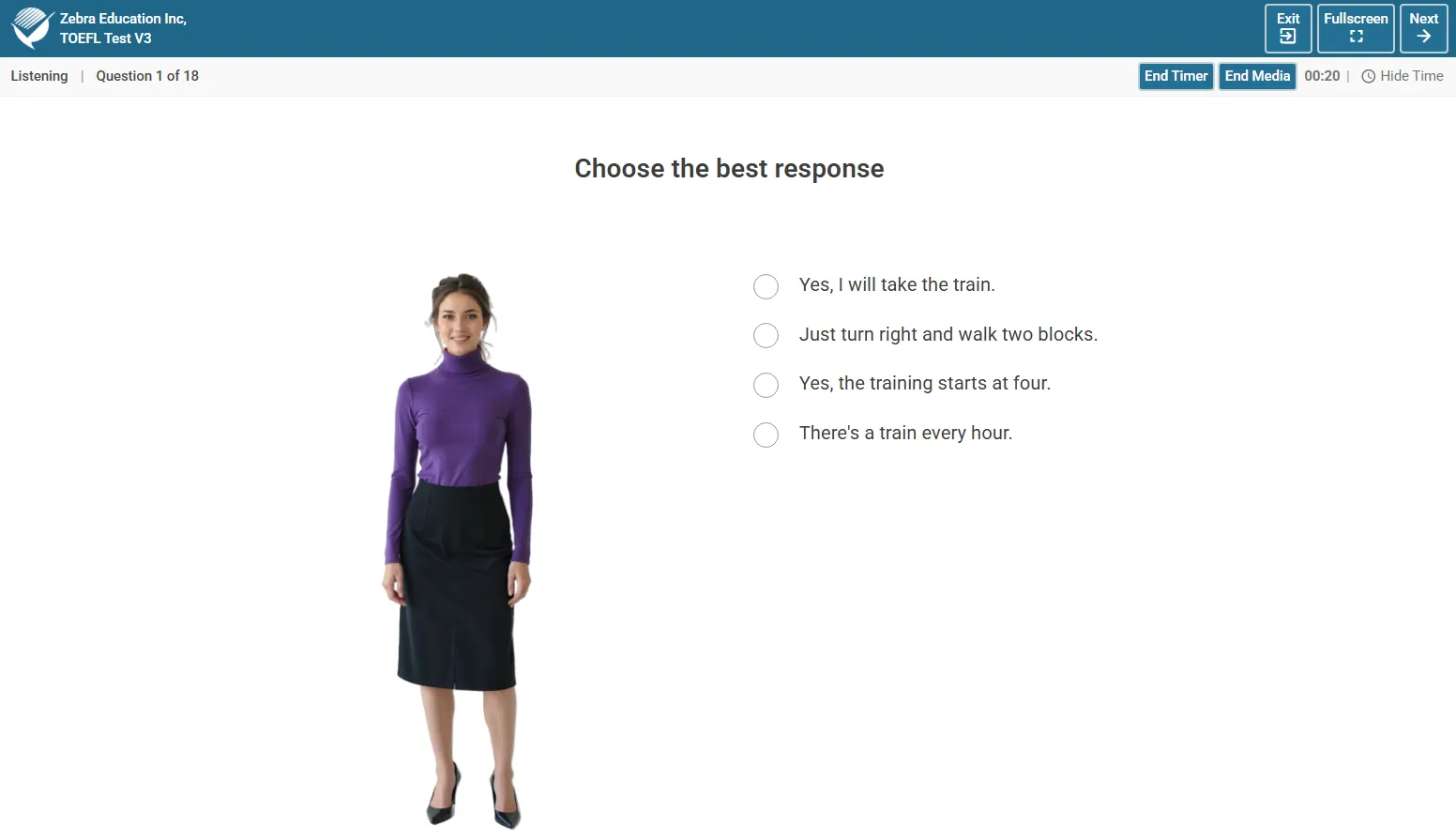
Listen and Choose a Response
You hear one short sentence or question from a speaker, then choose the best reply from four options. It feels like a quick exchange with a classmate or a staff member. Tip: listen for the purpose of what is said (a request, a complaint, an offer), because the right reply answers that purpose, not just the words.
In the Choose a Response task, you'll listen to a short question or statement and choose the most appropriate response.

- It is required for my degree.
- Language apps are popular.
- Let us practice together sometime.
- Have you tried that Spanish restaurant?
-
spellcheck Answer
Answer: A
(A) The correct answer is It is required for my degree. This is the only choice that gives a reason for learning Spanish.
(B) Language apps are popular. is incorrect because it is unrelated to the speaker's reason.
(C) Let us practice together sometime. is incorrect because it is a suggestion, not the reason for learning the language.
(D) Have you tried that Spanish restaurant? is incorrect because it is unrelated.
Transcript
Why are you learning Spanish?
- Yes, I can help you with it.
- The keyboard is new.
- It is in the top drawer.
- That is very expensive.
-
spellcheck Answer
Answer: A
(A) The correct answer is Yes, I can help you with it. This is the direct positive response that fits "Can you show me how to use this app?".
(B) The keyboard is new. is incorrect because it is unrelated.
(C) It is in the top drawer. is incorrect because it gives a location, not help with the app.
(D) That is very expensive. is incorrect because it is unrelated.
Transcript
Can you show me how to use this app?

- On the rack.
- It is thirty-five dollars.
- The fabric is soft.
- Very little time.
-
spellcheck Answer
Answer: B
(B) The correct answer is It is thirty-five dollars. This is the only choice that answers the price question in "What is the price of this sweater?".
(A) On the rack. is incorrect because it gives a location, not a price.
(C) The fabric is soft. is incorrect because it describes the sweater, not the cost.
(D) Very little time. is incorrect because it is unrelated.
Transcript
What is the price of this sweater?
Listen to a Conversation
You hear a short everyday conversation between two people, for example two students or a student and an employee, and answer questions about it. Questions ask about the main topic, details, and why a speaker does or says something. Tip: note the problem the speakers discuss and the solution they reach.
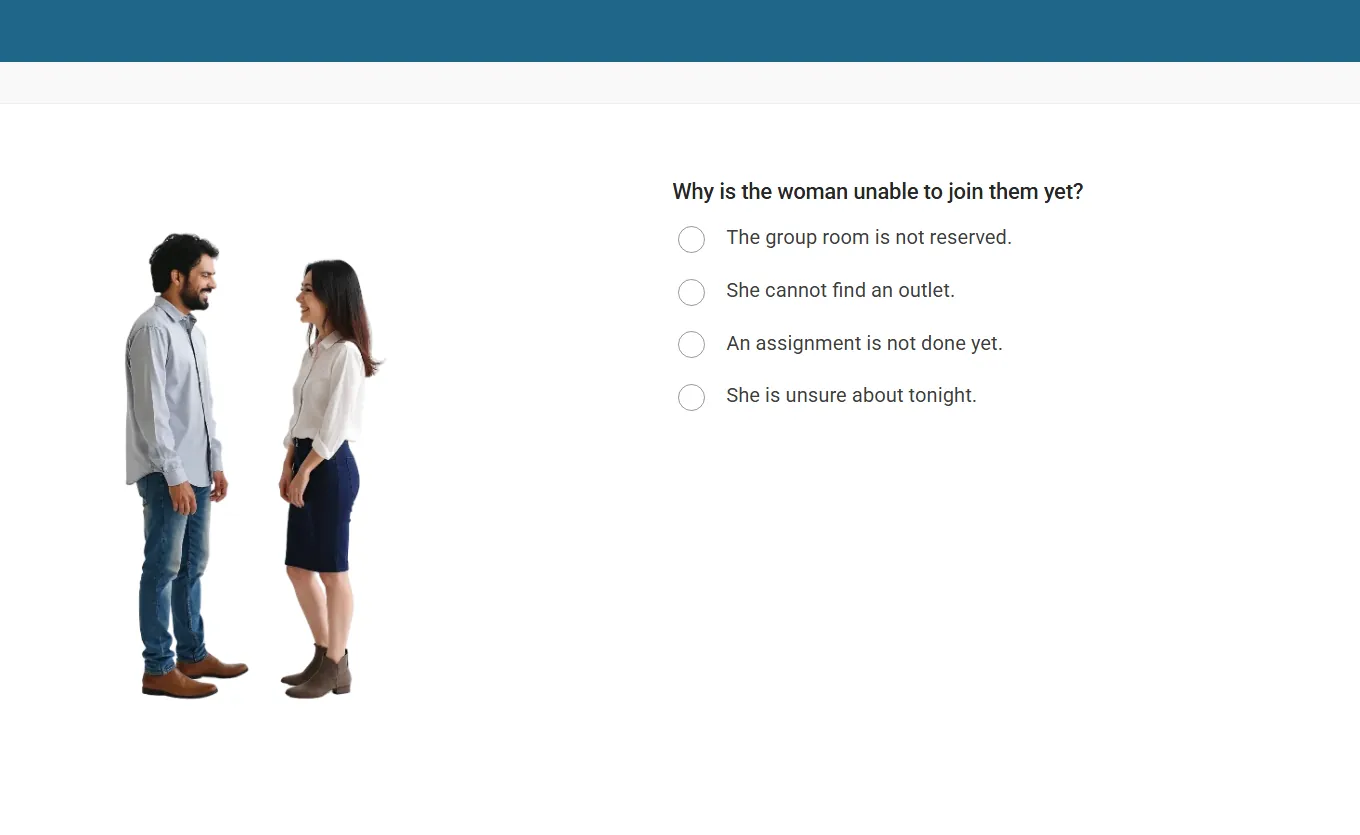
In the Listen to a Conversation task, you'll listen to a short conversation and answer 2 questions.

- They listed the wrong meeting room
- The printer produced only six copies
- The posters curled beside an open window
- The first print run failed the margin check.
- It contains money for the printing
- The woman will bring it from the library
- The cash is stored in a closet.
- The treasurer will place it on the table
-
spellcheck Answers
1. Answer: D
(D) The first print run failed the margin check. is correct because the woman states, "The copy center sent the first batch back. They said the scan code was sitting right on the border." The first print run failed the margin check.
(A) They listed the wrong meeting room is incorrect because the ecology lab is only the meeting place. She does not say the posters had the wrong room.
(B) The printer produced only six copies is incorrect because six is what her student card can pay for now, not why the first batch came back.
(C) The posters curled beside an open window is incorrect because that happened to last week's posters and is why he will bring clips.
2. Answer: C
(C) The cash is stored in a closet. is correct because the man states, "The treasurer left it in the closet with the extra paper, so I will grab it when I set up." The cash box is stored in a closet.
(A) It contains money for the printing is incorrect because he says six copies are fine for the posters. The money box is for the sign up table, not her printing.
(B) The woman will bring it from the library is incorrect because she is coming over after printing. He will grab the money box when he sets up.
(D) The treasurer will place it on the table is incorrect because the treasurer already left it in the closet, and the man will grab it.
Transcript
Man: Can you still make the sustainability club meeting later?
Woman: I think so, but I need to reprint the posters. The copy center sent the first batch back. They said the scan code was sitting right on the border.
Man: We are gathering at 5:45 in the ecology lab. I can bring table clips. Last week's posters curled near the open window.
Woman: Great. The library color printer is quick, but my student card has enough credit for only six copies. Do we need the club cash tonight?
Man: Six is fine for the posters. I still need the money box at the sign up table. The treasurer left it in the closet with the extra paper, so I will grab it when I set up.
Woman: Perfect. I will come over as soon as the printing finishes.

Reason for action
Learn how to answer question 1 in a step-by-step interactive exercise
Reason for action
Ein Grund wird oft zuerst als Problem genannt, und die Handlung folgt als Reaktion darauf. Verbinden Sie das Problem mit der Handlung, statt die erste Tatsache zu nehmen, die Sie hören.
Spätere Details im selben Gespräch sind meist nicht der Grund. Eine Antwortoption, die eines dieser Details wiederholt, aber die Bedeutung verändert, ist eine Falle.
Klicken Sie auf „Abspielen“, um das Audio anzuhören
Listen to an Announcement
You hear a short announcement, such as a message from a professor or a notice on campus, and answer questions about its purpose and key details. Tip: pay attention to dates, changes, and instructions, because announcements often tell listeners what to do differently.
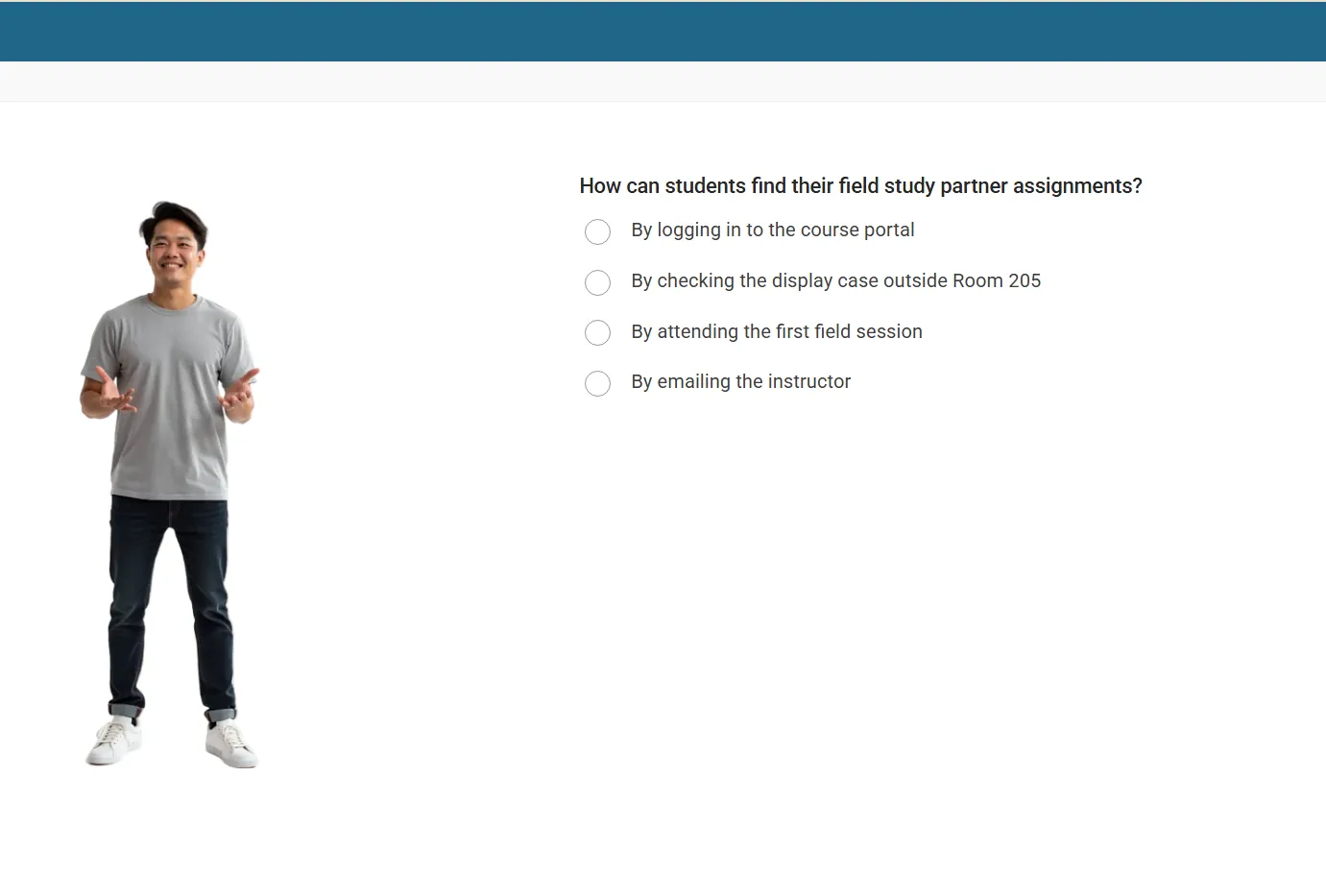
In the Listen to an Announcement task, you'll listen to a short announcement and answer 2 questions.

- To list the topics that will be covered in the workshop
- To explain the eligibility requirements for attending
- To describe outcomes achieved by previous workshop attendees
- To advertise new funding opportunities for the semester
- To announce deadline changes for current grant applications
- To describe a new graduate admissions requirement
- To invite students to a grant writing workshop
- To introduce a visiting professor's research seminar
-
spellcheck Answers
1. Answer: C
(C) The correct answer is To describe outcomes achieved by previous workshop attendees.. In the announcement, "Attendees from previous workshops have gone on to secure funding for independent research projects and conference travel." shows why the author or speaker mentions that detail, so "To describe outcomes achieved by previous workshop attendees." is the best explanation of its function.
(A) To list the topics that will be covered in the workshop. is incorrect because the author or speaker mentions the detail to support a different purpose, not this one
(B) To explain the eligibility requirements for attending. is incorrect because the author or speaker mentions the detail to support a different purpose, not this one
(D) To advertise new funding opportunities for the semester. is incorrect because the author or speaker mentions the detail to support a different purpose, not this one
2. Answer: C
(C) The correct answer is To invite students to a grant writing workshop.. The announcement as a whole conveys this purpose, as supported by "The graduate school is presenting a grant writing workshop this Wednesday.".
(A) To announce deadline changes for current grant applications. is incorrect because the overall purpose of the announcement is different from what this choice describes.
(B) To describe a new graduate admissions requirement. is incorrect because the overall purpose of the announcement is different from what this choice describes.
(D) To introduce a visiting professor's research seminar. is incorrect because the overall purpose of the announcement is different from what this choice describes.
Transcript
Listen to an announcement at a student center.
Attention all students! The graduate school is presenting a grant writing workshop this Wednesday at two p.m. in the student center conference room. A panel of funded researchers will walk you through the process of writing competitive grant proposals, from identifying funding sources to structuring a persuasive narrative. Attendees from previous workshops have gone on to secure funding for independent research projects and conference travel. All students considering graduate-level research are strongly encouraged to attend.

Function
Learn how to answer question 1 in a step-by-step interactive exercise
Function
Bei einer Funktionsfrage geht es nicht um die Wörterbuchbedeutung der Wörter. Es geht um die Aufgabe, die die Äußerung im Gespräch oder im Vortrag erfüllt. Die Sätze direkt vor und direkt nach dem zitierten Satz zeigen diese Aufgabe. Was der andere Sprecher als Nächstes sagt, zeigt oft, wie die Äußerung verstanden wurde.
Klicken Sie auf „Abspielen“, um das Audio anzuhören
Listen to an Academic Talk
You hear a short talk on an academic subject, up to about 250 words, much like a brief part of a class. Questions ask about the main idea, important details, and how the speaker organizes the ideas. Tip: take short notes on the main point and each example, since you hear the talk only once.
In the Listen to an Academic Talk task, you'll listen to a short academic talk and answer 4 questions.

- They only process numerical data, not text or images
- They learn patterns from data rather than following developer-written rules
- They require government certification for every application
- They process data faster than any other computing system available today
- To describe the physical hardware used in neural network laboratories
- To illustrate how neural networks learn patterns from examples rather than explicit rules
- To suggest that students should study animal biology before computer science
- To explain why printed textbooks are more reliable than digital learning tools
- Why traditional programming is more reliable than all machine learning systems
- The complete history of computing from the 1940s to today
- Brain-inspired computing systems, their key concepts, and their potential despite challenges
- How to build a neural network for personal investment decisions
- Deep learning proves that neural networks are too complex for any real-world use
- Multi-layered processing enables applications like self-driving cars that interpret complex visual information
- Deep learning requires more programmers than traditional software development does
- Deep learning shows that neural networks only work for image recognition tasks
-
spellcheck Answers
1. Answer: B
(B) The correct answer is They learn patterns from data rather than following developer-written rules. The speaker contrasts data-driven learning with explicit rule-writing.
(A) is incorrect because neural networks process multiple data types. (C) is incorrect because government certification isn't required. (D) is incorrect because processing speed isn't the distinguishing feature.
2. Answer: B
(B) The correct answer is To illustrate how neural networks learn patterns from examples rather than explicit rules. The child-learning analogy explains the training process.
(A) is incorrect because physical hardware isn't described by this analogy. (C) is incorrect because biology study advice isn't the purpose. (D) is incorrect because textbook reliability isn't argued.
3. Answer: C
(C) The correct answer is Brain-inspired computing systems, their key concepts, and their potential despite challenges. The talk covers training, deep learning, applications, and black-box concerns.
(A) is incorrect because traditional programming superiority isn't argued. (B) is incorrect because the full history of computing isn't the scope. (D) is incorrect because personal investment isn't discussed.
4. Answer: B
(B) The correct answer is Multi-layered processing enables applications like self-driving cars that interpret complex visual information. The speaker links deep layers to real-time object recognition in autonomous vehicles.
(A) is incorrect because deep learning demonstrates real capability. (C) is incorrect because programmer requirements aren't the main point. (D) is incorrect because applications extend beyond image recognition.
Transcript
Listen to a talk in a class about artificial neural networks.
Today, we're going to explore artificial neural networks, which are basically computing systems inspired by the human brain that could change how we solve problems in everything from medicine to transportation. Unlike traditional programs, where a developer writes explicit rules for every decision, neural networks learn patterns from data on their own. This makes them fundamentally different from the rule-based software most industries have relied on for decades.
Take the concept of training, for instance. Training means feeding a neural network massive amounts of data—images, text, numbers—and letting it adjust its internal connections until it can make accurate predictions or classifications. It's like teaching a child to recognize animals by showing them thousands of photos—you don't give them a list of rules about what makes a dog a dog; they just figure out the patterns by seeing enough examples. This pattern-learning ability is what makes neural networks powerful at tasks like image recognition and language translation.
Another crucial concept is deep learning. Deep learning uses neural networks with many layers—sometimes hundreds—each of which extracts increasingly complex features from the data. The first layers might detect simple edges in an image, while deeper layers combine those edges into shapes, and even deeper layers recognize entire objects. This layered processing is what allows systems like self-driving cars to identify pedestrians, traffic signs, and road markings in real time.
The potential applications are enormous—medical imaging diagnosis, fraud detection, personalized recommendations, autonomous vehicles. However, neural networks are often called black boxes because it's difficult to understand exactly how they reach their conclusions. The massive computational resources required for training, combined with concerns about bias in training data and lack of explainability, make regulation and transparency critical. Despite these challenges, neural networks remain one of the most transformative technologies in modern computing.
Detail - Academic Talk
Learn how to answer question 1 in a step-by-step interactive exercise
Detail - Academic Talk
Manche Detailfragen zu Vorträgen fragen, was der Professor über eine Person, einen Gegenstand, eine Theorie, einen Prozess oder einen Gedanken sagt. Wenn Sie das Thema hören, das die Frage nennt, achten Sie auf die Aussage, die der Professor damit verbindet.
Der Hintergrund rund um das Thema ist nicht die Antwort. Die konkrete Aussage über das Thema ist es.
Klicken Sie auf „Abspielen“, um das Audio anzuhören
For more sample questions with audio, see our TOEFL Listening test guide and the TOEFL listening question types.
TOEFL Writing Changes in 2026
The Writing section now has 12 questions in about 23 minutes. The integrated writing task, where you summarized a reading and a lecture, is removed. Two new tasks join the Academic Discussion task, which is the only task kept from the previous test.
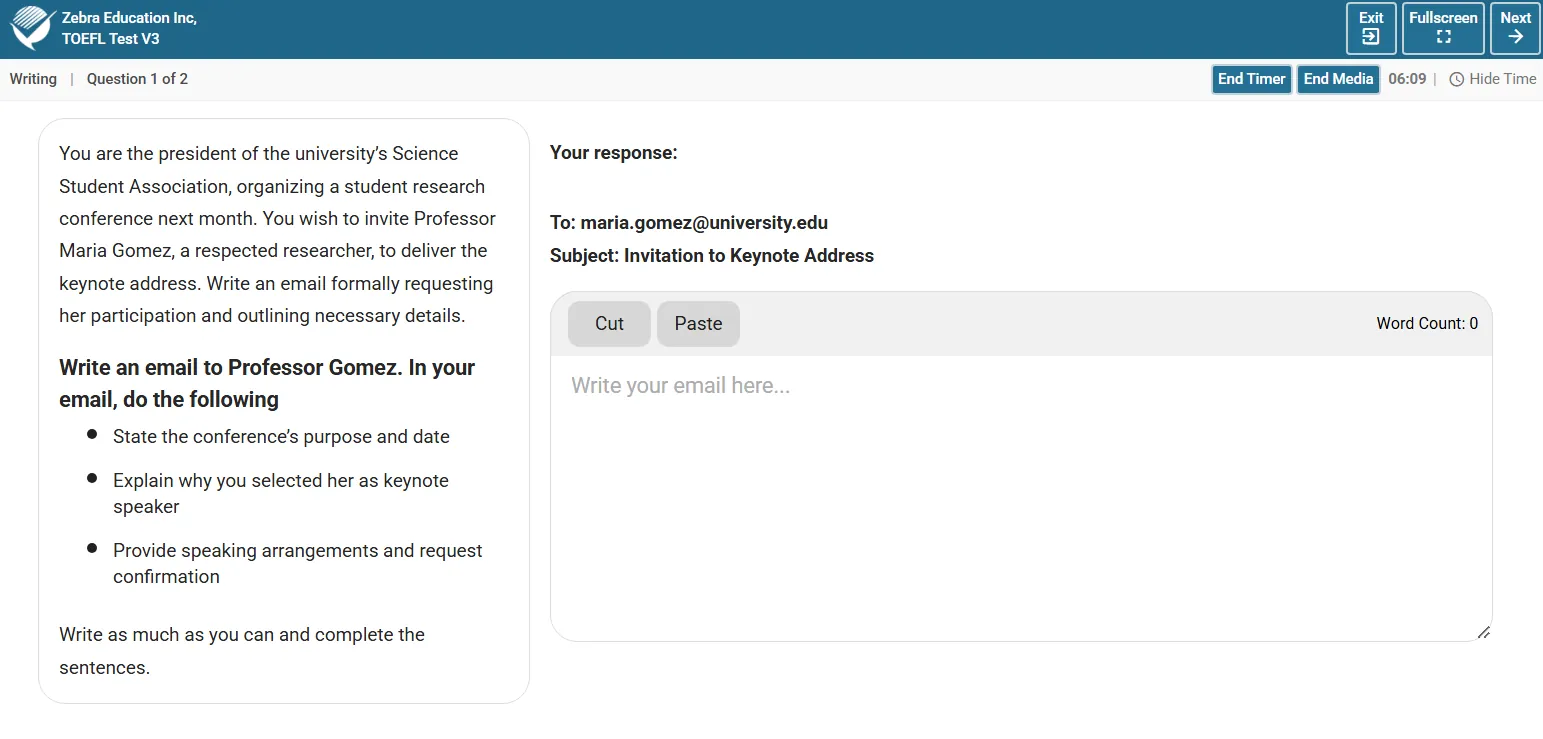
Build a Sentence
You see a short exchange where the reply is missing, plus a set of word chunks. You put the chunks in the right order to build a correct reply. There are 10 items in about 6 minutes, and one chunk may not be needed. Tip: find the subject and the main verb first, then place the question words and helpers around them.
 I'm thinking about starting a weekly strength routine.
 it ?
-
spellcheck AnswersWill it include any new exercises?

Build a Sentence
Learn how to answer this question in a step-by-step interactive exercise
Build a Sentence
Bei der Aufgabe Satz bilden sehen Sie eine Zeile eines Sprechers und eine Antwort, deren Wörter in der falschen Reihenfolge stehen. Sie setzen die Wörter in die Platzhalter ein, sodass eine grammatisch richtige Antwort entsteht, die zum Wortwechsel passt. Manchmal stehen einige Wörter der Antwort schon auf der Seite.
In dieser Übung füllen Sie einen Platzhalter nach dem anderen von links nach rechts, und für jeden Platzhalter haben Sie etwa 5 Sekunden. Diese knappe Zeit trainiert Sie darin, schnell zu entscheiden.
Lesen Sie vor dem Start die erste Zeile und alle Wörter der Antwort, die schon vorgegeben sind. Sie zeigen Ihnen, wer spricht, wann der Wortwechsel stattfindet und wohin der Satz führt.
Sehen Sie sich die Frage an und klicken Sie dann auf „Weiter“, um fortzufahren.
Die Frage ansehen
 I'm thinking about starting a weekly strength routine.
 it
?
Die Antwort ist eine Frage, sie beginnt also nicht mit ihrem Subjekt. Eine Ja-Nein-Frage beginnt mit einem Hilfsverb wie „should“, „would“, „could“ oder „did“. Eine Frage nach einer Information beginnt mit einem Fragewort wie „what“, „where“ oder „how“.
Lesen Sie die erste Zeile, um zu sehen, wonach die Antwort fragt, und suchen Sie dann im Wortkasten den einen Baustein, mit dem eine Frage beginnen kann.
Wählen Sie den Baustein, mit dem die Frage beginnt.
Das Wort nach dem Platzhalter ist it, und es ist schon vorgegeben. Der Baustein muss direkt dazu hinführen.
Platzhalter 1
I'm thinking about starting a weekly strength routine.
it
?
Jetzt haben Sie it, das Subjekt. Auf ein Subjekt folgt meist sein Verb. Davor kann noch ein Modal- oder Hilfsverb stehen (we can, she has), ebenso ein Wort wie never oder already.
Das Verb muss mit dem Subjekt übereinstimmen (she works, they work), und seine Zeitform muss zur Zeit des Wortwechsels passen. In einer Frage bestimmt das Hilfsverb am Anfang die Form: Could we move...?
Prüfen Sie jeden Baustein im Wortkasten anhand dieser Möglichkeiten.
Platzhalter 2
I'm thinking about starting a weekly strength routine.
Will
it
?
Jetzt haben Sie das Wort include, ein Verb. Nach dem Verb muss noch etwas folgen. Meist folgt auf ein Verb ein Objekt: ein Nomen, ein Pronomen oder eine Nominalgruppe (the report, a new plan). Stattdessen kann auch ein Infinitiv (to + Verb), eine -ing-Form oder ein Objektsatz (that / what / where + Subjekt + Verb) folgen. Nach be oder einem Kopulaverb wie seem kann ein Adjektiv folgen (is ready).
Jedes Verb erlaubt nur einige dieser Möglichkeiten. Überlegen Sie, wie include normalerweise verwendet wird: want to go, aber enjoy going, think that, aber ask if.
Prüfen Sie jeden Baustein im Wortkasten anhand dieser Möglichkeiten.
Platzhalter 3
I'm thinking about starting a weekly strength routine.
Will
it
include
?
Jetzt haben Sie any, einen Begleiter (Determinativ). Ein Begleiter leitet eine Nominalgruppe ein, deshalb folgt ein Nomen (the bus) oder ein Adjektiv und dann ein Nomen (the early bus). Ein Verb, to oder ein Pronomen kann nicht darauf folgen.
Prüfen Sie auch die Form. A und an stehen vor einer einzelnen Sache (a ticket), these und those vor mehreren (these tickets).
Prüfen Sie jeden Baustein im Wortkasten anhand dieser Möglichkeiten.
Platzhalter 4
I'm thinking about starting a weekly strength routine.
Will
it
include
any
?
Full guide: TOEFL Build a Sentence practice, with the time limit and six tips.
Write an Email
You read a short situation and write an email that covers each point you are given, for example to explain a problem and ask for help. You have 7 minutes. Tip: answer every point in its own short paragraph, and use a polite tone that fits the person you write to.
Write an email to your coworkers. In your email, do the following:
- Explain what still needs to be organized for the wellness day.
- Suggest a suitable location for the event.
- Ask for volunteers to support planning and event-day tasks.
Write as much as you can and complete the sentences.
Dear All Employees,
I am writing because we have started preparing next month's employee wellness day, and there are several details that still need to be organized. We need help confirming a venue, arranging healthy refreshments, and planning short activity stations such as stretching, stress-management, and team games.
I would like to suggest using the Riverside Activity Center. It has both indoor and outdoor space, enough seating for group sessions, and convenient parking for staff from different office locations.
If you are interested in helping, please let me know. Even volunteering for one part of the event, such as registration or activity support, would be very helpful.
Thank you, and I hope many of you can join the planning team.
Best regards,
Jordan Kim

Task Fulfillment — Email
Learn how to answer this question in a step-by-step interactive exercise
Task Fulfillment — Email
Bei einer E-Mail-Aufgabe erhalten Sie eine Situation, einen Empfänger und eine nummerierte Liste von Punkten, die Ihre Nachricht abdecken muss. Jeden Punkt abzudecken ist wichtiger als viel zu schreiben.
Zählen Sie die Pflichtpunkte, bevor Sie etwas planen. Eine kurze E-Mail, die alle beantwortet, ist stärker als eine lange E-Mail, die einen auslässt.
Sehen Sie sich die Aufgabe an und klicken Sie dann auf „Weiter“, um fortzufahren.
Die Frage ansehen
Write an email to your coworkers. In your email, do the following:
1. Explain what still needs to be organized for the wellness day.
2. Suggest a suitable location for the event.
3. Ask for volunteers to support planning and event-day tasks.
Beantworten Sie vor dem Schreiben drei Planungsfragen: Wer ist der Empfänger, warum schreiben Sie, und was müssen Sie laut Aufgabe aufnehmen?
Der Empfänger bestimmt, wie förmlich Ihre Sprache sein muss, und die nummerierten Punkte bestimmen, was im Hauptteil stehen muss. Die Aufgabe enthält bereits alle drei Antworten, Sie müssen also nichts raten.
Ordnen Sie jede Planungsfrage dem Teil der Aufgabe zu, der sie beantwortet.
Die Aufgabe verstehen
Ordnen Sie jede Planungsfrage dem Teil der Aufgabe zu, der sie beantwortet.
Anrede und Grußformel zeigen dem Empfänger, wie förmlich Ihre Nachricht ist. Halten Sie beide also auf derselben Ebene.
In dieser Aufgabe schreiben Sie an einen Kommilitonen oder eine andere gleichgestellte Person. Eine herzliche Anrede mit Vornamen und eine lockere Grußformel wie „Best,“ oder „See you soon,“ sind daher die richtige Wahl. Ein förmlicher Titel klingt hier kalt und distanziert und kostet beim Ton genauso Punkte wie ein lockerer Einstieg in einer förmlichen E-Mail.
Wählen Sie eine Anrede und eine Grußformel, die zum Empfänger passen.
Anrede und Grußformel wählen
Choose a greeting
- Dear All Employees,
- Hi everyone,
- Dear Sir or Madam,
- Hey guys,
- Dear Manager,
Choose a closing
- Best regards,
- Thanks,
- Cheers,
- Yours faithfully,
- Love,
Bauen Sie den Hauptteil Punkt für Punkt auf, in der Reihenfolge, in der die Aufgabe die Pflichtpunkte auflistet. Beginnen Sie mit dem ersten Pflichtpunkt.
Ein Satzanfang eröffnet den Satz in einem freundlichen, natürlichen Ton, und Sie führen den Gedanken selbst zu Ende. Kurzformen wie „I'm“ und „can't“ sind in Ordnung, aber schreiben Sie vollständige Sätze, keine Bruchstücke wie in einer Textnachricht. Ergänzen Sie ein eigenes Detail, damit der Satz den Punkt beantwortet, statt ihn nur zu wiederholen.
Wählen Sie einen Satzanfang für den ersten Pflichtpunkt und beenden Sie den Satz dann in Ihren eigenen Worten.
Pflichtpunkt 1 schreiben
Explain what still needs to be organized
Gehen Sie zum zweiten Pflichtpunkt über und geben Sie ihm einen eigenen Satz. Behalten Sie den freundlichen Ton bei, den Sie mit der Anrede festgelegt haben.
Sie können direkt fragen, wie in einer Nachricht an einen Freund, aber sagen Sie klar, was Sie möchten, denn der Empfänger muss trotzdem antworten können.
Wählen Sie einen Satzanfang für den zweiten Pflichtpunkt und beenden Sie den Satz dann in Ihren eigenen Worten.
Pflichtpunkt 2 schreiben
Suggest a suitable location
Schließen Sie den Hauptteil mit dem letzten Pflichtpunkt ab. Sobald jeder Punkt einen Satz hat, ist die Aufgabe erfüllt, und Sie müssen nichts mehr hinzufügen.
Lesen Sie die nummerierte Liste in der Aufgabe noch einmal, bevor Sie diesen Schritt verlassen. Ein fehlender Punkt kostet mehr als eine kurze Antwort.
Wählen Sie einen Satzanfang für den letzten Pflichtpunkt und beenden Sie den Satz dann in Ihren eigenen Worten.
Pflichtpunkt 3 schreiben
Ask for volunteers
Ihre Sätze aus allen Schritten erscheinen jetzt zusammen als eine E-Mail. Lesen Sie die ganze Nachricht und prüfen Sie die drei Dinge, die diese Aufgabe bewertet: Jeder Pflichtpunkt ist beantwortet, der Ton passt zum Empfänger, und Anrede und Grußformel rahmen die Nachricht ein.
Vergleichen Sie dann Ihre Formulierungen mit der Beispielantwort. Die Beispielantwort ist eine gute Antwort, nicht die einzige.
Lesen Sie Ihre vollständige E-Mail und vergleichen Sie sie dann mit der Beispielantwort.
Ihre vollständige E-Mail überprüfen
So schreiben Sie es
Bei einer E-Mail-Aufgabe bekommen Sie eine Situation, einen Empfänger und eine nummerierte Liste von Punkten, die Ihre Nachricht abdecken muss. Die Bewerter prüfen, ob jeder Punkt beantwortet ist und ob Ihre Sprache zum Empfänger passt.
Arbeiten Sie in einer festen Reihenfolge, damit kein Pflichtpunkt fehlt.
- Die Aufgabe verstehen. Klären Sie, wer der Empfänger ist, warum Sie schreiben und was Sie laut Aufgabenstellung aufnehmen müssen.
- Anrede und Grußformel wählen. Wählen Sie eine Anrede und eine Grußformel, die zum Grad der Förmlichkeit gegenüber dem Empfänger passen.
- Jeden Pflichtpunkt schreiben. Geben Sie jedem Punkt der Liste einen eigenen Satz, in der Reihenfolge der Aufgabenstellung, und ergänzen Sie ein eigenes Detail.
- Ihre vollständige E-Mail überprüfen. Lesen Sie die Nachricht als Ganzes und prüfen Sie, ob jeder Punkt beantwortet ist.
Zählen Sie die Pflichtpunkte, bevor Sie schreiben. Eine kurze E-Mail, die jeden Punkt beantwortet, erzielt mehr Punkte als eine lange E-Mail, der einer fehlt, denn ein fehlender Punkt fällt dem Bewerter als Erstes auf.
Planung
Drei Fragen planen die E-Mail: Wer ist der Empfänger, warum schreiben Sie, und was müssen Sie laut Aufgabenstellung aufnehmen? Der Empfänger bestimmt den Grad der Förmlichkeit, und die nummerierten Punkte bestimmen den Inhalt des Hauptteils.
Ton
Anrede und Grußformel zeigen dem Empfänger, wie förmlich die Nachricht ist, also halten Sie beide auf derselben Ebene. Klären Sie zuerst, wer der Empfänger ist. Ein Professor, ein Dekan oder ein Büro braucht einen Titel und eine förmliche Grußformel, ohne Kurzformen. Ein Studienberater, eine Tutorin oder ein Koordinator braucht einen höflichen, professionellen Ton mit dem Namen der Person. Ein Kommilitone oder ein Teammitglied braucht den Vornamen und eine lockere Grußformel. Die falsche Ebene, ob zu förmlich oder zu locker, kostet Punkte beim Ton.
Pflichtpunkte
Beantworten Sie die Punkte in der Reihenfolge, in der die Aufgabenstellung sie auflistet, und geben Sie jedem einen eigenen Satz. Beenden Sie jeden Satz mit einem eigenen Detail, denn ein Satz, der den Punkt nur wiederholt, beantwortet ihn nicht.
Full guide: TOEFL Write an Email task, with a sample email, scoring, and tips.
Write for an Academic Discussion
You read a professor's question on a class discussion board and two student replies, then write your own post with your opinion. You have 10 minutes. Tip: state your view clearly, add a new reason the other students did not give, and support it with an example.
In your response you should:
- express and support your opinion
- make a contribution to the discussion
An effective response will contain at least 100 words.
In my opinion, society should move toward mostly digital payment, but it should not remove cash completely. Electronic payment is useful because it leaves a clear trail for taxes and makes it easier for small shops to sell online or at street events without keeping many coins. However, a country also needs a back-up plan. During a power cut, a storm, or a problem with a payment company, people still need to buy food, medicine, and bus tickets. Cash also gives people some privacy for simple daily purchases. For this reason, I support a mixed system: digital payment as the normal choice, with cash protected for emergencies and basic public services.
Task Fulfillment — Discussion
Learn how to answer this question in a step-by-step interactive exercise
Task Fulfillment — Discussion
Bei der Aufgabe Akademische Diskussion erhalten Sie eine Frage des Professors und zwei kurze Beiträge von Studierenden. Sie schreiben innerhalb von zehn Minuten einen eigenen Beitrag.
Lesen Sie beide Beiträge, bevor Sie etwas planen. Deren Gründe und Beispiele stehen schon in der Diskussion, daher muss Ihr Beitrag etwas hinzufügen, das die beiden nicht gesagt haben.
Sehen Sie sich die Diskussion an und klicken Sie dann auf „Weiter“, um fortzufahren.
Die Frage ansehen
Jeder starke Beitrag beginnt mit einem klaren Standpunkt. Der Leser muss ab dem ersten Satz wissen, was Sie denken. Beginnen Sie also nicht mit einer allgemeinen Bemerkung zum Thema.
Sie können einem der anderen Studierenden zustimmen oder widersprechen oder einen eigenen Standpunkt einnehmen. Was Sie auch wählen, die Gründe, die Sie nennen, müssen Ihre eigenen sein, nicht deren. Jeder Standpunkt kann eine hohe Punktzahl erreichen, wenn Sie ihn untermauern. Wählen Sie also den, den Sie am schnellsten erklären können. Fassen Sie den Standpunkt in einem Satz und heben Sie Ihre Gründe für den nächsten Schritt auf.
Wählen Sie Ihren Standpunkt und formulieren Sie dann den Themensatz in Ihren eigenen Worten um.
Standpunkt wählen und Themensatz schreiben
Ein Hauptgedanke ist ein Grund, der erklärt, warum Ihr Standpunkt richtig ist. Zwei Gründe sind für zehn Minuten ein sicherer Plan. Ein Satz, der nur Ihren Standpunkt mit neuen Worten wiederholt, ist kein Grund, und ein Grund, den Sie von einem der Studierenden übernehmen, fügt der Diskussion nichts hinzu.
Schreiben Sie jeden Grund als einen ganzen Satz und verwenden Sie Ihren eigenen Wortschatz statt der Formulierungen der Aufgabe. Erklärungen und Beispiele kommen in den nächsten Schritten.
Formulieren Sie jeden Hauptgedanken als einen klaren Satz um, der Ihren Standpunkt stützt.
Zwei Hauptgedanken ausbauen
Digital payment helps with taxes and small shops.
Cash is a back-up when payment systems fail.
Ein Grund allein überzeugt nicht. Ergänzen Sie eine Erklärung oder ein konkretes Beispiel, damit der Leser sieht, wie der Grund im echten Leben wirkt.
Ein konkretes Beispiel nennt eine Situation, eine Person oder ein Ergebnis. Ein oder zwei Sätze genügen, denn Ihr zweiter Hauptgedanke und Ihr Schluss brauchen auch noch Zeit.
Schreiben Sie ein oder zwei Sätze mit einer Erklärung oder einem Beispiel für Ihren ersten Hauptgedanken.
Hauptgedanken 1 erklären oder mit einem Beispiel belegen
25
Untermauern Sie Ihren zweiten Grund genauso gut wie den ersten. Ein Beitrag, der einen Gedanken gut ausbaut und den anderen nackt stehen lässt, wirkt unausgewogen, und der Leser sieht nur einen Grund.
Verwenden Sie hier eine andere Erklärung oder ein anderes Beispiel. Wenn Sie die schon geschriebene Untermauerung wiederholen, wird der Text länger, aber nicht inhaltsreicher.
Schreiben Sie ein oder zwei Sätze mit einer Erklärung oder einem Beispiel für Ihren zweiten Hauptgedanken.
Hauptgedanken 2 erklären oder mit einem Beispiel belegen
25
Ein kurzer Schluss zeigt dem Leser, dass der Beitrag fertig ist. Ein Satz genügt: Wiederholen Sie Ihren Standpunkt mit neuen Worten und verweisen Sie auf Ihre Gründe zurück.
Schreiben Sie Ihren ersten Satz nicht Wort für Wort ab und bringen Sie keinen neuen Gedanken. Für einen Gedanken, der erst am Ende auftaucht, bleibt keine Zeit mehr, ihn zu untermauern.
Schreiben Sie einen Schlusssatz, der Ihren Standpunkt noch einmal formuliert.
Den Schluss schreiben
15
Ihre Sätze aus allen Schritten erscheinen jetzt zusammen als ein Beitrag. Lesen Sie den ganzen Beitrag und prüfen Sie die drei Dinge, die ein starker Beitrag braucht: einen klaren Standpunkt, zwei eigene Gründe und hinter jedem Grund eine konkrete Erklärung oder ein konkretes Beispiel.
Vergleichen Sie dann Ihre Formulierungen mit der Beispielantwort. Die Beispielantwort ist eine gute Antwort, nicht die einzige.
Lesen Sie Ihre vollständige Antwort und vergleichen Sie sie dann mit der Beispielantwort.
Ihre vollständige Antwort überprüfen
So schreiben Sie es
Bei der Aufgabe „Akademische Diskussion“ geben Sie Ihre eigene Meinung zur Frage des Professors ab, und zwar als einen kurzen Beitrag innerhalb von zehn Minuten. Die Bewerter wollen einen klaren, begründeten Standpunkt, keinen langen Aufsatz.
Arbeiten Sie in einer festen Reihenfolge, damit Ihnen nicht die Zeit ausgeht, bevor Ihre Gründe erklärt sind.
- Standpunkt wählen und Themensatz schreiben. Sagen Sie in einem Satz, was Sie denken. Sie dürfen einem Studierenden zustimmen oder widersprechen, aber Ihre Gründe müssen Ihre eigenen sein.
- Zwei Hauptgedanken ausbauen. Schreiben Sie zwei Gründe, die erklären, warum Ihr Standpunkt richtig ist.
- Jeden Hauptgedanken erklären oder mit einem Beispiel belegen. Ergänzen Sie unter jedem Grund ein oder zwei Sätze Erklärung oder ein konkretes Beispiel.
- Den Schluss schreiben. Formulieren Sie Ihren Standpunkt in einem Satz neu und verweisen Sie auf Ihre Gründe zurück.
- Ihre vollständige Antwort überprüfen. Lesen Sie den Beitrag als Ganzes und prüfen Sie, ob jeder Satz Ihren Standpunkt stützt und nichts davon wiederholt, was ein Studierender schon gesagt hat.
Beantworten Sie die Frage des Professors mit Ihrer eigenen Meinung. Sie dürfen einem der anderen Studierenden zustimmen oder widersprechen, aber Ihre Gründe und Beispiele müssen Ihre eigenen sein. Ein Beitrag, der wiederholt, was ein Studierender schon gesagt hat, bringt der Diskussion nichts Neues.
Standpunkt
Ihr Standpunkt ist Ihre Antwort auf die Frage des Professors. Setzen Sie ihn in den ersten Satz, damit der Leser nie raten muss, was Sie denken. Mit beiden Seiten können Sie eine hohe Punktzahl erreichen, also wählen Sie die Seite, die Sie am schnellsten begründen können.
Hauptgedanken
Ein Hauptgedanke ist ein Grund, der erklärt, warum Ihr Standpunkt richtig ist. Zwei Gründe reichen für zehn Minuten. Schreiben Sie jeden als vollständigen Satz mit Ihrem eigenen Wortschatz, statt den Wortlaut der Aufgabenstellung zu wiederholen.
Untermauerung
Eine Erklärung sagt, wie der Grund funktioniert. Ein Beispiel nennt eine Situation, eine Person oder ein Ergebnis. Geben Sie jedem Hauptgedanken ein oder zwei stützende Sätze, und verwenden Sie für jeden eine andere Untermauerung.
Schluss
Ein Satz genügt, um den Beitrag abzuschließen. Formulieren Sie Ihren Standpunkt mit neuen Worten und verweisen Sie auf Ihre Gründe zurück. Bringen Sie keinen neuen Gedanken ein, für dessen Begründung Ihnen die Zeit fehlt.
Full guide: TOEFL Academic Discussion task, with a sample post, strategy, and a template.
For more sample questions and answer structures, see our TOEFL Writing test guide, the TOEFL writing templates, and the TOEFL writing rubric.
TOEFL Speaking Changes in 2026
Speaking changed the most. The four old tasks and their 16 minutes are gone. The new section has 11 questions in about 8 minutes, split into two parts, and it comes last in the test. There is no reading or note-taking before you speak.
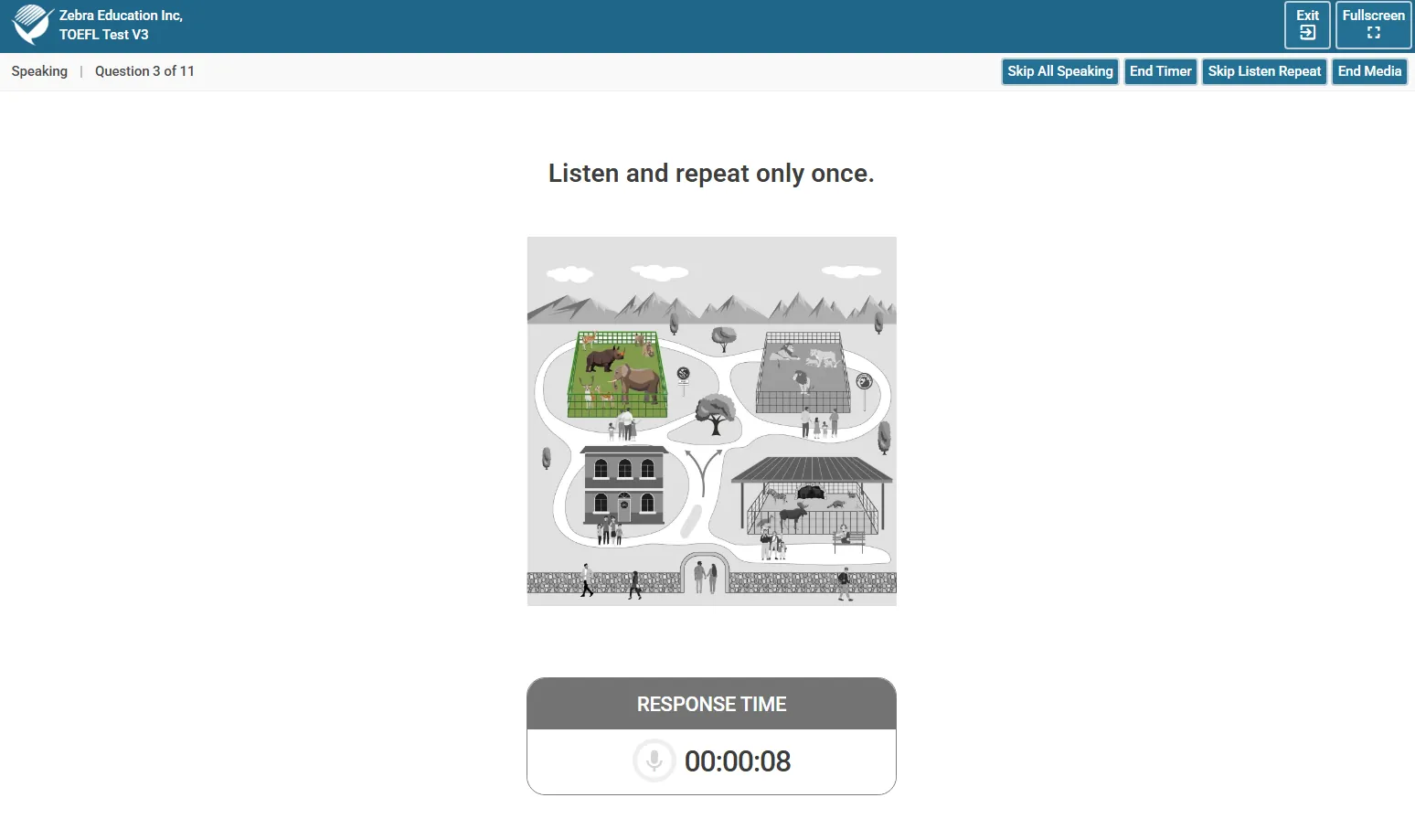
Listen and Repeat
You hear 7 sentences, one at a time, and say each one back exactly as you heard it. The sentences start short and get longer. This task checks pronunciation, rhythm, and how well you hold a sentence in memory. Tip: repeat in meaningful word groups instead of single words, and keep the speaker's stress and intonation.
You are learning to use a coffee machine. Listen to your trainer and repeat what he says. Repeat only once.
-
spellcheck AnswerBegin by filling the water chamber with clean water.
Listen to the audio, then click to record what you just heard.
Practice speaking questions in our app
-
spellcheck AnswerInsert a coffee filter into the holder.
Listen to the audio, then click to record what you just heard.
Practice speaking questions in our app
-
spellcheck AnswerSet the timer if you want coffee ready before morning.
Listen to the audio, then click to record what you just heard.
Practice speaking questions in our app
-
spellcheck AnswerPlace your mug on the drip tray before brewing starts.
Listen to the audio, then click to record what you just heard.
Practice speaking questions in our app
-
spellcheck AnswerChoose the drink strength you want on the control panel.
Listen to the audio, then click to record what you just heard.
Practice speaking questions in our app
-
spellcheck AnswerAvoid spills by keeping the water tank below the top line.
Listen to the audio, then click to record what you just heard.
Practice speaking questions in our app
-
spellcheck AnswerClean the coffee maker at least monthly for the best results.
Listen to the audio, then click to record what you just heard.
Practice speaking questions in our appFull guide: TOEFL Listen and Repeat practice, with audio, scoring, and tips.
Take an Interview
An interviewer asks you 4 questions on one theme, and you answer each one for 45 seconds. There is no preparation time, so you start speaking right after the question. Tip: every question fits one of seven question patterns, such as Opinion / Preference, Personal Background, or Advantages / Disadvantages. Recognize the pattern as you hear the question, then follow its structure.
You have agreed to take part in a research study about cooking at home. You will have a short online interview with a researcher. The researcher will ask you some questions.
Question 1
-
spellcheck TranscriptThank you for participating. Today I'd like to ask about cooking when your schedule changes every week. How do you decide whether a given evening is a cook-at-home night or an eat-out night?
-
Sample ResponseWell, on weeks when my schedule keeps shifting, I try to make the decision during my mid afternoon coffee break. First, I quickly look at my calendar and ask myself how much mental energy I still have after work. If I see an evening meeting or a late gym session, I quietly tell myself that takeout is perfectly fine, and I move on. Conversely, when I notice a free block, I get excited about using up the vegetables in the fridge. In either case, I text my partner so we stay on the same page.
Watch the video question, then click to record your answer.
Practice speaking questions in our appQuestion 2
-
spellcheck TranscriptGreat. If you had to cut your grocery budget by twenty percent, would you buy cheaper staples, smaller portions of protein, or fewer specialty items first? Why?
-
Sample ResponseHonestly, if I suddenly needed to shave twenty percent off the grocery bill, I would attack the specialty items first because they are the biggest silent wallet drain. For example, fancy cheeses, imported sauces, and single purpose spices look innocent, but they add up quickly. After trimming those, I would compare unit prices on staples and reach for store brands, though I would still keep whole grains and fresh produce. I would try to leave protein portions almost unchanged since they keep me full and stop me from snacking on more expensive convenience foods later.
Watch the video question, then click to record your answer.
Practice speaking questions in our appQuestion 3
-
spellcheck TranscriptInteresting. Some people film every meal they make; others never share food online. What effect, positive or negative, do you think food content on social media has on how people cook?
-
Sample ResponseRight, so when I think about food videos flooding my feeds, I see a double edged situation. On the positive side, short recipe clips give busy home cooks quick inspiration and demonstrate techniques that used to feel intimidating, like folding dumplings or tempering chocolate. As a result, many people cook more often and waste fewer ingredients. On the negative side, the constant parade of perfectly lit dishes sets unrealistic standards. Some viewers start believing every meal must look restaurant level, which can create guilt and push them toward costly gadgets or unnecessary ingredients.
Watch the video question, then click to record your answer.
Practice speaking questions in our appQuestion 4
-
spellcheck TranscriptGood points. One last question. Should high schools require at least one hands-on cooking course, or is that a poor use of limited class time?
-
Sample ResponsePersonally, I think every high school student should experience at least one practical cooking class. For one thing, many teenagers will move out within a few years, and knowing how to plan meals and handle raw food safely is as important as balancing a budget. Moreover, cooking lessons can reinforce biology and chemistry concepts in a tasty way, so the time is not really lost. Admittedly, schedules are crowded, yet a single semester elective or a week long workshop could fit without displacing core academics, and the lifelong benefits would justify the effort.
Watch the video question, then click to record your answer.
Practice speaking questions in our appTask Fulfillment
Learn how to answer these questions in a step-by-step interactive exercise
Task Fulfillment
Der erste Schritt bei einer Interview-Frage im TOEFL Speaking ist, das Fragemuster zu erkennen. Sobald Sie das Muster erkennen, können Sie im Kopf schnell die passende Antwortstruktur abrufen.
So wissen Sie genau, was Sie als Nächstes sagen, und können fast sofort losreden, ohne lange Pausen zu machen. Statt die ganze Antwort vorab zu planen, folgen Sie einfach der Struktur, einen Schritt nach dem anderen.
In diesem Schritt lernen Sie die 7 häufigen Fragemuster und die Antwortstruktur für jedes davon kennen. Klicken Sie auf die Reiter der einzelnen Muster, um zu sehen, wie sie funktionieren.
Arbeiten wir an Frage 1.
Erkennen Sie zuerst das Fragemuster. Fragen Sie sich: Was soll ich bei dieser Frage tun? Sobald Sie das Muster erkennen, lassen Sie sich von der passenden Antwortstruktur leiten.
Bei dieser Frage ist das Muster Personal Background. Folgen Sie also dieser Struktur:
Direct Answer → Background → What You Did → Specific Detail → Current Situation → Extra Detail
Verwenden Sie beim Sprechen kontrollierte Füllwörter wie Well, Actually, For example, What I mean by that is und So overall. Diese Wendungen lassen Ihre Antwort flüssiger klingen und verschaffen Ihnen etwas Zeit zum Nachdenken, falls Ihnen kurz nicht einfällt, was Sie als Nächstes sagen wollen. Setzen Sie sie natürlich ein, nicht in jedem Satz. Hier ist die Liste der kontrollierten Füllwörter.
Thank you for participating. Today I'd like to ask about cooking when your schedule changes every week. How do you decide whether a given evening is a cook-at-home night or an eat-out night?
Arbeiten wir an Frage 2.
Erkennen Sie zuerst das Fragemuster. Fragen Sie sich: Was soll ich bei dieser Frage tun? Sobald Sie das Muster erkennen, lassen Sie sich von der passenden Antwortstruktur leiten.
Bei dieser Frage ist das Muster Opinion / Preference. Folgen Sie also dieser Struktur:
Answer + Reason → Explain → Example → Details or Result → Second Reason or Contrast → Details → Conclusion
Verwenden Sie beim Sprechen kontrollierte Füllwörter wie Well, Actually, For example, What I mean by that is und So overall. Diese Wendungen lassen Ihre Antwort flüssiger klingen und verschaffen Ihnen etwas Zeit zum Nachdenken, falls Ihnen kurz nicht einfällt, was Sie als Nächstes sagen wollen. Setzen Sie sie natürlich ein, nicht in jedem Satz. Hier ist die Liste der kontrollierten Füllwörter.
Great. If you had to cut your grocery budget by twenty percent, would you buy cheaper staples, smaller portions of protein, or fewer specialty items first? Why?
Arbeiten wir an Frage 3.
Erkennen Sie zuerst das Fragemuster. Fragen Sie sich: Was soll ich bei dieser Frage tun? Sobald Sie das Muster erkennen, lassen Sie sich von der passenden Antwortstruktur leiten.
Bei dieser Frage ist das Muster Advantages / Disadvantages. Folgen Sie also dieser Struktur:
Main Advantage → Explain → Example or Result → Main Disadvantage → Explain → Example or Result → Conclusion
Verwenden Sie beim Sprechen kontrollierte Füllwörter wie Well, Actually, For example, What I mean by that is und So overall. Diese Wendungen lassen Ihre Antwort flüssiger klingen und verschaffen Ihnen etwas Zeit zum Nachdenken, falls Ihnen kurz nicht einfällt, was Sie als Nächstes sagen wollen. Setzen Sie sie natürlich ein, nicht in jedem Satz. Hier ist die Liste der kontrollierten Füllwörter.
Interesting. Some people film every meal they make; others never share food online. What effect, positive or negative, do you think food content on social media has on how people cook?
Arbeiten wir an Frage 4.
Erkennen Sie zuerst das Fragemuster. Fragen Sie sich: Was soll ich bei dieser Frage tun? Sobald Sie das Muster erkennen, lassen Sie sich von der passenden Antwortstruktur leiten.
Bei dieser Frage ist das Muster Opinion / Preference. Folgen Sie also dieser Struktur:
Answer + Reason → Explain → Example → Details or Result → Second Reason or Contrast → Details → Conclusion
Verwenden Sie beim Sprechen kontrollierte Füllwörter wie Well, Actually, For example, What I mean by that is und So overall. Diese Wendungen lassen Ihre Antwort flüssiger klingen und verschaffen Ihnen etwas Zeit zum Nachdenken, falls Ihnen kurz nicht einfällt, was Sie als Nächstes sagen wollen. Setzen Sie sie natürlich ein, nicht in jedem Satz. Hier ist die Liste der kontrollierten Füllwörter.
Good points. One last question. Should high schools require at least one hands-on cooking course, or is that a poor use of limited class time?
Full guide: TOEFL Take an Interview task, with sample questions, scoring, and the seven question patterns.
For more sample questions and scoring advice, see our TOEFL Speaking test guide and the TOEFL speaking rubric.
Adaptive Reading and Listening
The TOEFL Reading and Listening sections use a multistage adaptive format, which means the test adapts to your performance as you go:
- First stage: every test taker starts with a set of questions at a mix of levels.
- Second stage: based on your first-stage results, you get either a harder or an easier set of questions. Strong performers see more challenging questions, while others see questions closer to their level.
This approach gives a more accurate measure of your English with fewer questions, because the test fits your skill level. Writing and Speaking are not adaptive: everyone gets the same tasks.
The practical lesson: accuracy in the first stage matters most, because it decides which second stage you get, and the harder second stage is your route to the top bands. Our TOEFL adaptive test guide explains how the two stages work and how they affect your score, and our adaptive TOEFL practice page has free adaptive practice tests.
The New TOEFL 1–6 Band Score
Since January 21, 2026, TOEFL iBT scores are reported on a band scale from 1 to 6, in half-point steps, for each section and overall. Your overall band is the average of the four section bands, rounded to the nearest half point. The bands line up with the Common European Framework of Reference for Languages (CEFR), so universities and students can read a score more easily.
TOEFL band |
CEFR level |
Old TOEFL score (0–120) |
|---|---|---|
6.0 | C2 | 114–120 |
5.0–5.5 | C1 | 95–113 |
4.0–4.5 | B2 | 72–94 |
3.0–3.5 | B1 | 44–71 |
2.0–2.5 | A2 | 24–43 |
1.0–1.5 | A1 | 0–23 |
During a two-year transition, your score report also shows a comparable score on the old 0–120 scale, for universities that haven’t updated their requirements yet. See our TOEFL band score guide for the full conversion chart, what a good band score is, and how section bands are calculated.
Other TOEFL Changes: Score Delivery and Fairness
Other improvements include score delivery within 72 hours, better test-center audio with headphones designed by Koss, new official preparation resources, and a redesigned registration process. Together they are ETS's largest investment in the TOEFL iBT so far.
ETS also revised the test content to focus on academic authenticity and cultural neutrality. The texts and recordings reflect real academic and everyday situations while reducing cultural bias, so students from every background have a fair chance to succeed.
For more details, read the official announcement: ETS Press Release
How to Prepare for the New TOEFL Format
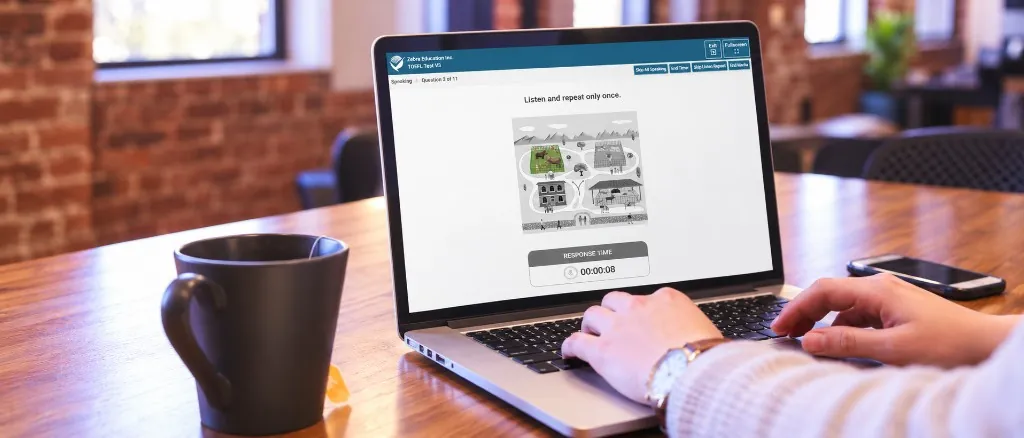
Preparing effectively for the new TOEFL requires more than reviewing English skills with older study materials. You need to become comfortable with the updated task types, the short timer for each Listening question, the adaptive Reading and Listening sections, and the demands of completing the 90-minute test without a break. Practicing in the current format from the beginning helps you build the right skills, pacing, and confidence for test day.
BestMyTest gives you that experience. All lessons, practice questions, and simulation tests follow the new TOEFL format, including the adaptive Reading and Listening sections. Instead of being surprised by the test, you can learn how it works, identify what is limiting your score, and improve through focused practice.
play_circle_outlineStart New TOEFL Sample Test
A strong study plan follows a simple cycle: test, review, improve, and retest. Begin with a practice test to establish your TOEFL band score in each section. Review the results to find the question types and English skills that need the most attention, spend the next 5 to 7 days improving those areas, and then take another test to measure your progress. Repeating this cycle turns every practice test into a clear plan for what to study next.
For a complete preparation schedule, see our TOEFL study plan and our guide to choosing and using an online TOEFL preparation course.
Tip 1: Practice Every 2026 TOEFL Question Type
Practice every updated Reading, Listening, Speaking, and Writing task until the instructions and response formats feel familiar. Materials created for the current test help you develop relevant strategies and avoid spending valuable study time on question types that no longer appear.
Tip 2: Review Mistakes and Use AI Tutor
Do not stop after checking whether an answer was right or wrong. Look for the skill behind each recurring mistake—such as vocabulary, grammar, comprehension, or pronunciation—then use targeted AI Tutor exercises to strengthen that skill. Apply what you learn to new TOEFL questions so the same weakness does not continue to lower your score.
Tip 3: Use Speaking and Writing Feedback
Use detailed feedback to understand exactly what is holding back your Speaking and Writing scores. Focus on specific areas such as pronunciation, fluency, grammar, vocabulary, organization, and supporting details. After working on those skills, submit another response and compare the feedback to confirm that your performance is improving.
Tip 4: Use Full-Length Adaptive Practice Tests
Full-length adaptive simulations prepare you for challenges that isolated questions cannot reproduce. They help you learn the testing interface, manage your time, maintain concentration for 90 minutes, and experience how Reading and Listening change after the first stage. Review each score report before taking another test so every simulation guides your next round of study.
Tip 5: Build English Skills With Lessons
Test strategies are useful, but they cannot replace strong English skills. Combine TOEFL practice with lessons in grammar, comprehension, vocabulary, pronunciation, speaking fluency, and writing organization. A stronger foundation makes it easier to respond accurately even when the topic or wording is unfamiliar.
Tip 6: Focus Your Schedule on Weak Areas
Avoid dividing your study time equally when your scores show that some areas need more attention than others. Prioritize the sections and skills with the greatest potential for improvement, then use later practice tests to confirm your progress and refine your schedule. This focused approach helps you make better use of every study session.
Free Guides to Every New TOEFL Task
- The big picture: why ETS redesigned the TOEFL and free adaptive TOEFL practice tests
- Reading: Complete the Words and the adaptive Reading and Listening sections
- Writing: Build a Sentence, Write an Email, and Academic Discussion
- Speaking: Listen and Repeat and Take an Interview
- Scores: the TOEFL 1–6 band score, the speaking rubric, and the writing rubric
- Section guides: TOEFL practice test, reading, listening, writing, and speaking
TOEFL 2026 Changes: Frequently Asked Questions
helpWhen did the TOEFL change in 2026?expand_moreexpand_less
The new TOEFL iBT format started on January 21, 2026. Every TOEFL iBT taken since then uses the new tasks, the adaptive Reading and Listening sections, and the 1–6 band score.
helpHow long is the new TOEFL test?expand_moreexpand_less
About 90 minutes of testing time: about 30 minutes of Reading, 29 of Listening, 23 of Writing, and 8 of Speaking, with no scheduled break. Plan for about 2 hours at the test center with check-in.
helpIs the new TOEFL easier?expand_moreexpand_less
It is shorter, and the tasks are closer to everyday and university English, but it is not easier to score high. In the adaptive sections, the first stage decides how hard the second stage is, and the new tasks need their own practice.
helpIs the TOEFL still scored out of 120?expand_moreexpand_less
No. The main score is now a band from 1 to 6 for each section and overall. During a two-year transition, the score report also shows a comparable score on the old 0–120 scale.
helpWhich TOEFL tasks are new in 2026?expand_moreexpand_less
Complete the Words, Read in Daily Life, Listen and Choose a Response, Listen to an Announcement, Build a Sentence, Write an Email, Listen and Repeat, and Take an Interview are all new. Write for an Academic Discussion is the only task kept from the previous test.
Was Lernende über BestMyTest sagen
It’s the best platform to practice for the toefl test, there is a lot of useful excercises that helps you improve the section that you struggle the most. Definitelly, I recommend using bestmytest as it is a practical way to prepare for the exam.
The Vocabulary lessons were absolutely amazing. I can vividly remember that I was struggling with new word across different topics, and those lessons assisted me to learn the needed vocabulary for the TOEFL test in a short matter of time, thanks to Ms., Sonya. I appreciate the efforts made by the best my test as a whole.
This application is easy, fun, and very helpful for anyone who wants to learn or practice for the TOEFL exam. The questions are well designed and make studying more enjoyable. I definitely recommend it for TOEFL preparation!
I scored a 5/6 in TOEFL with the help of Best My Test. Their wide range of material helped me practice, kept me consistent, and eventually improved my score. I would really appreciate if they would provide more writing and speaking reviews since their reviews are great and accurate as well. Lastly, I haven’t found so many materials for TOEFL on any other prep course website. Really grateful and highly recommended.
Very good site for Toefl Practice sessions
BestMyTest provided exceptional support during the internet shutdown in Iran by renewing my account for free. This showed real understanding and integrity. Beyond that, their TOEFL preparation platform is extremely effective—the lessons are well structured, the practice questions closely match the real TOEFL exam, and the explanations help you understand your mistakes clearly. I highly recommend BestMyTest both for their high-quality service and their strong ethical values.
BestMyTest is an absolutely fantastic platform. The service is excellent and very professional. The practice tests are high quality, very close to the real exam, and extremely helpful for building confidence. The explanations are clear, detailed, and easy to understand. Customer support is fast, friendly, and truly supportive. I highly recommend BestMyTest to anyone preparing for the TOEFL. An outstanding experience from start to finish
It's a really helpful website. With TOEFL practice sessions, you can improve your general reading and listening skills while also working towards the TOEFL. There are so many examples, you don't need to buy any additional reference books or anything else. By simply studying on this site, you can achieve excellent TOEFL scores by applying both your general English skills and exam-specific tactics.
With their help, I easily achieved a TOEFL score of 107. They helped me overcome the barriers.
This is the best website that I practiced TOEFL materials.
I find this website very useful. I believe it is one of the best online TOEFL preparation on the internet. One of the thing I like is it mimic test condition. If you are struggle with time management, it will help you a lot. After practicing with the BestMyTest, I saw a significant improvement in my TOEFL scores. My score increased by 8 points. However, I needed more time to study because pharmacy certification has different requirements, and due to unforeseen circumstances I had to take break. I would recommend this website to anyone to use it. You have everything you need to pass you test in one place.
After practicing with the BestMyTest app, I saw a noticeable improvement in my TOEFL scores. The practice questions helped me significantly enhance my reading and listening skills. As a result, my score increased by 6 points. The focused practice through BestMyTest played a key role in my progress.
Excellent I recommend to study for the toefl from there it has everything you need 💙
I highly recommend BestMyTest for TOEFL preparation. The platform offers comprehensive practice tests, detailed feedback, and excellent study resources. It significantly improved my skills and boosted my confidence. An invaluable tool for anyone aiming to achieve a high TOEFL score.
i have received my scores and i am glad😁 81: R18, L21, S22, W20! I already enrolled in the college and I will go to the US this fall! you helped me with the fulfillment of my childhood dream 🥰 i absolutely recommend BestMyTest for all students who want to pass TOEFL exam with the best grades!
The best website out there to learn about TOEFL! I'll always recommend it to my friends. Thanks so much for your effort to make such an amazing TOEFL platform.
I highly recommend bestmytest_toefl. I haven’t met my desired score yet, but i am working on it and obviously, I can tell, I have improvements.
The best ! I prepared for 8 days and scored 91, for me it’s amazing! I didn’t expect that. I highly recommend it !
I just prepared for few days and was able to score 103 on my TOEFL-iBT test, I am glad I made the right purchase, thankyou!
Best app for toefl practicer. Easy to access, gives so many instructions and reviews which can help to update my score. They are so humble and kind. I am still practicing from it....
The best platform available for TOEFL preparation. It saved my time by providing all materials I needed.
The number of tests is good and the the application resembles the actual toefl test app too.
I highly recommend BestMyTest for TOEFL preparation. The website offers fantastic resources that are comprehensive and user-friendly. The practice materials are top-notch, providing valuable insights into exam patterns. What sets BestMyTest apart is their exceptional customer service. The team is not only kind and understanding but also incredibly helpful. They genuinely care about your success and go the extra mile to assist you in your preparation journey. If you're looking for a reliable platform with excellent resources and a supportive team, BestMyTest is the way to go. They have made a significant difference in my preparation, and I am truly grateful for their guidance.
Great website to score 100+ in toefl 👏🏻
Great platform for TOEFL practice, I definitely recommend this platform to everyone. The staff is also very helpful with everything you need.
It's a great platform with everything someone will ever need to prepare for the TOEFL. Highly recommend.
Best my test have best course for TOEFL...... Helped me a lot to score good
Bestmytest has everything you need to prepare for toefl. As a non-english speaking person who lives in french-speaking country, it was almost impossible to defeat toefl. Nevertheless, because of this site, I learned and got what I needed. I highly recommend everyone who wants to pass their toefl exam to use this site. It is very cheap and easy to use. I practiced and learned strategies there for 3 months and got my toefl score. My dream score was 66(17 for each reading and writing, 16 for each listening and speaking) but I got 89(20 R, 23 W, 25 S and 21 L) on actual exam and the reviews I got from Bestmytest were almost the same. For you to succeed, you would just need to study carefully their lessons and follow their advices. Thank you Bestmytest for helping me defeat this dreadful english exam.
The customer service is responsive, also every time I have a question regarding a section for TOEFL, they explain it properly. The speaking and writing reviews are also effective in improving my score. Moreover, they also constructive feedback when they need to improve something on their website or content.
BestMyTest has been the best platform in my preparation process for the TOEFL. They have what appears to be the largest question bank of all websites. Plus, by doing the Simulation Tests, I have greatly improved my english overall. Their support is agile and effective as well.
It is the best website for studying TOEFL. Their questions are very similar to TOEFL format and not only questions, also the experience is very similar to TOEFL exam. Also, they are very thoughtful and helpful.
I just recently took my TOEFL test and managed to score 114/120 thanks to this course! :) Reading 30 / Listening 30 / Speaking 24 / Writing 30 The course especially helps getting into the "exam mode" and to get accustomed to the type of questions that aren't your everyday type of task (--> especially the speaking part). While I didn't do a lot of the learning modules, some of them really helped me to work on specific issues I had (e.g. a certain type of question in the reading part that I always messed up). Based on your right/wrong results, BestMyTest suggests you modules that may help to improve in that certain aspect. I primarily focused on these lectures + structure lectures for writing/speaking as well as practice to minimize the amount of time spent learning (I'd say I invested about 50h max preparing for the TOEFL). However, I found the grading done by BestMyTest tutors to be a little more strict than the actual results (at least that's what I believe as I never scored as high as I did in my actual exam). That's not a bad thing though as it motivates you to push even harder. Last, but not least ;) ... BestMyTest has great customer support. I reached out with an issue and they got back to me within under 24h + were able to help out. Twice. It's rare to have such great customer service nowadays :) Overall, I'd recommend everyone to get the course as it's really worth the money
It contains huge number of exercises and is probably the best way to prepare for TOEFL.
Bestmytest is the best way to study Toefl. They have a lot of lessons and practice questions. I recommend using this platform if you want to reach your goal. Also, they have great customer service.
Best website to improve and learn. I have tried multiple websites for Toefl but this is helping for sure.I am yet in the process of taking my test and will review once I get my expected scores. But I will certainly say that the customer service and the content of the study is awesome.
Since I have never took TOEFL before, best my test really helped with the introduction and tips and trick. The contents are precise and focused, with tactics and gradings that help us in greatly improving our scores.The structured video lessons, the practice resources and the full length tests helped me immensely.I absolutely love their chat support and how they resolve all your doubts. I wish I started sooner with best my test and also did all exercises. Thank you,Best my test! I definitely recommend it to everyone :)
This is by far the best website I used to prepare for the toefl. The speaking and the writing reviews helped me focus on my weaknesses. I ended up scoring 28/30 S and 29/30 W. I struggled while I was trying to find someone to accurately evaluate my speaking and writings. Furthermore, the practice test that the Toefl ibt offers on their website will give you a score without explanation or corrections so it was not that helpful. And most of the tutors I contacted charged 3 times more what the review costs here. I also appreciate that you can record your voice and take as many mock tests as you'd like. I absolutely recommend this for any student who is preparing for the toefl.
This is the good site to practice TOEFL I came across this site there features I like it -Flexible pricing according to need -Real time simulation similar to exam simulation -practice test are of similar level real exam
Bestmytest is actually the best website you can can ever find to help you prepare for TOEFL. They have ample number of tests and practice questions which is hard to find anywhere else, additionally, the tests are on a par with actual TOEFL test. No matter how much research you do, you will not find any platform better than this for TOEFL, take my word to the bank. I definitely recommend this to all those preparing for TOEFL exam. Prices are very much affordable, moreover the whole team of bestmytest is very kind and genuine, they always get back to you with their wonderful service if you are stuck somewhere. I had an amazing experience preparing with this platform. I wish bestmytest to continue helping students as they are in future. Thank you BESTMYTEST. You really are the best!
Frankly, the best platform to prepare for TOEFL. I would recommend it to everyone.
I would recommend best my test to each and every student preparing for TOEFL. It is the bestest portal I have ever used.
BestMyTest.com was my personal tutor in studying for my TOEFL exam. The platform is very user-friendly and navigation is easy. The practice and simulated tests really prepared me for the TOEFL in a way I could face the actual exam with ease. The feedback on the Writing and Speaking sections that were given by instructors was pointing out exactly where I had to focus and these gave me a pretty good indication about what I was doing wrong as well as getting right. I loved the learning experience and the many templates that are there in the lessons section were totally awesome! Those really gave me a guideline I could stick with and helped me organize my answers. I did not go to any physical classes. Instead, I followed the advice I was given and focused 1 month on my studies using this eLearning site and did really well in the TOEFL. Thank you so much! I highly recommend BestMyTest.com to anyone who wishes to do their TOEFL studies.
"Hello all, I am super happy with the pricing and rates from the company. Specifically I like the speaking parts. They have provided many practice tests to choose from. I took 7 day access and upon my request, they extended for 2 more days untill my real TOEFL test. It helped me a lot. Thanks "
I got my TOEFL scores today and I am so happy with that. Due to financial constraints, I could not take purchase any of your courses, but your free materials helped me a lot. This mail is a thanking mail to you. I want to express my gratitude towards you through this email. I would definitely recommend your website if anyone asks me for a TOEFL preparation recommendation.
This site is extremely helpful for TOEFL preparation. I haven't passed the exam yet but I do exercises much better than before. What is good about this site? 1)Reading, Listening Besides many available TOEFL questions, special lessons do help you. The system recommends the most relevant lessons based on your progress and mistakes. 2)Speaking, Writing Bestmytest is way ahead of competitors. As far as I'm concerned, it's the only popular TOEFL preparation site that has a large enough number of professional reviews of your work 3)Nice design, really responsive team Ideas for further improvement: developing a phone app; sending notifications
I started studying for Toefl in March, I didn't have much time and didn't know where to start. I searched on the internet for free materials, it was very confusing. Then I found the Bestmytest website, I studied all the free materials, but I needed more. Because of the banking system in my country, I couldn't purchase any of their plans. So I emailed them and promised to pay as soon as I moved to my destination country, surprisingly they accepted and gave me access to their platform for two months. It was AMAZING. My score improved from 87 to 98! I am grateful to them, not only for their number one platform but also for their kindness.
They have lots of questions to practice which helped me improve my basics and score well in TOEFL.
Helped me to improve my score by 12 points just in one month! Super useful strategies and clear explanations.
I used your app for my TOEFL exam, and I got the score I needed. It was extremely useful, so thank you very much. In one month, more or less, I improved 9 points.
I payed the 3-month subscription and it worked beautifully. I honestly feel like I “bested my test” (pun intended). I scored 9 points above the average calculated by the website. The more you practice, the best the website will work for you. The video lessons are very well organized. Recommended 10/10
This is so far the best course out there for TOEFL preparation. I found it extremely helpful, I am sure you will too.
I think bestmytest is the best way to study Toefl. They have tons of practice tests and everything for the Toefl preparation. Especially, their review system helped me a lot to improve my writing and speaking skills. Thank you so much bestmytest.
BESTMYTEST is extremely useful service. I love that there are a lot of theory and practice. Everyone can find the answers on their questions. Definitely recommend!
Best my test is the best TOEFL preparation! It’s very useful and helped me improved my score! On the first attempt, I study by myself and the results is not good enough then I decided to give best my test a chance for my second time. And it turns out great! I took a test today and so far I improved my reading part by 8 points and listening part by 5 points which made me happy. Also, the website and very easy to use! I love it.
It is the best app to practice for TOEFL!!! I really recommend Bestmytest!
Bestmytest is by far the best toefl preparation service ever. I was really amazed with their prep materials and their practice tests. Its so close to the actual Toefl test. Keep up the good work
It is the best app to practice for TOEFL. It has a lot of exercises in each of the four sections and also provides you a lot of useful tips to increase your score! I highly recommend it! It has helped me a lot... Thank you so much for your services.
Bestmytest helped me so much with my studying, it was extremely useful and efficient, thank you very much ! I deeply recommand Bestmytest for your TOEFL prep!
Best my test is a platform that helps you to clearly understand the objectives of each section and provide you with the best study tips on how to tackle each section. The tips provided are invaluable and the adequate practice questions help you gain the mastery over that section. I got a 94 in TOEFL without BMT, but with Best My test, I got a 117. I would 100% recommend this to anyone looking to improve their TOEFL score
Excellent experience. Very well organized. Same as Toefl.
Very helpful! Most questions provided by the BESTMYTEST service are similar to those of the actual TOEFL test. It helped me find my weaknesses and supplement those parts successfully. Subscribing the BESTMYTEST would be one of excellent ways to prepare for the TOEFL test considering the cost-effectiveness.
The best online preparation Toefl course, I recommend this course for all test taker for several reasons: - Very organized - Highly experienced touters - thousands of practices question. - Analytical dashboard which helps you to identify your weaknesses and strong point. - Quick response from touters when you ask for an essay writing and speaking review. Overall, I highly recommend every test taker to try this comprehensive preparation course.
This is the Best site for TOEFL preparation. Their detailed reviews on the speaking and writing section were very helpful. And the simulated tests were very accurate to the actual test. Would recommend BestMyTest to anyone who is preparing for TOEFL.
My experience with BestMyTest institute is very satisfying. The Mock-tests and the study materials are of very high quality. The teachers are really very helpful and co-operative. They always clear my doubts whenever I ask them. This is one of the best online coaching institutes for TOEFL preparation. I would definitely recommend to other students to Join BestMyTest for preparation of TOEFL exam.
Thank you BestMyTest! BestMyTest makes me successfully head to Stanford University to implement my research work in 4-month preparation. I am a Taiwanese student. Listening has always been my short. In Taiwan, probably because these TOEFL online learning websites are full English, a limited number of people would use websites. As a result, most people spend a great amount of money on going to cram schools since teachers there would share feedbacks and techniques on how to get high scores, especially in speaking and writing section. However, the teaching materials of cram schools are not sufficient, which makes students need to buy extra reference books or download exercises from the internet. Couple years ago, I spent nearly 100 USD on a famous cram school in Taiwan. To be honest, cram school is not a miraculous cure if you do not spend plenty of time in practice; as a result, I got only a 75. I found complete courses with YouTube videos included of how to use these logics (techniques of getting high scores) where I can achieve the same effect by cram school, and BestMyTest also provides speaking and writing reviews. The abundant simulated exercises perhaps value this website the most, an amount equal to buying 10 more reference books. In addition, the simulated exercises in BestMyTest is a bit more difficult than official TOEFL tests, which renders me to feel easier and less tense when I took the official TOEFL exam. Lastly, a long-term advantage, not the instant advantage for Taiwanese students-BestMyTest is a full English website, but I think it is a good start to adapt in English earlier for any student who wants to go abroad. To conclude, BestMyTest integrates accomplished courses and rich simulated exercises. Nevertheless, the cost is only one-fifth of going to a cram school. For those who want to get high scores or to immerse yourself in English, I sincerely recommend BestMyTest.
BestMyTest is a website that offers an online course that every candidate should consider when preparing for the TOEFL exam. This website meets all my personal needs. Of course, just following the course cannot replace other general sources of English learning such as conversing with English speakers, reading English books and articles, watching English TV shows and movies and so on. On the other hand, BestMyTest can be used as a primary source or guide, if you like, on your way to test preparation. To make it short, I can list several reasons why I liked this source. The main one I was looking for was the opportunity to practice as much as possible. In fact, the practice materials, in my opinion, correspond to the level of difficulty of this exam, if not more. Hence, this almost unlimited ability to practice and then reinforce all the skills by studying sample answers is crucial. Next, TOEFL is a test in which timing is everything, and therefore BestMyTest adequately solves this problem. Each candidate can start developing time-related skills from the very beginning on the way in ones preparation. In addition, anyone interested in building their own set of new academic vocabulary can find many useful lessons and materials in this regard. The site structure is very easy to navigate. Since BestMyTest offers a 7-day free trial, one can utilize this option effectively and learn how to navigate the website. Last but not least, my interaction with customer support has always been very productive. The service is organized professionally. I received all the answers to my inquiries in a timely and concise manner. As a final thought, I believe BestMyTest is a great all-round source when it comes to TOEFL preparation, and it works great when paired with polishing your general English as I mentioned above.
Bestmytest is a reliable online course preparation to enhance confidence for TOEFL exam. There are plenty of exercises, vocabulary lessons, simulations with a diagnostic overview, and really interesting statistics to understand how your training is. The writing and listening reviews are amazing to improve you grade in the test. Definitely, I recommend this course!
This is an absolutely great website. I have almost practiced all the exercises available on the website and I have noticed that all major and minute details are handled with so much effort and determination. If I will be unable to get a good score in TOEFL then I will own the whole blame as not for achieving a score even after getting myself prepared from the remarkable website.
It is really same with Toefl exam. I feel lucky to find you. Your practices are really helpful to prepare my exam 🌟
I think that Bestmytest is the best TOEFL preparation program. It's practice tests are of same level as original test. Also, the wide varieties of practice questions help you to improve English. The reviews from Bestmytest are really helpful to get better score. I really recommend others to use this program.
I started preparing for my TOEFL test one month ahead. Bestmytest gave me a plenty of possibilities to learn grammar, words, templates and gave me tips on how to prepare. However, best was a huge amount of practice exercises. I practised a lot and with the optional review on your writing and speaking bestmytest is great. I could improve from a score of less than 90 to 108 in four weeks.
The Practice tests are a good exercise for the TOEFL test preparation. Ask an instructor is an useful tool for tips and Q&A
If you need to take the TOEFL exam and you want to study on your own, you won't succeed. I thought I was doing great while studying on my own but I started the 1 month program and realized that you NEED this website to reach your goals. Feel free to try your 7 days free trial and you will realize that you need to keep using this website. I improved from 80 to 92 in only one month. And I am not the best at writing and speaking, but the templates provided for both section helped me a lot. I would recommend taking at least 1 month program 100%. THANKS!!
Great program. It helped me a lot with my TOEFL preparations. I would definitely suggest to many other people :)
If you are looking for a high TOEFL score you are at the perfect place. I would definitely recommend Bestmytest on my good experience with them.
I am preparing for TOEFL as a student studying in Korea. Bestmytest has been really helping me with the preparation for TOEFL. Without the need to purchase other materials, Bestmytest provides different packages all-in-one. 1. First, it allows us to set our goals for TOEFL scores and help us to track how we are doing. Tons of practice questions for all 4 sections are organized really well. A 7-day free trial is there, so you can always check out how they are before you pay for a subscription. 2. Moreover, Bestmytest provides lessons with a lot of tips for each section. Especially, at first, I faced problems in the speaking and writing section as I did not know to deal with the questions. However, with Bestmytest, I learned many strategies that I can apply to the questions. 3. Lastly, the best part of Bestmytest is that it has a review service for the speaking and writing section. It is really difficult to judge the performance of myself even with the rubrics, so reviews from the professional really help to know how well you are prepared for the test. I really suggest Bestmytest to people who are struggling with TOEFL for the above reasons! The price is really reasonable compared to the services they provide. I really thank Bestmytest for helping me with the study. :)
Very good course, helped me to get from 89 to 97 in 2 weeks. I will study for one more month though. Aiming to pass 100! Thank you to everyone who made bestmytest possible. My little suggestion is that speaking reviews seem to be very expensive :( And with a 1-month plan which does not cost a little, you only get 1 whole speaking task review, anyway I won't cut off stars, as this course absolutely helped me to improve my score significantly.
I think this website is one of the best to prepare for the TOEFL exam. It offers lessons, vocabulary, and tips/tricks for each section, a wide range of well-made tests (which imitate exactly how the exam goes) and it is also up to date. The price is very affordable and you can benefit from their free trial period as well. Another important thing to keep in mind is that the samples they offer (for speaking and writing) are almost perfect, professional. But normally nobody can provide such an accurate answer, so no need to worry. They are only for guidance. You can obtain a really good score with more natural responses (which can include pauses, stuttering or less fancy words).
I definitely recommend ''BEST MY TEST''. You will not get this helpful source and helpful , professional tutor service from anywhere. The way they created is not only amazing but also make your expert in toefl. You absolutely achieve your target score. thank you so much.
It is a wonderful site which helps you to achieve such a fabulous score on your toefl exam. I strictly recommend this site to everyone who is going to attend to TOEFL.
They are the best team on your TOEFL preparation. All of their practise tests are equal to real one. I personally increased my score by 15 points. This is awesome. I want to say thanks to. BestMyTest team. Wish you best
Best platform to prepare for TOEFl exam. You will see 100% improvement in your score.
As I have checked and used most of the online TOEFL preparation tools, I can definitly tell that Bestmytest is the top online tool on the market. Mert Cetin
First of all, I have been using Bestmytest for 2 months. This is the best program for Toefl. There are very good practices test. Moreover, my favorite section is grammar correction. Secondly, Bestmytest has excellent team. When i had a question, they responsed with big patient and quickly. Even if questions are weird. :) Thank you very my BESTMYTEST team. ☺️☺️☺️
I can't thank you enough for the perfect training your website has provided!! Received my scores today: achieved 119/120. I felt pretty confident at the test center due to the exercises I have done on your page - however I did not expect such a great result. Keep on doing what you are doing - this really is a great opportunitity for students to prepare at a price which is affordable for everyone.
I took my TOEFL test recently and recieved a score of 106. I think this was possible only because of the materials and preparation guides provided by bestmytest team. The prep materials were really good and I would surely recommend bestmytest to my friends or juniors. The company provided me with a one week free extension service when I requested which I think most of the companies would hesitate. I am very thankful for this deed. Once again thanks a lot bestmytest team. Keep continuing this work!
This is PERFECT! I normally don't prefer to give review. However, I would love to do it today because I am very happy that I got high score in TOEFL. Thanks to Bestmytest. Can't believe I did it :) I would Highly recommend Bestmytest. As name says: Bestmytest is best.... Really worth it.
After trying a different course, I can say that Best my test course is very professional and recommended. They have very good lessons and multiple ways to practice and strength both foundations and skills. Their practice tests are very similar to the actual TOFEL test and reflecting the real test level. Their online speaking and writing reviews are accurate and eventually reflected my score. Thanks to best my test I achieved my target score.
I got my TOEFL test score back today and I scored 108. This was my first try and I'm very happy with my score :) I just wanted to say thanks for taking the time to answer all my questions and also giving me the advice I needed. I hope many students will score high through this program. Thanks again! :D
I just got my Toefl score yesterday- 114/120, and I owe a massive part of that achievement to Bestmytest. The reason I went for Bestmytest is for access to experts to provide feedback on the speaking and writing areas in particular as I felt that self study won't enable me to see my mistakes. I got 30/30 in both these sections! Below are the benefits I experienced: 1. The home screen provides information on my progress: what my current score is and what I require, what percentage of each section I have completed and which question types, reading in particular, I am struggling with. I found the gist content and insert sentences questions to be particularly challenging so I sought further expert help in those areas. 2. For the few IT related queries I needed help with, Jane was really helpful and swiftly guided me. Overall, the program is sophisticated and user friendly. 3. The experts who reviewed my submissions gave really constructive feedback. The response was speedy too. I personally found their bank of questions to be harder, and the scores of submitted work to be non-lenient, which challenged me to work harder. 4. Practice makes perfect. Bestmytest have a universe of questions which was exactly what I needed. 5. They have helpful videos and templates on how to approach questions too. I am glad that I supplemented my revision with this excellent learning program. I would highly recommend it! I'm a very anxious exam taker and Bestmytest helped me build within myself, that confidence, which guided me to success.
Their 20 tests are almost identical to the actual TOEFL test. The writing and speaking feedback is very helpful as well. I spent two weeks using the website and I improved from 93 to 105. From a guy who spent nine months fighting against the toefl test, I can tell that there is no platform better than Bestmytest to prepare for the toefl test.
I prepared for 12 days(approximately 30hrs) on bestmytest and got 113/120 on TOEFL. I'm extremely happy that I got this score and I would say that bestmytest helped me a lot! I experienced the following advantages preparing from bestmytest: 1- Excellent speaking and writing reviews(I got the exact same score on speaking-29 and almost the same score on writing-28 on the actual TOEFL exam) 2- Excellent high level practice questions: I felt that the practice questions on bestmytest reading and listening section were of a higher level than tested on the actual TOEFL exam. But, that was a big plus, as I felt at ease during the TOEFL exam. 3- Excellent sample essays and speaking sample answers. One must go through 50% of these to get well prepared! 4- Excellent structure explained in videos for speaking and writing section. Make sure you go thorough all the videos on TOEFL guides for speaking and writing section, given on best my test. I followed the exact same structure for responses on speaking and writing section, and got 29 in speaking and 28 in writing. 5- Excellent questions and software for speaking and writing section. In fact, for all the sections :) The good thing is that you can record your responses on the speaking section and check for the errors. In conclusion, I would say that even if you have less time(about 10-20 days) to prepare for the TOEFL exam, you should take services of bestmytest. Good luck with your TOEFL prep! Regards, Shahzil
First of all, I am greatly appreciated to Bestmytest team! You guys are the best of the best in terms of the Toefl tutoring. I have struggled to get my required score for looong time. I finally got Improved my score from 77 to 90 with each section of R20, L24, W24, S22 for only 3 weeks of intense study. I have taken TOEFL for 3 times before, and never passed 80 each time. My first trial was 72 and 77, last one was 75. I was about to give up my studying and felt exhausted. I have studied by myself with official TOEFL books and youtube videos or other free resources whole this time. Out of four section, my listening and reading skills were the worst than other two, and I have tried many times, still, couldn’t improve them significantly. I think entire this time, I was just waisting my time and doing it wrong way over and over again. So I realized that I need tutoring but I couldnt afford personal tutoring, and I searched internet hoping that I would find some solution. Eventually, I found you guys very practical and affordable, and decided to give a shot after 7 weeks of free trial. It was the best decision of my life. I think everything on the website is super useful and handy. I realized that because of lack of my academic vacabulary knowledge, caused my L and R score low, after studying with Bestmytest, I felt much more familiar with the academic topics, and It helped me Improve a lot in my understanding of those sections. To be honest, I only utilized around 50% of what bestmytest offer and If I completed it fully, I feel like I could improve my score even higher than 90. Impossibilty became possible with you guys! I really didnt expect today that I would get this score. I was surprised and get emotionaly same time thanked for God that helped me find you guys! I would definetely recommend you guys to everyone who is not only taking Toefl but also wants to improve their english generally! Finally, I truly wish everyone in your team good luck at what you are doing and best of all from my heart! :)
I`d like to share my wonderful experience whit all who are looking for a great TOEFL prep plan , I am super satisfied with bestmytest and recommend it to all ,,,,
Fantastic website for students looking to study TOEFL. Very good interface and content. Can surely help you boost your scores.
A big thanks to BestMyTest. It played a major role in improving my skills in English. Especially in speaking, there were lots of practice questions and tests which is in the same kind of TOEFL speaking questions. It helped me to get familiar with the pattern. After practicing those questions I was able to face all the speaking questions without any anxiety. I felt vocabulary exercises and academic videos are useful because no other websites have this clarity in teaching academic words that are mostly used by ETS TOEFL exams. I found those vocabulary sessions are interesting since it has pictures and definitions with the word that you can easily relate the word with real-world situations. After going through these sessions, I was able to understand reading and listening sections easily. You can find plenty of resources for TOEFL online, but it is tough to find efficient TOEFL resources like BestMyTest. I am glad that I found them before taking my TOEFL exam.
I found bestmytest useful for studying for the TOEFL tests. Lessons and practice tests are diverse and helpful. I was able to get 98 on my TOEFL test after studying on BestMyTest for three months. I would recommend my anyone who want to pass the TOEFL exam to get a bestmytest TOEFL online course.
I strongly recommend bestmytest TOEFL preparation program. I scored 114 mainly thanks to the effective practice tests which includes very similar speaking tasks which was my main weakness.
Downsides - A - subscription is pricey B - I can't buy access only to the section I am interested in. Upsides - A - their question database is huge and the quality is impressive B - simulated tests are pretty realistic C - ideal for people who already speak english (like myself) but only need a specific TOEFL training thanks
TOEFL is a tough examination and I was finding it tough to crack on my own. It was at that time that I came across Best my test. The guidance they provide in the TOEFL examination is absolutely the best and it was they who helped me to crack the examination. Their special method of TOEFL practice test was very helpful, especially in building my confident approach towards the exam.
Amazing plateform and very helpful service after purchase. The UX is seamless, and allows you to progress and visualize your weaknesses and areas of improvement. I honestly wish I discovered it sooner, best investment made!
This app is not only great for their services but also for their gestures. I asked them to extend my service for 2 days and they did it unquestionably. Highly recommended to all tier of students.
I found this website awesome! organized lessons, reviews and techniques. customer service responds fast and greatly serve the customer. the only negative thing in my opinion is that the paid packages are limited with time not with a quantity. I have a suggestion for that. accessing the materials should be unlimited time but maybe taking reviews from real teachers can be limited with a certain time. I give it 5 start because for me the pros are more than cons. and it's specially for the customer service which I miss in so many services in Europe.
Very good services provided by the bestmytest team!!!
For a long time I was looking for a program that would help me to prepare for the exam. My best score is a program that really helped me in my study process to get the most out of everything and get my maximum score.
I have improved a lot in my english skills. There are many exercises to practice.
Amazing platform! Super helpful individuals! Really liked the fact that you could get free writing and speaking reviews with your plan! Anyways I can't thank them enough!
Amazing experience... Effective course material, test, questions and lessons all helped me to improve my English.. Thanks Best my test
This is a great platform for a beginner to learn from scratch. Best my test tool helps you to improve your scores and you can reach your target score easily with the materials and lessons provided by them.
Every resource on the bestmytest website was easy to understand and navigate, making it one of the best websites I've ever seen.
Best my test really helps me to reach my goal. And their customer service is really great.
It’s great platform. I recommend to everyone who wants to prepare themselves for toefl or ielts.
Go-to website for mock tests. After a lot of web searching I zeroed in on this website. Excellent content. After taking a free test, I decided it was worth it. The quality of test papers are really good. Especially the listening tests are very helpful.
I strongly recommend this course. By far is the best one and the staff always reply you in a short time. There is a lot of material to study and it is very interactive. Enjoy it!
Bmt helped me a lot while I was preparing for the exam. Actually I have 10 more days to take the test but, I have to say that they improved me a lot. I am so thankful to them. I recommend everyone because there are plenty of tests and questions.
They have many questions for practice which could be really helpful.
Very good website and service!
BestMyTest has a wide variety of training modules and tools, which are difficult to obtain from other sources. For me the BestMyTest speaking modules are especially important. They are well designed and convenient to use. I could not find anything similar by effectiveness from other sites.
Your study plan is very helpful and affordable. I'll highly recommend it to my friends.
I am happy with BestMyTest.
I started using this BestMyTest and it has been very helpful for my learning. From the lessons to the numerous practice questions. I definitely recommend.
I used this for my speaking and writing review. It is a very good resource and the team is very supportive.
This is the best platform where you will find lots of practice sets and you can get assistance any time you needed in any of the sections. This helped me strengthened all my weak sections especially writing section.
A lot of questions for preparation and helpful customer service.
Highly recommended Amazing content Quick support
Great material, variety of tests. Great customer service! They were keen to help on any question we had. Highly recommended.
The support is very helpful and gives a response quickly. Besides, the content is so well explaining, and there are many valuable tests and exercises.
Great costumer service! Great organized website, but you need to look at harder listening exercises.
They offer a great materia that completely close to the real test
The content is great.
I find this program great because it is comprehensive. It has well structured lessons, vocabulary cards and most importantly a lot of practice with sample answers. The package also includes thorough speaking and writing reviews as well as questions to ask to an instructor. In addition, requests are answered in a timely fashion.
The materials as well as services are excellent at a reasonable cost. I strongly recommend everyone.
This is currently the most comprehensive preparation for TOEFL and IELTS. What is included here? -Clear and useful lessons on exam preparation strategies -A lot of practical material. I have never seen so many tasks! -A great system for speaking exercises with the ability to record your answer many times -The packages include assessment of your oral and written answers by professional English-speaking teachers -11 complete real-time practice tests. -4 complete verification tests that emulate the conditions of a real exam -7 days of full trial access -Low cost compared to all other sites -All tasks are accompanied by explanations of errors.
I was searching for a course to help me with my IELTS exam. I would like to say that I found Bestmytest a great place in order to study. In the beginning, I took the custom study plan in Bestmyest for 1 month, I found the course with excellent resources, a lot of simulations, and good reviews of my speaking and writing from their teachers. I started getting in the reading part at 4.5 grade, and low scores in the other skills but thanks to the lesson on Bestmytest, now I got 6.5 in simulations. So, I decided to buy the premium package because I wanted to continue practicing for my IELTS exam (the first time that I paid for an online course, but I consider this course is the best investment that I did). In addition to that, the team supporters are ready to reply to you when you have any doubts. I am happy with Bestmytest due to I am improving my reading, speaking, writing, and listening. I consider this course is the best if someone wants to get a good score in IELTS.
Bestmytest is a great tool to prepare for IELTS. The lessons are structured in a clear format and quite detailed while the practice tests are very useful and well written aside for a few typos. I would recommend it to everyone who wants to get ready for any of the tests they offer.
I strongly recommend this platform for IELTS preparation. It has everything needed for the test
I recommend this to everyone preparing for an IELTS test! All material and instructors are super helpful. I really liked the amount of examples for speaking, listening etc. You even get grades and feedback for your practise if you pay for the service. I prepared for 2 months with this page only and got an overall 8.5
I am from India securing high IELTS band score (equivalence in CEFR C1 - Proficient user) in my IELTS examination investing few hours of preparation everyday for a couple of months with BestMyTest systematically. " The course offered by BestMyTest contains meticulous information on strategizing, practicing and weighing my potential. The module structure is segmented into chunks enabling quick preparation and easy representation in the practice tests. The listening and reading sections are tuned for complex tough question patterns. The speaking and writing techniques are greatly helpful. The base course price provides true value and custom add-on packages are handy for last minute preparations. The support provided by the team is tremendous in answering questions providing examples and reference links that nullifies the absence of a live session. I definitely recommend BestMyTest providing good service that enabled me to achieve success."
It is an excellent website, with a structure of costumer support which you can solve your problem as fast as possible. Besides that, the content is very objective and help me out a lot on my Ielts preparation. Thank you! I really recommend them.
I love bestmytest so much. There are lots of helpful lessons and practice test. My favourite part: ability to receive reviews of your work from professionals. Customer support team is also adorable! These guys are aware and ready for help.
I researched a lot regarding best IELTS preparation material. Finally, I settled on Bestmytest. They have the best IELTS preparation material and also offered the most competitive price. I took my initial mock test of IELTS and get it checked from verified teachers of BestmyTest. I scored... Listening 6.5 Reading 5.5 Writing 6.0 Speaking 6.0 Overall (Band 6.0) Afterwards, I went through intense practice. I found out that the Reading Articles and Listening sections both are of a bit higher level then original exams. Due to this fact, I was already practicing at a different level. Both writing and speaking material are thoroughly described, with some exceptional tips. So finally in my IELTS exam, I was expecting to score a Band 6.5 or Band 7 maximum. But my actual results were completely mind blowing. I managed to score Writing 7 Speaking 7 Reading 8.5 Listening 8.5 Overall (Band 8) This drastic change is because on exam day I found that the original questions were bit easier in comparison to what I was practiced on Bestmytest. All in all, I'm glad to study with their resources. Outstanding support team, state-of-the-art exam oriented resources and teachers. Thanks for helping me achieve an exceptional IELTS result.
The perfect website if you need to study for the IELTS, by far. I spent a month studying there, every comment is accurate, their database is incredibly wide, instructors are really helpful and Don't be afraid to pay for reviews (speaking and listening), it may be sharp sometimes, but it's actually what you need at the moment. Overall they helped me gain more than 1 point in each band. I am very thankful.
I would like to thank bestmytest team for their great support and study material, I would strongly recommend anyone who wants to pass IELTS exam to sign up with this great team.
In the beginning, when i started to study, my total score was around 5-5.5 but now I can easily get overall 6.5 and it is important progress for me. If you want to improve your exam score anything you need is BestMyTest which has lots of text and examples
Firstly, I want to thank you so much for your great service. I am seeing the improvement.I’m preparing for the Ielts exam and I’ve always had this problem with different sections of Ielts listening but your great website has solved it for me. Things I love about your website is that it gives you the required feedback and an estimated score which I think is necessary so that I can evaluate myself.The audio-scripts let me check my mistakes and I’ll go back to the recording and can get some great tips on how to not make those mistakes again. This feature of course goes for other sections of the test such as reading, speaking and writing. It is so thorough and it feels like an actual test. I couldn’t be more satisfied. Thank you so much.
To prepare for my Ielts exam I wanted a resource that could help me prepare at a level of the exam or higher. Plus, I wanted the tests to be in exactly the same format so that i dont have any surprises on the exam day. Bestmytest provided me exactly that. Lastly, they also have have exceptional customer service which is beneficial if you run into any problems.
I like this course because it cover all the basic concepts , help in developing new skill and easy to use both in mobile and laptop. Overall this course helps in improving the bands.
I did enroll myself with 2 other IELTS Coaches before BESTMYTEST. However, I am so pleased to inform to fellow IELTS aspirants that the BESTMYTEST platform is extremely helpful, and undoubtedly carrying the correct content and following structure formats with their sample papers. Practice material, their mock tests, their samples of WRITING MODULES are precise and provide you innumerable ideas to write and think. I am getting great academic support from this website. Highly recommended.... Good Luck IELTS fellow Aspirants.
The platform is quite user-friendly and the IELTS prep materials are great!
As many know, there are tens of IELTS education websites, I can easily say that BESTMYTEST is the easiest one to use and benefit from. the quality of questions and answers is impressive. I'm targeting 8, and I think with enough practice it is easy to get.
Bestmytest is the best tool for IELTS prep. I was able to increase my overall score 1 point higher by following some guidelines. This time I will practice more on this app to get my dream score.
There are lot of websites providing the IELTS training but trust me , The "Bestmytest" is giving you the most realistic training for IELTS. I would recommend this to you all. Other than best study material they are also very helpful in providing the support. Once again thanks Team.
With several websites available for the IELTS preparation, I can assure you will never repent your investment in BestMyTest. There website and its contents are flawless with some excellent practice exams and exercises. They value clients/ students and responds any query quickly. A real genuine partner whom we can trust. I wish them luck and more success in their business.
There are many valuable tests and exercises for the IELTS exam preparation. All the website is well-organized, and the costumer service helps so quickly which is great!! I highly recommend BESTMYTEST!!
Very helpful and quick response to any problem. BestMyTest trains you very well for the IELTS exam. Fully recommended website for home practice.
*****Highly highly recommonded***** Bestmytest is the best detailed course I have ever taken for sure I think that the wide varieties of practice questions help you to improve your general English plus learn best techniques for answering IELTS questions.Great customer service.Great team I'm so much confident now to pass my test with a high score thank you very much.
This is best IELTS preparation platform… I chose this almost 1 month before my IELTS exam and turned out to be best IELTS preparation platform available till now. It’s very easy to use and you can customise your study plan. Thanks to bestmytest team for developing this website.
BestMyTest is an excellent tool for IELTS exam! Specially Whey it regardes to classes about IELTS questions, which guides us to understand better about the exam and improve scores.
This is best IELTS preparation platform available till now. It’s very easy to use and you can customise your study plan. Thanks to bestmytest team for developing this website.
One of the best platforms for IELTS preparation. I would highly recommend everyone to make the maximum use of this site.
I struggled with the TOEFL exam for many years because I need it for pharmacy certification. I usually passed most sections but always missed one. When I retook the test, my score would drop in another section. There was never a time when I passed all four sections in the same exam. After ETS changed the exam format, I found that BestMyTest had a lot of helpful study materials. I decided to focus on this website because I had practiced with it before the exam format changed, so I was already familiar with it. The website is very user-friendly. If you put in the time to practice, it really helps you improve. I especially like that they explain both the correct and incorrect answers, which helped me understand my mistakes. There are also plenty of practice materials, so you will never run out of questions. The difficulty level is very similar to the actual ETS exam. Finally, I passed all four sections in one attempt. My scores were Reading: 5, Listening: 5, Writing: 5, and Speaking: 5. I would definitely recommend BestMyTest to anyone who is struggling with the TOEFL exam.