
Dans ce guide, vous pouvez commencer votre entraînement à la compréhension écrite IELTS en passant un test IELTS Reading gratuit. Il existe toutefois deux versions du test : IELTS general reading et IELTS academic reading. Vous apprendrez quelle version vous convient et comment aborder chaque type de question de lecture grâce à notre matériel de lecture IELTS.
Obtenez une analyse gratuite du score IELTS Reading et un plan d'étude personnalisé après avoir terminé un test d'entraînement IELTS Reading gratuit.
| Test IELTS General Reading | Test IELTS Academic Reading |
|---|---|
Vous trouverez ci-dessous notre liste complète des questions IELTS Reading avec réponses. Remarque : Les liens rouges sont nos questions Reading les plus populaires et recommandées selon nos étudiants, et vous pouvez les pratiquer gratuitement à tout moment.
Questions d'entraînement au test IELTS General Reading 1 - 135
Short everyday texts, workplace texts, and one longer passage
Questions d'entraînement au test IELTS Academic Reading 1 - 171
Three long passages from books, journals, magazines, and newspapers
Guide du test d'entraînement IELTS Reading
La suite de ce guide vous apprendra tout sur le test IELTS Reading, à la fois pour le test general training et le test academic reading. Vous découvrirez comment le score de reading est calculé, comment répondre avec succès à chaque type de question de reading, comment améliorer votre lecture avec du matériel de texte IELTS, et maîtriser nos 3 stratégies pour réussir votre entraînement à l'IELTS reading.
Table des matières
- Informations sur le test IELTS Reading
- Questions exemples du IELTS Reading
- Informations sur le test IELTS General Reading
- Informations sur le test IELTS Academic Reading
- Calculateur de score IELTS Reading
- Comment répondre aux 11 types de questions IELTS Reading
- Comment améliorer votre score de bande IELTS Reading
- 3 stratégies IELTS Reading
- Téléchargement gratuit d'un PDF d'entraînement IELTS Reading avec réponses
Informations sur le test IELTS Reading
Le test IELTS Reading se compose de 3 sections et d'un total de 40 questions. En général, vous répondrez à 12-14 questions pour chaque section et disposez d'exactement 60 minutes pour terminer votre examen de reading. Chaque section contient 1-3 passages selon le test que vous passez. Si vous connaissez le test que vous passez, vous pouvez sauter les deux prochaines sections. Sinon, il est important d'apprendre sur chaque test et comment s'y préparer.
Quel test IELTS Reading me convient ?
Le test IELTS reading a deux versions : IELTS General Reading et IELTS Academic Reading. Vous passerez le General Reading si vous cherchez à émigrer ou à vous inscrire au lycée. Vous passerez l'Academic Reading si vous cherchez à poursuivre des études supérieures. La plus grande différence entre le general reading et l'academic reading est la difficulté dans les passages IELTS reading. Comme son nom l'indique, le test academic utilise du matériel IELTS reading provenant de sources académiques, tandis que le test general utilise du matériel issu de la vie quotidienne.
Les deux tests contiennent 3 sections, 40 questions et 11 types de questions. Vous pouvez lire chaque section en détail pour les deux tests dans le tableau ci-dessous.
| Section | Test IELTS Academic Reading | Test IELTS General Reading |
|---|---|---|
| 1 | Un long texte académique allant du descriptif et factuel au discursif et analytique. Le texte sera
tiré de livres, de revues, de magazines et de journaux. 12-14 questions |
Deux ou trois textes factuels courts.
Les sujets sont pertinents pour la vie quotidienne dans un pays anglophone.
12-14 questions |
| 2 | Un long texte académique allant du descriptif et factuel au discursif et analytique. Le texte sera
tiré de livres, de revues, de magazines et de journaux. 10-14 questions |
Deux courts textes factuels axés sur des questions liées au travail (ex. : candidature à un emploi, politiques de l'entreprise, salaire et conditions).
12-14 questions |
| 3 | Un long texte académique allant du descriptif et factuel au discursif et analytique. Le texte sera
tiré de livres, de revues, de magazines et de journaux. 12-14 questions |
Un texte plus long et plus complexe sur un sujet d'intérêt général.
Les textes sont authentiques et sont tirés d'annonces, de publicités, de manuels d'entreprise, de livres, de magazines et de journaux.
12-14 questions |
Maintenant que vous êtes familiarisé avec la structure du test IELTS reading et à la fois l'IELTS general reading et l'IELTS academic reading, il est temps d'apprendre s'il vaut mieux passer le test sur papier ou le test sur ordinateur.
Test IELTS sur papier (PBT) VS Test IELTS sur ordinateur (CBT)
Dans le PBT, on vous remettra un livret de questions et une feuille de réponses. Le livret de questions est l'endroit où vous verrez toutes les questions auxquelles vous devez répondre. La feuille de réponses est l'endroit où vous écrirez vos réponses finales pour la notation. Vous pouvez consulter le PDF officiel de la feuille de réponses IELTS ici
Remarque : Contrairement au test IELTS listening, vous ne disposerez pas de temps supplémentaire pour transférer vos réponses du livret vers la feuille de réponses ; veillez donc à ajouter chaque réponse au test IELTS reading sur la feuille de réponses au fur et à mesure que vous y répondez.
Dans le CBT, vous répondrez aux questions sur ordinateur. Vos passages seront à gauche et vos questions à droite. Vous pourrez également surligner du texte et utiliser des fonctions de contrôle pour copier et coller des réponses. Pour plus d'informations sur le PBT et le CBT, consultez The IELTS Computer Based Test Guide.
Vous pouvez vous entraîner à l'une ou l'autre version à tout moment avec notre test d'entraînement IELTS reading gratuit. Vous trouverez des liens vers tout notre matériel IELTS reading en haut de la page.
Questions exemples du IELTS Reading
Voici deux exercices gratuits d'IELTS Academic Reading. Essayez chacun vous-même, puis ouvrez les réponses pour vérifier. Le guide des types de questions IELTS Reading explique chaque type et propose d'autres questions exemples.
Match each item with the period of time it best corresponds with
NB You may use any letter more than once.
- The Palaeolithic era
- The Bronze age
- The Iron age
- The Medieval era
- The Mesolithic age
- Roman times
-
spellcheck Answers1. FALSE
2. FALSE
3. NOT GIVEN
4. FALSE
5. TRUE
6. FALSE
7. FALSE
8. TRUE
9. FALSE
10. F
11. C
12. A
13. B
14. D
The climate in Britain has been arctic for the last several million years, punctuated by relatively warm timespans, or interglacials of thousands of years, one of which we are in as of now. Since the last glaciation, British woodland history is considered quite short in terms of geological time spans, and is also closely related to the human civilization developing.
At the peak of the last glaciation (100,000 – 12,000 BC), the majority of Britain would have had no trees. Birch and willow scrub may have grown along the lower reaches of the ice, with pine in some areas. It’s possible that remnants of pre-glacial flora were sheltered along the western bays of Great Britain and Ireland’s coasts, but as far as the southern parts of England, the ice kept any land barren. Information regarding the development of Britain’s flora following glaciation can be found by studying the deposits of pollen and seed in peat, as well as by the use of radiocarbon dating. Tundra and moorland followed the retreating ice, which lead to phases of different tree species spreading from the south. First came birch, aspen and sallow, followed by pine and hazel continuing to spread north as of 8500 BC, replacing birch to make it less commonly found for the next few thousand years. Oak and alder came after pine, then lime, elm, beech, and maple, all spreading northwards one after the other. From the moment lime arrived, in about 7300, to about 4500 BC the climate remained stable for a length of time known as the Atlantic Period, a time in which numerous species grew to form a series of wildwood or wilderness types.
What did the wilderness or wildwood look like, before man started interfering with it? One theory holds that Britain and Western Europe in Palaeolithic times was covered from coast to coast in a wildwood of continuous trees. However, a modern theory proposed by Francis Vera holds that Western Europe wilderness was a combination of grassland, scrub, and clusters or groves of trees. It was not a dense, impassable wildwood, but instead, an area similar to a park, kept up by wild herbivores eating the plants and grass. Throughout earlier interglacial periods, this may also have been the case in Britain, as creatures of the Palaeolithic era needed to roam large areas of grassland to survive. A variety of grassland plants continued to live there in the last interglacial, as according to pollen records. However, since the last glaciation, the bison, elk and other large herbivores which persisted on mainland Europe were extinct in Britain, so Vera’s theory may not apply so well to Britain.
Meanwhile, throughout the period since it’s spread northwards after the last glaciation, the sustained growth of oak in Britain demonstrates that the wildwood was not as continual as once believed. Oak is a pioneer species, which requires vacant space to generate more of itself. Grazing animals are also present to keep areas open, so Oak regenerates in the thorny brush as a protective measure from their grazing. Archaeological evidence indicates that red deer, who graze on grass as well as browse from trees, were essential to the economy in Mesolithic Britain, with people utilizing them for meat, skins, antlers and bones.
As the Mesolithic (10,000-3000 BC) era ended, evidence of the beginnings of agriculture emerges. Agricultural weeds, such as plantain and stinging nettle, were also increasing in number. Nearly all the wildwood was cut down as the population increased rapidly. However, the falling elm population around 4,000 BC all across Europe has been attributed not to the clearing of trees, but to what’s referred to as Elm disease.
Throughout the Bronze Age (2400-750 BC), people were cutting down trees more than ever before, until the prevalence of the practice “coppicing” peaked, likely at some point during the early Iron Age. Oliver Rackham (1990) theorizes that nearly 50% of land throughout England was no longer wildwood by 500 BC. The regrowth from a stump grows more readily than the original tree, and Neolithic man had discovered this practice, known as coppicing. Much of the remaining woods were maintained by way of this method during the Bronze Age.
The Celtic peoples living in the Iron Age were able to master woodworking as an artform. Today, Celtic woodworking can be seen in houses, boats, wheels and other artifacts of the time. Coppicing as a means to manage woodland was of massive importance throughout two millennia that followed. Buildings, roads, fences, carts, and the fuel for heating, cooking, metalworking and pottery were all made possible due to wood materials gained from the vital practice of coppicing.
A clear divide has existed between wooded and non-wooded regions of Britain since the time of the Romans. As evidenced by The Domesday Book (1086), all the wood in England had an economic value and was the property of either an individual or community owner. Woods were the territories, or ‘exclaves’ of communities who lived some miles away. Even though it had to be transported over long distances, the materials which woodlands produced were of obvious value, and their ownership was long before established. Merely around 15% of land in England was represented by woodland or wood- pasture in the year 1086.
English woodlands produced mostly underwood used as fuel along with other things, with small oaks being used to construct buildings. The average wood-framed houses of the Medieval era mostly used oaks shorter than 18” in diameter. Longer pieces of timber were hard to come by, and kept only for elaborate buildings intended for the Church. Imported boards of thin oak or wainscot from Central Europe were brought in for the purpose of domestic building. Woodland cover was as low as 15% in 1086, and continued to decline from as a result of an ever- growing population to 10% by 1350. This stopped suddenly with the plague of the Black Death of 1349 wiping out some of the human population. Woods which had persisted up to 1350 mostly prospered over the next 500 years.
Match each description with the correct psychologist
NB You may use any letter more than once.
- Clark Hull
- Howard and Tracy Kendler
- Michael Cole and colleagues
- Simon Hewson
-
spellcheck Answers1. D
2. C
3. D
4. A
5. C
6. B
7. C
8. D
9. TRUE
10. FALSE
11. TRUE
12. FALSE
Could it be that the very essence of reasoning itself is found in the way we behave? Clark Hull, an acclaimed American psychologist, theorized that it was, describing that reasoning is achieved by the way two “behavior segments” are combined in new ways to achieve goals. Howard and Tracey Kendler, who were two of Hull’s followers, used Hull’s principle ideas to design a reasoning test for children. In this test, children needed to learn how to use a machine in a two-step process. The children learned each of the two steps individually, with the first being to correctly choose and press one of two buttons, and the second to place a marble into a small opening. If both steps were completed successfully, a toy would be released as rewards to the children.
From this test, the Kendlers learned that although the children were able to learn each step, they were not able to “integrate” the two tasks without intervention. In other words, the children could not successfully perform the first step, pushing the button, and then proceed to the second step, inserting the marble into the hole, by themselves. This failure to independently integrate the steps led the Kendlers to believe that children of this age were not able to use deductive reasoning.
According the the work of psychologist and professor Michael Cole and his associates, some adults from specific African tribes are also unable to successfully complete the Kendlers' two-step test of deductive reasoning. However, this finding remains questionable in light of the findings of a similar test to the Kenders’, which revealed that the African tribes people were, in fact, able to complete the test.
In this test, Cole substituted a locked box for the machine with the buttons, and then used two matchboxes of different colors. One of the matchboxes held a key for the locked box. Just like with the Kendlers’ test, Cole’s test also involved two behavior segments, these being to first open the right match-box to get the key, and second to use the key to open the box. However, Cole’s test differs quite a bit psychologically. Instead of subjects being presented with a strange machine, they are given familiar objects in a simpler context. Cole found the difficulty of 'integration' was greatly reduced here.
It seems that the same truth which Cole discovered can be extended to explain the deductive reasoning skills of young children. Psychologist Simon Hewson believes that perhaps the task’s difficulty is not in inferential processes themselves, but is instead tied to confusing features of the test apparatus, such as the button machine, as well as the context of the procedure being tested. When these factors are adjusted in order to prevent the inferential nature of the problem being affected, five-year-old children are able to successfully complete these tests as well as college students did in the Kendlers' test.
Hewson made two essential changes to the test in order to build on this idea. First, he replaced the button-pressing mechanism with drawers that a child could slide open and shut. This removed confusion on what to do with the original button apparatus from the first stage of training. Secondly, Hewson made sure that children understood that there was nothing special or magical about the marble which was used to successfully complete the second step of the task and get the reward.
This is important because a child cannot easily comprehend a mechanism in which a marble put into a hole can open a little door. It would then be safe to say that the child will not assume that different marbles of identical size could be used the same way. But, to solve the problem, this assumption must be made. Hewson clearly demonstrated the functional equivalence of different marbles to the children by playing a 'swapping game.” Hewson's two modifications to the experiment led to a rise in success rates from 30 percent to 90 percent for five-year old children and from 35 percent to 72.5 per cent for four-year-olds. Strangely enough for three-year olds, Hewson’s changes did not lead to any improvement, and instead there was a slight drop in performance from the change. Hewson's experiments showed that children faced with the Kendler apparatus experienced difficulty not related to reasoning, but to the nature of the tasks themselves, and that difficulty cannot be taken as proof that they are incapable of deductive reasoning.
Test General IELTS Reading
Dans le test general, les passages IELTS reading sont tirés de livres, magazines, journaux, annonces, publicités, manuels d'entreprise et lignes directrices issus de matériel que vous rencontreriez au quotidien dans un environnement anglophone. Tout comme dans le test academic reading, il y a 3 sections, cependant dans un test IELTS general reading, chaque section est un peu différente de l'autre.
Vidéo d'introduction à l'IELTS General Reading
-
Section 1 : Contient deux ou trois textes courts ou plusieurs textes plus courts
Cette section s'appelle Social Survival et contient des textes pertinents pour la survie linguistique de base en anglais avec des tâches portant principalement sur la récupération et la communication d'informations factuelles générales, par exemple, des annonces, des publicités et des horaires. -
Section 2 : Comprend deux textes
Cette section s'appelle Workplace Survival et se concentre sur le contexte professionnel, par exemple, les descriptions de poste, les contrats et le matériel de formation et de développement du personnel. -
Section 3 : Est un long texte
Cette section s'appelle General Reading et implique la lecture d'une prose plus étendue avec une structure plus complexe. L'accent est mis sur des textes descriptifs et instructifs plutôt qu'argumentatifs.
J'espère que vous ne vous sentez pas trop submergé. Le test de reading n'est pas aussi difficile qu'il ne le paraît. Tant que vous suivez nos conseils IELTS reading et utilisez nos questions d'entraînement IELTS reading gratuites, vous serez prêt à gérer n'importe quel passage de reading et à atteindre votre score IELTS reading cible. Au fait, le test academic reading est noté un peu différemment du test general reading. Ensuite, nous passerons en revue le score de bande de reading et comment ils sont calculés.
Test IELTS Academic Reading
Dans le test academic, les passages IELTS reading sont tirés de livres, de revues, de magazines et de journaux issus de sources académiques qui seraient appropriées pour des étudiants universitaires. Chaque passage est long, peut-être 6 à 10 paragraphes, peut être rédigé dans divers styles comme narratif ou descriptif, et couvre un large éventail de sujets académiques tels que l'anthropologie, l'histoire, les sciences, la biologie, l'art, l'éducation, la linguistique, etc. Les passages incluront parfois des termes techniques ou même du matériel visuel tel que des graphiques et des diagrammes. Vous pouvez vous entraîner sur ces sujets et bien d'autres avec nos questions d'entraînement IELTS reading.
Vidéo d'introduction à l'IELTS Academic Reading
Alors, quels sujets académiques apparaissent le plus dans le test officiel IELTS Academic Reading ?
Eh bien, en 2022-2024 et 2024-2026, le sujet de reading académique le plus courant était l'histoire. La biologie venait ensuite, suivie de la psychologie et des sciences sociales, ce qui inclut la culture, l'éducation, la linguistique et la sociologie.
Le graphique ci-dessous montre les différents sujets testés dans les tests IELTS academic reading en 2022-2024 et 2024-2026.
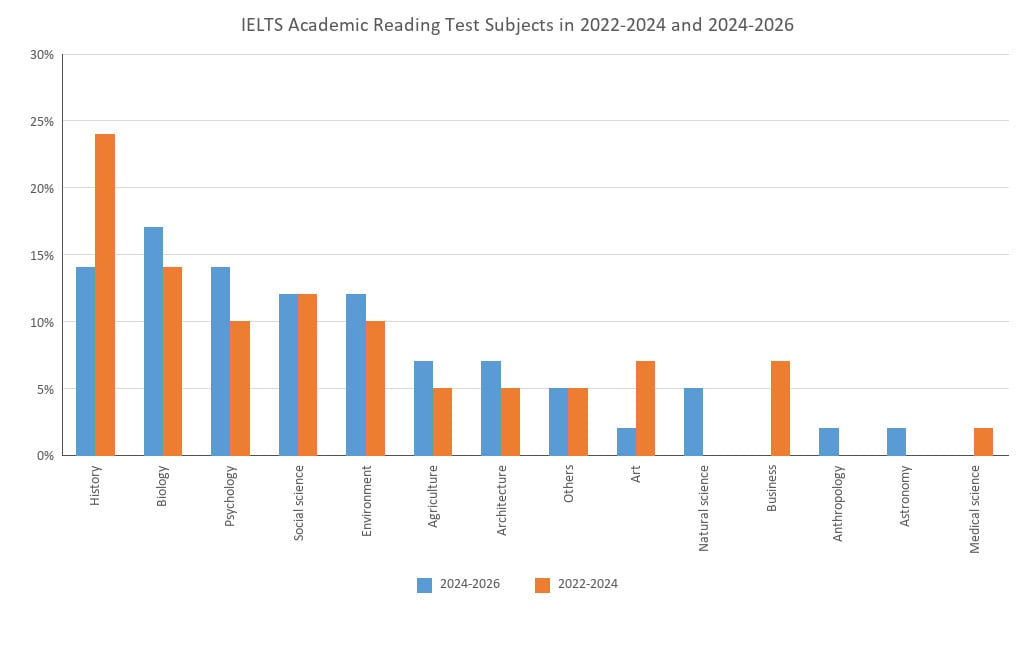
En raison de ces tendances, nous nous sommes assurés que nos tests d'entraînement IELTS reading couvrent ces sujets. Nous avons également ajouté des exemples de reading sur des sujets moins utilisés, au cas où. Il est important que vous vous prépariez à toutes les situations, car vous ne savez jamais quel sujet IELTS reading vous tomberez.
Comment votre score IELTS Reading est calculé
Chaque question IELTS reading vaut 1 point, vous pouvez donc obtenir un score « brut » allant jusqu'à 40 points. Ensuite, votre score brut sera converti en votre score de bande. Les tableaux ci-dessous peuvent vous donner une idée générale de la façon dont les scores bruts IELTS reading sont convertis en scores de bande pour chaque test.
Score IELTS General Reading VS Score IELTS Academic Reading
| Scores bruts : Academic | Scores de bande : Academic | Scores bruts : General | Scores de bande : General |
|---|---|---|---|
| 39-40 | 9 | 40 | 9 |
| 37-38 | 8.5 | 39 | 8.5 |
| 35-36 | 8 | 37-38 | 8 |
| 33-34 | 7.5 | 36 | 7.5 |
| 30-32 | 7 | 34-35 | 7 |
| 27-29 | 6.5 | 32-33 | 6.5 |
| 23-26 | 6 | 30-31 | 6 |
| 19-22 | 5.5 | 27-29 | 5.5 |
| 15-18 | 5 | 23-26 | 5 |
| 13-14 | 4.5 | 19-22 | 4.5 |
| 10-12 | 4 | 15-18 | 4 |
| 8-9 | 3.5 | 12-14 | 3.5 |
| 6-7 | 3 | 9-11 | 3 |
| 4-5 | 2.5 | 6-8 | 2.5 |
| 1-3 | 2 | 1-5 | 2 |
Cependant, gardez à l'esprit que chaque version du test IELTS reading est légèrement différente et le score requis pour atteindre une certaine bande varie selon les performances de tous ceux qui ont passé ce test ce jour-là. Par conséquent, le nombre de bonnes réponses nécessaires pour obtenir un score de bande variera légèrement d'un test à l'autre, mais en général, vous devriez viser environ 30 sur 40 si vous voulez obtenir un score de bande 7.
Une autre chose dont nous voulons vous rappeler est que les questions les plus difficiles et les questions les plus faciles comptent également pour votre score de reading final ; assurez-vous donc de ne pas perdre des points faciles en restant bloqué sur des questions plus difficiles. Ensuite, nous aborderons quelques conseils et stratégies IELTS reading sur la façon de répondre à chaque question du test de reading.
Conseils IELTS Reading - Comment répondre aux 11 types de questions de reading
Il existe 11 types de questions différents dans le test de reading et tous nécessitent une stratégie différente.
Chaque type a un exemple et sa réponse dans le guide des types de questions IELTS Reading.
- Type de question 1 – Matching Information
- Type de question 2 – Matching Headings
- Type de question 3 – Matching Features
- Type de question 4 – Identifying Information
- Type de question 5 – Identifying Writer's Views/claims
- Type de question 6 – Multiple Choice
- Type de question 7 – Matching Sentence Endings
- Type de question 8 – Sentence Completion
- Type de question 9 – Summary, Note, Table, Flow-chart Completion
- Type de question 10 – Diagram Label Completion
- Type de question 11 – Short Answer Questions
- Comment les tendances vous aident à vous préparer au test IELTS Reading
Comment les tendances vous aident à vous préparer au test IELTS Reading
Les types de questions de compréhension écrite que nos apprenants trouvent les plus difficiles
Les apprenants de BestMyTest ont répondu à un million de questions de compréhension écrite du module Academic et à 600 000 questions de compréhension écrite du module General Training dans nos tests d'entraînement. Le pourcentage indique la fréquence à laquelle les apprenants ont répondu correctement à chaque type de question.
| Type de question | Academic | General Training |
|---|---|---|
| Association d'informations | 34% | 72% |
| Vrai / Faux / Non indiqué | 39% | 60% |
| Choix multiple | 43% | 48% |
| Association de caractéristiques | 48% | 74% |
| Phrases à compléter | 49% | 75% |
| Association de titres | 53% | 40% |
| Oui / Non / Non indiqué | 55% | 57% |
| Résumé à compléter | 59% | 46% |
| Réponse courte | 54% | 75% |
- En compréhension écrite du module Academic, les deux types de questions les moins réussis sont l'association d'informations et les questions Vrai/Faux/Non indiqué, tous deux en dessous de 40%. Tous deux exigent de repérer une idée reformulée plutôt qu'un mot-clé identique.
- Dans le module General Training, la tendance s'inverse : l'association de titres est le type de question le moins réussi, avec 40%, tandis que les questions de repérage obtiennent une réponse correcte trois fois sur quatre, car les textes sont plus courts et plus explicites.
- Les questions portant sur les textes du module Academic obtiennent en moyenne 46% de réponses correctes, contre 59% pour celles du module General Training. La moitié des tentatives sur les textes du module Academic obtiennent un score de 40% ou moins.
- Sur 43 711 tests d'entraînement complets de compréhension écrite passés par 38 534 apprenants, la note moyenne était de 5.4. 36% ont atteint la note de 6.0 et 14% ont atteint la note de 7.0.
- Vous devez tout de même vous préparer à chaque type de question, mais si vous manquez de temps, le tableau vous indique où vos efforts seront les plus rentables.
Les chiffres proviennent des données des tests d'entraînement et des corrections de BestMyTest jusqu'en octobre 2026. Les pourcentages par type de question correspondent aux taux de bonnes réponses sur l'ensemble des tentatives ; les chiffres par critère sont des notes attribuées par un tuteur ou par l'IA, selon l'indication donnée. Dernière mise à jour le 5 octobre 2026.
Ensuite, nous passerons en revue les conseils et stratégies IELTS reading nécessaires pour obtenir un score de reading élevé.
Conseils IELTS Reading - Comment améliorer votre score de bande de reading
La plupart des étudiants échouent à la section de reading pour les trois raisons suivantes
- Vitesse de lecture lente
- Vocabulaire pauvre
- Peu ou pas de préparation
Améliorer votre vitesse de lecture
D'abord, mettons l'évidence de côté. Pour améliorer votre vitesse de lecture, vous devez réellement vous entraîner à lire et le faire de manière constante.
Maintenant, regardons une stratégie moins évidente qui vous aidera à comprendre le sens de gros morceaux de phrases. Commencez par disséquer la phrase. Faites-le en cherchant le sujet et le verbe de la phrase. Trouver le sujet et le verbe vous aidera à comprendre le sens de la phrase. Une raison pour laquelle les passages de reading académiques peuvent être difficiles à comprendre est qu'ils enchaînent des idées pour former de longues phrases composées. Cela produit de gros morceaux de phrases plus difficiles à absorber, donc utiliser le sujet et le verbe comme guide pour comprendre le morceau entier est un excellent outil que vous pouvez utiliser pendant votre examen IELTS reading.
Améliorer votre vocabulaire
Beaucoup de gens pensent que répondre aux questions de reading est aussi simple que de parcourir le paragraphe à la recherche de mots-clés et d'informations... Eh bien, malheureusement, ce n'est pas si simple. Les questions de reading sont généralement paraphrasées, ce qui signifie que les mots ont été modifiés pour utiliser des synonymes des mots du passage IELTS reading. Cela est fait pour augmenter la difficulté, sinon, le test serait trop facile. Pour cette raison, vous devez améliorer votre vocabulaire afin de connaître les nombreux synonymes différents d'un mot.
Au fur et à mesure que vous vous préparez au test de reading et que vous rencontrez un mot que vous ne connaissez pas, prenez l'habitude soit de vous arrêter et de le chercher, soit au moins de l'écrire et de le chercher plus tard. C'est un peu fastidieux, mais c'est extrêmement efficace. Votre objectif devrait être, mais sans s'y limiter, d'étudier 15 à 20 nouveaux mots académiques chaque jour.
Savoir dans quels types de questions les réponses sont/ne sont pas dans l'ordre
Il est important de savoir que pour certains types de questions, les réponses sont généralement (presque toujours) dans le même ordre que le passage IELTS reading. Pour d'autres types de questions, les réponses sont rarement dans le même ordre que le passage de reading. Nous avons rempli un tableau pour les types de questions qui suivent l'ordre et ceux qui ne le suivent pas. Veuillez garder à l'esprit.
| Les réponses sont généralement (presque toujours) dans le même ordre que le passage | Les réponses sont rarement dans le même ordre que le passage. |
|---|---|
|
|
Trouver la meilleure stratégie de reading pour vous
Le plus grand défi auquel la plupart des gens sont confrontés lors de l'examen IELTS reading est de terminer toutes les questions de reading avant la fin du temps. Dans la section suivante, vous apprendrez trois stratégies et il vous appartiendra de déterminer laquelle vous convient le mieux. Vous le ferez en utilisant nos pratiques de reading gratuites.
3 stratégies IELTS Reading
Stratégie 1 : Lire tout le passage puis répondre aux questions.
Tout d'abord, ce n'est pas vraiment une stratégie. C'est quelque chose que les gens font quand ils ne se préparent pas correctement à l'examen de reading. Cependant, nous l'avons incluse comme stratégie car, techniquement parlant, si vous pouvez retenir les informations du passage à la première lecture et que vous êtes capable de répondre aux questions, alors vous n'aurez pas besoin de la stratégie 2.
Cette stratégie, si vous n'avez pas une mémoire supérieure à la moyenne, est inefficace. Vous finirez par manquer de temps avant de pouvoir répondre à toutes les questions. Beaucoup de gens font cette erreur. Cependant, il y a quelques questions qui ne demandent pas beaucoup d'effort et qui bénéficieront de cette stratégie, comme si la question est une réponse « Oui » ou « Non », alors vous pourrez parcourir rapidement et trouver la réponse rapidement, mais il n'y a pas assez de ces types de questions, donc il n'est pas conseillé d'utiliser cette stratégie à moins que vous ne puissiez la gérer.
Stratégie 2 : Lire d'abord les questions, lire pour un objectif et prendre des notes, puis répondre aux questions intelligemment
C'est notre stratégie recommandée. Elle vous aidera à obtenir un meilleur score IELTS reading. Considérez ceci comme une carte claire de la façon générale d'aborder l'examen :
L'une des erreurs les plus courantes que les candidats commettent en
abordant l'examen de reading est de lire chaque mot des passages IELTS reading. Bien que vous puissiez
vous entraîner pour l'examen en lisant pour le plaisir, « lire à l'aveugle » (lire sans aucune idée de
ce que les questions demanderont) ne vous rendra aucun service lors de l'examen. Au contraire, cela nuira à vos
chances de gérer efficacement votre temps et d'obtenir le meilleur score.
La principale raison de lire d'abord les questions est parce que le type de question peut déterminer ce que
vous lisez dans le passage ou comment vous le lisez. Par exemple, certains types de questions appelleront
la technique de « skimming », tandis que d'autres peuvent appeler la technique de « scanning ».
Il est important de s'attaquer à un ensemble de questions du même type.
Vous devrez déterminer quel type de question vous voulez aborder en premier.
Une bonne stratégie serait de commencer par le type de question le plus facile et de passer aux types de questions plus difficiles plus tard.
Les types de questions les plus faciles sont ceux où vous passez moins de temps à lire.
Par exemple, le type de question Matching Heading est l'un des plus faciles car vous
n'avez qu'à trouver le titre qui décrit le mieux l'idée principale d'un paragraphe.
Un exemple de type de question difficile serait Identifying Information. Pour ce type de question,
vous devrez lire chaque paragraphe pour savoir si chaque énoncé est TRUE, FALSE ou NOT GIVEN selon le passage.
Voici un tableau qui répertorie les niveaux de difficulté pour chaque type de question. Utilisez ce tableau comme référence lorsque vous choisissez
quel type de question vous voulez aborder en premier.
| Niveau de difficulté | Type de question |
|---|---|
| Facile | Match Headings Short answer |
| Moyen |
Matching Sentence Endings Matching Features Multiple choice Sentence Completion Diagram Label, Summary, Note, Table, Flow-Chart Completion |
| Difficile |
Match Information Identifying Information (TRUE/FALSE/NOT GIVEN) Identifying Viewer's claims (YES/NO/NOT GIVEN) |
Après avoir lu les questions du texte IELTS, vous serez en mesure de lire pour un objectif. Qu'est-ce que cela signifie ? Par exemple, si vous rencontrez une question qui inclut l'année « 1896 », vous pouvez noter quand cette année apparaît dans le texte, en l'utilisant pour répondre à la question plus tard.
Il existe deux techniques de lecture qui vous aideront à rester sur la bonne voie en lisant pour un objectif. La première, skimming, est mieux définie comme la lecture rapide afin d'obtenir le « gist » ou l'idée générale, ou un passage. Avec cette technique, vous ne vous arrêtez pas pour des mots inconnus ou ne cherchez pas de détails spécifiques. La deuxième technique, scanning, est mieux définie comme la lecture pour des informations spécifiques. Avec cette technique, vous ne lisez pas pour l'idée générale, mais plutôt, pour des informations spécifiques. Remarquez comment chacune de ces techniques a un objectif spécifique en tête. Cela vous aidera à trouver l'information plus rapidement.
Pendant que vous lisez pour un objectif, vous devriez aussi prendre des notes dans les marges du passage, en plaçant des étoiles à côté des informations clés, ou en soulignant des choses que vous pensez vous aider à répondre aux diverses questions. Cela facilitera la vérification lorsque vous serez interrogé sur certaines choses dans les questions. Choisissez le système de prise de notes qui vous convient le mieux — assurez-vous simplement de le faire !
Après avoir lu les questions, lu le passage et pris les notes appropriées, vous devriez avoir localisé la partie du texte où vous devez lire attentivement. Ensuite, lisez simplement attentivement et pensez de manière critique pour déterminer la bonne réponse.
Stratégie 3 : Skimming, prise de notes et types de questions.
Il s'agit d'une autre stratégie utilisée par de nombreux candidats IELTS. Elle vous aidera à obtenir un meilleur score de reading. La stratégie se compose de 4 étapes :
- Parcourir rapidement (skim) chaque paragraphe pour obtenir l'idée générale de chaque paragraphe. L'idée principale d'un paragraphe se trouve généralement dans les premières phrases, alors concentrez-vous un peu plus sur ces phrases. Les phrases suivantes peuvent être parcourues rapidement, en soulignant les noms/mots/expressions qui ressortent.
- Après avoir parcouru chaque paragraphe, écrivez de courtes notes (2-5 mots) à côté de chaque paragraphe avec votre meilleure supposition sur l'idée principale de ce paragraphe.
- Ensuite, répondez à un ensemble de questions du même type.
- Enfin, répondez à un ensemble de questions de manière efficace et correcte.
Il est important que vous ne passiez pas plus de 3-5 minutes sur les étapes 1 et 2. Passer trop de temps sur ces étapes fera perdre trop de temps et vous finirez par en manquer.
Étapes 1 et 2L'objectif ici est de mettre en place une méthode efficace pour trouver les réponses dans le passage. En notant l'idée générale de chaque paragraphe, vous saurez quel paragraphe contient la réponse à chaque question. Cela vous fera gagner beaucoup de temps car si vous ne l'aviez pas noté, vous auriez probablement besoin de parcourir chaque paragraphe pour l'idée générale de la question, puis vous devriez scanner soigneusement le paragraphe pour la réponse. En notant l'idée principale de chaque paragraphe, vous évitez la première étape de parcourir chaque paragraphe et commencez à scanner pour la réponse.
Étape 3
Après avoir parcouru le texte en profondeur et écrit quelques notes, vous êtes prêt pour l'étape 3.
Dans cette étape, vous devrez déterminer quel type de question vous voulez aborder en premier.
Une bonne stratégie serait de commencer par le type de question le plus facile et de passer aux types de questions plus difficiles plus tard.
Les types de questions les plus faciles sont ceux où vous passez moins de temps à lire.
Par exemple, le type de question Matching Heading est l'un des plus faciles car vous
n'avez qu'à trouver le titre qui décrit le mieux l'idée principale d'un paragraphe, donc techniquement, vous n'avez besoin que des étapes 1 et 2 pour répondre à ce type de question.
Un exemple de type de question difficile serait Identifying Information. Pour ce type de question,
vous devrez lire chaque paragraphe pour savoir si chaque énoncé est TRUE, FALSE ou NOT GIVEN selon le passage.
Voici un tableau qui répertorie les niveaux de difficulté pour chaque type de question. Utilisez ce tableau comme référence lorsque vous choisissez quel type de question vous voulez aborder en premier.
| Niveau de difficulté | Type de question |
|---|---|
| Facile | Match Headings Short answer |
| Moyen |
Matching Sentence Endings Matching Features Multiple choice Sentence Completion Diagram Label, Summary, Note, Table, Flow-Chart Completion |
| Difficile |
Match Information Identifying Information (TRUE/FALSE/NOT GIVEN) Identifying Viewer's claims (YES/NO/NOT GIVEN) |
Maintenant que vous avez déterminé quel ensemble de questions vous allez répondre en premier, il est temps de réellement y répondre :( Ne vous inquiétez pas ! Bien que chaque type de question soit différent, la stratégie pour y répondre correctement s'applique à toutes. Le principe de base est simple, il suffit de suivre les étapes ci-dessous :
- Lisez attentivement la question et identifiez les mots-clés importants.
- Trouvez le paragraphe qui contient les informations nécessaires pour répondre à la question. (Espérons que vous avez déjà les idées générales notées pour chaque paragraphe, vous pouvez donc facilement comprendre cela.)
- Scannez le paragraphe à la recherche des mots-clés importants (ce sont très probablement des synonymes !) jusqu'à ce que vous localisiez la partie du texte où vous devez lire attentivement.
- Enfin, lisez attentivement et pensez de manière critique pour déterminer la bonne réponse.
Téléchargements gratuits d'exemples PDF IELTS Reading avec réponses
Voici quelques exemples de reading gratuits du British Council (les concepteurs de l'examen IELTS). Essayez de répondre aux questions et voyez comment vous vous en sortez !