Guide du Test de Compréhension Écrite IELTS : Test d'Entraînement IELTS Reading Gratuit pour IELTS General Reading et IELTS Academic Reading
Dans ce guide, vous pouvez commencer votre entraînement à la compréhension écrite IELTS en passant un test IELTS Reading gratuit. Il existe toutefois deux versions du test : IELTS general reading et IELTS academic reading. Vous apprendrez quelle version vous convient et comment aborder chaque type de question de lecture grâce à notre matériel de lecture IELTS.
Obtenez une analyse gratuite du score IELTS Reading et un plan d'étude personnalisé après avoir terminé un test d'entraînement IELTS Reading gratuit.
| Test IELTS General Reading | Test IELTS Academic Reading |
|---|---|
Vous trouverez ci-dessous notre liste complète des questions IELTS Reading avec réponses. Remarque : Les liens rouges sont nos questions Reading les plus populaires et recommandées selon nos étudiants, et vous pouvez les pratiquer gratuitement à tout moment.
Guide du test d'entraînement IELTS Reading
La suite de ce guide vous apprendra tout sur le test IELTS Reading, à la fois pour le test general training et le test academic reading. Vous découvrirez comment le score de reading est calculé, comment répondre avec succès à chaque type de question de reading, comment améliorer votre lecture avec du matériel de texte IELTS, et maîtriser nos 3 stratégies pour réussir votre entraînement à l'IELTS reading.
Table des matières
- Informations sur le test IELTS Reading
- Informations sur le test IELTS General Reading
- Informations sur le test IELTS Academic Reading
- Calculateur de score IELTS Reading
- Comment répondre aux 11 types de questions IELTS Reading
- Comment améliorer votre score de bande IELTS Reading
- 3 stratégies IELTS Reading
- Téléchargement gratuit d'un PDF d'entraînement IELTS Reading avec réponses
Informations sur le test IELTS Reading
Le test IELTS Reading se compose de 3 sections et d'un total de 40 questions. En général, vous répondrez à 12-14 questions pour chaque section et disposez d'exactement 60 minutes pour terminer votre examen de reading. Chaque section contient 1-3 passages selon le test que vous passez. Si vous connaissez le test que vous passez, vous pouvez sauter les deux prochaines sections. Sinon, il est important d'apprendre sur chaque test et comment s'y préparer.
Quel test IELTS Reading me convient ?
Le test IELTS reading a deux versions : IELTS General Reading et IELTS Academic Reading. Vous passerez le General Reading si vous cherchez à émigrer ou à vous inscrire au lycée. Vous passerez l'Academic Reading si vous cherchez à poursuivre des études supérieures. La plus grande différence entre le general reading et l'academic reading est la difficulté dans les passages IELTS reading. Comme son nom l'indique, le test academic utilise du matériel IELTS reading provenant de sources académiques, tandis que le test general utilise du matériel issu de la vie quotidienne.
Les deux tests contiennent 3 sections, 40 questions et 11 types de questions. Vous pouvez lire chaque section en détail pour les deux tests dans le tableau ci-dessous.
| Section | Test IELTS Academic Reading | Test IELTS General Reading |
|---|---|---|
| 1 | Un long texte académique allant du descriptif et factuel au discursif et analytique. Le texte sera
tiré de livres, de revues, de magazines et de journaux. 12-14 questions |
Deux ou trois textes factuels courts.
Les sujets sont pertinents pour la vie quotidienne dans un pays anglophone.
12-14 questions |
| 2 | Un long texte académique allant du descriptif et factuel au discursif et analytique. Le texte sera
tiré de livres, de revues, de magazines et de journaux. 10-14 questions |
Deux courts textes factuels axés sur des questions liées au travail (ex. : candidature à un emploi, politiques de l'entreprise, salaire et conditions).
12-14 questions |
| 3 | Un long texte académique allant du descriptif et factuel au discursif et analytique. Le texte sera
tiré de livres, de revues, de magazines et de journaux. 12-14 questions |
Un texte plus long et plus complexe sur un sujet d'intérêt général.
Les textes sont authentiques et sont tirés d'annonces, de publicités, de manuels d'entreprise, de livres, de magazines et de journaux.
12-14 questions |
Maintenant que vous êtes familiarisé avec la structure du test IELTS reading et à la fois l'IELTS general reading et l'IELTS academic reading, il est temps d'apprendre s'il vaut mieux passer le test sur papier ou le test sur ordinateur.
Test IELTS sur papier (PBT) VS Test IELTS sur ordinateur (CBT)
Dans le PBT, on vous remettra un livret de questions et une feuille de réponses. Le livret de questions est l'endroit où vous verrez toutes les questions auxquelles vous devez répondre. La feuille de réponses est l'endroit où vous écrirez vos réponses finales pour la notation. Vous pouvez consulter le PDF officiel de la feuille de réponses IELTS ici
Remarque : Contrairement au test IELTS listening, vous ne disposerez pas de temps supplémentaire pour transférer vos réponses du livret vers la feuille de réponses ; veillez donc à ajouter chaque réponse au test IELTS reading sur la feuille de réponses au fur et à mesure que vous y répondez.
Dans le CBT, vous répondrez aux questions sur ordinateur. Vos passages seront à gauche et vos questions à droite. Vous pourrez également surligner du texte et utiliser des fonctions de contrôle pour copier et coller des réponses. Pour plus d'informations sur le PBT et le CBT, consultez The IELTS Computer Based Test Guide.
Vous pouvez vous entraîner à l'une ou l'autre version à tout moment avec notre test d'entraînement IELTS reading gratuit. Vous trouverez des liens vers tout notre matériel IELTS reading en haut de la page.
Test General IELTS Reading
Dans le test general, les passages IELTS reading sont tirés de livres, magazines, journaux, annonces, publicités, manuels d'entreprise et lignes directrices issus de matériel que vous rencontreriez au quotidien dans un environnement anglophone. Tout comme dans le test academic reading, il y a 3 sections, cependant dans un test IELTS general reading, chaque section est un peu différente de l'autre.
Vidéo d'introduction à l'IELTS General Reading
-
Section 1 : Contient deux ou trois textes courts ou plusieurs textes plus courts
Cette section s'appelle Social Survival et contient des textes pertinents pour la survie linguistique de base en anglais avec des tâches portant principalement sur la récupération et la communication d'informations factuelles générales, par exemple, des annonces, des publicités et des horaires. -
Section 2 : Comprend deux textes
Cette section s'appelle Workplace Survival et se concentre sur le contexte professionnel, par exemple, les descriptions de poste, les contrats et le matériel de formation et de développement du personnel. -
Section 3 : Est un long texte
Cette section s'appelle General Reading et implique la lecture d'une prose plus étendue avec une structure plus complexe. L'accent est mis sur des textes descriptifs et instructifs plutôt qu'argumentatifs.
J'espère que vous ne vous sentez pas trop submergé. Le test de reading n'est pas aussi difficile qu'il ne le paraît. Tant que vous suivez nos conseils IELTS reading et utilisez nos questions d'entraînement IELTS reading gratuites, vous serez prêt à gérer n'importe quel passage de reading et à atteindre votre score IELTS reading cible. Au fait, le test academic reading est noté un peu différemment du test general reading. Ensuite, nous passerons en revue le score de bande de reading et comment ils sont calculés.
Test IELTS Academic Reading
Dans le test academic, les passages IELTS reading sont tirés de livres, de revues, de magazines et de journaux issus de sources académiques qui seraient appropriées pour des étudiants universitaires. Chaque passage est long, peut-être 6 à 10 paragraphes, peut être rédigé dans divers styles comme narratif ou descriptif, et couvre un large éventail de sujets académiques tels que l'anthropologie, l'histoire, les sciences, la biologie, l'art, l'éducation, la linguistique, etc. Les passages incluront parfois des termes techniques ou même du matériel visuel tel que des graphiques et des diagrammes. Vous pouvez vous entraîner sur ces sujets et bien d'autres avec nos questions d'entraînement IELTS reading.
Vidéo d'introduction à l'IELTS Academic Reading
Alors, quels sujets académiques apparaissent le plus dans le test officiel IELTS Academic Reading ?
Eh bien, en 2018 et 2019, les sujets de reading académique les plus courants étaient l'histoire et les sciences sociales, ce qui inclut la culture, l'éducation, la linguistique et la sociologie. Fait intéressant, les sujets d'histoire portaient principalement sur les animaux/plantes de Nouvelle-Zélande, d'Australie, du Royaume-Uni et du Canada. Les sujets IELTS reading suivants les plus populaires étaient la psychologie, les sciences naturelles, l'art, l'anthropologie, le commerce et la biologie.
Le graphique ci-dessous montre les différents sujets testés dans les tests IELTS academic reading en 2018 et 2019.
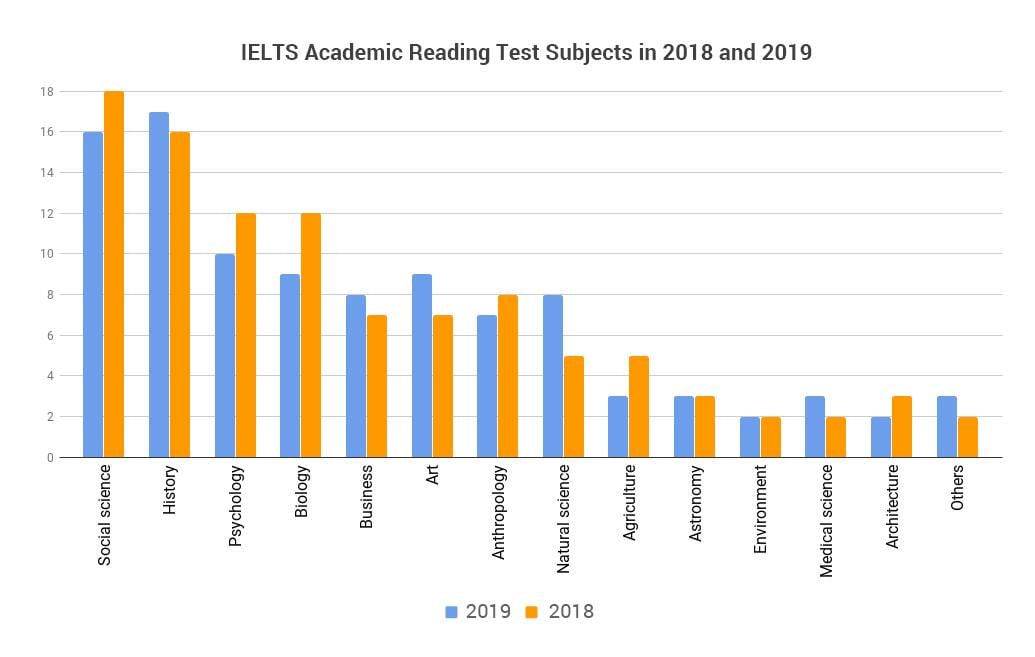
En raison de ces tendances, nous nous sommes assurés que nos tests d'entraînement IELTS reading couvrent ces sujets. Nous avons également ajouté des exemples de reading sur des sujets moins utilisés, au cas où. Il est important que vous vous prépariez à toutes les situations, car vous ne savez jamais quel sujet IELTS reading vous tomberez.
Comment votre score IELTS Reading est calculé
Chaque question IELTS reading vaut 1 point, vous pouvez donc obtenir un score « brut » allant jusqu'à 40 points. Ensuite, votre score brut sera converti en votre score de bande. Les tableaux ci-dessous peuvent vous donner une idée générale de la façon dont les scores bruts IELTS reading sont convertis en scores de bande pour chaque test.
Score IELTS General Reading VS Score IELTS Academic Reading
| Scores bruts : Academic | Scores de bande : Academic | Scores bruts : General | Scores de bande : General |
|---|---|---|---|
| 39-40 | 9 | 40 | 9 |
| 37-38 | 8.5 | 39 | 8.5 |
| 35-36 | 8 | 37-38 | 8 |
| 33-34 | 7.5 | 36 | 7.5 |
| 30-32 | 7 | 34-35 | 7 |
| 27-29 | 6.5 | 32-33 | 6.5 |
| 23-26 | 6 | 30-31 | 6 |
| 19-22 | 5.5 | 27-29 | 5.5 |
| 15-18 | 5 | 23-26 | 5 |
| 13-14 | 4.5 | 19-22 | 4.5 |
| 10-12 | 4 | 15-18 | 4 |
| 8-9 | 3.5 | 12-14 | 3.5 |
| 6-7 | 3 | 9-11 | 3 |
| 4-5 | 2.5 | 6-8 | 2.5 |
| 1-3 | 2 | 1-5 | 2 |
Cependant, gardez à l'esprit que chaque version du test IELTS reading est légèrement différente et le score requis pour atteindre une certaine bande varie selon les performances de tous ceux qui ont passé ce test ce jour-là. Par conséquent, le nombre de bonnes réponses nécessaires pour obtenir un score de bande variera légèrement d'un test à l'autre, mais en général, vous devriez viser environ 30 sur 40 si vous voulez obtenir un score de bande 7.
Une autre chose dont nous voulons vous rappeler est que les questions les plus difficiles et les questions les plus faciles comptent également pour votre score de reading final ; assurez-vous donc de ne pas perdre des points faciles en restant bloqué sur des questions plus difficiles. Ensuite, nous aborderons quelques conseils et stratégies IELTS reading sur la façon de répondre à chaque question du test de reading.
Conseils IELTS Reading - Comment répondre aux 11 types de questions de reading
Il existe 11 types de questions différents dans le test de reading et tous nécessitent une stratégie différente. Par conséquent, il est important que vous vous entraîniez à chaque type de question pour apprendre la meilleure façon de l'aborder afin d'obtenir un score IELTS reading élevé. Dans les sections suivantes, vous regarderez un exemple IELTS reading avec réponse pour chaque type de question et apprendrez des conseils sur la façon d'y répondre avec succès.
- Type de question 1 – Matching Information
- Type de question 2 – Matching Headings
- Type de question 3 – Matching Features
- Type de question 4 – Identifying Information
- Type de question 5 – Identifying Writer's Views/claims
- Type de question 6 – Multiple Choice
- Type de question 7 – Matching Sentence Endings
- Type de question 8 – Sentence Completion
- Type de question 9 – Summary, Note, Table, Flow-chart Completion
- Type de question 10 – Diagram Label Completion
- Type de question 11 – Short Answer Questions
- Comment les tendances vous aident à vous préparer au test IELTS Reading
Type de question 1 – Matching Information
Dans ce type de question, on vous demande de faire correspondre des énoncés à des paragraphes du texte de reading. Les énoncés pourraient être des raisons, des descriptions, des résumés, des définitions, des faits ou des explications. Vous devez trouver l'information spécifique dans le paragraphe et la faire correspondre à l'un des énoncés. La réponse sera normalement contenue dans une phrase entière ou un énoncé, plutôt qu'un seul mot. Voici un exemple de question Matching Information sur le test IELTS Academic Reading.
Consultez notre leçon complète d'entraînement IELTS reading sur How to Answer Matching Information Questions. Vous pouvez y regarder des leçons vidéo pour les deux types de tests et des explications détaillées avec des exemples de questions
Reading Passage 7 has eight paragraphs labelled A-F.
Which paragraphs contains the following information?
Write the correct letter A-F in boxes 27-32 on your answer sheet.
NB You may use any letter more than once.
- an explanation of the factors affecting the transmission of information
- an example of how unnecessary information can be omitted
- a reference to attitude to fame
- details of a machine capable of interpreting incomplete information
- a detailed account of an incident involving information theory
- a reference to what Shannon initially intended to achieve in his research
Feuille de réponses
| 27 | |
| 28 | |
| 29 | |
| 30 | |
| 31 | |
| 32 |
-
spellcheck Réponses27 D
28 F
29 B
30 E
31 A
32 C
Information theory lies at the heart of everything - from DVD players and the genetic code of DNA to the physics of the universe at its most fundamental. It has been central to the development of the science of communication, which enables data to be sent electronically and has therefore had a major impact on our lives
A In April 2002 an event took place which demonstrated one of the many applications of information theory. The space probe, Voyager I, launched in 1977, had sent back spectacular images of Jupiter and Saturn and then soared out of the Solar System on a one-way mission to the stars. After 25 years of exposure to the freezing temperatures of deep space, the probe was beginning to show its age. Sensors and circuits were on the brink of failing and NASA experts realised that they had to do something or lose contact with their probe forever. The solution was to get a message to Voyager I to instruct it to use spares to change the failing parts. With the probe 12 billion kilometres from Earth, this was not an easy task. By means of a radio dish belonging to NASA's Deep Space Network, the message was sent out into the depths of space. Even travelling at the speed of light, it took over 11 hours to reach its target, far beyond the orbit of Pluto. Yet, incredibly, the little probe managed to hear the faint call from its home planet, and successfully made the switchover.
B It was the longest-distance repair job in history, and a triumph for the NASA engineers. But it also highlighted the astonishing power of the techniques developed by American communications engineer Claude Shannon, who had died just a year earlier. Born in 1916 in Petoskey, Michigan, Shannon showed an early talent for maths and for building gadgets, and made breakthroughs in the foundations of computer technology when still a student. While at Bell Laboratories, Shannon developed information theory, but shunned the resulting acclaim In the 1940s, he single-handedly created an entire science of communication which has since inveigled its way into a host of applications, from DVDs to satellite communications to bar codes - any area, in short, where data has to be conveyed rapidly yet accurately.
C This all seems light years away from the down-to-earth uses Shannon originally had for his work, which began when he was a 22-year-old graduate engineering student at the prestigious Massachusetts Institute of Technology in 1939. He set out with an apparently simple aim: to pin down the precise meaning of the concept of 'information'. The most basic form of information, Shannon argued, is whether something is true or false - which can be captured in the binary unit, or 'bit', of the form 1 or 0. Having identified this fundamental unit, Shannon set about defining otherwise vague ideas about information and how to transmit it from place to place. In the process he discovered something surprising: it is always possible to guarantee information will get through random interference - 'noise' - intact.
D Noise usually means unwanted sounds which interfere with genuine information. Information theory generalises this idea via theorems that capture the effects of noise with mathematical precision. In particular, Shannon showed that noise sets a limit on the rate at which information can pass along communication channels while remaining error-free. This rate depends on the relative strengths of the signal and noise travelling down the communication channel, and on its capacity (its 'bandwidth'). The resulting limit, given in units of bits per second, is the absolute maximum rate of error-free communication given signal strength and noise level. The trick, Shannon showed, is to find ways of packaging up - 'coding' - information to cope with the ravages of noise, while staying within the information-carrying capacity - 'bandwidth' - of the communication system being used.
E Over the years scientists have devised many such coding methods, and they have proved crucial in many technological feats. The Voyager spacecraft transmitted data using codes which added one extra bit for every single bit of information; the result was an error rate of just one bit in 10,000 - and stunningly clear pictures of the planets. Other codes have become part of everyday life - such as the Universal Product Code, or bar code, which uses a simple error-detecting system that ensures supermarket check-out lasers can read the price even on, say, a crumpled bag of crisps. As recently as 1993, engineers made a major breakthrough by discovering so-called turbo codes - which come very close to Shannon's ultimate limit for the maximum rate that data can be transmitted reliably, and now play a key role in the mobile videophone revolution.
F Shannon also laid the foundations of more efficient ways of storing information, by stripping out superfluous ('redundant') bits from data which contributed little real information. As mobile phone text messages like 'I CN C U' show, it is often possible to leave out a lot of data without losing much meaning. As with error correction, however, there's a limit beyond which messages become too ambiguous. Shannon showed how to calculate this limit, opening the way to the design of compression methods that cram maximum information into the minimum space.
Type de question 2 – Matching Headings
Ce type de question teste votre capacité à comprendre l'idée principale de chaque paragraphe. On vous donnera entre 5 et 7 titres et vous devez faire correspondre chaque paragraphe du texte de reading à un titre. Un titre est une courte phrase qui résume les informations d'un paragraphe. Il y a toujours plus de titres que de paragraphes.
Consultez notre leçon complète d'entraînement IELTS reading sur How to Answer Matching Headings Questions. Vous pouvez y regarder des leçons vidéo pour les deux types de tests et des explications détaillées avec des exemples de questions
Reading Passage 6 has six sections, A-E.
Choose the correct heading for sections A-D and E from the list of headings below.
Write the correct number i-vii in boxes 2-5 on your answer sheet.
List of Headings
- Commercial pressures on people in charge
- Mixed views on current changes to museums
- Interpreting the facts to meet visitor expectations
- The international dimension
- Collections of factual evidence
- Fewer differences between public attractions
- Current reviews and suggestions
| Example | Answer |
| 1. Section A | v |
- Section B
- Section C
- Section D
- Section E
| 2 | |
| 3 | |
| 4 | |
| 5 |
-
spellcheck Réponses2. ii
3. vi
4. i
5. iii
Section A The conviction that historical relics provide infallible testimony about the past is rooted in the nineteenth and early twentieth centuries, when science was regarded as objective and value free. As one writer observes: 'Although it is now evident that artefacts are as easily altered as chronicles, public faith in their veracity endures: a tangible relic seems ipso facto real/ Such conviction was, until recently, reflected in museum displays. Museums used to look - and some still do - much like storage rooms of objects packed together in showcases: good for scholars who wanted to study the subtle differences in design, but not for the ordinary visitor, to whom it all looked alike. Similarly, the information accompanying the objects often made little sense to the lay visitor. The content and format of explanations dated back to a time when the museum was the exclusive domain of the scientific researcher.
Section B Recently, however, attitudes towards history and the way it should be presented have altered. The key word in heritage display is now 'experience', the more exciting the better and, if possible, involving all the senses. Good examples of this approach in the UK are the Jorvik Centre in York; the National Museum of Photography, Film and Television in Bradford; and the Imperial War Museum in London. In the US the trend emerged much earlier: Williamsburg has been a prototype for many heritage developments in other parts of the world. No one can predict where the process will end. On so-called heritage sites the re-enactment of historical events is increasingly popular, and computers will soon provide virtual reality experiences, which will present visitors with a vivid image of the period of their choice, in which they themselves can act as if part of the historical environment. Such developments have been criticised as an intolerable vulgarisation, but the success of many historical theme parks and similar locations suggests that the majority of the public does not share this opinion.
Section C In a related development, the sharp distinction between museum and heritage sites on the one hand, and theme parks on the other, is gradually evaporating. They already borrow ideas and concepts from one another. For example, museums have adopted story lines for exhibitions, sites have accepted 'theming' as a relevant tool, and theme parks are moving towards more authenticity and research-based presentations. In zoos, animals are no longer kept in cages, but in great spaces, either in the open air or in enormous greenhouses, such as the jungle and desert environments in Burgers' Zoo in Holland. This particular trend is regarded as one of the major developments in the presentation of natural history in the twentieth century.
Section D Theme parks are undergoing other changes,too, as they try to present more serious social and cultural issues, and move away from fantasy. This development is a response to market forces and, although museums and heritage sites have a special, rather distinct role to fulfil, they are also operating in a very competitive environment, where visitors make choices on how and where to spend their free time. Heritage and museum experts do not have to invent stories and recreate historical environments to attract their visitors: their assets are already in place. However, exhibits must be both based on artifacts and facts as we know them, and attractively presented. Those who are professionally engaged in the art of interpreting history are thus in a difficult position, as they must steer a narrow course between the demands of 'evidence' and 'attractiveness' especially given the increasing need in the heritage industry for income-generating activities.
Section E It could be claimed that in order to make everything in heritage more 'real', historical accuracy must be increasingly altered. For example, Pithecanthropus erectus is depicted in an Indonesian museum with Malay facial features, because this corresponds to public perceptions. Similarly, in the Museum of Natural History in Washington, Neanderthal man is shown making a dominant gesture to his wife. Such presentations tell us more about contemporary perceptions of the world than about our ancestors. There is one compensation, however, for the professionals who make these interpretations: if they did not provide the interpretation, visitors would do it for themselves, based on their own ideas, misconceptions and prejudices. And no matter how exciting the result it would contain a lot more bias than the presentations provided by experts.
Section F Human bias is inevitable, but another source of bias in the representation of history has to do with the transitory nature of the materials themselves. The simple fact is that not everything from history survives the historical process. Castles, palaces and cathedrals have a longer lifespan than the dwellings of ordinary people. The same applies to the furnishings and other contents of the premises. In a town like Leyden in Holland, which in the seventeenth century was occupied by approximately the same number of inhabitants as today, people lived within the walled town, an area more than five times smaller than modern Leyden. In most of the houses several families lived together in circumstances beyond our imagination. Yet in museums, fine period rooms give only an image of the lifestyle of the upper class of that era. No wonder that people who stroll around exhibitions are filled with nostalgia; the evidence in museums indicates that life was so much better in the past. This notion is induced by the bias in its representation in museums and heritage centres.
Type de question 3 – Matching Features
Dans ce type de test, vous devez faire correspondre une liste d'options à un ensemble d'énoncés.
Les options sont un groupe de caractéristiques du texte IELTS, identifiées par des lettres.
Par exemple, vous pourriez faire correspondre différentes conclusions de recherche à une liste de chercheurs,
ou des caractéristiques à des tranches d'âge, des événements à des périodes historiques, etc.
Notez qu'il est possible que certaines options ne soient pas utilisées, et que d'autres puissent être utilisées plus d'une fois.
Les instructions vous informeront si les options peuvent être utilisées plus d'une fois.
Consultez notre leçon complète d'entraînement IELTS reading sur How to Answer Matching Features Questions. Vous pouvez y regarder des leçons vidéo pour les deux types de tests et des explications détaillées avec des exemples de questions
Look at the following items (Questions 7-10) and the list of groups below.
Match each item with the group which first invented or used them.
Write the correct letter A-E in boxes 7-10 on your answer sheet.
NB You may use any letter more than once.
- black powder
- rocket-propelled arrows for fighting
- rockets as war weapons
- the rocket
A the Chinese
B the Indians
C the British
D the Arabs
E the Americans
Feuille de réponses
| 7 | |
| 8 | |
| 9 | |
| 10 |
-
spellcheck Réponses7 A
8 A
9 B
10 E
The invention of rockets is linked inextricably with the invention of 'black powder'. Most historians of technology credit the Chinese with its discovery. They base their belief on studies of Chinese writings or on the notebooks of early Europeans who settled in or made long visits to China to study its history and civilisation. It is probable that, some time in the tenth century, black powder was first compounded from its basic ingredients of saltpetre, charcoal and sulphur. But this does not mean that it was immediately used to propel rockets. By the thirteenth century, powder- propelled fire arrows had become rather common. The Chinese relied on this type of technological development to produce incendiary projectiles of many sorts, explosive grenades and possibly cannons to repel their enemies. One such weapon was the 'basket of fire' or, as directly translated from Chinese, the 'arrows like flying leopards'. The 0.7 metre-long arrows, each with a long tube of gunpowder attached near the point of each arrow, could be fired from a long, octagonal-shaped basket at the same time and had a range of 400 paces. Another weapon was the 'arrow as a flying sabre', which could be fired from crossbows. The rocket, placed in a similar position to other rocket-propelled arrows, was designed to increase the range. A small iron weight was attached to the 1.5m bamboo shaft, just below the feathers, to increase the arrow's stability by moving the centre of gravity to a position below the rocket. At a similar time, the Arabs had developed the 'egg which moves and burns'. This 'egg' was apparently full of gunpowder and stabilised by a 1.5m tail. It was fired using two rockets attached to either side of this tail.
It was not until the eighteenth century that Europe became seriously interested in the possibilities of using the rocket itself as a weapon of war and not just to propel other weapons. Prior to this, rockets were used only in pyrotechnic displays. The incentive for the more aggressive use of rockets came not from within the European continent but from far-away India, whose leaders had built up a corps of rocketeers and used rockets successfully against the British in the late eighteenth century. The Indian rockets used against the British were described by a British Captain serving in India as 'an iron envelope about 200 millimetres long and 40 millimetres in diameter with sharp points at the top and a 3m-long bamboo guiding stick'. In the early nineteenth century the British began to experiment with incendiary barrage rockets. The British rocket differed from the Indian version in that it was completely encased in a stout, iron cylinder, terminating in a conical head, measuring one metre in diameter and having a stick almost five metres long and constructed in such a way that it could be firmly attached to the body of the rocket. The Americans developed a rocket, complete with its own launcher, to use against the Mexicans in the mid-nineteenth century. A long cylindrical tube was propped up by two sticks and fastened to the top of the launcher, thereby allowing the rockets to be inserted and lit from the other end. However, the results were sometimes not that impressive as the behaviour of the rockets in flight was less than predictable.
Type de question 4 – Identifying Information (TRUE/FALSE/NOT GIVEN)
Dans ce type de question, on vous donnera des énoncés relatifs au passage de reading et votre travail consistera à répondre si l'énoncé est vrai, faux ou non donné. Ce type de question est l'un des plus difficiles du test IELTS reading car vous devez avoir une logique solide pour répondre correctement. Il est impératif que les candidats comprennent la différence entre les réponses « FALSE » et « NOT GIVEN ».
Si une réponse est « FALSE », cela signifie qu'il y a des informations dans le passage qui prouvent que l'énoncé en question est incorrect.
Si la réponse est « NOT GIVEN », cela signifie que le passage ne contient pas les informations présentées dans l'énoncé, et le passage ne confirme ni ne contredit ces informations.
Consultez notre leçon complète d'entraînement IELTS reading sur How to Answer Identifying Information (TRU/FALSE/NOT GIVEN) Questions. Vous pouvez y regarder des leçons vidéo pour les deux types de tests et des explications détaillées avec des exemples de questions
Do the following statements agree with the information given in Reading Passage 1? In boxes 1–7 on your answer sheet, write
TRUE if the statement agrees with the information
FALSE if the statement contradicts the information
NOT GIVEN if there is no information on this
- Chronobiology is the study of how living things have evolved over time.
- The rise and fall of sea levels affects how sea creatures behave.
- Most animals are active during the daytime.
- Circadian rhythms identify how we do different things on different days.
- A 'night person' can still have a healthy circadian rhythm.
- New therapies can permanently change circadian rhythms without causing harm.
- Naturally-produced vegetables have more nutritional value
| 1 | |
| 2 | |
| 3 | |
| 4 | |
| 5 | |
| 6 | |
| 7 |
-
spellcheck Réponses1. FALSE
2. TRUE
3. NOT GIVEN
4. FALSE
5. TRUE
6. FALSE
7. TRUE
Chronobiology might sound a little futuristic – like something from a science fiction novel, perhaps – but it's actually a field of study that concerns one of the oldest processes life on this planet has ever known: short-term rhythms of time and their effect on flora and fauna.
This can take many forms. Marine life, for example, is influenced by tidal patterns. Animals tend to be active or inactive depending on the position of the sun or moon. Numerous creatures, humans included, are largely diurnal – that is, they like to come out during the hours of sunlight. Nocturnal animals, such as bats and possums, prefer to forage by night. A third group are known as crepuscular: they thrive in the lowlight of dawn and dusk and remain inactive at other hours.
When it comes to humans, chronobiologists are interested in what is known as the circadian rhythm. This is the complete cycle our bodies are naturally geared to undergo within the passage of a twenty-four hour day. Aside from sleeping at night and waking during the day, each cycle involves many other factors such as changes in blood pressure and body temperature. Not everyone has an identical circadian rhythm. 'Night people', for example, often describe how they find it very hard to operate during the morning, but become alert and focused by evening. This is a benign variation within circadian rhythms known as a chronotype.
Scientists have limited abilities to create durable modifications of chronobiological demands. Recent therapeutic developments for humans such as artificial light machines and melatonin administration can reset our circadian rhythms, for example, but our bodies can tell the difference and health suffers when we breach these natural rhythms for extended periods of time. Plants appear no more malleable in this respect; studies demonstrate that vegetables grown in season and ripened on the tree are far higher in essential nutrients than those grown in greenhouses and ripened by laser.
Knowledge of chronobiological patterns can have many pragmatic implications for our day-to-day lives. While contemporary living can sometimes appear to subjugate biology – after all, who needs circadian rhythms when we have caffeine pills, energy drinks, shift work and cities that never sleep? – keeping in synch with our body clock is important.
The average urban resident, for example, rouses at the eye-blearing time of 6.04 a.m., which researchers believe to be far too early. One study found that even rising at 7.00 a.m. has deleterious effects on health unless exercise is performed for 30 minutes afterward. The optimum moment has been whittled down to 7.22 a.m.; muscle aches, headaches and moodiness were reported to be lowest by participants in the study who awoke then.
Once you're up and ready to go, what then? If you're trying to shed some extra pounds, dietitians are adamant: never skip breakfast. This disorients your circadian rhythm and puts your body in starvation mode. The recommended course of action is to follow an intense workout with a carbohydrate-rich breakfast; the other way round and weight loss results are not as pronounced.
Morning is also great for breaking out the vitamins. Supplement absorption by the body is not temporal-dependent, but naturopath Pam Stone notes that the extra boost at breakfast helps us get energised for the day ahead. For improved absorption, Stone suggests pairing supplements with a food in which they are soluble and steering clear of caffeinated beverages. Finally, Stone warns to take care with storage; high potency is best for absorption, and warmth and humidity are known to deplete the potency of a supplement.
After-dinner espressos are becoming more of a tradition – we have the Italians to thank for that – but to prepare for a good night's sleep we are better off putting the brakes on caffeine consumption as early as 3 p.m. With a seven hour half-life, a cup of coffee containing 90 mg of caffeine taken at this hour could still leave 45 mg of caffeine in your nervous system at ten o'clock that evening. It is essential that, by the time you are ready to sleep, your body is rid of all traces.
Evenings are important for winding down before sleep; however, dietitian Geraldine Georgeou warns that an after-five carbohydrate-fast is more cultural myth than chronobiological demand. This will deprive your body of vital energy needs. Overloading your gut could lead to indigestion, though. Our digestive tracts do not shut down for the night entirely, but their work slows to a crawl as our bodies prepare for sleep. Consuming a modest snack should be entirely sufficient.
Type de question 5 – Identifying Writer's Views/claims
Dans ce type de question, on vous donnera un certain nombre d'énoncés et on vous demandera :
Les énoncés suivants concordent-ils avec les opinions/affirmations de l'auteur ?
Vous devez écrire YES, NO ou NOT GIVEN dans les cases de leur feuille de réponses.
NO signifie que les opinions ou affirmations de l'auteur sont explicitement en désaccord avec l'énoncé.
NOT GIVEN signifie que l'opinion ou l'affirmation n'est ni confirmée ni contredite.
Consultez notre leçon complète d'entraînement IELTS reading sur How to Answer Identifying Writer's Views/Claims Questions. Vous pouvez y regarder des leçons vidéo pour les deux types de tests et des explications détaillées avec des exemples de questions
Do the following statements reflect the claims of the writer in the reading passage?
In boxes 4-7 on your answer sheet write
YES if the statement reflects the claims of the writer
NO if the statement contradicts the claims of the writer
NOT GIVEN if it is impossible to say what the writer thinks about this
- Thirty per cent of deaths in the United States are caused by smoking-relateddiseases.
- If one partner in a marriage smokes, the other is likely to take up smoking
- Teenagers whose parents smoke are at risk of getting lung cancer at some time during their lives.
- Opponents of smoking financed the UCSF study.
Feuille de réponses
| 4 | |
| 5 | |
| 6 | |
| 7 |
-
spellcheck Réponses4. NO
5. NOT GIVEN
6. YES
7. NOT GIVEN
Discovered in the early 1800s and named 'nicotianine', the oily essence now called nicotine is the main active ingredient of tobacco. Nicotine, however, is only a small component of cigarette smoke, which contains more than 4,700 chemical compounds, including 43 cancer-causing substances. In recent times, scientific research has been providing evidence that years of cigarette smoking vastly increases the risk of developing fatal medical conditions.
In addition to being responsible for more than 85 per cent of lung cancers, smoking is associated with cancers of, amongst others, the mouth, stomach and kidneys, and is thought to cause about 14 per cent of leukemia and cervical cancers. In 1990, smoking caused more than 84,000 deaths, mainly resulting from such problems as pneumonia, bronchitis and influenza. Smoking, it is believed, is responsible for 30 per cent of all deaths from cancer and clearly represents the most important preventable cause of cancer in countries like the United States today.
Passive smoking, the breathing in of the side-stream smoke from the burning of tobacco between puffs or of the smoke exhaled by a smoker, also causes a serious health risk. A report published in 1992 by the US Environmental Protection Agency (EPA) emphasized the health dangers, especially from side-stream smoke. This type of smoke contains more smaller particles and is therefore more likely to be deposited deep in the lungs. On the basis of this report, the EPA has classified environmental tobacco smoke in the highest risk category for causing cancer.
As an illustration of the health risks, in the case of a married couple where one partner is a smoker and one a non-smoker, the latter is believed to have a 30 per cent higher risk of death from heart disease because of passive smoking. The risk of lung cancer also increases over the years of exposure and the figure jumps to 80 per cent if the spouse has been smoking four packs a day for 20 years. It has been calculated that 17 per cent of cases of lung cancer can be attributed to high levels of exposure to second-hand tobacco smoke during childhood and adolescence.
A more recent study by researchers at the University of California at San Francisco (UCSF) has shown that second-hand cigarette smoke does more harm to non-smokers than to smokers. Leaving aside the philosophical question of whether anyone should have to breathe someone else's cigarette smoke, the report suggests that the smoke experienced by many people in their daily lives is enough to produce substantial adverse effects on a person's heart and lungs.
The report, published in the Journal of the American Medical Association (AMA), was based on the researchers' own earlier research but also includes a review of studies over the past few years. The American Medical Association represents about half of all US doctors and is a strong opponent of smoking. The study suggests that people who smoke cigarettes are continually damaging their cardiovascular system, which adapts in order to compensate for the effects of smoking. It further states that people who do not smoke do not have the benefit of their system adapting to the smoke inhalation. Consequently, the effects of passive smoking are far greater on non-smokers than on smokers.
This report emphasizes that cancer is not caused by a single element in cigarette smoke; harmful effects to health are caused by many components. Carbon monoxide, for example, competes with oxygen in red blood cells and interferes with the blood's ability to deliver life-giving oxygen to the heart. Nicotine and other toxins in cigarette smoke activate small blood cells called platelets, which increases the likelihood of blood clots, thereby affecting blood circulation throughout the body.
The researchers criticize the practice of some scientific consultants who work with the tobacco industry for assuming that cigarette smoke has the same impact on smokers as it does on non-smokers. They argue that those scientists are underestimating the damage done by passive smoking and, in support of their recent findings, cite some previous research which points to passive smoking as the cause for between 30,000 and 60,000 deaths from heart attacks each year in the United States. This means that passive smoking is the third most preventable cause of death after active smoking and alcohol-related diseases
The study argues that the type of action needed against passive smoking should be similar to that being taken against illegal drugs and AIDS (SIDA). The UCSF researchers maintain that the simplest and most cost-effective action is to establish smoke-free work places, schools and public places.
Type de question 6 – Multiple Choice
Dans le test IELTS academic reading et le test IELTS general reading, vous devrez répondre à des questions à choix multiple. Chaque question à choix multiple variera en termes de nombre de choix de réponses que vous devez sélectionner et de type de question qui vous sera posée.
Les différents nombres de choix de réponses
- Choisir une réponse parmi quatre options (la plus courante)
- Choisir deux réponses parmi cinq options
- Choisir trois réponses parmi six options
Le type de question
- Compléter une phrase
- Répondre à une question
Consultez notre leçon complète d'entraînement IELTS reading sur How to Answer Multiple Choice Questions. Vous pouvez y regarder des leçons vidéo pour les deux types de tests et des explications détaillées avec des exemples de questions
Choose the appropriate letters A, B, C or D.
Write your answers in boxes 10-12 on your answer sheet.
- reduced the productivity of farmland by 20 per cent.
- was almost as severe as in India and China.
- was causing significant damage to 20 per cent of farmland.
- could be reduced by converting cultivated land to meadow or forest.
- used 50 per cent less fertiliser than Dutch farmers.
- used twice as much fertiliser as they had in 1960.
- applied fertiliser much more frequently than in 1960.
- more than doubled the amount of pesticide they used in just 3 years.
- farm incomes
- use of fertiliser
- over-stocking
- farm diversification
Feuille de réponses
| 10 | |
| 11 | |
| 12 |
-
spellcheck Réponses10. C
11. B
12. D
All these activities may have damaging environmental impacts. For example, land clearing for agriculture is the largest single cause of deforestation; chemical fertilisers and pesticides may contaminate water supplies; more intensive farming and the abandonment of fallow periods tend to exacerbate soil erosion; and the spread of monoculture and use of high- yielding varieties of crops have been accompanied by the disappearance of old varieties of food plants which might have provided some insurance against pests or diseases in future. Soil erosion threatens the productivity of land in both rich and poor countries. The United States, where the most careful measurements have been done, discovered in 1982 that about one-fifth of its farmland was losing topsoil at a rate likely to diminish the soil's productivity. The country subsequently embarked upon a program to convert 11 per cent of its cropped land to meadow or forest. Topsoil in India and China is vanishing much faster than in America.
Government policies have frequently compounded the environmental damage that farming can cause. In the rich countries, subsidies for growing crops and price supports for farm output drive up the price of land. The annual value of these subsidies is immense: about $250 billion, or more than all World Bank lending in the 1980s. To increase the output of crops per acre, a farmer's easiest option is to use more of the most readily available inputs: fertilisers and pesticides. Fertiliser use doubled in Denmark in the period 1960-1985 and increased in The Netherlands by 150 per cent. The quantity of pesticides applied has risen too: by 69 per cent in 1975-1984 in Denmark, for example, with a rise of 115 per cent in the frequency of application in the three years from 1981.
In the late 1980s and early 1990s some efforts were made to reduce farm subsidies. The most dramatic example was that of New Zealand, which scrapped most farm support in 1984. A study of the environmental effects, conducted in 1993, found that the end of fertiliser subsidies had been followed by a fall in fertiliser use (a fall compounded by the decline in world commodity prices, which cut farm incomes). The removal of subsidies also stopped land-clearing and over-stocking, which in the past had been the principal causes of erosion. Farms began to diversify. The one kind of subsidy whose removal appeared to have been bad for the environment was the subsidy to manage soil erosion.
In less enlightened countries, and in the European Union, the trend has been to reduce rather than eliminate subsidies, and to introduce new payments to encourage farmers to treat their land in environmentally friendlier ways, or to leave it fallow. It may sound strange but such payments need to be higher than the existing incentives for farmers to grow food crops. Farmers, however, dislike being paid to do nothing. In several countries they have become interested in the possibility of using fuel produced from crop residues either as a replacement for petrol (as ethanol) or as fuel for power stations (as biomass). Such fuels produce far less carbon dioxide than coal or oil, and absorb carbon dioxide as they grow. They are therefore less likely to contribute to the greenhouse effect. But they are rarely competitive with fossil fuels unless subsidised - and growing them does no less environmental harm than other crops.
Type de question 7 – Matching Sentence Endings
Dans ce type de test, on vous donnera une liste de phrases incomplètes sans fin et une autre liste avec les fins possibles. Votre tâche est de faire correspondre les phrases incomplètes avec la fin correcte basée sur le texte de reading.
Consultez notre leçon complète d'entraînement IELTS reading sur How to Answer Matching Sentence Endings Questions. Vous pouvez y regarder des leçons vidéo pour les deux types de tests et des explications détaillées avec des exemples de questions
Complete each sentence with the correct ending A-J from the box below.
Write the correct letter A-J in boxes 8-10 on your answer sheet.
NB You may use any letter more than once.
- Passive smoking
- Compared with a non-smoker, a smoker
- The American Medical Association
- includes reviews of studies in its reports.
- argues for stronger action against smoking in public places.
- is one of the two most preventable causes of death.
- is more likely to be at risk from passive smoking diseases.
- is more harmful to non-smokers than to smokers.
- is less likely to be at risk of contracting lung cancer.
- is more likely to be at risk of contracting various cancers.
- opposes smoking and publishes research on the subject.
- is just as harmful to smokers as it is to non-smokers.
- reduces the quantity of blood flowing around the body.
Feuille de réponses
| 8 | |
| 9 | |
| 10 |
-
spellcheck Réponses8. E
9. G
10. H
Discovered in the early 1800s and named 'nicotianine', the oily essence now called nicotine is the main active ingredient of tobacco. Nicotine, however, is only a small component of cigarette smoke, which contains more than 4,700 chemical compounds, including 43 cancer-causing substances. In recent times, scientific research has been providing evidence that years of cigarette smoking vastly increases the risk of developing fatal medical conditions.
In addition to being responsible for more than 85 per cent of lung cancers, smoking is associated with cancers of, amongst others, the mouth, stomach and kidneys, and is thought to cause about 14 per cent of leukaemia and cervical cancers. In 1990, smoking caused more than 84,000 deaths, mainly resulting from such problems as pneumonia, bronchitis and influenza. Smoking, it is believed, is responsible for 30 per cent of all deaths from cancer and clearly represents the most important preventable cause of cancer in countries like the United States today.
Passive smoking, the breathing in of the side-stream smoke from the burning of tobacco between puffs or of the smoke exhaled by a smoker, also causes a serious health risk. A report published in 1992 by the US Environmental Protection Agency (EPA) emphasized the health dangers, especially from sidestream smoke. This type of smoke contains more smaller particles and is therefore more likely to be deposited deep in the lungs. On the basis of this report, the EPA has classified environmental tobacco smoke in the highest risk category for causing cancer.
As an illustration of the health risks, in the case of a married couple where one partner is a smoker and one a non-smoker, the latter is believed to have a 30 per cent higher risk of death from heart disease because of passive smoking. The risk of lung cancer also increases over the years of exposure and the figure jumps to 80 per cent if the spouse has been smoking four packs a day for 20 years. It has been calculated that 17 per cent of cases of lung cancer can be attributed to high levels of exposure to secondhand tobacco smoke during childhood and adolescence.
A more recent study by researchers at the University of California at San Francisco (UCSF) has shown that second-hand cigarette smoke does more harm to non-smokers than to smokers. Leaving aside the philosophical question of whether anyone should have to breathe someone else's cigarette smoke, the report suggests that the smoke experienced by many people in their daily lives is enough to produce substantial adverse effects on a person's heart and lungs.
The report, published in the Journal of the American Medical Association (AMA), was based on the researchers' own earlier research but also includes a review of studies over the past few years. The American Medical Association represents about half of all US doctors and is a strong opponent of smoking. The study suggests that people who smoke cigarettes are continually damaging their cardiovascular system, which adapts in order to compensate for the effects of smoking. It further states that people who do not smoke do not have the benefit of their system adapting to the smoke inhalation. Consequently, the effects of passive smoking are far greater on non-smokers than on smokers.
This report emphasizes that cancer is not caused by a single element in cigarette smoke; harmful effects to health are caused by many components. Carbon monoxide, for example, competes with oxygen in red blood cells and interferes with the blood's ability to deliver life-giving oxygen to the heart. Nicotine and other toxins in cigarette smoke activate small blood cells called platelets, which increases the likelihood of blood clots, thereby affecting blood circulation throughout the body.
The researchers criticize the practice of some scientific consultants who work with the tobacco industry for assuming that cigarette smoke has the same impact on smokers as it does on non-smokers. They argue that those scientists are underestimating the damage done by passive smoking and, in support of their recent findings, cite some previous research which points to passive smoking as the cause for between 30,000 and 60,000 deaths from heart attacks each year in the United States. This means that passive smoking is the third most preventable cause of death after active smoking and alcohol-related diseases.
The study argues that the type of action needed against passive smoking should be similar to that being taken against illegal drugs and AIDS (SIDA). The UCSF researchers maintain that the simplest and most cost-effective action is to establish smoke-free work places, schools and public places.
Type de question 8 – Sentence Completion
Dans ce genre de question, on vous donnera un certain nombre de phrases avec des lacunes et on vous demandera de compléter les
phrases avec des mots du texte de reading.
Ces questions sont à la fois des tests de vocabulaire et des tests de reading car elles exigent que vous soyez conscient de la paraphrase
(utiliser des mots différents pour répéter une phrase de sorte qu'elle ait la même signification) et des synonymes
(mots avec des significations identiques ou très similaires)
Consultez notre leçon complète d'entraînement IELTS reading sur How to Answer Sentence/Table Completion Questions. Vous pouvez y regarder des leçons vidéo pour les deux types de tests et des explications détaillées avec des exemples de questions
Complete the sentences below.
Choose NO MORE THAN THREE WORDS from the passage for each answer.
- ______would be a more effective target for government investment than micro-turbines.
- An indirect benefit of subsidising micro-turbines is the support it provides for ______
- Most spending has a _____effect on the environment
- If people buy a micro-turbine, they have less money to spend on things like foreign holidays and ____.
Feuille de réponses
| 10 | |
| 11 | |
| 12 | |
| 13 |
-
spellcheck Réponses10 offshore wind farms.
11. developing technology
12. negatived
13. cars
A In terms of micro-renewable energy sources suitable for private use, a 15-kilowatt (kW) turbine is at the biggest end of the spectrum. With a nine metre diameter and a pole as high as a four-storey house, this is the most efficient form of wind microturbine, and the sort of thing you could install only if you had plenty of space and money. According to one estimate, a 15-kW micro-turbine (that's one with the maximum output), costing £41,000 to purchase and a further £9,000 to install, is capable of delivering 25,000 kilowatt-hours (kWh)' of electricity each year if placed on a suitably windy site.
B I don't know of any credible studies of the greenhouse gas emissions involved in producing and installing turbines, so my estimates here are going to be even more broad than usual. However, it is worth trying. If turbine manufacture is about as carbon intensive per pound sterling of product as other generators and electrical motors, which seems a reasonable assumption, the carbon intensity of manufacture will be around 640 kilograms (kg) per £1,000 of value. Installation is probably about as carbon intensive as typical construction, at around 380 kg per £1,000. That makes the carbon footprint (the total amount of greenhouse gases that installing a turbine creates) 30 tonnes.
C The carbon savings from wind-powered electricity generation depend on the carbon intensity of the electricity that you're replacing. Let's assume that your generation replaces the coal-fuelled part of the country's energy mix. In other words, if you live in the UK, let's say that rather than replacing typical grid electricity, which comes from a mix of coal, gas, oil and renewable energy sources, the effect of your turbine is to reduce the use of coal-fired power stations. That's reasonable, because coal is the least preferable source in the electricity mix. In this case the carbon saving is roughly one kilogram per kWh, so you save 25 tonnes per year and pay back the embodied carbon in just 14 months - a great start.
D The UK government has recently introduced a subsidy for renewable energy that pays individual producers 24p per energy unit on top of all the money they save on their own fuel bill, and on selling surplus electricity back to the grid at approximately 5p per unit. With all this taken into account, individuals would get back £7,250 per year on their investment. That pays back the costs in about six years. It makes good financial sense and, for people who care about the carbon savings for their own sake, it looks like a fantastic move. The carbon investment pays back in just over a year, and every year after that is a 25-tonne carbon saving. (It's important to remember that all these sums rely on a wind turbine having a favourable location)
E So, at face value, the turbine looks like a great idea environmentally, and a fairly good long-term investment economically for the person installing it. However, there is a crucial perspective missing from the analysis so far. Has the government spent its money wisely? It has invested 24p per unit into each micro-turbine. That works out at a massive £250 per tonne of carbon saved. My calculations tell me that had the government invested its money in offshore wind farms, instead of subsidising smaller domestic turbines, they would have broken even after eight years. In other words, the micro-turbine works out as a good investment for individuals, but only because the government spends, and arguably wastes, so much money subsidising it. Carbon savings are far lower too.
F Nevertheless, although the micro-wind turbine subsidy doesn't look like the very best way of spending government resources on climate change mitigation, we are talking about investing only about 0.075 percent per year of the nation's GDP to get a one percent reduction in carbon emissions, which is a worthwhile benefit. In other words, it could be much better, but it could be worse. In addition, such investment helps to promote and sustain developing technology.
G There is one extra favourable way of looking at the micro-wind turbine, even if it is not the single best way of investing money in cutting carbon. Input- output modelling has told us that it is actually quite difficult to spend money without having a negative carbon impact. So if the subsidy encourages people to spend their money on a carbon-reducing technology such as a wind turbine, rather than on carbon-producing goods like cars, and services such as overseas holidays, then the reductions in emissions will be greater than my simple sums above have suggested.
Type de question 9 – Summary, Note, Table, Flow-chart Completion
Dans ce type de question, on vous donne un résumé du texte IELTS et il vous est demandé de le compléter en utilisant des informations du texte. Le résumé ne proviendra que d'une partie du passage IELTS reading, il ne résumera donc pas tout le passage de reading. Il existe deux variantes de ce type de question. On peut vous demander soit de sélectionner des mots dans le texte, soit de choisir parmi une liste de réponses.
Les informations données peuvent être sous la forme de :
- plusieurs phrases de texte connectées (appelées résumé)
- plusieurs notes (appelées notes)
- un tableau avec certaines de ses cellules vides ou partiellement vides (appelé tableau)
- une série de cases ou d'étapes reliées par des flèches pour montrer une séquence d'événements
- avec certaines des cases ou étapes vides ou partiellement vides (appelé organigramme).
Consultez notre leçon complète d'entraînement IELTS reading sur How to Answer Summary Completion Questions. Vous pouvez y regarder des leçons vidéo pour les deux types de tests et des explications détaillées avec des exemples de questions
Complete the table below.
Choose NO MORE THAN THREE WORDS from the passage for each answer.
Write your answers in boxes 9-13 on your answer sheet.
| Species | French | Spanish | South African ball |
| Preferred climate | cool | 9 _____ | 12 _____ |
| Complementary species | Spanish | 13 _____ | |
| Start of active period | late spring | 10 _____ | |
| Number of generations per year | 1-2 | 11 _____ |
Feuille de réponses
| 9 | |
| 10 | |
| 11 | |
| 12 | |
| 13 |
-
spellcheck Réponses9 temperate
10 early spring
11 two to five / 2-5
12 sub-tropical
13 South African tunneling/tunnelling
Introducing dung1 beetles into a pasture is a simple process: approximately 1,500 beetles are released, a handful at a time, into fresh cow pats2 in the cow pasture. The beetles immediately disappear beneath the pats digging and tunnelling and, if they successfully adapt to their new environment, soon become a permanent, self-sustaining part of the local ecology. In time they multiply and within three or four years the benefits to the pasture are obvious.
Dung beetles work from the inside of the pat so they are sheltered from predators such as birds and foxes. Most species burrow into the soil and bury dung in tunnels directly underneath the pats, which are hollowed out from within. Some large species originating from France excavate tunnels to a depth of approximately 30 cm below the dung pat. These beetles make sausage-shaped brood chambers along the tunnels. The shallowest tunnels belong to a much smaller Spanish species that buries dung in chambers that hang like fruit from the branches of a pear tree. South African beetles dig narrow tunnels of approximately 20 cm below the surface of the pat. Some surface-dwelling beetles, including a South African species, cut perfectly-shaped balls from the pat, which are rolled away and attached to the bases of plants.
For maximum dung burial in spring, summer and autumn, farmers require a variety of species with overlapping periods of activity. In the cooler environments of the state of Victoria, the large French species (2.5 cms long), is matched with smaller (half this size), temperate-climate Spanish species. The former are slow to recover from the winter cold and produce only one or two generations of offspring from late spring until autumn. The latter, which multiply rapidly in early spring, produce two to five generations annually. The South African ball-rolling species, being a sub-tropical beetle, prefers the climate of northern and coastal New South Wales where it commonly works with the South African tunneling species. In warmer climates, many species are active for longer periods of the year.
Glossary
1. dung: the droppings or excreta of animals
2. cow pats: droppings of cows
Type de question 10 – Diagram Label Completion
Ce type de question vous demande de compléter des étiquettes sur un diagramme, qui se rapporte à une description contenue dans le texte IELTS. Il existe trois types de diagrammes que vous pourriez avoir : un dessin technique d'une machine ou d'une invention, quelque chose du monde naturel, ou un dessin ou un plan.
Consultez notre leçon complète d'entraînement IELTS reading sur How to Answer Diagram Label Completion Questions. Vous pouvez y regarder des leçons vidéo pour les deux types de tests et des explications détaillées avec des exemples de questions
Label the tunnels on the diagram below using words from the box.
Write your answers in boxes 6-8 on your answer sheet.

Feuille de réponses
| 6 | |
| 7 | |
| 8 |
-
spellcheck Réponses6 South African
7 French
8 Spanish
Introducing dung1 beetles into a pasture is a simple process: approximately 1,500 beetles are released, a handful at a time, into fresh cow pats2 in the cow pasture. The beetles immediately disappear beneath the pats digging and tunnelling and, if they successfully adapt to their new environment, soon become a permanent, self-sustaining part of the local ecology. In time they multiply and within three or four years the benefits to the pasture are obvious.
Dung beetles work from the inside of the pat so they are sheltered from predators such as birds and foxes. Most species burrow into the soil and bury dung in tunnels directly underneath the pats, which are hollowed out from within. Some large species originating from France excavate tunnels to a depth of approximately 30 cm below the dung pat. These beetles make sausage-shaped brood chambers along the tunnels. The shallowest tunnels belong to a much smaller Spanish species that buries dung in chambers that hang like fruit from the branches of a pear tree. South African beetles dig narrow tunnels of approximately 20 cm below the surface of the pat. Some surface-dwelling beetles, including a South African species, cut perfectly-shaped balls from the pat, which are rolled away and attached to the bases of plants.
For maximum dung burial in spring, summer and autumn, farmers require a variety of species with overlapping periods of activity. In the cooler environments of the state of Victoria, the large French species (2.5 cms long), is matched with smaller (half this size), temperate-climate Spanish species. The former are slow to recover from the winter cold and produce only one or two generations of offspring from late spring until autumn. The latter, which multiply rapidly in early spring, produce two to five generations annually. The South African ball-rolling species, being a sub-tropical beetle, prefers the climate of northern and coastal New South Wales where it commonly works with the South African tunneling species. In warmer climates, many species are active for longer periods of the year.
1. dung: the droppings or excreta of animals
2. cow pats: droppings of cows
Type de question 11 – Short Answer Questions
Dans ce type de question, vous devez écrire un, deux ou trois mots ou un nombre comme réponse.
Les questions concernent généralement des informations factuelles sur des détails du texte.
Les instructions indiqueront clairement combien de mots/nombres les candidats doivent utiliser dans leurs réponses, par ex. NO MORE THAN THREE WORDS AND/OR A NUMBER du passage, ONE WORD ONLY ou NO MORE THAN TWO WORDS.
Si les candidats écrivent plus que le nombre de mots demandé, ils perdront des points.
Les nombres peuvent être écrits en chiffres ou en lettres.
Consultez notre leçon complète d'entraînement IELTS reading sur How to Answer Short Answer Questions. Vous pouvez y regarder des leçons vidéo pour les deux types de tests et des explications détaillées avec des exemples de questions
Answer the questions below using NO MORE THAN THREE WORDS for each answer.
Write your answers in boxes 1-3 on your answer sheet.
- In which year did the World Health Organisation define health in terms of mental, physical and social well-being
- Name the three broad areas which relate to people's health, according to the socio-ecological view of health.
- During which decade were lifestyle risks seen as the major contributors to poor health?
Feuille de réponses
| 1 | |
| 2 | |
| 3 |
-
spellcheck Réponses1. 1946
2. social, economic, environmental
3. 1970's
The concept of health holds different meanings for different people and groups. These meanings of health have also changed over time. This change is no more evident than in Western society today, when notions of health and health promotion are being challenged and expanded in new ways.
For much of recent Western history, health has been viewed in the physical sense only. That is, good health has been connected to the smooth mechanical operation of the body, while ill health has been attributed to a breakdown in this machine. Health in this sense has been defined as the absence of disease or illness and is seen in medical terms. According to this view, creating health for people means providing medical care to treat or prevent disease and illness. During this period, there was an emphasis on providing clean water, improved sanitation and housing.
In the late 1940s the World Health Organisation challenged this physically and medically oriented view of health. They stated that "health is a complete state of physical, mental and social well-being and is not merely the absence of disease" (WHO, 1946). Health and the person were seen more holistically (mind/body/spirit) and not just in physical terms.
The 1970s was a time of focusing on the prevention of disease and illness by emphasising the importance of the lifestyle and behaviour of the individual. Specific behaviours which were seen to increase risk of disease, such as smoking, lack of fitness and unhealthy eating habits, were targeted. Creating health meant providing not only medical health care, but health promotion programs and policies which would help people maintain healthy behaviours and lifestyles. While this individualistic healthy lifestyles approach to health worked for some (the wealthy members of society), people experiencing poverty, unemployment, underemployment or little control over the conditions of their daily lives benefited little from this approach. This was largely because both the healthy lifestyles approach and the medical approach to health largely ignored the social and environmental conditions affecting the health of people.
During the 1980s and 1990s there has been a growing swing away from seeing lifestyle risks as the root cause of poor health. While lifestyle factors still remain important, health is being viewed also in terms of the social, economic and environmental contexts in which people live. This broad approach to health is called the socio-ecological view of health. The broad socio-ecological view of health was endorsed at the first International Conference of Health Promotion held in 1986, Ottawa, Canada, where people from 38 countries agreed and declared that: "The fundamental conditions and resources for health are peace, shelter, education, food, a viable income, a stable eco-system, sustainable resources, social justice and equity. Improvement in health requires a secure foundation in these basic requirements." (WHO, 1986)
It is clear from this statement that the creation of health is about much more than encouraging healthy individual behaviours and lifestyles and providing appropriate medical care. Therefore, the creation of health must include addressing issues such as poverty, pollution, urbanisation, natural resource depletion, social alienation and poor working conditions. The social, economic and environmental contexts which contribute to the creation of heath do not operate separately or independently of each other. Rather, they are interacting and interdependent, and it is the complex interrelationships between them which determine the conditions that promote health. A broad socio-ecological view of health suggests that the promotion of health must include a strong social, economic and environmental focus.
At the Ottawa Conference in 1986, a charter was developed which outlined new directions for health promotion based on the socio-ecological view of health. This charter, known as the Ottawa Charter for Health Promotion, remains as the backbone of health action today. In exploring the scope of health promotion it states that:
Good health is a major resource for social, economic and personal development and an important dimension of quality of life. Political, economic, social, cultural, environmental, behavioural and biological factors can all favour health or be harmful to it. (WHO, 1986) The Ottawa Charter brings practical meaning and action to this broad notion of health promotion. It presents fundamental strategies and approaches in achieving health for all. The overall philosophy of health promotion which guides these fundamental strategies and approaches is one of "enabling people to increase control over and to improve their health" (WHO, 1986).
Comment les tendances vous aident à vous préparer au test IELTS Reading
Nous avons parlé des conseils IELTS reading pour répondre à chaque type de question, regardons maintenant une tendance intéressante qui peut vous aider à préparer votre test de reading. Le diagramme circulaire ci-dessous illustre la proportion de chaque type de question de reading apparue dans les tests officiels IELTS reading en 2017.
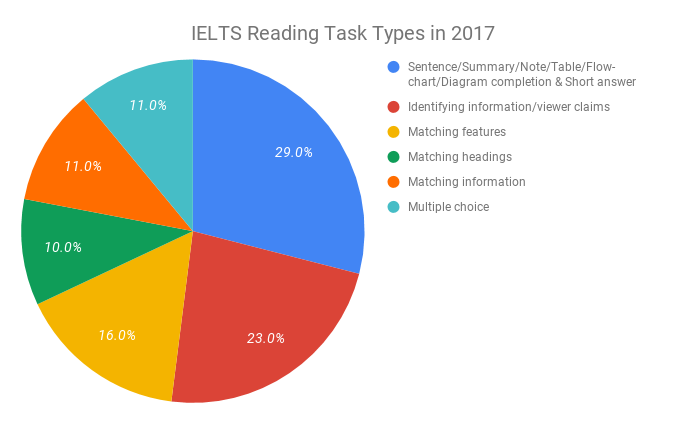
Comme vous pouvez le voir, les types de questions « Sentence/Summary/Note/Table/Flow-chart/Diagram completion & Short answer » étaient les plus courants à 29 %, avec les types de questions « Identifying information/viewer claims » en deuxième position avec 23 %. Enfin, le type de question « Matching features » représentait 16 %, « Matching information/Multiple choice » 11 %, et « Matching headings » 10 %.
Avec ces informations, vous pouvez voir quels types de questions sont les plus susceptibles d'apparaître dans votre examen IELTS reading. Bien que vous DEVEZ vous préparer à tous les types de questions, connaître ces informations peut vous aider à gérer votre temps entre eux. Bien sûr, si vous obtenez de bons scores avec certains types de questions, alors vous devriez probablement consacrer plus de temps aux types de questions avec lesquels vous avez des difficultés. Si vous voulez savoir exactement quels types de questions de reading vous posent problème, commencez un test d'exemple IELTS Reading GRATUIT et à la fin de l'examen, cliquez simplement sur Voir les résultats pour voir votre rapport diagnostique complet de reading, qui inclut également comment vous vous êtes débrouillé pour chaque type de question.
Ensuite, nous passerons en revue les conseils et stratégies IELTS reading nécessaires pour obtenir un score de reading élevé.
Conseils IELTS Reading - Comment améliorer votre score de bande de reading
La plupart des étudiants échouent à la section de reading pour les trois raisons suivantes
- Vitesse de lecture lente
- Vocabulaire pauvre
- Peu ou pas de préparation
Améliorer votre vitesse de lecture
D'abord, mettons l'évidence de côté. Pour améliorer votre vitesse de lecture, vous devez réellement vous entraîner à lire et le faire de manière constante.
Maintenant, regardons une stratégie moins évidente qui vous aidera à comprendre le sens de gros morceaux de phrases. Commencez par disséquer la phrase. Faites-le en cherchant le sujet et le verbe de la phrase. Trouver le sujet et le verbe vous aidera à comprendre le sens de la phrase. Une raison pour laquelle les passages de reading académiques peuvent être difficiles à comprendre est qu'ils enchaînent des idées pour former de longues phrases composées. Cela produit de gros morceaux de phrases plus difficiles à absorber, donc utiliser le sujet et le verbe comme guide pour comprendre le morceau entier est un excellent outil que vous pouvez utiliser pendant votre examen IELTS reading.
Améliorer votre vocabulaire
Beaucoup de gens pensent que répondre aux questions de reading est aussi simple que de parcourir le paragraphe à la recherche de mots-clés et d'informations... Eh bien, malheureusement, ce n'est pas si simple. Les questions de reading sont généralement paraphrasées, ce qui signifie que les mots ont été modifiés pour utiliser des synonymes des mots du passage IELTS reading. Cela est fait pour augmenter la difficulté, sinon, le test serait trop facile. Pour cette raison, vous devez améliorer votre vocabulaire afin de connaître les nombreux synonymes différents d'un mot.
Au fur et à mesure que vous vous préparez au test de reading et que vous rencontrez un mot que vous ne connaissez pas, prenez l'habitude soit de vous arrêter et de le chercher, soit au moins de l'écrire et de le chercher plus tard. C'est un peu fastidieux, mais c'est extrêmement efficace. Votre objectif devrait être, mais sans s'y limiter, d'étudier 15 à 20 nouveaux mots académiques chaque jour.
Savoir dans quels types de questions les réponses sont/ne sont pas dans l'ordre
Il est important de savoir que pour certains types de questions, les réponses sont généralement (presque toujours) dans le même ordre que le passage IELTS reading. Pour d'autres types de questions, les réponses sont rarement dans le même ordre que le passage de reading. Nous avons rempli un tableau pour les types de questions qui suivent l'ordre et ceux qui ne le suivent pas. Veuillez garder à l'esprit.
| Les réponses sont généralement (presque toujours) dans le même ordre que le passage | Les réponses sont rarement dans le même ordre que le passage. |
|---|---|
|
|
Trouver la meilleure stratégie de reading pour vous
Le plus grand défi auquel la plupart des gens sont confrontés lors de l'examen IELTS reading est de terminer toutes les questions de reading avant la fin du temps. Dans la section suivante, vous apprendrez trois stratégies et il vous appartiendra de déterminer laquelle vous convient le mieux. Vous le ferez en utilisant nos pratiques de reading gratuites.
3 stratégies IELTS Reading
Stratégie 1 : Lire tout le passage puis répondre aux questions.
Tout d'abord, ce n'est pas vraiment une stratégie. C'est quelque chose que les gens font quand ils ne se préparent pas correctement à l'examen de reading. Cependant, nous l'avons incluse comme stratégie car, techniquement parlant, si vous pouvez retenir les informations du passage à la première lecture et que vous êtes capable de répondre aux questions, alors vous n'aurez pas besoin de la stratégie 2.
Cette stratégie, si vous n'avez pas une mémoire supérieure à la moyenne, est inefficace. Vous finirez par manquer de temps avant de pouvoir répondre à toutes les questions. Beaucoup de gens font cette erreur. Cependant, il y a quelques questions qui ne demandent pas beaucoup d'effort et qui bénéficieront de cette stratégie, comme si la question est une réponse « Oui » ou « Non », alors vous pourrez parcourir rapidement et trouver la réponse rapidement, mais il n'y a pas assez de ces types de questions, donc il n'est pas conseillé d'utiliser cette stratégie à moins que vous ne puissiez la gérer.
Stratégie 2 : Lire d'abord les questions, lire pour un objectif et prendre des notes, puis répondre aux questions intelligemment
C'est notre stratégie recommandée. Elle vous aidera à obtenir un meilleur score IELTS reading. Considérez ceci comme une carte claire de la façon générale d'aborder l'examen :
L'une des erreurs les plus courantes que les candidats commettent en
abordant l'examen de reading est de lire chaque mot des passages IELTS reading. Bien que vous puissiez
vous entraîner pour l'examen en lisant pour le plaisir, « lire à l'aveugle » (lire sans aucune idée de
ce que les questions demanderont) ne vous rendra aucun service lors de l'examen. Au contraire, cela nuira à vos
chances de gérer efficacement votre temps et d'obtenir le meilleur score.
La principale raison de lire d'abord les questions est parce que le type de question peut déterminer ce que
vous lisez dans le passage ou comment vous le lisez. Par exemple, certains types de questions appelleront
la technique de « skimming », tandis que d'autres peuvent appeler la technique de « scanning ».
Il est important de s'attaquer à un ensemble de questions du même type.
Vous devrez déterminer quel type de question vous voulez aborder en premier.
Une bonne stratégie serait de commencer par le type de question le plus facile et de passer aux types de questions plus difficiles plus tard.
Les types de questions les plus faciles sont ceux où vous passez moins de temps à lire.
Par exemple, le type de question Matching Heading est l'un des plus faciles car vous
n'avez qu'à trouver le titre qui décrit le mieux l'idée principale d'un paragraphe.
Un exemple de type de question difficile serait Identifying Information. Pour ce type de question,
vous devrez lire chaque paragraphe pour savoir si chaque énoncé est TRUE, FALSE ou NOT GIVEN selon le passage.
Voici un tableau qui répertorie les niveaux de difficulté pour chaque type de question. Utilisez ce tableau comme référence lorsque vous choisissez
quel type de question vous voulez aborder en premier.
| Niveau de difficulté | Type de question |
|---|---|
| Facile | Match Headings Short answer |
| Moyen |
Matching Sentence Endings Matching Features Multiple choice Sentence Completion Diagram Label, Summary, Note, Table, Flow-Chart Completion |
| Difficile |
Match Information Identifying Information (TRUE/FALSE/NOT GIVEN) Identifying Viewer's claims (YES/NO/NOT GIVEN) |
Après avoir lu les questions du texte IELTS, vous serez en mesure de lire pour un objectif. Qu'est-ce que cela signifie ? Par exemple, si vous rencontrez une question qui inclut l'année « 1896 », vous pouvez noter quand cette année apparaît dans le texte, en l'utilisant pour répondre à la question plus tard.
Il existe deux techniques de lecture qui vous aideront à rester sur la bonne voie en lisant pour un objectif. La première, skimming, est mieux définie comme la lecture rapide afin d'obtenir le « gist » ou l'idée générale, ou un passage. Avec cette technique, vous ne vous arrêtez pas pour des mots inconnus ou ne cherchez pas de détails spécifiques. La deuxième technique, scanning, est mieux définie comme la lecture pour des informations spécifiques. Avec cette technique, vous ne lisez pas pour l'idée générale, mais plutôt, pour des informations spécifiques. Remarquez comment chacune de ces techniques a un objectif spécifique en tête. Cela vous aidera à trouver l'information plus rapidement.
Pendant que vous lisez pour un objectif, vous devriez aussi prendre des notes dans les marges du passage, en plaçant des étoiles à côté des informations clés, ou en soulignant des choses que vous pensez vous aider à répondre aux diverses questions. Cela facilitera la vérification lorsque vous serez interrogé sur certaines choses dans les questions. Choisissez le système de prise de notes qui vous convient le mieux — assurez-vous simplement de le faire !
Après avoir lu les questions, lu le passage et pris les notes appropriées, vous devriez avoir localisé la partie du texte où vous devez lire attentivement. Ensuite, lisez simplement attentivement et pensez de manière critique pour déterminer la bonne réponse.
Stratégie 3 : Skimming, prise de notes et types de questions.
Il s'agit d'une autre stratégie utilisée par de nombreux candidats IELTS. Elle vous aidera à obtenir un meilleur score de reading. La stratégie se compose de 4 étapes :
- Parcourir rapidement (skim) chaque paragraphe pour obtenir l'idée générale de chaque paragraphe. L'idée principale d'un paragraphe se trouve généralement dans les premières phrases, alors concentrez-vous un peu plus sur ces phrases. Les phrases suivantes peuvent être parcourues rapidement, en soulignant les noms/mots/expressions qui ressortent.
- Après avoir parcouru chaque paragraphe, écrivez de courtes notes (2-5 mots) à côté de chaque paragraphe avec votre meilleure supposition sur l'idée principale de ce paragraphe.
- Ensuite, répondez à un ensemble de questions du même type.
- Enfin, répondez à un ensemble de questions de manière efficace et correcte.
Il est important que vous ne passiez pas plus de 3-5 minutes sur les étapes 1 et 2. Passer trop de temps sur ces étapes fera perdre trop de temps et vous finirez par en manquer.
Étapes 1 et 2L'objectif ici est de mettre en place une méthode efficace pour trouver les réponses dans le passage. En notant l'idée générale de chaque paragraphe, vous saurez quel paragraphe contient la réponse à chaque question. Cela vous fera gagner beaucoup de temps car si vous ne l'aviez pas noté, vous auriez probablement besoin de parcourir chaque paragraphe pour l'idée générale de la question, puis vous devriez scanner soigneusement le paragraphe pour la réponse. En notant l'idée principale de chaque paragraphe, vous évitez la première étape de parcourir chaque paragraphe et commencez à scanner pour la réponse.
Étape 3
Après avoir parcouru le texte en profondeur et écrit quelques notes, vous êtes prêt pour l'étape 3.
Dans cette étape, vous devrez déterminer quel type de question vous voulez aborder en premier.
Une bonne stratégie serait de commencer par le type de question le plus facile et de passer aux types de questions plus difficiles plus tard.
Les types de questions les plus faciles sont ceux où vous passez moins de temps à lire.
Par exemple, le type de question Matching Heading est l'un des plus faciles car vous
n'avez qu'à trouver le titre qui décrit le mieux l'idée principale d'un paragraphe, donc techniquement, vous n'avez besoin que des étapes 1 et 2 pour répondre à ce type de question.
Un exemple de type de question difficile serait Identifying Information. Pour ce type de question,
vous devrez lire chaque paragraphe pour savoir si chaque énoncé est TRUE, FALSE ou NOT GIVEN selon le passage.
Voici un tableau qui répertorie les niveaux de difficulté pour chaque type de question. Utilisez ce tableau comme référence lorsque vous choisissez quel type de question vous voulez aborder en premier.
| Niveau de difficulté | Type de question |
|---|---|
| Facile | Match Headings Short answer |
| Moyen |
Matching Sentence Endings Matching Features Multiple choice Sentence Completion Diagram Label, Summary, Note, Table, Flow-Chart Completion |
| Difficile |
Match Information Identifying Information (TRUE/FALSE/NOT GIVEN) Identifying Viewer's claims (YES/NO/NOT GIVEN) |
Maintenant que vous avez déterminé quel ensemble de questions vous allez répondre en premier, il est temps de réellement y répondre :( Ne vous inquiétez pas ! Bien que chaque type de question soit différent, la stratégie pour y répondre correctement s'applique à toutes. Le principe de base est simple, il suffit de suivre les étapes ci-dessous :
- Lisez attentivement la question et identifiez les mots-clés importants.
- Trouvez le paragraphe qui contient les informations nécessaires pour répondre à la question. (Espérons que vous avez déjà les idées générales notées pour chaque paragraphe, vous pouvez donc facilement comprendre cela.)
- Scannez le paragraphe à la recherche des mots-clés importants (ce sont très probablement des synonymes !) jusqu'à ce que vous localisiez la partie du texte où vous devez lire attentivement.
- Enfin, lisez attentivement et pensez de manière critique pour déterminer la bonne réponse.
Téléchargements gratuits d'exemples PDF IELTS Reading avec réponses
Voici quelques exemples de reading gratuits du British Council (les concepteurs de l'examen IELTS). Essayez de répondre aux questions et voyez comment vous vous en sortez !