
In questa guida, puoi iniziare la tua pratica IELTS reading sostenendo un test IELTS reading gratuito. Tuttavia, esistono due versioni del test: IELTS general reading e IELTS academic reading. Imparerai quale versione è giusta per te e come affrontare ogni tipo di domanda di lettura utilizzando il nostro materiale IELTS reading.
Ottieni analisi gratuite del punteggio IELTS reading e un piano di studio personalizzato dopo aver completato un test di pratica IELTS reading gratuito.
| Test IELTS General Reading | Test IELTS Academic Reading |
|---|---|
Di seguito trovi il nostro elenco completo di domande IELTS reading con risposte. Nota: i link rossi sono le nostre domande reading piu popolari e consigliate, valutate dai nostri studenti, e puoi esercitarti gratuitamente in qualsiasi momento.
Domande di test di pratica IELTS General Reading 1 - 135
Short everyday texts, workplace texts, and one longer passage
Domande di test di pratica IELTS Academic Reading 1 - 171
Three long passages from books, journals, magazines, and newspapers
Guida al Test di Pratica IELTS Reading
Il resto di questa guida ti insegnerà tutto sul test IELTS reading sia per il general training che per l'academic reading test. Imparerai come viene calcolato il punteggio di reading, imparerai a rispondere con successo a ogni tipo di domanda di reading, migliorerai il tuo reading con materiale di testo IELTS e padroneggerai le nostre 3 strategie per il successo della tua pratica IELTS reading.
Indice
- Informazioni sul Test IELTS Reading
- Domande di esempio IELTS Reading
- Informazioni sul Test IELTS General Reading
- Informazioni sul Test IELTS Academic Reading
- Calcolatore del Punteggio IELTS Reading
- Come Rispondere a tutti gli 11 Tipi di Domande IELTS Reading
- Come Migliorare il tuo Punteggio di Banda IELTS Reading
- 3 Strategie per IELTS Reading
- Download Gratuito del PDF del Test di Pratica IELTS Reading con Risposte
Informazioni sul Test IELTS Reading
Il Test IELTS Reading è composto da 3 sezioni e un totale di 40 domande. In generale, risponderai a 12-14 domande per ogni sezione e ti vengono dati esattamente 60 minuti per completare il tuo esame di reading. Ogni sezione contiene 1-3 brani a seconda del test che stai sostenendo. Se conosci il test che stai sostenendo, puoi saltare le prossime due sezioni. In caso contrario, è importante imparare di ciascun test e come prepararsi per essi.
Quale Test IELTS Reading è Giusto per Me?
Il test IELTS reading ha due versioni: IELTS General Reading e IELTS Academic Reading. Sosterrai il General Reading se desideri migrare o iscriverti alla scuola superiore. Sosterrai l'Academic Reading se desideri proseguire con un'istruzione superiore. La differenza più grande tra general reading e academic reading è la difficoltà nei brani IELTS reading. Come suggerisce il nome, il test academic utilizza materiale IELTS reading da risorse accademiche, mentre il test general utilizza materiale tratto dalla vita quotidiana.
Entrambi i test contengono 3 sezioni, 40 domande e 11 tipi di domande. Puoi leggere su ogni sezione in dettaglio per entrambi i test nella tabella sottostante.
| Sezione | Test IELTS Academic Reading | Test IELTS General Reading |
|---|---|---|
| 1 | Un lungo testo accademico che spazia da quello descrittivo e fattuale a quello discorsivo e analitico. Il testo sarà
tratto da libri, riviste accademiche, periodici e giornali. 12-14 domande |
Due o tre brevi testi fattuali.
Gli argomenti sono pertinenti alla vita quotidiana in un paese di lingua inglese.
12-14 domande |
| 2 | Un lungo testo accademico che spazia da quello descrittivo e fattuale a quello discorsivo e analitico. Il testo sarà
tratto da libri, riviste accademiche, periodici e giornali. 10-14 domande |
Due brevi testi fattuali incentrati su questioni relative al lavoro (es. candidarsi per un lavoro, politiche aziendali, retribuzione e condizioni).
12-14 domande |
| 3 | Un lungo testo accademico che spazia da quello descrittivo e fattuale a quello discorsivo e analitico. Il testo sarà
tratto da libri, riviste accademiche, periodici e giornali. 12-14 domande |
Un testo più lungo e complesso su un argomento di interesse generale.
I testi sono autentici e sono tratti da avvisi, pubblicità, manuali aziendali, libri, riviste e giornali.
12-14 domande |
Ora che hai familiarità con la struttura del test IELTS reading e con entrambi i test IELTS general reading e IELTS academic reading, è ora di scoprire se è meglio sostenere il test su carta o quello al computer.
Test IELTS su Carta (PBT) VS Test IELTS al Computer (CBT)
Nel PBT, ti verranno forniti un Libretto delle Domande e un Foglio delle Risposte. Il Libretto delle Domande è dove vedrai tutte le domande a cui devi rispondere. Il Foglio delle Risposte è dove scriverai le tue risposte finali per la valutazione. Puoi consultare il PDF ufficiale del foglio delle risposte IELTS qui
Nota: A differenza del test IELTS listening, non ti verrà dato tempo extra per trasferire le tue risposte dal libretto al foglio delle risposte, quindi assicurati di aggiungere ogni domanda del test IELTS reading nel foglio delle risposte mentre rispondi.
Nel CBT, risponderai alle domande sul computer. I tuoi brani saranno sul lato sinistro e le tue domande saranno sul lato destro. Sarai anche in grado di evidenziare il testo e utilizzare le funzioni di controllo per copiare e incollare le risposte. Per maggiori informazioni sul PBT e sul CBT, consulta La Guida al Test IELTS al Computer.
Puoi esercitarti con qualsiasi versione in qualsiasi momento con il nostro test di pratica gratuito IELTS reading. Puoi trovare i link a tutto il nostro materiale IELTS reading in cima alla pagina.
Domande di esempio IELTS Reading
Ecco due esercizi gratuiti di IELTS Academic Reading. Prova ciascuno da solo, poi apri le risposte per controllare. La guida ai tipi di domande IELTS Reading spiega ogni tipo e offre altre domande di esempio.
Match each item with the period of time it best corresponds with
NB You may use any letter more than once.
- The Palaeolithic era
- The Bronze age
- The Iron age
- The Medieval era
- The Mesolithic age
- Roman times
-
spellcheck Answers1. FALSE
2. FALSE
3. NOT GIVEN
4. FALSE
5. TRUE
6. FALSE
7. FALSE
8. TRUE
9. FALSE
10. F
11. C
12. A
13. B
14. D
The climate in Britain has been arctic for the last several million years, punctuated by relatively warm timespans, or interglacials of thousands of years, one of which we are in as of now. Since the last glaciation, British woodland history is considered quite short in terms of geological time spans, and is also closely related to the human civilization developing.
At the peak of the last glaciation (100,000 – 12,000 BC), the majority of Britain would have had no trees. Birch and willow scrub may have grown along the lower reaches of the ice, with pine in some areas. It’s possible that remnants of pre-glacial flora were sheltered along the western bays of Great Britain and Ireland’s coasts, but as far as the southern parts of England, the ice kept any land barren. Information regarding the development of Britain’s flora following glaciation can be found by studying the deposits of pollen and seed in peat, as well as by the use of radiocarbon dating. Tundra and moorland followed the retreating ice, which lead to phases of different tree species spreading from the south. First came birch, aspen and sallow, followed by pine and hazel continuing to spread north as of 8500 BC, replacing birch to make it less commonly found for the next few thousand years. Oak and alder came after pine, then lime, elm, beech, and maple, all spreading northwards one after the other. From the moment lime arrived, in about 7300, to about 4500 BC the climate remained stable for a length of time known as the Atlantic Period, a time in which numerous species grew to form a series of wildwood or wilderness types.
What did the wilderness or wildwood look like, before man started interfering with it? One theory holds that Britain and Western Europe in Palaeolithic times was covered from coast to coast in a wildwood of continuous trees. However, a modern theory proposed by Francis Vera holds that Western Europe wilderness was a combination of grassland, scrub, and clusters or groves of trees. It was not a dense, impassable wildwood, but instead, an area similar to a park, kept up by wild herbivores eating the plants and grass. Throughout earlier interglacial periods, this may also have been the case in Britain, as creatures of the Palaeolithic era needed to roam large areas of grassland to survive. A variety of grassland plants continued to live there in the last interglacial, as according to pollen records. However, since the last glaciation, the bison, elk and other large herbivores which persisted on mainland Europe were extinct in Britain, so Vera’s theory may not apply so well to Britain.
Meanwhile, throughout the period since it’s spread northwards after the last glaciation, the sustained growth of oak in Britain demonstrates that the wildwood was not as continual as once believed. Oak is a pioneer species, which requires vacant space to generate more of itself. Grazing animals are also present to keep areas open, so Oak regenerates in the thorny brush as a protective measure from their grazing. Archaeological evidence indicates that red deer, who graze on grass as well as browse from trees, were essential to the economy in Mesolithic Britain, with people utilizing them for meat, skins, antlers and bones.
As the Mesolithic (10,000-3000 BC) era ended, evidence of the beginnings of agriculture emerges. Agricultural weeds, such as plantain and stinging nettle, were also increasing in number. Nearly all the wildwood was cut down as the population increased rapidly. However, the falling elm population around 4,000 BC all across Europe has been attributed not to the clearing of trees, but to what’s referred to as Elm disease.
Throughout the Bronze Age (2400-750 BC), people were cutting down trees more than ever before, until the prevalence of the practice “coppicing” peaked, likely at some point during the early Iron Age. Oliver Rackham (1990) theorizes that nearly 50% of land throughout England was no longer wildwood by 500 BC. The regrowth from a stump grows more readily than the original tree, and Neolithic man had discovered this practice, known as coppicing. Much of the remaining woods were maintained by way of this method during the Bronze Age.
The Celtic peoples living in the Iron Age were able to master woodworking as an artform. Today, Celtic woodworking can be seen in houses, boats, wheels and other artifacts of the time. Coppicing as a means to manage woodland was of massive importance throughout two millennia that followed. Buildings, roads, fences, carts, and the fuel for heating, cooking, metalworking and pottery were all made possible due to wood materials gained from the vital practice of coppicing.
A clear divide has existed between wooded and non-wooded regions of Britain since the time of the Romans. As evidenced by The Domesday Book (1086), all the wood in England had an economic value and was the property of either an individual or community owner. Woods were the territories, or ‘exclaves’ of communities who lived some miles away. Even though it had to be transported over long distances, the materials which woodlands produced were of obvious value, and their ownership was long before established. Merely around 15% of land in England was represented by woodland or wood- pasture in the year 1086.
English woodlands produced mostly underwood used as fuel along with other things, with small oaks being used to construct buildings. The average wood-framed houses of the Medieval era mostly used oaks shorter than 18” in diameter. Longer pieces of timber were hard to come by, and kept only for elaborate buildings intended for the Church. Imported boards of thin oak or wainscot from Central Europe were brought in for the purpose of domestic building. Woodland cover was as low as 15% in 1086, and continued to decline from as a result of an ever- growing population to 10% by 1350. This stopped suddenly with the plague of the Black Death of 1349 wiping out some of the human population. Woods which had persisted up to 1350 mostly prospered over the next 500 years.
Match each description with the correct psychologist
NB You may use any letter more than once.
- Clark Hull
- Howard and Tracy Kendler
- Michael Cole and colleagues
- Simon Hewson
-
spellcheck Answers1. D
2. C
3. D
4. A
5. C
6. B
7. C
8. D
9. TRUE
10. FALSE
11. TRUE
12. FALSE
Could it be that the very essence of reasoning itself is found in the way we behave? Clark Hull, an acclaimed American psychologist, theorized that it was, describing that reasoning is achieved by the way two “behavior segments” are combined in new ways to achieve goals. Howard and Tracey Kendler, who were two of Hull’s followers, used Hull’s principle ideas to design a reasoning test for children. In this test, children needed to learn how to use a machine in a two-step process. The children learned each of the two steps individually, with the first being to correctly choose and press one of two buttons, and the second to place a marble into a small opening. If both steps were completed successfully, a toy would be released as rewards to the children.
From this test, the Kendlers learned that although the children were able to learn each step, they were not able to “integrate” the two tasks without intervention. In other words, the children could not successfully perform the first step, pushing the button, and then proceed to the second step, inserting the marble into the hole, by themselves. This failure to independently integrate the steps led the Kendlers to believe that children of this age were not able to use deductive reasoning.
According the the work of psychologist and professor Michael Cole and his associates, some adults from specific African tribes are also unable to successfully complete the Kendlers' two-step test of deductive reasoning. However, this finding remains questionable in light of the findings of a similar test to the Kenders’, which revealed that the African tribes people were, in fact, able to complete the test.
In this test, Cole substituted a locked box for the machine with the buttons, and then used two matchboxes of different colors. One of the matchboxes held a key for the locked box. Just like with the Kendlers’ test, Cole’s test also involved two behavior segments, these being to first open the right match-box to get the key, and second to use the key to open the box. However, Cole’s test differs quite a bit psychologically. Instead of subjects being presented with a strange machine, they are given familiar objects in a simpler context. Cole found the difficulty of 'integration' was greatly reduced here.
It seems that the same truth which Cole discovered can be extended to explain the deductive reasoning skills of young children. Psychologist Simon Hewson believes that perhaps the task’s difficulty is not in inferential processes themselves, but is instead tied to confusing features of the test apparatus, such as the button machine, as well as the context of the procedure being tested. When these factors are adjusted in order to prevent the inferential nature of the problem being affected, five-year-old children are able to successfully complete these tests as well as college students did in the Kendlers' test.
Hewson made two essential changes to the test in order to build on this idea. First, he replaced the button-pressing mechanism with drawers that a child could slide open and shut. This removed confusion on what to do with the original button apparatus from the first stage of training. Secondly, Hewson made sure that children understood that there was nothing special or magical about the marble which was used to successfully complete the second step of the task and get the reward.
This is important because a child cannot easily comprehend a mechanism in which a marble put into a hole can open a little door. It would then be safe to say that the child will not assume that different marbles of identical size could be used the same way. But, to solve the problem, this assumption must be made. Hewson clearly demonstrated the functional equivalence of different marbles to the children by playing a 'swapping game.” Hewson's two modifications to the experiment led to a rise in success rates from 30 percent to 90 percent for five-year old children and from 35 percent to 72.5 per cent for four-year-olds. Strangely enough for three-year olds, Hewson’s changes did not lead to any improvement, and instead there was a slight drop in performance from the change. Hewson's experiments showed that children faced with the Kendler apparatus experienced difficulty not related to reasoning, but to the nature of the tasks themselves, and that difficulty cannot be taken as proof that they are incapable of deductive reasoning.
Test IELTS General Reading
Nel test general, i brani IELTS reading sono tratti da libri, riviste, giornali, avvisi, pubblicità, manuali aziendali e linee guida trovate dal materiale che incontreresti quotidianamente in un ambiente di lingua inglese. Proprio come nell'academic reading test, ci sono 3 sezioni, tuttavia in un test IELTS general reading, ogni sezione è un po' diversa l'una dall'altra.
Video di Introduzione a IELTS General Reading
-
Sezione 1: Contiene due o tre testi brevi o diversi testi più brevi
Questa sezione si chiama Social Survival e contiene testi rilevanti per la sopravvivenza linguistica di base in inglese con compiti principalmente sul recupero e fornitura di informazioni fattuali generali, ad esempio, avvisi, pubblicità e orari. -
Sezione 2: Comprende due testi
Questa sezione si chiama Workplace Survival e si concentra sul contesto lavorativo, ad esempio, descrizioni di lavoro, contratti e materiali di sviluppo e formazione del personale. -
Sezione 3: È un testo lungo
Questa sezione si chiama General Reading e prevede la lettura di prosa più estesa con una struttura più complessa. L'attenzione è su testi descrittivi e istruttivi anziché argomentativi.
Speriamo che tu non ti senta troppo sopraffatto. Il test di reading non è così difficile come sembra. Finché segui i nostri suggerimenti IELTS reading e utilizzi le nostre domande gratuite di pratica IELTS reading, sarai pronto ad affrontare qualsiasi brano di reading e raggiungere il tuo punteggio target IELTS reading. A proposito, l'academic reading test viene valutato leggermente in modo diverso dal general reading test. Successivamente, esamineremo il punteggio di banda di reading e come viene calcolato.
Test IELTS Academic Reading
Nel test academic, i brani IELTS reading sono tratti da libri, riviste accademiche, periodici e giornali da fonti accademiche che sarebbero appropriate per gli studenti universitari. Ogni brano è lungo, forse 6 - 10 paragrafi, può essere scritto in una varietà di stili come narrativo o descrittivo, e copre una vasta gamma di argomenti accademici come antropologia, storia, scienza, biologia, arte, educazione, linguistica,..ecc. I brani includeranno talvolta termini tecnici o anche materiale visivo come grafici e diagrammi. Puoi esercitarti con questi argomenti e altro con le nostre domande del test di pratica IELTS reading.
Video di Introduzione a IELTS Academic Reading
Quindi quali argomenti accademici appaiono di più nel Test IELTS Academic Reading ufficiale?
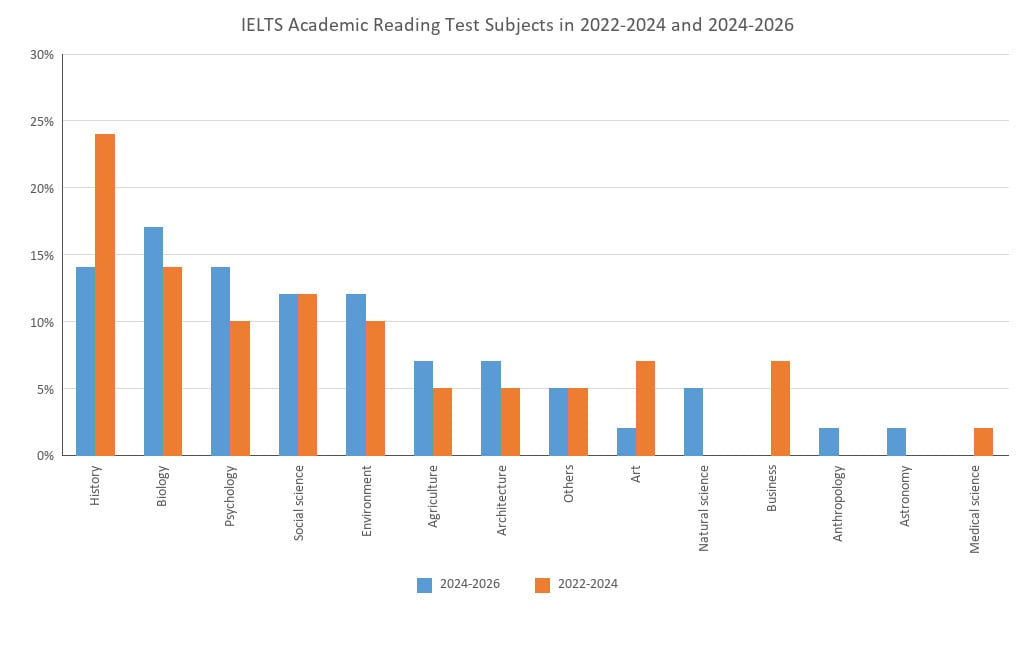
Bene, nel 2022-2024 e 2024-2026, l'argomento academic reading più comune è stato la storia. A seguire la biologia, poi psicologia e scienze sociali, che includono cultura, educazione, linguistica e sociologia.
Il grafico sottostante mostra le diverse materie testate nei test academic IELTS reading nel 2022-2024 e 2024-2026.
A causa di queste tendenze, ci siamo assicurati che i nostri test di pratica IELTS reading coprissero questi argomenti. Abbiamo anche aggiunto campioni di reading da argomenti meno utilizzati, per ogni evenienza. È importante prepararsi per tutte le situazioni, perché non sai mai quale argomento di IELTS reading ti capiterà.
Come Viene Calcolato il tuo Punteggio IELTS Reading
Ogni domanda di IELTS reading vale 1 punto, quindi puoi ottenere un punteggio "grezzo" fino a 40 punti. Quindi, il tuo punteggio grezzo verrà convertito nel tuo punteggio di banda. Le tabelle sottostanti possono darti un'idea generale su come i punteggi grezzi IELTS reading vengono convertiti in punteggi di banda per ciascun test.
Punteggio IELTS General Reading VS Punteggio IELTS Academic Reading
| Punteggi Grezzi: Academic | Punteggi di Banda: Academic | Punteggi Grezzi: General | Punteggi di Banda: General |
|---|---|---|---|
| 39-40 | 9 | 40 | 9 |
| 37-38 | 8.5 | 39 | 8.5 |
| 35-36 | 8 | 37-38 | 8 |
| 33-34 | 7.5 | 36 | 7.5 |
| 30-32 | 7 | 34-35 | 7 |
| 27-29 | 6.5 | 32-33 | 6.5 |
| 23-26 | 6 | 30-31 | 6 |
| 19-22 | 5.5 | 27-29 | 5.5 |
| 15-18 | 5 | 23-26 | 5 |
| 13-14 | 4.5 | 19-22 | 4.5 |
| 10-12 | 4 | 15-18 | 4 |
| 8-9 | 3.5 | 12-14 | 3.5 |
| 6-7 | 3 | 9-11 | 3 |
| 4-5 | 2.5 | 6-8 | 2.5 |
| 1-3 | 2 | 1-5 | 2 |
Tuttavia, tieni presente che ogni versione del test IELTS reading è leggermente diversa e il punteggio richiesto per raggiungere una determinata banda cambia a seconda di come chiunque abbia sostenuto quel test ha fatto in quel particolare giorno. Pertanto, il numero di risposte corrette necessarie per ottenere un punteggio di banda differirà leggermente da test a test, ma in generale dovresti puntare a ottenere circa 30 su 40 se vuoi ottenere un punteggio di banda 7.
Un'altra cosa che vogliamo ricordarti è che le domande più difficili e le domande più facili contano allo stesso modo per il tuo punteggio finale di reading, quindi assicurati di non perdere punti più facili rimanendo bloccato su domande più difficili. Successivamente esamineremo alcuni suggerimenti e strategie per IELTS reading su come rispondere a ciascuna domanda del test di reading.
Suggerimenti per IELTS Reading - Come Rispondere agli 11 Tipi di Domande di Reading
Ci sono 11 diversi tipi di domande nel test di reading e tutti richiedono una strategia diversa.
Ogni tipo ha un esempio e la risposta nella guida ai tipi di domande IELTS Reading.
- Tipo di Domanda 1 – Matching Information
- Tipo di Domanda 2 – Matching Headings
- Tipo di Domanda 3 – Matching Features
- Tipo di Domanda 4 – Identifying Information
- Tipo di Domanda 5 – Identifying Writer's Views/claims
- Tipo di Domanda 6 – Multiple Choice
- Tipo di Domanda 7 – Matching Sentence Endings
- Tipo di Domanda 8 – Sentence Completion
- Tipo di Domanda 9 – Summary, Note, Table, Flow-chart Completion
- Tipo di Domanda 10 – Diagram Label Completion
- Tipo di Domanda 11 – Short Answer Questions
- Come le Tendenze ti Aiutano a Prepararti per il Test IELTS Reading
Come le Tendenze ti Aiutano a Prepararti per il Test IELTS Reading
Quali tipi di domande di lettura risultano più difficili per i nostri studenti
Gli studenti di BestMyTest hanno risposto a un milione di domande di lettura Academic e a 600.000 domande di lettura General Training nei nostri test di esercitazione. La percentuale indica la frequenza con cui gli studenti hanno risposto correttamente a ciascun tipo di domanda.
| Tipo di domanda | Academic | General Training |
|---|---|---|
| Abbinamento di informazioni | 34% | 72% |
| Vero / Falso / Non indicato | 39% | 60% |
| Scelta multipla | 43% | 48% |
| Abbinamento di caratteristiche | 48% | 74% |
| Completamento di frasi | 49% | 75% |
| Abbinamento di titoli | 53% | 40% |
| Sì / No / Non indicato | 55% | 57% |
| Completamento di riassunti | 59% | 46% |
| Risposta breve | 54% | 75% |
- Nella lettura Academic i due tipi con i risultati più bassi sono l'abbinamento di informazioni e Vero/Falso/Non indicato, entrambi sotto il 40%. Entrambi richiedono di individuare un'idea parafrasata anziché una parola chiave corrispondente.
- Nel General Training la situazione si ribalta: l'abbinamento di titoli è il tipo con i risultati più bassi, al 40%, mentre le domande che richiedono di individuare informazioni ricevono risposte corrette tre volte su quattro perché i testi sono più brevi e più letterali.
- Alle domande sui brani Academic si risponde correttamente in media nel 46% dei casi, mentre per i brani General Training la percentuale è del 59%. La metà dei tentativi sui brani Academic ottiene un punteggio del 40% o inferiore.
- Su 43.711 test completi di esercitazione di lettura svolti da 38.534 studenti, il punteggio medio è stato di 5.4. Il 36% ha raggiunto un punteggio di 6.0 e il 14% ha raggiunto un punteggio di 7.0.
- Devi comunque prepararti per ogni tipo di domanda, ma se hai poco tempo, la tabella ti indica dove investirlo per ottenere i maggiori benefici.
I dati provengono dai test di esercitazione e dalle revisioni di BestMyTest fino a ottobre 2026. Le percentuali per tipo di domanda indicano i tassi di risposte corrette sul totale dei tentativi; i dati relativi ai criteri sono punteggi assegnati da tutor o dall'IA, come indicato. Ultimo aggiornamento: 5 ottobre 2026.
Successivamente esamineremo i suggerimenti e le strategie IELTS reading necessarie per un alto punteggio di reading.
Suggerimenti IELTS Reading - Come Migliorare il tuo Punteggio di Banda di Reading
La maggior parte degli studenti fallisce la sezione di reading per i seguenti tre motivi
- Velocità di lettura lenta
- Scarso vocabolario
- Poca o nessuna preparazione
Migliorare la tua velocità di lettura
Per prima cosa, mettiamo in chiaro l'ovvio. Per migliorare la tua velocità di lettura, devi effettivamente esercitarti a leggere e farlo in modo costante.
Ora diamo un'occhiata a una strategia meno ovvia che ti aiuterà a comprendere il significato di grandi blocchi di frasi. Inizia analizzando la frase. Fallo cercando il soggetto e il verbo della frase. Trovare il soggetto e il verbo ti aiuterà a comprendere il significato della frase. Una ragione per cui i brani di academic reading possono essere difficili da comprendere è perché uniscono catene di idee per formare lunghe frasi composte. Questo produce grandi blocchi di frasi più difficili da assimilare, quindi usare il soggetto e il verbo come tua guida per comprendere l'intero blocco è uno strumento eccellente che puoi usare durante il tuo esame IELTS reading.
Migliorare il tuo vocabolario
Molte persone pensano che rispondere alle domande di reading sia semplice come scansionare il paragrafo per parole chiave e informazioni... Bene, sfortunatamente, non è così semplice. Le domande di reading sono solitamente parafrasate, ovvero, le parole sono state cambiate per usare sinonimi delle parole dal brano IELTS reading. Questo viene fatto per aumentare la difficoltà, altrimenti il test sarebbe troppo facile. Per questo motivo, devi migliorare il tuo vocabolario per conoscere i molti diversi sinonimi di una parola.
Mentre ti prepari per il test di reading e incontri una parola che non conosci, prendi l'abitudine di fermarti e cercarla o almeno annotarla e cercarla più tardi. È un po' tedioso, ma è estremamente efficace. Il tuo obiettivo dovrebbe essere, ma non è limitato a, studiare 15-20 nuove parole accademiche ogni giorno.
Sapere in quali tipi di domande le risposte sono/non sono in ordine
È importante sapere che per alcuni tipi di domande, le risposte sono solitamente (quasi sempre) nello stesso ordine del brano IELTS reading. Per altri tipi di domande, le risposte sono raramente nello stesso ordine del brano di reading. Abbiamo completato una tabella per i tipi di domande che lo seguono e per quelli che non lo fanno. Tienilo presente.
| Le risposte sono solitamente (quasi sempre) nello stesso ordine del brano | Le risposte sono raramente nello stesso ordine del brano. |
|---|---|
|
|
Trovare la migliore strategia di reading per te
La sfida più grande che la maggior parte delle persone affronta nell'esame IELTS reading è completare tutte le domande di reading prima che il tempo scada. Nella prossima sezione, imparerai tre strategie e starà a te capire quale ti si addice meglio. Lo farai utilizzando le nostre pratiche di reading gratuite.
3 Strategie per IELTS Reading
Strategia 1: Leggere l'intero brano e poi rispondere alle domande.
Prima di tutto, questa non è molto una strategia. È qualcosa che le persone fanno quando non si preparano adeguatamente per l'esame di reading. Tuttavia, l'abbiamo inclusa come strategia perché, tecnicamente parlando, se riesci a trattenere le informazioni dal brano alla tua prima lettura e sei in grado di rispondere alle domande, allora non avrai bisogno della strategia 2.
Questa strategia, se non hai una memoria migliore della media, è inefficiente. Finirai per esaurire il tempo prima di poter rispondere a tutte le domande. Molte persone commettono questo errore. Tuttavia, ci sono alcune domande che non richiedono molto sforzo e beneficeranno di questa strategia come Se la domanda è una risposta "Sì" o "No", allora sarai in grado di scorrere rapidamente e trovare velocemente la risposta, ma non ci sono abbastanza di questi tipi di domande, quindi non è consigliabile utilizzare questa strategia a meno che tu non possa gestirla.
Strategia 2: Leggere prima le domande, leggere per un obiettivo e prendere appunti, e poi rispondere saggiamente alle domande
Questa è la nostra strategia consigliata. Ti aiuterà ad ottenere un punteggio IELTS reading più alto. Pensa a questo come a una mappa chiara di come affrontare in generale l'esame:
Uno degli errori più comuni che i candidati commettono quando
affrontano l'esame di reading è leggere ogni singola parola dei brani IELTS reading. Sebbene tu possa
esercitarti per l'esame leggendo per piacere, "leggere alla cieca" (leggere senza alcun senso di
ciò che le domande chiederanno) non ti farà nessun favore nell'esame. Invece, danneggerà le tue
possibilità di gestire efficacemente il tuo tempo e ottenere il miglior punteggio.
Il motivo principale per leggere prima le domande è perché il tipo di domanda potrebbe determinare cosa
leggi nel brano o come lo leggi. Ad esempio, alcuni tipi di domande richiederanno la
tecnica di "skimming", mentre altri possono richiedere la tecnica di "scanning".
È importante affrontare un set di domande dello stesso tipo.
Dovrai determinare quale tipo di domanda vuoi affrontare per primo.
Una buona strategia sarebbe iniziare con il tipo di domanda più facile e passare ai tipi di domande più difficili in seguito.
I tipi di domande più facili sono quelli in cui spendi meno tempo a leggere.
Ad esempio, il tipo di domanda Matching Heading è uno più facile perché
devi solo trovare l'intestazione che descrive meglio l'idea principale di un paragrafo.
Un esempio di un tipo di domanda difficile sarebbe Identifying Information. Per questo tipo di domanda,
dovrai leggere ogni paragrafo per scoprire se ogni affermazione è TRUE, FALSE o NOT GIVEN secondo il brano.
Ecco una tabella che elenca i livelli di difficoltà per ciascun tipo di domanda. Usa questa tabella come riferimento quando scegli quale tipo
di domanda vuoi affrontare per primo.
| Livello di difficoltà | Tipo di Domanda |
|---|---|
| Facile | Match Headings Short answer |
| Medio |
Matching Sentence Endings Matching Features Multiple choice Sentence Completion Diagram Label, Summary, Note, Table, Flow-Chart Completion |
| Difficile |
Match Information Identifying Information (TRUE/FALSE/NOT GIVEN) Identifying Viewer's claims (YES/NO/NOT GIVEN) |
Dopo aver letto le domande dal testo IELTS, sarai in grado di leggere per un obiettivo. Cosa significa? Ad esempio, se incontri una domanda che include l'anno "1896", puoi prendere nota di quando questo anno appare nel testo, usandolo per rispondere alla domanda in seguito.
Ci sono due tecniche di lettura che ti aiuteranno a rimanere in pista con la lettura per un obiettivo. La prima, skimming, è meglio definita come leggere velocemente per ottenere il "succo", o l'idea generale, di un brano. Con questa tecnica, non ti fermi per nessuna parola sconosciuta o per cercare dettagli specifici. La seconda tecnica, scanning, è meglio definita come leggere per informazioni specifiche. Con questa tecnica, non stai leggendo per il senso generale, ma piuttosto, informazioni specifiche. Nota come ognuna di queste tecniche ha un obiettivo specifico in mente. Questo ti aiuterà a trovare le informazioni più rapidamente.
Mentre leggi per un obiettivo, dovresti anche prendere appunti sui margini del brano, mettendo stelle accanto alle informazioni chiave o sottolineando cose che ritieni ti aiuteranno a rispondere alle varie domande. Questo renderà più facile per te ricontrollare quando ti vengono chieste alcune cose nelle domande. Scegli qualunque sistema di presa di appunti sia giusto per te—assicurati solo di farlo!
Dopo aver letto le domande, letto il brano e preso eventuali appunti appropriati, dovresti aver localizzato la parte del testo dove devi leggere attentamente. Quindi, semplicemente leggi attentamente e pensa criticamente per determinare la risposta corretta.
Strategia 3: Skimming, presa di appunti e tipi di domande.
Questa è un'altra strategia utilizzata da molti candidati IELTS. Ti aiuterà ad ottenere un punteggio di reading più alto. La strategia consiste in 4 passi:
- Scorri ogni paragrafo per ottenere l'idea generale di ciascun paragrafo. L'idea principale di un paragrafo si trova solitamente nelle prime frasi quindi concentrati un po' di più su quelle frasi. Le frasi successive possono essere scorse rapidamente, sottolineando nomi/parole/frasi che si distinguono.
- Dopo aver scorso ogni paragrafo, scrivi brevi appunti (2-5 parole) accanto a ciascun paragrafo con la tua migliore ipotesi sull'idea principale di quel paragrafo.
- Successivamente, rispondi a un set di domande dello stesso tipo.
- Infine, Rispondi a un set di domande in modo efficiente e corretto.
È importante non spendere più di 3-5 minuti sui Passi 1 e 2. Spendere troppo tempo su questi passi sprecherà troppo tempo e finirai per esaurirlo.
Passi 1 e 2L'obiettivo qui è impostare un metodo efficiente per trovare risposte nel brano. Annotando l'idea generale di ciascun paragrafo, saprai quale paragrafo contiene la risposta a ciascuna domanda. Questo ti farà risparmiare molto tempo perché se non l'avessi annotato, probabilmente avresti bisogno di scorrere ogni paragrafo per l'idea generale della domanda, quindi avresti bisogno di scansionare attentamente il paragrafo per la risposta. Annotando l'idea principale di ciascun paragrafo, puoi saltare il primo passo dello scorrimento di ciascun paragrafo e iniziare a scansionare per la risposta.
Passo 3
Dopo aver scorso a fondo il testo e annotato alcuni appunti, sei pronto per il Passo 3.
In questo passo, dovrai determinare quale tipo di domanda vuoi affrontare per primo.
Una buona strategia sarebbe iniziare con il tipo di domanda più facile e passare ai tipi di domande più difficili in seguito.
I tipi di domande più facili sono quelli in cui spendi meno tempo a leggere.
Ad esempio, il tipo di domanda Matching Heading è uno più facile perché
devi solo trovare l'intestazione che descrive meglio l'idea principale di un paragrafo, quindi tecnicamente hai solo bisogno dei Passi 1 e 2 per rispondere a questo tipo di domanda.
Un esempio di un tipo di domanda difficile sarebbe Identifying Information. Per questo tipo di domanda,
dovrai leggere ogni paragrafo per scoprire se ogni affermazione è TRUE, FALSE o NOT GIVEN secondo il brano.
Ecco una tabella che elenca i livelli di difficoltà per ciascun tipo di domanda. Usa questa tabella come riferimento quando scegli quale tipo di domanda vuoi affrontare per primo.
| Livello di difficoltà | Tipo di Domanda |
|---|---|
| Facile | Match Headings Short answer |
| Medio |
Matching Sentence Endings Matching Features Multiple choice Sentence Completion Diagram Label, Summary, Note, Table, Flow-Chart Completion |
| Difficile |
Match Information Identifying Information (TRUE/FALSE/NOT GIVEN) Identifying Viewer's claims (YES/NO/NOT GIVEN) |
Ora che hai capito quale set di domande risponderai per primo, è ora di rispondere effettivamente :( Non preoccuparti! Sebbene ogni tipo di domanda sia diverso, la strategia per rispondere correttamente si applica a tutti. Il principio di base è semplice, basta seguire i passi seguenti:
- Leggi attentamente la domanda e identifica le parole chiave importanti.
- Trova il paragrafo che contiene le informazioni necessarie per rispondere alla domanda. (Si spera che tu abbia già le idee generali annotate per ogni paragrafo, quindi puoi facilmente capire questo.)
- Scansiona il paragrafo per le parole chiave importanti (Sono molto probabilmente sinonimi!) finché non localizzi la parte del testo dove devi leggere attentamente.
- Infine, leggi attentamente e pensa criticamente per determinare la risposta corretta.
Download Gratuiti del PDF di Esempio IELTS Reading con Risposte
Di seguito alcuni esempi di reading gratuiti dal British Council (i creatori dell'esame IELTS). Prova a rispondere alle domande e vedi come fai!