歡迎來到我們的免費 TOEFL 聽力模擬測驗指南。在這裡,你可以用數千道 TOEFL 聽力題目準備考試,還能參加一份和官方 TOEFL iBT 聽力考試一樣的完全適性 TOEFL 聽力模擬考。你也可以透過聽力範例和練習提升聽力技能,學到準備技巧,並了解我們從學生完成的 451,000 次 TOEFL 聽力練習中學到了什麼。
點下方連結即可使用免費的托福聽力測驗,還可獲得專業的成績分析與量身打造的學習計畫。
play_circle_outline 開始托福聽力測驗下方列出是我們完整的 TOEFL 聽力題庫與答案。你可以隨時免費練習。
TOEFL 聽力測驗題庫 - 句子答題 1 - 131
TOEFL 聽力測驗題庫 - 生活對話 1 - 301
TOEFL 聽力測驗題庫 - 廣播通告 1 - 230
TOEFL 聽力測驗題庫 - 學術演講 1 - 179
目錄
TOEFL 聽力部分考什麼?
2026 年版 TOEFL 聽力部分共有 47 題,作答時間約 29 分鐘。它分成兩個階段進行適性測驗。所有考生都從同一個 18 分鐘的分流模組開始。你在這裡的作答會決定第二個模組是較簡單的 7 分鐘模組,還是較難的 11 分鐘模組。每段錄音只播放一次,每一題都有自己的計時:Listen and Choose a Response 題是 20 秒,其他題目都是 30 秒。你可以做筆記,但不能回到已經作答過的題目。
任務 |
題數 |
你會聽到什麼 |
|---|---|---|
Listen and Choose a Response |
15 到 19 |
一句簡短的日常英語,重音音節不超過六個。你要從四個書面選項中選出最自然的回應。很多題目考的是你是否聽懂說話者想做什麼:提問、提議、確認,還是抱怨。 |
Listen to a Conversation |
10 |
兩個人之間的一段簡短對話,約 35 到 100 個字,主題與校園或日常生活有關。每段對話後有兩題,問說話者說了什麼、問了什麼、建議了什麼、做了什麼,或接下來要做什麼。 |
Listen to an Announcement |
6 到 10 |
一則關於課程、服務或活動的簡短公告。之後有兩題,問公告的目的、重要細節、變更,或聽眾應該做什麼。 |
Listen to an Academic Talk |
8 到 16 |
一段最長 250 個字的講座,主題是生物、歷史或經濟等大學科目。之後有四題,問主旨、細節、說話者為什麼這樣說、隱含的意思,以及接下來會講什麼。 |
共 47 題,約 29 分鐘 |
||
兩個模組中都會混合出現這四種任務。說話者使用美國、加拿大、英國和澳洲口音,語速自然。各部分分數為 1 到 6 級分,TOEFL 總分是四個部分級分的平均,四捨五入到最接近的半級分。資料來源:ETS 2026 年測驗藍圖。
新版 TOEFL 聽力範例題目
以下是四道 TOEFL 聽力範例題目,每種任務類型一題,附有音檔、解答和聽力逐字稿。BestMyTest 上的每組練習都使用和正式考試相同的音檔、圖片和計時器。
In the Choose a Response task, you'll listen to a short question or statement and choose the most appropriate response.

- It is required for my degree.
- Language apps are popular.
- Let us practice together sometime.
- Have you tried that Spanish restaurant?
-
spellcheck Answer
Answer: A
(A) The correct answer is It is required for my degree. This is the only choice that gives a reason for learning Spanish.
(B) Language apps are popular. is incorrect because it is unrelated to the speaker's reason.
(C) Let us practice together sometime. is incorrect because it is a suggestion, not the reason for learning the language.
(D) Have you tried that Spanish restaurant? is incorrect because it is unrelated.
Transcript
Why are you learning Spanish?

- Yes, I can help you with it.
- The keyboard is new.
- It is in the top drawer.
- That is very expensive.
-
spellcheck Answer
Answer: A
(A) The correct answer is Yes, I can help you with it. This is the direct positive response that fits "Can you show me how to use this app?".
(B) The keyboard is new. is incorrect because it is unrelated.
(C) It is in the top drawer. is incorrect because it gives a location, not help with the app.
(D) That is very expensive. is incorrect because it is unrelated.
Transcript
Can you show me how to use this app?

- On the rack.
- It is thirty-five dollars.
- The fabric is soft.
- Very little time.
-
spellcheck Answer
Answer: B
(B) The correct answer is It is thirty-five dollars. This is the only choice that answers the price question in "What is the price of this sweater?".
(A) On the rack. is incorrect because it gives a location, not a price.
(C) The fabric is soft. is incorrect because it describes the sweater, not the cost.
(D) Very little time. is incorrect because it is unrelated.
Transcript
What is the price of this sweater?
In the Listen to a Conversation task, you'll listen to a short conversation and answer 2 questions.

- They listed the wrong meeting room
- The printer produced only six copies
- The posters curled beside an open window
- The first print run failed the margin check.
- It contains money for the printing
- The woman will bring it from the library
- The cash is stored in a closet.
- The treasurer will place it on the table
-
spellcheck Answers
1. Answer: D
(D) The first print run failed the margin check. is correct because the woman states, "The copy center sent the first batch back. They said the scan code was sitting right on the border." The first print run failed the margin check.
(A) They listed the wrong meeting room is incorrect because the ecology lab is only the meeting place. She does not say the posters had the wrong room.
(B) The printer produced only six copies is incorrect because six is what her student card can pay for now, not why the first batch came back.
(C) The posters curled beside an open window is incorrect because that happened to last week's posters and is why he will bring clips.
2. Answer: C
(C) The cash is stored in a closet. is correct because the man states, "The treasurer left it in the closet with the extra paper, so I will grab it when I set up." The cash box is stored in a closet.
(A) It contains money for the printing is incorrect because he says six copies are fine for the posters. The money box is for the sign up table, not her printing.
(B) The woman will bring it from the library is incorrect because she is coming over after printing. He will grab the money box when he sets up.
(D) The treasurer will place it on the table is incorrect because the treasurer already left it in the closet, and the man will grab it.
Transcript
Man: Can you still make the sustainability club meeting later?
Woman: I think so, but I need to reprint the posters. The copy center sent the first batch back. They said the scan code was sitting right on the border.
Man: We are gathering at 5:45 in the ecology lab. I can bring table clips. Last week's posters curled near the open window.
Woman: Great. The library color printer is quick, but my student card has enough credit for only six copies. Do we need the club cash tonight?
Man: Six is fine for the posters. I still need the money box at the sign up table. The treasurer left it in the closet with the extra paper, so I will grab it when I set up.
Woman: Perfect. I will come over as soon as the printing finishes.

Reason for action
Learn how to answer question 1 in a step-by-step interactive exercise
Reason for action
理由常常先以問題的形式出現,接著才是作為回應的行為。把問題和行為連結起來,而不是抓住你聽到的第一個事實。
同一段對話中後來出現的細節,通常不是原因。重複其中某個細節、卻改變了意思的選項是陷阱。
點擊播放,聆聽音檔
In the Listen to an Announcement task, you'll listen to a short announcement and answer 2 questions.

- To list the topics that will be covered in the workshop
- To explain the eligibility requirements for attending
- To describe outcomes achieved by previous workshop attendees
- To advertise new funding opportunities for the semester
- To announce deadline changes for current grant applications
- To describe a new graduate admissions requirement
- To invite students to a grant writing workshop
- To introduce a visiting professor's research seminar
-
spellcheck Answers
1. Answer: C
(C) The correct answer is To describe outcomes achieved by previous workshop attendees.. In the announcement, "Attendees from previous workshops have gone on to secure funding for independent research projects and conference travel." shows why the author or speaker mentions that detail, so "To describe outcomes achieved by previous workshop attendees." is the best explanation of its function.
(A) To list the topics that will be covered in the workshop. is incorrect because the author or speaker mentions the detail to support a different purpose, not this one
(B) To explain the eligibility requirements for attending. is incorrect because the author or speaker mentions the detail to support a different purpose, not this one
(D) To advertise new funding opportunities for the semester. is incorrect because the author or speaker mentions the detail to support a different purpose, not this one
2. Answer: C
(C) The correct answer is To invite students to a grant writing workshop.. The announcement as a whole conveys this purpose, as supported by "The graduate school is presenting a grant writing workshop this Wednesday.".
(A) To announce deadline changes for current grant applications. is incorrect because the overall purpose of the announcement is different from what this choice describes.
(B) To describe a new graduate admissions requirement. is incorrect because the overall purpose of the announcement is different from what this choice describes.
(D) To introduce a visiting professor's research seminar. is incorrect because the overall purpose of the announcement is different from what this choice describes.
Transcript
Listen to an announcement at a student center.
Attention all students! The graduate school is presenting a grant writing workshop this Wednesday at two p.m. in the student center conference room. A panel of funded researchers will walk you through the process of writing competitive grant proposals, from identifying funding sources to structuring a persuasive narrative. Attendees from previous workshops have gone on to secure funding for independent research projects and conference travel. All students considering graduate-level research are strongly encouraged to attend.

Function
Learn how to answer question 1 in a step-by-step interactive exercise
Function
功能題考的不是這些字在字典裡的意思,而是這句話在對話或談話中發揮的作用。被引用那句話的前後幾句,會透露出這個作用。另一位說話者接下來說的話,常能顯示這句話是怎麼被理解的。
點擊播放,聆聽音檔
In the Listen to an Academic Talk task, you'll listen to a short academic talk and answer 4 questions.

- They only process numerical data, not text or images
- They learn patterns from data rather than following developer-written rules
- They require government certification for every application
- They process data faster than any other computing system available today
- To describe the physical hardware used in neural network laboratories
- To illustrate how neural networks learn patterns from examples rather than explicit rules
- To suggest that students should study animal biology before computer science
- To explain why printed textbooks are more reliable than digital learning tools
- Why traditional programming is more reliable than all machine learning systems
- The complete history of computing from the 1940s to today
- Brain-inspired computing systems, their key concepts, and their potential despite challenges
- How to build a neural network for personal investment decisions
- Deep learning proves that neural networks are too complex for any real-world use
- Multi-layered processing enables applications like self-driving cars that interpret complex visual information
- Deep learning requires more programmers than traditional software development does
- Deep learning shows that neural networks only work for image recognition tasks
-
spellcheck Answers
1. Answer: B
(B) The correct answer is They learn patterns from data rather than following developer-written rules. The speaker contrasts data-driven learning with explicit rule-writing.
(A) is incorrect because neural networks process multiple data types. (C) is incorrect because government certification isn't required. (D) is incorrect because processing speed isn't the distinguishing feature.
2. Answer: B
(B) The correct answer is To illustrate how neural networks learn patterns from examples rather than explicit rules. The child-learning analogy explains the training process.
(A) is incorrect because physical hardware isn't described by this analogy. (C) is incorrect because biology study advice isn't the purpose. (D) is incorrect because textbook reliability isn't argued.
3. Answer: C
(C) The correct answer is Brain-inspired computing systems, their key concepts, and their potential despite challenges. The talk covers training, deep learning, applications, and black-box concerns.
(A) is incorrect because traditional programming superiority isn't argued. (B) is incorrect because the full history of computing isn't the scope. (D) is incorrect because personal investment isn't discussed.
4. Answer: B
(B) The correct answer is Multi-layered processing enables applications like self-driving cars that interpret complex visual information. The speaker links deep layers to real-time object recognition in autonomous vehicles.
(A) is incorrect because deep learning demonstrates real capability. (C) is incorrect because programmer requirements aren't the main point. (D) is incorrect because applications extend beyond image recognition.
Transcript
Listen to a talk in a class about artificial neural networks.
Today, we're going to explore artificial neural networks, which are basically computing systems inspired by the human brain that could change how we solve problems in everything from medicine to transportation. Unlike traditional programs, where a developer writes explicit rules for every decision, neural networks learn patterns from data on their own. This makes them fundamentally different from the rule-based software most industries have relied on for decades.
Take the concept of training, for instance. Training means feeding a neural network massive amounts of data—images, text, numbers—and letting it adjust its internal connections until it can make accurate predictions or classifications. It's like teaching a child to recognize animals by showing them thousands of photos—you don't give them a list of rules about what makes a dog a dog; they just figure out the patterns by seeing enough examples. This pattern-learning ability is what makes neural networks powerful at tasks like image recognition and language translation.
Another crucial concept is deep learning. Deep learning uses neural networks with many layers—sometimes hundreds—each of which extracts increasingly complex features from the data. The first layers might detect simple edges in an image, while deeper layers combine those edges into shapes, and even deeper layers recognize entire objects. This layered processing is what allows systems like self-driving cars to identify pedestrians, traffic signs, and road markings in real time.
The potential applications are enormous—medical imaging diagnosis, fraud detection, personalized recommendations, autonomous vehicles. However, neural networks are often called black boxes because it's difficult to understand exactly how they reach their conclusions. The massive computational resources required for training, combined with concerns about bias in training data and lack of explainability, make regulation and transparency critical. Despite these challenges, neural networks remain one of the most transformative technologies in modern computing.
Detail - Academic Talk
Learn how to answer question 1 in a step-by-step interactive exercise
Detail - Academic Talk
有些講座細節題會問教授對某個人、物品、理論、過程或想法說了什麼。聽到題目中提到的主題時,注意聽教授對它提出的重點。
主題周圍的背景資訊不是答案,關於這個主題的具體重點才是。
點擊播放,聆聽音檔
我們從 451,000 組 TOEFL 聽力練習中學到了什麼
學生已經在我們這裡完成了 451,965 組 TOEFL 聽力練習,其中包括 95,190 個完整模擬測驗的聽力部分和 356,775 道練習題。這些結果顯示了學生最容易在哪裡遇到困難。學生在 Choose a Response 題上表現最好(答對率 85%),但會在 Inference 題(60%)和 Academic Talk 題組(75%)上失分。
TOEFL 聽力是我們學生分數最高的部分。在 55,750 位學生的 95,190 個 TOEFL 聽力模擬測驗部分中,平均是 4.8 級分(滿分 6)。62% 達到 5 級分,20% 達到 6 級分。其他部分的平均級分是:閱讀 4.2 級分、寫作 3.6 級分,以及口說 3.5 級分。如果聽力已經是你最強的部分,這是好消息。這表示你的準備時間最好花在拉低你總分的其他部分上。

Inference 題是最難的 TOEFL 聽力題型。學生答對 Inference 題的比例是 60%。相比之下,Reason for Action 題是 61%、Detail 題是 69%,以及 Rhetorical Purpose 題是 71%。原因很簡單:推論題的答案從來不會在錄音裡直接說出來。你必須把聽到的內容連結起來,推斷出說話者的意思。

TOEFL 聽力目的題比主題題容易。Gist-Purpose 題問說話者為什麼要說話,學生的答對率是 80%。Gist-Content 題問這段話在講什麼,答對率是 76%,低了 4 個百分點。主題題的一個陷阱是把一個例子誤當成整個主題。說話者可能花一分鐘講一個例子,但整段話講的是更大的主題。

Listen and Choose a Response 是最簡單的 TOEFL 聽力任務。學生在 Listen and Choose a Response 題組的得分是 85%,一組八題大約要花 111 秒。其他任務比較難:Conversation 題組的得分是 76%、Announcement 題組的得分是 76%,以及 Academic Talk 題組的得分是 75%。時間也很重要。最長的題組是 Listen and Choose a Response,大約 111 秒,而最難的任務 Academic Talk 一組大約要花 74 秒。

如何準備 TOEFL 聽力測驗
想提高 TOEFL 聽力分數,只聽懂英語口語是不夠的。你需要辨認說話者的意思,跟上重要細節,並且在錄音只聽一次後做出正確判斷。好消息是,你不需要把每項聽力技能都提升到同樣程度。有些題型比其他題型難得多,學會正確的策略可以幫你避免那些正在讓你失分的錯誤。
最有效的方法是了解每種聽力任務如何運作,練習它需要的技能,並從錯誤中學習。以下六個技巧會告訴你具體怎麼做。
TOEFL 聽力技巧 1:Listen and Choose a Response
Listen and Choose a Response 是在 TOEFL 聽力部分拿分的好機會。我們的學生能答對這類題目的 85%,這是他們表現最好的任務。不過,不要被簡短的錄音騙了。正確答案取決於你是否理解說話者想表達的意圖,而不只是聽出單字。
例如,假設你聽到:
"So the grocery store near campus closes at 10?"
說話者是在請求確認,所以 "Yes, but only on weekdays" 是恰當的回應。而 "Groceries can be expensive" 雖然和同一個主題有關,卻是錯誤的。
最重要的策略是在選答案之前先判斷說話者的意圖。問問自己:說話者是在提問、提議、請求協助、確認資訊,還是表達擔心?一旦理解了意圖,選出自然的回應就容易多了。
要小心那些重複錄音中單字或想法的選項。它們聽起來可能相關,但這不代表它們是對說話者這句話的恰當回應。
想要進步,就練習在聽完後、看選項之前,立刻判斷說話者的意圖。這能訓練你理解整句話的意思,而不是依賴熟悉的字彙。
試試我們的 Listen and Choose a Response 練習題。每組有八題,每題有 20 秒的作答計時,幫助你培養正式考試需要的速度和準確度。
你的目標應該是讓這類題目成為穩定的得分來源。學會快速辨認說話者的意圖,你就能有自信地作答,不必猶豫。
TOEFL 聽力技巧 2:Conversation
TOEFL 聽力的 Conversation 涉及熟悉的情境,所以聽起來可能很簡單,但要答對題目,只理解大致主題是不夠的。我們的學生大約能答對 76% 的 Conversation 題目。其中很多題目著重細節,例如說話者對一個問題說了什麼、給了什麼建議,或接下來打算做什麼。
學生常犯的一個錯誤是只記住說話者一開始的回應,卻沒聽清楚對話後來怎麼發展。
例如,一位學生一開始說自己沒辦法參加會議。後來教授提出另一個時間,學生同意參加。如果題目問這位學生可能會做什麼,正確答案取決於最後的決定,而不是一開始的回應。
訓練自己跟上整段對話,特別是在說話者改變心意、做出決定,或說明接下來要做什麼的時候。
聽的時候,注意對話為什麼開始、說話者交換了哪些重要資訊,以及事情最後怎麼解決。留意 actually, instead, in that case, 和 then 這類說法,它們常常代表改變或決定。
聽完錄音後,在看題目之前,花一點時間閉上眼睛,在腦中重播對話的經過。試著回想對話為什麼開始、說話者提到的重要細節,以及他們最後決定了什麼。
很多學生一開始讀題目和選項,就會忘記重要細節。這是因為題目和錯誤選項會讓他們分心,偏離自己真正聽到的內容。
先在腦中回顧對話,可以加深你對關鍵資訊的記憶,降低被錯誤選項誤導的機會。
你可以用我們的 TOEFL 聽力 Conversation 練習題來加強這些技能。
TOEFL 聽力技巧 3:Announcement
TOEFL 聽力的 Announcement 常常包含學生需要記住或照著去做的資訊,例如行程變更、截止日期、地點或新的規定。我們的學生大約能答對 76% 的 Announcement 題目。這些錄音通常很直接,但漏掉一個細節就可能答錯。
例如,假設一則公告說明,原本排在星期五的校園工作坊因為維修工程改到星期一。如果你記住了星期五,卻漏聽了這個變更,即使聽懂了錄音的大部分內容,也可能選錯答案。
最好的策略是聽清楚三件重要的事:什麼改變了、為什麼改變、聽眾需要做什麼。
仔細注意帶出變更的說法,例如 instead, has been moved to, 和 no longer。指示常常以 please remember to 或 students must 這類片語開頭,而 because 和 due to 用來帶出原因。
另外,要仔細聽公告的結尾。說話者常常在最後說明學生接下來該做什麼,例如填寫報名表、到某個辦公室,或聯絡老師。
練習時,試著找出公告的主要目的,以及最重要的行動或變更。不用擔心記不住每個字,把注意力放在對聽到這則公告的人來說重要的資訊上。
用我們的 TOEFL 聽力 Announcement 練習題來練習。
記住,目標不是背下整則公告,而是辨認出重要的資訊,並理解聽眾應該知道什麼、做什麼。
TOEFL 聽力技巧 4:Academic Talk
對我們的學生來說,Academic Talk 是TOEFL 聽力中最難的部分。它需要你跟上較長的說明,並理解想法之間的關聯。在我們的模擬測驗中,學生答對了 75% 的 Academic Talk 題目。每段講座後有四題,所以誤解了主要說明,可能會影響好幾題的答案。
很多學生想記住每個細節,或太在意不熟悉的學術字彙。但這樣反而更難跟上說話者的說明。你應該專注於理解主旨,以及說話者如何透過原因、例子、比較和解釋來發展它。
例如,假設一位教授在講海洋溫度上升如何影響珊瑚礁。說明可能先提出問題,再說明為什麼較暖的海水會造成珊瑚白化,然後解釋這對海洋生態系的影響。
如果你理解了這些關聯,即使記不住每一句話,也能更好地回答關於主旨、因果關係和支持細節的題目。
留意 because, as a result, however, in contrast, 和 for example 這類說法。它們標示出想法之間的重要關係,幫助你理解講座的結構。
如果簡短的筆記能幫你記住重要資訊,你可以記一些,但不要讓做筆記分散你聽的注意力。有些學生全神貫注聽說話者時,反而更能聽懂錄音。選擇最適合你的方法。
聽完後,練習用自己的話說出主要主題和兩三個重要的支持重點。這能幫你檢查自己是否真正理解了說明。
試試我們的 TOEFL Academic Talk 練習題,提升你跟上學術說明、看出想法之間關聯的能力。
TOEFL 聽力技巧 5:依照真實的 TOEFL 聽力時間限制練習
很多學生在反覆重聽錄音,或暫停下來思考意思時,能夠聽懂聽力錄音。但正式的 TOEFL 不會給你這樣的彈性。在和正式考試一樣的 TOEFL 聽力模擬測驗中,每題 Listen and Choose a Response 只有 20 秒作答,其他聽力題目只有 30 秒。每段錄音只播放一次。
所以,不限時練習可能會給你一種錯誤的自信。時間不限時,你也許能完全聽懂錄音,但需要快速做決定時就可能很吃力。
想要有效準備,就要經常練習錄音只聽一次,並在實際時間限制內作答。做完一題練習後,你可以重聽錄音、研究聽力逐字稿,弄清楚自己錯在哪裡。這是學習的重要部分,但你的第一次作答應該盡量模擬正式考試。
你可以免費註冊並參加 Sample Test 1,體驗我們的適性 TOEFL 聽力模擬測驗。成績報告會顯示你的聽力級分和各題型的表現,幫你找出準備時應該加強的地方。進階會員還能使用 50 份模擬測驗。
TOEFL 聽力技巧 6:了解 TOEFL 聽力題型
了解八種 TOEFL 聽力題型,可以幫你在題目出現之前就預測要聽什麼資訊。知道可能會被問到哪些問題,你就能更有目的地聽,並在聽到重要資訊時立刻認出來。八種 TOEFL 聽力題型是 Gist-Content、Gist-Purpose、Detail、Function、Inference、Rhetorical Purpose、Reason for Action 和 Listen and Choose a Response。
例如,在 Academic Talk 中,你應該聽主旨(Gist-Content)、重要事實(Detail)、隱含意思(Inference),以及教授為什麼舉出某些例子(Rhetorical Purpose)。
在 Conversation 中,要注意具體細節(Detail),例如某人對一個主題說了什麼或問了什麼、提議和建議、過去或最近的活動,以及某人接下來打算做什麼。也要聽說話者的意圖(Function)、他們做決定的原因(Reason for Action),以及整段討論的目的(Gist-Purpose)。
在 Announcement 中,專注於發布公告的原因(Gist-Purpose),日期、地點、變更和指示等重要細節(Detail),以及沒有直接說出、而是隱含的資訊(Inference)。
我們的模擬測驗資料顯示,有些題型明顯比其他題型更難。學生答對 Choose a Response 題的比例是 85%,而 Inference 題是 60%,Reason for Action 題是 61%。了解這些差異,可以幫你找出準備時哪些聽力技能值得多花心力。
每次做完模擬測驗,都依題型檢討你的錯誤。你對題型越熟悉,就越容易預測錄音裡什麼重要、記住重要細節,並避開誤導的選項。
我們的 TOEFL 聽力題型指南用音檔範例、正確答案,以及其他選項為什麼錯誤的說明,講解每一種題型。
我們的 TOEFL 聽力練習題
我們的 TOEFL 聽力練習題在外觀和感覺上都和官方 TOEFL 考試一樣。難度、任務類型、圖片、計時器,以及每段錄音只播放一次,這些都相同,所以你是在真實的考試情境中練習。我們有超過 2,800 道 TOEFL 聽力練習題,分布在 840 多組練習中:131 組 Listen and Choose a Response、301 組 Conversation、230 組 Announcement 和 179 組 Academic Talk。每組練習都會顯示解答、聽力逐字稿和題型。
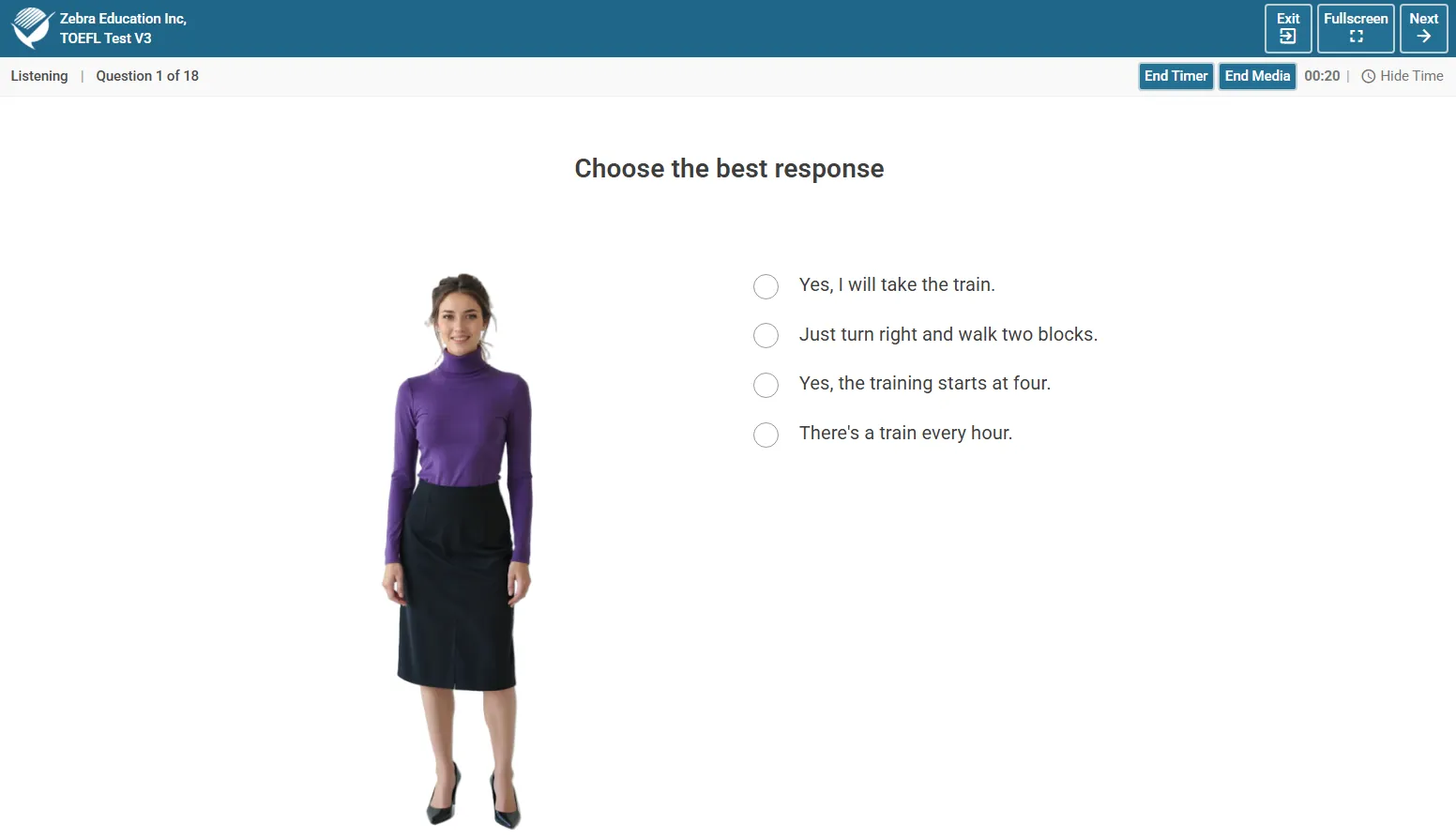
要查看全部練習,請打開我們 TOEFL Tutor App 中的 TOEFL Practice 選單。聽力是一項技能,透過針對正確重點的 TOEFL iBT 聽力練習就能進步。了解任務類型,完成練習,並依題型檢查你的錯誤。
如果你需要協助,我們的聽力輔助工具包括:
- BestMyLingo (聽真實生活情境並做出回應)
- TOEFL 字彙訓練 (幫你快速辨認單字的互動練習)
- TOEFL 聽力 Tutor App (練習題、課程和模擬測驗)
免費 TOEFL 聽力課程
建立免費帳號,就能打開前三堂 TOEFL 聽力課程,開始提升你的聽力技能:
- TOEFL 聽力入門
- TOEFL 聽力成功策略
- Detail(細節)題
進階會員還能使用 Inference、Gist-Purpose、Gist-Content、Rhetorical Purpose、Choose a Response、Function 和 Reason-for-Action 課程,TOEFL 聽力模範測驗 1,以及 15 組模範練習。
免費註冊免費 TOEFL 聽力練習資源
以下所有內容都是免費的 TOEFL 聽力練習。它們都是為現行 TOEFL 聽力部分的四種任務類型製作的,每組練習都有音檔、聽力逐字稿和解答。
- Listen and Choose a Response 完整練習題:八題,附有圖片、音檔和 20 秒計時器。
- Conversation 完整練習題:一段簡短對話,附有兩題和聽力逐字稿。
- Announcement 完整練習題:一則簡短公告,附有兩題和聽力逐字稿。
- Academic Talk 完整練習題:一段講座,附有四題和聽力逐字稿。
- Sample Test 1:適性模擬測驗中的一份免費完整 TOEFL 聽力模擬考。
- TOEFL 聽力題型:每種題型都有音檔範例,並說明每個選項對或錯的原因。
- 附解答的 TOEFL 聽力 PDF:16 組共 68 題,附聽力逐字稿和解答,註冊免費帳號即可免費取得。
本頁的數據來自BestMyTest TOEFL 學員表現數據,也就是截至 2026年10月 在 BestMyTest 上的 TOEFL 練習紀錄。每個數據的計算方式都在該頁說明。最後更新:2026年10月15日。