無料のTOEFLリスニング練習テストガイドへようこそ。ここでは数千問のTOEFLリスニング問題で準備でき、公式のTOEFL iBTリスニング試験と同じ完全適応型のTOEFLリスニング模試も受けられます。リスニングのサンプルや練習問題でリスニング力を伸ばし、準備のコツを学び、BestMyTestの学習者が受けた451,000回のTOEFLリスニング練習テストから分かったことも知ることができます。
下のリンクをクリックすると、無料のTOEFLリスニング模擬テストを受けることができ、専門的なスコア分析とパーソナライズされた学習プランを受け取れます。
play_circle_outline TOEFLリスニング模擬テストを開始以下はBestMyTestのTOEFLリスニング問題と解答の全リストです。いつでも無料で練習できます。
TOEFL リスニング練習問題 - 応答を選ぶ 1 - 131
TOEFL リスニング練習問題 - 会話 1 - 301
TOEFL リスニング練習問題 - アナウンス 1 - 230
TOEFL リスニング練習問題 - アカデミック・トーク 1 - 179
目次
TOEFL Listeningセクションの内容
2026年のTOEFLリスニングセクションは47問で、所要時間は約29分です。2段階の適応型になっています。全員が同じ18分のルーター(最初のモジュール)から始めます。そこでの解答によって、2つ目のモジュールが易しい7分のモジュールになるか、難しい11分のモジュールになるかが決まります。音声はどれも1回しか流れず、問題ごとにタイマーがあります。Listen and Choose a Responseの問題は20秒、それ以外の問題は30秒です。メモを取ることはできますが、一度進んだ問題には戻れません。
課題 |
問題数 |
聞く内容 |
|---|---|---|
Listen and Choose a Response |
15〜19 |
日常英語の短い一文を聞きます。強勢のある音節は6つ以内です。4つの書かれた選択肢から、最も自然な返事を選びます。多くの問題では、話し手が何をしたいのかを理解しているかが問われます。たとえば、質問する、申し出る、確認する、苦情を言うなどです。 |
Listen to a Conversation |
10 |
キャンパスや日常生活の話題について2人が話す、約35〜100語の短い会話です。1つの会話につき2問あります。話し手が言ったこと、尋ねたこと、提案したこと、したこと、次にすることが問われます。 |
Listen to an Announcement |
6〜10 |
授業、サービス、イベントについての短いアナウンスです。2問あります。目的、重要な詳細、変更点、聞き手がすべきことが問われます。 |
Listen to an Academic Talk |
8〜16 |
生物学、歴史、経済学などの大学の科目についての、最長250語の講義です。4問あります。主旨、詳細、話し手がなぜそう言うのか、暗に示されていること、次に何が来るかが問われます。 |
47問、約29分 |
||
このセクションでは、両方のモジュールで4つの課題が混ざって出題されます。話し手はアメリカ、カナダ、イギリス、オーストラリアのアクセントで、自然なスピードで話します。セクションのスコアはバンド1〜6で、TOEFLの総合スコアは4つのセクションのバンドの平均を0.5バンド単位で四捨五入したものです。出典:ETS 2026年テスト設計書。
新しいTOEFL Listeningのサンプル問題
4つの課題タイプごとに1問ずつ、音声、解答、スクリプト付きのTOEFLリスニングのサンプル問題を紹介します。BestMyTestの練習セットはどれも、本番と同じ音声、画像、タイマーを使っています。
In the Choose a Response task, you'll listen to a short question or statement and choose the most appropriate response.

- It is required for my degree.
- Language apps are popular.
- Let us practice together sometime.
- Have you tried that Spanish restaurant?
-
spellcheck Answer
Answer: A
(A) The correct answer is It is required for my degree. This is the only choice that gives a reason for learning Spanish.
(B) Language apps are popular. is incorrect because it is unrelated to the speaker's reason.
(C) Let us practice together sometime. is incorrect because it is a suggestion, not the reason for learning the language.
(D) Have you tried that Spanish restaurant? is incorrect because it is unrelated.
Transcript
Why are you learning Spanish?

- Yes, I can help you with it.
- The keyboard is new.
- It is in the top drawer.
- That is very expensive.
-
spellcheck Answer
Answer: A
(A) The correct answer is Yes, I can help you with it. This is the direct positive response that fits "Can you show me how to use this app?".
(B) The keyboard is new. is incorrect because it is unrelated.
(C) It is in the top drawer. is incorrect because it gives a location, not help with the app.
(D) That is very expensive. is incorrect because it is unrelated.
Transcript
Can you show me how to use this app?

- On the rack.
- It is thirty-five dollars.
- The fabric is soft.
- Very little time.
-
spellcheck Answer
Answer: B
(B) The correct answer is It is thirty-five dollars. This is the only choice that answers the price question in "What is the price of this sweater?".
(A) On the rack. is incorrect because it gives a location, not a price.
(C) The fabric is soft. is incorrect because it describes the sweater, not the cost.
(D) Very little time. is incorrect because it is unrelated.
Transcript
What is the price of this sweater?
In the Listen to a Conversation task, you'll listen to a short conversation and answer 2 questions.

- They listed the wrong meeting room
- The printer produced only six copies
- The posters curled beside an open window
- The first print run failed the margin check.
- It contains money for the printing
- The woman will bring it from the library
- The cash is stored in a closet.
- The treasurer will place it on the table
-
spellcheck Answers
1. Answer: D
(D) The first print run failed the margin check. is correct because the woman states, "The copy center sent the first batch back. They said the scan code was sitting right on the border." The first print run failed the margin check.
(A) They listed the wrong meeting room is incorrect because the ecology lab is only the meeting place. She does not say the posters had the wrong room.
(B) The printer produced only six copies is incorrect because six is what her student card can pay for now, not why the first batch came back.
(C) The posters curled beside an open window is incorrect because that happened to last week's posters and is why he will bring clips.
2. Answer: C
(C) The cash is stored in a closet. is correct because the man states, "The treasurer left it in the closet with the extra paper, so I will grab it when I set up." The cash box is stored in a closet.
(A) It contains money for the printing is incorrect because he says six copies are fine for the posters. The money box is for the sign up table, not her printing.
(B) The woman will bring it from the library is incorrect because she is coming over after printing. He will grab the money box when he sets up.
(D) The treasurer will place it on the table is incorrect because the treasurer already left it in the closet, and the man will grab it.
Transcript
Man: Can you still make the sustainability club meeting later?
Woman: I think so, but I need to reprint the posters. The copy center sent the first batch back. They said the scan code was sitting right on the border.
Man: We are gathering at 5:45 in the ecology lab. I can bring table clips. Last week's posters curled near the open window.
Woman: Great. The library color printer is quick, but my student card has enough credit for only six copies. Do we need the club cash tonight?
Man: Six is fine for the posters. I still need the money box at the sign up table. The treasurer left it in the closet with the extra paper, so I will grab it when I set up.
Woman: Perfect. I will come over as soon as the printing finishes.

Reason for action
Learn how to answer question 1 in a step-by-step interactive exercise
Reason for action
理由はまず問題として述べられ、その対応として行動が続くことがよくあります。最初に聞こえた事実に飛びつかず、問題と行動を結びつけましょう。
同じ会話の後のほうに出てくる細部は、たいてい理由ではありません。そうした細部の1つをくり返していても意味を変えている選択肢は、ひっかけです。
「再生」をクリックして音声を聞いてください
In the Listen to an Announcement task, you'll listen to a short announcement and answer 2 questions.

- To list the topics that will be covered in the workshop
- To explain the eligibility requirements for attending
- To describe outcomes achieved by previous workshop attendees
- To advertise new funding opportunities for the semester
- To announce deadline changes for current grant applications
- To describe a new graduate admissions requirement
- To invite students to a grant writing workshop
- To introduce a visiting professor's research seminar
-
spellcheck Answers
1. Answer: C
(C) The correct answer is To describe outcomes achieved by previous workshop attendees.. In the announcement, "Attendees from previous workshops have gone on to secure funding for independent research projects and conference travel." shows why the author or speaker mentions that detail, so "To describe outcomes achieved by previous workshop attendees." is the best explanation of its function.
(A) To list the topics that will be covered in the workshop. is incorrect because the author or speaker mentions the detail to support a different purpose, not this one
(B) To explain the eligibility requirements for attending. is incorrect because the author or speaker mentions the detail to support a different purpose, not this one
(D) To advertise new funding opportunities for the semester. is incorrect because the author or speaker mentions the detail to support a different purpose, not this one
2. Answer: C
(C) The correct answer is To invite students to a grant writing workshop.. The announcement as a whole conveys this purpose, as supported by "The graduate school is presenting a grant writing workshop this Wednesday.".
(A) To announce deadline changes for current grant applications. is incorrect because the overall purpose of the announcement is different from what this choice describes.
(B) To describe a new graduate admissions requirement. is incorrect because the overall purpose of the announcement is different from what this choice describes.
(D) To introduce a visiting professor's research seminar. is incorrect because the overall purpose of the announcement is different from what this choice describes.
Transcript
Listen to an announcement at a student center.
Attention all students! The graduate school is presenting a grant writing workshop this Wednesday at two p.m. in the student center conference room. A panel of funded researchers will walk you through the process of writing competitive grant proposals, from identifying funding sources to structuring a persuasive narrative. Attendees from previous workshops have gone on to secure funding for independent research projects and conference travel. All students considering graduate-level research are strongly encouraged to attend.

Function
Learn how to answer question 1 in a step-by-step interactive exercise
Function
発言の意図を問う問題は、言葉の辞書的な意味を問うものではありません。その発言が会話やトークの中で果たしている役割を問うものです。その役割は、引用された文のすぐ前と後の発言からわかります。もう一方の話し手が次に言うことから、その発言がどう受け取られたかがわかることもよくあります。
「再生」をクリックして音声を聞いてください
In the Listen to an Academic Talk task, you'll listen to a short academic talk and answer 4 questions.

- They only process numerical data, not text or images
- They learn patterns from data rather than following developer-written rules
- They require government certification for every application
- They process data faster than any other computing system available today
- To describe the physical hardware used in neural network laboratories
- To illustrate how neural networks learn patterns from examples rather than explicit rules
- To suggest that students should study animal biology before computer science
- To explain why printed textbooks are more reliable than digital learning tools
- Why traditional programming is more reliable than all machine learning systems
- The complete history of computing from the 1940s to today
- Brain-inspired computing systems, their key concepts, and their potential despite challenges
- How to build a neural network for personal investment decisions
- Deep learning proves that neural networks are too complex for any real-world use
- Multi-layered processing enables applications like self-driving cars that interpret complex visual information
- Deep learning requires more programmers than traditional software development does
- Deep learning shows that neural networks only work for image recognition tasks
-
spellcheck Answers
1. Answer: B
(B) The correct answer is They learn patterns from data rather than following developer-written rules. The speaker contrasts data-driven learning with explicit rule-writing.
(A) is incorrect because neural networks process multiple data types. (C) is incorrect because government certification isn't required. (D) is incorrect because processing speed isn't the distinguishing feature.
2. Answer: B
(B) The correct answer is To illustrate how neural networks learn patterns from examples rather than explicit rules. The child-learning analogy explains the training process.
(A) is incorrect because physical hardware isn't described by this analogy. (C) is incorrect because biology study advice isn't the purpose. (D) is incorrect because textbook reliability isn't argued.
3. Answer: C
(C) The correct answer is Brain-inspired computing systems, their key concepts, and their potential despite challenges. The talk covers training, deep learning, applications, and black-box concerns.
(A) is incorrect because traditional programming superiority isn't argued. (B) is incorrect because the full history of computing isn't the scope. (D) is incorrect because personal investment isn't discussed.
4. Answer: B
(B) The correct answer is Multi-layered processing enables applications like self-driving cars that interpret complex visual information. The speaker links deep layers to real-time object recognition in autonomous vehicles.
(A) is incorrect because deep learning demonstrates real capability. (C) is incorrect because programmer requirements aren't the main point. (D) is incorrect because applications extend beyond image recognition.
Transcript
Listen to a talk in a class about artificial neural networks.
Today, we're going to explore artificial neural networks, which are basically computing systems inspired by the human brain that could change how we solve problems in everything from medicine to transportation. Unlike traditional programs, where a developer writes explicit rules for every decision, neural networks learn patterns from data on their own. This makes them fundamentally different from the rule-based software most industries have relied on for decades.
Take the concept of training, for instance. Training means feeding a neural network massive amounts of data—images, text, numbers—and letting it adjust its internal connections until it can make accurate predictions or classifications. It's like teaching a child to recognize animals by showing them thousands of photos—you don't give them a list of rules about what makes a dog a dog; they just figure out the patterns by seeing enough examples. This pattern-learning ability is what makes neural networks powerful at tasks like image recognition and language translation.
Another crucial concept is deep learning. Deep learning uses neural networks with many layers—sometimes hundreds—each of which extracts increasingly complex features from the data. The first layers might detect simple edges in an image, while deeper layers combine those edges into shapes, and even deeper layers recognize entire objects. This layered processing is what allows systems like self-driving cars to identify pedestrians, traffic signs, and road markings in real time.
The potential applications are enormous—medical imaging diagnosis, fraud detection, personalized recommendations, autonomous vehicles. However, neural networks are often called black boxes because it's difficult to understand exactly how they reach their conclusions. The massive computational resources required for training, combined with concerns about bias in training data and lack of explainability, make regulation and transparency critical. Despite these challenges, neural networks remain one of the most transformative technologies in modern computing.
Detail - Academic Talk
Learn how to answer question 1 in a step-by-step interactive exercise
Detail - Academic Talk
講義の詳細問題の中には、教授が人物、物、理論、過程、考えについて何と言っているかを問うものがあります。設問で名前が出ている話題が聞こえたら、教授がそれについて述べるポイントを聞き取りましょう。
その話題の背景は答えではありません。その話題についての具体的なポイントが答えです。
「再生」をクリックして音声を聞いてください
451,000回のTOEFLリスニング練習セットから分かったこと
BestMyTestの学習者は、これまでに451,965回のTOEFLリスニング練習セットに取り組みました。その内訳は、フル模試のリスニングセクション95,190回と練習問題356,775問です。この結果から、学習者がどこでつまずきやすいかが分かります。学習者が一番よくできているのはChoose a Response 問題(正答率85%)です。でも、Inference 問題(60%)とAcademic Talk のセット(75%)では点を落としています。
TOEFLリスニングは、BestMyTestの学習者のスコアが一番高いセクションです。55,750人の学習者による95,190件のTOEFLリスニング模試セクションでは、平均はバンド4.8(6点満点)でした。62%がバンド5に、20%がバンド6に届いています。ほかのセクションの平均バンドは、リーディングが4.2、ライティングが3.6、スピーキングが3.5でした。リスニングがすでに一番得意なセクションなら、それはよい知らせです。勉強の時間は、総合スコアを下げているセクションに使ったほうがよいでしょう。

Inference 問題は、TOEFLリスニングで一番難しい問題タイプです。学習者の Inference 問題の正答率は60%です。これに対して、Reason for Action 問題は61%、Detail 問題は69%、Rhetorical Purpose 問題は71%です。理由はシンプルです。Inference 問題の答えは、音声の中で直接言われることがありません。聞いた内容をつなげて、話し手が何を言いたいのかを考える必要があります。

TOEFLリスニングで話の目的を問う問題は、話の主題を問う問題よりやさしいです。話し手がなぜ話しているのかを問う Gist-Purpose 問題の正答率は80%です。話が何についてなのかを問う Gist-Content 問題の正答率は76%で、4ポイント低くなっています。主題を問う問題のひっかけの1つは、1つの例を話全体の主題と取り違えることです。話し手が1つの例に1分使うことがあっても、話そのものはもっと大きなことについてです。

Listen and Choose a Response は、TOEFLリスニングで一番やさしい課題です。学習者の Listen and Choose a Response のセットのスコアは85%で、8問のセット1つに約111秒かかります。ほかの課題はもっと難しく、Conversation のセットのスコアは76%、Announcement のセットのスコアは76%、Academic Talk のセットのスコアは75%です。時間も大切です。一番長いセットは Listen and Choose a Response で、約111秒です。一番難しい課題の Academic Talk のセットには、約74秒かかります。

TOEFL Listening試験の対策方法
TOEFLリスニングのスコアを上げるには、話された英語を理解するだけでは足りません。話し手の意図を読み取り、重要な詳細を追い、1回だけ聞いた音声をもとに正確に判断する必要があります。うれしいことに、すべてのリスニングスキルを同じように伸ばす必要はありません。問題タイプによって難しさは大きく違い、正しい戦略を学べば、点を落とす原因になっているミスを防げます。
最も効果的な方法は、各リスニング課題の仕組みを理解し、その課題に必要なスキルを練習し、自分のミスから学ぶことです。以下の6つのコツで、その具体的な方法を紹介します。
TOEFLリスニングのコツ1:Listen and Choose a Response
Listen and Choose a Responseは、TOEFLリスニングセクションで点を取る大きなチャンスです。BestMyTestの学習者は、この問題の85%に正解しています。これは学習者の成績が一番良い課題です。ただし、音声が短いからといって油断しないでください。正解を選ぶには、単語を聞き取るだけでなく、話し手が何を伝えようとしているのかを理解する必要があります。
たとえば、次のように聞こえたとします。
"So the grocery store near campus closes at 10?"
話し手は確認を求めているので、"Yes, but only on weekdays"は適切な返事です。一方、"Groceries can be expensive"は同じ話題に関係していますが、正解ではありません。
最も大切な戦略は、答えを選ぶ前に話し手の意図をつかむことです。話し手が質問しているのか、申し出ているのか、助けを求めているのか、情報を確認しているのか、心配を伝えているのかを考えましょう。意図が分かれば、自然な返事を選ぶのはずっと簡単になります。
音声の単語や考えをそのまま繰り返す選択肢には注意しましょう。関係がありそうに聞こえても、話し手の発言への適切な返事になっているとは限りません。
力を伸ばすには、聞き終わったらすぐ、選択肢を見る前に話し手の意図を考える練習をしましょう。こうすると、知っている単語に頼るのではなく、発言全体の意味を理解する力がつきます。
Listen and Choose a Responseの練習問題に挑戦してみましょう。各セットには20秒の解答タイマー付きの問題が8問あり、本番に必要なスピードと正確さを身につけられます。
この問題を確実な得点源にすることを目標にしましょう。話し手の意図をすばやくつかめるようになれば、迷わずに自信を持って答えられます。
TOEFLリスニングのコツ2:Conversation
TOEFLリスニングのConversationは、身近な場面を扱うので簡単に聞こえるかもしれません。でも、正しく答えるには、話題を大まかに理解するだけでは足りません。BestMyTestの学習者のConversation問題の正答率は約76%です。問題の多くは、話し手が問題について何を言ったか、どんなアドバイスがあったか、次に何をするつもりかといった詳細を問います。
学生がよくするミスは、話し手の最初の反応だけを覚えていて、会話がどう展開したかを聞き逃すことです。
たとえば、学生が最初はミーティングに出られないと言ったとします。その後、教授が別の時間を提案し、学生は参加することに同意します。学生がおそらく何をするかを問う問題では、最初の反応ではなく最終的な決定が正解の根拠になります。
会話全体を追う習慣をつけましょう。特に、話し手が考えを変えたとき、何かを決めたとき、次にすることを説明したときに注意しましょう。
聞きながら、会話がなぜ始まったのか、話し手がどんな重要な情報をやり取りしたのか、状況がどう解決したのかに注目しましょう。actually, instead, in that case, や then のような表現は、変化や決定の合図になることが多いので注意して聞きましょう。
音声を聞き終わったら、問題を見る前に少し目を閉じて、会話の流れを頭の中で再生してみましょう。会話が始まった理由、話し手が挙げた重要な詳細、最終的に決めたことを思い出してみてください。
多くの学生は、問題と選択肢を読み始めると重要な詳細を忘れてしまいます。問題や間違った選択肢に気を取られて、実際に聞いた内容から離れてしまうからです。
先に会話を頭の中で振り返ることで、重要な情報の記憶を強め、間違った選択肢にまどわされる可能性を減らせます。
TOEFLリスニングのConversation練習問題で、このスキルを伸ばしましょう。
TOEFLリスニングのコツ3:Announcement
TOEFLリスニングのAnnouncementには、予定の変更、締め切り、場所、新しい条件など、学生が覚えておくべき情報や行動につなげるべき情報がよく含まれます。BestMyTestの学習者のAnnouncement問題の正答率は約76%です。音声の内容はたいてい分かりやすいものですが、詳細を1つ聞き逃すだけで間違った答えを選んでしまうことがあります。
たとえば、金曜日に予定されていたキャンパスのワークショップが、保守作業のため月曜日に変更されたというアナウンスがあったとします。金曜日だけを覚えていて変更を聞き逃すと、音声のほとんどを理解していても間違った答えを選んでしまうかもしれません。
最もよい戦略は、何が変わったのか、なぜ変わったのか、聞き手が何をする必要があるのか、という3つの重要な点を聞き取ることです。
instead, has been moved to, や no longer のような、変更を伝える表現に注意しましょう。指示は please remember to や students must のような表現で始まることが多く、because や due to は理由を伝えます。
また、アナウンスの最後のほうも注意して聞きましょう。話し手は、登録フォームの記入、事務室への訪問、講師への連絡など、学生が次にすべきことを説明して締めくくることがよくあります。
練習するときは、アナウンスの主な目的と、最も重要な行動や変更を見つけるようにしましょう。すべての単語を覚えようとしなくて大丈夫です。アナウンスを聞く人にとって大切な情報に集中しましょう。
TOEFLリスニングのAnnouncement問題で練習しましょう。
大切なのは、アナウンスを暗記することではありません。重要な情報を見分け、聞き手が知っておくべきことやすべきことを理解することです。
TOEFLリスニングのコツ4:Academic Talk
BestMyTestの学習者にとって、Academic TalkはTOEFLリスニングで一番難しいパートです。長い説明を追い、考えのつながりを理解する必要があります。BestMyTestの模試では、Academic Talk問題の正答率は75%です。1つの講義のあとに4問が続くので、主な説明を誤解すると、いくつもの答えに影響します。
多くの学生は、すべての詳細を覚えようとしたり、知らない学術用語に気を取られすぎたりします。でも、そうすると話し手の説明を追うのが難しくなります。代わりに、主旨と、話し手が理由、例、比較、説明を使ってそれをどう展開しているかを理解することに集中しましょう。
たとえば、教授が海水温の上昇がサンゴ礁にどう影響するかを話しているとします。説明はまず問題から始まり、なぜ温かい海水がサンゴの白化を引き起こすのかを説明し、そのあと海の生態系への影響を説明するかもしれません。
こうしたつながりを理解していれば、すべての文を覚えていなくても、主旨、原因と結果、裏付けとなる詳細についての問題に答えやすくなります。
because, as a result, however, in contrast, や for example のような表現を聞き取りましょう。これらは考えどうしの重要な関係を示し、講義の構成を理解する助けになります。
重要な情報を覚えるのに役立つなら短いメモを取ってもかまいませんが、メモに気を取られて聞くことがおろそかにならないようにしましょう。話し手に集中したほうが音声をよく理解できる学生もいます。自分に一番合う方法を選びましょう。
聞き終わったら、主なテーマと2つか3つの重要な裏付けを自分の言葉で説明する練習をしましょう。説明を本当に理解できたかを確かめられます。
TOEFLのAcademic Talk練習問題で、学術的な説明を追い、考えのつながりを見抜く力を伸ばしましょう。
TOEFLリスニングのコツ5:本番と同じTOEFLリスニングの制限時間で練習する
多くの学生は、音声を何度も聞き直したり、一時停止して意味を考えたりすれば、リスニングの音声を理解できます。でも、本番のTOEFLではそうはいきません。本番どおりのTOEFLリスニング模試では、Listen and Choose a Responseの各問題に20秒、それ以外のリスニング問題に30秒しかありません。音声はそれぞれ1回しか流れません。
だからこそ、制限時間なしで練習すると、実力以上の自信を持ってしまうことがあります。時間が無制限なら音声を完璧に理解できても、すばやく判断しなければならないときには苦労するかもしれません。
効果的に準備するには、音声を1回だけ聞き、本番の制限時間内に答える練習を定期的にしましょう。練習問題を終えたら、音声を聞き直したりスクリプトを読んだりして、ミスの原因を理解できます。これは学習の大切な一部ですが、最初の1回はできるだけ本番に近い形で解きましょう。
無料で登録してサンプルテスト1を受けると、BestMyTestの適応型TOEFLリスニングシミュレーションを体験できます。スコアレポートにはリスニングのバンドと問題タイプ別の成績が表示されるので、どこに力を入れて準備すべきかが分かります。プレミアム会員は50回分のシミュレーションテストも受けられます。
TOEFLリスニングのコツ6:TOEFLリスニングの問題タイプを覚える
TOEFLリスニングの8つの問題タイプを覚えておくと、問題が表示される前から、どんな情報を聞き取ればよいかを予測できます。どんな問題が出るかを知っていれば、目的を持って聞き、重要な情報を聞いたその場で気づけます。TOEFLリスニングの8つの問題タイプは、Gist-Content、Gist-Purpose、Detail、Function、Inference、Rhetorical Purpose、Reason for Action、Listen and Choose a Responseです。
たとえばAcademic Talkでは、主旨(Gist-Content)、重要な事実(Detail)、暗に示された意味(Inference)、教授がなぜ特定の例を挙げるのか(Rhetorical Purpose)を聞き取りましょう。
Conversationでは、話題について誰かが言ったことや尋ねたこと、提案やアドバイス、過去や最近の行動、次にするつもりのことなど、具体的な詳細(Detail)に注意しましょう。また、話し手の意図(Function)、決定の理由(Reason for Action)、話し合い全体の目的(Gist-Purpose)も聞き取りましょう。
Announcementでは、アナウンスがなぜ行われるのか(Gist-Purpose)、日付、場所、変更、指示などの重要な詳細(Detail)、そしてはっきり言われてはいないものの暗に示されている情報(Inference)に集中しましょう。
BestMyTestの模試のデータを見ると、問題タイプによって難しさがかなり違います。学習者の正答率は、Choose a Response 問題では85%ですが、Inference 問題では60%、Reason for Action 問題では61%です。こうした違いを理解すると、準備の中でどのリスニングスキルにもっと力を入れるべきかが分かります。
模試のたびに、ミスを問題タイプ別に見直しましょう。問題タイプに慣れるほど、音声の中で何が大切かを予測し、重要な詳細を覚え、まぎらわしい選択肢を避けやすくなります。
TOEFLリスニングの問題タイプガイドでは、各問題タイプを、音声付きの例、正解、ほかの選択肢が間違いである理由の解説と一緒に説明しています。
当サイトのTOEFL Listening練習問題
BestMyTestのTOEFLリスニング練習問題は、公式TOEFLテストと同じ見た目と感覚で作られています。難易度、課題タイプ、画像、タイマー、各音声が1回しか流れないことまで同じなので、本番と同じ状況で練習できます。2,800問以上のTOEFLリスニング練習問題が840以上の練習セットに収録されています。内訳は、Listen and Choose a Responseが131セット、Conversationが301セット、Announcementが230セット、Academic Talkが179セットです。各セットで、解答、スクリプト、問題タイプを確認できます。
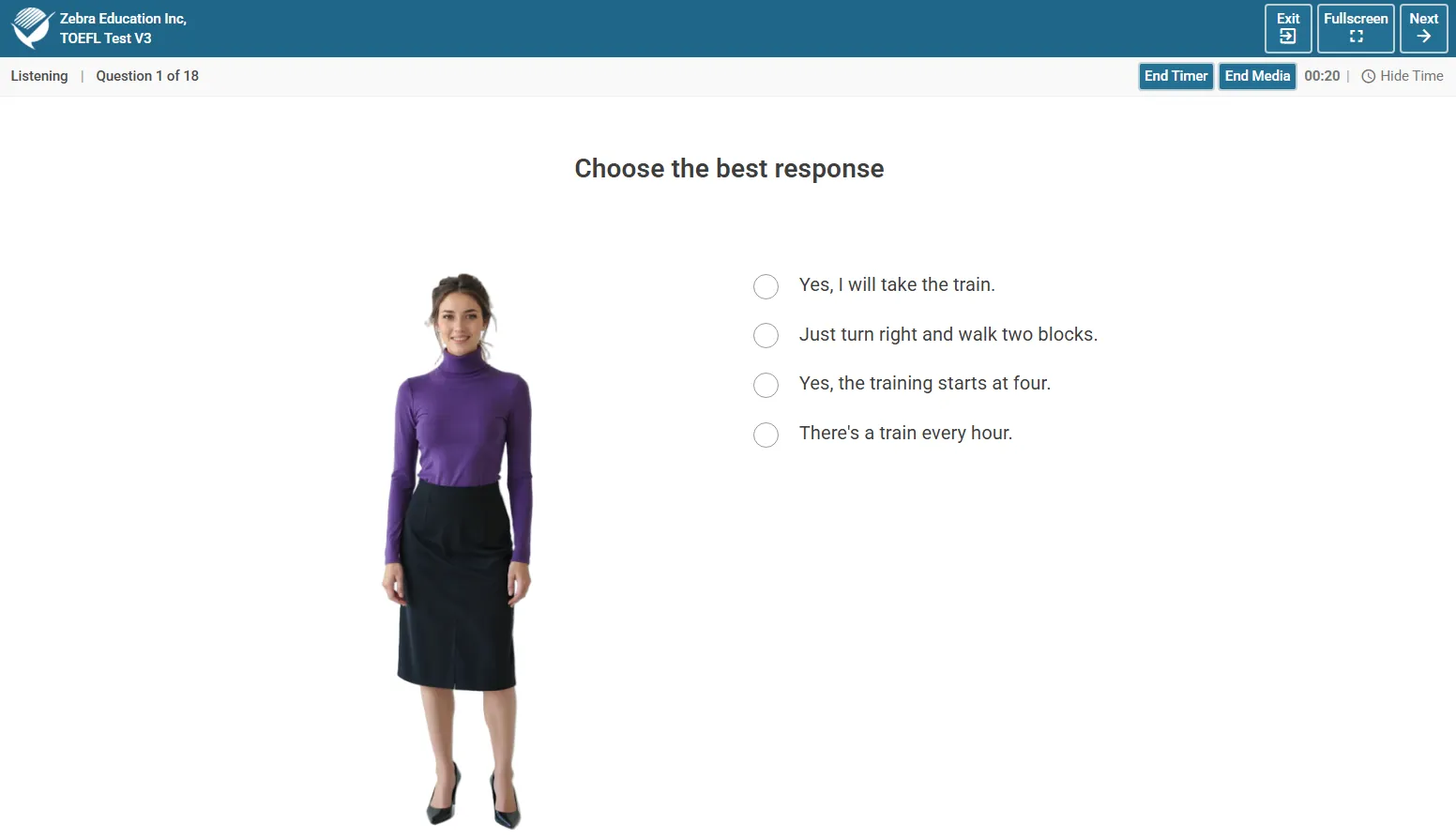
すべての問題を見るには、TOEFL Tutor AppのTOEFL Practiceメニューを開いてください。リスニングはスキルです。正しいポイントに絞ったTOEFL iBTリスニングの練習で伸びていきます。課題タイプを学び、練習セットを解き、ミスを問題タイプ別に確認しましょう。
サポートが必要な場合は、次のリスニングサポートツールをご利用ください:
- BestMyLingo (実際の場面を聞いて応答する)
- TOEFL語彙トレーニング (すばやく単語を認識する力をつける対話型の練習)
- TOEFLリスニングTutor App (練習問題、レッスン、シミュレーションテスト)
無料のTOEFLリスニングレッスン
無料アカウントを作成すると、TOEFLリスニングの最初の3つのレッスンを開いて、リスニングスキルを伸ばし始められます。
- TOEFLリスニング入門
- 成功のためのTOEFLリスニング戦略
- Detail(詳細)問題
プレミアム会員は、Inference、Gist-Purpose、Gist-Content、Rhetorical Purpose、Choose a Response、Function、Reason-for-Actionの各レッスン、TOEFLリスニング模範テスト1、15の模範練習セットも利用できます。
無料でサインアップTOEFL Listening向けの無料練習教材
以下はすべて無料のTOEFLリスニング練習です。どれも現在のTOEFLリスニングセクションの4つの課題タイプに合わせて作られていて、各練習セットには音声、スクリプト、解答が付いています。
- Listen and Choose a Responseのフル練習問題:画像、音声、20秒タイマー付きの8問です。
- Conversationのフル練習問題:2問とスクリプト付きの短い会話です。
- Announcementのフル練習問題:2問とスクリプト付きの短いアナウンスです。
- Academic Talkのフル練習問題:4問とスクリプト付きの講義です。
- サンプルテスト1:適応型シミュレーションで受けられる、無料のフルレングスTOEFLリスニング模試です。
- TOEFLリスニングの問題タイプ:すべての問題タイプを、音声の例と各選択肢の理由と一緒に紹介しています。
- 解答付きTOEFLリスニングPDF:スクリプトと解答付きの16セット68問です。無料アカウントがあれば無料で使えます。
このページの数字は、BestMyTest での TOEFL 練習の 2026年10月 までの記録であるBestMyTest TOEFL 学習者パフォーマンスデータによるものです。それぞれの数字の測り方はそのページで説明しています。最終更新:2026年10月15日。