
This guide collects our TOEFL preparation lessons: how to prepare, a one month study plan, a six month study plan, how to score high, and how to reach your dream score.
The Ultimate Guide for Your TOEFL Preparation
When it comes to taking the TOEFL it may seem a bit intimidating at first or a bit confusing on where to start. This is where the ultimate guide for your TOEFL preparation comes in handy. The following preparation guides for each of the TOEFL sections and the article how to score high on the TOEFL will help you achieve your target TOEFL score.
- The ultimate guide for the TOEFL reading section
- The ultimate guide for the TOEFL listening section
- The ultimate guide for the TOEFL speaking section
- The ultimate guide for the TOEFL writing section
In addition to the above preparation guides, you need to have a plan for your TOEFL preparation. Here is a simple step by step plan you can follow to help you prepare well enough to achieve your desired TOEFL score.
Step 1: Set a TOEFL Goal Score
The best way to figure out a single passing TOEFL score is to determine beforehand what the bare minimum TOEFL score requirements are for the schools you wish to study in. Out of your list of schools try to take the school with the highest TOEFL score requirement and set that as your TOEFL score goal. This way even if you don't meet the highest score requirement you will still be able to meet your other choices for college/university and their TOEFL score requirements.
For example, you can make a simple chart showing the schools you want to apply to, their minimum TOEFL score requirements, and any other notes about the schools. Finding each school's TOEFL score requirements is as simple as looking up “TOEFL requirements for this [school name]” or “minimum TOEFL score requirements for [school name]”.
Here is an example:
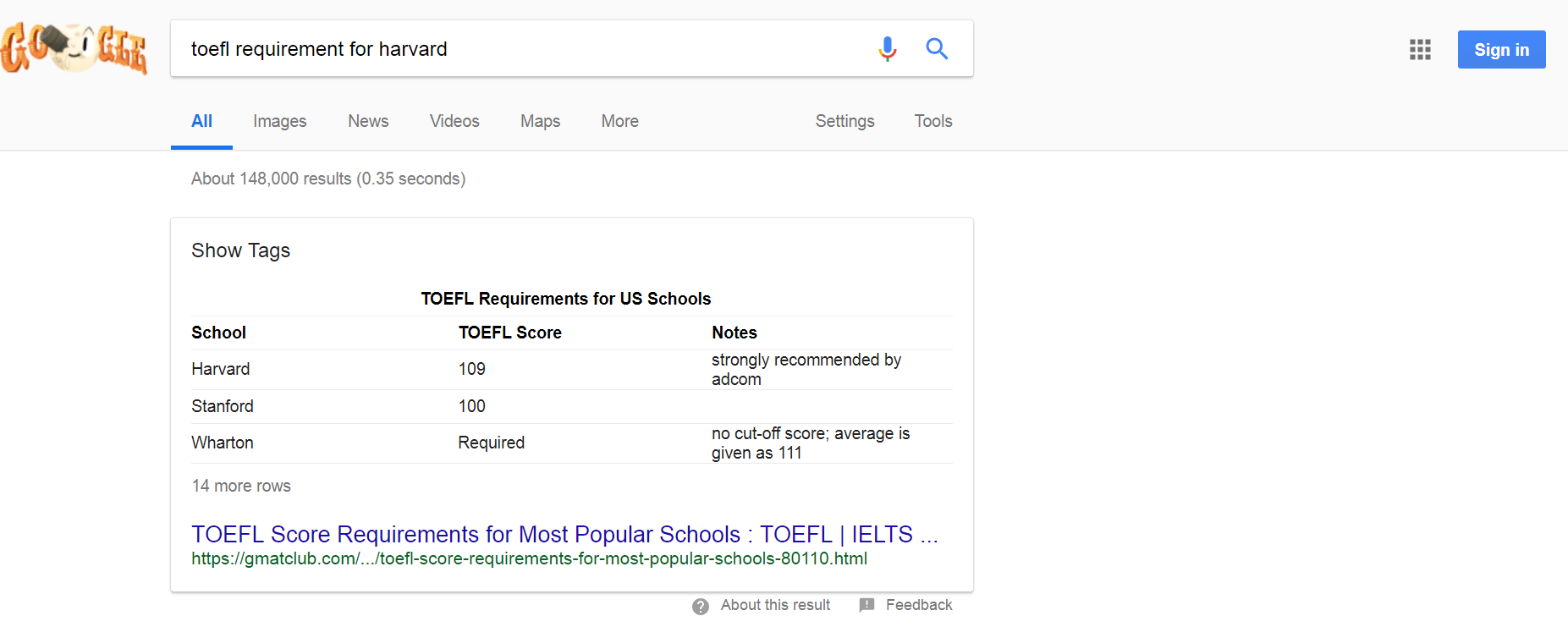
To look up for TOEFL requirements for universities, you can check online here. There are many universities in Scotland, Wales, and Northern Ireland that are partnered with UK universities and colleges. However, these colleges may not accept TOEFL and instead either require no TOEFL scores or IELTS scores for admissions.
Related article: TOEFL Requirements for Colleges and Universities: What Score Do You Need for Admissions?
Step 2: Get to know the TOEFL format
The TOEFL is divided up into four sections: reading, listening, speaking and writing. Here is how the TOEFL is generally structured:
| Test Section | Number of questions | Timing |
| Reading | 3-4 passages 12-16 questions each | 60–80 minutes |
| Listening | 4-6 lectures, 6 questions each 2-3 conversations, 5 questions each | 60–90 minutes |
| BREAK | 10 minutes | |
| Speaking | 6 tasks: 2 independent and 4 integrated | 20 minutes |
| Writing | 1 integrated task 1 independent task | 20 minutes 30 minutes |
Also please note that you may be given extra experimental questions for the reading and listening sections of the test. This will add both more questions and increase the time for these sections of the TOEFL. Make sure you research and review each section of the TOEFL to understand what sort of content you may need to review in advance.
For more information, visit ETS.
Step 3: Find your baseline score
You are probably wondering what is a baseline score? Well, a baseline score is the overall total score that you get when you take a practice test version of the TOEFL.
Once you finish a practice test, write down the scores for each section, add them together to get your total TOEFL score. Having a baseline TOEFL score can be helpful when you want to determine which areas of the test you need to focus on the most.
Take your first TOEFL practice test.
Step 4: Calculate the Number of Hours You’ll Need to Study
Once you have figured out both your baseline score and your goal score you can now begin to determine how many hours you will need to study. First, subtract you base score from your goal score. The point difference will determine how many hours you should spend studying.
For every 15 hours you study with Bestmytest, you expect to improve 1 point.
For example, if you scored a 75 on your last TOEFL and your dream TOEFL score is 100, that means that you need 25 more points.
25 points x 15 hours per point = 375 hours. If you study 4 hours a day, you need to study for over 93 days (over 3 months).
Now, apply our formula: how many hours do you need to reach your dream TOEFL score?
Step 5: Make a study plan

Making a study plan can sound tedious and a bit confusing at first. You may or may not know where to start either as far as reading, listening, writing and speaking. Don't worry though this guide has you covered! If you are unsure about where to start your studying, you can use this great example of a one-month study plan to achieve your TOEFL score goals.
| Task | Goal | Time |
| Complete Master TOEFL speaking 1-6 lessons | Learn tips and answer templates of all TOEFL speaking tasks. | 1 - 2 hours |
| Practice 30 TOEFL speaking task 1 questions | Become comfortable with giving an organized 45-second speech for the speaking task 1 | 10 hours |
| Practice 30 TOEFL speaking task 2 questions | Become comfortable with giving an organized 45-second speech for the speaking task 2 | 10 hours |
| Practice 15 TOEFL speaking 3 questions | Become familiar with taking notes from the reading campus passages and campus conversations in order to give an organized 60 seconds speech for the speaking task 3 | 8 hours |
| Practice 20 TOEFL speaking 4 questions | Become familiar with taking notes from the academic passages and university lectures in order to give an organized 60 seconds speech for the speaking task 4 | 10 hours |
| Practice 15 TOEFL speaking 5 questions | Become familiar with taking notes from campus conversations in order to give an organized 60 seconds speech for the speaking task 5 | 8 hours |
| Practice 20 TOEFL speaking 6 questions | Become familiar with taking notes from university lectures in order to give an organized 60 seconds speech for the speaking task 4 | 10 hours |
| Take a full TOEFL speaking exam and have our TOEFL reviewers review your speaking responses | Identify your speaking mistakes and how to improve TOEFL speaking score by following feedback from our TOEFL reviewers | 1 hour |
| Complete 4 TOEFL Independent writing lessons | Learn how to write a full TOEFL Independent essay | 1 - 2 hours |
| Complete 2 TOEFL Integrated writing lessons | Learn how to write a full TOEFL Integrated essay | 1 - 2 hours |
| Write 12 essays for 6 question types of TOEFL independent essays | 1. Get used to writing essays for 6 different question types of TOEFL independent essays. 2. Compare your essays with sample essays
| 12 hours |
| Write 8 TOEFL integrated writing tasks | Get used to writing for TOEFL integrated writing tasks. Compare your essays with sample essays | 8 hours |
| Request 4 writing reviews | Identify your writing mistakes and how to improve TOEFL writing score by following feedback from our TOEFL reviewers | 1 hour |
| Complete 60 TOEFL reading practice and review answers | 1. Increase your reading comprehension speed via reading TOEFL reading passages 2. Be familiar with answering different reading question types. 3. Practice timing during TOEFL reading tests | 40 hours |
| Complete 60 TOEFL Listening practice and review answers | 40 hours | |
| Take 2 TOEFL full tests | 8 hours | |
| Total | 170 hours | |
To see our TOEFL lessons, go to our TOEFL Lessons page
Here are other two recommended study plans for you:
Intense One month TOEFL study plan
Intense Six-month TOEFL study plan
Step 6: Use High-Quality Resources to Practice
There are multiple resources you can use to study and prepare for your TOEFL. You can use some of the free official TOEFL resources, these will have sample TOEFL questions and tips to help you better your score. The official TOEFL website offers many resources to help you prepare well such as books, apps, and online practice tests (for a fee)
There are many great online TOEFL courses and tutors that will be able to help you for a small cost. Tutors are one of the best ways to help you prepare well for the TOEFL. Tutors help assess your trouble areas, provide feedback and study plans to help you get on track, provide lessons and more. It is definitely worth the investment to get a tutor if you are unsure of how to meet your TOEFL score goals.
Other high-quality resources you can use are TOEFL study guide books since they often offer multiple practice tests and can help supplement your lessons with your tutor.
If you are looking for high-quality TOEFL practice tests, check this guide Preparing for the TOEFL Test with TOEFL Practice Tests
Step 7: Hone your test-prep and test-taking strategies
There are multiple strategies you can try when studying for each section. Go to our TOEFL Lessons page to check out test-prep and test-taking strategies.
Step 8: Target Your Weaknesses
The best study tip of all is to study the hard parts first. By studying and spending more time on the sections you struggle with most, you will be able to improve your understanding and overall score in those sections. For example, if you spend more study time with practicing your listening and speaking skills you will be able to improve your score in these specific sections. Practicing these hard sections first will also help you build more confidence in your English speaking and listening skills. If you struggle with writing or reading, then you should spend time practicing these skills as often as possible.

What to do if you don't meet your TOEFL score goal
In the unfortunate event that you were not able to achieve a high enough score, you can always retake the TOEFL. By retaking the exam after you have spent time targeting your weaknesses you will have a better chance of reaching your TOEFL score goal.
Retaking the test is also a great way to determine how you can do better next time. For instance, you can learn where you need the most work in, what you need to practice and/or study most in, and what parts you don't need as much practice. This can all help you determine what you need to do to get a higher score next time. Avoid retaking the test twice within 12 days of your last TOEFL.
Remember with every small setback there is always a lesson to be learned. The TOEFL is no different.
Final thoughts
When you want to meet your TOEFL score goal you will need to make sure you have plenty of time to study. To help with your studying you can take advantage of the various studying resources for the TOEFL.
Books are a great resource and study tool to use since you get access to not only practice tests but also a physical text that you can take with you when you don't have access to a computer.
Online tutors are another great study option to use when you want to make improvements by at least 7+ points. Not only will they help you improve through lessons but they will also be able to offer feedback and advice outside of your lessons.
Remember to give yourself time if you were unable to meet your original TOEFL score goal.
A One Month Study Plan for TOEFL® Success
Introduction
This study plan was created by professional TOEFL instructors to help you organize your TOEFL studying over a one month period. This plan includes suggestions on how to study each TOEFL section and a one-month study schedule.
Do I have to use this study plan to pass TOEFL?
No. We created this plan to help users who want/need help organizing their TOEFL studying and users whose English skills are not at a high level. You are more than welcome to use our TOEFL preparation website on your own. Actually, many of our previous users passed TOEFL without using this study plan, but most of them were individuals who have a higher level of English and simply needed to practice.
The Goal
If you use this study guide, it’s safe to assume your test will be within 1 month. Therefore, the main objective of this plan is to improve your overall English skills and get you completely familiar with the TOEFL test within 1 month. By the end of the study plan, you will know the TOEFL format and question types, as well as the skills needed to successfully ace the exam.
Before You Start
If you have not already done so, familiarize yourself with the TOEFL test format and questions, in order to get a quick glimpse at what the exam entails.
How to Study each TOEFL section
Vocabulary Section
A good command of English vocabulary is extremely important in scoring well on the four sections of the TOEFL. We strongly recommend that you utilize our TOEFL vocabulary interactive training program to study the top 1200 vocabulary words that are most likely to show up on the TOEFL. In addition, it is highly recommended that you complete 6 lessons of “Learn Common TOEFL Synonyms” series to enhance your paraphrasing skills.
While studying vocabulary words, we suggest the following:
- Write the words in a notebook.
- Say the words many times
- Use the words in your speaking and writing answers.
Reading Section
When studying the TOEFL Reading section, make sure of the following:
- Improve your reading and comprehension speed. The key to improving reading and comprehension speed is having a strong knowledge of English sentence structures and academic vocabularies. You can work on them by utilizing our TOEFL vocabulary interactive training program, our grammar lessons, and other external materials that teach you grammar.
- Understand the 12 different types of reading questions. Some question types such as “inference questions” and “Negative factual information” are tricky. If you find yourself stuck on those type of questions, you should skip them and move on to easier questions. Our TOEFL reading lessons cover all the reading question types and offer strategies for answering them successfully.
- When practicing reading exercises, do not just complete them and move on. If you have trouble understanding the passages, please do not skip the passages, you must put more effort toward understanding them.
Listening Section
When studying the TOEFL Listening section, make sure of the following
- Listen to a variety of academic topics. TOEFL listening topics are selected from a wide array of academic topics including biology, history, ecology, anthropology, etc. Few students are good at all of them. This is the biggest challenge for many TOEFL test takers. For example, you might have no clue about topics related to archaeology. But don’t worry, our listening questions cover all of the topics. You’ll just need to follow our study plan.
- When listening to the lecture, listen for important nouns, main ideas, and key relationships, (The relationship can be comparison, contrast, or cause-effect). If you can take note of them, it would be ideal as you can refer to them when answering questions. If you can’t, make sure you understand and memorize the main ideas.
- If you find yourself struggling with one exercise, listen to the same one multiple times until you can understand at least 85% of the lecture.
- ALWAYS LISTEN in your daily life. Aside from our listening exercises and vocabulary listening materials, you can listen to other English podcasts or videos.
Speaking Section
Here are a few tips for studying the TOEFL Speaking section:
- PRACTICE SPEAKING AS MUCH AS YOU CAN. Make sure you read your responses aloud and pay attention to your pronunciation, intonation, grammar, organization, and fluency. You should record your responses in our recorder and analyze your responses to see where and what you can do better.
- Imitate responses from sample answers to improve your pronunciation, intonation, grammar, organization, and fluency.
- Be sure to look up words that you don’t know how to pronounce or use them and learn to pronounce them correctly.
- When listening to the lecture, listen for important nouns, main ideas, and key relationships, (The relationship can be comparison, contrast, or cause-effect). If you can take note of them, it would be ideal as you can refer to them when preparing your response. If you can’t, make sure you understand and memorize the main ideas.
- You can use your speaking review tickets to get our TOEFL reviewer to review your speaking responses.
- Use external materials like Youtube to teach you how to improve your English pronunciation and speak like a native English speaker.
Writing Section
It takes time to develop good writing skills. Chances are a good English writer already has years of experience writing English and using English in their daily life. If you are not a good English writer, do not get frustrated. The good news is that you only need to be able to write well on TOEFL independent and integrated tasks. Here are a few things we suggest you do in order to complete the TOEFL Writing section in the most effective manner.
- To write well, first you need to read good essays so your brain has a database of good English structures and vocabularies you can use when writing. That being said, we recommend that you read and learn from our sample essays as much as possible. When learning these sample essays, do not just memorize them, but study how a paragraph is formed with different sentence structures, what words are used, and what main ideas are included. Ask yourself “Can I write similar sentence structures?” and “Can I form a sentence with these vocabulary words?”. The more you study, the more your writing skills will improve. The next time you write about a similar topic, you will be able to utilize them in your writing and add your own ideas.
- If you are not a good writer, spend at least an hour a day practicing independent writing and integrated writing tasks.
- Spend some time brainstorming ideas for all independent writing essays.
- Complete our writing lessons to ensure you know what characteristics a high-scoring TOEFL essay should have. In short, the following are key factors in scoring well on the TOEFL Writing section
- Understand the different types of prompts that appear in the independent writing section.
- Write a clear opinion or position on an issue.
- Write a good introduction and a good conclusion paragraph.
- Write 3 main body paragraphs. Each body paragraph should consist of a main idea and specific examples with details that support the main idea.
- Make good use of transition words to connect your ideas.
- Use a variety of words, both common and academic, correctly and appropriately.
- Use a variety of sentence structures correctly and appropriately.
- Master paraphrasing, synthesising, citing, and note-taking skills.
- Utilize all of our writing lessons
1 Month Study Schedule
Week One
Reading Section:
- Complete 9 reading exercises.
Optional:
- Complete 5 more reading exercises.
- Complete all TOEFL reading lessons.
Listening Section:
- Study Anthropology & Archaeology Vocabularies
- Study Astronomy Vocabularies
- Study Marine Biology Vocabularies
- Complete 1 listening exercise in the “Anthropology” category.
- Complete 3 listening exercises in the “Archaeology” categories.
- Complete 2 listening exercises in the “Astronomy” category.
- Complete 2 listening exercises in the “Marine Biology” category.
- Complete 3 listening exercises in the “Campus Conversation“ category.
Optional:
- Complete 1 more listening exercise in the Anthropology” category.
- Complete 2 more listening exercises in the Archaeology” category.
- Complete 2 more listening exercises in the “Astronomy” category.
- Complete 2 more listening exercises in the “Marine Biology” category.
- Complete all TOEFL listening lessons
Writing Section:
- Complete all TOEFL Writing lessons.
- Learn “compare and contrast transition words” lesson
- Learn “cause and effect transition words” lesson
- Write 4 independent writing essays for the “Agree and Disagree” questions.
- Write 2 independent writing essays for the “Comparison and Contrast” questions..
- Using “Agree and Disagree” and “Comparison and Contrast” writing questions from the question bank, try to think of three main points for each question. If possible, take notes about the main points in your notebook. This will help you practice brainstorming and save time during the test.
- Practice 4 TOEFL integrated writing questions.
Optional:
- Read and study 8 sample essays of Agree and Disagree” and 4 sample essays of “Comparison and Contrast” questions. (The more you read and study, the more your writing skills will improve.)
- Get a professional to review your essays.
Speaking Section:
- Do 4 questions of independent speaking question 1
- Do 4 questions of independent speaking question 2
- Do 3 questions of integrated speaking question 3
- Do 5 questions of integrated speaking question 4
- Do 3 questions of integrated speaking question 5
- Do 5 questions of integrated speaking question 6
Optional:
- Complete TOEFL Speaking lessons
- Do 3 more questions of independent speaking question 1.
- Do 3 more questions of independent speaking question 2.
- Do 2 more questions of integrated speaking question 3.
- Do 2 more questions of integrated speaking question 4.
- Do 2 more questions of integrated speaking question 5.
- Do 2 more questions of integrated speaking question 6.
- Use your speaking review tickets to request our TOEFL reviewer to review your speaking responses.
TOEFL Simulated Test
- Complete reserved Simulated Test 1.
Week Two
Reading Section:
- Complete 9 reading exercises.
Optional:
- Complete 5 more reading exercises.
Listening Section:
- Study Biology Vocabularies: https://www.bestmytest.com/toefl/vocabulary/exercise/5 https://www.bestmytest.com/toefl/vocabulary/exercise/6
- Study Botany Vocabularies: https://www.bestmytest.com/toefl/vocabulary/exercise/7
- Study Ecology Vocabularies: https://www.bestmytest.com/toefl/vocabulary/exercise/11
- Study Geology Vocabularies: https://www.bestmytest.com/toefl/vocabulary/exercise/14
- Complete 3 listening exercises in the “Biology” category.
- Complete 2 listening exercises in the “Botany” category.
- Complete 2 listening exercises in the “Ecology” category.
- Complete 2 listening exercises in the “Geology” category.
- Complete 3 listening exercises in the “Campus Conversation“ category.
Optional:
- Complete 2 more listening exercises in the “Biology” category.
- Complete 1 more listening exercise in the “Botany” category.
- Complete 1 more listening exercise in the “Ecology” category.
- Complete 2 more listening exercises in the “Geology” category.
Writing Section:
- Write 4 independent writing essays for the “Preference” questions.
- Write 2 independent writing essays for the “Comparison and Contrast” questions.
- Using “Preference” and “Comparison and Contrast” writing questions from the question bank, try to think of three main points for each question. If possible, take notes on these main points in your notebook. This will help you practice brainstorming and save time during the test.
- Practice 4 TOEFL integrated writing questions.
Optional:
- Read and study 7 sample essays of “Preference” questions and 3 sample essays of “Comparison and Contrast” questions from our TOEFL Writing Question Bank.
- Get a professional to review your essays.
Speaking Section:
- Do 4 questions of independent speaking question 1
- Do 4 questions of independent speaking question 2
- Do 3 questions of integrated speaking question 3
- Do 5 questions of integrated speaking question 4
- Do 3 questions of integrated speaking question 5
- Do 5 questions of integrated speaking question 6
Optional:
- Complete TOEFL Speaking lessons
- Do 3 more questions of independent speaking question 1
- Do 3 more questions of independent speaking question 2
- Do 2 more questions of integrated speaking question 3
- Do 2 more questions of integrated speaking question 4
- Do 2 more questions of integrated speaking question 5
- Do 2 more questions of integrated speaking question 6
- Use your speaking review tickets to request our TOEFL reviewer to review your speaking responses
TOEFL Simulated Test
- Completed reserved Simulated Test 2.
Week Three
Reading Section:
- Complete 9 reading exercises.
Optional:
- Complete 5 more reading exercises
Listening Section:
- Study Art History Vocabularies
- Study Business Vocabularies
- Study Economics Vocabularies
- Study History Vocabularies
- Complete 4 listening exercises in the “History” category
- Complete 3 listening exercises in the “Art History“ category
- Complete 2 listening exercises in the “Architecture” category
- Complete 1 listening exercise in the “Film History” category
- Complete 3 listening exercises in the “Campus Conversation“ category
Optional:
- Complete 2 listening exercises in the “History” category
- Complete 2 listening exercises in the “Art History“ category
- Complete 1 listening exercise in the “Architecture” category
- Complete 1 listening exercise in the “Film History” category
Writing Section:
- Write 4 independent writing essays for the “If / Imaginary” questions.
- Using “If / Imaginary” writing questions from the question bank, try to think of three main points for each question. If possible, take notes on the main points in your notebook. This will help you practice brainstorming and save time during the test.
- Practice 4 TOEFL integrated writing questions.
Optional:
- Read and study 7 sample essays of “If / Imaginary” questions from our TOEFL Writing Question Bank.
- Get a professional to review your essays.
Speaking Section:
- Do 4 questions of independent speaking question 1
- Do 4 questions of independent speaking question 2
- Do 3 questions of integrated speaking question 3
- Do 5 questions of integrated speaking question 4
- Do 3 questions of integrated speaking question 5
- Do 5 questions of integrated speaking question 6
Optional:
- Complete TOEFL Speaking lessons
- Do 3 more questions of independent speaking question 1
- Do 3 more questions of independent speaking question 2
- Do 2 more questions of integrated speaking question 3
- Do 2 more questions of integrated speaking question 4
- Do 2 more questions of integrated speaking question 5
- Do 2 more questions of integrated speaking question 6
- Use your speaking review tickets to request our TOEFL reviewer to review your speaking responses
TOEFL Simulated Test
- Complete reserved Simulated Test 3
Week Four
Reading Section:
- Complete 9 reading exercises
Optional:
- Complete 5 more reading exercises
Listening Section:
- Study Earth Science Vocabularies
- Complete 3 listening exercises in the “Earth Science” category
- Complete 2 listening exercises in the “Literature“ category
- Complete 1 listening exercise in the “Human Biology” category
- Complete 1 listening exercise in the “Marketing” category
- Complete 2 listening exercises in the “Sociology” category
- Complete 3 listening exercises in the “Campus Conversation“ category
Optional:
- Complete 2 more listening exercises in the “Earth Science” category
- Complete 2 more listening exercises in the “Literature“ category
- Complete 1 more listening exercise in the “Human Biology” category
- Complete 1 more listening exercise in the “Sociology” category
Writing Section:
- Write 4 independent writing essays for the “Description and Explanation” questions.
- Using “Description and Explanation” writing questions from the question bank, try to think of three main points for each question. If possible, take notes on the main points in your notebook. This will help you practice brainstorming and save time during the test.
- Practice 4 TOEFL integrated writing questions.
Optional:
- Read and study 7 sample essays of “Description and Explanation” questions from our TOEFL Writing Question Bank. The more you read and study, the more your writing skills improve.
- Get your essays reviewed
Speaking Section
- Do 4 questions of independent speaking question 1
- Do 4 questions of independent speaking question 2
- Do 3 questions of integrated speaking question 3
- Do 5 questions of integrated speaking question 4
- Do 3 questions of integrated speaking question 5
- Do 5 questions of integrated speaking question 6
Optional:
- Complete TOEFL Speaking lessons
- Do 3 more questions of independent speaking question 1
- Do 3 more questions of independent speaking question 2
- Do 2 more questions of integrated speaking question 3
- Do 2 more questions of integrated speaking question 4
- Do 2 more questions of integrated speaking question 5
- Do 2 more questions of integrated speaking question 6
- Use your speaking review tickets to request our TOEFL reviewer to review your speaking responses
TOEFL Simulated Test
- Complete reserved Simulated Test 4
Review
Leave some time for yourself to review what you have studied
You are now finished the One Month Study Plan.
Congratulations and good luck on TOEFL!
A 6 Month TOEFL Study Plan for Your TOEFL Preparation Success
Who needs a 6 Month TOEFL Study Plan
If you want to score high in TOEFL, planning out a TOEFL study schedule is a critical first step in your TOEFL preparation. The first thing you need to figure out is how much time you want to spend studying for TOEFL. To do that, you'll need to know your target TOEFL score and your level of English proficiency. Typically, there are two types of students who prepare for the TOEFL iBT:
- TOEFL Preparation Student Type #1: Those who already have advanced academic English proficiency and who want to familiarize themselves with the structure, format, and test-taking strategies for the TOEFL iBT.
- TOEFL Preparation Student Type #2: Those who do not have advanced English proficiency and who want to, at least, get a score of 85 or who want to improve their overall TOEFL score by more than 15 points.
The second group of students, before they are ready to focus on test-taking strategies for the TOEFL iBT, will first need to spend time on enhancing their vocabulary, pronunciation, grammar, listening, reading, writing, and speaking skills. From the past 7 years of experience helping students prepare for TOEFL, a type #2 student needs a minimum of at least 4 months to improve their academic English abilities to a level where they are able to handle the TOEFL test comfortably. The additional 2 month of TOEFL study will further help improve their confidence and TOEFL skills and should not be wasted.
It's been shown that if you stop studying for TOEFL, even just a few weeks before your TOEFL test, your English skills become rusty and that could prevent you from achieving your target TOEFL score. Therefore, if you're a TOEFL preparation student type #2 (which is completely fine; More than 50% of our students are type #2) it's highly recommended you prepare for a minimum of 4 months using our 6 month TOEFL study plan.
6 Month TOEFL Study Plan Breakdown
This study plan was created by professional TOEFL instructors to help you organize your TOEFL studying over a six month period. This plan includes suggestions on how to study each TOEFL section and a six-month study schedule.
This plan is broken down into 6 months and 4 phases:
- Month 1: You will be focussing on building fundamental English skills.
- Month 2 - 4: Using the skills you learned during month 1, you will do many TOEFL exercises, TOEFL practices, and 3 reserved simulated tests.
- Month 5: You will review everything you learned in months 1 - 4.
- Month 6: You will do a final reserved simulated test and review everything before the official TOEFL exam.
Before we begin, it's important you understand how to study each section of the TOEFL during your TOEFL preparation.
How to Study TOEFL Vocabulary Section
A good command of English vocabulary is extremely important in scoring well on the four sections of the TOEFL. We strongly recommend that you utilize our TOEFL vocabulary interactive training program to study the top 1200 vocabulary words that are most likely to show up on the TOEFL. In addition, it is highly recommended that you complete 6 lessons of “Learn Common TOEFL Synonyms” series to enhance your paraphrasing skills.
While studying vocabulary words, we suggest the following:
- Write the words in a notebook.
- Say the words many times
- Use the words in your speaking and writing answers.
How to Study TOEFL Reading Section
When studying the TOEFL Reading section, make sure of the following:
- Improve your reading and comprehension speed. We explain why you should do that in the TOEFL Reading Tip section. The key to improving reading and comprehension speed is having a strong knowledge of English sentence structures and academic vocabularies. You can work on them by utilizing our TOEFL vocabulary interactive training program, our grammar lessons, and other external materials that teach you grammar.
- Understand the 12 different types of reading questions. Some question types such as “inference questions” and “Negative factual information” are tricky. If you find yourself stuck on those type of questions, you should skip them and move on to easier questions. Our TOEFL reading lessons cover all the reading question types and offer strategies for answering them successfully.
- When practicing reading exercises, do not just complete them and move on. If you have trouble understanding the passages, please do not skip the passages, you must put more effort toward understanding them.
How to Study TOEFL Listening section
When studying the TOEFL Listening section, make sure of the following
- Listen to a variety of academic topics. TOEFL listening topics are selected from a wide array of academic topics including biology, history, ecology, anthropology, etc. Few students are good at all of them. This is the biggest challenge for many TOEFL test takers. For example, you might have no clue about topics related to archaeology. But don’t worry, our listening questions cover all of the topics. You’ll just need to follow our study plan.
- When listening to the lecture, listen for important nouns, main ideas, and key relationships, (The relationship can be comparison, contrast, or cause-effect). If you can take note of them, it would be ideal as you can refer to them when answering questions. If you can’t, make sure you understand and memorize the main ideas.
- If you find yourself struggling with one exercise, listen to the same one multiple times until you can understand at least 85% of the lecture.
- ALWAYS LISTEN in your daily life. Aside from our listening exercises and vocabulary listening materials, you can listen to other English podcasts or videos.
How to Study TOEFL Speaking Section
Here are a few tips for studying the TOEFL Speaking section:
- PRACTICE SPEAKING AS MUCH AS YOU CAN. Make sure you read your responses aloud and pay attention to your pronunciation, intonation, grammar, organization, and fluency. You should record your responses in our recorder and analyze your responses to see where and what you can do better.
- Imitate responses from sample answers to improve your pronunciation, intonation, grammar, organization, and fluency.
- Be sure to look up words that you don’t know how to pronounce or use them and learn to pronounce them correctly.
- When listening to the lecture, listen for important nouns, main ideas, and key relationships, (The relationship can be comparison, contrast, or cause-effect). If you can take note of them, it would be ideal as you can refer to them when preparing your response. If you can’t, make sure you understand and memorize the main ideas.
- You can use your speaking review tickets to get our TOEFL reviewer to review your speaking responses.
- Use external materials like Youtube to teach you how to improve your English pronunciation and speak like a native English speaker.
How to Study TOEFL Writing Section
It takes time to develop good writing skills. Chances are a good English writer already has years of experience writing English and using English in their daily life. If you are not a good English writer, do not get frustrated. The good news is that you only need to be able to write well on TOEFL independent and integrated tasks. Here are a few things we suggest you do in order to complete the TOEFL Writing section in the most effective manner.
- To write well, first you need to read good essays so your brain has a database of good English structures and vocabularies you can use when writing. That being said, we recommend that you read and learn from our sample essays as much as possible. When learning these sample essays, do not just memorize them, but study how a paragraph is formed with different sentence structures, what words are used, and what main ideas are included. Ask yourself “Can I write similar sentence structures?” and “Can I form a sentence with these vocabulary words?”. The more you study, the more your writing skills will improve. The next time you write about a similar topic, you will be able to utilize them in your writing and add your own ideas.
- If you are not a good writer, spend at least an hour a day practicing independent writing and integrated writing tasks.
- Spend some time brainstorming ideas for all independent writing essays.
- Complete our writing lessons to ensure you know what characteristics a high-scoring TOEFL essay should have. In short, the following are key factors in scoring well on the TOEFL Writing section
- Understand the different types of prompts that appear in the independent writing section.
- Write a clear opinion or position on an issue.
- Write a good introduction and a good conclusion paragraph.
- Write 3 main body paragraphs. Each body paragraph should consist of a main idea and specific examples with details that support the main idea.
- Make good use of transition words to connect your ideas.
- Use a variety of words, both common and academic, correctly and appropriately.
- Use a variety of sentence structures correctly and appropriately.
- Master paraphrasing, synthesising, citing, and note-taking skills.
- Utilize all of our writing lessons

TOEFL Study Plan: Month 1
English Skills Section:
1) Complete and study all exercises in the TOEFL Vocabulary Interactive training program. Write down all vocabulary words that you learn in your notebook. When studying them, do not just complete each exercise and move on. Instead, ask yourself the following questions before you move on to the next exercise:
- Can you pronounce each vocabulary word correctly?
- Can you identity these vocabulary words when you hear them?
- Can you use these vocabulary words correctly in your speaking and writing answers?
- Do you understand all the usages of prepositions and other vocabulary words in the example sentences?
2) Complete all “Academic Skills” lessons.
3) This is optional, but it would be a good idea to complete all “Grammar” lessons and study other external grammar teaching materials such as books, youtube videos, etc. Make sure you pick up the following grammar topics in the first month:
- All tenses including conditional tenses.
- Nouns (especially Countable nouns and Uncountable nouns), adjectives, and adverbs.
- Subject-Verb Agreement.
- Determiners (quantifiers, articles, etc.)
- Relative Pronouns and Relative Clauses
- Verb Complementation (Infinitive, Gerund, That-clause)
- Noun, adjective, and adverb clauses
- Prepositions
- Coordinating Conjunctions and Subordinating Conjunctions
- Joining two sentences using participial phrases
- Comparative and Superlative
Reading Section:
- Complete TOEFL Reading lessons
Listening Section:
- Complete 40 campus-conversation listening exercises. (Campus conversation exercises are easy to get started. Get yourself comfortable with the speed of native speakers and study vocabularies, idioms, and phrasal verbs used in the campus conversation settings)
- Complete TOEFL listening lessons
Writing Section:
- Complete all TOEFL writing lessons
- Read and study 7 sample essays from the TOEFL independent writing “Preference” questions
- Read and study 7 sample essays from the TOEFL independent writing “Agree & Disagree” questions
- Read and study 7 sample essays from the TOEFL independent writing “If / Imaginary” questions
- Read and study 7 sample essays from the TOEFL independent writing “Comparison and Contrast” questions
- Read and study 7 sample essays from the TOEFL independent writing “Description or Explanation” questions
Speaking Section:
- Complete all TOEFL Speaking lessons
- Work on your pronunciation
TOEFL Study Plan: Month 2
Reading Section:
- Complete 20 reading exercises
Listening Section:
- Complete 5 listening exercises in the “Anthropology & Archaeology” category
- Complete 4 listening exercises in the “Astronomy” category
- Complete 4 listening exercises in the “Sociology” category
- Complete 5 listening exercises in the “Biology” category
- Complete 3 listening exercises in the “Botany” category
- Complete 2 listening exercises in the “Film History” category
Writing Section:
- Complete all TOEFL Integrated Writing lessons
- Write 8 independent writing essays for the “Agree and Disagree” questions
- Practice 8 TOEFL integrated writing questions
Speaking Section:
- Do 14 questions of independent speaking question 1
- Do 14 questions of independent speaking question 2
- Do 6 questions of integrated speaking question 3
- Do 8 questions of integrated speaking question 4
- Do 6 questions of integrated speaking question 5
- Do 8 questions of integrated speaking question 6
TOEFL Simulated Test
- Complete TOEFL Simulated Test 1
TOEFL Study Plan: Month 3
Reading Section:
- Complete 20 reading exercises.
Listening Section:
- Complete 9 listening exercises in the “History” category
- Complete 5 listening exercises in the “Art History“ category
- Complete 3 listening exercises in the “Architecture” category
- Complete 2 listening exercises in the “Human Biology” category
- Complete 2 listening exercises in the “Ecology” category
Writing Section:
- Write 8 independent writing essays for the “Preference” questions
- Write 4 independent writing essays for the “Comparison and Contrast” questions
- Practice 8 TOEFL integrated writing questions
Speaking Section:
- Do 14 questions of independent speaking question 1
- Do 14 questions of independent speaking question 2
- Do 6 questions of integrated speaking question 3
- Do 8 questions of integrated speaking question 4
- Do 6 questions of integrated speaking question 5
- Do 8 questions of integrated speaking question 6
TOEFL Simulated Test
Complete reserved Simulated Test 2
TOEFL Study Plan: Month 4
Reading Section:
- Complete 20 reading exercises
Listening Section:
- Complete 7 listening exercises in the “Earth Science” category
- Complete 4 listening exercises in the “Literature“ category
- Complete 4 listening exercises in the “Marine Biology” category
- Complete 1 listening exercise in the “Marketing” category
- Complete 2 listening exercises in the “Psychology” category
- Complete 4 listening exercises in the “Geology” category
Writing Section:
- Write 8 independent writing essays for the “If / Imaginary” questions
- Write 4 independent writing essays for the “Comparison and Contrast” questions
- Practice 8 TOEFL integrated writing questions
Speaking Section
- Do 14 questions of independent speaking question 1
- Do 14 questions of independent speaking question 2
- Do 6 questions of integrated speaking question 3
- Do 8 questions of integrated speaking question 4
- Do 6 questions of integrated speaking question 5
- Do 8 questions of integrated speaking question 6
TOEFL Simulated Test
- Complete TOEFL Simulated Test 3
TOEFL Study Plan: Month 5
- Review what you have studied over the past four months
TOEFL Study Plan: Month 6
- Complete TOEFL Simulated Test 4
- Review everything
That's It! Bookmark this page, so you can easily come back to it anytime you feel you need a reminder.
Happy Studying! :)
How to score high in TOEFL
Unlike most exams or tests, when it comes to the TOEFL there is no passing or failing. What you do get is a score for each section and the test as a whole. You can then compare it to the basic entry requirements of any colleges or universities you are applying to. If you are trying to apply to multiple colleges/universities, then it is advised to strive for the highest required TOEFL score.
Are you unsure about where to start? The following guide can help you achieve a higher TOEFL score.
How to score high in TOEFL speaking
If you want to achieve a score above 26/30 on the TOEFL, then you will need to improve communication, pronunciation, language usage, and topic development.
Pronunciation and tone of voice
A student seems to be having issues with their pronunciation and/or tone when speaking in English. A TOEFL iBT pronunciation specialist can listen to the student speaking to determine what the student needs to work on most. The speaking specialist will then provide specific lessons for the student to follow.
Grammar and vocabulary
If you struggle with your grammar and vocabulary, then you should complete both an independent and integrated speaking practice test, daily. Once you complete enough of these tests, your speaking responses should be evaluated by a TOEFL iBT speaking specialist. This is so the speaking specialist can determine what you need the most help in.
For example:
A student completes a few independent speaking practice tests. The speaking specialist begins to notice that the student is avoiding or misusing adjective clauses. The specialist will then help the student learn how to rephrase the sentence to be more complex and accurate.
A TOEFL speaking specialist notices that the student is using mainly basic English vocabulary or is struggling to find the right word to say. The speaking specialist will then give recommendations for alternative synonyms. This is so the student will learn more English vocabulary and score higher on the TOEFL speaking section.
In both cases, the TOEFL iBT speaking specialist will recommend a variety of specific grammar and vocabulary lessons. These lessons will help the student achieve a higher score for the speaking section of the TOEFL.
Communication and topic development
If you need to improve your topic development and communication, you will need to complete an independent and integrated speaking practice test. This is so a TOEFL iBT speaking specialist can determine whether or not you are having problems organizing and developing ideas.
You will need to learn how to coherently organize your ideas. Knowing how to coherently organize your thoughts and idea is so your audience can distinguish between your most important and least important ideas.
Example:
A student is unable to create sharply-focused topic statements, or the details they are trying to use are not specific enough to strongly support the generalizations. A TOEFL speaking specialist will determine what the student is missing or needs to correct. The specialist will then be able to help teach the student how to organize their ideas more effectively, as well as how to provide more relevant supporting details.
How to score high in TOEFL Listening
Listen for the main idea(s) in the lecture
Expect the first question after almost every lecture to be a question about the main idea of the lecture. These types of questions are very common, so it is important to listen for the main idea. At the beginning of every listening passage, the professor usually mentions what the main topic of the lecture will be about. However, sometimes the topic might be branched into something more specific.
Make sure you pay attention to the main idea of the lecture at the beginning and be mindful when the topic changes!
Sample question:
Q. What was the lecture mainly about?
a. A comparison of two types of detective novels
b. Ways in which detective novels have changed over time
c. The Moonstone as a model for later detective novels
d. Flaws that can be found in the plot of The Moonstone
Listen to the speaker’s tone of voice or changes in intonation
Sometimes you will encounter questions that are about the speaker’s attitude or opinion. To answer these questions correctly, you need to pay attention to the speaker’s tone of voice.
For example, does the speaker sounds excited, confused, or sad?
Sample question:
Q. What can be inferred about the professor when he says this: “Uh, it’s hard at this juncture to read this novel and realize that no one had ever done that before because it all seems so strikingly familiar.”
a. He is impressed by the novel’s originality.
b. He is concerned that students may find the novel difficult to read.
c. He is bored by the novel’s descriptions of ordinary events.
d. He is eager to write a book about a less familiar subject
Listen to how the ideas are connected throughout the lecture
When listening to the lectures, make sure you take lots of notes about the way the ideas in the lectures are connected. Pay attention to how the professor organized the lecture. Taking these notes will help you in case you encounter a question asking about how the lecture is organized. You can then refer back to your notes for the answer.
Some of the main relations between ideas include cause and effect, compare and contrast, and steps in a process.
Listen for the key points of the lecture instead of specific details
TOEFL listening questions are not going to test you on the specific or small details. You won’t see any questions that are about a specific year, name, or location. Instead, you may see questions that will test your understanding of various key points mentioned in the lectures.
Sample questions:
Q. In what way is The Moonstone different from earlier works featuring a detective?
a. In its unusual ending
b. In its unique characters
c. In its focus on a serious crime
d. In its greater length
Q. According to the professor, what do the roses in The Moonstone represent?
a. A key clue that leads to the solving of the mystery
b. A relief and comfort to the detective
c. A romance between the main characters
d. Brilliant ideas that occur to the detective
Listen for any and all signal words that indicate different parts of the lecture
To help you capture the various key points in the lectures, you need to learn how to listen for specific signal words or transition words. These signal words are like the road signs that tell you what is about to come next in the lecture. Signal words can tell you the beginning or the ending of a topic. They can also help you move through the middle of the lecture by introducing other topics.
Useful study methods to help you improve your TOEFL listening score
When it comes to passing the listening section of the TOEFL, you are most likely not going to benefit much from watching movies/ TV shows or listening to music in English.
The most effective way to prepare for the TOEFL listening section is to listen to various types of academic English material. Since this will be what you encounter on the official TOEFL listening portion of the test. A great example of academic English is listening to English documentaries or listening to audible recordings of academic literature in English.
Once you have all of your TOEFL listening practice materials at hand, you will then need a systematic studying method to achieve your desired score for this section of the TOEFL.
Check this article: https://www.bestmytest.com/blog/toefl/proven-study-method-improve-your-toefl-listening-score
How to score high in TOEFL writing
Being able to express yourself clearly in writing is an essential skill, both inside and outside the classroom. It is a skill you will definitely need to have if you want to attend an English-speaking university. Most universities and colleges require students to write multiple academic essays and/or other academic-related works such as case-studies or a thesis. If your writing isn’t well-structured and fluent, then your grades will suffer.
This is the main point of the TOEFL writing section. The TOEFL writing section's main goal is to ensure that you are well equipped to flourish in an academic environment.
It can be hard to write in a language that is not your first language, but you don't need to worry as many people struggle with this too.
The key to scoring well on the writing section of the TOEFL is to understand what the TOEFL requires. Once you determine the TOEFL writing rubric and standards you can then hone your academic writing skills. If you want to score high on the writing section of the TOEFL then you will need to spend time perfecting your English academic writing.
Unsure of how to improve your writing? Here we provide you with five basic writing tips that can help you perfect your academic writing skills:
Learn how to properly structure your essay
All of your answers in the written section of the TOEFL will be in essay format. A decently written essay breaks down into three essential parts:
The introduction – a brief paragraph consisting of two or five sentences that introduce the main topic. It should also present a thesis that is a direct response to the question asked. You should also include two to three main ideas that will be discussed in the body of the essay.
The body – two to three paragraphs that support your thesis statement. Each paragraph should cover one main idea.
The conclusion – a short paragraph of three to five sentences that summarizes your thesis and draws conclusions and readdressed the key points of your essay.
If you want to do well on the TOEFL, you must be able to organize your thoughts quickly and structure them well in an essay so that what you have written is easy to understand and read. It is advised to create an outline first and then write your essay using the outline as a guide.
2.) Get used to picking sides on an issue
TOEFL essays often require students to pick a side on a particular issue, articulate a thesis, and then support the thesis with clear writing.
One of the best ways to prepare for the written portion of the exam is to learn how to evaluate a topic. You should try to pick the argument that will give you the best chance of writing a compelling essay. What often surprises many students is that they do not have to agree with the thesis they are proposing.
Once you pick the topic you want to write about, you can then brainstorm a few ideas for each side of the issue. Then you pick the side that you feel has the most compelling arguments.
If you are unsure about what topics are given on the TOEFL, you can easily find lists of typical TOEFL topics online and use them to practice. The more you practice writing about various topics the higher the chance is that you will score well in this section of the exam.
3.) Focus on the quality of the writing rather than quantity of words
Writing a long essay is not necessary. The quality of your writing shouldn't suffer as a result of writing a long response. You will be better off keeping your written responses short so as to assure a quality essay. The structure and clarity of your written responses will determine your TOEFL writing score.
As you prepare for the written portion of the exam, your main goal should be to get as comfortable as you can with the process of writing. You should strive for a clear and compelling essay that supports your main argument. It is not unheard of for short essays to get a higher score than the longer essays.
4.) Practice writing different sentence structures
Academic writing must be clear, but it shouldn't be too simple either. If you have read any well-written essay, you will notice that the sentence structure varies. Some sentences are short and straightforward, while others are can be long and more complex.
You don’t have to know all the ways to structure a sentence, but it is a good idea to study sentences and have a few structures that you can easily use correctly.
5.) Learn how to proofread and edit your own writing
If you have a few minutes after you finish writing an essay, use that remaining time to read over your essay and edit it as needed. It is fairly common, even for native English speakers, to make mistakes as they write. Sometimes we think faster than we can write. This can result in using improper grammar, poor punctuation, poor sentence structure or vocabulary.
Some of the most common writing mistakes to look for are:
- Spelling errors, including improper use of homonyms
- Punctuation errors
- Subject/verb agreement
- Repetitive words or phrases
- Poor sentence structure or run on sentences
- Improper use of a vocabulary word
Make sure you read slowly and carefully over what you have written. This will help you catch any mistakes and allow you to correct as much as you can within the remaining time that you have. Attention to detail can make a huge difference in your final writing score.
In addition to these five tips, you should always try to write in English every day. Keeping a journal or diary can help you with your writing. All you need to do is spend at least five minutes writing about your day before you go to bed.
The more ways you apply your English grammar and vocabulary, the better your writing skills will be.
How to score high in TOEFL reading
1.) Improve your reading speed
Time is of the essence when it comes to the TOEFL. In fact, having good timing and the ability to pace yourself well can make or break your TOEFL score. In other sections of the exam, time is specifically called out. For example, when you are speaking, you will have 15 seconds to prepare an answer and 45 seconds to record it. In the Listening section, you can only hear the dialogue when it is played out to you.
The reading section, however, is where having a sense of time and pace will be left up to you. You will need to judge how much time you have left to complete the required readings and answer the questions. This can be a bit tricky because you will be dealing with three to four difficult texts that may be difficult to understand.
The TOEFL reading section can have up to 56 questions for 3 to 4 passages, and the maximum time given for the whole section is 80 minutes. What this basically means is you will only have 5 minutes to read each text and approximately 1 minute to answer each question. If you want to have more time to answer the questions, then you will need read each passage in just 3 to 4 minutes. Also, you will probably want to read each passage multiple times to adequately answer the questions given.
To do well on the TOEFL reading section, you will need to improve your reading speed. As you study and practice, try to time yourself. Take note of how long it takes you to go through a given passage. You may notice that you slow down when your level of comprehension drops down. Don't worry this is perfectly normal and fixable!
When you understand less, you end up needing to slow down and read more carefully. Everyone reads at a different pace even native English speakers. What you will need to do is to make your reading pace slightly faster for this specific test-taking situation. This is so you can get through the reading section and have enough time to answer the questions for each passage.
In order to improve your reading comprehension, you should try to read from various sources. The TOEFL-style academic passages are just one source you can use. Other sources for English language material are English literature, newspapers, and magazines. When you read a variety of English writing styles you become more comfortable with the English language and you will improve your reading speed too.
2.) Work on your reading comprehension speed
Once you have worked on your reading speed and are comfortable with reading a variety of complex English passages in less than 4 minutes, you can now move on to reading comprehension.
An important test-taking strategy is to teach yourself to remain calm and avoid stressing out when you come across a word you don't know. The reading section will be full of unfamiliar words. The TOEFL puts in these unfamiliar words on purpose.
The reading section will ask you to determine the meaning of a word or use context clues to determine the unfamiliar words meaning. This is what the TOEFL reading section is mainly testing for. The TOEFL is not testing your ability to memorize a thesaurus. It is instead testing your skill at dealing with vocabulary words that you do not know.
Not knowing a word is normal, and is often expected from non-native English speakers. When you come across a word you don't understand, you might try to check an online translating tool, translating app or consult a dictionary. These types of tools are not always available. You also waste time when you panic or get hung up on an unfamiliar word.
When this happens you need to relax, skip the unknown word and continue reading. More often than not, you will find the meaning of the whole text to be fairly easy to understand, even if you were unable not understand a few of the words.
3.) Learn specific vocabulary by making a variety of vocabulary lists
You should always strive to broaden your vocabulary. This will help you to lessen the chances of stumbling over unfamiliar words. As you study for the reading section of the TOEFL, whether you are at home, on a work break or in class, go ahead and try to look up any words you don’t understand.
While you practice for the reading section of the TOEFL, try to read each and every passage completely without having to look up any words. Once you have read the whole text and tried to understand everything on your own, then you may look up any unfamiliar words. This is similar to the actual TOEFL reading section of the test.
It is important to make a list of unfamiliar words and translate them using an English-to-English dictionary. You must avoid any temptation to use a dictionary which translates words from the English language into your native language. Using these dictionaries too much can cause you to become too reliant and hinder your ability to expand your vocabulary.
The English-to-English dictionary can be very helpful. It gives you a clear English explanation for the word you do not understand and will help you familiarize yourself with synonyms (words that are similar in meaning) and antonyms (words that have opposite meanings).
Being able to recognize these types of words will come in handy for the TOEFL reading section and improve your English language skills too. Your vocabulary will grow and so will your confidence. By the time you get to your test day, you will have a much larger English vocabulary to help you out.
4.) You must keep moving, don't stop!
The TOEFL is a test after all, so timing is extremely important.
When it comes to the reading section of the exam, you must remember that you will not have more than 4 minutes per passage. Do not get hung up on every passage. Avoid stopping as much as possible. You have to keep moving no matter what!
There are 3 to 4 passages in the TOEFL reading section, and you are will most likely feel more comfortable with some of the reading passages over others.
Some passages will seem harder and some will seem easier. Skim each passage, note keywords in the sentences and remember to leave the unfamiliar terms behind. Bear in mind that the TOEFL reading passages may contain words that even native English speakers don’t typically know.
Also, the TOEFL is can be very specific.
You may see questions on the TOEFL that look like this: “The word X on line Y is closest in meaning to…” with four choices of words following. Most of the choices will either sound similar or have very similar meanings. You will need to read the text carefully in order to identify the correct answer.
5.) Use the line numbering provided on the TOEFL
The TOEFL numbers ever fifth line in each of the passages. This is meant to help you navigate quickly to the words or sentences referred to in the questions. Practice locating specific lines by the numbers provided. This will help prevent you from wasting time on the exam.
When starting the actual TOEFL, make sure you take a deep breath and remain calm throughout the reading section of the test. With all these tips, lessons, practice and so on provided in this guide, you are bound to get the high TOEFL score you worked hard for!
Reaching That Dream Score on the TOEFL®
TOEFL is not a pass/fail exam. So no matter how badly you have done or how well you perform, you will always get back a numeric score. If there's no Fail rate, how can you know what is a good TOEFL score? Honestly, that is a difficult question to answer correctly. A good score can be 90 or 100 or 110. It all depends on the program you apply to and your personal goal. On average a TOEFL score of 90 is really good, however, if your program requires 100, then it's not good enough. Some programs don’t require a specific overall score, but require a higher score in the speaking section. Please be aware of this when you are studying.
No matter what your goal is, we can all agree on one thing: a higher score is better. So, how do get that dream score of yours? Here are a few easy things that if you do regularly can help you improve your English skills and therefore your TOEFL score.
Study
I know. I know. Why am I talking about this? Isn't it obvious that you have to study for a test? (Yes, you do.) What I'm talking about here is not just studying but studying with the right approach.
First of all, you need to study all four skills that the TOEFL will test you on: speaking, listening, writing, and reading. Get yourself familiar with the test patterns. Know what to expect. After practicing each section and skill individually, try taking a full-length practice test. It would be best if you time yourself as if it's a real test. You can take a TOEFL practice test with integrated timer here: https://www.bestmytest.com/toefl/practice-test. The result of the full-length test will help you understand your strengths and weaknesses. Those strengths and weaknesses are what move you to the next level of studying. Knowing what you are good at and what needs to be improved will help you distribute your study time more efficiently and you can be sure your overall TOEFL score will improve.
Study Buddy
Sometimes it is helpful to have someone to study with, not only to make study sessions fun, but you can help each other learn. Your study buddy can also be the one that motivates you to keep going whenever you are down. You can do the same for him/her. If you can't find a study buddy in person, I'm sure you can find one online. Isn't it exciting to study while making new friends! Here at BestMyTest we have a social platform where you can communicate with other BestMyTest users. You can even use our social platform to have a voice or video call. But remember to be respectful of others.
Little other things to do
The smallest effort can bring the biggest impact if you are patient enough.
- If after evaluating your strengths and weaknesses through the TOEFL full-length exam you feel like you are nowhere near ready, then give yourself more time to prepare for the TOEFL. It's normal to give yourself six months. If you work hard in those 6 months, you can progress from a basic to a proficient English user.
- The Internet is your best friend. Use as many tools, apps, and programs that will help you study as much as possible. TOEFL vocabulary apps and TOEFL help websites…..like BestMyTest (Haha, sorry) are all over the Internet. Start searching for your best companion now.
- Read English newspapers, articles, magazines, novels, or anything you can find that is written in proper English. Look up the words you don't know and note them down. You are more likely to remember the words in a context than just from the dictionary.
- Watch movies, television shows, news, or anything that has English speakers. Get yourself familiar with the slangs, the pauses, and the speed of the speakers. Don't hesitate to use subtitles and train yourself up from there.
- Talk in English often. Don't be shy or ashamed if you make mistakes. Who doesn't? Even native English speakers make mistakes sometimes. Actually, making mistakes will help you improve significantly more than not trying.
- Start writing essays and ask someone to proof read them for you. They will help you improve your writing by pointing out your mistakes.
- You should focus more on the skills you are weakest at, but don't abandon other skills. TOEFL will test all four skills and development in any skill is good for your score.
If you are already confident with your English, you can plan a shorter study plan like 1,2, or 3 months. But do remember to study. Even if your English is good, you can always do better if you spend time studying and getting to know the format of the TOEFL exam.