
En esta guía puedes empezar tu práctica de reading IELTS haciendo un test de reading IELTS gratuito. Sin embargo, existen dos versiones del examen: IELTS general reading e IELTS academic reading. Aprenderás cuál es la versión adecuada para ti y cómo abordar cada tipo de pregunta de reading utilizando nuestro material de reading IELTS.
Obtén un análisis gratuito de tu puntuación de reading de IELTS y un plan de estudio personalizado después de completar una prueba gratuita de reading de IELTS.
| Examen de IELTS General Reading | Examen de IELTS Academic Reading |
|---|---|
A continuación encontrarás nuestra lista completa de preguntas de reading de IELTS con respuestas. Nota: los enlaces en rojo son nuestras preguntas de reading más populares y recomendadas por nuestros estudiantes, y puedes practicarlas gratis cuando quieras.
Preguntas de práctica de reading de IELTS General 1 - 135
Short everyday texts, workplace texts, and one longer passage
Preguntas de práctica de reading de IELTS Academic 1 - 171
Three long passages from books, journals, magazines, and newspapers
Guía de práctica del IELTS Reading
El resto de esta guía te enseñará todo sobre el examen de IELTS Reading, tanto para la versión general como para la académica. Aprenderás cómo se calcula la puntuación de Reading, cómo responder con éxito a cada tipo de pregunta, a mejorar tu lectura con material en inglés y a dominar nuestras 3 estrategias para tener éxito en la práctica del IELTS Reading.
Índice de contenidos
- Información sobre el examen de IELTS Reading
- Preguntas de ejemplo de IELTS Reading
- Información sobre el IELTS General Reading
- Información sobre el IELTS Academic Reading
- Calculadora de puntuación del IELTS Reading
- Cómo responder a los 11 tipos de preguntas del IELTS Reading
- Cómo mejorar tu band score en el IELTS Reading
- 3 estrategias para el IELTS Reading
- Descarga gratis un PDF de práctica del IELTS Reading con respuestas
Información sobre el examen de IELTS Reading
El examen de IELTS Reading consta de 3 secciones y un total de 40 preguntas. En general, responderás de 12 a 14 preguntas en cada sección y dispondrás de exactamente 60 minutos para completar la prueba. Cada sección contiene de 1 a 3 pasajes, según la versión del examen. Si ya sabes qué versión vas a hacer, puedes saltarte las próximas secciones. Si no, es importante que conozcas cada examen y cómo prepararte.
¿Qué examen de IELTS Reading es el adecuado para mí?
El examen de IELTS Reading tiene dos versiones: IELTS General Reading y IELTS Academic Reading. Harás el General Reading si vas a emigrar o a matricularte en la enseñanza secundaria. Harás el Academic Reading si vas a acceder a la enseñanza superior. La mayor diferencia entre el general y el académico está en la dificultad de los pasajes de lectura. Como su nombre indica, la versión académica utiliza material de fuentes académicas, mientras que la general utiliza material de la vida cotidiana.
Ambos exámenes tienen 3 secciones, 40 preguntas y 11 tipos de preguntas. En la tabla siguiente puedes ver con detalle cada sección de ambos exámenes.
| Sección | Examen IELTS Academic Reading | Examen IELTS General Reading |
|---|---|---|
| 1 | Un texto académico largo que va desde lo descriptivo y factual hasta lo discursivo y analítico. El texto procede de
libros, revistas científicas, revistas y periódicos. De 12 a 14 preguntas |
Dos o tres textos factuales cortos.
Los temas están relacionados con la vida cotidiana en un país de habla inglesa.
De 12 a 14 preguntas |
| 2 | Un texto académico largo que va desde lo descriptivo y factual hasta lo discursivo y analítico. El texto procede de
libros, revistas científicas, revistas y periódicos. De 10 a 14 preguntas |
Dos textos factuales cortos centrados en cuestiones laborales (por ejemplo, solicitudes de empleo, políticas de empresa, retribución y condiciones).
De 12 a 14 preguntas |
| 3 | Un texto académico largo que va desde lo descriptivo y factual hasta lo discursivo y analítico. El texto procede de
libros, revistas científicas, revistas y periódicos. De 12 a 14 preguntas |
Un texto más largo y complejo sobre un tema de interés general.
Los textos son auténticos y proceden de anuncios, avisos, manuales de empresa, libros, revistas y periódicos.
De 12 a 14 preguntas |
Ahora que ya conoces la estructura del examen de IELTS Reading y las versiones general y académica, es momento de saber si te conviene más la prueba en papel o la prueba por ordenador.
IELTS en papel (PBT) vs. IELTS por ordenador (CBT)
En el PBT se te entregará un Cuadernillo de Preguntas y una Hoja de Respuestas. En el Cuadernillo de Preguntas verás todas las preguntas que debes responder. En la Hoja de Respuestas escribirás tus respuestas definitivas para la corrección. Puedes consultar la hoja oficial de respuestas del IELTS en PDF aquí
Nota: A diferencia del examen de IELTS Listening, no se da tiempo adicional para transferir las respuestas del cuadernillo a la hoja de respuestas, así que asegúrate de ir trasladando cada pregunta a la hoja de respuestas a medida que la respondes.
En el CBT responderás a las preguntas en el ordenador. Los pasajes aparecen a la izquierda y las preguntas a la derecha. También podrás resaltar texto y utilizar funciones de control para copiar y pegar respuestas. Para más información sobre el PBT y el CBT, consulta la guía del IELTS por ordenador.
Puedes practicar cualquiera de las dos versiones cuando quieras con nuestro examen de práctica gratuito del IELTS Reading. Encontrarás enlaces a todo nuestro material de IELTS Reading en la parte superior de la página.
Preguntas de ejemplo de IELTS Reading
Aquí hay dos prácticas gratuitas de IELTS Academic Reading. Resuelve cada una y luego abre las respuestas para comprobarlas. La guía de tipos de preguntas IELTS Reading explica cada tipo y ofrece más preguntas de ejemplo.
Match each item with the period of time it best corresponds with
NB You may use any letter more than once.
- The Palaeolithic era
- The Bronze age
- The Iron age
- The Medieval era
- The Mesolithic age
- Roman times
-
spellcheck Answers1. FALSE
2. FALSE
3. NOT GIVEN
4. FALSE
5. TRUE
6. FALSE
7. FALSE
8. TRUE
9. FALSE
10. F
11. C
12. A
13. B
14. D
The climate in Britain has been arctic for the last several million years, punctuated by relatively warm timespans, or interglacials of thousands of years, one of which we are in as of now. Since the last glaciation, British woodland history is considered quite short in terms of geological time spans, and is also closely related to the human civilization developing.
At the peak of the last glaciation (100,000 – 12,000 BC), the majority of Britain would have had no trees. Birch and willow scrub may have grown along the lower reaches of the ice, with pine in some areas. It’s possible that remnants of pre-glacial flora were sheltered along the western bays of Great Britain and Ireland’s coasts, but as far as the southern parts of England, the ice kept any land barren. Information regarding the development of Britain’s flora following glaciation can be found by studying the deposits of pollen and seed in peat, as well as by the use of radiocarbon dating. Tundra and moorland followed the retreating ice, which lead to phases of different tree species spreading from the south. First came birch, aspen and sallow, followed by pine and hazel continuing to spread north as of 8500 BC, replacing birch to make it less commonly found for the next few thousand years. Oak and alder came after pine, then lime, elm, beech, and maple, all spreading northwards one after the other. From the moment lime arrived, in about 7300, to about 4500 BC the climate remained stable for a length of time known as the Atlantic Period, a time in which numerous species grew to form a series of wildwood or wilderness types.
What did the wilderness or wildwood look like, before man started interfering with it? One theory holds that Britain and Western Europe in Palaeolithic times was covered from coast to coast in a wildwood of continuous trees. However, a modern theory proposed by Francis Vera holds that Western Europe wilderness was a combination of grassland, scrub, and clusters or groves of trees. It was not a dense, impassable wildwood, but instead, an area similar to a park, kept up by wild herbivores eating the plants and grass. Throughout earlier interglacial periods, this may also have been the case in Britain, as creatures of the Palaeolithic era needed to roam large areas of grassland to survive. A variety of grassland plants continued to live there in the last interglacial, as according to pollen records. However, since the last glaciation, the bison, elk and other large herbivores which persisted on mainland Europe were extinct in Britain, so Vera’s theory may not apply so well to Britain.
Meanwhile, throughout the period since it’s spread northwards after the last glaciation, the sustained growth of oak in Britain demonstrates that the wildwood was not as continual as once believed. Oak is a pioneer species, which requires vacant space to generate more of itself. Grazing animals are also present to keep areas open, so Oak regenerates in the thorny brush as a protective measure from their grazing. Archaeological evidence indicates that red deer, who graze on grass as well as browse from trees, were essential to the economy in Mesolithic Britain, with people utilizing them for meat, skins, antlers and bones.
As the Mesolithic (10,000-3000 BC) era ended, evidence of the beginnings of agriculture emerges. Agricultural weeds, such as plantain and stinging nettle, were also increasing in number. Nearly all the wildwood was cut down as the population increased rapidly. However, the falling elm population around 4,000 BC all across Europe has been attributed not to the clearing of trees, but to what’s referred to as Elm disease.
Throughout the Bronze Age (2400-750 BC), people were cutting down trees more than ever before, until the prevalence of the practice “coppicing” peaked, likely at some point during the early Iron Age. Oliver Rackham (1990) theorizes that nearly 50% of land throughout England was no longer wildwood by 500 BC. The regrowth from a stump grows more readily than the original tree, and Neolithic man had discovered this practice, known as coppicing. Much of the remaining woods were maintained by way of this method during the Bronze Age.
The Celtic peoples living in the Iron Age were able to master woodworking as an artform. Today, Celtic woodworking can be seen in houses, boats, wheels and other artifacts of the time. Coppicing as a means to manage woodland was of massive importance throughout two millennia that followed. Buildings, roads, fences, carts, and the fuel for heating, cooking, metalworking and pottery were all made possible due to wood materials gained from the vital practice of coppicing.
A clear divide has existed between wooded and non-wooded regions of Britain since the time of the Romans. As evidenced by The Domesday Book (1086), all the wood in England had an economic value and was the property of either an individual or community owner. Woods were the territories, or ‘exclaves’ of communities who lived some miles away. Even though it had to be transported over long distances, the materials which woodlands produced were of obvious value, and their ownership was long before established. Merely around 15% of land in England was represented by woodland or wood- pasture in the year 1086.
English woodlands produced mostly underwood used as fuel along with other things, with small oaks being used to construct buildings. The average wood-framed houses of the Medieval era mostly used oaks shorter than 18” in diameter. Longer pieces of timber were hard to come by, and kept only for elaborate buildings intended for the Church. Imported boards of thin oak or wainscot from Central Europe were brought in for the purpose of domestic building. Woodland cover was as low as 15% in 1086, and continued to decline from as a result of an ever- growing population to 10% by 1350. This stopped suddenly with the plague of the Black Death of 1349 wiping out some of the human population. Woods which had persisted up to 1350 mostly prospered over the next 500 years.
Match each description with the correct psychologist
NB You may use any letter more than once.
- Clark Hull
- Howard and Tracy Kendler
- Michael Cole and colleagues
- Simon Hewson
-
spellcheck Answers1. D
2. C
3. D
4. A
5. C
6. B
7. C
8. D
9. TRUE
10. FALSE
11. TRUE
12. FALSE
Could it be that the very essence of reasoning itself is found in the way we behave? Clark Hull, an acclaimed American psychologist, theorized that it was, describing that reasoning is achieved by the way two “behavior segments” are combined in new ways to achieve goals. Howard and Tracey Kendler, who were two of Hull’s followers, used Hull’s principle ideas to design a reasoning test for children. In this test, children needed to learn how to use a machine in a two-step process. The children learned each of the two steps individually, with the first being to correctly choose and press one of two buttons, and the second to place a marble into a small opening. If both steps were completed successfully, a toy would be released as rewards to the children.
From this test, the Kendlers learned that although the children were able to learn each step, they were not able to “integrate” the two tasks without intervention. In other words, the children could not successfully perform the first step, pushing the button, and then proceed to the second step, inserting the marble into the hole, by themselves. This failure to independently integrate the steps led the Kendlers to believe that children of this age were not able to use deductive reasoning.
According the the work of psychologist and professor Michael Cole and his associates, some adults from specific African tribes are also unable to successfully complete the Kendlers' two-step test of deductive reasoning. However, this finding remains questionable in light of the findings of a similar test to the Kenders’, which revealed that the African tribes people were, in fact, able to complete the test.
In this test, Cole substituted a locked box for the machine with the buttons, and then used two matchboxes of different colors. One of the matchboxes held a key for the locked box. Just like with the Kendlers’ test, Cole’s test also involved two behavior segments, these being to first open the right match-box to get the key, and second to use the key to open the box. However, Cole’s test differs quite a bit psychologically. Instead of subjects being presented with a strange machine, they are given familiar objects in a simpler context. Cole found the difficulty of 'integration' was greatly reduced here.
It seems that the same truth which Cole discovered can be extended to explain the deductive reasoning skills of young children. Psychologist Simon Hewson believes that perhaps the task’s difficulty is not in inferential processes themselves, but is instead tied to confusing features of the test apparatus, such as the button machine, as well as the context of the procedure being tested. When these factors are adjusted in order to prevent the inferential nature of the problem being affected, five-year-old children are able to successfully complete these tests as well as college students did in the Kendlers' test.
Hewson made two essential changes to the test in order to build on this idea. First, he replaced the button-pressing mechanism with drawers that a child could slide open and shut. This removed confusion on what to do with the original button apparatus from the first stage of training. Secondly, Hewson made sure that children understood that there was nothing special or magical about the marble which was used to successfully complete the second step of the task and get the reward.
This is important because a child cannot easily comprehend a mechanism in which a marble put into a hole can open a little door. It would then be safe to say that the child will not assume that different marbles of identical size could be used the same way. But, to solve the problem, this assumption must be made. Hewson clearly demonstrated the functional equivalence of different marbles to the children by playing a 'swapping game.” Hewson's two modifications to the experiment led to a rise in success rates from 30 percent to 90 percent for five-year old children and from 35 percent to 72.5 per cent for four-year-olds. Strangely enough for three-year olds, Hewson’s changes did not lead to any improvement, and instead there was a slight drop in performance from the change. Hewson's experiments showed that children faced with the Kendler apparatus experienced difficulty not related to reasoning, but to the nature of the tasks themselves, and that difficulty cannot be taken as proof that they are incapable of deductive reasoning.
IELTS General Reading
En el examen general, los pasajes del IELTS Reading se extraen de libros, revistas, periódicos, anuncios, avisos, manuales de empresa y directrices que podrías encontrar en el día a día en un entorno de habla inglesa. Al igual que en el examen académico, hay 3 secciones, pero en el IELTS General Reading cada sección es algo distinta de la anterior.
Vídeo de introducción al IELTS General Reading
-
Sección 1: contiene dos o tres textos cortos o varios textos breves
Esta sección se denomina Social Survival y contiene textos relacionados con la supervivencia lingüística básica en inglés, con tareas centradas principalmente en obtener y aportar información factual general, por ejemplo: avisos, anuncios y horarios. -
Sección 2: incluye dos textos
Esta sección se denomina Workplace Survival y se centra en el contexto laboral, por ejemplo, descripciones de puestos, contratos y materiales de formación o desarrollo profesional. -
Sección 3: es un único texto largo
Esta sección se denomina General Reading e implica leer prosa más extensa, con una estructura más compleja. El enfoque es descriptivo e instructivo, en lugar de argumentativo.
Esperamos que no te sientas abrumado. El examen de Reading no es tan difícil como parece. Si sigues nuestros consejos de IELTS Reading y utilizas nuestras preguntas de práctica gratuitas, estarás listo para enfrentarte a cualquier pasaje y alcanzar el band score que te has propuesto. Por cierto, el examen académico de Reading se puntúa de forma ligeramente distinta al general. A continuación, hablaremos de las band scores y de cómo se calculan.
IELTS Academic Reading
En el examen académico, los pasajes del IELTS Reading proceden de libros, revistas científicas, revistas y periódicos de fuentes académicas adecuadas para estudiantes universitarios. Cada pasaje es largo —entre 6 y 10 párrafos—, puede estar escrito en distintos estilos, como el narrativo o el descriptivo, y abarca una amplia variedad de temas académicos como antropología, historia, ciencia, biología, arte, educación, lingüística, etc. Los pasajes incluirán a veces términos técnicos o incluso material visual, como tablas y gráficos. Puedes practicar estos y otros temas con nuestras preguntas de práctica del IELTS Reading.
Vídeo de introducción al IELTS Academic Reading
¿Qué temas académicos aparecen con más frecuencia en el examen oficial de IELTS Academic Reading?
En 2022-2024 y 2024-2026, el tema de lectura académica más frecuente fue historia. Después vino biología, seguida de psicología y ciencias sociales, lo que incluye cultura, educación, lingüística y sociología.
El gráfico siguiente muestra los distintos temas evaluados en los exámenes académicos de IELTS Reading en 2022-2024 y 2024-2026.
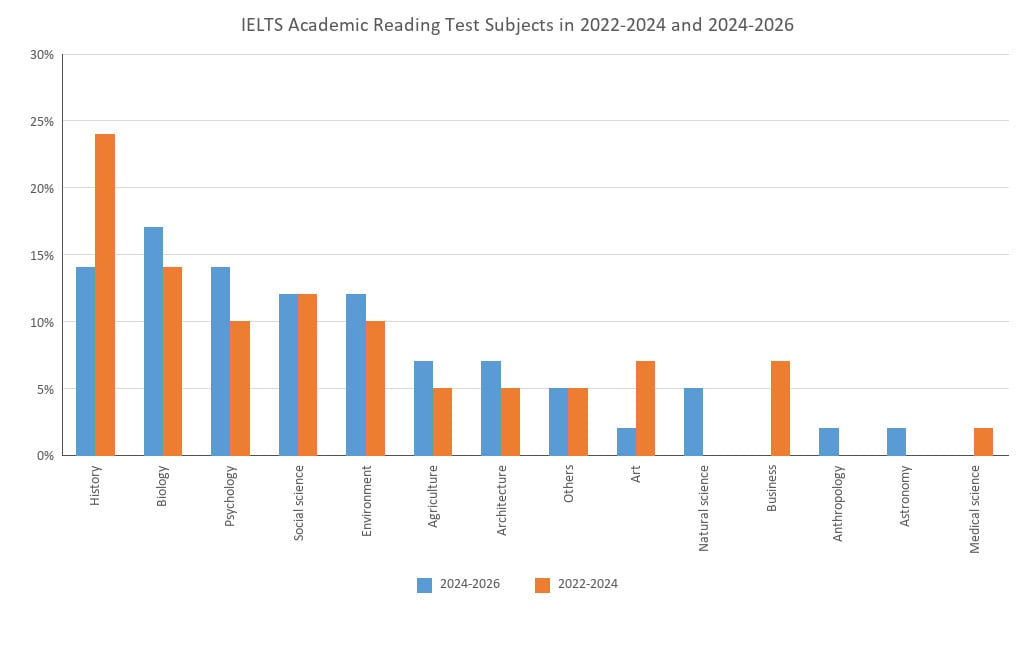
Por estas tendencias, nos hemos asegurado de que nuestros exámenes de práctica del IELTS Reading cubran estos temas. También hemos añadido lecturas sobre temas menos frecuentes, por si acaso. Es importante que te prepares para todas las situaciones, porque nunca se sabe qué tema te tocará en el examen.
Cómo se calcula tu puntuación del IELTS Reading
Cada pregunta del IELTS Reading vale 1 punto, así que puedes conseguir una puntuación «bruta» de hasta 40 puntos. Después, tu puntuación bruta se convierte en tu band score. Las tablas siguientes te dan una idea general de cómo se convierten las puntuaciones brutas en band scores en cada examen.
Puntuación del IELTS General Reading vs. IELTS Academic Reading
| Puntuación bruta: Academic | Band score: Academic | Puntuación bruta: General | Band score: General |
|---|---|---|---|
| 39-40 | 9 | 40 | 9 |
| 37-38 | 8.5 | 39 | 8.5 |
| 35-36 | 8 | 37-38 | 8 |
| 33-34 | 7.5 | 36 | 7.5 |
| 30-32 | 7 | 34-35 | 7 |
| 27-29 | 6.5 | 32-33 | 6.5 |
| 23-26 | 6 | 30-31 | 6 |
| 19-22 | 5.5 | 27-29 | 5.5 |
| 15-18 | 5 | 23-26 | 5 |
| 13-14 | 4.5 | 19-22 | 4.5 |
| 10-12 | 4 | 15-18 | 4 |
| 8-9 | 3.5 | 12-14 | 3.5 |
| 6-7 | 3 | 9-11 | 3 |
| 4-5 | 2.5 | 6-8 | 2.5 |
| 1-3 | 2 | 1-5 | 2 |
Sin embargo, ten en cuenta que cada versión del examen de IELTS Reading es ligeramente diferente y la puntuación necesaria para alcanzar una determinada banda varía en función de cómo se desempeñaron todas las personas que hicieron el examen ese día concreto. Por eso, el número de respuestas correctas para conseguir una band score variará un poco de un examen a otro, pero, en general, deberías intentar acertar unas 30 de 40 preguntas si quieres obtener una banda 7.
Otra cosa que conviene recordar: las preguntas más difíciles y las más fáciles cuentan lo mismo en tu puntuación final de Reading, así que asegúrate de no perder puntos fáciles por quedarte atascado en las preguntas difíciles. A continuación veremos algunos consejos y estrategias para responder a cada tipo de pregunta del examen de Reading.
Consejos para el IELTS Reading: cómo responder a los 11 tipos de preguntas
En el examen de Reading hay 11 tipos de preguntas diferentes y cada uno requiere una estrategia distinta.
Cada tipo tiene un ejemplo y su respuesta en la guía de tipos de preguntas IELTS Reading.
- Tipo de pregunta 1 – Emparejar información
- Tipo de pregunta 2 – Emparejar títulos
- Tipo de pregunta 3 – Emparejar características
- Tipo de pregunta 4 – Identificar información
- Tipo de pregunta 5 – Identificar opiniones o afirmaciones del autor
- Tipo de pregunta 6 – Opción múltiple
- Tipo de pregunta 7 – Emparejar finales de frase
- Tipo de pregunta 8 – Completar oraciones
- Tipo de pregunta 9 – Completar resúmenes, notas, tablas y diagramas de flujo
- Tipo de pregunta 10 – Completar etiquetas de diagramas
- Tipo de pregunta 11 – Preguntas de respuesta corta
- Cómo las tendencias te ayudan a preparar el IELTS Reading
Cómo las tendencias te ayudan a preparar el IELTS Reading
Qué tipos de preguntas de comprensión lectora les resultan más difíciles a nuestros estudiantes
Los estudiantes de BestMyTest han respondido a un millón de preguntas de comprensión lectora de la modalidad académica y a 600.000 preguntas de comprensión lectora de la modalidad de formación general en nuestros exámenes de práctica. El porcentaje indica la frecuencia con la que se respondió correctamente a cada tipo de pregunta.
| Tipo de pregunta | Modalidad académica | Formación general |
|---|---|---|
| Relacionar información | 34% | 72% |
| Verdadero / Falso / No se indica | 39% | 60% |
| Opción múltiple | 43% | 48% |
| Relacionar características | 48% | 74% |
| Completar oraciones | 49% | 75% |
| Relacionar encabezados | 53% | 40% |
| Sí / No / No se indica | 55% | 57% |
| Completar un resumen | 59% | 46% |
| Respuesta corta | 54% | 75% |
- En la comprensión lectora de la modalidad académica, los dos tipos con peores resultados son relacionar información y Verdadero/Falso/No se indica, ambos por debajo del 40%. Ambos requieren localizar una idea parafraseada en lugar de una palabra clave que coincida.
- En la modalidad de formación general, la situación se invierte: relacionar encabezados es el tipo con peores resultados, con un 40%, mientras que las preguntas de localización de información se responden correctamente tres de cada cuatro veces porque los textos son más cortos y más literales.
- Las preguntas sobre los textos de la modalidad académica se responden correctamente en un 46% de los casos de media, y las de los textos de formación general, en un 59%. La mitad de los intentos de responder a las preguntas de un texto de la modalidad académica obtienen una puntuación del 40% o menos.
- En 43.711 exámenes de práctica completos de comprensión lectora realizados por 38.534 estudiantes, la puntuación media de banda fue de 5.4. El 36% alcanzó la banda 6.0 y el 14% alcanzó la banda 7.0.
- Aun así, debes prepararte para todos los tipos, pero, si tienes poco tiempo, la tabla te indica dónde puedes aprovecharlo mejor.
Las cifras proceden de los datos de exámenes de práctica y revisiones de BestMyTest hasta octubre de 2026. Los porcentajes por tipo de pregunta son las tasas de respuestas correctas en el conjunto de todos los intentos; las cifras por criterio son puntuaciones asignadas por un tutor o por IA, según se indique. Última actualización: 5 de octubre de 2026.
A continuación veremos consejos y estrategias del IELTS Reading necesarios para conseguir una puntuación alta.
Consejos para el IELTS Reading: cómo mejorar tu band score
La mayoría de los candidatos no aprueban la sección de Reading por las siguientes tres razones:
- Velocidad de lectura lenta
- Vocabulario pobre
- Poca o ninguna preparación
Cómo mejorar tu velocidad de lectura
Empecemos por lo obvio: para mejorar tu velocidad de lectura tienes que leer y hacerlo de forma constante.
Ahora veamos una estrategia menos evidente que te ayudará a entender el significado de bloques de frases extensos. Empieza diseccionando la frase. Para ello, busca el sujeto y el verbo de la oración. Encontrar el sujeto y el verbo te ayudará a comprender el significado de la frase. Una razón por la que los pasajes académicos pueden resultar difíciles de entender es que encadenan varias ideas en oraciones compuestas largas. Esto produce bloques largos de texto difíciles de asimilar, así que usar el sujeto y el verbo como guía para entender todo el bloque es una herramienta excelente para el examen.
Cómo mejorar tu vocabulario
Mucha gente piensa que responder a las preguntas de Reading consiste simplemente en buscar palabras clave e información... pero no es tan sencillo. Las preguntas suelen estar parafraseadas, es decir, las palabras se cambian usando sinónimos del pasaje. Esto se hace para aumentar la dificultad; de lo contrario, el examen sería demasiado fácil. Por eso, debes mejorar tu vocabulario para conocer los distintos sinónimos de cada palabra.
Mientras te preparas para el examen, cuando te encuentres con una palabra que no conoces, acostúmbrate a buscarla en el momento o, al menos, a anotarla para buscarla después. Es un poco tedioso, pero muy efectivo. Tu objetivo debería ser estudiar entre 15 y 20 palabras académicas nuevas cada día.
Saber en qué tipos de pregunta las respuestas siguen el orden del texto
Es importante saber que, en algunos tipos de pregunta, las respuestas suelen aparecer (casi siempre) en el mismo orden que en el pasaje. En otros tipos, las respuestas rara vez siguen el mismo orden del texto. Hemos preparado una tabla con los tipos que siguen el orden y los que no.
| Las respuestas suelen seguir (casi siempre) el orden del pasaje | Las respuestas rara vez siguen el orden del pasaje |
|---|---|
|
|
Encontrar la mejor estrategia de lectura para ti
El mayor reto al que se enfrenta la mayoría de los candidatos en el IELTS Reading es completar todas las preguntas antes de que se acabe el tiempo. En el siguiente apartado aprenderás tres estrategias y dependerá de ti decidir cuál es la que mejor se adapta a ti. Lo harás con nuestras prácticas gratuitas de lectura.
3 estrategias para el IELTS Reading
Estrategia 1: Leer todo el pasaje y luego responder a las preguntas.
En realidad, esto no es tanto una estrategia. Es lo que hacen quienes no se preparan adecuadamente para el examen. Aun así, la incluimos como estrategia porque, técnicamente, si puedes retener la información del pasaje en la primera lectura y responder a las preguntas, no necesitarás la estrategia 2.
Esta estrategia, si no tienes una memoria mejor que la media, es ineficiente. Acabarás quedándote sin tiempo antes de poder responder a todas las preguntas. Mucha gente comete este error. Sin embargo, hay algunas preguntas que no requieren mucho esfuerzo y se benefician de esta estrategia. Por ejemplo, si la respuesta es «sí» o «no», podrás repasar el texto rápidamente y encontrar la respuesta enseguida, pero no hay suficientes preguntas de este tipo, así que no es recomendable usar esta estrategia salvo que puedas asumirla.
Estrategia 2: Leer primero las preguntas, leer con un objetivo, tomar notas y responder con criterio
Esta es nuestra estrategia recomendada. Te ayudará a conseguir un band score más alto. Considéralo un mapa claro para enfrentarte al examen:
Uno de los errores más comunes que cometen los candidatos al
abordar el examen de Reading es leer cada palabra de los pasajes. Aunque puedes
practicar para el examen leyendo por placer, «leer a ciegas» (leer sin tener idea de
qué te van a preguntar) no te ayudará en el examen. Al contrario, perjudicará
tus opciones de gestionar bien el tiempo y conseguir la mejor puntuación.
La principal razón para leer las preguntas primero es que el tipo de pregunta puede determinar qué
lees del pasaje o cómo lo lees. Por ejemplo, algunos tipos requieren la técnica
«skimming», mientras que otros requieren «scanning».
Es importante abordar un conjunto de preguntas del mismo tipo.
Tendrás que decidir qué tipo de pregunta vas a afrontar primero.
Una buena estrategia es empezar por el tipo más fácil y dejar los más difíciles para después.
Los tipos más fáciles son aquellos en los que dedicas menos tiempo a leer.
Por ejemplo, el tipo Emparejar títulos es más fácil porque
solo tienes que encontrar el título que mejor describe la idea principal de un párrafo.
Un ejemplo de tipo difícil sería Identificar información. En este tipo,
debes leer cada párrafo para determinar si cada afirmación es TRUE, FALSE o NOT GIVEN según el pasaje.
Aquí tienes una tabla con los niveles de dificultad para cada tipo de pregunta. Úsala como referencia para decidir cuál abordar primero.
| Nivel de dificultad | Tipo de pregunta |
|---|---|
| Fácil | Emparejar títulos Respuesta corta |
| Medio |
Emparejar finales de frase Emparejar características Opción múltiple Completar oraciones Completar etiquetas, resúmenes, notas, tablas y diagramas de flujo |
| Difícil |
Emparejar información Identificar información (TRUE/FALSE/NOT GIVEN) Identificar afirmaciones del autor (YES/NO/NOT GIVEN) |
Después de haber leído las preguntas, podrás leer con un objetivo. ¿Qué significa esto? Por ejemplo, si encuentras una pregunta que incluye el año «1896», puedes anotar dónde aparece ese año en el texto y usarlo después para responder a la pregunta.
Hay dos técnicas de lectura que te ayudarán a mantenerte centrado al leer con un objetivo. La primera, skimming, consiste en leer rápido para captar la idea general de un pasaje. Con esta técnica no te detienes en palabras desconocidas ni buscas detalles específicos. La segunda, scanning, consiste en leer en busca de información concreta. Con ella no te interesa la idea general, sino datos específicos. Cada técnica tiene un objetivo concreto. Eso te ayudará a encontrar la información más rápidamente.
Mientras lees con un objetivo, también debes tomar notas en los márgenes del pasaje, poniendo estrellas junto a la información clave o subrayando cosas que creas que te ayudarán a responder a las distintas preguntas. Así te resultará más fácil volver al texto cuando te hagan determinadas preguntas. Elige el sistema de notas que mejor te funcione, pero asegúrate de hacerlo.
Después de haber leído las preguntas, leído el pasaje y tomado las notas oportunas, deberías haber localizado la parte del texto que debes leer con detenimiento. Entonces, lee con atención y piensa de forma crítica para determinar la respuesta correcta.
Estrategia 3: Skimming, toma de notas y tipos de pregunta.
Esta es otra estrategia utilizada por muchos candidatos al IELTS. Te ayudará a conseguir una mejor puntuación de Reading. La estrategia consta de 4 pasos:
- Haz skimming en cada párrafo para captar su idea general. La idea principal de un párrafo suele estar en las primeras frases, así que céntrate un poco más en ellas. Las frases siguientes pueden leerse rápido, subrayando nombres, palabras o expresiones que destaquen.
- Tras hacer skimming en cada párrafo, escribe notas breves (2-5 palabras) al lado de cada párrafo con tu mejor estimación de la idea principal.
- A continuación, responde a un conjunto de preguntas del mismo tipo.
- Por último, responde a un conjunto de preguntas de forma eficiente y correcta.
Es importante que no dediques más de 3-5 minutos a los pasos 1 y 2. Dedicarles demasiado tiempo te dejará sin tiempo para el resto.
Pasos 1 y 2El objetivo es montar un método eficiente para encontrar respuestas en el pasaje. Al anotar la idea general de cada párrafo, sabrás qué párrafo contiene la respuesta a cada pregunta. Esto te ahorrará mucho tiempo, porque si no lo anotas, probablemente tengas que hacer skimming en cada párrafo para encontrar la idea general y luego escanear con cuidado para localizar la respuesta. Al anotar la idea principal de cada párrafo te saltas el primer paso de skimming y empiezas a escanear directamente.
Paso 3
Después de haber hecho skimming y tomado notas, estás listo para el paso 3.
En este paso debes decidir qué tipo de pregunta vas a abordar primero.
Una buena estrategia es empezar por el tipo más fácil y dejar los más difíciles para después.
Los tipos más fáciles son aquellos en los que dedicas menos tiempo a leer.
Por ejemplo, el tipo Emparejar títulos es más fácil porque
solo tienes que encontrar el título que mejor describe la idea principal de un párrafo, así que técnicamente solo necesitas los pasos 1 y 2 para resolverlo.
Un ejemplo de tipo difícil sería Identificar información. En este tipo,
debes leer cada párrafo para determinar si cada afirmación es TRUE, FALSE o NOT GIVEN según el pasaje.
Aquí tienes una tabla con los niveles de dificultad para cada tipo de pregunta. Úsala como referencia para decidir cuál abordar primero.
| Nivel de dificultad | Tipo de pregunta |
|---|---|
| Fácil | Emparejar títulos Respuesta corta |
| Medio |
Emparejar finales de frase Emparejar características Opción múltiple Completar oraciones Completar etiquetas, resúmenes, notas, tablas y diagramas de flujo |
| Difícil |
Emparejar información Identificar información (TRUE/FALSE/NOT GIVEN) Identificar afirmaciones del autor (YES/NO/NOT GIVEN) |
Ahora que ya sabes qué conjunto de preguntas vas a responder primero, llega el momento de responderlas :( ¡No te preocupes! Aunque cada tipo de pregunta es diferente, la estrategia para responder correctamente es la misma para todos. El principio básico es sencillo, basta con seguir los pasos siguientes:
- Lee la pregunta con atención e identifica las palabras clave importantes.
- Encuentra el párrafo que contiene la información necesaria para responder. (Si ya tienes anotadas las ideas generales de cada párrafo, esto es fácil de averiguar).
- Escanea el párrafo buscando las palabras clave importantes (¡probablemente serán sinónimos!) hasta localizar la parte del texto que debes leer con atención.
- Por último, lee con atención y piensa de forma crítica para determinar la respuesta correcta.
Descarga gratis muestras del IELTS Reading en PDF con respuestas
A continuación tienes algunas muestras gratuitas del British Council (los creadores del examen IELTS). Intenta responder a las preguntas y comprueba qué tal lo haces.