
Dans ce guide, vous apprendrez à rédiger des essais à score élevé pour l'IELTS writing task 1 et l'IELTS writing task 2. Quel que soit le test que vous passez, academic ou general training, nous avons ce qu'il vous faut. Ce guide comprend des exemples IELTS Writing, des sujets et des leçons détaillées pour le general writing task 1 et 2 ainsi que pour l'academic writing task 1 et 2.
Obtenez des réponses modèles gratuites pour l'IELTS Writing après avoir terminé un test d'entraînement IELTS Writing.
| Test IELTS General Writing | Test IELTS Academic Writing |
|---|---|
Vous trouverez ci-dessous notre liste complète des questions IELTS Writing avec essais modèles. Remarque : Les liens rouges sont nos questions Writing les plus populaires et recommandées selon nos étudiants, et vous pouvez les pratiquer gratuitement à tout moment.
Exemples IELTS General Writing Task 1 1 - 44
Informal, formal, & semi-formal letters
Exemples IELTS Academic Writing Task 1 1 - 52
Line graphs, bar charts, pie charts, tables, maps, flow charts, & multiple charts
Exemples IELTS Writing Task 2 1 - 96
Opinion, discussion, advantages & disadvantages, problem & solution, cause & effect, & two-part questions
Table des matières
Informations sur le test IELTS Writing
Le test d'expression écrite se compose de 2 tâches de rédaction et vous disposerez d'un total de 60 minutes pour les compléter toutes les deux. Vous pouvez accomplir les tâches dans l'ordre de votre choix, assurez-vous simplement de bien gérer votre temps et de consacrer environ 20 minutes à IELTS writing task 1 et 40 minutes à IELTS writing task 2.
IELTS Academic Writing Task VS IELTS General Writing Task
L'IELTS propose deux versions du test. La version Academic est destinée aux personnes qui souhaitent poursuivre des études supérieures, tandis que la version General Training s'adresse à celles qui cherchent simplement à immigrer ou peut-être à suivre une formation de niveau inférieur. Il existe d'autres critères pour les deux versions, veuillez donc contacter le service client IELTS pour savoir quel test vous convient.
Alors, quel test est plus difficile ? Le test academic, comme vous l'avez peut-être deviné, est plus difficile que le test general training. La différence entre les deux réside dans la difficulté de IELTS writing task 1. Heureusement, seul Writing Task 1 est différent. IELTS writing task 2 est identique pour les deux versions du test. Le tableau ci-dessous résume les deux types de tests IELTS Writing.
| Type de test | Task 1 | Task 2 |
|---|---|---|
| Academic Writing | IELTS Academic Writing Task 1
Dans IELTS academic writing task 1, on vous présente un graphique, un tableau, un diagramme ou un schéma et il vous est demandé de décrire, résumer ou expliquer les informations avec vos propres mots. |
IELTS Writing Task 2 Dans IELTS writing task 2, vous devrez rédiger une dissertation de style traditionnel en réponse à une question. Vous devez écrire au moins 250 mots |
| General Writing |
IELTS General Writing Task 1
Dans IELTS General Writing Task 1, on vous demande de rédiger une lettre concernant une situation donnée. Cette lettre sera de l'un des types suivants : - Formelle (les lettres formelles sont adressées à des personnes que nous ne connaissons pas ou que nous n'avons jamais rencontrées.) - Semi-formelle (les lettres semi-formelles sont adressées à des personnes que nous ne connaissons pas bien.) - Informelle (les lettres informelles sont adressées à des personnes que nous connaissons bien, comme nos amis) |
Vidéo de présentation de IELTS Academic Writing Task
Vidéo de présentation de IELTS General Writing Task
Bientôt disponible !
Comment le test IELTS Writing est-il noté
Lors du test IELTS Writing, votre score d'expression écrite sera évalué selon quatre catégories. Celles-ci sont connues sous le nom de
Task Achievement/Task Response, Coherence and Cohesion, Lexical Resource, et Grammatical Range and Accuracy.
Consultez les descripteurs de bande suivants que les examinateurs IELTS utilisent pour noter la section writing du test :
- IELTS Writing Task 1 Band Descriptors
- IELTS Writing Task 2 Band Descriptors
Notez que les critères de notation des deux tâches comprennent :
- Task Achievement/Task Response - Avez-vous entièrement répondu à la question et présenté une réponse pleinement développée ?
- Coherence and Cohesion - Votre argumentation ou votre analyse a-t-elle du sens ? Est-elle bien réfléchie et présentée de manière complète ?
- Lexical Resource – Avez-vous utilisé un large éventail de vocabulaire dans un ton naturel et formel ?
- Grammatical Range and Accuracy – Votre dissertation est-elle pratiquement sans erreur ? Avez-vous réussi à utiliser un large éventail de structures grammaticales ?
Les tâches IELTS Writing Task 1 et IELTS Writing Task 2 valent-elles le même nombre de points ?
Eh bien, tout comme vous passerez deux fois plus de temps à rédiger IELTS writing task 2,
elle vaut également environ deux fois plus de points. Ce n'est pas exactement le double.
Une autre façon de voir les choses est d'ajouter le score de writing task 2 deux fois. Ainsi, prenons
les scores de bande 7 pour task one et 4 pour task two et on obtient la
formule suivante pour calculer votre score IELTS Writing :
(7 + (4 x 2))/3 = 5.
Par conséquent, le score de bande IELTS Writing total est d'environ 4,5 - 6. Vous voyez, nous ne pouvons pas donner un chiffre exact
car l'IELTS n'a pas rendu publique sa formule de notation, mais la formule
présentée ici est assez précise, à environ 0,5 point près.
Ce que révèlent 19 000 rédactions IELTS notées
Entre 2020 et 2026, les tuteurs de BestMyTest ont noté environ 9 400 travaux d'expression écrite IELTS et notre service de correction par IA a corrigé 9 614 rédactions supplémentaires. Trois constats se dégagent.
- La grammaire détermine la note. L'étendue et la précision grammaticales étaient le critère le moins bien noté des quatre dans 91% des rédactions de Task 2, 84% des rapports de Task 1 du module Academic et 94% des lettres du module General Training. Notes moyennes attribuées par les tuteurs pour Task 2 : grammaire 5.5, richesse lexicale 6.0, cohérence et cohésion 6.1, réponse à la consigne 6.1. Pour Task 1 du module Academic : grammaire 5.5, cohérence 5.8, réalisation de la tâche 5.8, richesse lexicale 5.8. Pour Task 1 du module General Training : grammaire 5.3, richesse lexicale 5.9, cohérence 6.0, réalisation de la tâche 6.2.
- Les rédactions trop courtes sont pénalisées. 17% des rédactions de Task 2 n'atteignaient pas le minimum de 250 mots et obtenaient en moyenne 4.9 pour la réponse à la consigne, contre 6.1 pour les rédactions qui atteignaient 250 mots. 13% des rapports de Task 1 du module Academic et 16% des lettres du module General Training comptaient moins de 150 mots. Les moyennes de nos apprenants sont de 285 mots pour Task 2 et d'environ 175 mots pour Task 1.
- Les erreurs sont mineures et répétitives. Une rédaction de Task 2 fait l'objet d'environ 21 corrections. La ponctuation arrive en tête (17% des corrections), suivie des articles (11%), de l'orthographe (10%), des noms au singulier et au pluriel (9%), de l'accord sujet-verbe (7%) et des prépositions (6%). Deux tiers des rédactions de Task 2 contenaient une erreur d'article et 58% une erreur d'accord sujet-verbe. Dans Task 1 du module Academic, le vocabulaire utilisé pour décrire les données entraîne des erreurs supplémentaires : "male" à "males", "increase" à "increased", "compare" à "compared". Dans les lettres du module General Training, l'emploi des majuscules (9% des corrections) et les temps verbaux (6%) ont plus de poids que dans les autres tâches.
- Les corrections que notre service apporte le plus souvent : "this" à "these", "is" à "are", "have" à "has", "in" à "on", "of" à "for", "amount" à "number", "then" à "than", "that" à "who", "goverment" à "government", "belive" à "believe", "accomodation" à "accommodation".
Les chiffres proviennent des données des tests d'entraînement et des corrections de BestMyTest jusqu'en octobre 2026. Les pourcentages par type de question correspondent aux taux de bonnes réponses sur l'ensemble des tentatives ; les chiffres par critère sont les notes attribuées par les tuteurs ou l'IA, selon les indications. Dernière mise à jour le 5 octobre 2026.
IELTS Academic Writing Task 1
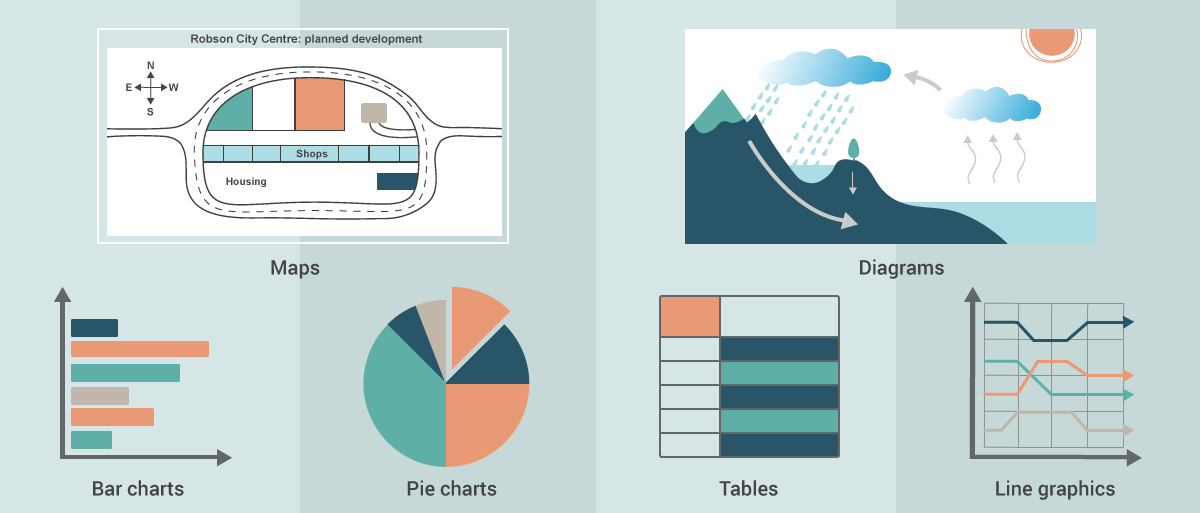
Dans IELTS academic writing task 1, on vous présente un graphique, un tableau, un diagramme ou un schéma et il vous est demandé de décrire, résumer ou expliquer les informations avec vos propres mots. Il pourra vous être demandé de décrire et d'expliquer des données, de décrire les étapes d'un processus, le fonctionnement de quelque chose, ou de décrire un objet ou un événement.
Quelle que soit l'information visuelle qui vous est présentée, votre tâche est de rédiger un résumé des informations visuelles et de décrire les principales tendances, différences globales, principaux changements ou principaux composants d'un système, ou les principales phases d'un processus. Vous devez écrire 150 mots ou plus, et vous devriez consacrer environ 20 minutes à cette partie du test. La structure de rédaction peut être la suivante :
- Introduction : Paraphrasez la question
- Vue d'ensemble : Décrivez la tendance générale ou rédigez une vue d'ensemble des principaux groupements
- Paragraphe 1 du corps : Rédigez en détail sur le premier groupement de manière logique
- Paragraphe 2 du corps : Rédigez en détail sur le deuxième groupement de manière logique
Les étapes pour rédiger le rapport de cette tâche sont donc très simples :
- Analysez le ou les graphiques et planifiez comment regrouper les informations
- Rédigez une dissertation en utilisant la structure recommandée
- Relisez la dissertation
Examinons chaque type possible de graphique, tableau, diagramme et schéma visuels que vous pourriez rencontrer dans votre test IELTS Writing :
Graphiques linéaires
Dans ce type de tâche, on vous donne un ou plusieurs graphiques linéaires. Chaque graphique linéaire comportera 1 à 8 lignes montrant comment les valeurs évoluent au fil du temps. La période peut être le passé, le présent ou le futur, ou une combinaison des trois. Votre tâche est de rédiger un résumé, couvrant les points les plus importants et en appuyant votre description par des données.
The chart illustrates average CO2 emissions per person in four European countries between 1975 and 2015.
Summarise the information by selecting and reporting the main features, and make comparisons where relevant.
- Write at least 150 words.
- You should spend around 20 minutes on this task.
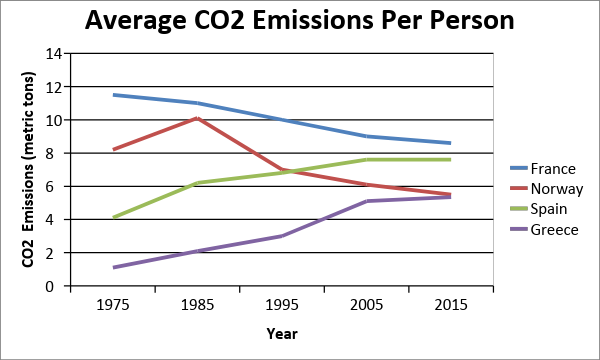
The line graph depicts the average Carbon dioxide emission for each individual residing in four countries, namely France, Norway, Spain, and Greece, over 40 years.
Overall, although CO2 production in France and Norway declined, it increased significantly in Spain and Greece over the period. Norway improved the most to become the most environmentally friendly, whereas Greece had the highest increase of all in that time.
Throughout the period, France produced the most CO2, though production declined overall from 11 tonnes per individual in 1975 to around 8.5 tonnes by 2015. In turn, except for a spike in emissions in 1985, Norway’s production of CO2 fell from 8 to under 6 tonnes forty years later.
On the contrary, CO2 release in Spain and Greece saw a more upward turn. In Spain, production doubled from 4 tonnes in 1975, overtaking Norway by 1995, to a final figure of just under 8 metric tonnes per head of population. Similarly, emissions in Greece, which were the lowest in 1975, increased five times to equal those of Norway in 2015.

Line Chart
Learn how to answer this question in a step-by-step interactive exercise
Line Chart
Dans la Task 1 de l'IELTS Academic, vous décrivez ce que montre un graphique. Vous ne donnez pas votre avis et vous n'expliquez pas pourquoi les chiffres sont tels qu'ils sont.
Un graphique linéaire montre l'évolution de valeurs dans le temps, souvent pour plusieurs courbes à la fois : ce rapport décrit donc l'évolution et compare les courbes.
Prenez connaissance de la consigne, puis cliquez sur Suivant pour continuer.
Prendre connaissance de la question
Summarise the information by selecting and reporting the main features, and make comparisons where relevant.
Write at least 150 words.
Lisez le graphique avant d'écrire. Vérifiez le titre, la période sur l'axe horizontal, les unités sur l'axe vertical et la légende qui nomme chaque courbe.
Trouvez ensuite le point où s'arrêtent les données mesurées et où commence une projection. Ce point partage vos temps : des formes du passé pour les années déjà mesurées, et des formes comme is expected to, is predicted to et is set to pour les années à venir.
Répondez aux questions sur le graphique.
Lire le diagramme
L'introduction dit avec vos propres mots ce que montre le graphique. Paraphrasez la consigne : changez les mots, gardez le sens, et conservez le sujet, ce que mesurent les courbes et la période.
Recopier la phrase de la consigne ne rapporte rien, et les chiffres n'ont pas leur place ici. Gardez tous les chiffres pour les paragraphes de développement.
Écrivez une ou deux phrases qui paraphrasent la consigne.
Rédiger l'introduction
Question de la tâche
The chart illustrates average CO2 emissions per person in four European countries between 1975 and 2015.
Summarise the information by selecting and reporting the main features, and make comparisons where relevant.
Write at least 150 words.
Un rapport de Task 1 demande un paragraphe de développement par groupe de courbes, et un graphique linéaire a généralement plus de courbes que de groupes. Regroupez les courbes qui évoluent dans le même sens : celles qui montent, celles qui baissent et celles qui restent stables. Si toutes les courbes évoluent de la même façon, cela fait un paragraphe ; une de chaque sorte, cela en fait trois.
Un paragraphe par courbe, ou un paragraphe pour chaque moitié de la période, casse la comparaison que demande la consigne. Regrouper uniquement selon le niveau peut mettre une courbe en hausse et une courbe en baisse dans le même paragraphe.
Choisissez le regroupement qui donne à chaque paragraphe une seule tendance claire.
Former les groupes
Choisissez le regroupement qui donne à chaque paragraphe une seule tendance claire.
- Group 1: Norway, Spain, Greece. Group 2: France.
- Group 1: Greece. Group 2: France, Norway, Spain.
- Group 1: Norway, Greece. Group 2: France, Spain.
- Group 1: France, Norway. Group 2: Spain, Greece.
La vue d'ensemble présente la tendance principale de tout le graphique. Elle repose sur les caractéristiques principales. D'abord : quelle est l'évolution générale de chaque groupe sur la période ? Ensuite : lorsqu'il y a deux groupes ou plus, quel écart y a-t-il entre le premier et le dernier groupe, et cet écart se creuse-t-il, se réduit-il ou s'inverse-t-il ?
Réunissez ces caractéristiques et vous obtenez votre vue d'ensemble. N'ajoutez pas ici d'années ou de chiffres isolés. Gardez-les pour les paragraphes de développement.
Trouvez les caractéristiques principales pour construire votre vue d'ensemble.
Trouver la tendance générale
Transformez maintenant les deux caractéristiques principales en une ou deux phrases. La vue d'ensemble est la partie du rapport que l'examinateur cherche en premier : écrivez-la donc avant tout détail et restez général.
Accordez le temps des verbes au graphique, et décrivez ce que montre le graphique plutôt que pourquoi. Ne donnez pas de chiffres et n'ajoutez pas d'opinion.
Écrivez une ou deux phrases générales sur la tendance principale.
Rédiger votre vue d'ensemble
Le paragraphe de développement 1 porte uniquement sur votre premier groupe de courbes, sur toute la période, et c'est ici que les chiffres ont leur place.
Décrivez la forme de chaque courbe plutôt que chacun de ses points : la valeur de départ, la direction, tout changement de direction et la valeur finale ou prévue. Employez le vocabulaire de l'évolution dans le temps, comme rise steadily, fluctuate, level off et peak, et indiquez l'année avec chaque chiffre.
Si vous ne savez pas comment formuler un point, cliquez dessus et un exemple de phrase sera ajouté à votre zone de rédaction.
Écrivez trois ou quatre phrases sur votre premier groupe, avec des chiffres.
Rédiger le paragraphe de développement 1
Le paragraphe de développement 2 porte uniquement sur votre deuxième groupe de courbes. Traitez-le de la même manière : la forme de chaque courbe, appuyée par des chiffres.
Ne répétez pas le paragraphe de développement 1. Reliez les groupes lorsqu'une différence mérite d'être signalée, avec des expressions comme in contrast et far lower than.
Si vous ne savez pas comment formuler un point, cliquez dessus et un exemple de phrase sera ajouté à votre zone de rédaction.
Écrivez trois ou quatre phrases sur votre deuxième groupe, avec des chiffres.
Rédiger le paragraphe de développement 2
Le plan de votre rapport est terminé. Une réponse complète à la Task 1 comporte ces parties, dans cet ordre : une introduction qui paraphrase la consigne, une vue d'ensemble de la tendance principale et un paragraphe de développement par groupe, qui appuie cette tendance avec des chiffres choisis.
Relisez vos parties ensemble et vérifiez trois choses : la vue d'ensemble et les détails concordent, les temps correspondent aux valeurs mesurées et prévues, et chaque chiffre est accompagné de son unité et de son année.
Relisez le plan de votre rapport, puis comparez-le avec la rédaction modèle.
Plan complet du rapport
Comment décider
Un graphique linéaire de la Task 1 de l'IELTS Academic montre comment des valeurs évoluent dans le temps, souvent pour plusieurs courbes à la fois. Vous décrivez ces évolutions et comparez les courbes. Vous n'avez pas besoin de chaque point de chaque courbe.
Travaillez toujours dans le même ordre pour que le rapport soit planifié avant d'écrire votre première phrase.
- Lire le diagramme. Vérifiez le titre, la période, les unités, la légende, et l'endroit où s'arrêtent les données mesurées et où commence une éventuelle projection.
- Rédiger l'introduction. Paraphrasez la consigne et indiquez ce que montre le graphique.
- Former les groupes. Regroupez les courbes qui évoluent de la même façon pour que chaque paragraphe de développement ait une seule idée claire.
- Trouver la tendance générale. Dégagez la tendance la plus marquante de tout le graphique avant d'examiner les valeurs une par une.
- Rédiger le rapport par étapes. Rédigez d'abord la vue d'ensemble, puis un paragraphe de développement pour chaque groupe avec des chiffres choisis, puis relisez le plan complet.
Regroupez les courbes avant de les décrire. Un graphique comportant beaucoup de courbes devient un rapport court dès que les courbes similaires partagent un paragraphe, et c'est ce regroupement que la consigne appelle sélectionner les éléments principaux.
Lire le graphique
Commencez par les axes. L'axe horizontal donne la période, l'axe vertical donne les unités, et la légende nomme chaque courbe. Trouvez le point où s'arrêtent les données mesurées, car tout ce qui suit est une projection et demande des formes du futur.
Introduction
L'introduction tient en une ou deux phrases qui disent ce que montre le graphique avec d'autres mots que la consigne. Gardez le sujet, ce que mesurent les courbes et la période. Laissez de côté les chiffres et les tendances.
Groupes
Un rapport de Task 1 comporte un paragraphe de développement pour chaque groupe de courbes. Regroupez les courbes qui évoluent dans le même sens : celles qui montent, celles qui baissent et celles qui restent stables. Si toutes les courbes évoluent de la même façon, cela donne un paragraphe ; une de chaque sorte en donne trois.
Tendance générale
La tendance générale est le motif le plus marquant du graphique : l'orientation générale de chaque groupe sur la période, et l'écart qui sépare les groupes. C'est une affirmation générale : elle ne contient donc aucun chiffre.
Pour apprendre à aborder les graphiques linéaires d'IELTS Academic Writing Task 1, consultez notre leçon IELTS Academic Writing Task - Line Graphs.
Essai gratuit de 7 joursDiagrammes à barres
Dans ce type de tâche, on vous donne un ou plusieurs diagrammes à barres. Les diagrammes à barres peuvent montrer comment les valeurs évoluent au fil du temps (données dynamiques), les différences entre les valeurs à un moment donné (données statiques) ou les résultats d'une enquête ou d'un questionnaire. L'information peut concerner la situation passée, présente ou future, ou une combinaison des trois. Votre tâche est de rédiger un résumé, couvrant les points les plus importants et en appuyant votre description par des données.
The chart below shows the proportion of males and females in Malaysia who commonly do physical activity in 2010.
Summarise the information by selecting and reporting the main features, and make comparisons where necessary.
- Write at least 150 words.
- You should spend around 20 minutes on this task.
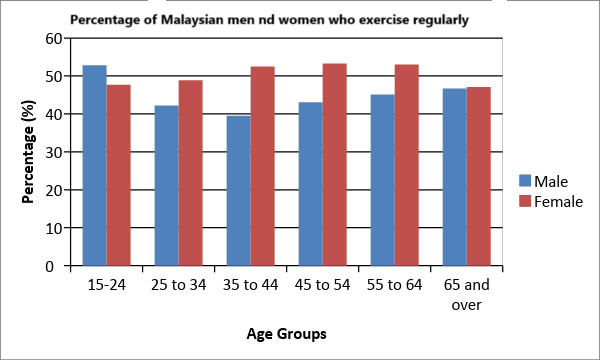
The bar chart compares the proportion of male and females of differing age groups who frequently undertook physical activity in 2010.
Overall, while the Malaysian population keeps fit in general, a higher proportion of women than men exercised in 2010, with some further differences between age groups. Middle-aged females were the most likely to work out, while for men, those aged 15 to 24 tended to do the most physical activity.
In terms of men’s exercise habits, younger men were much more likely to exercise than older men with 52.8% of those aged under 24 exercising as opposed to only around 40% of older age groups
By contrast, around half of all women in all age groups reported keeping fit, especially those aged between 35 and 64 at around 53%. The exception was the youngest age group in which only 47.7 percent of women exercised compared to 52.8% of men. Similarly, for people 65 and over, just approximately 47% of both sexes were recorded regularly working out.
Bar Chart
Learn how to answer this question in a step-by-step interactive exercise
Bar Chart
Dans la Task 1 de l'IELTS Academic, vous décrivez ce que montre un graphique. Vous ne donnez pas votre avis et vous n'expliquez pas pourquoi les chiffres sont tels qu'ils sont.
Un diagramme en barres compare des groupes sur un ensemble de catégories : ce rapport repose donc sur des comparaisons, et non sur une évolution dans le temps.
Prenez connaissance de la consigne, puis cliquez sur Suivant pour continuer.
Prendre connaissance de la question
Summarise the information by selecting and reporting the main features, and make comparisons where necessary.
Write at least 150 words
Lisez le diagramme avant d'écrire. Vérifiez le titre, les catégories sur l'axe horizontal, les unités sur l'axe vertical et la légende qui nomme chaque groupe de barres.
Les unités déterminent vos formulations. Un nombre de personnes, un pourcentage et une somme d'argent ne sont pas la même chose, et se tromper d'unité fait perdre des points même si le reste de la phrase est correct.
Répondez aux questions sur le diagramme.
Lire le diagramme
L'introduction dit avec vos propres mots ce que montre le diagramme. Paraphrasez la consigne : changez les mots, gardez le sens, et conservez le sujet, les groupes comparés, ainsi que le lieu ou la période si la consigne les indique.
Recopier la phrase de la consigne ne rapporte rien, et les chiffres n'ont pas leur place ici. Gardez tous les chiffres pour les paragraphes de développement.
Écrivez une ou deux phrases qui paraphrasent la consigne.
Rédiger l'introduction
Question de la tâche
The chart below shows the proportion of males and females in Malaysia who commonly do physical activity in 2010.
Summarise the information by selecting and reporting the main features, and make comparisons where necessary.
Write at least 150 words
Un rapport de Task 1 demande un paragraphe de développement par groupe : décidez donc tôt comment vous allez répartir les données. Regroupez les séries de la légende qui se comportent de la même façon : les séries qui se situent à un niveau similaire, ou qui sont plus hautes et plus basses dans les mêmes catégories, partagent un paragraphe. Les séries qui se comportent différemment ont le leur. Chaque paragraphe porte alors une seule idée claire.
Une répartition qui sépare seulement les valeurs hautes des valeurs basses, ou qui donne un paragraphe à chaque catégorie, vous oblige à vous répéter.
Choisissez le regroupement qui donne à chaque paragraphe une seule idée claire.
Former les groupes
Choisissez le regroupement qui donne à chaque paragraphe une seule idée claire.
- Group 1: Female. Group 2: Male.
- One group: Male and Female.
La vue d'ensemble présente la tendance principale de tout le diagramme. Elle repose sur trois caractéristiques principales au maximum. Quel groupe est le plus haut dans la plupart des catégories ? Quel groupe est le plus bas dans la plupart des catégories ? L'écart est-il à peu près le même dans chaque catégorie, ou une catégorie se distingue-t-elle nettement des autres ?
Tous les diagrammes ne présentent pas ces trois caractéristiques : cette étape ne porte donc que sur celles qui comptent pour ce diagramme. Réunissez-les et vous obtenez votre vue d'ensemble. N'ajoutez pas de chiffres isolés ici. Gardez-les pour les paragraphes de développement.
Trouvez les caractéristiques principales pour construire votre vue d'ensemble.
Trouver la tendance générale
Transformez maintenant les caractéristiques principales trouvées en une ou deux phrases. La vue d'ensemble est la partie du rapport que l'examinateur cherche en premier : écrivez-la donc avant tout détail et restez général.
Décrivez ce que montre le diagramme, pas pourquoi il se présente ainsi. Ne donnez pas de chiffres et n'ajoutez pas d'opinion.
Écrivez une ou deux phrases générales sur la tendance principale.
Rédiger votre vue d'ensemble
Le paragraphe de développement 1 porte uniquement sur votre premier groupe, et c'est ici que les chiffres ont leur place.
Sélectionnez les comparaisons qui comptent : la valeur la plus élevée, la valeur la plus basse et toute catégorie qui se comporte différemment des autres. Comme un diagramme en barres compare des groupes sur une même période, employez des expressions de comparaison comme higher than, twice as many as et the largest of all the categories.
Si vous ne savez pas comment formuler un point, cliquez dessus et un exemple de phrase sera ajouté à votre zone de rédaction.
Écrivez trois ou quatre phrases sur votre premier groupe, avec des chiffres.
Rédiger le paragraphe de développement 1
Le paragraphe de développement 2 porte uniquement sur votre deuxième groupe. Traitez-le comme le premier : les comparaisons les plus claires, appuyées par des chiffres.
Ne répétez pas le paragraphe de développement 1. Reliez les groupes lorsqu'une différence mérite d'être signalée, avec des expressions comme in contrast et compared with.
Si vous ne savez pas comment formuler un point, cliquez dessus et un exemple de phrase sera ajouté à votre zone de rédaction.
Écrivez trois ou quatre phrases sur votre deuxième groupe, avec des chiffres.
Rédiger le paragraphe de développement 2
Le plan de votre rapport est terminé. Une réponse complète à la Task 1 comporte ces parties, dans cet ordre : une introduction qui paraphrase la consigne, une vue d'ensemble de la tendance principale et un paragraphe de développement par groupe, qui appuie cette tendance avec des chiffres choisis.
Relisez vos parties ensemble et vérifiez trois choses : la vue d'ensemble et les détails concordent, chaque chiffre est accompagné de son unité, et vous avez décrit le diagramme sans l'expliquer.
Relisez le plan de votre rapport, puis comparez-le avec la rédaction modèle.
Plan complet du rapport
Comment décider
Un diagramme en barres de la Task 1 de l'IELTS Academic vous demande de décrire ce que montre le diagramme et de comparer les groupes qu'il présente. Vous n'avez pas besoin de chaque chiffre. Il vous faut les comparaisons qui comptent.
Travaillez toujours dans le même ordre pour que le rapport soit planifié avant d'écrire votre première phrase.
- Lire le diagramme. Vérifiez le titre, les catégories, les unités et la légende avant d'écrire quoi que ce soit.
- Rédiger l'introduction. Paraphrasez la consigne et indiquez ce que montre le diagramme.
- Former les groupes. Répartissez les données pour que chaque paragraphe de développement ait une seule idée claire.
- Trouver la tendance générale. Dégagez la tendance la plus marquante de tout le diagramme avant d'examiner les valeurs une par une.
- Rédiger le rapport par étapes. Rédigez d'abord la vue d'ensemble, puis un paragraphe de développement pour chaque groupe avec des chiffres choisis, puis relisez le plan complet.
Une vue d'ensemble claire vaut plus que des chiffres supplémentaires. La consigne vous demande de sélectionner les éléments principaux : une affirmation générale accompagnée de quelques comparaisons fortes obtient une meilleure note qu'une liste de toutes les valeurs.
Lire le diagramme
Commencez par les axes. L'axe horizontal indique ce qui est comparé, l'axe vertical donne les unités, et la légende nomme chaque groupe de barres. Un rapport qui se trompe d'unité change le sens de chacune de ses phrases.
Introduction
L'introduction tient en une ou deux phrases qui disent ce que montre le diagramme avec d'autres mots que la consigne. Gardez le sujet, les groupes comparés, et le lieu ou la période. Laissez de côté les chiffres et les tendances.
Groupes
Un rapport de Task 1 comporte un paragraphe de développement pour chaque groupe. Regroupez les séries de la légende qui se comportent de la même façon : des séries d'un niveau similaire, ou des séries qui sont plus élevées et plus basses dans les mêmes catégories. Ainsi, chaque paragraphe contient une seule idée et vous ne vous répétez jamais.
Tendance générale
La tendance générale est le motif le plus marquant du diagramme : le groupe le plus élevé dans la plupart des catégories, le groupe le plus bas dans la plupart des catégories, et si l'écart reste à peu près le même dans chaque catégorie ou si une catégorie est très différente. Un diagramme peut montrer un, deux ou ces trois éléments. C'est une affirmation générale : elle ne contient donc aucun chiffre.
Les diagrammes à barres sont assez courants dans IELTS writing task 1 academic. Il existe trois scénarios différents que vous rencontrerez dans une tâche de diagramme à barres :
- Un diagramme à barres avec des catégories sur l'axe des x
- Un diagramme à barres avec des dates ou des années sur l'axe (fonctionne comme un graphique linéaire)
- Deux diagrammes à barres présentés
Chaque scénario nécessite que vous rédigiez le rapport différemment. Inscrivez-vous à un essai gratuit de 7 jours pour accéder aux leçons suivantes sur les diagrammes à barres :
- Leçon IELTS Academic Writing Task - Bar Charts Part 1.
- Leçon IELTS Academic Writing Task - Bar Charts Part 2.
- Leçon IELTS Academic Writing Task - Bar Charts Part 3.
Diagrammes circulaires
Dans ce type de tâche, on vous donne un, deux ou trois diagrammes circulaires. Les diagrammes circulaires peuvent montrer des pourcentages d'un chiffre total. Si vous avez un diagramme circulaire, il représentera un moment dans le temps (données statiques). Si vous avez deux diagrammes circulaires ou plus, ils peuvent représenter comment les pourcentages évoluent au fil du temps ou comparer différents pays ou groupes. Votre tâche est de rédiger un résumé, couvrant les points les plus importants et en appuyant votre description par des données.
The charts below show the percentage of water used for different purposes in six areas of the world. Summarise the information by selecting and reporting the main features, and make comparisons where relevant.
- Write at least 150 words.
- You should spend around 20 minutes on this task.
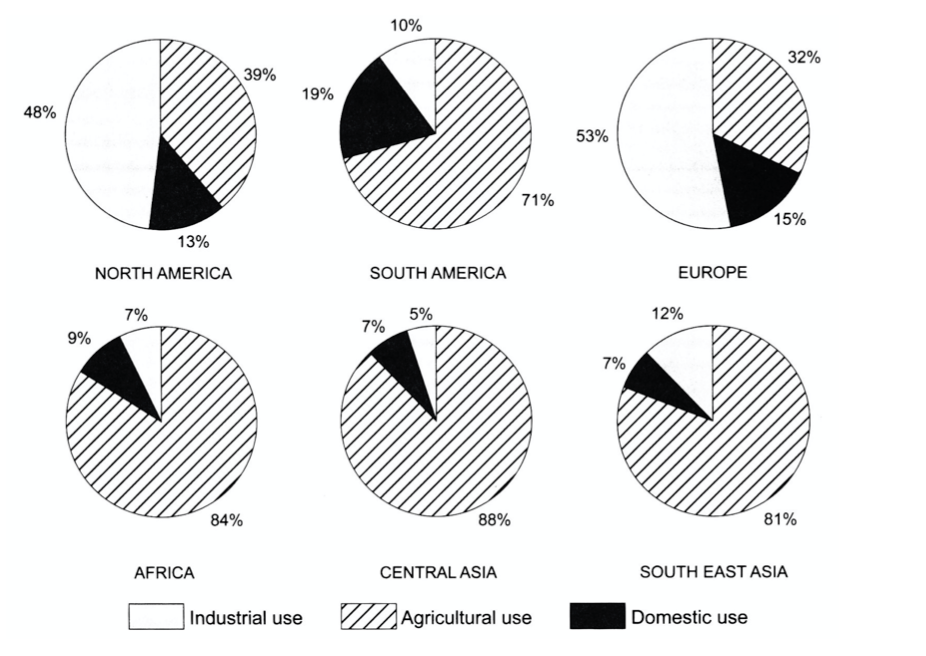
The pie charts provide information regarding the proportions of water used for industrial, agriculture, and domestic use in six regions.
In general, water serves mostly an industrial purpose in North America and Europe, whereas it is predominantly used for agriculture in South America, Africa, Central Asia, and South-East Asia.
Regarding industrial and domestic use, North America and Europe consume an average of approximately 50 percent of water for industrial purposes. However, these two regions report much less water consumption for domestic purposes, utilizing 13 percent and 15 percent, respectively. Out of all six regions, South America dedicates the highest percentage of water consumption for domestic use, but uses only 10 percent for industrial reasons. Both industrial and domestic use remain the least popular choices in Africa, Central Asia, and South-East Asia, where their combined use makes up less than 20 percent of the overall water consumption in each of the three regions.
Agricultural use, on the other hand, accounts for 71 percent of water consumption in South America and over three-fourths of water use in Africa, South-East Asia, and Central Asia, where it is nearly 90 percent. North America and Europe consume less than 40 percent of water for agricultural purposes.
Pour apprendre à aborder les diagrammes circulaires d'IELTS Academic Writing Task 1, inscrivez-vous à un essai gratuit de 7 jours pour accéder à la leçon IELTS Academic Writing Task - Pie Charts.
Essai gratuit de 7 joursTableaux
Dans ce type de tâche, on vous donne un tableau contenant des données. Il peut afficher des chiffres dynamiques qui évoluent au fil du temps ou des données statiques à un moment donné. Souvent, il y a trop d'informations, vous ne pourrez donc pas inclure tous les détails. Votre tâche est de rédiger un résumé, couvrant les points les plus importants et en appuyant votre description par des données.
The table below gives the average time spent and distance traveled by UK commuters in one year. Time and distance are given in minutes and miles accordingly.
Summarise the information by selecting and reporting the main features, and make comparisons where relevant.
Commuting Habits of different regions of the UK in a year
UK Region | Average Commuting Time (minutes) | Average Commuting Distance (miles) |
London | 54 | 14 |
South East | 78 | 20 |
Scotland | 45 | 19 |
West Midlands | 39 | 18 |
North West | 36 | 18 |
Northern Ireland | 36 | 15 |
Yorkshire & Humberside | 36 | 14 |
South West | 34 | 16 |
East Anglia | 33 | 15 |
North East | 32 | 19 |
East Midlands | 32 | 15 |
Wales | 27 | 14 |
- Write at least 150 words.
- You should spend around 20 minutes on this task.
The table shows data on the average commuting time (minutes) and distance (miles) completed by UK citizens in 12 different regions in one year.
Overall, with the exception of London, the further people travel, the more time they need to reach work people. Commuters in the south east region spend the longest time commuting over the greatest distance, whereas people in Wales spend the least.
Regarding the top three UK regions, on average, people in the south east travel both the farthest and longest at 20 miles over 78 minutes. Likewise inhabitants of Scotland journey a similar distance to work, yet spend almost half the time doing so at 45 minutes to get there, while those living in London spend the second-longest time travelling (54 minutes) over just 14 miles.
Of the other regions, people in the West Midlands spent the most time travelling at 39 minutes whereas those in Wales recorded the lowest time at 27 minutes. With regard to distance, residents of the North East, West Midlands and North West recorded the greatest mileage at 19, 18 and 18 miles respectively, while people in Yorkshire and Humberside as well as Wales both travelled the shortest distance to work of all at 14 miles.
Pour apprendre à aborder les tableaux d'IELTS Academic Writing Task 1, inscrivez-vous à un essai gratuit de 7 jours pour accéder aux leçons suivantes :
- Leçon IELTS Academic Writing Task - Tables Part 1.
- Leçon IELTS Academic Writing Task - Tables Part 2.
Diagrammes de processus
Pour ce type de question, on vous donnera un diagramme qui montre comment quelque chose fonctionne.
Le diagramme peut représenter une machine, un système ou un phénomène naturel.
Souvent, il n'y a pas de données ou peu de données incluses.
Votre tâche est de résumer les informations présentées dans le diagramme.
The diagram below shows the water cycle, which is the continuous movement of water on, above and below the surface of the Earth.
Summarise the information by selecting and reporting the main features.
- Write at least 150 words.
- You should spend around 20 minutes on this task.
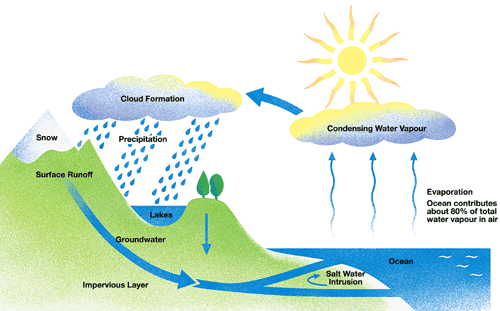
The diagram illustrates the hydrological cycle by which water moves through our natural environment. Overall, there are several stages to the process involving evaporation, precipitation and the final return of water to the ocean where the process begins over.
Since 80% of all water begins in the ocean, most water originates from this source. Initially sea water is warmed by the sun, causing it to evaporate into the air becoming water vapor. This then rises to condense into clouds at a higher elevation, which are then then pushed by the wind over land where it condenses further and precipitation occurs, falling as either snow or rain.
After precipitation on land, water then takes one of three routes. Some of it may fall into lakes or return to the ocean as surface runoff. Still further water percolates underground to an impermeable layer where it again flows back to the sea. Salt water also intrudes from the ocean into the land in coastal areas.

Process Diagram
Learn how to answer this question in a step-by-step interactive exercise
Process Diagram
Une tâche de schéma de processus de la Task 1 de l'IELTS Academic montre comment quelque chose est fabriqué ou comment un système fonctionne, étape par étape. Vous présentez les étapes dans l'ordre du schéma, sans donner de raisons ni d'opinion.
Prenez connaissance de la consigne, puis cliquez sur Suivant pour continuer.
Prendre connaissance de la question
Summarise the information by selecting and reporting the main features.
Write at least 150 words.
Avant d'écrire quoi que ce soit, assurez-vous de bien comprendre le schéma. Comptez les étapes et suivez les flèches pour voir où le processus commence et où il se termine. Si la dernière flèche revient à la première étape, le processus est un cycle et il n'y a pas de produit final.
Répondez aux questions sur le schéma.
Lire le diagramme
L'introduction indique au lecteur ce que montre le schéma. Paraphrasez la consigne avec vos propres mots au lieu de la recopier, et nommez le processus. Ne décrivez ici aucune des étapes.
Écrivez une ou deux phrases pour votre introduction.
Rédiger l'introduction
Question de la tâche
The diagram below shows the water cycle, which is the continuous movement of water on, above and below the surface of the Earth.
Summarise the information by selecting and reporting the main features.
Write at least 150 words.
Un rapport de Task 1 de l'IELTS demande un paragraphe de développement par groupe d'étapes. N'écrivez pas un paragraphe par étape. Découpez le processus à ses points de rupture naturels, là où le lieu, la matière ou l'objectif change, pour que chaque groupe soit une suite d'étapes qui s'enchaînent. La plupart des processus donnent deux groupes ; un processus court peut n'en donner qu'un, et un long, trois.
Choisissez les groupes.
Former les groupes
Choisissez les groupes.
- Group 1: stages 1 to 2 (Evaporation to Condensing Water Vapour). Group 2: stages 3 to 4 (Cloud Formation to Precipitation). Group 3: stages 5 to 6 (Surface Runoff to Groundwater).
- Group 1: stages 1 to 3 (Evaporation to Cloud Formation). Group 2: stages 4 to 5 (Precipitation to Surface Runoff). Group 3: stage 6 (Groundwater).
- Group 1: stages 1 to 3 (Evaporation to Cloud Formation). Group 2: stages 4 to 6 (Precipitation to Groundwater).
- Group 1: stages 1 to 2 (Evaporation to Condensing Water Vapour). Group 2: stages 3 to 5 (Cloud Formation to Surface Runoff). Group 3: stage 6 (Groundwater).
La vue d'ensemble résume tout le processus en un coup d'œil. Demandez-vous combien d'étapes il y a et quelles sont les grandes phases du début à la fin. Un processus est rarement comparé à autre chose : décrivez donc la forme du processus au lieu de chercher une hausse ou une baisse.
Répondez aux questions pour trouver la tendance générale.
Trouver la tendance générale
Servez-vous de vos notes de l'étape précédente. La vue d'ensemble indique le nombre d'étapes et les grandes phases, et précise si le processus aboutit à un produit ou se répète en cycle. Gardez le matériel, les durées et les températures pour les paragraphes de développement, et ne donnez ni raisons ni opinion.
Écrivez une ou deux phrases pour votre vue d'ensemble.
Rédiger votre vue d'ensemble
Le paragraphe de développement 1 décrit le premier groupe d'étapes, une par une, dans l'ordre indiqué par les flèches. Employez des formes passives comme is heated, is mixed et is poured, car le schéma dit rarement qui fait le travail. Reliez les étapes avec des mots de séquence comme first, then et after that.
Écrivez trois ou quatre phrases pour le paragraphe de développement 1.
Rédiger le paragraphe de développement 1
Le paragraphe de développement 2 décrit votre deuxième groupe d'étapes. Il reprend là où le paragraphe de développement 1 s'est arrêté, pour que la séquence ne soit jamais interrompue. Continuez à employer des formes passives et reliez les groupes avec des expressions comme once et after this. S'il s'agit du dernier paragraphe, marquez la fin avec in the final stage ou finally, et si le processus est un cycle, indiquez que la dernière étape ramène à la première.
Écrivez trois ou quatre phrases pour le paragraphe de développement 2.
Rédiger le paragraphe de développement 2
Vos parties forment maintenant un seul rapport : l'introduction, la vue d'ensemble et un paragraphe de développement par groupe d'étapes. Relisez-les ensemble et vérifiez que les étapes sont toujours dans l'ordre, que les formes passives sont correctes et que le rapport est assez long.
Relisez le plan complet de votre rapport, puis cliquez sur Suivant pour le comparer avec le rapport modèle.
Plan complet du rapport
Comment décider
Une tâche avec un schéma de processus montre, étape par étape, comment une chose est fabriquée ou comment un système fonctionne. Le schéma suit un ordre fixe : le rapport suit donc cet ordre, de la première à la dernière étape.
Travaillez toujours dans le même ordre pour que les étapes restent dans l'ordre et qu'aucune ne soit oubliée.
- Lire le diagramme. Comptez les étapes et suivez les flèches pour voir où le processus commence et où il se termine.
- Rédiger l'introduction. Paraphrasez la consigne et nommez le processus, sans aucun détail.
- Former les groupes. Découpez les étapes en groupes aux points de rupture naturels du processus, avec un paragraphe de développement pour chaque groupe.
- Trouver la tendance générale. Déterminez combien il y a d'étapes et quelles sont les phases principales, du début à la fin.
- Rédiger la vue d'ensemble et les paragraphes de développement. Résumez d'abord la forme générale du processus, puis décrivez les étapes dans l'ordre.
- Plan complet du rapport. Relisez vos parties ensemble et comparez-les avec le rapport modèle.
Un rapport sur un processus s'écrit au passif. Le schéma dit rarement qui fait le travail : utilisez donc des formes comme « is heated », « is mixed » et « is stored », et reliez les étapes avec des mots de séquence comme « first », « after that » et « finally ».
Lire
Un schéma de processus montre des étapes reliées par des flèches. Comptez les étapes et suivez les flèches pour vérifier où le processus commence et où il se termine. Si la dernière flèche revient à la première étape, le processus est un cycle et il n'y a pas de produit final.
Introduction
L'introduction dit ce que montre le schéma. Paraphrasez la consigne avec vos propres mots au lieu de la recopier, et nommez le processus. Laissez les étapes individuelles en dehors de ces phrases.
Groupes
Un rapport de Task 1 demande un paragraphe de développement pour chaque groupe d'étapes. N'écrivez pas un paragraphe par étape. Découpez le processus à ses points de rupture naturels, là où le lieu, la matière ou l'objectif change, pour que chaque groupe soit une suite d'étapes consécutives. La plupart des processus donnent deux groupes ; un processus court peut n'en donner qu'un, et un long en donner trois.
Tendance
La vue d'ensemble résume tout le processus en un coup d'œil : combien il y a d'étapes et quelles sont les phases principales. Un processus est rarement comparé à autre chose : décrivez donc la forme générale du processus au lieu de chercher une hausse ou une baisse.
Écrire
La vue d'ensemble vient en premier et reste générale, sans équipement, durées ni températures. Chaque paragraphe de développement décrit ensuite ses étapes dans l'ordre indiqué par les flèches. Utilisez des formes passives comme « is heated » et « is poured », et reliez les étapes avec des mots de séquence comme « first », « next », « after that » et « finally ».
Pour apprendre à aborder les diagrammes de processus d'IELTS Academic Writing Task 1, inscrivez-vous à un essai gratuit de 7 jours pour accéder à la leçon IELTS Academic Writing Task - Process Diagrams.
Essai gratuit de 7 joursCartes
Pour ce type de question, on vous donnera une, deux ou trois cartes.
Les cartes peuvent représenter une ville, une cité, une île ou une autre zone géographique.
Les cartes montrent généralement les changements survenus dans la zone au cours d'une période donnée.
Les changements peuvent être liés à la construction (par exemple, l'aménagement d'une zone à des fins touristiques)
ou à la destruction (par exemple, comment une zone a été affectée par une catastrophe naturelle comme un tremblement de terre)
Votre tâche est de rédiger un résumé des changements qui ont eu lieu et couvrir les points les plus importants.
The maps below show the centre of a small town called Islip as it is now, and plans for its development. Summarise the information by selecting and reporting the main features, and make comparisons where relevant.
- Write at least 150 words.
- You should spend around 20 minutes on this task.
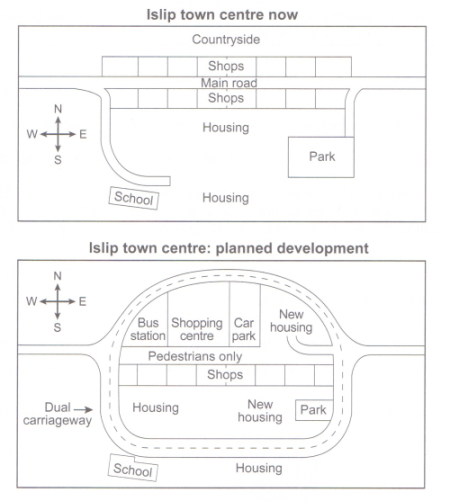
The diagrams illustrate some proposed changes to the central area of the town of Islip.
Overall, the principal change to the town will be the construction of a ring road around the centre. Various other developments with regard to shops and housing will accompany the building of this road.
As the first map reveals, lslip town center now is relatively small. There is a main road from the west to the east with shops on both sides. The northern area is rarely countryside, while the southern area is filled with houses with a school at the end of the fork road in the southwest corner and a park in the southeast area.
In the future, the main road is expected to reform into a dual carriageway as a round containing all the new buildings. The shops along the north side of the new pedestrian street will be demolished to make way for a bus station, shopping centre, car parks and new housing area. The shops along the south side of the street will remain, but it seems that the town's park will be reduced in size so that more new houses can be built within the ring road.
Map
Learn how to answer this question in a step-by-step interactive exercise
Map
Une tâche de plan de la Task 1 de l'IELTS Academic vous présente deux plans ou plus d'un même lieu à différentes époques, généralement deux. Vous rédigez un rapport d'au moins 150 mots qui décrit comment le lieu a changé, sans donner d'opinion ni de raisons.
Prenez connaissance de la consigne, puis cliquez sur Suivant pour continuer.
Prendre connaissance de la question
Write at least 150 words.
Commencez par lire les plans, pas par écrire. Vérifiez le lieu représenté, les dates comparées et le nombre de plans. Cherchez ensuite ce qui est nouveau, ce qui a disparu et ce qui sert désormais à autre chose.
Répondez aux questions sur les plans.
Lire le diagramme
L'introduction paraphrase la consigne avec vos propres mots. Indiquez ce que montrent les plans et la période qu'ils couvrent, en changeant les mots de la consigne au lieu de la recopier. Les détails, le vocabulaire de la position et les verbes de changement viendront plus tard.
Écrivez une ou deux phrases qui paraphrasent la consigne.
Rédiger l'introduction
Question de la tâche
The maps below show the centre of a small town called Islip as it is now, and plans for its development. Summarise the information by selecting and reporting the main features, and make comparisons where relevant.
Write at least 150 words.
Un rapport de Task 1 demande un paragraphe de développement par groupe de plans. En général, chaque plan forme son propre groupe : le plan le plus ancien dans le premier paragraphe et le plus récent dans le second, ce qui sépare bien les dates. Deux plans qu'il vaut mieux décrire ensemble peuvent former un seul groupe, et trois plans donnent généralement trois paragraphes.
Un paragraphe par élément, ou un paragraphe pour chaque moitié du plan, casse la comparaison entre les dates.
Choisissez le regroupement qui donne des paragraphes de développement clairs.
Former les groupes
Choisissez le regroupement qui donne des paragraphes de développement clairs.
- One group: now and planned development.
- Group 1: now. Group 2: planned development.
La vue d'ensemble présente le changement le plus important sur toute la période. Demandez-vous si le lieu s'est agrandi ou réduit, et quels types d'occupation du sol sont apparus ou ont disparu. Les éléments isolés et les positions exactes restent en dehors de la vue d'ensemble.
Choisissez les réponses qui décrivent le changement d'ensemble.
Trouver la tendance générale
Rédigez maintenant la vue d'ensemble avec vos propres mots, à partir des notes de l'étape précédente. Une ou deux phrases suffisent. Décrivez l'évolution générale du lieu, sans positions exactes, sans éléments isolés et sans raison du changement.
Rédigez votre vue d'ensemble en une ou deux phrases.
Rédiger votre vue d'ensemble
Le premier paragraphe de développement décrit en détail le ou les plans de votre premier groupe. Employez des formes du passé pour une situation qui n'existe plus, et le vocabulaire de la position, comme « to the north of », « beside » et « on the edge of », pour que le lecteur puisse situer chaque élément. Décrivez les éléments, pas les raisons.
Écrivez trois ou quatre phrases pour le paragraphe de développement 1.
Rédiger le paragraphe de développement 1
Le deuxième paragraphe de développement décrit le ou les plans de votre deuxième groupe et ce qui a changé depuis le plan précédent. Employez des formes passives pour ce qui a été construit, supprimé ou remplacé, comme « was built », « had been cleared » et « has been converted », car les plans ne disent pas qui a fait les travaux. Le vocabulaire de la position montre toujours où chaque changement a eu lieu.
Écrivez trois ou quatre phrases pour le paragraphe de développement 2.
Rédiger le paragraphe de développement 2
Vos parties forment maintenant un seul rapport : introduction, vue d'ensemble et un paragraphe de développement par groupe de plans. Relisez-les dans l'ordre et vérifiez que la vue d'ensemble présente la situation générale et que les paragraphes de développement apportent les détails.
Relisez le plan de votre rapport, puis comparez-le avec le rapport modèle.
Plan complet du rapport
Comment décider
Une tâche avec des plans vous présente deux plans ou plus d'un même lieu à différentes époques. Vous ne décrivez pas chaque légende. Vous rapportez comment le lieu a changé d'une date à l'autre.
Travaillez toujours dans le même ordre pour que le rapport présente la vue générale avant les détails.
- Lire le diagramme. Vérifiez le lieu, les dates et les éléments principaux de chaque plan avant de faire votre plan de rédaction.
- Former les groupes. Répartissez les informations en groupes de plans, avec un paragraphe de développement pour chacun, généralement le plan le plus ancien d'abord et le plus récent ensuite.
- Trouver la tendance générale. Dégagez le changement le plus important sur toute la période, comme une croissance, un déclin ou une nouvelle utilisation du terrain.
- Rédiger le rapport par étapes. Rédigez l'introduction, puis la vue d'ensemble, puis un paragraphe de développement pour chaque groupe.
- Plan complet du rapport. Relisez les parties ensemble et comparez-les avec le rapport modèle.
Le vocabulaire de la position et les formes passives portent un rapport sur des plans. Des expressions comme « to the north of » et « beside the river » situent chaque élément, et des formes comme « was built » ou « had been removed » rapportent un changement sans dire qui a fait le travail.
Lire
Avant de faire votre plan de rédaction, vérifiez ce que montrent les plans : le lieu, les dates et les éléments principaux de chaque plan. Cherchez ensuite ce qui est nouveau, ce qui a disparu et ce qui sert maintenant à autre chose. Cette étape de lecture vous évite de ne décrire qu'un seul des plans.
Groupes
Un rapport de Task 1 de l'IELTS demande un paragraphe de développement pour chaque groupe de plans. En général, chaque plan forme son propre groupe, le plan le plus ancien d'abord et le plus récent ensuite. Deux plans qu'il vaut mieux décrire ensemble peuvent former un seul groupe, et trois plans donnent généralement trois paragraphes. Décidez de la répartition avant d'écrire, car elle fixe l'ordre de tout le rapport.
Vue d'ensemble
La vue d'ensemble présente le changement le plus important sur toute la période, et non le petit détail. Demandez-vous si le lieu s'est agrandi ou réduit, et quels types d'utilisation du terrain sont apparus ou ont disparu. Les éléments isolés et les positions exactes ont leur place dans les paragraphes de développement.
Écrire
Le rapport se construit par courtes étapes. L'introduction paraphrase la consigne, la vue d'ensemble présente le changement principal, et un paragraphe de développement décrit chaque groupe. Utilisez des formes du passé pour une situation qui n'existe plus, des formes passives comme « was built » ou « had been cleared » pour les changements, et le vocabulaire de la position pour montrer où se trouve chaque élément.
Pour apprendre à aborder les cartes d'IELTS Academic Writing Task 1, inscrivez-vous à un essai gratuit de 7 jours pour accéder à la leçon IELTS Academic Writing Task - Maps.
Essai gratuit de 7 joursDonnées mixtes
Dans ce type de tâche, on vous donnera deux ensembles de données.
Les données seront de types différents. Par exemple, un ensemble peut représenter une évolution dans le temps tandis que le second est statique.
Alternativement, un ensemble de données peut afficher un pourcentage tandis que le second affiche des nombres.
On pourra également vous donner une illustration (par exemple, un diagramme ou une carte) et un ensemble de données (par exemple, un diagramme à barres, un graphique linéaire, un diagramme circulaire ou un tableau)
Votre tâche est de résumer les deux ensembles de données.
The pie graph depicts the main reasons for the productivity loss of agricultural land worldwide. The table shows how these causes influenced three world regions during the 2000s.
Summarise the information by selecting and reporting the main features, and make comparisons where relevant.
Causes of Land Degradation by Region (%) | ||||
Region: | Deforestation | Over-cultivation | Over-grazing | Total land degraded |
North America | 0.3 | 3.4 | 1.7 | 5.4 |
Asia | 9.8 | 7.8 | 5.7 | 23.3 |
Australia & Oceania | 1.6 | 0.3 | 11 | 12.9 |
- Write at least 150 words.
- You should spend around 20 minutes on this task.
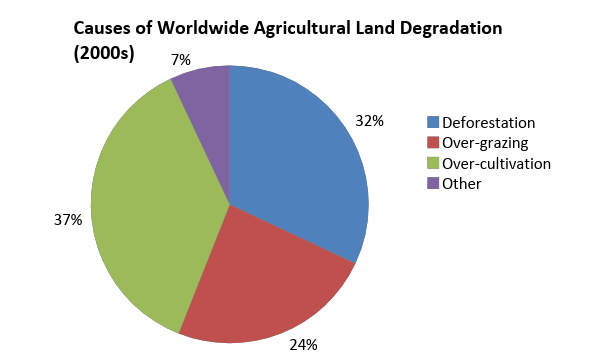
The pie chart shows the four main causes of farmland degradation in the world today, while the table presents the amount of land surface area affected by each one in three separate global regions during the 2000s.
Overall, Asia suffered more from the deterioration of farmland than other regions owing to deforestation and over-cultivation which were also the primary reasons for agricultural land loss worldwide.
Globally, 69% of degraded land is attributed to excessive cultivation and tree clearance, constituting 37% and 32% respectively. A further quarter of global land loss is due to over cultivation of crops. Other causes made up only 7% collectively.
In the 2000s, these causes affected regions of our planet differently. Asia was the worst affected where the top two causes of global land loss, deforestation and over-cultivation, resulted in 9.8% and 7.8% of degraded land there. The impact on Australia and Oceania was less severe though over-grazing was the predominant cause of land deterioration at eleven percent. The least affected of all was North America where only 5.4% of land was diminished, principally because of over-cultivation at 3.4%.
Mixed Charts
Learn how to answer this question in a step-by-step interactive exercise
Mixed Charts
Une tâche de graphiques combinés de la Task 1 de l'IELTS Academic vous présente deux visuels ou plus, de types différents, sur un même sujet. Vous rédigez un rapport d'au moins 150 mots qui présente les caractéristiques principales et relie les visuels, sans donner d'opinion ni de raisons.
Prenez connaissance de la consigne, puis cliquez sur Suivant pour continuer.
Prendre connaissance de la question
Summarise the information by selecting and reporting the main features, and make comparisons where relevant.
Write at least 150 words.
Commencez par lire les visuels, pas par écrire. Vérifiez ce que montre chaque visuel et lisez chaque titre d'axe et chaque unité avant de faire votre plan. Des visuels de types différents mesurent souvent des choses différentes : notez donc ce qu'ils ont en commun, comme le même groupe de personnes ou la même période.
Répondez aux questions sur les visuels.
Lire le diagramme
L'introduction paraphrase la consigne avec vos propres mots. Indiquez clairement ce que montre chaque visuel, ainsi que le groupe et la période qu'il couvre, en changeant les mots de la consigne au lieu de la recopier. Les chiffres et les liens entre les visuels viendront plus tard.
Écrivez une ou deux phrases qui paraphrasent la consigne.
Rédiger l'introduction
Question de la tâche
The pie graph depicts the main reasons for the productivity loss of agricultural land worldwide. The table shows how these causes influenced three world regions during the 2000s.
Summarise the information by selecting and reporting the main features, and make comparisons where relevant.
Write at least 150 words.
Un rapport de Task 1 demande un paragraphe de développement par groupe de visuels, et un ensemble de visuels combinés donne d'un à trois groupes. Les visuels d'un même type ou sur un même sujet vont ensemble, car un paragraphe qui mélange deux mesures est difficile à suivre. Deux diagrammes circulaires sur la même chose partagent un paragraphe, et un graphique linéaire portant sur une autre mesure a le sien.
Un paragraphe par visuel peut séparer ce qui va ensemble, et un seul paragraphe pour tous les visuels mélange les mesures. Répartir par années ou selon les chiffres les plus hauts et les plus bas casse la comparaison que demande la consigne.
Choisissez le regroupement qui donne à chaque paragraphe une seule mesure claire.
Former les groupes
Choisissez le regroupement qui donne à chaque paragraphe une seule mesure claire.
- Group 1: the pie chart. Group 2: the table.
- One group: the pie chart and the table.
La vue d'ensemble présente la tendance principale de l'ensemble des visuels, et elle vient avant tout détail. Trouvez le mouvement principal de chaque visuel, puis décidez si un visuel confirme ou explique l'autre. Les chiffres exacts restent en dehors de la vue d'ensemble.
Choisissez les réponses qui décrivent la tendance principale.
Trouver la tendance générale
Rédigez maintenant la vue d'ensemble avec vos propres mots, à partir des notes de l'étape précédente. Une ou deux phrases suffisent. Présentez la tendance principale et le lien entre les visuels, sans chiffres exacts et sans raison de cette tendance.
Rédigez votre vue d'ensemble en une ou deux phrases.
Rédiger votre vue d'ensemble
Le premier paragraphe de développement décrit en détail le premier groupe. Présentez les comparaisons significatives, comme le point le plus haut, le point le plus bas et le changement le plus net, et appuyez chacune d'elles avec quelques chiffres choisis. N'énumérez pas tous les nombres et ne décrivez pas les autres groupes ici.
Écrivez trois ou quatre phrases pour le paragraphe de développement 1.
Rédiger le paragraphe de développement 1
Le deuxième paragraphe de développement décrit le deuxième groupe et le relie au premier. Regroupez les comparaisons qui vont ensemble au lieu de prendre chaque catégorie l'une après l'autre, et employez une expression de liaison pour montrer où les visuels concordent. Présentez ce que montrent les données, pas pourquoi.
Écrivez trois ou quatre phrases pour le paragraphe de développement 2.
Rédiger le paragraphe de développement 2
Vos parties forment maintenant un seul rapport : introduction, vue d'ensemble et un paragraphe de développement par groupe de visuels. Relisez-les dans l'ordre et vérifiez que la vue d'ensemble présente la situation générale et que les paragraphes de développement apportent les détails.
Relisez le plan de votre rapport, puis comparez-le avec le rapport modèle.
Plan complet du rapport
Comment décider
Une tâche avec graphiques combinés vous présente deux documents visuels ou plus, de types différents, sur un même sujet. Vous n'écrivez pas un rapport séparé pour chaque document. Vous rapportez les éléments principaux de chacun et vous les reliez là où les données se rejoignent.
Travaillez toujours dans le même ordre pour que le rapport présente la vue générale avant les détails.
- Lire le diagramme. Vérifiez ce que montre chaque document visuel, et lisez chaque axe, chaque légende et chaque unité avant de faire votre plan de rédaction.
- Former les groupes. Répartissez les documents visuels en un à trois groupes, avec un paragraphe de développement pour chacun, généralement un type de graphique ou un sujet par groupe.
- Trouver la tendance générale. Dégagez la tendance la plus marquante de l'ensemble des documents visuels, et notez les liens entre eux.
- Rédiger le rapport par étapes. Rédigez l'introduction, puis la vue d'ensemble, puis un paragraphe de développement pour chaque groupe.
- Plan complet du rapport. Relisez les parties ensemble et comparez-les avec le rapport modèle.
Regroupez les comparaisons importantes au lieu d'énumérer tous les chiffres. Quelques chiffres choisis qui appuient une tendance rapportent plus qu'une longue liste qui ne fait que répéter ce que le document visuel montre déjà.
Lire
Des documents visuels de types différents mesurent des choses différentes : lisez donc d'abord chacun séparément. Vérifiez le titre, les intitulés des axes, les unités et la période, puis notez ce que les documents ont en commun, comme le même groupe de personnes ou la même période. Une part de temps dans un diagramme circulaire et un total dans un graphique linéaire ne sont pas la même mesure.
Groupes
Un rapport de Task 1 de l'IELTS demande un paragraphe de développement pour chaque groupe de documents visuels : les documents doivent donc se répartir en un, deux ou trois groupes. Les documents d'un même type ou sur un même sujet vont ensemble, et un document qui porte sur une autre mesure a son propre paragraphe. Décidez de la répartition avant d'écrire, car elle fixe l'ordre de tout le rapport.
Vue d'ensemble
La vue d'ensemble présente en une ou deux phrases la tendance la plus marquante de l'ensemble des documents visuels. Trouvez l'évolution principale de chaque document, puis déterminez si l'un appuie ou explique l'autre. Les chiffres exacts et les catégories isolées ont leur place dans les paragraphes de développement.
Écrire
Le rapport se construit par courtes étapes. L'introduction paraphrase la consigne, la vue d'ensemble présente la tendance principale, et un paragraphe de développement décrit chaque groupe. Dans les paragraphes de développement, regroupez les comparaisons qui vont ensemble et appuyez chacune sur quelques chiffres choisis au lieu d'énumérer tous les chiffres.
Pour apprendre à aborder les données mixtes d'IELTS Academic Writing Task 1, inscrivez-vous à un essai gratuit de 7 jours pour accéder à la leçon IELTS Academic Writing Task - Mixed Data.
Essai gratuit de 7 joursVocabulaire pour IELTS Academic Writing Task 1
Pour obtenir un score élevé sur cette tâche, vous devez apprendre à utiliser des mots et des phrases appropriés pour présenter les données fournies dans un graphique circulaire/à barres/linéaire/mixte. Nous vous suggérons de vous inscrire à un essai gratuit de 7 jours et de compléter les leçons suivantes :
- IELTS Academic Writing Task 1 Lesson - How to write about numbers
- IELTS Academic Writing Task 1 Lesson - How to write about percentages
- IELTS Academic Writing Task 1 Lesson - How to write about changes in data
Exemples IELTS Writing Task 1
Cette section présente une liste d'exemples de IELTS Writing pour IELTS Academic Writing Task 1.
- IELTS Academic Writing Task 1 - Line Chart Questions
- IELTS Academic Writing Task 1 - Bar Chart Questions
- IELTS Academic Writing Task 1 - Pie Chart Questions
- IELTS Academic Writing Task 1 - Map Questions
- IELTS Academic Writing Task 1 - Process Diagram Questions
- IELTS Academic Writing Task 1 - Mixed Data Questions
IELTS General Writing Task 1
Dans IELTS general training writing task 1, on vous présentera une situation et vous devrez rédiger une réponse personnelle sous la forme d'une lettre informelle, semi-formelle ou formelle d'au moins 150 mots. Les situations que l'on vous demande d'aborder sont des situations courantes et quotidiennes telles que :
- écrire à un responsable de logement universitaire au sujet de problèmes de logement,
- écrire à un nouvel employeur au sujet de problèmes de gestion du temps,
- écrire à un journal local au sujet d'un projet d'agrandissement d'un aéroport local,
- écrire à une agence de location pour régler des problèmes avec le système de chauffage de votre maison.
Concernant la situation, on vous fournira des informations sous la forme de trois puces que vous devrez inclure dans votre réponse. Il pourra vous être demandé de demander ou de donner des informations et/ou d'expliquer une situation. Pour ce faire, vous devrez peut-être faire certaines des choses suivantes :
- demander et/ou fournir des informations factuelles générales,
- exprimer des besoins, des envies, des goûts ou des aversions,
- exprimer des opinions ou des plaintes,
- faire des demandes ou des suggestions/recommandations.
Style de IELTS General Writing
Le style d'écriture que vous utiliserez dépend de la personne à qui l'on vous demande d'écrire (c'est-à-dire le destinataire) et de la mesure dans laquelle vous êtes censé la connaître. Vous devez écrire dans un style adapté à votre destinataire et qui vous aidera à atteindre votre objectif de rédaction, par exemple écrire à un ami (informel) ou écrire à un responsable (semi-formel ou formel). Vous n'avez pas besoin d'inclure d'adresses en en-tête de vos lettres.
Comment éviter de perdre des points en IELTS General Writing Task 1
Comme mentionné, ne consacrez pas plus de 20 minutes à cette tâche et assurez-vous d'écrire au moins 150 mots, sinon vous serez pénalisé. Bien que vous ne soyez pas pénalisé pour avoir écrit plus de 150 mots, vous devez vous rappeler qu'une réponse plus longue à task 1 peut signifier que vous aurez moins de temps à consacrer à task 2, qui contribue deux fois plus au score de bande Writing.
Vous devez également vous rappeler que vous serez pénalisé pour hors-sujet, si la réponse est hors sujet ou si elle n'est pas rédigée comme un texte complet et lié (par exemple, en utilisant des puces dans une partie quelconque de la réponse, ou sous forme de notes, etc.). Vous serez sévèrement pénalisé pour plagiat (c'est-à-dire copier à partir d'une autre source).
Last weekend, your cousin celebrated her 50th birthday, but you couldn't attend and you forgot to cancel.
Write a letter to your cousin. In your letter:
- Apologize for missing the birthday celebration
- Explain why you missed it and why you hadn't let her know
- Describe how you will make it up to her
You do NOT need to write any addresses.
Begin your letter as follows:
Dear ___,
- Write at least 150 words.
- You should spend around 20 minutes on this task.
Dear Marnie,
Happy belated birthday! I hope you're doing well and that you had a great 50th birthday party.
I'm so sorry that I wasn't at your party to celebrate with you. It's been such a long time since we've been able to catch up and see each other.
To be completely honest, I've been swamped with work lately, and I was asked to go on a last-minute business trip a few days before your birthday. I was so busy that I had completely forgotten about your party, and it didn't occur to me to call you and cancel.
My busy schedule is absolutely not an excuse for missing your 50th birthday, though, and I would love to make it up to you. I've reserved a table for two next Friday night at the new sushi restaurant in town. Can I please treat you to a luxurious birthday dinner?
I hope we can celebrate together next Friday!
Speak to you soon,
Jessica
Total Word Count: 162 words

Task Achievement — Letter
Learn how to answer this question in a step-by-step interactive exercise
Task Achievement — Letter
Dans la Task 1 de l'IELTS General Training, vous écrivez une lettre en réponse à une situation. La réalisation de la tâche dépend de votre capacité à couvrir chaque point de la consigne, car une bonne lettre qui en oublie un perd quand même des points.
Lisez la situation, les points de la consigne et toute phrase d'ouverture que la consigne vous donne.
Prenez connaissance de la consigne, puis cliquez sur Suivant pour continuer.
Prendre connaissance de la question
Write a letter to your cousin. In your letter:
- Apologize for missing the birthday celebration
- Explain why you missed it and why you hadn't let her know
- Describe how you will make it up to her
Write at least 150 words. You do NOT need to write any addresses.
Begin your letter as follows:
Dear ___,
Avant d'écrire, faites le plan de la lettre en répondant à trois questions. À qui écrivez-vous, pourquoi écrivez-vous et que doit contenir la lettre ?
Le destinataire détermine le niveau de formalité, l'objectif détermine la façon de commencer, et les points de la consigne déterminent le contenu. Chaque réponse se trouve déjà quelque part dans la consigne.
Associez chaque question de planification à la partie de la consigne qui y répond.
Comprendre la tâche
Associez chaque question de planification à la partie de la consigne qui y répond.
La formule d'appel et la formule de politesse indiquent au lecteur le niveau de formalité de la lettre : elles doivent donc correspondre à la personne à qui vous écrivez. Une lettre à un inconnu ou à un responsable est formelle, et une lettre à un ami est informelle.
Gardez le même niveau au début et à la fin de la lettre. Une formule d'appel formelle suivie d'une formule de politesse familière déroute le lecteur.
Choisissez une formule d'appel et une formule de politesse adaptées au destinataire.
Choisir la salutation et la formule de fin
Confirm the greeting
- Dear ___,
- Dear Sir or Madam,
- Dear Ms. Smith,
- Hey you,
Choose a closing
- Speak to you soon,
- Lots of love,
- Best wishes,
- Yours faithfully,
- Yours sincerely,
Consacrez un paragraphe au premier point de la consigne. La réalisation de la tâche est évaluée selon que chaque point est traité et développé, et pas seulement mentionné.
Des débuts de phrase vous sont proposés. Terminez l'idée avec vos propres mots et gardez le même ton que dans la formule d'appel.
Écrivez un paragraphe qui traite le premier point de la consigne.
Rédiger le point 1 de la consigne
Apologise for missing the birthday celebration
Le deuxième point de la consigne a lui aussi besoin de son propre paragraphe. Donnez-lui la même longueur et le même niveau de détail que le premier, car un point traité à moitié coûte quand même des points.
Commencez avec un début de phrase, puis ajoutez les détails dont le lecteur aurait réellement besoin dans cette situation.
Écrivez un paragraphe qui traite le deuxième point de la consigne.
Rédiger le point 2 de la consigne
Explain why you missed it and did not let her know
Terminez le corps de la lettre avec le troisième point de la consigne. Une fois les trois points traités en phrases complètes, la tâche est accomplie.
Gardez le même ton jusqu'à la fin, et vérifiez que ce paragraphe répond bien à ce que demande le point de la consigne.
Écrivez un paragraphe qui traite le troisième point de la consigne.
Rédiger le point 3 de la consigne
Describe how you will make it up to her
Vos paragraphes forment maintenant une seule lettre, avec la formule d'appel et la formule de politesse en place. Lisez-la comme un texte unique et vérifiez que chaque point de la consigne est traité.
Comparez vos formulations avec l'exemple de lettre et remarquez comment le ton reste le même de la formule d'appel à la formule de politesse.
Relisez votre lettre, puis cliquez sur Suivant pour continuer.
Relire votre lettre complète
Comment décider
Une lettre de Task 1 répond à une situation et traite une série de points de la consigne. La réalisation de la tâche dépend de deux choses : traiter chaque point de la consigne et adapter le ton au destinataire.
Travaillez toujours dans le même ordre pour ne manquer aucun point de la consigne et garder le même niveau de formalité du début à la fin.
- Comprendre la tâche. Déterminez à qui vous écrivez, pourquoi vous écrivez et ce que la lettre doit contenir.
- Choisir la salutation et la formule de fin. Adaptez la formule d'ouverture et la formule de clôture au destinataire, et gardez-les au même niveau de formalité.
- Rédiger les points de la consigne. Consacrez un paragraphe à chaque point de la consigne et développez-le avec de vrais détails.
- Relire votre lettre complète. Relisez les paragraphes ensemble et vérifiez que chaque point de la consigne est traité.
Écrivez un paragraphe pour chaque point de la consigne. Avec ce plan simple, il devient presque impossible d'oublier un point de la consigne, ce qui est le moyen le plus rapide de perdre des points en réalisation de la tâche.
Plan
Trois questions suffisent pour planifier toute la lettre. À qui écrivez-vous, pourquoi écrivez-vous, et que doit contenir la lettre ? Chaque réponse se trouve déjà quelque part dans la consigne.
Ton
La formule d'appel et la formule de clôture montrent au destinataire le niveau de formalité de la lettre. Une lettre à un inconnu ou à un responsable est formelle, une lettre à un ami est informelle, et le début comme la fin de la lettre doivent rester au même niveau.
Points de la consigne
Chaque point de la consigne a son propre paragraphe. Traitez-le en phrases complètes avec les détails dont le destinataire aurait vraiment besoin, et donnez aux paragraphes une longueur similaire pour qu'aucun point ne paraisse bâclé.
Pour plus d'informations sur IELTS General Writing Task 1, consultez The Ultimate Guide for the IELTS General Writing Task 1
IELTS Writing Task 2
Dans IELTS writing task 2, vous devrez rédiger une dissertation de style traditionnel en réponse à une question. Vous devez écrire au moins 250 mots. Si vous n'écrivez pas assez de mots, vous serez pénalisé. Il existe 6 types de questions différents dans task 2. Examinons des exemples de questions et des dissertations modèles pour chaque type de dissertation.
Causes et effets
Dans ce type de question, on vous donnera un problème ou une situation. Votre tâche est de décrire les causes de la situation et certains des effets de la situation.
It is observed that in many countries not enough students are choosing to study science at university. What are the causes? And what will be the effects on society?
- Write at least 250 words.
- You should spend around 40 minutes on this task.
It is a fact that many students globally are avoiding science in favor of other subjects at university. Such a trend is largely due to how science is perceived, which may be having a detrimental effect on a nation’s development.
The primary reason for the drop in enrollment in science-based courses is that many undergraduates are put off by their difficulty. While many high school students enjoy science, they soon find themselves facing a lot of theory and research based courses once in college. For example according to a recent poll of UK universities, many students stated that while science was interesting in high school, there was too much theory learnt in classes, and not enough application in the lab to make it interesting. Furthermore, there are plenty of easier alternatives such as humanities for students to choose from these days. As a result, most choose a more appealing humanities degree over a science one.
Countries with the lowest science enrollment rates are affected the most competitively and economically. Fewer science graduates mean a shortage of skilled researchers in science-related fields like bio-engineering which reduces a countries competitiveness in attracting foreign investment. In other words foreign companies are usually unwilling to invest in nations with a low pool of skilled workers. In addition, a low number of skilled workers mean fewer technological developments for such countries, which may cause their economies to suffer from lost business in being the first to market with new products. For example, evidence shows that the number of patents filed by Chinese corporations is beginning to threaten the number credited to American ones.
In conclusion, there is a direct correlation between the perceived difficulty of science degrees and limited economic growth. Only by changing this attitude will countries reverse this trend.
Task Achievement — Task 2
Learn how to answer this question in a step-by-step interactive exercise
Task Achievement — Task 2
Dans la Task 2 de l'IELTS Writing, vous rédigez un essai qui répond à chaque partie de la question. Lisez attentivement l'affirmation et la phrase de consigne, et repérez ce que la question vous demande de traiter.
Un essai qui reste dans le sujet mais ne répond jamais à la question posée ne peut pas obtenir une note élevée.
Prenez connaissance de la question, puis cliquez sur Suivant pour continuer.
Prendre connaissance de la question
Rédigeons l'introduction en deux phrases, soit environ 25 à 35 mots au total. D'abord, reformulez la question avec vos propres mots. Paraphrasez-la en utilisant vos propres mots et des synonymes. Cela garantit que votre essai reste dans le sujet et vous permet de montrer un vocabulaire varié. La deuxième phrase présente les points précis que vous traiterez dans les paragraphes de développement.
Écrivez une introduction.
Rédiger l'introduction
Chaque paragraphe de développement a besoin d'une phrase principale qui présente son idée principale. Deux paragraphes de développement suffisent pour un essai de cette longueur.
Écrivez une phrase claire pour chaque paragraphe. Limitez chaque phrase à 12 à 20 mots et gardez les explications et les exemples pour les étapes suivantes.
Écrivez une phrase principale pour chaque paragraphe de développement.
Écrire deux phrases principales
science courses are seen as too hard
fewer scientists hurt the economy
Une phrase principale ne rapporte des points que si elle est appuyée. Développez le premier paragraphe de développement avec deux idées. Pour chaque idée, écrivez une explication et un exemple précis.
Chaque paragraphe de développement doit compter environ 4–5 phrases, soit 60 à 80 mots. Une situation concrète et précise a plus de poids qu'une affirmation générale.
Écrivez la suite du premier paragraphe de développement.
Étoffer le paragraphe de développement 1
60
Donnez au deuxième paragraphe de développement la même profondeur qu'au premier. Utilisez deux idées et appuyez chacune d'elles avec une explication et un exemple.
Chaque paragraphe de développement doit compter environ 4–5 phrases, soit 60 à 80 mots. Ne répétez pas le premier paragraphe avec d'autres mots.
Écrivez la suite du deuxième paragraphe de développement.
Étoffer le paragraphe de développement 2
60
La conclusion termine l'essai. Écrivez un résumé en deux phrases des idées principales, puis ajoutez une ou deux phrases sur l'importance du sujet.
Ne recopiez pas l'introduction et n'ajoutez pas de nouvel argument. Limitez l'ensemble de la conclusion à 35 à 50 mots.
Écrivez une conclusion de 3–4 phrases.
Rédiger la conclusion
35
Votre introduction, vos phrases principales, vos paragraphes de développement et votre conclusion forment maintenant un seul essai. Lisez-le comme un texte unique et vérifiez qu'il répond à chaque partie de la question.
Comparez vos formulations avec l'exemple d'essai et remarquez comment chaque paragraphe remplit un rôle différent.
Relisez votre essai, puis cliquez sur Suivant pour continuer.
Relire votre dissertation complète
Comment décider
Un essai de Task 2 répond à toutes les parties de la question. La réalisation de la tâche dépend de deux choses : traiter ce que demande la question et appuyer chaque point principal sur une explication et un exemple.
Travaillez toujours dans le même ordre : introduction, deux phrases principales, deux paragraphes de développement étoffés, puis une conclusion.
- Rédiger l'introduction.
En général, ce paragraphe demande deux phrases. Paraphrasez la question avec vos propres mots et des synonymes. Votre essai reste ainsi dans le sujet, et vous montrez l'étendue de votre vocabulaire. La deuxième phrase présente les sujets précis que vous allez traiter dans les paragraphes de développement. Votre introduction doit donc contenir :
- La question reformulée
- La présentation des sujets précis
- Écrire deux phrases principales. Écrivez une phrase principale pour chaque paragraphe de développement.
- Étoffer les paragraphes de développement. Appuyez chaque paragraphe de développement sur deux points, et donnez à chaque point une explication et un exemple. Chaque paragraphe de développement doit compter environ 4 à 5 phrases.
- Rédiger la conclusion. Résumez les points principaux, puis dites pourquoi le sujet est important.
- Relire votre dissertation complète. Relisez les parties ensemble et vérifiez que chaque partie de la question a reçu une réponse.
Deux paragraphes étoffés obtiennent une meilleure note que quatre points non développés. Les examinateurs récompensent les justifications : ajoutez donc une explication et un exemple à un point que vous avez déjà plutôt que d'ajouter un nouveau point.
Introduction
En général, ce paragraphe demande deux phrases. Paraphrasez la question avec vos propres mots et des synonymes. Votre essai reste ainsi dans le sujet, et vous montrez l'étendue de votre vocabulaire. La deuxième phrase présente les sujets précis que vous allez traiter dans les paragraphes de développement. Votre introduction doit donc contenir :
- La question reformulée
- La présentation des sujets précis
Phrases principales
Écrivez une phrase principale pour chaque paragraphe de développement. Chaque phrase doit présenter le point principal de son paragraphe en 12 à 20 mots et garder les exemples pour l'étape suivante.
Appui
Une phrase principale rapporte des points dès qu'elle est justifiée. Expliquez pourquoi le point est vrai, donnez un exemple précis, et accordez autant de justifications aux deux paragraphes de développement. Chaque paragraphe de développement doit compter environ 4 à 5 phrases.
Conclusion
La conclusion résume les points principaux en deux phrases, puis ajoute une ou deux phrases sur l'importance du sujet. Ne recopiez pas l'introduction et n'ajoutez pas de nouvel argument.
Discutez les deux points de vue et donnez votre propre opinion
Dans ce type de question, on vous donnera deux points de vue opposés liés à un sujet. Habituellement, les deux points de vue seront dans des phrases séparées reliées par un mot de transition tel que « however » pour indiquer que les deux points de vue s'opposent. Votre tâche est de rédiger une dissertation discursive, en contrastant les deux côtés du sujet et en présentant votre propre point de vue.
Some people argue that the public should be allowed to have guns. Others do not agree. Discuss both points of view and give your opinion.
- Write at least 250 words.
- You should spend around 40 minutes on this task.
Gun ownership is a controversial topic with some people arguing that the public should have the choice to own them, while others disagree wholeheartedly with the idea. In my opinion, I believe that the public should only be entitled to own guns after having proper training.
The benefits of gun ownership are touted in some countries more than others. In countries where owning one is a civic right, like the United States, it is legal to use one in self-defense is legal. With muggings, murder and burglary rising in many countries, there may be some truth to the claim that owing a gun gives the owner increased security. Furthermore, in remote or dangerous areas, guns may be a necessity rather than an option. Without police nearby, properly stored, guns may be a great asset in deterring criminals from breaking and entering a remote property.
However, rather than deter violence, guns tend to escalate it in areas where they are widely available. Research shows that violent crime increases dramatically when guns are prevalent in society. When the public is armed, criminals and the police become so too, creating a situation in which guns beget more guns and eventually death. Additionally, greater ease of access is dangerous for children. Having a gun easily accessible may tempt children to abuse them as evidenced by the almost weekly school shootings in the US. There is further a proven link between increased suicide rates when guns are present.
It is my belief that the general public should be barred from owning guns of any kind. Also, guns should be restricted to specialists with a proven need for a firearm such as soldiers or hunters. While there are certain circumstances where owning a gun is an advantage, in the vast majority of situations there is no place for a gun in modern society.
Task Achievement — Task 2
Learn how to answer this question in a step-by-step interactive exercise
Task Achievement — Task 2
Dans la Task 2 de l'IELTS Writing, vous rédigez un essai qui répond à chaque partie de la question. Lisez attentivement l'affirmation et la phrase de consigne, et repérez ce que la question vous demande de traiter.
Un essai qui reste dans le sujet mais ne répond jamais à la question posée ne peut pas obtenir une note élevée.
Prenez connaissance de la question, puis cliquez sur Suivant pour continuer.
Prendre connaissance de la question
Rédigeons l'introduction en deux phrases, soit environ 25 à 35 mots au total. D'abord, reformulez la question avec vos propres mots. Paraphrasez-la en utilisant vos propres mots et des synonymes. Cela garantit que votre essai reste dans le sujet et vous permet de montrer un vocabulaire varié. La deuxième phrase présente les points précis que vous traiterez dans les paragraphes de développement.
Écrivez une introduction.
Rédiger l'introduction
Chaque paragraphe de développement a besoin d'une phrase principale qui présente son idée principale. Deux paragraphes de développement suffisent pour un essai de cette longueur.
Écrivez une phrase claire pour chaque paragraphe. Limitez chaque phrase à 12 à 20 mots et gardez les explications et les exemples pour les étapes suivantes.
Écrivez une phrase principale pour chaque paragraphe de développement.
Écrire deux phrases principales
guns help people defend themselves
more guns lead to more violence
Une phrase principale ne rapporte des points que si elle est appuyée. Développez le premier paragraphe de développement avec deux idées. Pour chaque idée, écrivez une explication et un exemple précis.
Chaque paragraphe de développement doit compter environ 4–5 phrases, soit 60 à 80 mots. Une situation concrète et précise a plus de poids qu'une affirmation générale.
Écrivez la suite du premier paragraphe de développement.
Étoffer le paragraphe de développement 1
60
Donnez au deuxième paragraphe de développement la même profondeur qu'au premier. Utilisez deux idées et appuyez chacune d'elles avec une explication et un exemple.
Chaque paragraphe de développement doit compter environ 4–5 phrases, soit 60 à 80 mots. Ne répétez pas le premier paragraphe avec d'autres mots.
Écrivez la suite du deuxième paragraphe de développement.
Étoffer le paragraphe de développement 2
60
La conclusion termine l'essai. Écrivez un résumé en deux phrases des idées principales, puis ajoutez une ou deux phrases sur l'importance du sujet.
Ne recopiez pas l'introduction et n'ajoutez pas de nouvel argument. Limitez l'ensemble de la conclusion à 35 à 50 mots.
Écrivez une conclusion de 3–4 phrases.
Rédiger la conclusion
35
Votre introduction, vos phrases principales, vos paragraphes de développement et votre conclusion forment maintenant un seul essai. Lisez-le comme un texte unique et vérifiez qu'il répond à chaque partie de la question.
Comparez vos formulations avec l'exemple d'essai et remarquez comment chaque paragraphe remplit un rôle différent.
Relisez votre essai, puis cliquez sur Suivant pour continuer.
Relire votre dissertation complète
Comment décider
Un essai de Task 2 répond à toutes les parties de la question. La réalisation de la tâche dépend de deux choses : traiter ce que demande la question et appuyer chaque point principal sur une explication et un exemple.
Travaillez toujours dans le même ordre : introduction, deux phrases principales, deux paragraphes de développement étoffés, puis une conclusion.
- Rédiger l'introduction.
En général, ce paragraphe demande deux phrases. Paraphrasez la question avec vos propres mots et des synonymes. Votre essai reste ainsi dans le sujet, et vous montrez l'étendue de votre vocabulaire. La deuxième phrase présente les sujets précis que vous allez traiter dans les paragraphes de développement. Votre introduction doit donc contenir :
- La question reformulée
- La présentation des sujets précis
- Écrire deux phrases principales. Écrivez une phrase principale pour chaque paragraphe de développement.
- Étoffer les paragraphes de développement. Appuyez chaque paragraphe de développement sur deux points, et donnez à chaque point une explication et un exemple. Chaque paragraphe de développement doit compter environ 4 à 5 phrases.
- Rédiger la conclusion. Résumez les points principaux, puis dites pourquoi le sujet est important.
- Relire votre dissertation complète. Relisez les parties ensemble et vérifiez que chaque partie de la question a reçu une réponse.
Deux paragraphes étoffés obtiennent une meilleure note que quatre points non développés. Les examinateurs récompensent les justifications : ajoutez donc une explication et un exemple à un point que vous avez déjà plutôt que d'ajouter un nouveau point.
Introduction
En général, ce paragraphe demande deux phrases. Paraphrasez la question avec vos propres mots et des synonymes. Votre essai reste ainsi dans le sujet, et vous montrez l'étendue de votre vocabulaire. La deuxième phrase présente les sujets précis que vous allez traiter dans les paragraphes de développement. Votre introduction doit donc contenir :
- La question reformulée
- La présentation des sujets précis
Phrases principales
Écrivez une phrase principale pour chaque paragraphe de développement. Chaque phrase doit présenter le point principal de son paragraphe en 12 à 20 mots et garder les exemples pour l'étape suivante.
Appui
Une phrase principale rapporte des points dès qu'elle est justifiée. Expliquez pourquoi le point est vrai, donnez un exemple précis, et accordez autant de justifications aux deux paragraphes de développement. Chaque paragraphe de développement doit compter environ 4 à 5 phrases.
Conclusion
La conclusion résume les points principaux en deux phrases, puis ajoute une ou deux phrases sur l'importance du sujet. Ne recopiez pas l'introduction et n'ajoutez pas de nouvel argument.
Avantages et inconvénients
Dans ce type de question, on vous demandera de discuter des aspects positifs et négatifs d'une situation, d'une solution ou d'une tendance. On pourra également vous demander de donner votre opinion sur le côté que vous jugez le plus important.
In some countries, governments are encouraging industries and businesses to move to regional areas outside the big cities. Do the advantages of this trend outweigh the disadvantages?
- Write at least 250 words.
- You should spend around 40 minutes on this task.
There is a movement among some countries to promote regional areas away from cities as attractive to business and industry. In my opinion, I consider relocation of business to bring about more drawbacks than benefits over the long term.
There are several attractive benefits to businesses moving to regional areas. For businesses rural locations mean lower land prices. Cheaper land allows large or small business equal prospects to become established cheaply with additional room to expand. As an example, the average size of a business in UK cities is currently 25 square meters while those in the rural locales average around 50m2. Additionally, countries benefits principally from the direct investment in underperforming parts of the country. Having companies operating in less urbanized areas, creates jobs, attracts talent and increases immigration which brings greater wealth.
On the other hand, relocation is not without its drawbacks. For one thing, locations away from population centers may mean a greater distance to market for goods. As a result, cost savings from cheaper land may be mitigated by the increased transportation costs of shipping products to customers. For another thing, there are often fewer skilled workers in regional areas. It may not be easy to attract employees to work in out-of-the-way places, which would mean longer commutes for staff from nearby cities at the expense of the company coffers. Lastly, increased business in country areas, disturbs the life of local residents. Country roads are not built for heavy trucks or traffic which may cause increased noise, congestions and inconvenience to those living nearby.
To sum up, while regional settings may be well suited to certain internet-based businesses, for more traditional companies, the distance from the city presents many challenges to overcome.
Task Achievement — Task 2
Learn how to answer this question in a step-by-step interactive exercise
Task Achievement — Task 2
Dans la Task 2 de l'IELTS Writing, vous rédigez un essai qui répond à chaque partie de la question. Lisez attentivement l'affirmation et la phrase de consigne, et repérez ce que la question vous demande de traiter.
Un essai qui reste dans le sujet mais ne répond jamais à la question posée ne peut pas obtenir une note élevée.
Prenez connaissance de la question, puis cliquez sur Suivant pour continuer.
Prendre connaissance de la question
Rédigeons l'introduction en deux phrases, soit environ 25 à 35 mots au total. D'abord, reformulez la question avec vos propres mots. Paraphrasez-la en utilisant vos propres mots et des synonymes. Cela garantit que votre essai reste dans le sujet et vous permet de montrer un vocabulaire varié. La deuxième phrase présente les points précis que vous traiterez dans les paragraphes de développement.
Écrivez une introduction.
Rédiger l'introduction
Chaque paragraphe de développement a besoin d'une phrase principale qui présente son idée principale. Deux paragraphes de développement suffisent pour un essai de cette longueur.
Écrivez une phrase claire pour chaque paragraphe. Limitez chaque phrase à 12 à 20 mots et gardez les explications et les exemples pour les étapes suivantes.
Écrivez une phrase principale pour chaque paragraphe de développement.
Écrire deux phrases principales
cheaper land and new jobs in the regions
higher transport costs and fewer skilled workers
Une phrase principale ne rapporte des points que si elle est appuyée. Développez le premier paragraphe de développement avec deux idées. Pour chaque idée, écrivez une explication et un exemple précis.
Chaque paragraphe de développement doit compter environ 4–5 phrases, soit 60 à 80 mots. Une situation concrète et précise a plus de poids qu'une affirmation générale.
Écrivez la suite du premier paragraphe de développement.
Étoffer le paragraphe de développement 1
60
Donnez au deuxième paragraphe de développement la même profondeur qu'au premier. Utilisez deux idées et appuyez chacune d'elles avec une explication et un exemple.
Chaque paragraphe de développement doit compter environ 4–5 phrases, soit 60 à 80 mots. Ne répétez pas le premier paragraphe avec d'autres mots.
Écrivez la suite du deuxième paragraphe de développement.
Étoffer le paragraphe de développement 2
60
La conclusion termine l'essai. Écrivez un résumé en deux phrases des idées principales, puis ajoutez une ou deux phrases sur l'importance du sujet.
Ne recopiez pas l'introduction et n'ajoutez pas de nouvel argument. Limitez l'ensemble de la conclusion à 35 à 50 mots.
Écrivez une conclusion de 3–4 phrases.
Rédiger la conclusion
35
Votre introduction, vos phrases principales, vos paragraphes de développement et votre conclusion forment maintenant un seul essai. Lisez-le comme un texte unique et vérifiez qu'il répond à chaque partie de la question.
Comparez vos formulations avec l'exemple d'essai et remarquez comment chaque paragraphe remplit un rôle différent.
Relisez votre essai, puis cliquez sur Suivant pour continuer.
Relire votre dissertation complète
Comment décider
Un essai de Task 2 répond à toutes les parties de la question. La réalisation de la tâche dépend de deux choses : traiter ce que demande la question et appuyer chaque point principal sur une explication et un exemple.
Travaillez toujours dans le même ordre : introduction, deux phrases principales, deux paragraphes de développement étoffés, puis une conclusion.
- Rédiger l'introduction.
En général, ce paragraphe demande deux phrases. Paraphrasez la question avec vos propres mots et des synonymes. Votre essai reste ainsi dans le sujet, et vous montrez l'étendue de votre vocabulaire. La deuxième phrase présente les sujets précis que vous allez traiter dans les paragraphes de développement. Votre introduction doit donc contenir :
- La question reformulée
- La présentation des sujets précis
- Écrire deux phrases principales. Écrivez une phrase principale pour chaque paragraphe de développement.
- Étoffer les paragraphes de développement. Appuyez chaque paragraphe de développement sur deux points, et donnez à chaque point une explication et un exemple. Chaque paragraphe de développement doit compter environ 4 à 5 phrases.
- Rédiger la conclusion. Résumez les points principaux, puis dites pourquoi le sujet est important.
- Relire votre dissertation complète. Relisez les parties ensemble et vérifiez que chaque partie de la question a reçu une réponse.
Deux paragraphes étoffés obtiennent une meilleure note que quatre points non développés. Les examinateurs récompensent les justifications : ajoutez donc une explication et un exemple à un point que vous avez déjà plutôt que d'ajouter un nouveau point.
Introduction
En général, ce paragraphe demande deux phrases. Paraphrasez la question avec vos propres mots et des synonymes. Votre essai reste ainsi dans le sujet, et vous montrez l'étendue de votre vocabulaire. La deuxième phrase présente les sujets précis que vous allez traiter dans les paragraphes de développement. Votre introduction doit donc contenir :
- La question reformulée
- La présentation des sujets précis
Phrases principales
Écrivez une phrase principale pour chaque paragraphe de développement. Chaque phrase doit présenter le point principal de son paragraphe en 12 à 20 mots et garder les exemples pour l'étape suivante.
Appui
Une phrase principale rapporte des points dès qu'elle est justifiée. Expliquez pourquoi le point est vrai, donnez un exemple précis, et accordez autant de justifications aux deux paragraphes de développement. Chaque paragraphe de développement doit compter environ 4 à 5 phrases.
Conclusion
La conclusion résume les points principaux en deux phrases, puis ajoute une ou deux phrases sur l'importance du sujet. Ne recopiez pas l'introduction et n'ajoutez pas de nouvel argument.
Problèmes et solutions
Dans ce type de question, on vous donnera un problème ou une situation. Votre tâche est de décrire les causes de la situation et certaines solutions au problème. La question peut demander des solutions générales (par exemple, comment ce problème pourrait-il être résolu) ou demander comment des groupes spécifiques peuvent résoudre le problème (par exemple, quelles mesures les gouvernements et les particuliers peuvent-ils prendre pour résoudre le problème ?). Vous n'avez pas besoin de mentionner les effets en détail, juste brièvement.
More and more wild animals are on the verge of extinction and others are on the endangered list. What are the reasons for this? What can be done to solve this problem?
- Write at least 250 words.
- You should spend around 40 minutes on this task.
The number of critically endangered animals is growing significantly, while a disturbing number of other species have become threatened. This worrying trend stems from several causes, though solutions exist where the will to implement them is present.
Regarding species on the critically endangered list, outmoded beliefs in Eastern medicine that endangered animal parts have medicinal qualities is driving demand for them, particularly in China. Animals are needlessly killed to cure ailments from infertility to arthritis, and China’s increasing affluence mean demand is expected to increase even further. Despite this, limited action by governments has proven ineffective at stopping such a trade. Many species threatened with extinction live in national parks, typically in developing countries. However, chronic underfunding means officials there are powerless to catch poachers, and corruption means the ones who are caught, often get away.
Where political will is available, several solutions may help. To begin with, developed countries could help fund budgets to protect endangered species in poorer countries. While this doesn’t solve the issue of corruption, it would increase deterrence and hopefully reduce the number of animals needlessly killed. More meaningfully, in countries where animal parts are bought and sold, laws should be more strictly enforced and punishments massively increased to discourage both sellers and buyers alike. A concerted education campaign should also be effected to stamp out the perception that animal parts have any curative properties to reduce the market for such ‘goods’ once and for all.
In conclusion, removing the market for animal parts, and better protecting the endangered animals that remain may help preserve the world’s natural heritage before it is too late.
Further reasons to consider:
Development destroying their habitat and food sourceGrowing cities and farmland encroach on habitatMany animals cannot find the place to raise their youngFurther solutions to consider:
Increase government budgets to protect animalsFor example, the panda is now rebounding in Southern China due to concerted government efforts to protect it.Task Achievement — Task 2
Learn how to answer this question in a step-by-step interactive exercise
Task Achievement — Task 2
Dans la Task 2 de l'IELTS Writing, vous rédigez un essai qui répond à chaque partie de la question. Lisez attentivement l'affirmation et la phrase de consigne, et repérez ce que la question vous demande de traiter.
Un essai qui reste dans le sujet mais ne répond jamais à la question posée ne peut pas obtenir une note élevée.
Prenez connaissance de la question, puis cliquez sur Suivant pour continuer.
Prendre connaissance de la question
Rédigeons l'introduction en deux phrases, soit environ 25 à 35 mots au total. D'abord, reformulez la question avec vos propres mots. Paraphrasez-la en utilisant vos propres mots et des synonymes. Cela garantit que votre essai reste dans le sujet et vous permet de montrer un vocabulaire varié. La deuxième phrase présente les points précis que vous traiterez dans les paragraphes de développement.
Écrivez une introduction.
Rédiger l'introduction
Chaque paragraphe de développement a besoin d'une phrase principale qui présente son idée principale. Deux paragraphes de développement suffisent pour un essai de cette longueur.
Écrivez une phrase claire pour chaque paragraphe. Limitez chaque phrase à 12 à 20 mots et gardez les explications et les exemples pour les étapes suivantes.
Écrivez une phrase principale pour chaque paragraphe de développement.
Écrire deux phrases principales
animals are killed for traditional medicine
more funding, stricter laws and education
Une phrase principale ne rapporte des points que si elle est appuyée. Développez le premier paragraphe de développement avec deux idées. Pour chaque idée, écrivez une explication et un exemple précis.
Chaque paragraphe de développement doit compter environ 4–5 phrases, soit 60 à 80 mots. Une situation concrète et précise a plus de poids qu'une affirmation générale.
Écrivez la suite du premier paragraphe de développement.
Étoffer le paragraphe de développement 1
60
Donnez au deuxième paragraphe de développement la même profondeur qu'au premier. Utilisez deux idées et appuyez chacune d'elles avec une explication et un exemple.
Chaque paragraphe de développement doit compter environ 4–5 phrases, soit 60 à 80 mots. Ne répétez pas le premier paragraphe avec d'autres mots.
Écrivez la suite du deuxième paragraphe de développement.
Étoffer le paragraphe de développement 2
60
La conclusion termine l'essai. Écrivez un résumé en deux phrases des idées principales, puis ajoutez une ou deux phrases sur l'importance du sujet.
Ne recopiez pas l'introduction et n'ajoutez pas de nouvel argument. Limitez l'ensemble de la conclusion à 35 à 50 mots.
Écrivez une conclusion de 3–4 phrases.
Rédiger la conclusion
35
Votre introduction, vos phrases principales, vos paragraphes de développement et votre conclusion forment maintenant un seul essai. Lisez-le comme un texte unique et vérifiez qu'il répond à chaque partie de la question.
Comparez vos formulations avec l'exemple d'essai et remarquez comment chaque paragraphe remplit un rôle différent.
Relisez votre essai, puis cliquez sur Suivant pour continuer.
Relire votre dissertation complète
Comment décider
Un essai de Task 2 répond à toutes les parties de la question. La réalisation de la tâche dépend de deux choses : traiter ce que demande la question et appuyer chaque point principal sur une explication et un exemple.
Travaillez toujours dans le même ordre : introduction, deux phrases principales, deux paragraphes de développement étoffés, puis une conclusion.
- Rédiger l'introduction.
En général, ce paragraphe demande deux phrases. Paraphrasez la question avec vos propres mots et des synonymes. Votre essai reste ainsi dans le sujet, et vous montrez l'étendue de votre vocabulaire. La deuxième phrase présente les sujets précis que vous allez traiter dans les paragraphes de développement. Votre introduction doit donc contenir :
- La question reformulée
- La présentation des sujets précis
- Écrire deux phrases principales. Écrivez une phrase principale pour chaque paragraphe de développement.
- Étoffer les paragraphes de développement. Appuyez chaque paragraphe de développement sur deux points, et donnez à chaque point une explication et un exemple. Chaque paragraphe de développement doit compter environ 4 à 5 phrases.
- Rédiger la conclusion. Résumez les points principaux, puis dites pourquoi le sujet est important.
- Relire votre dissertation complète. Relisez les parties ensemble et vérifiez que chaque partie de la question a reçu une réponse.
Deux paragraphes étoffés obtiennent une meilleure note que quatre points non développés. Les examinateurs récompensent les justifications : ajoutez donc une explication et un exemple à un point que vous avez déjà plutôt que d'ajouter un nouveau point.
Introduction
En général, ce paragraphe demande deux phrases. Paraphrasez la question avec vos propres mots et des synonymes. Votre essai reste ainsi dans le sujet, et vous montrez l'étendue de votre vocabulaire. La deuxième phrase présente les sujets précis que vous allez traiter dans les paragraphes de développement. Votre introduction doit donc contenir :
- La question reformulée
- La présentation des sujets précis
Phrases principales
Écrivez une phrase principale pour chaque paragraphe de développement. Chaque phrase doit présenter le point principal de son paragraphe en 12 à 20 mots et garder les exemples pour l'étape suivante.
Appui
Une phrase principale rapporte des points dès qu'elle est justifiée. Expliquez pourquoi le point est vrai, donnez un exemple précis, et accordez autant de justifications aux deux paragraphes de développement. Chaque paragraphe de développement doit compter environ 4 à 5 phrases.
Conclusion
La conclusion résume les points principaux en deux phrases, puis ajoute une ou deux phrases sur l'importance du sujet. Ne recopiez pas l'introduction et n'ajoutez pas de nouvel argument.
Question en deux parties
Dans ce type de question, on vous donnera deux questions et vous devrez répondre aux deux. Les deux questions seront différentes. Par exemple, vous devrez peut-être évaluer l'importance d'une idée ou d'une action (par exemple, à quel point est-ce important ?) et dire si vous êtes d'accord ou en désaccord (par exemple, êtes-vous d'accord ou en désaccord ?).
News editors decide what to broadcast on television and what to print in newspapers. What factors do you think influence these decisions? Do you think that there is too much emphasis on bad news these days?
- Write at least 250 words.
- You should spend around 40 minutes on this task.
In the news business, editors have the final say in what makes it to air, or what makes it to print in newspapers. There are a variety of factors that affect their decision making; however, in my opinion, the public is inundated with negative news content, and more positive news would be beneficial to all.
Regarding news stories worth focusing on, editors must weigh up a number of aspects. For one thing, timing is a major factor in choosing stories to inform the public, especially ones that affect many people. Stories that happen right away are classified as newsworthy, however, if the same story happens again, it’s no longer interesting. For another, proximity to a story is important. Stories that happen closer to home become more newsworthy than those far away, so domestic news stories become more noteworthy than international ones. Finally, human interest stories always garner attention since they don’t date quickly, and often offer an emotion connection with the audience.
However, to my mind most news shared with the public is of a negative slant. Through TV, print and online media, society is inundated with stories of crime, disasters, and war to the point that the good news becomes exceptional. As a result, people have become accustomed to this trend and become more anxious about the state of the world. For this reason, I believe having a greater proportion of positive news in the media would benefit everyone. Stories of human interest, scientific discovery or human achievement help everyone understand the world around them, and make better decisions. That way, society can better understand the world rather than simply view it as a dangerous place.
In conclusion, although news editors face a lot of challenges in choosing newsworthy stories, I believe a more optimistic approach would add further value to the news profession.
Task Achievement — Task 2
Learn how to answer this question in a step-by-step interactive exercise
Task Achievement — Task 2
Dans la Task 2 de l'IELTS Writing, vous rédigez un essai qui répond à chaque partie de la question. Lisez attentivement l'affirmation et la phrase de consigne, et repérez ce que la question vous demande de traiter.
Un essai qui reste dans le sujet mais ne répond jamais à la question posée ne peut pas obtenir une note élevée.
Prenez connaissance de la question, puis cliquez sur Suivant pour continuer.
Prendre connaissance de la question
Rédigeons l'introduction en deux phrases, soit environ 25 à 35 mots au total. D'abord, reformulez la question avec vos propres mots. Paraphrasez-la en utilisant vos propres mots et des synonymes. Cela garantit que votre essai reste dans le sujet et vous permet de montrer un vocabulaire varié. La deuxième phrase présente les points précis que vous traiterez dans les paragraphes de développement.
Écrivez une introduction.
Rédiger l'introduction
Chaque paragraphe de développement a besoin d'une phrase principale qui présente son idée principale. Deux paragraphes de développement suffisent pour un essai de cette longueur.
Écrivez une phrase claire pour chaque paragraphe. Limitez chaque phrase à 12 à 20 mots et gardez les explications et les exemples pour les étapes suivantes.
Écrivez une phrase principale pour chaque paragraphe de développement.
Écrire deux phrases principales
timing, distance and human interest
too much bad news makes people anxious
Une phrase principale ne rapporte des points que si elle est appuyée. Développez le premier paragraphe de développement avec deux idées. Pour chaque idée, écrivez une explication et un exemple précis.
Chaque paragraphe de développement doit compter environ 4–5 phrases, soit 60 à 80 mots. Une situation concrète et précise a plus de poids qu'une affirmation générale.
Écrivez la suite du premier paragraphe de développement.
Étoffer le paragraphe de développement 1
60
Donnez au deuxième paragraphe de développement la même profondeur qu'au premier. Utilisez deux idées et appuyez chacune d'elles avec une explication et un exemple.
Chaque paragraphe de développement doit compter environ 4–5 phrases, soit 60 à 80 mots. Ne répétez pas le premier paragraphe avec d'autres mots.
Écrivez la suite du deuxième paragraphe de développement.
Étoffer le paragraphe de développement 2
60
La conclusion termine l'essai. Écrivez un résumé en deux phrases des idées principales, puis ajoutez une ou deux phrases sur l'importance du sujet.
Ne recopiez pas l'introduction et n'ajoutez pas de nouvel argument. Limitez l'ensemble de la conclusion à 35 à 50 mots.
Écrivez une conclusion de 3–4 phrases.
Rédiger la conclusion
35
Votre introduction, vos phrases principales, vos paragraphes de développement et votre conclusion forment maintenant un seul essai. Lisez-le comme un texte unique et vérifiez qu'il répond à chaque partie de la question.
Comparez vos formulations avec l'exemple d'essai et remarquez comment chaque paragraphe remplit un rôle différent.
Relisez votre essai, puis cliquez sur Suivant pour continuer.
Relire votre dissertation complète
Comment décider
Un essai de Task 2 répond à toutes les parties de la question. La réalisation de la tâche dépend de deux choses : traiter ce que demande la question et appuyer chaque point principal sur une explication et un exemple.
Travaillez toujours dans le même ordre : introduction, deux phrases principales, deux paragraphes de développement étoffés, puis une conclusion.
- Rédiger l'introduction.
En général, ce paragraphe demande deux phrases. Paraphrasez la question avec vos propres mots et des synonymes. Votre essai reste ainsi dans le sujet, et vous montrez l'étendue de votre vocabulaire. La deuxième phrase présente les sujets précis que vous allez traiter dans les paragraphes de développement. Votre introduction doit donc contenir :
- La question reformulée
- La présentation des sujets précis
- Écrire deux phrases principales. Écrivez une phrase principale pour chaque paragraphe de développement.
- Étoffer les paragraphes de développement. Appuyez chaque paragraphe de développement sur deux points, et donnez à chaque point une explication et un exemple. Chaque paragraphe de développement doit compter environ 4 à 5 phrases.
- Rédiger la conclusion. Résumez les points principaux, puis dites pourquoi le sujet est important.
- Relire votre dissertation complète. Relisez les parties ensemble et vérifiez que chaque partie de la question a reçu une réponse.
Deux paragraphes étoffés obtiennent une meilleure note que quatre points non développés. Les examinateurs récompensent les justifications : ajoutez donc une explication et un exemple à un point que vous avez déjà plutôt que d'ajouter un nouveau point.
Introduction
En général, ce paragraphe demande deux phrases. Paraphrasez la question avec vos propres mots et des synonymes. Votre essai reste ainsi dans le sujet, et vous montrez l'étendue de votre vocabulaire. La deuxième phrase présente les sujets précis que vous allez traiter dans les paragraphes de développement. Votre introduction doit donc contenir :
- La question reformulée
- La présentation des sujets précis
Phrases principales
Écrivez une phrase principale pour chaque paragraphe de développement. Chaque phrase doit présenter le point principal de son paragraphe en 12 à 20 mots et garder les exemples pour l'étape suivante.
Appui
Une phrase principale rapporte des points dès qu'elle est justifiée. Expliquez pourquoi le point est vrai, donnez un exemple précis, et accordez autant de justifications aux deux paragraphes de développement. Chaque paragraphe de développement doit compter environ 4 à 5 phrases.
Conclusion
La conclusion résume les points principaux en deux phrases, puis ajoute une ou deux phrases sur l'importance du sujet. Ne recopiez pas l'introduction et n'ajoutez pas de nouvel argument.
Opinion
Dans ce type de question, on vous donnera une question qui contient une opinion. Votre tâche consiste à rédiger une dissertation en réponse à cette opinion. Ce type de question demande souvent si vous êtes d'accord ou en désaccord avec une opinion.
Some people are concerned that children spend too much time on computers – playing games, chatting and watching videos. But all this time is actually good preparation for children, who will have to spend many hours working on computers throughout their education and their working lives.To what extent do you agree or disagree with this statement?
- Write at least 250 words.
- You should spend around 40 minutes on this task.
With all the time that children spend engaged in various activities on computers, some people believe this is good preparation for a future in which many will work on computers full time through school and at work. I completely oppose this belief for several reasons.
To begin with, time on computers learning computer skills cannot be equated with that spent playing games or chatting online. While there may be some truth that videos games increase problem solving and analytical skills, there is no evidence to suggest that they improve other workplace skills. The skills children really need in a future work place are coding, designing, and software skills to name a few. The only way to ensure they learn these is for adults to be on hand to teach and supervise such learning.
Furthermore, spending too much time online may further have negative consequences to a child’s mental health. Unsupervised time on computers can result in children encountering inappropriate content online. Children have an extremely short attention span so are easily distracted by what they see or encounter online. There’s also the very real risk that children become addicted to the video games they play. Video game addiction is a proven disorder and affects many children in the US today. The quick-reward based system of such games is attractive and negatively affects how children learn and are motivated.
In conclusion, unless a child wishes to be a video game designer, increased computer time not only has little value to them beyond entertainment, it may even negatively affect a child’s development in the long term. Children should be supervised by adults when using computers to ensure they learn what they’re supposed to.
Task Achievement — Task 2
Learn how to answer this question in a step-by-step interactive exercise
Task Achievement — Task 2
Dans la Task 2 de l'IELTS Writing, vous rédigez un essai qui répond à chaque partie de la question. Lisez attentivement l'affirmation et la phrase de consigne, et repérez ce que la question vous demande de traiter.
Un essai qui reste dans le sujet mais ne répond jamais à la question posée ne peut pas obtenir une note élevée.
Prenez connaissance de la question, puis cliquez sur Suivant pour continuer.
Prendre connaissance de la question
Rédigeons l'introduction en deux phrases, soit environ 25 à 35 mots au total. D'abord, reformulez la question avec vos propres mots. Paraphrasez-la en utilisant vos propres mots et des synonymes. Cela garantit que votre essai reste dans le sujet et vous permet de montrer un vocabulaire varié. La deuxième phrase présente les points précis que vous traiterez dans les paragraphes de développement.
Écrivez une introduction.
Rédiger l'introduction
Chaque paragraphe de développement a besoin d'une phrase principale qui présente son idée principale. Deux paragraphes de développement suffisent pour un essai de cette longueur.
Écrivez une phrase claire pour chaque paragraphe. Limitez chaque phrase à 12 à 20 mots et gardez les explications et les exemples pour les étapes suivantes.
Écrivez une phrase principale pour chaque paragraphe de développement.
Écrire deux phrases principales
games do not teach work skills
too much screen time harms children
Une phrase principale ne rapporte des points que si elle est appuyée. Développez le premier paragraphe de développement avec deux idées. Pour chaque idée, écrivez une explication et un exemple précis.
Chaque paragraphe de développement doit compter environ 4–5 phrases, soit 60 à 80 mots. Une situation concrète et précise a plus de poids qu'une affirmation générale.
Écrivez la suite du premier paragraphe de développement.
Étoffer le paragraphe de développement 1
60
Donnez au deuxième paragraphe de développement la même profondeur qu'au premier. Utilisez deux idées et appuyez chacune d'elles avec une explication et un exemple.
Chaque paragraphe de développement doit compter environ 4–5 phrases, soit 60 à 80 mots. Ne répétez pas le premier paragraphe avec d'autres mots.
Écrivez la suite du deuxième paragraphe de développement.
Étoffer le paragraphe de développement 2
60
La conclusion termine l'essai. Écrivez un résumé en deux phrases des idées principales, puis ajoutez une ou deux phrases sur l'importance du sujet.
Ne recopiez pas l'introduction et n'ajoutez pas de nouvel argument. Limitez l'ensemble de la conclusion à 35 à 50 mots.
Écrivez une conclusion de 3–4 phrases.
Rédiger la conclusion
35
Votre introduction, vos phrases principales, vos paragraphes de développement et votre conclusion forment maintenant un seul essai. Lisez-le comme un texte unique et vérifiez qu'il répond à chaque partie de la question.
Comparez vos formulations avec l'exemple d'essai et remarquez comment chaque paragraphe remplit un rôle différent.
Relisez votre essai, puis cliquez sur Suivant pour continuer.
Relire votre dissertation complète
Comment décider
Un essai de Task 2 répond à toutes les parties de la question. La réalisation de la tâche dépend de deux choses : traiter ce que demande la question et appuyer chaque point principal sur une explication et un exemple.
Travaillez toujours dans le même ordre : introduction, deux phrases principales, deux paragraphes de développement étoffés, puis une conclusion.
- Rédiger l'introduction.
En général, ce paragraphe demande deux phrases. Paraphrasez la question avec vos propres mots et des synonymes. Votre essai reste ainsi dans le sujet, et vous montrez l'étendue de votre vocabulaire. La deuxième phrase présente les sujets précis que vous allez traiter dans les paragraphes de développement. Votre introduction doit donc contenir :
- La question reformulée
- La présentation des sujets précis
- Écrire deux phrases principales. Écrivez une phrase principale pour chaque paragraphe de développement.
- Étoffer les paragraphes de développement. Appuyez chaque paragraphe de développement sur deux points, et donnez à chaque point une explication et un exemple. Chaque paragraphe de développement doit compter environ 4 à 5 phrases.
- Rédiger la conclusion. Résumez les points principaux, puis dites pourquoi le sujet est important.
- Relire votre dissertation complète. Relisez les parties ensemble et vérifiez que chaque partie de la question a reçu une réponse.
Deux paragraphes étoffés obtiennent une meilleure note que quatre points non développés. Les examinateurs récompensent les justifications : ajoutez donc une explication et un exemple à un point que vous avez déjà plutôt que d'ajouter un nouveau point.
Introduction
En général, ce paragraphe demande deux phrases. Paraphrasez la question avec vos propres mots et des synonymes. Votre essai reste ainsi dans le sujet, et vous montrez l'étendue de votre vocabulaire. La deuxième phrase présente les sujets précis que vous allez traiter dans les paragraphes de développement. Votre introduction doit donc contenir :
- La question reformulée
- La présentation des sujets précis
Phrases principales
Écrivez une phrase principale pour chaque paragraphe de développement. Chaque phrase doit présenter le point principal de son paragraphe en 12 à 20 mots et garder les exemples pour l'étape suivante.
Appui
Une phrase principale rapporte des points dès qu'elle est justifiée. Expliquez pourquoi le point est vrai, donnez un exemple précis, et accordez autant de justifications aux deux paragraphes de développement. Chaque paragraphe de développement doit compter environ 4 à 5 phrases.
Conclusion
La conclusion résume les points principaux en deux phrases, puis ajoute une ou deux phrases sur l'importance du sujet. Ne recopiez pas l'introduction et n'ajoutez pas de nouvel argument.
Exemples et stratégies IELTS Writing pour IELTS Writing Task 2
En général, il y a 4 étapes pour aborder IELTS Writing Task 2 :
1. Lire et comprendre - Bien que cette étape puisse sembler évidente, de nombreux candidats laissent leur nervosité prendre le dessus et ne comprennent pas pleinement la question posée. C'est pourquoi la première chose à faire pendant Writing Task 2 est de bien comprendre la question et souligner les mots-clés. De plus, pensez à ces deux choses :
- Quel type de dissertation devrai-je rédiger ? (Par exemple, il peut s'agir de Problem and Solution).
- À quel point suis-je familier avec ce sujet ? (Cette question est importante, car elle peut affecter le plan que vous choisissez d'utiliser.
2. Planifiez votre plan - Maintenant que vous avez compris ce que demande la question ainsi que le type de dissertation que vous devrez rédiger, vous êtes prêt à élaborer votre plan. Ne sautez pas cette étape. Cela ne devrait prendre que 2 ou 3 minutes et servira de référence pour la suite. De plus, selon la façon dont la question vous est posée, le plan sera différent. Pour apprendre à analyser la question et à planifier le plan pour chaque type de dissertation, consultez nos leçons IELTS writing task 2
3. Prenez des notes du plan - Maintenant que vous avez choisi et rédigé votre plan, prenez des notes dans votre plan en utilisant les mots-clés des phrases principales de chaque paragraphe. Cela vous aidera à « cartographier » votre dissertation et à avoir une vue d'ensemble de ce à quoi elle ressemblera. À ce stade, vous devriez déjà être en mesure de comprendre les principaux sujets de chaque paragraphe.4. Commencez à écrire - Après avoir planifié votre plan, commencez à écrire par votre introduction et continuez à partir de là. Veillez à utiliser un ton formel (n'utilisez pas de contractions, écrivez en toutes lettres les nombres inférieurs à 10, etc.) et faites un retrait après chaque paragraphe.
Les articles de blog suivants vous apprennent à aborder chaque type de question et contiennent plus de 100 questions et exemples de dissertation pour IELTS writing task 2. N'hésitez pas à les utiliser pour votre préparation IELTS.
- How to Answer Opinion Question Types in IELTS Writing Task 2
- How to Answer Discussion Question Types in IELTS Writing Task 2
- How to Answer Advantage & Disadvantage Question Types in IELTS Writing Task 2
- How to Answer Problem and Solution Question Types in IELTS Writing Task 2
- How to Answer Answer Cause and Effect Question Types in IELTS Writing Task 2
- How to Answer Two-part Question Types in IELTS Writing Task 2