
Welcome to our free TOEFL practice test guide, where you can take a free TOEFL mock test online and get your scores right away. Our full-length TOEFL iBT practice test matches the official TOEFL test. The sample tests include free AI scores for the speaking and writing sections. In this guide, you will learn about the TOEFL test, see example questions for each section, our 3 step study guide for improvement, and what we learned from practice tests taken by our students.
If you're looking for a free TOEFL practice test, then click the button below to take a full 2-hour free TOEFL sample test.
play_circle_outline Start Free TOEFL Sample Test 1Sample Test 1 is free. You can start it without an account, but you need a free account to see your scores and keep your results. Premium members get all 50 TOEFL practice tests, listed in the TOEFL practice tests section below.
Table Of Contents
- What Is in the TOEFL Test?
- TOEFL Test Example Questions for Each Section
- Our 3 Step TOEFL Study Guide Based on Practice Tests
WATCH VIDEO: 3-Step Study Guide play_circle_filled - What We Learned from TOEFL Practice Tests
- Our 50 Full-Length TOEFL Practice Tests
- Free TOEFL Practice Resources for Every Section
What Is in the TOEFL Test?
The TOEFL iBT test has four sections, Reading, Listening, Writing, and Speaking, with 120 questions in about 90 minutes of test time. Reading and Listening are adaptive in two stages, so your answers in stage 1 decide how hard stage 2 is. Each section gets a band from 1 to 6, and your total score is the average of the four bands.
Section |
Questions |
Time |
What you do |
|---|---|---|---|
Reading |
50 |
About 30 minutes |
Three item types: Complete the Words, Read in Daily Life, and Read an Academic Passage. One timer runs for the whole section. Two adaptive stages. |
Listening |
47 |
About 29 minutes |
Four tasks: Listen and Choose a Response, Conversations, Announcements, and Academic Talks. Every recording plays once, and each question has its own timer of 20 or 30 seconds. Two adaptive stages. |
Writing |
12 |
About 23 minutes |
Three tasks: Build a Sentence (10 questions in about 6 minutes), Write an Email (7 minutes), and Write for an Academic Discussion (10 minutes). |
Speaking |
11 |
About 8 minutes |
Two parts: Listen and Repeat (7 sentences) and the Speaking Interview (4 questions, 45 seconds each, no preparation time). |
120 questions, about 90 minutes of test time |
|||
Since January 2026 the TOEFL test uses this format. The texts and recordings are short and come from university life and everyday situations, so the test measures how you use English, not what you know about a subject. With the instructions and the start of each section, plan for about two hours. You can take the test at a test center or at home with an online proctor.
Each section band goes from 1 to 6 in half-band steps, and the bands match the CEFR levels B1, B2, and C1. Your total score is the average of the four section bands, rounded to the nearest half band. Until 2028, ETS also reports the old 0 to 120 score next to the band, so universities can compare. A TOEFL iBT practice test on BestMyTest gives you the same band per section, so you can see your level before test day.
Each section has its own guide with the item types, sample questions with answers, and tips: the TOEFL reading practice guide, the TOEFL listening practice guide, the TOEFL writing practice guide, and the TOEFL speaking practice guide.
TOEFL Test Example Questions for Each Section
Here is one TOEFL test example for every item type in the four sections. Each link opens a free full practice question in the real test layout, with scoring and an explanation, so you see exactly what the question looks like before you take a full test.
TOEFL Reading Example Questions
- Complete the Words Full Practice Question: a short academic text with ten words to complete, scored as you type.
- Read in Daily Life Full Practice Question: an email or notice with two questions and explanations.
- Read an Academic Passage Full Practice Question: a passage with five questions and an explanation for each.
TOEFL Listening Example Questions
- Listen and Choose a Response Full Practice Question: one short line and four written replies to choose from.
- Conversation Full Practice Question: a short campus conversation with two questions.
- Announcement Full Practice Question: a short announcement with two questions.
- Academic Talk Full Practice Question: a short university talk with four questions.
TOEFL Writing Example Questions
- TOEFL build a sentence practice: the task explained with a sample question and its answer.
- Write an Email Full Practice Question: a situation with points to cover, written in 7 minutes and scored by AI.
- Academic Discussion Full Practice Question: a professor's question and two student posts, written in 10 minutes and scored by AI.
TOEFL Speaking Example Questions
- Listen and Repeat Full Practice Question: seven sentences to repeat, with AI pronunciation scoring.
- Speaking Interview Full Practice Question: four interview questions with 45 seconds each and AI scoring.
Our 3 Step TOEFL Study Guide Based on Practice Tests
To prepare for the TOEFL test, take one practice test first, use the score report to find your weakest section and question types, study those with lessons and practice questions, then take the next test to measure the change. Our 3 step study guide comes from the scored practice-test sections in the next section: they show that most learners lose their points in one or two sections, so the plan starts with a test, not with a book.
- Step 1: Take a TOEFL practice test and get it scored. Take Sample Test 1 free. Get your speaking and writing answers scored. The score report shows your band for each section and your result by question type.
- Step 2: Learn the skills you missed. Open the lessons for your weakest section and question types. Each lesson teaches one skill, for example inference questions in Listening or the Speaking Interview answer structure.
- Step 3: Practice the new skills, then take the next test. Do the practice questions for those skills for 5 to 7 days, then take a new practice test and compare the two score reports. Repeat the three steps until you score above your target band.
The six tips below give you one finding from our data for each part of the plan, what it means, and what to do.

TOEFL Test Tip 1: Take a TOEFL Practice Test Before You Make a Study Plan
Our learners average band in Listening but band in Speaking, so the four sections of one learner can be two bands apart. Your weakest section decides your study plan, and you cannot guess which one it is. So take Sample Test 1 free before you plan anything. The score report shows your band for each section, your result by question type, and your time per question. For example, a learner with band 5 in Listening and band 3.5 in Speaking should spend most study time on the Speaking Interview, not on more listening.
TOEFL Test Tip 2: Get Your TOEFL Speaking and Writing Answers Scored
Grammar was the lowest criterion in % of discussion posts and % of emails, and Support and Development was the lowest in % of Interview answers. Most learners cannot see these problems in their own answers. So get every speaking and writing answer scored. Our AI scores your speaking and writing answers free on every practice test and marks each correction. A tutor review adds a teacher's comments on your ideas and your tone. Our TOEFL writing rubric and TOEFL speaking rubric guides explain what each score means.
TOEFL Test Tip 3: Make Your TOEFL Test Practice Match the Adaptive Format and the Timers
In our tests one academic passage with its questions takes about 0 minutes, and in Listening every question has its own timer of 20 or 30 seconds with one play of the recording. Time is the hidden part of the TOEFL test. So always practice with the real timers on. In Reading, pick your best answer and move on when a question takes too long; you can come back inside a stage, but not after you finish it. In Listening, take short notes while you listen, because you cannot hear the recording again. Your TOEFL test practice should feel like the real test, so that nothing on test day is new.
TOEFL Test Tip 4: Review Every Wrong Answer by Question Type
Insert a Sentence questions were answered % correctly and Listening inference questions %, while gist-purpose questions were answered % correctly. The hard types are the ones where the answer is not written or said, so you have to connect ideas. After each test, sort your mistakes by question type in the score report, then open the lesson for the type you miss most. Our guides to the TOEFL reading question types and the TOEFL listening question types show a sample of each type with its answer.
TOEFL Test Tip 5: How Many TOEFL Practice Tests to Take and When
Take one practice test at the start of your preparation and one in the last week before your test date. Most learners need 3 to 6 months to prepare. If you have more than 3 months, plan at least 6 full-length tests. If you have less than 3 months, plan at least 4. Between two tests, spend 5 to 7 days on the lessons and practice questions for your weak question types, then take the next test to see if your band moved. In the last two weeks, take one full test each week under the real timers, so that your stamina is ready for test day.
TOEFL Test Tip 6: Mix Full-Length Tests with a TOEFL Mock Test for One Section
A full-length TOEFL mock test takes about two hours with the four sections in a row, and that is the only way to build the stamina the real test needs. A mock test of one section takes 8 to 30 minutes, so you can fit one into a busy day and repeat your weakest section more often. Use the full-length tests to measure your total band and the section mock tests to drill the section you lose the most points in. On the TOEFL practice test dashboard you can start a full test or any single section.
What We Learned from TOEFL Practice Tests
When our students take a TOEFL practice test, we keep the scores, and over the years that has become scored practice-test sections and about 0 writing reviews. We looked at all of them to find out where points are lost. Here are the six things we learned, with the numbers behind each one.
- In Listening sections from learners, the average band was , and % reached band 5. In Reading sections from learners, the average band was , and % reached band 5. Academic discussion posts average band in 0 AI reviews, and emails average band in . In tutor-scored Speaking sections, the average was band , and only % reached band 5.
- Grammar was the lowest score in % of AI-reviewed discussion posts and in % of tutor-scored emails. In Speaking Interview answers from full tests reviewed by our tutors, grammar was the lowest score in %.
- In AI-scored Interview answers, Support and Development was the lowest score in %. Our students give an answer but no reason and no example. The average score on Listen and Repeat is % in attempts, and on the Interview % in attempts.
- Read an Academic Passage questions were answered % correctly, and one passage with its questions took about 0 minutes. Read in Daily Life texts were answered % correctly. In Listening, Listen and Choose a Response scored % and Academic Talks %.
- We learned that the hardest question types ask for what is not stated. In Reading, was answered % correctly and %. In Listening, questions were answered % correctly and inference questions %, while gist-purpose questions, which ask why the speaker is talking, were answered % correctly.
- We learned that small mistakes repeat in writing. Spelling is % of all email corrections, and % of emails had at least one misspelling. Posts with an AI score of 2 had words on average, and posts with a score of 5 had words.
Figures are from the BestMyTest TOEFL learner performance data: Reading and Listening sections of our full practice tests on the previous and the current test format, tutor-scored Speaking sections, AI reviews and 0 tutor reviews of emails and discussion posts, and AI-scored Interview answers, from practice tests and reviews up to 8 October 2026. Question types that are in both formats are combined. Percentages are correct answers divided by questions answered. Band scores convert the section score to the 1 to 6 scale with the same lookup table as our score report. Criterion figures are tutor scores out of 4 or AI scores out of 5, as labelled. Last updated 8 October 2026.
Our 50 Full-Length TOEFL Practice Tests
BestMyTest has 50 full-length TOEFL practice tests built on the adaptive format. Each TOEFL iBT practice test has the four sections, the same item types, the two-stage Reading and Listening, and the real timers, and each one ends with a score report. Sample Test 1 is free, and premium members get all 50 and can also take each section on its own.
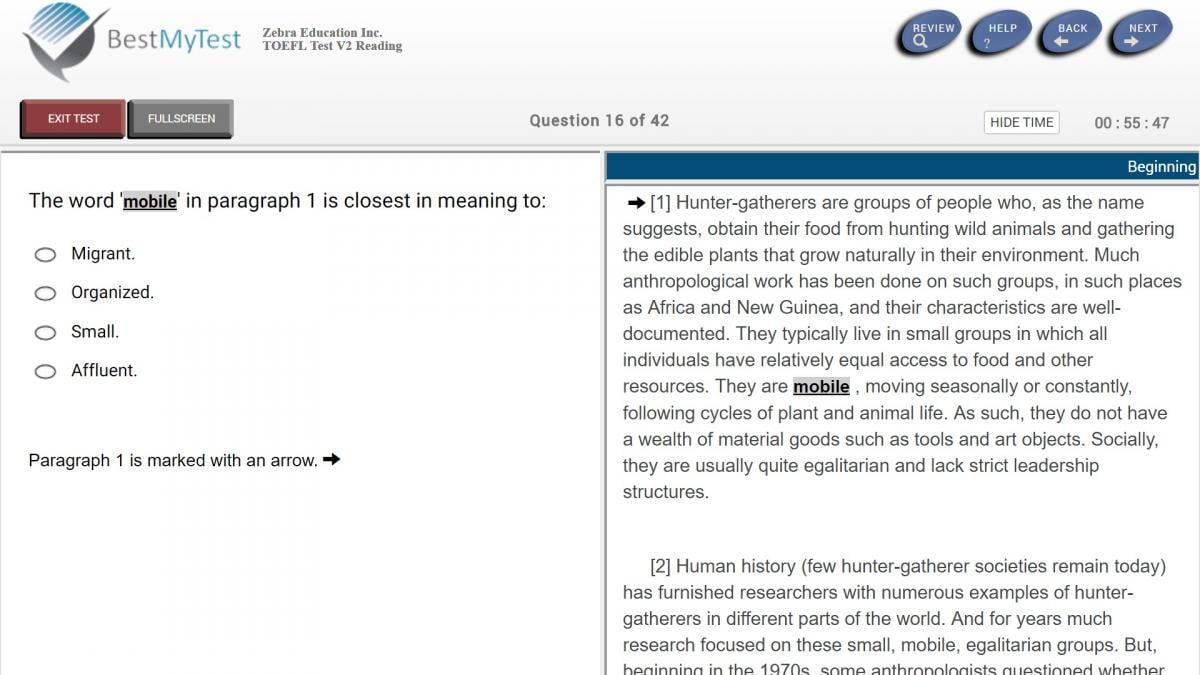
Our TOEFL practice tests look and feel like the official TOEFL test. The passages, recordings, and tasks match the official test in length, difficulty, and style, and the layout and the timers are the same, so you practice in a real test situation. Every question has an answer explanation. The score report after each test shows:
- A band from 1 to 6 for each section and your total band, with the same lookup table as the official scale.
- Your result by question type, so you see which types to study next.
- Your time per question, so you see where you slow down.
- AI scores for your speaking and writing answers, with every correction marked. Premium members can also send answers to a tutor for a review with comments.
Do I Need an Account for the Free TOEFL Sample Test?
You can start the free TOEFL sample test without an account, but you need a free account to see your score report and keep your results. The free account also opens the first lessons for each section and the free practice questions linked on this page. You can take a TOEFL practice test free as many times as you like with Sample Test 1; premium members get all 50 tests.
All 50 TOEFL Practice Tests
Create a Free Account
Free TOEFL Practice Resources for Every Section
Everything below is free TOEFL practice made for the current test. Start with the guide for your weakest section, then use its sample questions and lessons between your practice tests.
- Sample Test 1: a free full-length TOEFL mock test with a band score for every section.
- TOEFL reading practice guide: the three item types, sample questions with answers, and six tips.
- TOEFL listening practice guide: the four tasks, sample questions with audio and answers, and seven tips.
- TOEFL writing practice guide: the three tasks, sample questions with answers, and six tips.
- TOEFL speaking practice guide: the two parts, sample questions with audio and answers, and six tips.
- TOEFL reading question types and TOEFL listening question types: every type with a sample and its answer.
- TOEFL speaking templates and TOEFL writing templates: answer structures with sample answers.
- TOEFL writing rubric and TOEFL speaking rubric: what each score means and where learners lose points.
- TOEFL reading practice PDF and TOEFL listening PDF with answers: printable practice sets with answer keys, free with a free account.
- TOEFL vocabulary lists, TOEFL vocabulary flashcards, and TOEFL vocabulary training: the words you meet in the test, with a mini-lesson for each.
- TOEFL Tutor App: all our TOEFL practice questions and lessons by section, with the AI Tutor that finds your weak question types.