Welcome to our free TOEFL reading practice test guide, where you can take a free TOEFL reading sample test with answers and detailed explanations. Our reading test uses the same adaptive testing as the official TOEFL reading exam. You can also practice with our reading exercises, get tips on how to prepare, and learn helpful insights from 636,000 TOEFL reading practice tests taken by our students.
First off, if you're looking to take a free TOEFL reading practice test or are just curious what taking an official TOEFL reading test is like, then click the button below.
play_circle_outline Start TOEFL Reading Practice TestBelow is a list of all our TOEFL reading questions where you can study each question at your own pace. To start a free TOEFL reading test question, click the Mock Test 1 link.
TOEFL Reading Practice Questions - Complete the Words 1 - 224
TOEFL Reading Practice Questions - Read in Daily Life 1 - 232
TOEFL Reading Practice Questions - Academic Passage Reading 1 - 163
Table Of Contents
- What Is in the TOEFL Reading Test?
- TOEFL Reading Sample Questions
- Helpful Insights from 636,000 TOEFL Reading Practice Sets
- How TOEFL Reading Questions Changed in the New Test
- The 10 TOEFL Reading Question Types
- How to Prepare for the TOEFL Reading Test
- Our TOEFL Reading Practice Questions
- Free TOEFL Reading Lessons
- Free TOEFL Reading Practice Resources
What Is in the TOEFL Reading Test?
In the TOEFL Reading test, you’ll have about 30 minutes to answer 50 questions. You’ll work through three types of tasks: Complete the Words, Read in Daily Life, and Read an Academic Passage. The section is split into two stages and adapts to your performance. This means how well you do in the first stage determines how challenging the second stage will be. Your Reading score is reported on a band scale from 1 to 6.
Task type |
What you do |
Length |
|---|---|---|
Complete the Words |
You read a short academic text. Ten words are missing the second half of their letters. You type the missing letters. |
About 80 words, 10 gaps |
Read in Daily Life |
You read an everyday text, for example an email, a notice, a message, or an online post. Then you answer multiple-choice questions about it. |
50 to 170 words, usually 2 questions |
Read an Academic Passage |
You read a short passage like one from a first-year university course. Then you answer multiple-choice and click-in-the-passage questions about it. |
150 to 400 words, usually 5 questions |
50 questions, about 30 minutes in total |
||
Since January 21, 2026, the TOEFL Reading test has used these three task types. You’ll read short texts, and you don’t need to be familiar with the topics beforehand. The texts give you the information you need to answer the questions.
There’s no separate time limit for each question, but each stage has its own timer. You can skip a question and come back to it within the same stage. Just remember that once you start stage 2, you can’t return to stage 1. With about 30 minutes for 50 questions, that works out to roughly 36 seconds per question on average, but you can spend more time on harder questions and move through easier ones more quickly.
The texts range from everyday English to the academic language you’d find in an introductory university course. If you do well in stage 1, you’ll get a more challenging stage 2. Answering those harder questions correctly can help you earn a higher band score.
TOEFL Reading Sample Questions
Want to see what the new TOEFL Reading test is like? Try these three free TOEFL Reading sample questions, one for each reading task: Complete the Words, Read in Daily Life, and Read an Academic Passage. Answer each question on your own first, then check the answers to see how you did. If you need help with Complete the Words, our TOEFL Complete the Words guide explains the eight types of missing words and how to figure out the correct answers.
-
spellcheck Answers1. gists (Biologists)
2. nted (jointed)
3. sory (sensory)
4. stand (understand)
5. cupy (occupy)
6. tats (habitats)
7. ders (spiders)
8. ong (belong)
9. oad (broad)
10. oup (group)

Complete the Words
Learn how to answer this question in a step-by-step interactive exercise
Complete the Words
In a Complete-the-words question type you are given a paragraph with gaps. A gap is a word that is missing half its letters. Your job is to fill in all 10 gaps.
Preview the question, then click next to continue.
Preview the Question
Question 1: Choose the correct grammar category. After choosing the correct category, you will fill in the missing letters.
Complete the Word Biolo_____
How to decide
You do not need to know every difficult word to solve these gaps. Grammar gives you a reliable starting point, and the visible letters confirm your choice.
- Temporarily ignore the visible letters.
- Read the words on both sides and ask: What job must the missing word do?
- Predict the category: noun, verb, modal verb, adjective, adverb, preposition, or determiner.
- Use the visible letters and meaning only after you know the category.
The experiment produced a surprising
result: a noun after an adjective.Scientists the samples daily
observed: a verb after the subject.The change affect the climate
might: a modal verb before a base verb.The team used a method
reliable: an adjective before a noun.Researchers recorded the data
carefully: an adverb describing how they recorded it.The samples remained the cabinet
inside: a preposition showing place.As a , the trial was repeated
result: a noun completing a transition phrase.studies reached the same conclusion
Several: a determiner introducing a noun.Skip the words you don't know. Filling in the words you know can help you figure out the words you don't know.
Noun (S/O)
A noun names a person, place, thing, or idea. In a sentence, it often performs one of two jobs: the subject doing the action or the object receiving it.
Look for strong clues: a, an, the, this, or that before the gap; an adjective directly before it; or a verb/preposition that needs an object after it.
ExamplesThe changed medicine
discovery: subject noun.Researchers measured the
temperature: object noun.a useful
method: noun after an adjective.If the gap answers “who?” or “what?”, a noun is an excellent prediction.
Noun (transition)
Some nouns live inside fixed transition phrases that connect ideas. Learn the whole phrase as one useful unit: for example, in fact, and as a result.
Examplesfor
example: part of the phrase for example.in
fact: part of the phrase in fact.As a
result: part of the phrase as a result.Many test-takers expect an academic passage to test only complex vocabulary such as photosynthesis or archaeological. In reality, this task removes letters from regularly spaced words, so a simple structural word inside a connector can easily become a gap.
When you see commas or the beginning of a familiar connector, complete the phrase you already know. The answer may be much simpler than the topic.
Verb
A verb expresses an action or state. It must fit its subject and the sentence time. A verb may also appear as a participle ending in -ing or -ed.
ExamplesPlants sunlight
require: a verb after the subject.The evidence a change
suggests: a verb after the subject.The river is rapidly
flowing: a verb after a helping verb.Clues: find the subject, then ask what it does or what state it is in. Check nearby helping verbs such as is, was, has, or can.
Once you locate the subject, the missing verb form is often strongly constrained.
Modal verb
A modal verb is a special helping verb that expresses possibility, ability, permission, advice, prediction, or necessity. Common modals include can, could, may, might, must, should, will, and would.
ExamplesThe change affect the climate
might: a modal verb before a base verb.This process explain the pattern
could: a modal verb before a base verb.Researchers compare both samples
should: a modal verb before a base verb.The strongest clue is the word after the gap: a modal is normally followed by the base form of a verb, without to. For example: might occur, could explain, and should compare.
When a short missing word comes before a plain base verb, test a modal. These small structural verbs are common and highly predictable.
Adjective
An adjective describes a noun. It usually appears immediately before that noun or after a linking verb such as be, seem, or become.
Examplesa source
reliable: an adjective before a noun.the known fossil
oldest: an adjective before a noun.The surface became
rough: an adjective after a linking verb.Clues: look right after the gap for a noun, or look left for a linking verb. More, most, -er, and -est also point toward an adjective.
If the gap tells you “what kind?” or “which one?” about a noun, predict an adjective.
Adverb
An adverb modifies a verb, an adjective, or another adverb. It can tell you how, when, where, or to what degree something happens.
Examplesly
only: an adverb before -ly.The team moved
quickly: an adverb ending in -ly.The result was significant
highly: an adverb modifying an adjective.The -ly ending is a powerful clue, although not every adverb ends in -ly and not every -ly word is an adverb. Confirm the word’s job in the sentence.
If the gap changes the strength or manner of another word, an adverb is likely.
Preposition
A preposition is a short structural word that shows a relationship: place, time, direction, source, or means. Common examples include in, on, at, by, with, through, and between.
ExamplesResearchers worked the sample
with: a preposition showing means.The border lies two regions
between: a preposition showing place.Water passed the membrane
through: a preposition showing direction.Many test-takers expect an academic passage to test only complex vocabulary such as photosynthesis or archaeological. In reality, this task removes letters from regularly spaced words, so very simple structural words are often chopped up too.
Do not reject an easy answer because the passage sounds difficult. Check which relationship the sentence needs.
Determiner
A determiner introduces or limits a noun phrase. It tells us which one, how many, or whose. Examples include a, an, the, this, these, each, every, several, and many.
Examplesparticipant
each: a determiner introducing a noun.experiments
several: a determiner introducing a noun.results
these: a determiner introducing a noun.Many test-takers expect an academic passage to test only complex vocabulary such as photosynthesis or archaeological. In reality, this task removes letters from regularly spaced words, so small grammar words that introduce nouns are frequent possibilities.
If an adjective or noun follows immediately and the phrase needs an introducer, try a determiner. Simple words can be correct answers.
Question 2: Choose the correct grammar category. After choosing the correct category, you will fill in the missing letters.
Complete the Word joi____
How to decide
You do not need to know every difficult word to solve these gaps. Grammar gives you a reliable starting point, and the visible letters confirm your choice.
- Temporarily ignore the visible letters.
- Read the words on both sides and ask: What job must the missing word do?
- Predict the category: noun, verb, modal verb, adjective, adverb, preposition, or determiner.
- Use the visible letters and meaning only after you know the category.
The experiment produced a surprising
result: a noun after an adjective.Scientists the samples daily
observed: a verb after the subject.The change affect the climate
might: a modal verb before a base verb.The team used a method
reliable: an adjective before a noun.Researchers recorded the data
carefully: an adverb describing how they recorded it.The samples remained the cabinet
inside: a preposition showing place.As a , the trial was repeated
result: a noun completing a transition phrase.studies reached the same conclusion
Several: a determiner introducing a noun.Skip the words you don't know. Filling in the words you know can help you figure out the words you don't know.
Noun (S/O)
A noun names a person, place, thing, or idea. In a sentence, it often performs one of two jobs: the subject doing the action or the object receiving it.
Look for strong clues: a, an, the, this, or that before the gap; an adjective directly before it; or a verb/preposition that needs an object after it.
ExamplesThe changed medicine
discovery: subject noun.Researchers measured the
temperature: object noun.a useful
method: noun after an adjective.If the gap answers “who?” or “what?”, a noun is an excellent prediction.
Noun (transition)
Some nouns live inside fixed transition phrases that connect ideas. Learn the whole phrase as one useful unit: for example, in fact, and as a result.
Examplesfor
example: part of the phrase for example.in
fact: part of the phrase in fact.As a
result: part of the phrase as a result.Many test-takers expect an academic passage to test only complex vocabulary such as photosynthesis or archaeological. In reality, this task removes letters from regularly spaced words, so a simple structural word inside a connector can easily become a gap.
When you see commas or the beginning of a familiar connector, complete the phrase you already know. The answer may be much simpler than the topic.
Verb
A verb expresses an action or state. It must fit its subject and the sentence time. A verb may also appear as a participle ending in -ing or -ed.
ExamplesPlants sunlight
require: a verb after the subject.The evidence a change
suggests: a verb after the subject.The river is rapidly
flowing: a verb after a helping verb.Clues: find the subject, then ask what it does or what state it is in. Check nearby helping verbs such as is, was, has, or can.
Once you locate the subject, the missing verb form is often strongly constrained.
Modal verb
A modal verb is a special helping verb that expresses possibility, ability, permission, advice, prediction, or necessity. Common modals include can, could, may, might, must, should, will, and would.
ExamplesThe change affect the climate
might: a modal verb before a base verb.This process explain the pattern
could: a modal verb before a base verb.Researchers compare both samples
should: a modal verb before a base verb.The strongest clue is the word after the gap: a modal is normally followed by the base form of a verb, without to. For example: might occur, could explain, and should compare.
When a short missing word comes before a plain base verb, test a modal. These small structural verbs are common and highly predictable.
Adjective
An adjective describes a noun. It usually appears immediately before that noun or after a linking verb such as be, seem, or become.
Examplesa source
reliable: an adjective before a noun.the known fossil
oldest: an adjective before a noun.The surface became
rough: an adjective after a linking verb.Clues: look right after the gap for a noun, or look left for a linking verb. More, most, -er, and -est also point toward an adjective.
If the gap tells you “what kind?” or “which one?” about a noun, predict an adjective.
Adverb
An adverb modifies a verb, an adjective, or another adverb. It can tell you how, when, where, or to what degree something happens.
Examplesly
only: an adverb before -ly.The team moved
quickly: an adverb ending in -ly.The result was significant
highly: an adverb modifying an adjective.The -ly ending is a powerful clue, although not every adverb ends in -ly and not every -ly word is an adverb. Confirm the word’s job in the sentence.
If the gap changes the strength or manner of another word, an adverb is likely.
Preposition
A preposition is a short structural word that shows a relationship: place, time, direction, source, or means. Common examples include in, on, at, by, with, through, and between.
ExamplesResearchers worked the sample
with: a preposition showing means.The border lies two regions
between: a preposition showing place.Water passed the membrane
through: a preposition showing direction.Many test-takers expect an academic passage to test only complex vocabulary such as photosynthesis or archaeological. In reality, this task removes letters from regularly spaced words, so very simple structural words are often chopped up too.
Do not reject an easy answer because the passage sounds difficult. Check which relationship the sentence needs.
Determiner
A determiner introduces or limits a noun phrase. It tells us which one, how many, or whose. Examples include a, an, the, this, these, each, every, several, and many.
Examplesparticipant
each: a determiner introducing a noun.experiments
several: a determiner introducing a noun.results
these: a determiner introducing a noun.Many test-takers expect an academic passage to test only complex vocabulary such as photosynthesis or archaeological. In reality, this task removes letters from regularly spaced words, so small grammar words that introduce nouns are frequent possibilities.
If an adjective or noun follows immediately and the phrase needs an introducer, try a determiner. Simple words can be correct answers.
Question 3: Choose the correct grammar category. After choosing the correct category, you will fill in the missing letters.
Complete the Word sen____
How to decide
You do not need to know every difficult word to solve these gaps. Grammar gives you a reliable starting point, and the visible letters confirm your choice.
- Temporarily ignore the visible letters.
- Read the words on both sides and ask: What job must the missing word do?
- Predict the category: noun, verb, modal verb, adjective, adverb, preposition, or determiner.
- Use the visible letters and meaning only after you know the category.
The experiment produced a surprising
result: a noun after an adjective.Scientists the samples daily
observed: a verb after the subject.The change affect the climate
might: a modal verb before a base verb.The team used a method
reliable: an adjective before a noun.Researchers recorded the data
carefully: an adverb describing how they recorded it.The samples remained the cabinet
inside: a preposition showing place.As a , the trial was repeated
result: a noun completing a transition phrase.studies reached the same conclusion
Several: a determiner introducing a noun.Skip the words you don't know. Filling in the words you know can help you figure out the words you don't know.
Noun (S/O)
A noun names a person, place, thing, or idea. In a sentence, it often performs one of two jobs: the subject doing the action or the object receiving it.
Look for strong clues: a, an, the, this, or that before the gap; an adjective directly before it; or a verb/preposition that needs an object after it.
ExamplesThe changed medicine
discovery: subject noun.Researchers measured the
temperature: object noun.a useful
method: noun after an adjective.If the gap answers “who?” or “what?”, a noun is an excellent prediction.
Noun (transition)
Some nouns live inside fixed transition phrases that connect ideas. Learn the whole phrase as one useful unit: for example, in fact, and as a result.
Examplesfor
example: part of the phrase for example.in
fact: part of the phrase in fact.As a
result: part of the phrase as a result.Many test-takers expect an academic passage to test only complex vocabulary such as photosynthesis or archaeological. In reality, this task removes letters from regularly spaced words, so a simple structural word inside a connector can easily become a gap.
When you see commas or the beginning of a familiar connector, complete the phrase you already know. The answer may be much simpler than the topic.
Verb
A verb expresses an action or state. It must fit its subject and the sentence time. A verb may also appear as a participle ending in -ing or -ed.
ExamplesPlants sunlight
require: a verb after the subject.The evidence a change
suggests: a verb after the subject.The river is rapidly
flowing: a verb after a helping verb.Clues: find the subject, then ask what it does or what state it is in. Check nearby helping verbs such as is, was, has, or can.
Once you locate the subject, the missing verb form is often strongly constrained.
Modal verb
A modal verb is a special helping verb that expresses possibility, ability, permission, advice, prediction, or necessity. Common modals include can, could, may, might, must, should, will, and would.
ExamplesThe change affect the climate
might: a modal verb before a base verb.This process explain the pattern
could: a modal verb before a base verb.Researchers compare both samples
should: a modal verb before a base verb.The strongest clue is the word after the gap: a modal is normally followed by the base form of a verb, without to. For example: might occur, could explain, and should compare.
When a short missing word comes before a plain base verb, test a modal. These small structural verbs are common and highly predictable.
Adjective
An adjective describes a noun. It usually appears immediately before that noun or after a linking verb such as be, seem, or become.
Examplesa source
reliable: an adjective before a noun.the known fossil
oldest: an adjective before a noun.The surface became
rough: an adjective after a linking verb.Clues: look right after the gap for a noun, or look left for a linking verb. More, most, -er, and -est also point toward an adjective.
If the gap tells you “what kind?” or “which one?” about a noun, predict an adjective.
Adverb
An adverb modifies a verb, an adjective, or another adverb. It can tell you how, when, where, or to what degree something happens.
Examplesly
only: an adverb before -ly.The team moved
quickly: an adverb ending in -ly.The result was significant
highly: an adverb modifying an adjective.The -ly ending is a powerful clue, although not every adverb ends in -ly and not every -ly word is an adverb. Confirm the word’s job in the sentence.
If the gap changes the strength or manner of another word, an adverb is likely.
Preposition
A preposition is a short structural word that shows a relationship: place, time, direction, source, or means. Common examples include in, on, at, by, with, through, and between.
ExamplesResearchers worked the sample
with: a preposition showing means.The border lies two regions
between: a preposition showing place.Water passed the membrane
through: a preposition showing direction.Many test-takers expect an academic passage to test only complex vocabulary such as photosynthesis or archaeological. In reality, this task removes letters from regularly spaced words, so very simple structural words are often chopped up too.
Do not reject an easy answer because the passage sounds difficult. Check which relationship the sentence needs.
Determiner
A determiner introduces or limits a noun phrase. It tells us which one, how many, or whose. Examples include a, an, the, this, these, each, every, several, and many.
Examplesparticipant
each: a determiner introducing a noun.experiments
several: a determiner introducing a noun.results
these: a determiner introducing a noun.Many test-takers expect an academic passage to test only complex vocabulary such as photosynthesis or archaeological. In reality, this task removes letters from regularly spaced words, so small grammar words that introduce nouns are frequent possibilities.
If an adjective or noun follows immediately and the phrase needs an introducer, try a determiner. Simple words can be correct answers.
Question 4: Choose the correct grammar category. After choosing the correct category, you will fill in the missing letters.
Complete the Word under_____
How to decide
You do not need to know every difficult word to solve these gaps. Grammar gives you a reliable starting point, and the visible letters confirm your choice.
- Temporarily ignore the visible letters.
- Read the words on both sides and ask: What job must the missing word do?
- Predict the category: noun, verb, modal verb, adjective, adverb, preposition, or determiner.
- Use the visible letters and meaning only after you know the category.
The experiment produced a surprising
result: a noun after an adjective.Scientists the samples daily
observed: a verb after the subject.The change affect the climate
might: a modal verb before a base verb.The team used a method
reliable: an adjective before a noun.Researchers recorded the data
carefully: an adverb describing how they recorded it.The samples remained the cabinet
inside: a preposition showing place.As a , the trial was repeated
result: a noun completing a transition phrase.studies reached the same conclusion
Several: a determiner introducing a noun.Skip the words you don't know. Filling in the words you know can help you figure out the words you don't know.
Noun (S/O)
A noun names a person, place, thing, or idea. In a sentence, it often performs one of two jobs: the subject doing the action or the object receiving it.
Look for strong clues: a, an, the, this, or that before the gap; an adjective directly before it; or a verb/preposition that needs an object after it.
ExamplesThe changed medicine
discovery: subject noun.Researchers measured the
temperature: object noun.a useful
method: noun after an adjective.If the gap answers “who?” or “what?”, a noun is an excellent prediction.
Noun (transition)
Some nouns live inside fixed transition phrases that connect ideas. Learn the whole phrase as one useful unit: for example, in fact, and as a result.
Examplesfor
example: part of the phrase for example.in
fact: part of the phrase in fact.As a
result: part of the phrase as a result.Many test-takers expect an academic passage to test only complex vocabulary such as photosynthesis or archaeological. In reality, this task removes letters from regularly spaced words, so a simple structural word inside a connector can easily become a gap.
When you see commas or the beginning of a familiar connector, complete the phrase you already know. The answer may be much simpler than the topic.
Verb
A verb expresses an action or state. It must fit its subject and the sentence time. A verb may also appear as a participle ending in -ing or -ed.
ExamplesPlants sunlight
require: a verb after the subject.The evidence a change
suggests: a verb after the subject.The river is rapidly
flowing: a verb after a helping verb.Clues: find the subject, then ask what it does or what state it is in. Check nearby helping verbs such as is, was, has, or can.
Once you locate the subject, the missing verb form is often strongly constrained.
Modal verb
A modal verb is a special helping verb that expresses possibility, ability, permission, advice, prediction, or necessity. Common modals include can, could, may, might, must, should, will, and would.
ExamplesThe change affect the climate
might: a modal verb before a base verb.This process explain the pattern
could: a modal verb before a base verb.Researchers compare both samples
should: a modal verb before a base verb.The strongest clue is the word after the gap: a modal is normally followed by the base form of a verb, without to. For example: might occur, could explain, and should compare.
When a short missing word comes before a plain base verb, test a modal. These small structural verbs are common and highly predictable.
Adjective
An adjective describes a noun. It usually appears immediately before that noun or after a linking verb such as be, seem, or become.
Examplesa source
reliable: an adjective before a noun.the known fossil
oldest: an adjective before a noun.The surface became
rough: an adjective after a linking verb.Clues: look right after the gap for a noun, or look left for a linking verb. More, most, -er, and -est also point toward an adjective.
If the gap tells you “what kind?” or “which one?” about a noun, predict an adjective.
Adverb
An adverb modifies a verb, an adjective, or another adverb. It can tell you how, when, where, or to what degree something happens.
Examplesly
only: an adverb before -ly.The team moved
quickly: an adverb ending in -ly.The result was significant
highly: an adverb modifying an adjective.The -ly ending is a powerful clue, although not every adverb ends in -ly and not every -ly word is an adverb. Confirm the word’s job in the sentence.
If the gap changes the strength or manner of another word, an adverb is likely.
Preposition
A preposition is a short structural word that shows a relationship: place, time, direction, source, or means. Common examples include in, on, at, by, with, through, and between.
ExamplesResearchers worked the sample
with: a preposition showing means.The border lies two regions
between: a preposition showing place.Water passed the membrane
through: a preposition showing direction.Many test-takers expect an academic passage to test only complex vocabulary such as photosynthesis or archaeological. In reality, this task removes letters from regularly spaced words, so very simple structural words are often chopped up too.
Do not reject an easy answer because the passage sounds difficult. Check which relationship the sentence needs.
Determiner
A determiner introduces or limits a noun phrase. It tells us which one, how many, or whose. Examples include a, an, the, this, these, each, every, several, and many.
Examplesparticipant
each: a determiner introducing a noun.experiments
several: a determiner introducing a noun.results
these: a determiner introducing a noun.Many test-takers expect an academic passage to test only complex vocabulary such as photosynthesis or archaeological. In reality, this task removes letters from regularly spaced words, so small grammar words that introduce nouns are frequent possibilities.
If an adjective or noun follows immediately and the phrase needs an introducer, try a determiner. Simple words can be correct answers.
Question 5: Choose the correct grammar category. After choosing the correct category, you will fill in the missing letters.
Complete the Word oc____
How to decide
You do not need to know every difficult word to solve these gaps. Grammar gives you a reliable starting point, and the visible letters confirm your choice.
- Temporarily ignore the visible letters.
- Read the words on both sides and ask: What job must the missing word do?
- Predict the category: noun, verb, modal verb, adjective, adverb, preposition, or determiner.
- Use the visible letters and meaning only after you know the category.
The experiment produced a surprising
result: a noun after an adjective.Scientists the samples daily
observed: a verb after the subject.The change affect the climate
might: a modal verb before a base verb.The team used a method
reliable: an adjective before a noun.Researchers recorded the data
carefully: an adverb describing how they recorded it.The samples remained the cabinet
inside: a preposition showing place.As a , the trial was repeated
result: a noun completing a transition phrase.studies reached the same conclusion
Several: a determiner introducing a noun.Skip the words you don't know. Filling in the words you know can help you figure out the words you don't know.
Noun (S/O)
A noun names a person, place, thing, or idea. In a sentence, it often performs one of two jobs: the subject doing the action or the object receiving it.
Look for strong clues: a, an, the, this, or that before the gap; an adjective directly before it; or a verb/preposition that needs an object after it.
ExamplesThe changed medicine
discovery: subject noun.Researchers measured the
temperature: object noun.a useful
method: noun after an adjective.If the gap answers “who?” or “what?”, a noun is an excellent prediction.
Noun (transition)
Some nouns live inside fixed transition phrases that connect ideas. Learn the whole phrase as one useful unit: for example, in fact, and as a result.
Examplesfor
example: part of the phrase for example.in
fact: part of the phrase in fact.As a
result: part of the phrase as a result.Many test-takers expect an academic passage to test only complex vocabulary such as photosynthesis or archaeological. In reality, this task removes letters from regularly spaced words, so a simple structural word inside a connector can easily become a gap.
When you see commas or the beginning of a familiar connector, complete the phrase you already know. The answer may be much simpler than the topic.
Verb
A verb expresses an action or state. It must fit its subject and the sentence time. A verb may also appear as a participle ending in -ing or -ed.
ExamplesPlants sunlight
require: a verb after the subject.The evidence a change
suggests: a verb after the subject.The river is rapidly
flowing: a verb after a helping verb.Clues: find the subject, then ask what it does or what state it is in. Check nearby helping verbs such as is, was, has, or can.
Once you locate the subject, the missing verb form is often strongly constrained.
Modal verb
A modal verb is a special helping verb that expresses possibility, ability, permission, advice, prediction, or necessity. Common modals include can, could, may, might, must, should, will, and would.
ExamplesThe change affect the climate
might: a modal verb before a base verb.This process explain the pattern
could: a modal verb before a base verb.Researchers compare both samples
should: a modal verb before a base verb.The strongest clue is the word after the gap: a modal is normally followed by the base form of a verb, without to. For example: might occur, could explain, and should compare.
When a short missing word comes before a plain base verb, test a modal. These small structural verbs are common and highly predictable.
Adjective
An adjective describes a noun. It usually appears immediately before that noun or after a linking verb such as be, seem, or become.
Examplesa source
reliable: an adjective before a noun.the known fossil
oldest: an adjective before a noun.The surface became
rough: an adjective after a linking verb.Clues: look right after the gap for a noun, or look left for a linking verb. More, most, -er, and -est also point toward an adjective.
If the gap tells you “what kind?” or “which one?” about a noun, predict an adjective.
Adverb
An adverb modifies a verb, an adjective, or another adverb. It can tell you how, when, where, or to what degree something happens.
Examplesly
only: an adverb before -ly.The team moved
quickly: an adverb ending in -ly.The result was significant
highly: an adverb modifying an adjective.The -ly ending is a powerful clue, although not every adverb ends in -ly and not every -ly word is an adverb. Confirm the word’s job in the sentence.
If the gap changes the strength or manner of another word, an adverb is likely.
Preposition
A preposition is a short structural word that shows a relationship: place, time, direction, source, or means. Common examples include in, on, at, by, with, through, and between.
ExamplesResearchers worked the sample
with: a preposition showing means.The border lies two regions
between: a preposition showing place.Water passed the membrane
through: a preposition showing direction.Many test-takers expect an academic passage to test only complex vocabulary such as photosynthesis or archaeological. In reality, this task removes letters from regularly spaced words, so very simple structural words are often chopped up too.
Do not reject an easy answer because the passage sounds difficult. Check which relationship the sentence needs.
Determiner
A determiner introduces or limits a noun phrase. It tells us which one, how many, or whose. Examples include a, an, the, this, these, each, every, several, and many.
Examplesparticipant
each: a determiner introducing a noun.experiments
several: a determiner introducing a noun.results
these: a determiner introducing a noun.Many test-takers expect an academic passage to test only complex vocabulary such as photosynthesis or archaeological. In reality, this task removes letters from regularly spaced words, so small grammar words that introduce nouns are frequent possibilities.
If an adjective or noun follows immediately and the phrase needs an introducer, try a determiner. Simple words can be correct answers.
Question 6: Choose the correct grammar category. After choosing the correct category, you will fill in the missing letters.
Complete the Word habi____
How to decide
You do not need to know every difficult word to solve these gaps. Grammar gives you a reliable starting point, and the visible letters confirm your choice.
- Temporarily ignore the visible letters.
- Read the words on both sides and ask: What job must the missing word do?
- Predict the category: noun, verb, modal verb, adjective, adverb, preposition, or determiner.
- Use the visible letters and meaning only after you know the category.
The experiment produced a surprising
result: a noun after an adjective.Scientists the samples daily
observed: a verb after the subject.The change affect the climate
might: a modal verb before a base verb.The team used a method
reliable: an adjective before a noun.Researchers recorded the data
carefully: an adverb describing how they recorded it.The samples remained the cabinet
inside: a preposition showing place.As a , the trial was repeated
result: a noun completing a transition phrase.studies reached the same conclusion
Several: a determiner introducing a noun.Skip the words you don't know. Filling in the words you know can help you figure out the words you don't know.
Noun (S/O)
A noun names a person, place, thing, or idea. In a sentence, it often performs one of two jobs: the subject doing the action or the object receiving it.
Look for strong clues: a, an, the, this, or that before the gap; an adjective directly before it; or a verb/preposition that needs an object after it.
ExamplesThe changed medicine
discovery: subject noun.Researchers measured the
temperature: object noun.a useful
method: noun after an adjective.If the gap answers “who?” or “what?”, a noun is an excellent prediction.
Noun (transition)
Some nouns live inside fixed transition phrases that connect ideas. Learn the whole phrase as one useful unit: for example, in fact, and as a result.
Examplesfor
example: part of the phrase for example.in
fact: part of the phrase in fact.As a
result: part of the phrase as a result.Many test-takers expect an academic passage to test only complex vocabulary such as photosynthesis or archaeological. In reality, this task removes letters from regularly spaced words, so a simple structural word inside a connector can easily become a gap.
When you see commas or the beginning of a familiar connector, complete the phrase you already know. The answer may be much simpler than the topic.
Verb
A verb expresses an action or state. It must fit its subject and the sentence time. A verb may also appear as a participle ending in -ing or -ed.
ExamplesPlants sunlight
require: a verb after the subject.The evidence a change
suggests: a verb after the subject.The river is rapidly
flowing: a verb after a helping verb.Clues: find the subject, then ask what it does or what state it is in. Check nearby helping verbs such as is, was, has, or can.
Once you locate the subject, the missing verb form is often strongly constrained.
Modal verb
A modal verb is a special helping verb that expresses possibility, ability, permission, advice, prediction, or necessity. Common modals include can, could, may, might, must, should, will, and would.
ExamplesThe change affect the climate
might: a modal verb before a base verb.This process explain the pattern
could: a modal verb before a base verb.Researchers compare both samples
should: a modal verb before a base verb.The strongest clue is the word after the gap: a modal is normally followed by the base form of a verb, without to. For example: might occur, could explain, and should compare.
When a short missing word comes before a plain base verb, test a modal. These small structural verbs are common and highly predictable.
Adjective
An adjective describes a noun. It usually appears immediately before that noun or after a linking verb such as be, seem, or become.
Examplesa source
reliable: an adjective before a noun.the known fossil
oldest: an adjective before a noun.The surface became
rough: an adjective after a linking verb.Clues: look right after the gap for a noun, or look left for a linking verb. More, most, -er, and -est also point toward an adjective.
If the gap tells you “what kind?” or “which one?” about a noun, predict an adjective.
Adverb
An adverb modifies a verb, an adjective, or another adverb. It can tell you how, when, where, or to what degree something happens.
Examplesly
only: an adverb before -ly.The team moved
quickly: an adverb ending in -ly.The result was significant
highly: an adverb modifying an adjective.The -ly ending is a powerful clue, although not every adverb ends in -ly and not every -ly word is an adverb. Confirm the word’s job in the sentence.
If the gap changes the strength or manner of another word, an adverb is likely.
Preposition
A preposition is a short structural word that shows a relationship: place, time, direction, source, or means. Common examples include in, on, at, by, with, through, and between.
ExamplesResearchers worked the sample
with: a preposition showing means.The border lies two regions
between: a preposition showing place.Water passed the membrane
through: a preposition showing direction.Many test-takers expect an academic passage to test only complex vocabulary such as photosynthesis or archaeological. In reality, this task removes letters from regularly spaced words, so very simple structural words are often chopped up too.
Do not reject an easy answer because the passage sounds difficult. Check which relationship the sentence needs.
Determiner
A determiner introduces or limits a noun phrase. It tells us which one, how many, or whose. Examples include a, an, the, this, these, each, every, several, and many.
Examplesparticipant
each: a determiner introducing a noun.experiments
several: a determiner introducing a noun.results
these: a determiner introducing a noun.Many test-takers expect an academic passage to test only complex vocabulary such as photosynthesis or archaeological. In reality, this task removes letters from regularly spaced words, so small grammar words that introduce nouns are frequent possibilities.
If an adjective or noun follows immediately and the phrase needs an introducer, try a determiner. Simple words can be correct answers.
Question 7: Choose the correct grammar category. After choosing the correct category, you will fill in the missing letters.
Complete the Word spi____
How to decide
You do not need to know every difficult word to solve these gaps. Grammar gives you a reliable starting point, and the visible letters confirm your choice.
- Temporarily ignore the visible letters.
- Read the words on both sides and ask: What job must the missing word do?
- Predict the category: noun, verb, modal verb, adjective, adverb, preposition, or determiner.
- Use the visible letters and meaning only after you know the category.
The experiment produced a surprising
result: a noun after an adjective.Scientists the samples daily
observed: a verb after the subject.The change affect the climate
might: a modal verb before a base verb.The team used a method
reliable: an adjective before a noun.Researchers recorded the data
carefully: an adverb describing how they recorded it.The samples remained the cabinet
inside: a preposition showing place.As a , the trial was repeated
result: a noun completing a transition phrase.studies reached the same conclusion
Several: a determiner introducing a noun.Skip the words you don't know. Filling in the words you know can help you figure out the words you don't know.
Noun (S/O)
A noun names a person, place, thing, or idea. In a sentence, it often performs one of two jobs: the subject doing the action or the object receiving it.
Look for strong clues: a, an, the, this, or that before the gap; an adjective directly before it; or a verb/preposition that needs an object after it.
ExamplesThe changed medicine
discovery: subject noun.Researchers measured the
temperature: object noun.a useful
method: noun after an adjective.If the gap answers “who?” or “what?”, a noun is an excellent prediction.
Noun (transition)
Some nouns live inside fixed transition phrases that connect ideas. Learn the whole phrase as one useful unit: for example, in fact, and as a result.
Examplesfor
example: part of the phrase for example.in
fact: part of the phrase in fact.As a
result: part of the phrase as a result.Many test-takers expect an academic passage to test only complex vocabulary such as photosynthesis or archaeological. In reality, this task removes letters from regularly spaced words, so a simple structural word inside a connector can easily become a gap.
When you see commas or the beginning of a familiar connector, complete the phrase you already know. The answer may be much simpler than the topic.
Verb
A verb expresses an action or state. It must fit its subject and the sentence time. A verb may also appear as a participle ending in -ing or -ed.
ExamplesPlants sunlight
require: a verb after the subject.The evidence a change
suggests: a verb after the subject.The river is rapidly
flowing: a verb after a helping verb.Clues: find the subject, then ask what it does or what state it is in. Check nearby helping verbs such as is, was, has, or can.
Once you locate the subject, the missing verb form is often strongly constrained.
Modal verb
A modal verb is a special helping verb that expresses possibility, ability, permission, advice, prediction, or necessity. Common modals include can, could, may, might, must, should, will, and would.
ExamplesThe change affect the climate
might: a modal verb before a base verb.This process explain the pattern
could: a modal verb before a base verb.Researchers compare both samples
should: a modal verb before a base verb.The strongest clue is the word after the gap: a modal is normally followed by the base form of a verb, without to. For example: might occur, could explain, and should compare.
When a short missing word comes before a plain base verb, test a modal. These small structural verbs are common and highly predictable.
Adjective
An adjective describes a noun. It usually appears immediately before that noun or after a linking verb such as be, seem, or become.
Examplesa source
reliable: an adjective before a noun.the known fossil
oldest: an adjective before a noun.The surface became
rough: an adjective after a linking verb.Clues: look right after the gap for a noun, or look left for a linking verb. More, most, -er, and -est also point toward an adjective.
If the gap tells you “what kind?” or “which one?” about a noun, predict an adjective.
Adverb
An adverb modifies a verb, an adjective, or another adverb. It can tell you how, when, where, or to what degree something happens.
Examplesly
only: an adverb before -ly.The team moved
quickly: an adverb ending in -ly.The result was significant
highly: an adverb modifying an adjective.The -ly ending is a powerful clue, although not every adverb ends in -ly and not every -ly word is an adverb. Confirm the word’s job in the sentence.
If the gap changes the strength or manner of another word, an adverb is likely.
Preposition
A preposition is a short structural word that shows a relationship: place, time, direction, source, or means. Common examples include in, on, at, by, with, through, and between.
ExamplesResearchers worked the sample
with: a preposition showing means.The border lies two regions
between: a preposition showing place.Water passed the membrane
through: a preposition showing direction.Many test-takers expect an academic passage to test only complex vocabulary such as photosynthesis or archaeological. In reality, this task removes letters from regularly spaced words, so very simple structural words are often chopped up too.
Do not reject an easy answer because the passage sounds difficult. Check which relationship the sentence needs.
Determiner
A determiner introduces or limits a noun phrase. It tells us which one, how many, or whose. Examples include a, an, the, this, these, each, every, several, and many.
Examplesparticipant
each: a determiner introducing a noun.experiments
several: a determiner introducing a noun.results
these: a determiner introducing a noun.Many test-takers expect an academic passage to test only complex vocabulary such as photosynthesis or archaeological. In reality, this task removes letters from regularly spaced words, so small grammar words that introduce nouns are frequent possibilities.
If an adjective or noun follows immediately and the phrase needs an introducer, try a determiner. Simple words can be correct answers.
Question 8: Choose the correct grammar category. After choosing the correct category, you will fill in the missing letters.
Complete the Word bel___
How to decide
You do not need to know every difficult word to solve these gaps. Grammar gives you a reliable starting point, and the visible letters confirm your choice.
- Temporarily ignore the visible letters.
- Read the words on both sides and ask: What job must the missing word do?
- Predict the category: noun, verb, modal verb, adjective, adverb, preposition, or determiner.
- Use the visible letters and meaning only after you know the category.
The experiment produced a surprising
result: a noun after an adjective.Scientists the samples daily
observed: a verb after the subject.The change affect the climate
might: a modal verb before a base verb.The team used a method
reliable: an adjective before a noun.Researchers recorded the data
carefully: an adverb describing how they recorded it.The samples remained the cabinet
inside: a preposition showing place.As a , the trial was repeated
result: a noun completing a transition phrase.studies reached the same conclusion
Several: a determiner introducing a noun.Skip the words you don't know. Filling in the words you know can help you figure out the words you don't know.
Noun (S/O)
A noun names a person, place, thing, or idea. In a sentence, it often performs one of two jobs: the subject doing the action or the object receiving it.
Look for strong clues: a, an, the, this, or that before the gap; an adjective directly before it; or a verb/preposition that needs an object after it.
ExamplesThe changed medicine
discovery: subject noun.Researchers measured the
temperature: object noun.a useful
method: noun after an adjective.If the gap answers “who?” or “what?”, a noun is an excellent prediction.
Noun (transition)
Some nouns live inside fixed transition phrases that connect ideas. Learn the whole phrase as one useful unit: for example, in fact, and as a result.
Examplesfor
example: part of the phrase for example.in
fact: part of the phrase in fact.As a
result: part of the phrase as a result.Many test-takers expect an academic passage to test only complex vocabulary such as photosynthesis or archaeological. In reality, this task removes letters from regularly spaced words, so a simple structural word inside a connector can easily become a gap.
When you see commas or the beginning of a familiar connector, complete the phrase you already know. The answer may be much simpler than the topic.
Verb
A verb expresses an action or state. It must fit its subject and the sentence time. A verb may also appear as a participle ending in -ing or -ed.
ExamplesPlants sunlight
require: a verb after the subject.The evidence a change
suggests: a verb after the subject.The river is rapidly
flowing: a verb after a helping verb.Clues: find the subject, then ask what it does or what state it is in. Check nearby helping verbs such as is, was, has, or can.
Once you locate the subject, the missing verb form is often strongly constrained.
Modal verb
A modal verb is a special helping verb that expresses possibility, ability, permission, advice, prediction, or necessity. Common modals include can, could, may, might, must, should, will, and would.
ExamplesThe change affect the climate
might: a modal verb before a base verb.This process explain the pattern
could: a modal verb before a base verb.Researchers compare both samples
should: a modal verb before a base verb.The strongest clue is the word after the gap: a modal is normally followed by the base form of a verb, without to. For example: might occur, could explain, and should compare.
When a short missing word comes before a plain base verb, test a modal. These small structural verbs are common and highly predictable.
Adjective
An adjective describes a noun. It usually appears immediately before that noun or after a linking verb such as be, seem, or become.
Examplesa source
reliable: an adjective before a noun.the known fossil
oldest: an adjective before a noun.The surface became
rough: an adjective after a linking verb.Clues: look right after the gap for a noun, or look left for a linking verb. More, most, -er, and -est also point toward an adjective.
If the gap tells you “what kind?” or “which one?” about a noun, predict an adjective.
Adverb
An adverb modifies a verb, an adjective, or another adverb. It can tell you how, when, where, or to what degree something happens.
Examplesly
only: an adverb before -ly.The team moved
quickly: an adverb ending in -ly.The result was significant
highly: an adverb modifying an adjective.The -ly ending is a powerful clue, although not every adverb ends in -ly and not every -ly word is an adverb. Confirm the word’s job in the sentence.
If the gap changes the strength or manner of another word, an adverb is likely.
Preposition
A preposition is a short structural word that shows a relationship: place, time, direction, source, or means. Common examples include in, on, at, by, with, through, and between.
ExamplesResearchers worked the sample
with: a preposition showing means.The border lies two regions
between: a preposition showing place.Water passed the membrane
through: a preposition showing direction.Many test-takers expect an academic passage to test only complex vocabulary such as photosynthesis or archaeological. In reality, this task removes letters from regularly spaced words, so very simple structural words are often chopped up too.
Do not reject an easy answer because the passage sounds difficult. Check which relationship the sentence needs.
Determiner
A determiner introduces or limits a noun phrase. It tells us which one, how many, or whose. Examples include a, an, the, this, these, each, every, several, and many.
Examplesparticipant
each: a determiner introducing a noun.experiments
several: a determiner introducing a noun.results
these: a determiner introducing a noun.Many test-takers expect an academic passage to test only complex vocabulary such as photosynthesis or archaeological. In reality, this task removes letters from regularly spaced words, so small grammar words that introduce nouns are frequent possibilities.
If an adjective or noun follows immediately and the phrase needs an introducer, try a determiner. Simple words can be correct answers.
Question 9: Choose the correct grammar category. After choosing the correct category, you will fill in the missing letters.
Complete the Word br___
How to decide
You do not need to know every difficult word to solve these gaps. Grammar gives you a reliable starting point, and the visible letters confirm your choice.
- Temporarily ignore the visible letters.
- Read the words on both sides and ask: What job must the missing word do?
- Predict the category: noun, verb, modal verb, adjective, adverb, preposition, or determiner.
- Use the visible letters and meaning only after you know the category.
The experiment produced a surprising
result: a noun after an adjective.Scientists the samples daily
observed: a verb after the subject.The change affect the climate
might: a modal verb before a base verb.The team used a method
reliable: an adjective before a noun.Researchers recorded the data
carefully: an adverb describing how they recorded it.The samples remained the cabinet
inside: a preposition showing place.As a , the trial was repeated
result: a noun completing a transition phrase.studies reached the same conclusion
Several: a determiner introducing a noun.Skip the words you don't know. Filling in the words you know can help you figure out the words you don't know.
Noun (S/O)
A noun names a person, place, thing, or idea. In a sentence, it often performs one of two jobs: the subject doing the action or the object receiving it.
Look for strong clues: a, an, the, this, or that before the gap; an adjective directly before it; or a verb/preposition that needs an object after it.
ExamplesThe changed medicine
discovery: subject noun.Researchers measured the
temperature: object noun.a useful
method: noun after an adjective.If the gap answers “who?” or “what?”, a noun is an excellent prediction.
Noun (transition)
Some nouns live inside fixed transition phrases that connect ideas. Learn the whole phrase as one useful unit: for example, in fact, and as a result.
Examplesfor
example: part of the phrase for example.in
fact: part of the phrase in fact.As a
result: part of the phrase as a result.Many test-takers expect an academic passage to test only complex vocabulary such as photosynthesis or archaeological. In reality, this task removes letters from regularly spaced words, so a simple structural word inside a connector can easily become a gap.
When you see commas or the beginning of a familiar connector, complete the phrase you already know. The answer may be much simpler than the topic.
Verb
A verb expresses an action or state. It must fit its subject and the sentence time. A verb may also appear as a participle ending in -ing or -ed.
ExamplesPlants sunlight
require: a verb after the subject.The evidence a change
suggests: a verb after the subject.The river is rapidly
flowing: a verb after a helping verb.Clues: find the subject, then ask what it does or what state it is in. Check nearby helping verbs such as is, was, has, or can.
Once you locate the subject, the missing verb form is often strongly constrained.
Modal verb
A modal verb is a special helping verb that expresses possibility, ability, permission, advice, prediction, or necessity. Common modals include can, could, may, might, must, should, will, and would.
ExamplesThe change affect the climate
might: a modal verb before a base verb.This process explain the pattern
could: a modal verb before a base verb.Researchers compare both samples
should: a modal verb before a base verb.The strongest clue is the word after the gap: a modal is normally followed by the base form of a verb, without to. For example: might occur, could explain, and should compare.
When a short missing word comes before a plain base verb, test a modal. These small structural verbs are common and highly predictable.
Adjective
An adjective describes a noun. It usually appears immediately before that noun or after a linking verb such as be, seem, or become.
Examplesa source
reliable: an adjective before a noun.the known fossil
oldest: an adjective before a noun.The surface became
rough: an adjective after a linking verb.Clues: look right after the gap for a noun, or look left for a linking verb. More, most, -er, and -est also point toward an adjective.
If the gap tells you “what kind?” or “which one?” about a noun, predict an adjective.
Adverb
An adverb modifies a verb, an adjective, or another adverb. It can tell you how, when, where, or to what degree something happens.
Examplesly
only: an adverb before -ly.The team moved
quickly: an adverb ending in -ly.The result was significant
highly: an adverb modifying an adjective.The -ly ending is a powerful clue, although not every adverb ends in -ly and not every -ly word is an adverb. Confirm the word’s job in the sentence.
If the gap changes the strength or manner of another word, an adverb is likely.
Preposition
A preposition is a short structural word that shows a relationship: place, time, direction, source, or means. Common examples include in, on, at, by, with, through, and between.
ExamplesResearchers worked the sample
with: a preposition showing means.The border lies two regions
between: a preposition showing place.Water passed the membrane
through: a preposition showing direction.Many test-takers expect an academic passage to test only complex vocabulary such as photosynthesis or archaeological. In reality, this task removes letters from regularly spaced words, so very simple structural words are often chopped up too.
Do not reject an easy answer because the passage sounds difficult. Check which relationship the sentence needs.
Determiner
A determiner introduces or limits a noun phrase. It tells us which one, how many, or whose. Examples include a, an, the, this, these, each, every, several, and many.
Examplesparticipant
each: a determiner introducing a noun.experiments
several: a determiner introducing a noun.results
these: a determiner introducing a noun.Many test-takers expect an academic passage to test only complex vocabulary such as photosynthesis or archaeological. In reality, this task removes letters from regularly spaced words, so small grammar words that introduce nouns are frequent possibilities.
If an adjective or noun follows immediately and the phrase needs an introducer, try a determiner. Simple words can be correct answers.
Question 10: Choose the correct grammar category. After choosing the correct category, you will fill in the missing letters.
Complete the Word gr___
How to decide
You do not need to know every difficult word to solve these gaps. Grammar gives you a reliable starting point, and the visible letters confirm your choice.
- Temporarily ignore the visible letters.
- Read the words on both sides and ask: What job must the missing word do?
- Predict the category: noun, verb, modal verb, adjective, adverb, preposition, or determiner.
- Use the visible letters and meaning only after you know the category.
The experiment produced a surprising
result: a noun after an adjective.Scientists the samples daily
observed: a verb after the subject.The change affect the climate
might: a modal verb before a base verb.The team used a method
reliable: an adjective before a noun.Researchers recorded the data
carefully: an adverb describing how they recorded it.The samples remained the cabinet
inside: a preposition showing place.As a , the trial was repeated
result: a noun completing a transition phrase.studies reached the same conclusion
Several: a determiner introducing a noun.Skip the words you don't know. Filling in the words you know can help you figure out the words you don't know.
Noun (S/O)
A noun names a person, place, thing, or idea. In a sentence, it often performs one of two jobs: the subject doing the action or the object receiving it.
Look for strong clues: a, an, the, this, or that before the gap; an adjective directly before it; or a verb/preposition that needs an object after it.
ExamplesThe changed medicine
discovery: subject noun.Researchers measured the
temperature: object noun.a useful
method: noun after an adjective.If the gap answers “who?” or “what?”, a noun is an excellent prediction.
Noun (transition)
Some nouns live inside fixed transition phrases that connect ideas. Learn the whole phrase as one useful unit: for example, in fact, and as a result.
Examplesfor
example: part of the phrase for example.in
fact: part of the phrase in fact.As a
result: part of the phrase as a result.Many test-takers expect an academic passage to test only complex vocabulary such as photosynthesis or archaeological. In reality, this task removes letters from regularly spaced words, so a simple structural word inside a connector can easily become a gap.
When you see commas or the beginning of a familiar connector, complete the phrase you already know. The answer may be much simpler than the topic.
Verb
A verb expresses an action or state. It must fit its subject and the sentence time. A verb may also appear as a participle ending in -ing or -ed.
ExamplesPlants sunlight
require: a verb after the subject.The evidence a change
suggests: a verb after the subject.The river is rapidly
flowing: a verb after a helping verb.Clues: find the subject, then ask what it does or what state it is in. Check nearby helping verbs such as is, was, has, or can.
Once you locate the subject, the missing verb form is often strongly constrained.
Modal verb
A modal verb is a special helping verb that expresses possibility, ability, permission, advice, prediction, or necessity. Common modals include can, could, may, might, must, should, will, and would.
ExamplesThe change affect the climate
might: a modal verb before a base verb.This process explain the pattern
could: a modal verb before a base verb.Researchers compare both samples
should: a modal verb before a base verb.The strongest clue is the word after the gap: a modal is normally followed by the base form of a verb, without to. For example: might occur, could explain, and should compare.
When a short missing word comes before a plain base verb, test a modal. These small structural verbs are common and highly predictable.
Adjective
An adjective describes a noun. It usually appears immediately before that noun or after a linking verb such as be, seem, or become.
Examplesa source
reliable: an adjective before a noun.the known fossil
oldest: an adjective before a noun.The surface became
rough: an adjective after a linking verb.Clues: look right after the gap for a noun, or look left for a linking verb. More, most, -er, and -est also point toward an adjective.
If the gap tells you “what kind?” or “which one?” about a noun, predict an adjective.
Adverb
An adverb modifies a verb, an adjective, or another adverb. It can tell you how, when, where, or to what degree something happens.
Examplesly
only: an adverb before -ly.The team moved
quickly: an adverb ending in -ly.The result was significant
highly: an adverb modifying an adjective.The -ly ending is a powerful clue, although not every adverb ends in -ly and not every -ly word is an adverb. Confirm the word’s job in the sentence.
If the gap changes the strength or manner of another word, an adverb is likely.
Preposition
A preposition is a short structural word that shows a relationship: place, time, direction, source, or means. Common examples include in, on, at, by, with, through, and between.
ExamplesResearchers worked the sample
with: a preposition showing means.The border lies two regions
between: a preposition showing place.Water passed the membrane
through: a preposition showing direction.Many test-takers expect an academic passage to test only complex vocabulary such as photosynthesis or archaeological. In reality, this task removes letters from regularly spaced words, so very simple structural words are often chopped up too.
Do not reject an easy answer because the passage sounds difficult. Check which relationship the sentence needs.
Determiner
A determiner introduces or limits a noun phrase. It tells us which one, how many, or whose. Examples include a, an, the, this, these, each, every, several, and many.
Examplesparticipant
each: a determiner introducing a noun.experiments
several: a determiner introducing a noun.results
these: a determiner introducing a noun.Many test-takers expect an academic passage to test only complex vocabulary such as photosynthesis or archaeological. In reality, this task removes letters from regularly spaced words, so small grammar words that introduce nouns are frequent possibilities.
If an adjective or noun follows immediately and the phrase needs an introducer, try a determiner. Simple words can be correct answers.
Upcoming Billing Cycle and Payment Reminders
Important Dates for July 2025 Billing Cycle
The monthly billing cycle for all SecureBank credit accounts will close on July 24, 2025, with automatic payments processed on July 25, 2025 for enrolled customers. To avoid payment failure or late fees, make sure sufficient funds are available in your linked account by 5:00 P.M. on July 24. Customers not enrolled in automatic payments are encouraged to submit their payment manually through our online banking platform, mobile app, or at any branch before the due date.
To review your billing statement, sign in at www.securebank.com. For questions or updates to your payment settings, contact us at billing@securebank.com or call (800) 555-0123.
Thank you for choosing SecureBank.
- To announce a new account policy
- To remind all customers of the upcoming billing cycle
- To confirm individual payments
- To promote mobile banking features
- Update their credit limit
- Disable payment alerts
- Ensure funds are available by July 24
- Close their accounts
-
spellcheck Answers
1. Answer: B
(B) The correct answer is to remind all customers of the upcoming billing cycle. In paragraph 1 and the heading, "Upcoming Billing Cycle and Payment Reminders," the notice explains that "The monthly billing cycle for all SecureBank credit accounts will close on July 24, 2025, with automatic payments processed on July 25, 2025" and provides instructions about avoiding late fees. These details confirm that the notice’s main purpose is to alert every customer about the upcoming billing cycle and associated payment dates.
(A) "To announce a new account policy" is incorrect since no new or revised policies are introduced; the text only reiterates existing billing dates and procedures.
(C) "To confirm individual payments" is incorrect because the notice does not acknowledge receipt of any specific payment; instead, it speaks prospectively about what customers should do before the billing cycle ends.
(D) "To promote mobile banking features" is incorrect; although the notice mentions the mobile app as one payment option, the document’s focus is not marketing the app but reminding customers of billing deadlines.
2. Answer: C
(C) The correct answer is ensure funds are available by July 24. In paragraph 1, the notice states, "To avoid payment failure or late fees, make sure sufficient funds are available in your linked account by 5:00 P.M. on July 24." This directive is specifically aimed at customers whose automatic payments will be processed the next day, indicating the recommended action.
(A) "Update their credit limit" is incorrect because the notice never advises changing credit limits; it only addresses payment timing and fund availability.
(B) "Disable payment alerts" is incorrect as the notice does not mention disabling alerts; instead, it emphasizes keeping automatic payments active and funded.
(D) "Close their accounts" is incorrect since the text nowhere suggests that customers should close their accounts; it focuses on maintaining payments.

Gist Purpose
Learn how to answer question 1 in a step-by-step interactive exercise
Gist Purpose
A Gist-Purpose question asks for the writer's main purpose in a notice, an announcement, or an email. It does not ask about a small detail later in the text. You choose one letter: A, B, C, or D.
Preview the question, then click next to continue.
Preview the Question
- To announce a new account policy
- To remind all customers of the upcoming billing cycle
- To confirm individual payments
- To promote mobile banking features
To answer a Gist-Purpose question, you first need the main idea of the text. In notices, announcements, and emails, writers state the main point immediately, so the first few sentences usually carry it. Those opening sentences name what the text is for and add the first supporting details. Sentences further down usually add information that is true but too small to be the purpose.
Select the sentences that reveal the main purpose.
The First Few Sentences (The Hook)
Select the sentences that reveal the main purpose.
Important Dates for July 2025 Billing Cycle
The monthly billing cycle for all SecureBank credit accounts will close on July 24, 2025, with automatic payments processed on July 25, 2025 for enrolled customers. To avoid payment failure or late fees, make sure sufficient funds are available in your linked account by 5:00 P.M. on July 24. Customers not enrolled in automatic payments are encouraged to submit their payment manually through our online banking platform, mobile app, or at any branch before the due date.
To review your billing statement, sign in at www.securebank.com. For questions or updates to your payment settings, contact us at billing@securebank.com or call (800) 555-0123.
Before you compare the remaining choices, cross out any answer that is obviously incorrect. An obvious wrong choice either contradicts what the text says or names something that is never mentioned. A choice that reports a real detail from the text is not obvious; leave it.
Remember, only use Process of Elimination when you are stuck. You will usually find the answer, or drop wrong choices naturally as you think. Only focus on eliminating choices when you are struggling to determine the correct answer.
Cross out at least one obvious incorrect answer.
Process of Elimination (Optional)
Important Dates for July 2025 Billing Cycle
The monthly billing cycle for all SecureBank credit accounts will close on July 24, 2025, with automatic payments processed on July 25, 2025 for enrolled customers. To avoid payment failure or late fees, make sure sufficient funds are available in your linked account by 5:00 P.M. on July 24. Customers not enrolled in automatic payments are encouraged to submit their payment manually through our online banking platform, mobile app, or at any branch before the due date.
To review your billing statement, sign in at www.securebank.com. For questions or updates to your payment settings, contact us at billing@securebank.com or call (800) 555-0123.
Cross out at least one obvious incorrect answer.
- To announce a new account policy
- To remind all customers of the upcoming billing cycle
- To confirm individual payments
- To promote mobile banking features
You have the opening sentences and a shorter list of choices. The correct answer rarely repeats the wording of the text. It restates the purpose with synonyms or different words, so do not choose an option just because it contains words you saw in the text.
Choose the letter that restates the main purpose.
Important Dates for July 2025 Billing Cycle
The monthly billing cycle for all SecureBank credit accounts will close on July 24, 2025, with automatic payments processed on July 25, 2025 for enrolled customers. To avoid payment failure or late fees, make sure sufficient funds are available in your linked account by 5:00 P.M. on July 24. Customers not enrolled in automatic payments are encouraged to submit their payment manually through our online banking platform, mobile app, or at any branch before the due date.
To review your billing statement, sign in at www.securebank.com. For questions or updates to your payment settings, contact us at billing@securebank.com or call (800) 555-0123.
Answer the Question
- To announce a new account policy
- To remind all customers of the upcoming billing cycle
- To confirm individual payments
- To promote mobile banking features
The development of windmills marked an important step in the history of mechanical power. Historical evidence suggests that early wind-driven machines were used for grinding grain, pumping water, and supporting agricultural communities. These devices were especially valuable in regions where flowing water was limited.
Some of the earliest windmills were simple in design. [A] Builders often used wooden frames and cloth sails to catch moving air. [B] However, not all early windmills remained rudimentary. [C] Over time, engineers developed improved gears and stronger towers that allowed mills to work more reliably. [D] These advances increased the range of tasks windmills could perform.
The shift from simple wind-powered structures to more refined machines suggests advances in design, planning, and local engineering knowledge. Better windmills allowed communities to process food more efficiently and manage water with less labor. Recent discoveries have also shown that windmill technology may have spread between regions in more complex ways than researchers once believed.
- basic
- decorative
- fragile
- imported
- They could help grind grain.
- Some used cloth sails.
- They were always highly complex from the beginning.
- They were valuable where flowing water was limited.
- They made windmills more reliable and useful for more tasks.
- They removed the need for sails entirely.
- They prevented windmills from spreading between regions.
- They made wind power less efficient than before.
- It spread between regions in more complex ways than once believed.
- It was used only for decorative buildings.
- It depended entirely on metal sails.
- It appeared only after steam engines were invented.
There are four locations [▪] in the passage that indicate where the following sentence could be added.
Where would the sentence best fit? Select a location [▪] to add the sentence to the passage.
Some mills could be turned so their sails faced changing wind directions more effectively.
- [A]
- [B]
- [C]
- [D]
-
spellcheck Answers
1. Answer: A
(A) The correct answer is basic. In the passage, "The development of windmills marked an important step in the history of mechanical power." shows that the word is closest in meaning to "basic".
(B) decorative is incorrect because that meaning does not fit the way the word is used in the sentence
(C) fragile is incorrect because that meaning does not fit the way the word is used in the sentence
(D) imported is incorrect because that meaning does not fit the way the word is used in the sentence
2. Answer: C
(C) The correct answer is They were always highly complex from the beginning. This question asks for the choice that is NOT mentioned or supported. The passage gives support for They could help grind grain.; Some used cloth sails.; They were valuable where flowing water was limited., but it does not support "They were always highly complex from the beginning."
(A) They could help grind grain. is incorrect because the passage does mention this point; However, not all early windmills remained rudimentary.
(B) Some used cloth sails. is incorrect because the passage does mention this point; However, not all early windmills remained rudimentary.
(D) They were valuable where flowing water was limited. is incorrect because the passage does mention this point; These devices were especially valuable in regions where flowing water was limited.
3. Answer: A
(A) The correct answer is They made windmills more reliable and useful for more tasks. In the passage, "Some of the earliest windmills were simple in design." supports the inference that "They made windmills more reliable and useful for more tasks."
(B) They removed the need for sails entirely. is incorrect because it is not supported by what the passage implies
(C) They prevented windmills from spreading between regions. is incorrect because it goes beyond what the passage suggests; the support points instead to Some of the earliest windmills were simple in design.
(D) They made wind power less efficient than before. is incorrect because it is not supported by what the passage implies
4. Answer: A
(A) The correct answer is It spread between regions in more complex ways than once believed. In the passage, "Recent discoveries have also shown that windmill technology may have spread between regions in more complex ways than researchers once believed." directly supports "It spread between regions in more complex ways than once believed."
(B) It was used only for decorative buildings. is incorrect because the passage does not support that detail
(C) It depended entirely on metal sails. is incorrect because the passage does not support that detail
(D) It appeared only after steam engines were invented. is incorrect because the passage does not support that detail
5. Answer: C
(C) The correct answer is Position C. This position follows the sentence “However, not all early windmills remained rudimentary,” which clearly introduces a shift toward technological improvements. The added sentence fits perfectly here as a specific example of that improvement, and it smoothly leads into the next sentence about improved gears and stronger towers. The structure becomes: contrast → example → further developments.
(A) Position A. Too early—this part describes simple windmills. The sentence adds an advanced feature, which contradicts that idea.
(B) Position B. It comes before “However,” which introduces improvement. Adding the sentence here makes the contrast unclear or repetitive.
(D) Position D. Too late—the paragraph is summarizing. Adding a specific detail here breaks the general flow.

Vocabulary
Learn how to answer question 1 in a step-by-step interactive exercise
Vocabulary
In this step, you will learn the synonym clue. A synonym clue is a word nearby with a similar meaning, in the same sentence or the next one.
Writers do not like to repeat the same word. They often say the same idea again with a different word, in the same sentence or in the sentence before or after. Look for words joined to the highlighted word in a list, or for the writer naming the same thing again with a new word.
The correct choice is not the clue word itself. It is another word with the same meaning, so use the clue to decide what the highlighted word means.
Click the clue words, then choose the meaning of the highlighted word.
Synonym Clues
Click the clue words, then choose the meaning of the highlighted word.
Some of the earliest windmills were simple in design. Builders often used wooden frames and cloth sails to catch moving air. However, not all early windmills remained rudimentary. Over time, engineers developed improved gears and stronger towers that allowed mills to work more reliably.
Now choose the meaning of the highlighted word.
- basic
- decorative
- fragile
- imported
Helpful Insights from 636,000 TOEFL Reading Practice Sets
Our learners have completed 636,975 TOEFL Reading practice sets with us, including 117,593 Reading sections from full practice tests and 519,382 individual practice questions. Their results show where students tend to struggle. Academic Passage questions give learners the most trouble, at 62.1% correct, while Read in Daily Life questions are the easiest, at 83.4%. Two question types are especially tricky because learners get them right less than half the time.
The Average TOEFL Reading Practice Test Score Is Band 4.2
In 117,593 Reading sections from 69,392 learners, 69% reached band 4 or higher, 28.9% reached band 5 or higher, and 3% reached band 6.

Students Lose the Most Points on Academic Passage Questions in TOEFL Reading
In our adaptive tests, from the easiest task type to the hardest, learners got 83.4% of Read in Daily Life questions right, 65.3% of Complete the Words questions right, and 62.1% of Academic Passage questions right. Learners also spent about 8 minutes reading a single academic passage and answering its questions. That is 27% of the 30 minutes you have for the whole Reading section.

Two TOEFL Reading Question Types Are Below 50% Correct
Learners got Select in Passage questions right 46.9% of the time. Next came Insert a Sentence at 47.6%, Rhetorical Purpose at 55.8%, and Negative Factual Information at 57.7%. What these four types have in common is that you need to interpret or use information from the passage, rather than simply locate a stated fact.
The easiest question types were Gist Purpose at 82.0% and Detail at 74.7%.

TOEFL Reading Complete the Words Takes About 12 Seconds per Gap
Across 1.34 million Complete the Words questions, learners spent about 12 seconds per question and answered 65.3% correctly. The missing letters can sit in academic vocabulary or in short grammar words, so read the sentence around each gap before you type.

Vocabulary Is the Fifth Easiest of the 10 TOEFL Reading Question Types
Learners answered 62.4% of 201,299 Vocabulary questions correctly. Inference (60.6%) scored lower, and Organization (63.1%) scored higher. A vocabulary question can be as challenging as a question that asks how ideas connect in the passage, so give the words around the highlighted word the same attention.

How TOEFL Reading Questions Changed in the New Test
The TOEFL Reading question types stayed mostly the same in January 2026, but the passages changed a lot. Older academic passages were about 700 words long and usually had 10 questions. The new passages are much shorter, at around 150 to 400 words, with about 5 questions each.
We compared how learners performed on the same question types in both formats. The results show that the shorter passages did not make every question easier. Some question types became much easier, while others actually became harder.
Question type |
Old passages |
New passages |
|---|---|---|
Inference | 47.4% | 71.7% |
Rhetorical Purpose | 46.0% | 63.9% |
Detail | 67.7% | 79.9% |
Vocabulary | 62.8% | 62.1% |
Negative Factual Information | 62.0% | 54.0% |
Insert a Sentence | 48.3% | 40.1% |
TOEFL Reading Inference and Rhetorical Purpose Questions Got Much Easier
Learners answered 47.4% of Inference questions correctly on the old passages, compared with 71.7% on the new ones, so Inference got much easier. Rhetorical Purpose got much easier too, from 46.0% to 63.9%.
One reason may be that the shorter passages keep the evidence closer to the question. For these question types, start with the sentence the question points to, then read the sentences just before and after it.

TOEFL Reading Detail Questions Got Much Easier Too
Detail questions went from 67.7% correct on the old passages to 79.9% on the new ones, which makes Detail the second easiest of the 10 TOEFL Reading question types. The best strategy is simple: find the keywords from the question in the passage, then choose the answer that expresses the same idea in different words.

TOEFL Reading Negative Factual Information and Insert a Sentence Questions Got Harder
Negative Factual Information got harder, from 62.0% correct to 54.0%, and Insert a Sentence got harder, from 48.3% to 40.1%. Both question types require you to understand how information fits across the passage, not only locate one fact.
For Negative Factual Information, match three answer choices to information in the passage. The choice you cannot support is the answer. For Insert a Sentence, look for words in the new sentence that connect it to nearby ideas, such as “this,” “these,” or “however.”

TOEFL Reading Vocabulary Questions Got Harder in the New Test
Learners answered 62.8% of Vocabulary questions correctly on the old passages and 62.1% on the new ones. The shorter passages made Vocabulary questions 0.7 points harder. If you do not know the word, having less text around it may not help, so building your TOEFL vocabulary is as important as before.

Four Old Questions Are No Longer on the TOEFL Reading Test
Reference, Essential Information, Complete the Summary, and Complete the Table are no longer part of the TOEFL Reading test. In their place, you’ll now see Complete the Words, Select in Passage, Organization, and Gist Purpose questions.
Older TOEFL books can still be useful for practicing question types such as Detail, Inference, and Vocabulary. But for the new question types, make sure you practice with the shorter passage format used on the current test.
The 10 TOEFL Reading Question Types
Across the three task types, you’ll see ten TOEFL Reading question types. Read in Daily Life texts mostly use Detail, Gist Purpose, and Inference questions, while Academic Passages can include all ten question types.
- Detail: a fact that is stated in the passage.
- Gist Purpose: why the writer wrote the text.
- Rhetorical Purpose: why the author included one detail.
- Inference: what the passage suggests but does not say.
- Negative Factual Information: which choice the passage does NOT support.
- Vocabulary: the meaning of a highlighted word in the passage.
- Organization: how two parts of the passage are connected.
- Select in Passage: click the one sentence that answers the question.
- Insert a Sentence: click the square where a new sentence fits.
- Complete the Words: type the missing letters in ten words.
Each question type needs a slightly different strategy, and our lessons teach you how to handle them one at a time. Our guide to the TOEFL Reading question types explains all ten types and includes a sample question and answer for each one.
How to Prepare for the TOEFL Reading Test
Improving your TOEFL Reading score isn't just about reading more English. It's about understanding what each question type tests, learning how to find the correct answers, and managing your time effectively. Some TOEFL Reading questions test your grammar and vocabulary, while others require you to find specific information, understand the writer's purpose, or connect ideas. Each question type requires a slightly different strategy, so practicing them all in the same way may not give you the best results.
The seven TOEFL Reading tips below will help you recognize common mistakes, develop better answering strategies, and focus your preparation on the skills that matter most.
Tip 1: Complete the Words
Complete the Words may look simple, but even a small grammar mistake can cost you points. In our practice tests, students answer 65% of these questions correctly, spending an average of 12 seconds on each one. A gap can sit in a preposition, an article, or another grammar word as easily as in an academic word. This means that knowing more advanced words isn't always enough to improve your score.
The key is to use the grammar and meaning of the sentence before trying to guess the missing word. Read the words before and after the gap. Does the sentence need a noun, verb, preposition, or another type of word? Once you understand what kind of word is missing, use the visible letters to confirm your answer.
If you get stuck on a gap, don't waste too much time guessing. Move to the next one and return later. Completing the surrounding words may make the missing word easier to recognize.
Our TOEFL Complete the Words guide explains eight common types of missing words and how to recognize them. You can also try a free Complete the Words practice question to apply the strategy and get instant feedback.
Remember, you don't always need a bigger vocabulary to answer these questions correctly. You need to pay closer attention to how words work together in a sentence.
Tip 2: Read in Daily Life
Emails, notices, schedules, and other everyday texts may seem easier than academic passages, but can you quickly identify what the writer wants the reader to know or do? Read in Daily Life is the strongest of the 3 Reading task types for our students, with an average accuracy of 83.4%. Most questions ask about specific details, while others test your understanding of the text's main purpose or require you to make an inference.
One common mistake is choosing an answer simply because it mentions something that appears in the text. An answer can contain a true detail and still be incorrect because it doesn't answer the question being asked.
Start by identifying the purpose of the text. If you're reading an email or notice, check the subject line, heading, and opening sentences for clues about why it was written. Then read the question carefully and decide whether you need to find a detail, identify the overall purpose, or make a logical inference.
For example, an email might mention a meeting time, a location, and a deadline. If the question asks why the email was sent, the correct answer may be to remind someone to submit a document, not simply to provide the meeting details.
Don't confuse information mentioned in the text with the main reason the text was written. Learning to recognize this difference will help you avoid common traps.
Try a free Read in Daily Life practice question and practice identifying both the writer's purpose and the information needed to answer each question.
Tip 3: Read an Academic Passage
Academic Reading passages are the most challenging of the 3 task types in the TOEFL Reading section for our students. In our practice tests, students answer 62% of these questions correctly and spend approximately 8 minutes on each passage. But here's something important: You don't need to understand every word in an academic passage to answer its questions correctly.
Many students make the mistake of reading every sentence slowly, trying to understand every detail before looking at the questions. This can waste valuable time, especially when a question only requires information from one part of the passage.
For questions about specific details, start by reading the question and identifying its keywords. Scan the passage to locate the relevant information, then read the surrounding sentences carefully to understand the meaning.
Be especially careful with answer choices that repeat words from the passage. The correct answer often expresses the same idea using different words, while an incorrect choice may use familiar vocabulary but change an important detail or relationship.
However, not every question can be answered by locating a single sentence. Questions about the writer's purpose, paragraph organization, or where to insert a sentence require you to understand how ideas connect. These are skills you need to practice separately.
Some of the most challenging question types include Select in Passage, Insert a Sentence, Rhetorical Purpose, and Negative Factual Information. Learning a specific strategy for each type can help you answer more accurately without wasting time.
Instead of trying to read everything perfectly, learn to read with a purpose. Know what the question is asking, find the information you need, and check that your answer matches the passage's meaning.
Try a free Read an Academic Passage practice question to practice these strategies and identify which question types need more attention.
Tip 4: Read Faster by Breaking Down Long Sentences
One of the biggest reasons students struggle with TOEFL Reading is that they spend too much time trying to understand every word in a sentence. The secret to reading faster isn't moving your eyes more quickly. It's learning to recognize the main idea without getting distracted by unnecessary details. Academic passages often contain long sentences filled with relative clauses, descriptive phrases, and additional information. These sentences may look complicated, but their main meaning is often surprisingly simple once you know what to focus on.
The key is to identify the subject, main verb, and object or complement of each sentence. These elements tell you who or what the sentence is about and what is happening. When reading for the main idea, you can temporarily skip less important details and return to them if a question requires that information.
For example, consider this sentence:
The researchers, who had spent several years studying marine ecosystems in the Pacific Ocean, discovered a new species of fish near an underwater volcano.
The sentence looks complicated, but its core meaning is straightforward:
The researchers (subject) + discovered (verb) + a new species of fish (object).
The additional information describes the researchers and where the discovery happened, but you don't need all those details to understand the main point.
Practice identifying the core meaning of each sentence before examining its supporting details. As you become more comfortable with this technique, you'll spend less time rereading complicated sentences and more time understanding the passage.
However, reading faster doesn't mean ignoring important information. Details about causes, comparisons, contrasts, and conditions may be essential for answering certain questions. The goal is to understand the main idea first and examine additional details when needed.
Reading faster by breaking down long sentences means you simplify complex sentences and focus on the information that matters most.
You don't need to read every word with equal attention. Learn to recognize the core meaning of a sentence first, and you'll be able to read more efficiently without sacrificing comprehension.
Tip 5: Manage Your TOEFL Reading Time
Have you ever spent several minutes on one difficult Reading question, only to rush through the easier questions at the end? Poor time management can cost you points even when you understand the passage. In our TOEFL Reading practice tests, students have approximately 36 seconds per question on average. An academic passage and its questions take our students about 8 minutes. That is more than the 3 minutes its five questions get at 36 seconds each, so spending too long on one passage may leave you with insufficient time for the remaining questions.
The most important time-management skill is knowing when to move on. If you're struggling with a question, eliminate the answers you know are incorrect, choose your best option, and continue. You can return to previous questions within the same stage if time remains, but you cannot go back after completing that stage.
Remember that not every question deserves the same amount of time. Some questions can be answered quickly, while others require more careful reading. The goal is to use your time wisely rather than giving every question exactly the same amount of attention.
Practice under realistic time limits instead of always studying without a timer. After each test, check your score report to see how much time you spent on individual questions. Look for patterns: Are you spending too long on inference questions? Do you reread academic passages several times? Are certain question types slowing you down?
Once you identify where you're losing time, you can practice the strategies needed to answer those questions more efficiently.
A difficult question should never prevent you from answering several easier ones. Learning when to move forward can make a meaningful difference to your Reading performance.
Tip 6: Take a TOEFL Reading Practice Test
You might feel confident answering Reading practice questions one at a time, but can you maintain the same accuracy when you have to complete an entire Reading section under time pressure? That's why taking a TOEFL Reading practice test is an essential part of your preparation. Individual exercises help you develop specific skills, but a complete practice test shows how well you can apply those skills under realistic conditions.
The TOEFL Reading section uses an adaptive format, meaning your performance in the first stage influences the difficulty of the second stage. In our simulation tests, you'll experience the two-stage adaptive structure, complete 50 questions, and practice managing your time across the section.
Start by taking a Reading practice test to find out where you stand. Your score report will show your Reading band, your accuracy by question type, and how much time you spent answering questions. Use these results to identify the skills that need the most attention.
For example, if you perform well on Read in Daily Life questions but struggle with Academic Passage questions, don't spend equal time practicing both. Focus on the academic question types that are lowering your score.
After reviewing the relevant lessons and completing targeted exercises, take another practice test to measure your progress. This will help you see whether your strategies are working and where you still need improvement.
You can sign up for free and take Sample Test 1, a full-length adaptive practice test. Premium members also have access to 50 simulation tests. If you want to focus specifically on Reading, you can take a TOEFL Reading mock test on its own.
Don't use practice tests just to collect scores. Use each test to discover what you should study next.
Tip 7: Build Your TOEFL Reading Vocabulary
A strong vocabulary is one of the most important skills for TOEFL Reading. The more words you recognize automatically, the faster you can read and the easier it becomes to understand academic passages. In our practice tests, students answer 62% of Vocabulary questions correctly, the fifth highest rate of the 10 question types. But vocabulary affects more than just these questions. When you encounter too many unfamiliar words, you may struggle to understand the main idea, miss important details, or spend valuable time rereading sentences.
The key is to learn vocabulary in context rather than simply memorizing definitions. When you encounter an unfamiliar word, read the surrounding sentence for clues about its meaning. Look for restatements, examples, and contrasting ideas. Words such as or, but, and however can help you understand how an unfamiliar word relates to the rest of the sentence.
For example, consider this sentence:
The region experienced an arid climate, with very little rainfall throughout the year.
Even if you don't know the word arid, the phrase very little rainfall helps you understand that it means extremely dry.
However, relying on context clues alone isn't enough. You also need to build a vocabulary that allows you to recognize common academic words quickly and accurately. Instead of memorizing random word lists, focus on words you encounter in TOEFL Reading passages. Learn their meanings, study how they are used in sentences, and review them regularly until you can recognize them without hesitation.
To help you build your vocabulary more effectively, we provide three learning tools:
- TOEFL Vocabulary Lists – Learn useful TOEFL vocabulary through mini-lessons that explain each word's meaning and usage.
- TOEFL Vocabulary Flashcards – Test your memory and keep track of the words you know and those you still need to review.
- TOEFL Vocabulary Training – Practice recognizing and remembering vocabulary through interactive exercises.
Our TOEFL Reading Practice Questions
Our TOEFL Reading practice questions look and feel like the official TOEFL test. The task types, the layout, the difficulty, and the timing are the same, so you practice in a real test situation. Every question has an answer explanation, and your results feed the AI Tutor, which finds your weak question types and gives you exercises for them.
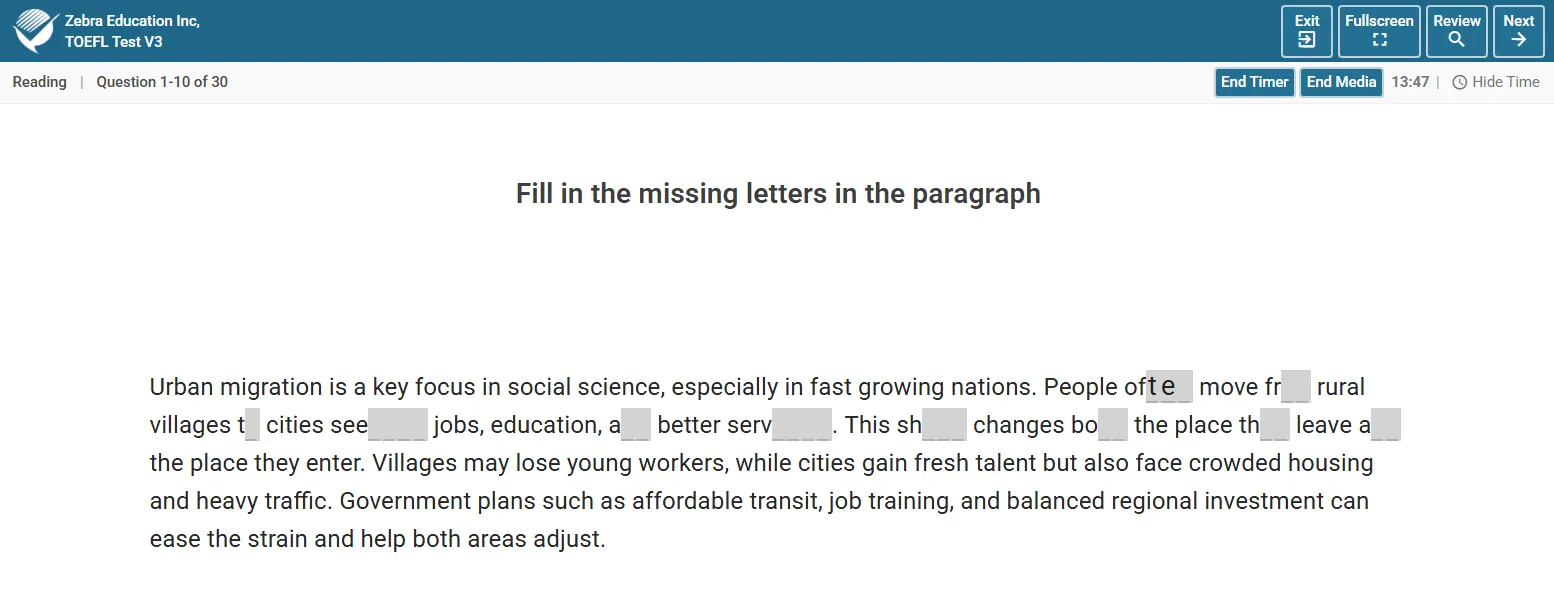
To see all our TOEFL Reading practice questions, open the TOEFL Practice menu in our TOEFL Tutor App. Reading is a skill. It improves with practice that targets your weak question types, and your reading comprehension improves with every passage you review.
The Reading section has 50 questions in three task types:
- Complete the Words: 10 gaps per text
- Read in Daily Life: usually 2 questions per text
- Read an Academic Passage: usually 5 questions per passage
Free TOEFL Reading Lessons
Create a free account to open these TOEFL Reading lessons and start building your reading skills:
- TOEFL Reading Introduction
- TOEFL Reading Strategies for Success
- Complete the Words Question
- Detail Question
- Gist Purpose Question
- Rhetorical Purpose Question
- Inference Question
- Negative Factual Information Question
- Vocabulary Question
- Organization Question
- Select in Passage Question
- Sentence Insertion Question
Free TOEFL Reading Practice Resources
Everything below is free TOEFL reading practice made for the three task types in the current test. Each full practice question scores your answers and shows the explanation.
- Complete the Words Full Practice Question: one academic text with ten gaps, scored as you type.
- Read in Daily Life Full Practice Question: an email with questions and explanations.
- Read an Academic Passage Full Practice Question: a passage with five questions and an explanation for each.
- Sample Test 1: a free full-length simulation of the adaptive TOEFL, with the Reading section and a band score.
- TOEFL reading question types: a guide to the ten question types with a sample of each.
- TOEFL complete the words: the task, a sample text, the eight kinds of missing word, and the time to spend.
- TOEFL reading practice PDF: 13 texts and 64 questions with an answer key, free with a free account.
The figures on this page come from the BestMyTest TOEFL learner performance data, our records of TOEFL practice on BestMyTest up to October 2026. That page explains how we measure each figure. Last updated 15 October 2026.