Welcome to our free TOEFL writing practice test guide, where you can study using TOEFL writing examples, take a free TOEFL writing test, and study sample answers for all three tasks: Build a Sentence, Write an Email, and Academic Discussion (the Integrated writing section is no longer part of the TOEFL iBT Writing Exam.) You can also learn helpful insights from 126,000 TOEFL writing practice reviews requested by our students.
First off, if you're looking to take a free TOEFL writing practice test or are just curious what taking an official TOEFL writing test is like, then click the button below.
play_circle_outline Start TOEFL Writing Practice TestBelow is a list of all our TOEFL writing questions where you can study each question at your own pace. To start a free TOEFL writing test question, click the Mock Test 1 link.
TOEFL Writing Practice Questions - Build a Sentence 1 - 126
TOEFL Writing Practice Questions - Write an Email 1 - 131
TOEFL Writing Practice Questions - Academic Discussion Writing 1 - 224
Table Of Contents
- What Is in the TOEFL Writing Test?
- TOEFL Writing Sample Questions with Answers
- Helpful Insights from 126,000 TOEFL Writing Practice Reviews
- How Is the TOEFL Writing Test Scored?
- How to Prepare for the TOEFL Writing Test
- Our TOEFL Writing Practice Questions
- Free TOEFL Writing Lessons
- Free TOEFL Writing Practice Resources
What Is in the TOEFL Writing Test?
In the TOEFL Writing test, you’ll complete 12 items in three tasks in about 23 minutes. In Build a Sentence, you put the words of 10 short replies in the right order. In Write an Email, you write one email in 7 minutes. In Write for an Academic Discussion, you write one post in 10 minutes. Your Writing score is a band from 1 to 6.
|
Section |
Question |
Time |
|---|---|---|
|
Build a Sentence |
10 questions |
About 6 minutes |
|
You see one line from a speaker and a reply with its words out of order. You move the words into the gaps to make a correct reply. Some words of the reply may already be in place, and one word in the bank does not belong. |
||
|
Write an Email |
1 task |
About 7 minutes |
|
You read a situation and a list of points to cover. You write an email to a professor, an office, or a classmate that answers every point in the right tone. |
||
|
Write for an Academic Discussion |
1 task |
About 10 minutes |
|
You read a question from a professor and two posts from other students. You write your own post of at least 100 words with your opinion and your reasons. |
||
|
About 23 minutes in total |
||
TOEFL Writing Sample Questions with Answers
Want to see what the new TOEFL Writing test looks like? Here are three free TOEFL writing samples with answers, one for each task, taken from our practice bank. Try each question yourself first, then open the answer or the sample response and compare it with yours. The TOEFL writing topics come from everyday student life: classes, campus offices, study groups, and discussion questions on subjects such as education.
TOEFL Build a Sentence Sample Question
A Build a Sentence item is one short exchange: a first line from a speaker and a reply broken into pieces. Before you touch the word bank, read the first line and any words already in place. They tell you who is speaking and whether the reply is a statement or a question. Remember that one piece in the bank never fits, so don’t force it in. You can practice this task on our TOEFL build a sentence practice page.
 I'm thinking about starting a weekly strength routine.
 it ?
it ?
-
spellcheck AnswersWill it include any new exercises?

Build a Sentence
Learn how to answer this question in a step-by-step interactive exercise
Build a Sentence
A Build a Sentence task shows you one line from a speaker and a reply with its words in the wrong order. You move the words into the placeholders to form a grammatical reply that fits the exchange. Sometimes a few words of the reply are already given on the page.
In this exercise you fill one placeholder at a time, from left to right, and each placeholder gives you about 5 seconds. That short clock trains you to decide quickly.
Before you start, read the first line, and read any words of the reply that are already given. They tell you who is speaking, the time of the exchange, and where the sentence is going.
Preview the question, then click next to continue.
Preview the Question
 I'm thinking about starting a weekly strength routine.
 it
?
it
?
The reply is a question, so it does not start with its subject. A yes or no question opens with an auxiliary such as should, would, could, or did. A question that asks for information opens with a question word such as what, where, or how.
Read the first line to see what the reply is asking about, then find the one segment in the bank that can open a question.
Choose the segment that opens the question.
The word after the placeholder is it, which is already given. The segment has to lead straight into it.
Placeholder 1
I'm thinking about starting a weekly strength routine.
it
?
Now, you have it, the subject. A subject is usually followed by its verb. A modal or auxiliary can come first (we can, she has), and so can a word such as never or already.
The verb has to agree with the subject (she works, they work), and its tense has to match the time of the exchange. In a question, the auxiliary at the start decides the form: Could we move...?
Test each segment in the bank against these options.
Placeholder 2
I'm thinking about starting a weekly strength routine.
Will
it
?
Now, you have the word include, a verb. We need to add something after the verb. A verb is usually followed by an object: a noun, a pronoun, or a noun phrase (the report, a new plan). It may instead be followed by an infinitive (to + verb), an -ing form, or a noun clause (that / what / where + subject + verb). After be or a linking verb such as seem, an adjective can follow (is ready).
Each verb takes only some of these. Think of how include is normally used: want to go but enjoy going, think that but ask if.
Test each segment in the bank against these options.
Placeholder 3
I'm thinking about starting a weekly strength routine.
Will
it
include
?
Now, you have any, a determiner. A determiner starts a noun phrase, so it is followed by a noun (the bus) or by an adjective and then a noun (the early bus). A verb, to, or a pronoun cannot follow it.
Check the form too. A and an take one thing (a ticket), and these and those take more than one (these tickets).
Test each segment in the bank against these options.
Placeholder 4
I'm thinking about starting a weekly strength routine.
Will
it
include
any
?
TOEFL Email Writing Sample Question
A TOEFL email writing task gives you a reader, a situation, and a list of points to cover. Your email needs to answer every point, and its tone has to match the reader: formal for a professor or an office, friendly for a classmate. Keep in mind that a short email that covers all the points scores better than a long one that misses a point. Try the sample, then compare your email with the sample answer.
Write an email to your coworkers. In your email, do the following:
- Explain what still needs to be organized for the wellness day.
- Suggest a suitable location for the event.
- Ask for volunteers to support planning and event-day tasks.
Write as much as you can and complete the sentences.
Dear All Employees,
I am writing because we have started preparing next month's employee wellness day, and there are several details that still need to be organized. We need help confirming a venue, arranging healthy refreshments, and planning short activity stations such as stretching, stress-management, and team games.
I would like to suggest using the Riverside Activity Center. It has both indoor and outdoor space, enough seating for group sessions, and convenient parking for staff from different office locations.
If you are interested in helping, please let me know. Even volunteering for one part of the event, such as registration or activity support, would be very helpful.
Thank you, and I hope many of you can join the planning team.
Best regards,
Jordan Kim

Task Fulfillment — Email
Learn how to answer this question in a step-by-step interactive exercise
Task Fulfillment — Email
An email task gives you a situation, a reader, and a numbered list of points that your message must cover. Covering every point matters more than writing at length.
Count the required points before you plan anything. A short email that answers all of them is stronger than a long email that leaves one out.
Preview the task, then click next to continue.
Preview the Question
Write an email to your coworkers. In your email, do the following:
1. Explain what still needs to be organized for the wellness day.
2. Suggest a suitable location for the event.
3. Ask for volunteers to support planning and event-day tasks.
Before you write, answer three planning questions: who the reader is, why you are writing, and what the task requires you to include.
The reader decides how formal your language has to be, and the numbered points decide what has to appear in the body. The prompt already contains all three answers, so none of this is a guess.
Match each planning question to the part of the prompt that answers it by clicking the prompt part then clicking the area under the matching question.
Understand the Task
Match each planning question to the part of the prompt that answers it.Match each planning question to the part of the prompt that answers it by clicking the prompt part then clicking the area under the matching question.
The greeting and the closing show the reader how formal your message is, so keep them at the same level as each other.
This task names a classmate or another peer, so a warm greeting with a first name and a relaxed sign-off such as "Best," or "See you soon," are the right choice. A formal title here sounds cold and distant, and it costs marks for tone just as a casual opening would in a formal email.
Choose a greeting and a closing that fit the reader.
Choose Greeting and Closing
Choose a greeting
- Dear All Employees,
- Hi everyone,
- Dear Sir or Madam,
- Hey guys,
- Dear Manager,
Choose a closing
- Best regards,
- Thanks,
- Cheers,
- Yours faithfully,
- Love,
Build the body one required point at a time, in the order the prompt lists them. Start with the first required point.
A sentence starter opens the sentence in a friendly, natural voice, and you finish the thought yourself. Contractions such as "I'm" and "can't" are fine, but write complete sentences, not text-message fragments. Add one detail of your own so the sentence answers the point instead of repeating it.
Choose a starter for the first required point, then finish the sentence in your own words.
Write Required Point 1
Explain what still needs to be organized
Move to the second required point and give it a sentence of its own. Keep the friendly tone you set in the greeting.
You can ask directly, as you would in a message to a friend, but stay clear about what you want, because the reader still has to be able to answer.
Choose a starter for the second required point, then finish the sentence in your own words.
Write Required Point 2
Suggest a suitable location
Finish the body with the last required point. Once every point has a sentence, the task is complete and you do not need to add more.
Read the numbered list in the prompt one more time before you leave this step. A missing point costs more than a short answer.
Choose a starter for the last required point, then finish the sentence in your own words.
Write Required Point 3
Ask for volunteers
Your sentences from each step now appear together as one email. Read the whole message and check the three things this task measures: every required point is answered, the tone fits the reader, and the greeting and closing frame the message.
Then compare your wording with the sample. The sample is one good answer, not the only one.
Read your complete email, then compare it with the sample.
Review Your Complete Email
How to write it
An email task gives you a situation, a reader, and a numbered list of points that your message must cover. The graders check whether every point is answered and whether your language fits the reader.
Work in a fixed order so that no required point is left out.
- Understand the Task. Decide who the reader is, why you are writing, and what the prompt requires you to include.
- Choose Greeting and Closing. Pick an opening and a sign-off that match how formal the reader is.
- Write Each Required Point. Give every point in the list its own sentence, in the order the prompt uses, and add a detail of your own.
- Review Your Complete Email. Read the message as a whole and check that every point is answered.
Count the required points before you write. A short email that answers every point scores better than a long email that misses one, because a missing point is the first thing a grader notices.
Plan
Three questions plan the email: who the reader is, why you are writing, and what the prompt requires you to include. The reader sets the level of formality, and the numbered points set the content of the body.
Tone
The greeting and the closing show the reader how formal the message is, so keep them at the same level. Read who the reader is first. A professor, a dean, or an office needs a title and a formal sign-off, with no contractions. An advisor, a teaching assistant, or a coordinator needs a polite, professional tone with the person's name. A classmate or a teammate needs a first name and a relaxed sign-off. The wrong level in either direction costs marks for tone.
Required points
Answer the points in the order the prompt lists them and give each one its own sentence. Finish every sentence with a detail of your own, because a sentence that only repeats the point does not answer it.
TOEFL Academic Discussion Sample Question
In the TOEFL academic discussion task, you join an online class discussion. You read the professor’s question and two student posts, then write your own post in 10 minutes. State your opinion in your first sentence and give reasons of your own. You can agree or disagree with a student, but don’t just repeat what they already said. The graders want to see your ideas.
In your response you should:
- express and support your opinion
- make a contribution to the discussion
An effective response will contain at least 100 words.
In my opinion, society should move toward mostly digital payment, but it should not remove cash completely. Electronic payment is useful because it leaves a clear trail for taxes and makes it easier for small shops to sell online or at street events without keeping many coins. However, a country also needs a back-up plan. During a power cut, a storm, or a problem with a payment company, people still need to buy food, medicine, and bus tickets. Cash also gives people some privacy for simple daily purchases. For this reason, I support a mixed system: digital payment as the normal choice, with cash protected for emergencies and basic public services.
Task Fulfillment — Discussion
Learn how to answer this question in a step-by-step interactive exercise
Task Fulfillment — Discussion
An Academic Discussion task gives you a question from the professor and two short student posts. You write one post of your own inside a ten minute limit.
Read both students before you plan anything. Their reasons and examples are already in the discussion, so your post has to add something they did not say.
Preview the discussion, then click next to continue.
Preview the Question
Every strong post opens with a clear position. The reader has to know what you think from the first sentence, so do not begin with a general comment about the topic.
You may agree or disagree with one of the other students, or take a position of your own. Whichever you choose, the reasons you give must be yours, not theirs. Any position can earn a high score when you support it, so choose the one you can explain fastest. Keep the position to one sentence and save your reasons for the next step.
Choose your position, then rewrite the topic sentence in your own words.
Choose Your Position and Write the Topic Sentence
A main idea is a reason that explains why your position is correct. Two reasons is a safe plan for ten minutes. A sentence that only repeats your position in new words is not a reason, and a reason copied from one of the students adds nothing to the discussion.
Write each reason as one full sentence, and use your own vocabulary rather than the wording of the prompt. Explanations and examples come in the next steps.
Rewrite each main idea as one clear sentence that supports your position.
Develop Two Main Ideas
Digital payment helps with taxes and small shops.
Cash is a back-up when payment systems fail.
A reason on its own is not convincing. Add an explanation or a specific example so the reader can see how the reason works in real life.
A specific example names a situation, a person, or a result. One or two sentences are enough, because your second main idea and your conclusion still need time.
Write one or two sentences that explain or give an example for your first main idea.
Explain or Give an Example for Main Idea 1
25
Give your second reason the same support as the first. A post that develops one idea well and leaves the other bare looks unbalanced, and the reader sees only one reason.
Use a different explanation or example here. Repeating the support you have already written adds length but no new content.
Write one or two sentences that explain or give an example for your second main idea.
Explain or Give an Example for Main Idea 2
25
A short conclusion tells the reader that the post is finished. One sentence is enough: restate your position in new words and point back to your reasons.
Do not copy your opening sentence word for word, and do not raise a new idea. There is no time left to support an idea that arrives at the end.
Write one concluding sentence that restates your position.
Write the Conclusion
15
Your sentences from each step now appear together as one post. Read the whole post and check the three things a strong post needs: a clear position, two reasons of your own, and a specific explanation or example behind each reason.
Then compare your wording with the sample. The sample is one good answer, not the only one.
Read your complete response, then compare it with the sample.
Review Your Complete Response
How to write it
An Academic Discussion task asks for your own opinion on the question from the professor, written as one short post inside a ten minute limit. The graders want a clear position that is supported, not a long essay.
Work in a fixed order so that you do not run out of time before your reasons are explained.
- Choose Your Position and Write the Topic Sentence. State what you think in one sentence. You may agree or disagree with a student, but your reasons must be your own.
- Develop Two Main Ideas. Write two reasons that explain why your position is correct.
- Explain or Give an Example for Each Main Idea. Add one or two sentences of explanation, or a specific example, under each reason.
- Write the Conclusion. Restate your position in one sentence and point back to your reasons.
- Review Your Complete Response. Read the post as a whole and check that every sentence supports your position and that none of it repeats what a student already said.
Answer the professor's question with your own opinion. You may agree or disagree with one of the other students, but your reasons and examples must be your own. A post that repeats what a student already said adds nothing to the discussion.
Position
Your position is your answer to the question from the professor. Put it in the first sentence so the reader never has to guess what you think. Either side can earn a high score, so choose the side you can support fastest.
Main ideas
A main idea is a reason that explains why your position is correct. Two reasons are enough for ten minutes. Write each one as a full sentence in your own vocabulary rather than repeating the wording of the prompt.
Support
An explanation says how the reason works. An example names a situation, a person, or a result. Give each main idea one or two supporting sentences, and use different support for each one.
Conclusion
One sentence is enough to close the post. Restate your position in new words and point back to your reasons. Do not raise a new idea that you have no time to support.
Helpful Insights from 126,000 TOEFL Writing Practice Reviews
Our data shows exactly where TOEFL Writing practice loses points. Grammar is the weakest criterion in both written tasks, spelling is the most common correction in emails, and longer discussion posts score higher. Here are the numbers, taken from 62,565 AI reviews and 64,048 tutor reviews of TOEFL writing on both the previous test format and the current one.
Grammar Is the Lowest TOEFL Writing Criterion in Every Task
Across all TOEFL writing tasks, old and new, grammar was the lowest score in 86% of 62,565 AI-reviewed responses. In 64,048 tutor-scored responses, it was the lowest score in 87%. In the current tasks, grammar is the criterion that is lowest most often in both discussion posts and emails.
In 30,982 AI-reviewed discussion posts, grammar was the lowest score 84% of the time. On a 0 to 5 scale, the averages, lowest first, were grammar 2.6, vocabulary 2.8, coherence 2.9, support and relevance 3.0, organization 3.1, and task fulfillment 3.4. In 9,981 emails scored by our tutors, grammar was lowest 92% of the time, and the averages were grammar 2.6, vocabulary 2.8, coherence 3.3, support and relevance 3.4, organization 3.5, and task fulfillment 3.7. In other words, students know what to write. What costs them points is how they write it.

Grammar Is the Lowest TOEFL Writing Score Most Often in Both Tasks
Grammar was the lowest score most often in both tasks: in 84% of discussion posts and 92% of emails. Task fulfillment was the lowest score in 18% of discussion posts and 21% of emails, and vocabulary in 59% and 71%. The points go missing in the language, not in the ideas.

Spelling Is the Number One Correction in TOEFL Emails
Spelling makes up 23% of all email corrections, and 78% of emails had at least one misspelled word. Punctuation comes next at 15% of email corrections, and the words whose capital letter is fixed most often are I and Friday. Discussion posts put spelling first too. There, the most frequent corrections are spelling (16%), punctuation (16%), articles (10%), singular or plural nouns (8%), subject-verb agreement (6%), and prepositions (6%). A quick spelling and punctuation check at the end of your email is one of the easiest ways to save points.

Longer TOEFL Discussion Posts Score Higher
Posts with an AI score of 1 had about 107 words on average. Posts scoring 1.5 had 120 words, posts scoring 2 had 124 words, posts scoring 2.5 had 129 words, posts scoring 3 had 131 words, posts scoring 3.5 had 138 words, posts scoring 4 had 144 words, posts scoring 4.5 had 150 words, and posts scoring 5 had 154 words. At every step, the higher score came with more words: the more you develop your ideas, the higher your post scores. Emails grow less with the score: 108 words at a score of 1, 99 at 1.5, 103 at 2, 112 at 2.5, 115 at 3, 120 at 3.5, 125 at 4, 126 at 4.5, and 141 at 5. In an email, covering every point matters more than writing more.

The Same Small Fixes Come Back in the TOEFL Writing Answers of 887 Learners
Our tutors and AI correct the same small mistakes again and again. In discussion posts, the most frequent fixes are "is" to "are" (887 learners), "in" to "on" (755), "i" to "I" (754), "are" to "is" (632), "on" to "in" (620), "have" to "has" (589), a missing comma after "In my opinion" (555), and "for" to "to" (518). In emails, they are "i" to "I" (420), "for" to "to" (368), "in" to "on" (285), "you" to "your" (271), "on" to "in" (253), and "a" to "an" (208). If you recognise your own habit in one of these, that’s the first thing to practise.

A TOEFL Discussion Post Gets About 11 Corrections on Average and an Email About 10
Our learners’ discussion posts average 133 words, and their emails average 117 words. Across all 60,455 AI-reviewed responses, old and new, the average is 13 corrections per answer. That number is higher than today’s tasks alone because the older integrated essays were much longer.

How Is the TOEFL Writing Test Scored?
ETS scores TOEFL Writing with a combination of AI scoring and certified human raters. You get one Writing section score on a scale from 1 to 6 in half-point steps, and the scale lines up with the CEFR levels. ETS doesn’t publish how much each task counts toward that score, so the safest plan is to prepare for all three.
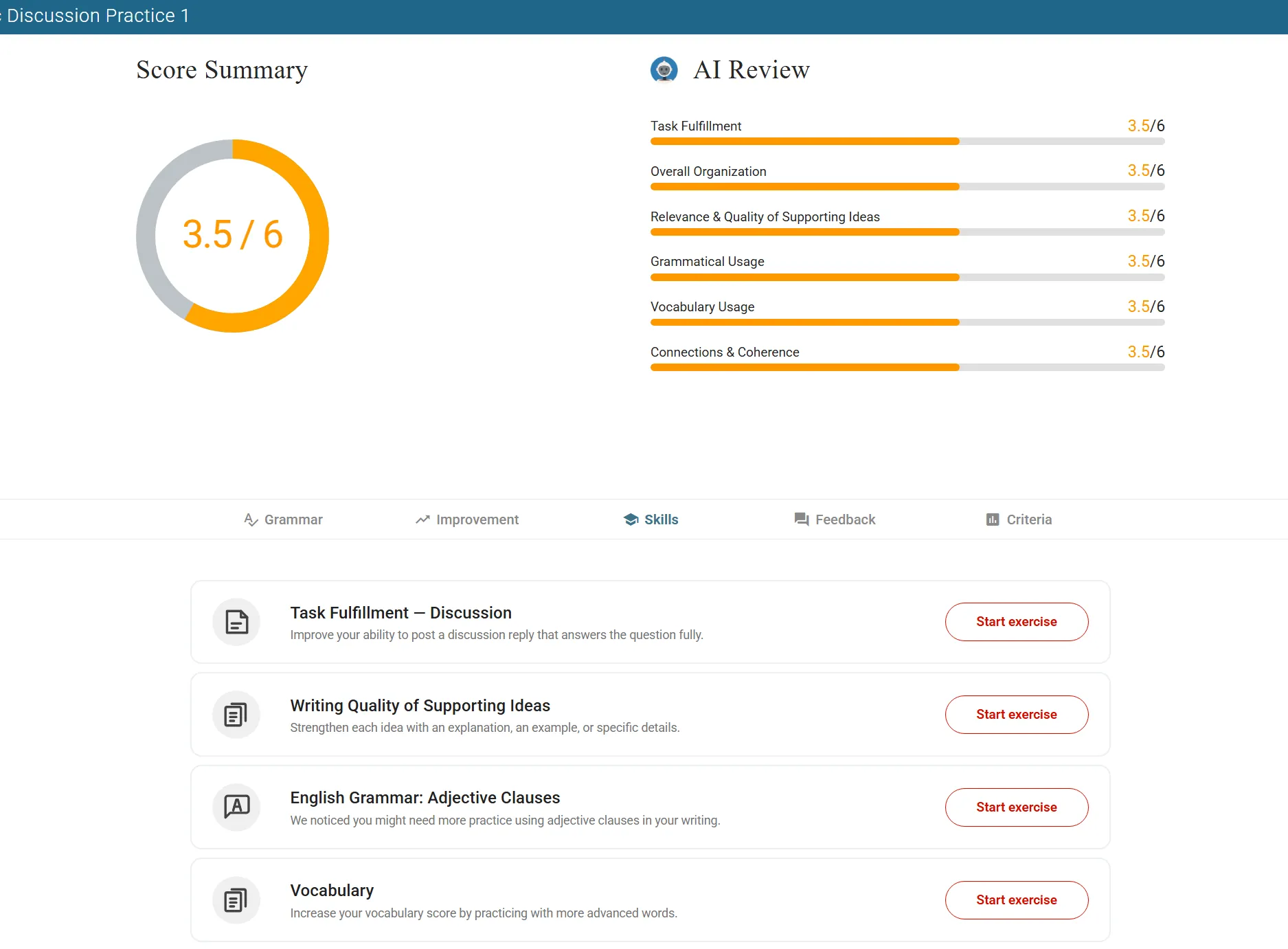
On BestMyTest, a Build a Sentence practice set is marked out of 10. Each email and discussion post you submit for review gets a score on six criteria: task fulfillment, overall organization, relevance and support, connections and coherence, vocabulary, and grammar. Your score report then shows your writing as a band from 1 to 6. If you want to know what each band looks like in a real answer, our TOEFL writing rubric guide explains each one.
How to Prepare for the TOEFL Writing Test
The TOEFL Writing section can be challenging because you need to write grammatically correct sentences, communicate your ideas clearly, and complete each task within a strict time limit. Even small mistakes in grammar, word choice, or sentence structure can affect your score. The test includes three tasks: Build a Sentence, Write an Email, and Write for an Academic Discussion. Each requires a different approach. You need to arrange words into correct sentences, write emails that address specific requirements, and develop well-supported opinions in academic discussions.
The good news is that many common Writing mistakes can be improved with the right strategies and focused practice. Our students' results show that grammar is the criterion lowest most often and that spelling is the most common correction in emails, which means learning to recognize and correct these errors is an important part of your preparation.
The following six TOEFL Writing tips will teach you how to approach each task, improve your grammar and writing skills, manage your time, and use feedback to work toward a higher score.
TOEFL Writing Practice Tip 1: Build a Sentence
Build a Sentence tests your understanding of English grammar and sentence structure. To answer correctly, you need to recognize how different parts of a sentence fit together, including word order, verb forms, and the relationships between phrases and clauses. With approximately six minutes to complete ten questions, you have an average of just 36 seconds per sentence. The faster you recognize common grammar patterns, the less time you'll spend guessing and rearranging words.
The most effective strategy is to understand the sentence structure before arranging the segments. Let's look at two examples.
Example 1: Building a Statement
Suppose you need to arrange these segments:
a different course | next semester | taking | the professor | suggested
Start by identifying the subject and main verb. In this example, the professor is the subject, and suggested is the main verb.
Next, think about what should follow the verb. Because suggest is followed by an -ing form when recommending an activity, the next segment should be taking, followed by a different course and next semester.
The correct sentence is:
The professor suggested taking a different course next semester.
Notice how recognizing the grammar pattern helps you determine the correct order without testing every possible combination.
Example 2: Building a Question
Now suppose you need to respond to this question:
"I'm having trouble understanding the assignment. What should I do?"
You are given these segments:
the professor | contact | we | should | about the assignment
First, recognize that you are building a question. The segment should is a modal verb, so it can appear at the beginning of a question.
The correct word order is modal verb + subject + base verb, followed by the remaining information:
- Modal verb: should
- Subject: we
- Base verb: contact
- Remaining information: the professor about the assignment
The correct sentence is:
Should we contact the professor about the assignment?
This pattern also applies to many questions beginning with can, will, or could. Learning to recognize these structures will help you arrange the segments more quickly and accurately.
How to Apply These Strategies on Test Day
Before moving any segments, read the original sentence and any words already provided in the answer. Use them to understand the context and determine whether you need to build a statement or a question.
Next, identify the subject and main verb, then consider which grammatical structures are needed to complete the sentence. Pay attention to verb patterns, such as infinitives with to, -ing forms, and clauses introduced by words such as that or because.
Once you've arranged the segments, read the complete sentence to check its grammar, meaning, and word order. Make sure it also forms a natural and appropriate response to the original statement.
The goal is to recognize grammar patterns automatically instead of relying on trial and error. The more familiar you become with these structures, the faster and more accurately you'll be able to answer.
You can learn these strategies step by step in our TOEFL Build a Sentence practice guide, which includes explanations and practice questions to help you strengthen your sentence-building skills.
TOEFL Writing Practice Tip 2: TOEFL Email Writing
The TOEFL Email task tests your ability to communicate clearly and appropriately in everyday situations, such as requesting information, explaining a problem, or writing to a professor. To earn a high score, you need to address the task requirements, organize your message clearly, and use accurate grammar and vocabulary. Our students' writing results reveal an important weakness. In our AI reviews of emails, Grammar was the weakest criterion in 92% of them, and task fulfillment was the lowest in 21%. In the same reviews, 78% of emails contained at least one spelling mistake.
This suggests that many students understand what they need to write but struggle to express their message accurately.
A useful strategy is to organize your email into three parts:
1. Opening: Explain why you're writing.
Begin with an appropriate greeting and clearly state the purpose of your email. Avoid long introductions that don't add useful information.
For example, if you're emailing a professor because you missed class, you might write:
"Dear Professor Lee, I'm writing to apologize for missing yesterday's class and to ask about the assignment I missed."
2. Body: Address every point in the prompt.
Read the instructions carefully and make sure you cover all the required information. Don't just mention each point briefly. Add enough explanation to make your message clear.
For example, if the prompt asks you to explain your absence and request an extension, you could write:
"I was unable to attend class because I was sick. Since I missed the assignment instructions, I would appreciate it if you could give me an extra day to complete the work."
3. Closing: End politely and appropriately.
Finish your email with a suitable closing sentence and sign-off. Keep your tone respectful, especially when writing to a professor or someone in a professional position.
For example:
"Thank you for your understanding. I look forward to hearing from you. Best regards, Alex"
After writing your email, use any remaining time to check for grammar and spelling mistakes. Pay particular attention to subject-verb agreement, prepositions, possessive forms, and capitalization.
Our students frequently make mistakes such as writing i without its capital letter, writing for instead of to, or writing in instead of on. These errors may seem small, but repeated mistakes can lower your language accuracy score.
The key to a high-scoring TOEFL email is to address every requirement in the prompt, organize your ideas logically, use an appropriate tone, and write with accurate grammar and vocabulary. With regular practice and careful attention to grammar and spelling, you can reduce common mistakes and write more confidently and effectively within the time limit.
Practice these strategies with our TOEFL Write an Email practice question and review the lesson Write an Email: How to Get a High Score to learn how to write more effective emails under the test's time limit.
TOEFL Writing Practice Tip 3: TOEFL Academic Discussion
The TOEFL Academic Discussion task requires you to express your opinion on a topic and contribute meaningful ideas to an ongoing classroom discussion. To achieve a high score, you need to present a clear opinion, develop your ideas with relevant reasons and examples, and use accurate grammar and vocabulary. Our practice test data shows that responses receiving an AI score of 5 contain approximately 154 words on average, and responses scoring 1 average around 107 words. However, writing more doesn't automatically mean earning a higher score. What matters is how well you explain and support your ideas.
A useful approach is to organize your response into three parts:
1. State your opinion clearly.
Begin by directly answering the professor's question. Avoid spending too much time on a general introduction.
For example, if the professor asks whether university students should take courses outside their major, you might write:
"I believe university students should take courses outside their major because these classes can help them develop useful skills and discover new interests."
This immediately communicates your position and introduces two reasons you can develop.
2. Explain your reasons with specific supporting details.
Simply mentioning a reason isn't enough. Explain why it matters and show how it supports your opinion.
For example, instead of writing:
"Students can learn useful skills by taking different classes."
You could develop the idea further:
"For example, an engineering student who takes a communication course may become better at presenting technical ideas to people without an engineering background. This skill could be valuable when working with clients or colleagues in the future."
Notice how the stronger explanation connects the reason to a realistic example and explains its benefits.
3. Contribute your own ideas to the discussion.
Read the other students' responses carefully before writing. You can agree or disagree with their opinions, but avoid simply repeating what they have already said.
For example, if another student argues that taking additional courses improves career opportunities, you could introduce a different perspective by explaining how those courses help students discover interests they might otherwise never explore.
Adding a new reason, example, or perspective shows that you understand the discussion and can contribute meaningfully to it.
Don't forget grammar and language accuracy.
Even a well-developed argument can lose points if your sentences contain frequent grammar mistakes or unclear expressions. After writing, use any remaining time to check subject-verb agreement, verb tenses, sentence structure, and word choice.
If you find it difficult to organize your ideas quickly, our TOEFL Writing Templates guide provides useful structures for presenting opinions, developing reasons, and adding supporting examples.
You can also try our Academic Discussion practice question to practice applying these strategies under the real time limit.
TOEFL Writing Practice Tip 4: Fix Your Most Common Grammar Mistakes
Many TOEFL students spend a lot of time memorizing advanced vocabulary and complicated sentence structures, hoping these will improve their Writing score. However, correcting basic grammar mistakes may be a much more effective place to start. Our student data shows that Grammar was the lowest-scoring criterion in 84% of Academic Discussion responses and 92% of emails.
Even more importantly, the same fixes come back for many learners.
For example, our correction data includes:
- 887 learners who needed to correct is to are.
- 755 learners who needed to correct in to on.
- 754 learners who needed to correct i to I.
- 632 learners who needed to correct are to is.
These examples show why mastering common grammar rules is so important. Focus on subject-verb agreement, prepositions, and "i" and "I". After each writing task, review your mistakes and identify recurring grammar problems.
Once your grammar improves, focus on sentence variety by learning to use adjective clauses, noun clauses, adverb clauses, and participle phrases.
Our interactive grammar and writing skill exercises help you correct common mistakes and rewrite sentences using more advanced structures, improving both your grammar accuracy and sentence variety.
How to Get Personalized Grammar and Writing Skill Exercises
Our AI Tutor automatically tracks your Writing performance and identifies weaknesses in your responses. Based on the mistakes you make, it recommends personalized grammar exercises and sentence-variety writing exercises using sentences from your own essays.
For example, if you frequently make subject-verb agreement mistakes, the AI Tutor will provide targeted exercises to help you correct them. If your writing relies too heavily on simple sentences, it will recommend sentence-variety exercises that teach you how to improve your own writing using more advanced grammatical structures.
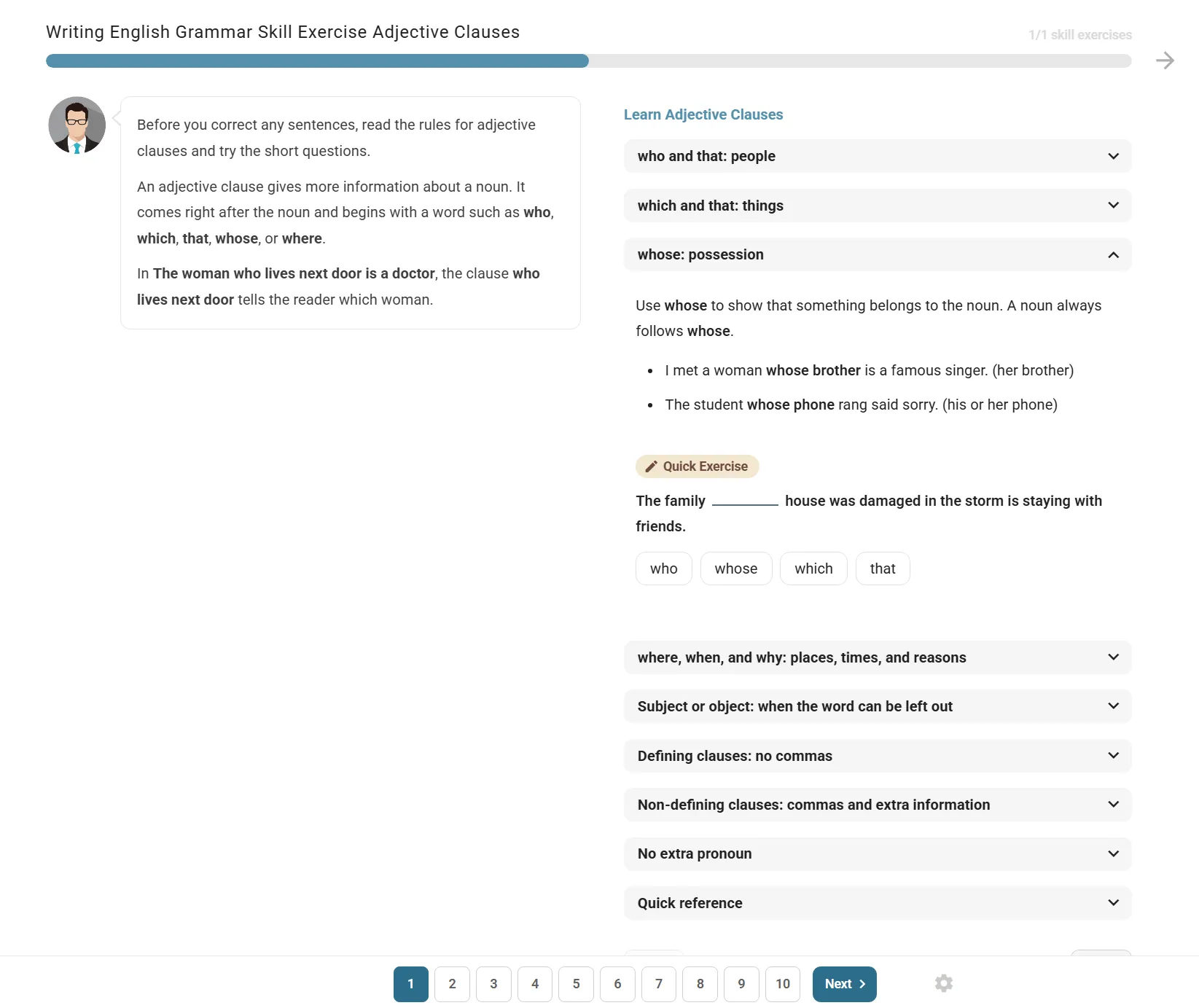
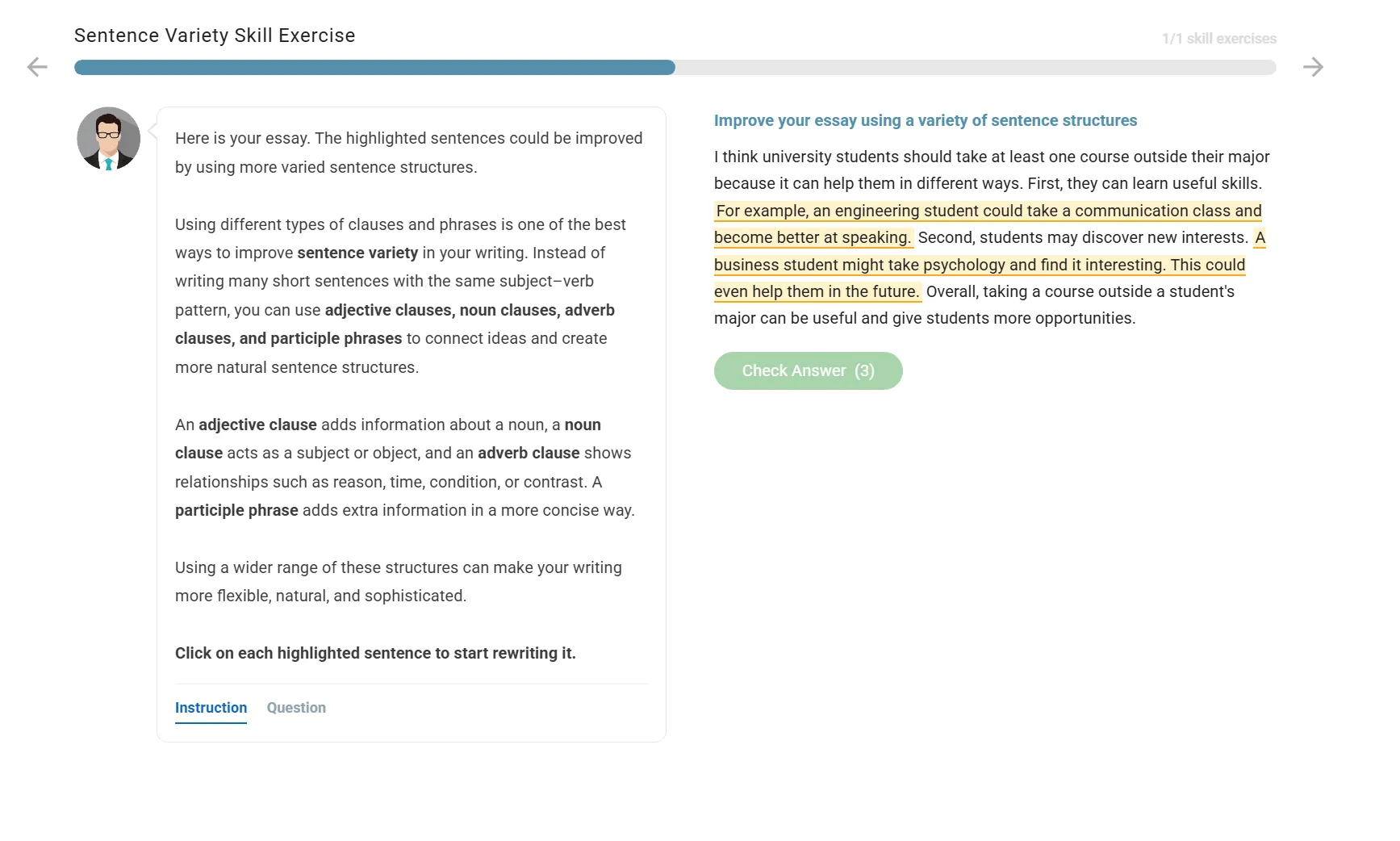
Instead of practicing random grammar rules, you'll work on the specific weaknesses that are holding back your TOEFL Writing score.
TOEFL Writing Practice Tip 5: Take a TOEFL Writing Practice Test
Writing accurately under time pressure is one of the biggest challenges in TOEFL Writing. Even if you understand the task and know what to write, poor time management can prevent you from completing a strong response. The TOEFL Writing section gives you approximately 6 minutes for 10 Build a Sentence questions, 7 minutes for the Email task, and 10 minutes for the Academic Discussion task.
To make the most of your time, develop a clear strategy for each task:
- Build a Sentence: Recognize grammar patterns and correct word order quickly instead of guessing different combinations.
- Write an Email: Identify all the required points before writing, and address them clearly without spending too long on the introduction.
- Academic Discussion: Decide on your opinion and supporting reasons before writing, then develop your ideas with relevant explanations and examples.
Always leave a little time to check for grammar mistakes, spelling errors, and missing information.
The best way to build these habits is to practice under realistic time limits. Sign up for free and take Sample Test 1 to experience the TOEFL Writing section under test conditions. Premium members can also access 50 simulation tests.
TOEFL Writing Practice Tip 6: Get Your TOEFL Writing Answers Reviewed
A common misconception about TOEFL Writing is that the more essays you write, the higher your score will become. But practicing the same mistakes over and over won't necessarily help you improve. What matters is understanding exactly where you're losing points and learning how to correct those weaknesses.
Our student data shows that Grammar is the weakest scoring criterion in 84% of Academic Discussion responses and 92% of emails. Many students don't recognize these mistakes in their own writing, which is why getting detailed feedback is so valuable.
Don't just practice writing more. Make sure every response helps you improve.
Our AI Writing review evaluates your Email and Academic Discussion responses across six scoring criteria, identifies mistakes, and provides suggested corrections. You can see where you're losing points and what you need to change to produce a stronger response. You can also request a tutor review to receive personalized feedback from an experienced instructor on your ideas, organization, grammar, and tone.
After reviewing your feedback, use our AI Tutor's personalized skill exercises to work on your specific weaknesses. Based on your writing performance, the AI Tutor provides targeted exercises to help you develop stronger supporting details, correct grammar mistakes, improve sentence variety, and learn more effective vocabulary using examples from your own essays.
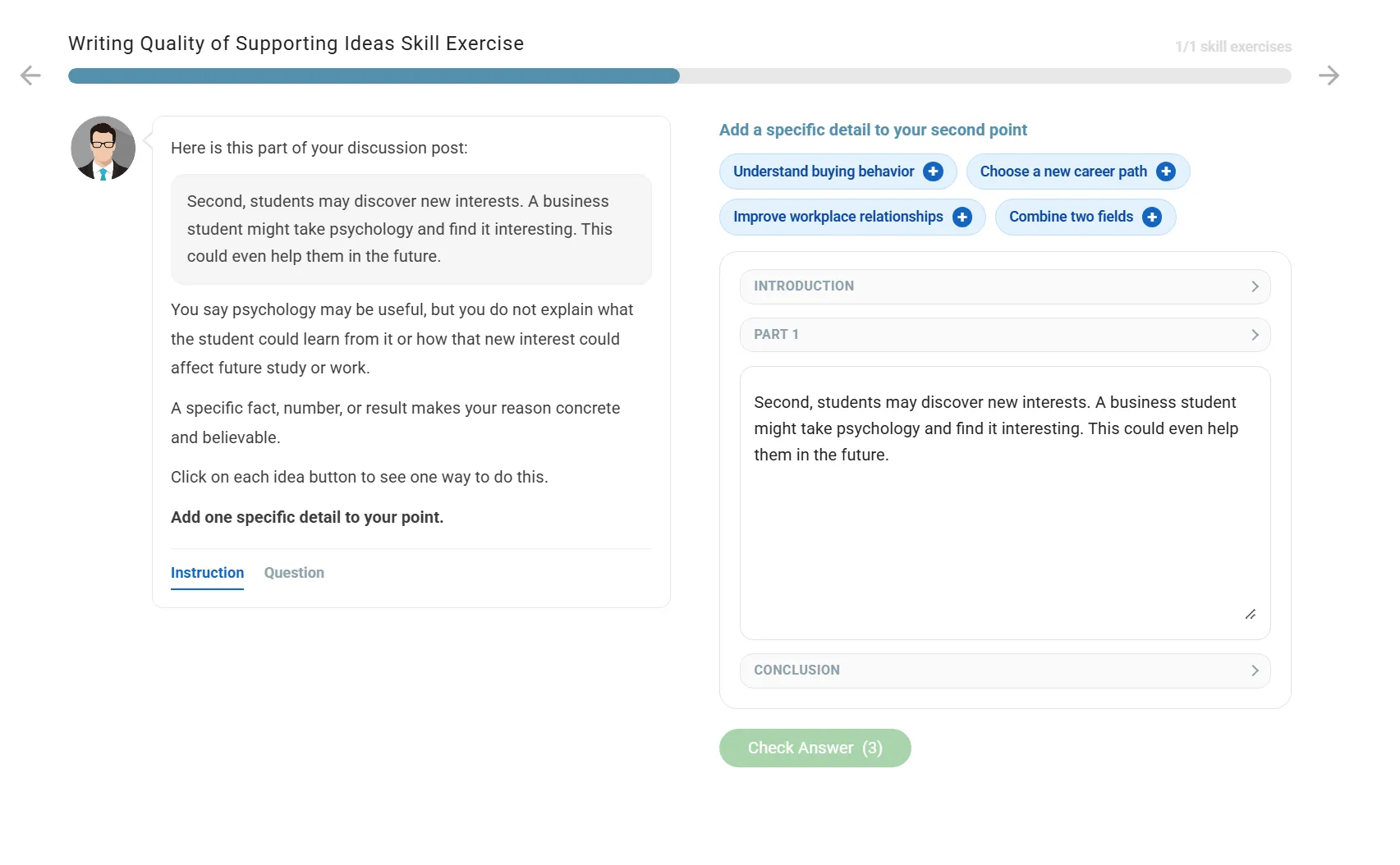
The goal isn't simply to complete more Writing tasks. It's to make each new response better than the last. Get your answers reviewed, understand your weaknesses, and apply the feedback to your next response. That's how you turn regular practice into measurable progress toward a higher TOEFL Writing score.
Our TOEFL Writing Practice Questions
Our TOEFL Writing practice questions look and feel like the official TOEFL test. The three tasks, the layout, and the time limits are the same, so your TOEFL iBT writing practice happens in a real test situation. Every email and discussion post you write can be sent for an AI review or a tutor review.
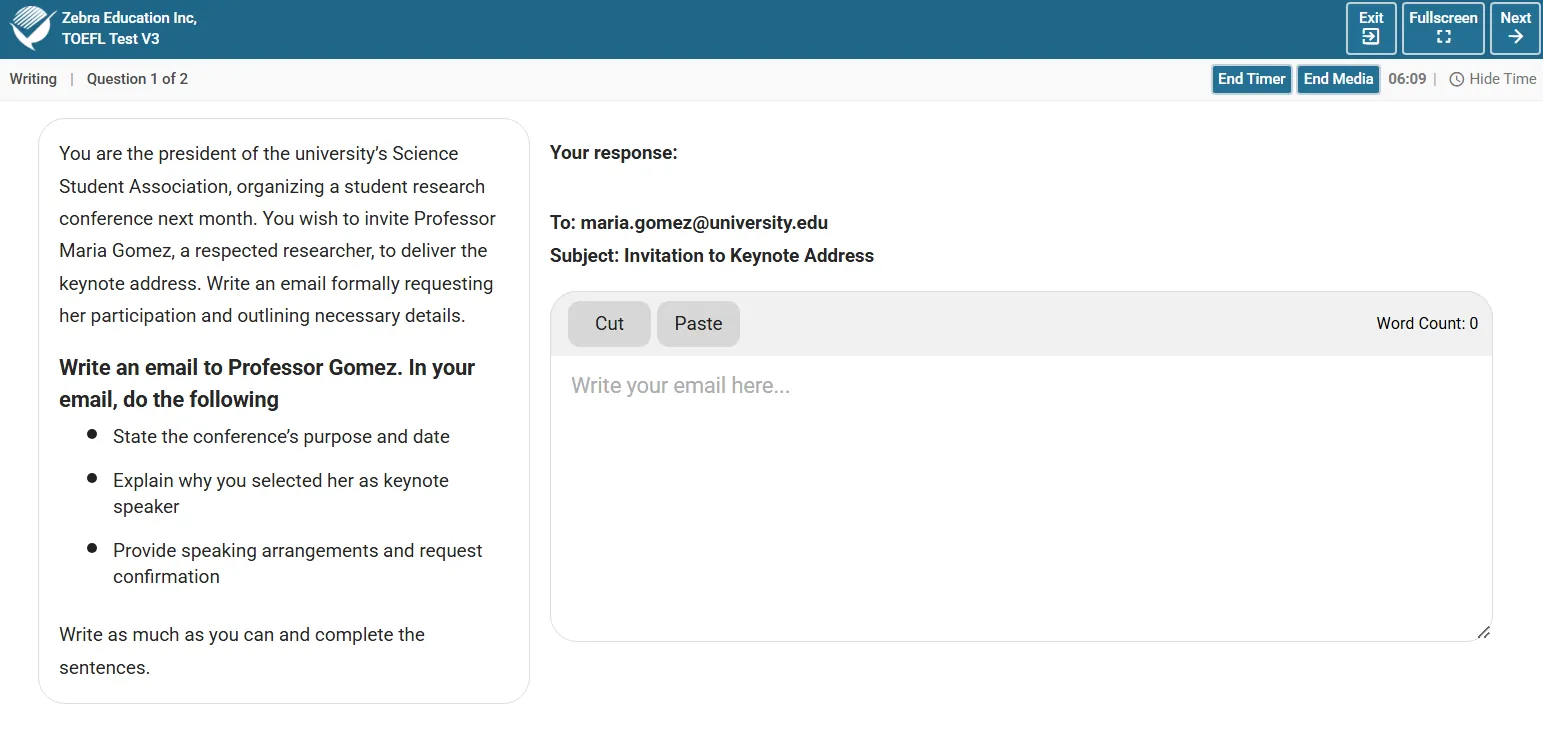
To see all our TOEFL writing questions, open the TOEFL Practice menu in our TOEFL Tutor App. The Writing section has 12 items in three TOEFL writing tasks:
- Build a Sentence: 10 questions
- Write an Email: 1 task
- Write for an Academic Discussion: 1 task
Free TOEFL Writing Lessons
Create a free account to open these TOEFL Writing lessons and start building your writing skills:
- TOEFL Writing Introduction
- TOEFL Writing Build a Sentence: Strategies for Success
- Write an Email: How to Get a High Score
- Academic Discussion: How to Get a High Score
- Connecting Ideas in Your Essay
- Achieving Sentence Variety
Free TOEFL Writing Practice Resources
Everything below is free TOEFL Writing practice made for the three tasks in the current test. Each full practice question shows you a sample answer, so you can compare it with your own and see what to improve.
- TOEFL build a sentence practice: the task explained, with a practice question and its answer.
- Write an Email Full Practice Question: a prompt with a sample email.
- Academic Discussion Full Practice Question: a professor's question, two student posts, and a sample post.
- Sample Test 1: a free full-length simulation of the adaptive TOEFL, with the Writing section.
- TOEFL writing templates: the email and discussion structures with sample answers.
The figures on this page come from the BestMyTest TOEFL learner performance data, our records of TOEFL practice on BestMyTest up to October 2026. That page explains how we measure each figure. Last updated 15 October 2026.