Free IELTS Speaking Test: Prepare with IELTS Speaking Topics and Templates for IELTS Speaking Part 1, 2, & 3
In this guide, you'll take a free IELTS speaking test and practice with the most frequently used IELTS speaking question topics with answers. You'll learn how to answer IELTS speaking test questions for part 1, 2, & 3 using our fully tested speaking templates.
Get free IELTS speaking sample answers after completing an IELTS speaking practice test.
play_circle_outline Start IELTS Speaking Practice TestBelow is our full list of IELTS speaking questions with sample answers. Note: The red links are our most popular and recommended speaking questions rated by our students and you can practice them free anytime you like.
IELTS Speaking Success Guide
Welcome to the official BestMyTest IELTS speaking test guide. The remainder of this guide will focus on learning the most frequently used IELTS speaking topics for speaking part 1 - 3, listening to band 9 speaking sample answers, and learning important IELTS speaking tips and resources for your success. Use the table of contents below to quickly find what you're looking for.
Table Of Contents
- IELTS Speaking Test Introduction
- IELTS Speaking Topics for Part 1
- IELTS Speaking Topics for Part 2 & 3
- How to Tackle IELTS Speaking Part 1
- How to Tackle IELTS Speaking Part 2
- How to Tackle IELTS Speaking Part 3
- IELTS Speaking Practice for Your Success
- How IELTS Speaking Questions are Scored
- Free IELTS Speaking Test Resources
IELTS Speaking Test
The IELTS speaking test can be a little intimidating at first, especially because you'll be tested live in front of your examiner. Due to this live format, finding free speaking topics with sample answers can be difficult, but don't worry we have you covered. Before practicing with our IELTS speaking topics, let's take a quick look at the speaking test and see how it works.
Speaking Test Format
The speaking test lasts about 11 - 15 minutes, consisting of 3 parts. Please note the speaking topics for Greeting and Part 1 are the same, so they are considered only 1 part, but we have separated them for your convenience.
- IELTS Speaking Test Greeting
- IELTS Speaking Test Part 1
- IELTS Speaking Test Part 2
- IELTS Speaking Test Part 3
The Greeting
When you take the IELTS speaking test and walk into the examination room, the examiner does not start off with tough IELTS speaking questions, instead, they start slow with greetings. Please note, you WILL BE graded on your ability to greet, so it's important you're prepared for it. Having said that, let's take a quick look at a simple greeting and answer.
- The examiner will introduce themselves and ask what your name is. You'll reply "My name's _______".
- Next, you'll be asked "What can I call you?", in which you can reply "You can call me_______". You may use your English name here, if you have one. This may sound odd, but some people cannot pronounce their own English name. This is NOT ACCEPTABLE. If you cannot pronounce it, you're better off not using it.
- Following your name, they'll ask where you're from. Just say "I'm from_____". That's enough. You don't need to give any extra information about your answers at this stage.
- Finally, you'll be asked for identification. After showing it, you'll begin the test.
IELTS Speaking Part 1
IELTS Speaking part 1 lasts between 4-5 minutes, includes around 8-10 IELTS speaking questions, and about 2-3 familiar IELTS speaking topics such as your job, your studies, your family, your hometown, your accommodation, etc. These topics are easier than the topics from IELTS speaking part 2. Below are some examples of what you could be asked.
Where is your hometown?
What do you like about it?
What do you not like about it?
How important is your hometown to you?
Let's move on to talk about accommodation:
Tell me about the kind of accommodation you live in?
Does the place you live in have many amenities?
Is there anything you would like to change about the place you live in?
Do you plan to live there for a long time?
Part 1 questions might best be described as questions that imitate small talk between two strangers or acquaintances. They are not very in-depth, but don't let these questions fool you into thinking you don't need to prepare for them. Just a little preparation can go a long way and you'll thank us for making you do it! You'll also find some tips on how to prepare for part 1 questions later in this post.
IELTS Speaking Part 2
In part 2, you'll talk about a particular IELTS speaking topic. The topic is selected for you and will be given to you on a card (Candidate Task Card). You will then have 1 minute to prepare your answer and then a maximum of 2 minutes to speak. A pencil and paper will be provided for you to make notes. Below is an example IELTS speaking part 2 question:
Describe a useful electronic device you would like to own.
You should say:
- What it is
- How it would help your life
- If it would be expensive to buy
And explain why you would like it.
Once your two minutes of speaking time is finished, it's possible the test examiner will conclude this part of the test by asking you a couple of simple questions related to your part 2 answer.
These are sometimes known as rounding off questions,
since they help "round off," or complete your conversation. Let's look at some IELTS speaking questions that could be asked.
For instance, perhaps the IELTS speaking topic you discussed in part 2 was "Describe your favorite form of public transport".
The examiner might round off your conversation by asking:
- Are the buses cheap in your city?
- Did you travel to the test today by bus?
Typically, these rounding off questions are simple, so it will only be necessary for you to respond with simple answers.
Long, complex answers are not required here, as the examiner will likely be ready to transition into part 3.
For example, you can answer a rounding off question with a short response like this:
- Yes, about 2 dollars for a single journey.
- No, actually I came by taxi.
On the other hand, there are instances when the examiner might skip the rounding off questions altogether and will, instead, proceed directly to part 3. If this turns out to be the case during your IELTS speaking test, don't worry; This indicates that your speaking part 2 answer was long enough, and that your 3 minutes speaking time for part 2 has already run out.
IELTS Speaking Part 3
In part 3, you'll be asked about 4-8 more IELTS speaking questions which are connected to the IELTS speaking topics discussed in part 2. The examiner will also ask you a few questions based on your answers, so the entire part 3 is a two-way discussion with the examiner and will last 4 - 5 minutes. Here are some general speaking questions the examiner could ask you based on the above IELTS speaking part 2 topics:
What devices do you think will be popular in the future?
Do you think people spend too much money on electronic devices?
In what ways can electronic devices make our lives harder?
What would the world be like without computers?
Should children be taught to use computers at school?
IELTS Speaking Topics
Now that you've been introduced to how the IELTS speaking test works, you can see there could be any number of topics asked. It's important you familiarize yourself with some of the more frequently used IELTS speaking topics. Not only have we created a comprehensive list, but each one also includes an IELTS speaking sample answer.
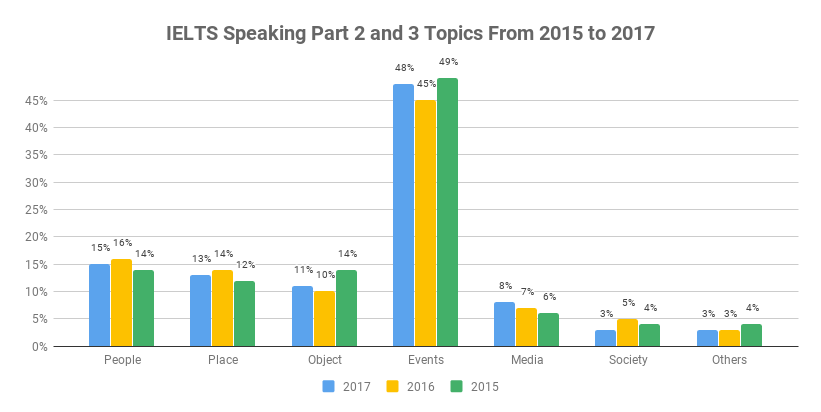
The below bar graph represents the most popular speaking topics used in 2015 to 2017. The y-axis shows the percentage they were used, while the the x-axis represents the topics. Finally, starting from left, each bar represents a year: 2017, 2016, and 2015, accordingly.
IELTS Speaking Topics Part 1
The below list contains more than just questions, it also shows speaking topics examiners have asked people in the past. A great tip is to answer these IELTS speaking part 1 questions in a mirror or with a friend. The table below shows the frequency each topic is used:
| Topics | Frequency |
|---|---|
| Hometown/Accommodation/Country | High |
| Friends/Family/Housework/Children | High |
| TV/Reading/Music/Newspapers & Magazines/Films | High |
| Technology/Computers/Internet | High |
| Work/Jobs/Career Planning/Volunteer Work | High |
| School majors/High School | Medium |
| Sports/Outdoor Activities/Indoor Activities | Medium |
| Travel/Lifestyle | Medium |
| Season/Rain/Sunny Days/Weather | Medium |
| Fashion/Shoes/Bags/Clothes | Medium |
| Transportation/Boats/Buses/Taxis | Medium |
| Celebrities/Advertisements/Media | Medium |
| Photos/Photography/Colors/Art | Low |
| Noise/Patience/Politeness | Low |
| Mirrors/Gifts | Low |
My hometown is a tiny village in Malaysia. It is about 40 kilometers away from any major city. Most people probably wouldn't be able to find it on a map.
I like how the people in my hometown are so friendly, and the way that everyone knows everyone. It’s a really close-knit community, which is hard to find in big cities.
Well...I suppose my least favorite thing about it is that there aren’t too many fun things to do or see. It’s not the most exciting place, so sometimes I feel a little bored.
My hometown is very important to me, because that’s where my family lives. It’s where I come from, so it shapes a lot of who I am as a person. If I move away, I’ll likely be homesick for awhile.
Well...I’ve lived in my hometown since I was born, and I would be happy to continue living there. However, I’d like to try living abroad, even if it’s just for a short time.
My hometown, Delhi, is the second largest in India. The capital of the country, New Delhi, is also there. There is an international airport in Delhi, so it’s easy to travel in and out of the country from there.
It has developed much better public transportation, such as the metro, which has really improved the overall accessibility of the city. There have also been measures undertaken to reduce pollution and crowds, so those problems have slightly improved. Improvements are still being made to the education system, as well.
I think one of the biggest issues in Delhi is women’s safety. The city does not have a good reputation surrounding this problem, and many women fear going out alone in the city because of it. More needs to be done to protect women in Delhi.
Yes, there are trains, buses and major highways that connect easily to Delhi. There is an airport in New Delhi, and since it’s the capital of India, it is very well connected to the rest of the country.
Well, there are many different kinds of jobs, since it is a major city, but I think some of the fastest growing job markets are in computer programming and software development. There are also many jobs in marketing and retail. However, the salaries that people make can vary quite a bit depending on how much experience they have, so sometimes it can be hard to make a living even in a city like Delhi.
Want to see our complete list of our IELTS speaking topics? You can check them out here: See complete list of speaking topics
Are you looking for IELTS speaking samples with answers? You can start practicing free now by clicking the button below.
Free IELTS Speaking Mock Test - Part 1
IELTS Speaking Topics Part 2 & 3
Now you'll learn some of the more commonly used topics from speaking part 2 & 3 and go through a few speaking questions related to the topics (included with each question is a band 9 sample response).
| Broad Category | IELTS Speaking Part 2 & 3 |
|---|---|
| Media & Entertainment | Advertisements/Art/Books/Internet/News/TV |
| Object | Clothing/Electronic Devices/Food/Furniture/Gifts Machine/Money/Musical Instruments/Traditional Products/Vegetables |
| People | Teacher/Family/Friends/Influential People/Good Parents |
| Place | City/Company/School/Museums/party/Shopping Places |
| Events | A change in life/Decision/Exciting Experiences/Holiday/Illness Experiences Helping People/Memorable Experiences/An Experience of Being Late/Travel Experiences |
| Society | Environment/Traffic Rule/Society/Transportation |
| Others | Leisure Activities/Language/Sports |
Speaking part 2 and 3 will test you on similar topics, so the topic advertisement below will have sample questions and responses for both parts included.
Speaking Part 2
candidate task card
Describe an advertisement that persuaded you to buy a product.
You should say
What advertisement it was
Was it shown on TV, radio or newspaper
What was good about that advertisement
Explain why you think that advertisement made the product seem attractive.
Speaking Part 3
There are many popular ways companies can choose to advertise. In today’s world, the top three advertisement types are probably internet ads, TV ads, and signs. Internet ads are obviously popular because they are cheap, yet they are highly effective, and can be targeted to the customer based on their online habits. On the other hand, TV ads are probably equally as popular, because although they are more expensive, they will be viewed by a large number of people watching TV. Lastly, signs are popular to use for ads because they can be put into specific places where potential customers might see them, like department stores. So, those are some of the most popular ways to advertise.
Well, I would say that I prefer internet ads. I say that because the internet is the only type of media I even use these days, as I don’t own a television or listen to the radio. I like internet ads because they’re often based on my internet history, which means I only see ads that are relevant to things I’m interested in, rather than ads for things I don’t care about. Another reason why I like internet ads is that they are easy to ignore or cancel when they appear. Unlike TV commercials, which are distracting, noisy, and cannot be skipped, internet ads are usually more subtle, like a small banner on the side of the webpage that can be easily ignored. That’s why I like internet ads the best.
Yes, definitely. If there were no advertising and you went to a shop, then you would just buy whatever you wanted. Your choice might be based on what others have told you, what the product looks like, or, depending on the product, what it says on the label. Advertising builds up a brand and people then trust a certain thing because they have seen it on television or elsewhere. Also, there is so much advertising around us that it must influence us. You can’t escape it, as it is fed to us constantly in our daily lives – not only in magazines, radio and television, but on billboards, on TVs installed on trains and platforms, even in schools and universities. So yes, advertising influences what we buy.
I think that advertisers should bear a certain level of responsibility when they make their ads. The most important thing is they need to ensure that the information they are sharing is relatively truthful, and is not harmful or destructive in some way. For example, fast food ads for fried chicken should not turn around and try to convince people that the food they’re selling is somehow healthy. They can, however, promote how delicious the food is. Advertisers should try to tell the truth as much as possible.
It could be seen as necessary in terms of the fact that, as I mentioned before, there are so many choices that we might need someone to guide us in what to buy, or to give us some extra information about products. Without this, it would be difficult to know where to start. However, that said, I’m not sure that I would regard it as ‘necessary’, as overall I think it may do more harm than good. As we just discussed, advertising encourages people to buy things they might not need. We live in a consumer society and many people are in debt because we are encouraged to buy and buy, and I’m sure advertising plays a major role in this. Without advertising, we could just do our own research and decide what we really need. So no, I would not say that advertising in necessary in modern society.
It seems to me that advertising can affect kids in a few different ways. First of all, advertisements can mislead and confuse children by exaggerating the effects a product can have, like how makeup ads try to convince people that their eyelashes will grow if they use a particular brand of mascara. Secondly, ads can affect children’s self-image and self-esteem by causing them to think that they need to be like the people in the ads, who are often misrepresentations of real people. Impressionable children who see ads may get the wrong idea about some things.
Unfortunately, there are some ads that can be harmful to kids. For example, ads for types of foods and drinks which contain high amounts of sugar and fat can manipulate children into wanting to eat these foods. Another way that ads can harm children is that they can negatively affect children’s self-esteem. Children who see models in advertisements may believe that they need to look like those people, and become upset when they aren’t able to achieve perfection. So, promoting unhealthy influences and lowering self-esteem are a few reasons why ads can be harmful to kids.
Want to see our complete list of our IELTS speaking topics? You can check them out here: See complete list of speaking topics
Are you looking for IELTS speaking samples with answers? You can start practicing free now by clicking the button below.
Free IELTS Speaking Mock Test - Part 2
How to Tackle IELTS Speaking Part 1
As noted before, IELTS speaking test part 1 questions are like daily conversations with native speakers. If you're comfortable having basic conversations with a native English speaker, part 1 should not be too much trouble, however, you should still prepare for it.
When answering IELTS speaking topics from part 1, your answer shouldn't be too short or too long.. For example, if you're asked "Do you like sports?" Saying "No. I don't like sports." is not a good enough answer. Always remember, you're here to prove you can speak English, so you need to give the examiner longer answers in order for them to grade you. An acceptable response would be "I understand the benefits of being in sports and the entertainment of watching it, but even as a child, I could never get into sports. I prefer to sit down and read an engaging book.". As a general rule, a part 1 answer should have about 3-4 sentences.
Fortunately, there are some simple ways for you to extend your IELTS speaking answers naturally, without running the risk of using any difficult or unfamiliar grammar. Here, you can find 5 easy ways, with provided examples, of how to effectively extend your answers when taking IELTS speaking part 1.
| 1. Providing Reasons | |
|---|---|
|
What do you like to do in your spare time? I am really into swimming, so I like to swim in my free time. I suppose this is thanks to the influence of my parents who both like swimming. |
|
|
What kind of programme do you like to watch on TV? My favorite TV programmes are dramas, since I don't have to think too much when I watch them. They're a little over dramatic at times, but that's part of the fun. |
|
|
Do you usually watch films alone or with others? I like watching films with my family and friends, because afterwards we can talk about our favorite parts and figure out what we think the plot was about. |
|
|
Who do you get on best within your family? It's hard to say, since we're all so close. I guess I probably get on best with my mother, as we are the most alike. We're both very chatty and warm people. |
|
| 2. Providing Examples | |
|---|---|
|
Do you like to keep fit? Yes! I like to keep fit. I am keen on sports! For instance, I play basketball every week and use the gym whenever I have the chance |
|
|
Do you like learning a new language? Yes! I really do! Take learning English as example. I love reading English magazines and listening to English podcasts. |
|
|
Is there anything you would change about your hometown? Well.. my least favorite thing about it is that there aren't too many fun things to do or see. A case in point is that shopping centres and restaurants close too early. |
|
| 3. Providing Details | |
|---|---|
|
Tell me about your hometown? My hometown, Delhi, is the second largest in India. The capital of the country, New Delhi, is also there. There is an international airport in Delhi, so it's easy to travel in and out of the country from there. |
|
|
Tell me about the kind of accommodation you live in? I live in a rented room in a paying guest accommodation. It is a superb building equipped with all the facilities. Round-the-clock security, access to free Wi-Fi, medical room and a common room all are made available to the guests living in the building. Every major part of the city is accessible from our building. |
|
|
Tell me about the favorite shop you often go to? It is a book shop near where I live. It's on the main street. I often go in there to browse and have a look through all the books they have. |
|
| 4. Talking About the Past or the Future | |
|---|---|
|
Where do you live in your country now? I am currently living in Delhi, which is the second most populated city in India. I've lived there for a couple of years, but I used to live in Bangalore, which is also a big city in southern India. |
|
|
Are you working at the moment? No! Not at the moment. I am unemployed now, but I am planning to apply for some internship positions this summer. Hopefully things will change soon. |
|
|
Have you ever been to a concert before? No. I've never been to a concert before, but I think I will. Concerts are always happening around where I live, so I will try to go check them out when I can. |
|
| 5. Making Speculations | |
|---|---|
|
Do you think you'll ever live in another country? I suppose I'd be happy to leave my country if I was offered a job abroad that was interesting. |
|
|
What would be your ideal holiday destination? Hmm.. I'd doubt whether I'll ever go there, but I'd love to go to Africa to see the wild nature. Right now I don't have money for vacation. If I had more money, I would probably go with my girlfriend. |
|
|
What would be your ideal job? You know..that's a tricky one. It would probably be working as a software engineer in Google if I managed to pass Google's interview. |
|
When speaking in the exam, try to sound natural—just like you're talking to a good friend. When you feel nervous or stressed, it's common to look down, speak in a monotone voice, talk too quietly, give short one-word answers, or even frown. These habits make your responses sound less confident and can negatively affect your score, so they are behaviours you must avoid.
Instead, focus on doing the things that create a strong, positive impression. Make natural eye contact with the examiner, speak with energy and enthusiasm, and project your voice so you're easy to hear. Give descriptive, developed answers rather than short ones, and remember to smile. A friendly, confident attitude makes your speaking much more engaging and effective.
How to Tackle IELTS Speaking Part 2
The IELTS speaking part 2 requires you to speak for 2 minutes straight and potentially talk about an unfamiliar topic. Many IELTS students get nervous and stress out during their speech and run out of things to say. In order to help you overcome these problems, we have come up with 4 IELTS speaking tips that can help you feel confident and relaxed during your speech.
1. Don't let bullet points on the cue card limit your answer
A common misconception is that students have to talk about exactly what is written on the card, but that is not true. In the Official Marking Criteria there is nothing stating that you have to talk about every bullet point. The bullet points are only there to help you, so if there are one or two that you don't like or you don't feel comfortable talking about, leave them out and talk about something else. So what does this mean to you? It means you can choose to talk about some of the bullet points you are comfortable with and other things unrelated to the bullet points but related to the topic. This will help you give a better and a more fluent answer.
2. Plan your answer during the 1 minute preparation time
You will have one minute to prepare before you start talking. During this 1 minute, You should layout your speaking response's structure and put down some keywords to help you remember what you want to talk about during your speech.
3. Don't worry about making mistakes
The last IELTS speaking tip is not to worry about making mistakes. Everybody taking an IELTS speaking test makes both grammar and vocabulary mistakes. The examiners are actually expecting you to make some mistakes. What's important is getting the message across; making a few small mistakes will not hurt your overall message. What will hurt your message is thinking about the mistake because you'll lose your train of thought and that is very dangerous. If you can correct it immediately, then it's fine to correct it, but if you struggle or it takes a little bit of time to think of the correction, then please forget it and move on.
4. Prepare a structure to plan out your speaking answer
There's nothing worse then having an idea in your mind, but failing to express it into words that's easy for the listener to follow and understand. This is typically the case when you aren't practiced in speaking with structure. It's recommended you have a structure in mind to answer all IELTS speaking questions. Here we recommend two strategies to structure your answers:
First Strategy
In the first strategy, the structure of the response is divided into 3 parts:
Introduction:
In the introduction, you can rephrase the question a little, and then use a sentence to introduce what you will talk about.
Just a simple introductory phrase like, "I'm going to talk about..." or "I'd like to talk about..." will work just fine.
The introduction usually takes up around 10 seconds.
Or you can say something like, "Hmm..this is an interesting topic. My first thought is.." or,
"That's a tough question for me, but if I had to choose, I'd choose..".
Then, you'll want to move on to talk about the main points.
Main points:
When you've decided what you want to talk about, the first thing you'll want to do is to think about question words like
"who," "what," "where," or "when," and then you can start coming up with basic responses to these questions.
You can write down a few of your ideas on your paper. Next, you can start looking at the bullet points, and then choose two of them to talk about.
Again, you can write down a few ideas for each bullet point on the card.
Finally, you want to focus on questions that start with "why". Usually there is a "why" question on the question card.
Extension:
If up to this point, you have still not used all 2 minutes of your time, you can extend your answer by talking about how you feel overall and what you might like to do in the future in regards to the topic.
Doing that should help you add another 20 seconds. You can always start with sentences like "Overall, I feel .., and "I think in the future I will....".
You should say:
- what it is
- what you used it for
- how long you have used it
- and describe why it is important to you
Laptop, HP, Good configuration, Windows 8
Bought from BestBuy few years ago.
Present from my mom
Bullet point:
What I used it for: study, take notes, watch movies, listen to music
How long I have used it: 1 year
Why: essential part of my life
This is an interesting topic. My first thought is that I find a lot of electronic equipment useful, but today I am going to talk about the laptop I have.
My laptop computer is manufactured by HP. This laptop has a good configuration and it supports most of the latest software. It came with the Windows 8 operating system and a warranty for three years. I remembered my mom bought it for me as a present. We bought it at Best Buy. I remember it was black friday, so the computers were on sale and we got a great discount.
As for what I use it for, I'd say it is useful in virtually all aspects of my life, including studying, and entertainment. For instance, I use my laptop to take notes. I remember I used to take notes by hand in highschool. It was extremely time-consuming. Now with my laptop, I can type notes directly into a document. It is just much faster and much more flexible. I also use my laptop for entertainment purposes. For example, when I get home from school, I listen to music on my laptop. On weekends, I like watching my favorite TV shows on Netflix. If I didn't have my laptop, I would have to use my phone to watch videos, and I think the phone's screen would be too small for me to really enjoy the programme.
With regards to how long I have used it, well, I had my old laptop for over 5 years, but I finally decided to upgrade and bought my current one a year ago.
Finally, I want to talk about why the laptop is important to me. As I said earlier, this laptop has become an essential piece of equipment for me in almost every aspect of my life. I use it to watch movies and listen to music. I also use it to take notes. I even use it to write a blog, and play games occasionally.
Overall, I feel I am a bit emotionally attached to this laptop as it has become a part of my life. I think in the future, I will continue to use it until it stops working. Even if it breaks, I'll probably still keep it and treat it as a valuable.
Second Strategy
In this strategy, the structure of the response is also divided into 3 parts, which you can think of as being 3 different "stories" that you'll tell the IELTS speaking test examiner.These three stories will concern events from the past, present, and future. So, that means you will tell a story about what happened before, a story about what is happening now, and a story about what you think will happen later. By using this structure, you won't get stuck trying to think about what to talk about, and you are more likely to speak long enough to reach 2 minutes.
If you don't have enough to talk about using the bullet points alone, this structure can help you get ideas to extend your answer. In fact, you don't need to stick with the questions on the bullet points. Although you should start with the IELTS speaking topic given on the card, you don't need to stay on that topic; It's okay to answer by using relevant stories and even go off-topic.
- Who they are
- How you met them
- Why you think they are good parents
- And explain what it requires to be good parents.
There are lots of ways to be a good parent, and today I'd like to tell you three stories about my experiences with parenting.
Well, first of all, when I was growing up, I think I was very fortunate to have good parents. My parents both worked very hard, but also took the time to make sure they taught us valuable lessons and spent time with us every day. I remember that we would always have dinner at the dinner table together, and my mother and father would ask me and my siblings questions about our day and make jokes with us. They are still very important people in my life now.
Next, I'd like to talk about some great parents that I know today. They are my friends who are new parents. Even though they are still learning about how to be good parents, I watch them lose sleep each night and sacrifice their own comfort regularly for the sake of their baby. The mother is so patient, even when she has not had time to take a shower or relax, she always smiles and plays with the baby. The father works hard and even after a long day, he still takes time to give his wife a break when he comes home from work, so she can have some time to herself. The couple is not only kind to their baby, but they are also kind to each other.
For my last story today, I'm going to tell you about a TV show I saw that has influenced how I think I want to be a parent in the future. The show is called "Parenthood," and it's a sitcom about a few different families. Although they are all very different, the thing that holds them together is their support, honesty, and love for one another. I hope that when I become a parent someday, I can give my family the same amount of all of those things, and be accepting of my children even if they are different from how I expected them to be.
How to Tackle IELTS Speaking Part 3
In part 3 of the IELTS speaking test, the examiner will ask a broader range of questions which are based on the topics discussed in part 2. These questions are more general and require you to develop your answer further with explanations and examples.
If you have done some research on IELTS speaking questions for part 3, you might think they are unpredictable, making them challenging to prepare for. However, if you look at them closely, you can see patterns among the questions. Generally speaking, questions in IELTS speaking part 3 ask you to
- give your opinion on a topic
- express your preference on a topic
- compare and contrast two things
- make a prediction on something in the future
- make a comparison with the past
- talk about a hypothetical situation
- talk about your ideas about people in society
- talk about causes and effects
- provide solutions to a problem
| IELTS Speaking Part 3 Question Types | |
|---|---|
Give your opinion on a topic
|
|
Express your preference
|
|
Talk about people or things in your country
|
|
Talk about causes and effects
|
|
Compare and contrast two things
|
|
Make a prediction on something in the future
|
|
Make a comparison with the past
|
|
Talk about a hypothetical situation
|
|
Provide solutions to a problem
|
|
If you're worried about speaking that many sentences, you're not alone. Even native speakers would need to practice with IELTS speaking questions to provide a high scoring 5-8 sentence answer. However, there are some IELTS speaking sample templates that'll make your life easier. As long as you practice enough questions, learn our IELTS speaking topics, and you follow our speaking structure, you'll feel more confident and improve your speech.
Now let’s look at how to structure your answer based on the IELTS speaking question style. Keep in mind that the answer structures are only to help you have a clear picture of what you want to say and to help you stay organized. However, you don’t necessarily have to follow them as long as your answer is on topic and can showcase your English proficiency.
Let's look at how to extend and structure your answer based on the question style.
| Make a prediction on something in the future | |
|---|---|
| Structure |
|
| IELTS Speaking Question | What do you think cities will be like in 50 years time? |
| Model Answer and Analysis: | |
|
Describe the prediction:
I think cities in the future will be more densely populated. At the same time, people will still require transportation, so I think the transportation in future cities will be more modern, fast, and convenient. Describe the current trend and say this trend will probably continue: In fact, I think there is a growing trend across the world of futuristic cities emerging where transportation is becoming more convenient to meet the growing demands of population. This trend will probably continue going forward. Describe how you feel about this prediction: I personally like this trend as more futuristic cities will emerge. A good example of a futuristic city is I think I will say it is Tokyo, where people have access to clean transportation, and live in compact spaces, like high-rises. |
|
| Make a comparison with the past | |
|---|---|
| Structure |
|
| IELTS Speaking Question | How has teaching changed in your country over the past few decades? |
| Model Answer and Analysis: | |
|
State that there have been changes over the past decade:
In the past few decades, there have definitely been some noticeable changes in education through generations. Describe the first comparison: I mean ..most notably, students today can no longer be punished physically by teachers, while in the past, that was pretty common. Describe the second comparison: Another way that education has changed is teacher student interaction. Today, it’s more normal to see students answering questions and having discussions, while in the past, the teacher simply lectured, and the students listened silently. Describe how you feel about this change: Overall, I think education is making progress in my country. |
|
| Compare and contrast two things | |
|---|---|
| Structure |
|
| IELTS Speaking Question | What are the differences between living in the city and the countryside? |
| Model Answer and Analysis: | |
|
State that there are a few differences between two things:
For me, there are quite a few differences between life in the city and life in the country. Life in the city and in the country is vastly different. Describe the first comparison: First of all, the way people interact with each other is different. For example, in a small town, people usually wave to say hello, and notice strangers in town. But in a big city, most people ignore each other and try to give each other space in public. Describe the second comparison: Another big difference between the two is the amount of noise, which is higher in cities, and lower in small towns. Give a short conclusion: Overall, life in both places varies. |
|
| Provide solutions to a problem | |
|---|---|
| Structure |
|
| IELTS Speaking Question | How can we stop violence on TV? |
| Model Answer and Analysis: | |
|
Briefly talk about the problem:
I think violence on TV is the most problematic for children, but there isn’t really a simple way to make it stop, because there is a demand for action, horror, and excitement on TV. Talk about the first solution: The way I see it, there are two possible ways to deal with violent TV shows. The first is to make policies that actually ban that kind of programming altogether, although that would likely not be popular. Talk about the second solution: The second way could be to educate people on why violent TV shows are problematic, and see if they will stop watching the shows to lower the demand for them. Describe how you feel about the problem and the solutions: I mean either way, I think this problem probably isn’t going to disappear with just one simple solution. |
|
| Talk about causes or effects of a phenomenon | |
|---|---|
| Structure |
|
| IELTS Speaking Question | What are some of the causes of water pollution? |
| Model Answer and Analysis: | |
|
Briefly talk about the phenomenon:
Water pollution definitely has more disastrous effects on our health Point out the cause or effect: From what I understand, water pollution is caused mostly by human activity, so it seems like the likely sources of water pollution would be factories, runoff from farms, and sewage from cities. Provide an example of the cause or effect: For instance, I’ve seen a few studies recently that declared the Australian Great Barrier Reef to be dead due to man-made pollutants and garbage in the water. Describe how you feel about the phenomenon: I think it’s quite sad, as that probably could have been prevented if people paid more attention to the effects big industry has on the environment. |
|
| Talk about people or things in your country | |
|---|---|
| Structure |
|
| IELTS Speaking Question | How popular is watching television in your country? |
| Model Answer and Analysis: | |
|
Answer the IELTS speaking question:
As far as I know, watching TV is probably one of the most popular pastimes for people in my country. Give examples of how most people do things: For example, in the evening, almost every home I pass has the TV in the living room switched on, and families will be sitting around together watching shows. I think most people like watching the news, or watching dramas. Give examples of how you do things: As for me, I also watch quite a bit of TV when I’m at home. For instance, I watch sitcoms on Friday nights after work.I guess other people in my country probably do the same thing as I do. |
|
| Give your opinion on a topic | |
|---|---|
| IELTS Speaking Question | Do you think people spend too much money on electronic devices? |
| Model Answer and Analysis: | |
|
Answer the question:
If you ask me, yes, I think that some people spend too much money trying to keep up with the latest trends in technology. Explain the reason: However, I can understand why they do it, because these days devices become obsolete almost immediately after they are purchased. Give examples to support your reasons: For example, a new smartphone might have some great new camera today, but tomorrow, another one will appear with an even better camera. Then, everyone will want to upgrade to the new device. As for me, I am satisfied with using a slightly outdated device in order to save money until I really need a new one. |
|
| Express your preference | |
|---|---|
| IELTS Speaking Question | Do you generally read a lot of books or do you prefer watching T.V? |
| Model Answer and Analysis: | |
|
Answer the question:
Even though I love to read, the reality is I spend quite a bit more time watching TV. Explain the reason: I think the main reason I watch more TV is because it’s lazier, which is unfortunate. But at the same time, there are some great shows to choose from. Give examples to support your reasons: For instance, one of my favorite shows is “Dexter”, which has great writing, an interesting plot, and well-developed characters, just like a book. I think in the age we live in now, TV is just going to keep getting better and better, so I am going to probably continue watching more TV. |
|
| Talk about a hypothetical situation | |
|---|---|
| IELTS Speaking Question | If you could influence or had the power to change the world with your writings what would you want to change? |
| Model Answer and Analysis: | |
|
Answer the question:
If I could change the world with my writings, my biggest priority would probably be to educate people about how and why they need to make changes to what they buy, what they eat, and consume to help save the environment. Explain the reason: The main reason is that people nowadays are using so much disposable plastic and products. This has led to many environmental problems. If my writing could change our consumption habits, that would have a drastic effect on our environmental footprint. Give examples to support your reasons: For example, I’ve seen a few studies recently predicting that, by 2050, the mass of plastic in the world’s oceans will exceed the mass of all the fish that live there. If that happens, the entire food chain will be severely damaged. |
|
IELTS Speaking Practice for Your Success
BestMyTest is an online IELTS preparation course built for your convenience. Our IELTS speaking test questions were designed to look and feel identical to the official IELTS speaking test (We did our best to simulate an interview like scenario for you). We made sure everything was the same including difficulty, formatting, and even how the test functions. Please note we offer 4 simulated IELTS tests with never before seen questions and a completely free IELTS speaking test sample. You can start practicing now: IELTS Speaking Practice 1 part 1
These IELTS speaking topics were created with the most recent year's topics, so our IELTS speaking samples are relevant to your IELTS speaking preparation! Make sure you complete them all and you'll achieve a high IELTS speaking band score.
What's next
Sign up for a 7 day free trial to access our IELTS speaking lessons and questions and start your IELTS preparation.
7 day free trialHow IELTS Speaking Questions are Scored
In the IELTS speaking test, your speaking ability will be scored based on four categories. These are known as Fluency and coherence, Lexical resource, Grammatical range and accuracy, and Pronunciation. Read on for an opportunity to get more familiar with each of these categories. For more information, you can also refer to these band descriptors which IELTS examiners use to score the Speaking section of the test. Now, let's look at these four categories in detail.
Fluency & Coherence
Can you discuss your thoughts in a clear, logical way? Fluency refers to your ability to get your ideas across rationally, and coherence refers to the extent to which others can understand your ideas. To get a Band 9 score in the Fluency and Coherence category, you should be able to speak continuously without stopping to remember words or grammar, while simultaneously developing a complete, practical response to IELTs speaking questions.
If you are frequently hesitating to put a grammatically correct response together, your fluency will be negatively impacted. You should be focused on using English to effectively communicate the content of your message at all times, not on finding the right words themselves. To score well in the area of coherence, your ideas need to flow together sensibly to your listener. You can make use of cohesive features, like transitions, and common discourse markers to improve your cohesion, and also buy yourself a little more time to think of your best response.
Lexical Resource
Your lexical resource concerns your ability to effectively tap into your "mental dictionary" or lexicon. If you tend to speak with an expansive, varied vocabulary, you will surely do well in the lexical resource category. Note that both the appropriateness and accuracy of your vocabulary choices are considered here, so you must be sure to choose the correct word for both its meaning AND the context in which it appears.
On the other hand, if you have a limited vocabulary, or are inexperienced with finding the right context for some words, you may need some additional practice in this area. Remember, just knowing what an English word "means" does not ensure that you are using it correctly, as English words often have connotations which are not necessarily found in the dictionary. By the way, you'll understand what we're talking about more as you go through our IELTS speaking samples. Continuing on, repeating the same words that you are comfortable using again and again is another common mistake to avoid, as it will indicate to the examiner that your lexical resources are limited. Finally, the examiner will expect you to be able to correctly paraphrase IELTS speaking questions by using your own words to repeat the question. That means listening and understanding the phrasing of questions is important, too.
Grammatical Range
Unsurprisingly to most, your grammar will also be considered as part of your IELTS speaking score. To do your best in this category, you should become familiar with as many IELTS speaking topics as you can, so you can focus more on your grammar, then you can attempt to demonstrate your grammatical ability and range as naturally as possible. Avoiding mistakes will not be enough to get a high score in this area, as the examiner needs ample opportunities to hear you using more complex or difficult grammatical structures and features. Your goal should be to show off your grammatical knowledge while appearing comfortable using a variety of sentence constructions and verb tenses.
However, as many second-language speakers know, this is easier said than done. If you're confused about how to use some grammar points, or you aren't sure whether you're making mistakes when speaking, consider recording your spoken responses next time you practice answering IELTS speaking test questions. While listening, you may find that there are some mistakes you didn't even know you were making. Discovering these will allow you to figure out how to break bad habits BEFORE the examiner hears you making them on the test. If possible, get a native speaker, instructor, or a friend with good English to help you correct your mistakes and explain grammar rules. Be sure to go back and review as well - even the most basic grammar lessons.
Pronunciation
Last but not least, examiners will score your pronunciation. Those with the highest scores in this category will pronounce words well enough for native speakers to understand them perfectly at all times. Pronunciation problems which limit your ability to be understood when speaking will reduce your score.
It's important to remember that English pronunciation involves more than just the sounds of words. Native speakers will also be listening for proper tone, stress, and flow in your words as well as within sentences. When test-takers are unfamiliar with the natural rhythm and intonation patterns of English, the only surefire way to improve is to hear and use as much spoken English as possible throughout the day. You can speak English and listen to your response every day right here at BestMyTest with our IELTS speaking practice questions.
Realistically, doing this may not be possible for everyone. Even so, you can still make the most of your limited time by listening to recordings of native speakers. To practice improving your pronunciation, you'll need to channel your inner parrot. Try stopping the recording and repeating short portions exactly the way you heard them a few times. Listen for rising and falling tones, pauses, and even the speaker's emotion. Doing this will allow you to develop your own pronunciation within different contexts, as well as train yourself to hear and replicate the real sounds of native-like English.
Free IELTS Speaking Test Resources
Improving your speaking skills with free resources is a little more challenging than the other three IELTS sections. It's true that speaking English can help you improve, but what really helps is having conversations with a fluent English speaker. Someone that can help correct your mistakes. Of course, a fluent English speaker isn't always available, so we'll go to the next best thing. Free IELTS speaking resources.
IELTS Speaking Questions
To get an idea of what the IELTS speaking test is like for each part, you can watch the official IELTS YouTube videos below completely free. They contain a ton of useful information and IELTS speaking samples.
- YouTube Video: IELTS Speaking 1 (Kenn, Band 8.5)
- YouTube Video: IELTS Speaking 2 (Tina, Band 5)
- YouTube Video: IELTS Speaking 3 (Kopi, Band 8)
Below are a few amazing free resources you can use to train and maintain your IELTS speaking skills.
1. Google Speech-to-Text
This is a great tool for teaching yourself to speak at a good pace and to pronounce correctly. What you'll notice is if you make a mistake, Google API will write down what it thinks you said. We actually have something similar in our IELTS speaking question section under the "SAMPLE" tab, but you'll need Google chrome on desktop to use it.
2. YouTube
YouTube has tons of free resources related to IELTS speaking test practice. Some videos even offer IELTS speaking samples with answer.
3. Google Play Store
There are loads of free English speaking fluency apps from Google play store. You really can't go wrong with these free apps. Just download them and start. With the right app, you should be able to improve your IELTS speaking skills, at least, a little bit.